On our main Accurateshooter.com website, you’ll find a comprehensive review of the STM system for cleaning cartridge brass with stainless media. To clean brass with stainless media, start with five pounds of small stainless pins sold by StainlessTumblingMedia.com. Place these along with a gallon of water, a little liquid cleaner, and two pounds of cartridge brass in a rotary tumbler, and run the machine for one to four hours.
Forum Member Tests STM System
Our reviewer, Forum member Jason Koplin, purchased the STM media and a new Thumler’s Tumbler. He then tested the STM cleaning procedure on his own brass, including some extremely dirty and tarnished “range pick-up” brass. Jason was thoroughly impressed with how well the STM process worked — as you can see from the “before and after” photos below. Brass which looked like it was ready for the scrap heap was restored to “like-new” appearance. The process works equally well on both rifle brass and pistol brass. Jason observed that one surprise benefit of the STM cleaning procedure is a big reduction in noise. Jason said the water-filled rotary tumbler was much quieter than his vibratory tumblers.
You’ll want to read Jason’s full review which shows more before and after images. The full article features a “how-to” video created by Forum member Cory Dickerson, the young man who pioneered the stainless tumbling process and founded STM. The video shows how to load brass, media, and cleaner solutions into the tumbler, and how to separate media from brass once the tumbling is done.
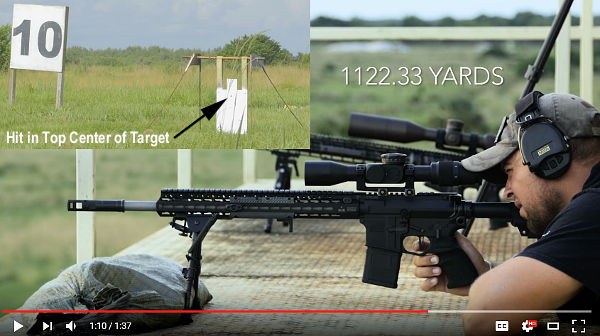
Many of our readers have never had a chance to shoot much past 600 yards. How far away does a 1000-yard+ target really seem to the naked eye? Well this short video answers that question. Gorilla Ammo, the video’s producers, used a camera-carrying aerial drone to fly downrange from the firing line all the way out to 1122 yards (and back again). Watch the drone footage at 0:00-0:07 and especially 0:48-1:03. The “bird’s-eye view” really gives you a sense of the distance. The “fly-back” at 0:48-1:03 time-mark is what makes this video worth watching.
The video features prone shooting at steel targets placed at 750 and 1122 yards. We do apologize for the lame, “oh so serious” voice-over which attempts to make this rather ordinary range session seem like some kind of life-changing experience. (Frankly, you may just want to turn the sound off — it’s that annoying.) It’s really not that big a deal to hit steel at 750 yards with a quality AR-15, chambered in .223 Rem, shooting Sierra 77 grain MatchKings.
Hitting Steel at 1122 Yards with 2540 FPS Ammo Can Be Challenging
The 1122-yard hits are a bit more impressive. Gorilla Ammo lists a relatively sedate 2540 fps Muzzle Velocity for its .223 Rem 77gr SMK ammunition. According to JBM Ballistics, at 1125 yards, that 2540 fps load has 68.3 MOA of drop from a 100-yard zero (firing at sea level and 80° F ambient). Morever the bullet goes trans-sonic around 750 yards (losing stability) and is traveling just 933 fps at impact. And the wind’s the killer — at 1125 yards, with this bullet/load, a mere 2 mph, full-value wind change can move the Point of Impact over three feet!
There’s a new long-range precision tactical rifle from Ritter & Stark (R&S) of Austria. The new SX-1 Modular Tactical Rifle (MTR) is designed to allow rapid barrel changes for three chamberings: .308 Winchester, .300 Winchester Magnum, and .338 Lapua Magnum.
Notably, the scope rail is mounted on the barrel itself, and the bolt locks directly into the barrel. This patented system allows scope, rail, and barrel to be swapped out as one integrated assembly, which should definitely help maintain zero when barrels are exchanged.
Ritter & Stark explains: “The MIL-STD 1913 Picatinny rail is installed directly on the barrel, allowing barrel interchangeability with pre-set scopes for no shift of impact when changing calibers. Easily and quickly done in the field, the patented caliber conversion system allows the barrel to be precisely positioned in the machined aluminum receiver with a greater area of contact allowing for more stability. The bolt is locked directly into the barrel breech[.]”
Video Shows Barrel Swap System, and Bolt Locking in Barrel Breech:
CNC-Controlled Rifling Process
Ritter & Stark states: “The rifling is processed in a CNC-controlled electrochemical machine. This avoids the transmission of thermal effects and mechanical stress to the material. Furthermore, this process allows us to produce barrels with unique uniformity and within tolerance zones that were not possible in a serial production before.” This is very interesting technology, and we’d like to learn more about it.
Accuracy Guarantee and Barrel Life Guarantee
Apparently the CNC-controlled rifling process works well as Ritter & Stark guarantees that its barrels maintain accuracy for a long time. The Austrian company states: “Our barrels are guaranteed to at least 5,000 rounds for .308 Win and .338 LM, and 2,000 rounds for .300 WM before noticing any degradation in accuracy.” That kind of claim certainly invites a long-term test. Who’s got enough ammo? Ritter & Stark also claims that “every rifle we manufacture can achieve 0.5 MOA 3-round groups or better with factory match-grade ammunition.”
The Ritter & Stark SX-1 MTR is designed for adaptability. It will accept third-party Rem 700-compatible triggers as well as a variety of AR-type grips. In addition, the SX-1, in standard configuration, will accept other manufacturers’ AI, SR25, or AR10 magazines. The rifle can also accept other buttstock assemblies compatible with Ritter & Stark’s folding mechanism which, interestingly, can be set to fold to either side.
Product Tip from EdLongrange. We welcome reader submissions.
Vihtavuori has updated and enhanced its reloading information, adding VV powder load recipes for many more cartridge types. Data is now online for 64 rifle cartridge types and 26 pistol cartridge types. You’ll find the updated reloading data on the Vihtavuori Website. Bookmark this link: www.vihtavuori.com/en/reloading-data/about-reloading.html.
The updated online information supplements the Vihtavuori Reloading Guide (2016 Edition) available in PDF format. The online Reloading Database has dedicated sections for Rifle Cartridges, Pistol Cartridges, and Cowboy Action. There is also a handy, FREE Reload Mobile App for iOS and Android.
Vihtavuori’s Rifle Reloading Database is now very comprehensive. Many of the popular modern match cartridges such as the 6.5×47 Lapua and 6.5 Creedmoor are now included, and of course you’ll find the 6mm PPC, 6mmBR, and 6XC. (There is no .284 Win or 7mm RSAUM data unfortunately.) You will find recommended load recipes for all the following cartridges:
.204 Ruger
.221 Remington Fireball
.222 Remington
.22 Hornet
.22 PPC-USA
.223 Remington
.22-250 Remington
.223 WSSM
.243 Winchester
.243 WSSM
6mm PPC-USA
6mmBR Norma
6 XC
6mm Remington
.240 Weatherby Magnum
6.5 Grendel
6.5 x 47 Lapua
6.5 Creedmoor
6,5 x 55 Swedish Mauser
6,5 x 55 Swedish Mauser/ SKAN
6.5-284 Norma
.25-06 Remington
.260 Remington
.270 Winchester
.270 WSM
.270 Weatherby Magnum
7 mm-08 Remington
7 x 57
7 x 64
7 mm Remington Magnum
7 mm WSM
7 mm RUM
7 x 57R
7 mm Weatherby Magnum
7,5 x 55 Swiss GP31
.30 Carbine
.30-30 Winchester
.300 AAC Blackout
7,62 x 39
.300 Savage
7,62 x 53R (7,62 Russian)
.308 Winchester
.30-06 Springfield
.300 Lapua Magnum
.300 Remington Ultra Magnum
.300 Winchester Magnum
.300 Weatherby Magnum
.30-.378 Weatherby Magnum
.300 H&H Magnum
.300 WSM
.303 British
8 x 57 IRS
8 x 57 IS (8 mm Mauser)
.338 Winchester Magnum
.338 Lapua Magnum
9,3 x 62
9,3 x 66 Sako
9,3 x 74R
.375 H&H Magnum
.416 Rigby
.444 Marlin
.45-70 Government
.458 Winchester Magnum
.50 Browning
.32 S&W Long N.P.
.32 S&W Long Wadcutter
.357 Remington Maximum
.357 Magnum
.357 SIG
.38 Super Lapua
.38 Super Auto
.38 Special
7 mm GJW
7 mm TCU
7 mm BR Remington
7,62 x 25 Tokarev
9 mm Luger
9 x 21
9 x 23 Winchester
.40 S&W
10 mm AUTO
.41 Remington Magnum
.44 S&W Special
.44 Remington Magnum
.45 ACP
.45 Colt
.45 Winchester Magnum
.454 Casull
.500 S&W Magnum
.50 AE
Story Tip by EdLongrange. We welcome reader submissions.
This summer, our friend Dennis Santiago made his first-ever pilgrimage to Camp Perry, Ohio to compete in the National Matches. He recounts his experience in a fascinating, informative, and often humorous story on his Dennis Talks Guns Blog. When you have a few moments to spare, you should definitely read Santiago’s account of his First Time at Camp Perry. This is much, much more than a match report. Dennis gives insights into the human side of the experience — and the little things that make Camp Perry so special. CLICK HERE to Read Full Camp Perry Story.
Dennis competed in a number of events during his two-week stay. Shooting “classic” service rifle and his new scoped, “modern AR” service rifle Dennis competed solo (in Presidents 100 and NTI matches among others) and also as a member of the California Adult Team in the 4-man NTT match.
Santiago’s First Time at Camp Perry report is a “must-read” for anyone contemplating a Camp Perry visit. Here are some highlights — but honestly folks, do read the entire story — it’s well worth it.
First Time at Camp Perry, by Dennis Santiago
Perry Ain’t Like Home
Iron Sights and “Perry-Vision”
This range is kicking me hard. I tell people about how hard I was pushing my eye into my aperture. They smile that “welcome to Camp Perry” smile again. They ask what sights I’m shooting on my A2 and I tell them I’ve got an 0.050″ front and 0.038″ rear to maximize depth of field. They smile more broadly and tell me my problem is that I’m from the Western provinces where the sun is bright and the ground is devoid of flora. Lots of light. It’s green here and we have clouds I’m told. Not nearly the same ambient lighting. You have the wrong sights my son. Where the green grass grows you want a big fat 0.072″ front the size of an aircraft carrier deck and a huge 0.046″ hole in the morning and maybe close it down to an 0.042″ rear aperture later if the sun comes out. But that desert glare sight system of yours will lose you about 5-8 points in these parts. Well there you go. Learn something every day.
Baptism at Camp Perry
One’s first visit to Camp Perry is a series of baptismal rites. I shall now enumerate them…
Walk the Base. Do not drive around. Get used to walking. Walk from your hut to everything. Walk to the administration buildings. Walk to the ranges. Walk to commercial row. Walk to the CMP North Store. Walk to the CMP or Army trailer to have the triggers of your rifles(s) weighed. Walk. This is your primary mode of transportation while on base for the next couple of weeks.
Go Shopping. It’s called Commercial Row. It is the best shopping mall for competitive shooters ever. The sale prices here are Black Friday quality. You stock up on supplies. You can buy elusive powders in quantity with the same lot number. Same with bullets and primers. Everything you need to keep making your pet loads. Oddly, not cases. This is a service rifle tournament. Pretty much everyone is using LC or WCC cases. I stocked up. Then I began politely watching my expected cubic feet and gross weight capacity for the drive home as other people asked if I could take stuff back for them instead of shipping their loot.
Learn about the Perils of Perry. One, evacuate the range. It rains at Camp Perry. Sometimes that rain comes with lightning. When that happens range controls issues an evacuation order. Depending on where you are and how much time you have, you either grab your stuff and make for a sheltered structure or leave your stuff under whatever rain cover you have and leave it there until the storm cell passes. This happened on squadded practice day. There was no squadded practice. There was learning to make a better rain cover for the next two weeks because it’d probably happened again. I was particularly proud of my final design which involved a very large tarp and many bungee cords. Modern art to be sure. I received many compliments.
Peril Two — Cease fire, boat in the impact area. One has not truly been to Camp Perry until your shooting string is put on hold while range control sends someone out to tell an errant yacht or jet ski that it’s not a good idea to go into that area with all the buoys with the signs on them that say, Danger. Live Fire. Keep Out.
Shooting Gear
I brought two rifles with me to Camp Perry. The first was my iron sights-configured AR-15. Being my very first trip to the Nationals, I wanted to check off a bucket list item to shoot irons at a National Match. The gun has a Geiselle trigger and an upper I assembled from White Oak Armament parts. The barrel is a Krieger that had 3,800 rounds arriving at Perry. The sights are pinned 1/4×1/4s. I run Sierra 77gr SMKs short line and 80gr SMKs seated .015″ off the lands Long Line with it.
The other rifle I brought was for NRA week. It’s a 2016 Rule Service Rifle, Optic. It has a collapsible UBR stock and a Geiselle Mk VII quad rail. The barrel is an older DPMS .223 that was cryo-treated back in the day. Round count on arrival at Nationals was around 1,800. Same ammunition combination [as the iron sights rifle]. The chamber on this barrel has a shorter throat so I brought a Lee Hand Press with an RCBS competition seater die to set the 80gr SMKs back to proper jump for NRA week. The sighting system for this gun was one of the very new Nightforce 4.5X Competition SR’s with the CMP R223 reticle. Parallax is set to 200 yards. It’s mounted using Nightforce’s superbly engineered AR-15 service rifle Unimount.
Members of the State of California Teams at Camp Perry. Dennis is front row left.
Coaching — When It All Comes Together, at Last
I coached one of the California teams in the NTIT Rattle Battle match. This was the day I finally began to be comfortable at Camp Perry. Walking up and down the field, first as a verifier and then as a coach, I felt back in the game. At team matches you get to confer with your teammates comparing wind calls and observing the effects of their calls as the shooting members of their squads send rounds downrange. You watch the traces of bullets arcing in the air going left or right of the bull’s center depending whether or not the call was right. This process was cathartic. I began to remember that I really can read a range once I get the hang of it.
Here is a great deal on a great little rifle. Right now at Cabela’s you can get the Howa 1500 Mini-Action in .223 Rem for just $314.99 with Coupon Code 16STALKUP. The rifle (with black synthetic stock) is already on sale, marked down to $349.99. That discount code gives you another 10% off. That’s a bargain — other vendors are charging $515.00 or more for this rifle. We actually “walked through” the online ordering process ourselves to confirm that the discount code works (see below). Note, you order online, but the rifles must be picked up in a Cabela’s store.
The Howa 1500 Mini Action is nearly an inch shorter than a Rem 700 short action, making for a nice, compact carry-around varminter (OAL length is just 41.5″). Your Editor checked out the Howa Mini Action Rifle at SHOT Show. The bolt opens and closes VERY smoothly (way better than most mass-produced bolt guns). The two-stage HACT trigger is excellent — it’s plenty light, with a crisp release and no annoying spring-loaded blade in the middle. I like it MUCH better than standard Remington, Ruger, or Savage triggers.
The standard Howa Mini Action rifle weighs 6 pounds without scope. This particular model comes with a 22″ barrel, black synthetic stock, and 10-round detachable box magazine. The Howa Mini on sale at Cabelas.com is a .223 Remington, but other chamberings are available at a higher price if you shop around. Howa offers Mini Action rifles in .204 Ruger, .222 Rem, .223 Rem, 6.5 Grendel, and 7.62x39mm.
“[Elite] shooters have this specific thing that happens in their brain when they are shooting well. Maybe you’d call it a ‘quiet time’. One interpretation is that it is a lack of self-instruction or analysis. Once you are an expert you really shouldn’t be [thinking] ‘don’t do this, don’t do that’.”
In this video from USA Shooting, a scientist uses brain wave (EEG) and muscle activity monitors to study the biomechanics and cognitive functions involved in competitive shooting. The study explores how elite shooters control their muscles and mind before executing a perfect shot.
In the video, USOC Sports Psychologist Lindsay Thornton works with pistol shooter Teresa Chambers to evaluate (and optimize) Teresa muscle and brain wave activity during shooting. One purpose of the study is to see how a shooter’s muscles function before, during and after a firing sequence. The goal is to use the muscles in the most efficient manner. This reduces fatigue and improves shot-to-shot consistency. Thorton says: “We are trying to define [muscle activity] efficiency with numbers so we can replicate that.”
Thorton is also exploring how a top shooter’s brain functions when he or she is “dialed in” and shooting most accurately. Thornton explains: “We are looking at EEG activity, which is brain wave activity. Research studies show that shooters have this specific thing that happens in their brain when they are shooting well. Maybe you’d call it a ‘quiet time’. One interpretation is that it is a lack of self-instruction or analysis. Once you are an expert you really shouldn’t be [thinking] ‘don’t do this, don’t do that’ — everything should be pretty automatic.” Interestingly, the test showed a specific pattern of Alpha band brain waves right before a trained shooter breaks the shot.
The 2016 NRA World Shooting Championship (WSC) takes place September 15th through 17th, 2016 at the Peacemaker National Training Center in Glengary, West Virginia. The richest multi-gun event in North America, boasting $250,000 in cash and prizes, the WSC attracts the world’s best multi-gun shooters. This unique 3-day multi-gun match tests competitors’ skills across twelve stages sampling nearly every major shooting discipline (rifle, shotgun, and pistol). To be honest, the WSC is mostly a “run and gun” speed game, but competitors still must engage small targets at long range, so genuine marksmanship skills are required.
This year there will be three divisions: Open Professional, Stock Professional, and Amateur. Stock Professionals and Amateurs will use provided guns and ammo. But a 2016 WSC Rule change allows Open Pro competitors to bring their own firearms and ammunition for the match. Allowing the top Pros to shoot their own, optimized match guns should produce faster times and higher scores (plus fewer complaints about off-the-shelf guns that aren’t zeroed or don’t run right).
How to Win the World Shooting Championship
As first published in the NRA Blog, here are competition tips from reigning overall NRA World Shooting Champion Bruce Piatt, and Dianna Muller, the top female competitor at the 2015 WSC:
“The format at the NRA World Shooting Championship is unique in that you don’t know what you have to shoot until you show up, so training for the event is a little difficult. My advice is to pack some good eye and ear protection, bring an open mind, be prepared to listen to the stage descriptions, figure out the best way you can take the guns they provide, and post the best score you can. When the match supplies all the guns and ammo, all you have to do is deal with ‘the performance’. This is the most level playing field in the shooting sports — anyone from around the world can come and play.” — Bruce Piatt
“The NRA World Shooting Championship match is such a different breed — it’s really a difficult match for which to prepare! Over the past two years, I’ve learned to relax. I focus on relaxing in my own sport, because when you focus on the expectations over the procedure, it usually never works out in the shooter’s favor. The same goes for this match. You are tackling disciplines outside your expertise and using guns you aren’t familiar with, and that can really rattle your nerves if you don’t prepare for that mental challenge. But you can use this match design to your advantage. Remove all expectations, because, who is great at ALL the disciplines (besides Jerry Miculek)?! Give yourself some room to be ‘not so great’, focus on the fundamentals and try to enjoy the match. It is kind of liberating throwing everything to the wind and seeing how you stack up against all kinds of shooters! Coming from such a gear intensive sport as 3-Gun, I really enjoy walking up to 12 different stages and shooting guns and ammo that are provided. Although there may be issues with that format, it’s a great way to level the playing field, get down to brass tacks and see who is the most well rounded world champion shooter!” — Dianna Muller
The 2016 F-Class Nationals kick off in nine days. The nation’s top F-Class shooters head to Lodi, Wisconsin for the Mid-Range Championship (Sept. 23-27) followed by the Long-Range Championship (Sept. 27 – Oct. 1). If you want to polish your skills with some last-minute practice at your home range, here’s a handy option for F-Class shooters. Here are some reduced 300-yard target centers that let you duplicate the MOA size of the official F-Class targets, but at closer range.
These reduced-size target centers were created by Forum member SleepyGator, an F-Class competitor who needed practice targets he could use at 300 yards. There is an official reduced-distanced standard for 300-yard F-Class matches. This utilizes the NRA No. MR-63FC – F-Class Target Center which is pasted over the MR-63 target. It provides a 1.42″ X-Ring, 2.85″ 10-Ring, and 5.85″ Nine-Ring. (The dimensions of F-Class targets are found in the NRA High Power Rules, Sec. 22, part 4, page 70 — see sample below.)
To duplicate the 300-yard target, SleepyGator has prepared a printable version of the MR-63FC Target Center, along with a pair of training targets with two bulls and five bulls. The two-bull and five-bull targets mirror the scoring rings on the MR-63FC, but they display only the innermost three rings and two rings respectively. All three targets are Adobe Acrobat (PDF) files that can be easily printed. You may need to adjust the scale (sizing) on your printer to get the dimensions exactly correct. As noted above, when printed, the 10-Ring on all three targets should measure 2.85″. This should provide some handy practice targets you can use between matches. Thanks to SleepyGator for providing these targets. You can download all three as a .Zip archive. After downloading the .Zip file, just click on the .Zip archive to extract the individual targets.
Tech Milestone — Norm Crawford won the 2016 Wimbledon Cup at Camp Perry using a carbon-fiber composite barrel. That’s a first for composite barrel technology.
With a score of 200-16X, Norman Crawford won the Wimbledon Cup Match during the 2016 National Long Range Rifle Championships using a 32″ Proof Research carbon-fiber composite barrel chambered in .284 Shehane. The Wimbledon Cup Match, a prestigious 1,000-yard shooting competition, dates back to 1875. The current course of fire consists of 20 timed shots, fired from prone. Crawford’s win represents the first time in the Cup’s 141-year history that it has been won with anything other than an all-steel barrel. The Proof Research barrel features a steel core with an external multi-axis carbon wrap.
Crawford’s Wimbledon Cup win really is an important technological milestone. Crawford’s performance may encourage other competitors to consider steel/carbon composite barrels for a variety of shooting disciplines. Without question, composite technology barrels offer significant weight-savings over conventional all-steel barrels. And Crawford proved that a composite barrel can deliver winning accuracy, at least in a sling/prone discipline.
“I don’t know of anyone else in this sport using a carbon fiber [composite] barrel,” said Crawford, who has been shooting Proof composite barrels since 2013.
“The benefits over a steel barrel are that you get a larger-diameter, stiffer, faster-cooling barrel that weighs less than a standard, medium Palma-taper barrel. [There is] no real downside I’ve been able to identify in three years of shooting them. All five Proof barrels I own are capable of winning any match — providing I do my part.”
A 30-year Army vet and former Army Special Operations Sniper, Crawford has been shooting competitively since 1990. He has won many major titles, including the NRA National Long Range Championship in 2005. His 2016 Wimbledon Cup victory was his second — Norm also won the Cup in 2003. A three-time member of the U.S. Rifle Team at the World Championships, Crawford also used a Proof Research barrel to tie the national record for a 600-yard Any Gun, Any Sight competition in North Carolina last November, one of five national records he has set or tied during his shooting career.
Proof Research CEO Larry Murphy praised Crawford: “We are honored that Norm chose our barrel to go up against the best shooters in the world with. By putting our barrels to the test in intense competition, he pushes us to do our best as well.”


 On our main Accurateshooter.com website, you’ll find a comprehensive review of the STM system for cleaning cartridge brass with stainless media. To clean brass with stainless media, start with five pounds of small stainless pins sold by StainlessTumblingMedia.com. Place these along with a gallon of water, a little liquid cleaner, and two pounds of cartridge brass in a rotary tumbler, and run the machine for one to four hours.






 “The NRA World Shooting Championship match is such a different breed — it’s really a difficult match for which to prepare! Over the past two years, I’ve learned to relax. I focus on relaxing in my own sport, because when you focus on the expectations over the procedure, it usually never works out in the shooter’s favor. The same goes for this match. You are tackling disciplines outside your expertise and using guns you aren’t familiar with, and that can really rattle your nerves if you don’t prepare for that mental challenge. But you can use this match design to your advantage. Remove all expectations, because, who is great at ALL the disciplines (besides Jerry Miculek)?! Give yourself some room to be ‘not so great’, focus on the fundamentals and try to enjoy the match. It is kind of liberating throwing everything to the wind and seeing how you stack up against all kinds of shooters! Coming from such a gear intensive sport as 3-Gun, I really enjoy walking up to 12 different stages and shooting guns and ammo that are provided. Although there may be issues with that format, it’s a great way to level the playing field, get down to brass tacks and see who is the most well rounded world champion shooter!” — Dianna Muller


