At the request of our readers, we provide select “Deals of the Week”. Every Monday morning we offer our Bargain selections. Here are some of the best deals on firearms, hardware, reloading components, and shooting accessories. Be aware that sale prices are subject to change, and once clearance inventory is sold, it’s gone for good. You snooze you lose.
1. Stocky’s Stocks — Composite Stock with Bedding Block, $199.99
Here’s a killer deal on a versatile Stocky’s Long Range Stock with aluminum V-block bedding system. For just $199.99, order this for Rem/Rem Clone long actions or short actions, with either narrow or wide (varmint/tactical) barrel channel. This would be a good choice for a varmint rifle. This is also offered with a matte black, tan, or olive baked-on textured finish for $239.99.
2. Sportsmans — .45 ACP Ammo, 300 Rds $84.95 with Rebate
The .45 ACP is probably our favorite centerfire pistol cartridge. It is reliable, inherently accurate, and makes big, easy-to-see holes in paper. Here’s a good deal for .45 ACP shooters. Sportsmans Outdoor Superstore is selling 300 rounds of American Eagle .45 ACP 230gr FMJ ammo for $114.95 in a handy plastic ammo can. And with factory rebate, you can knock thirty bucks off that price. Through the end of 2016, Federal Ammunition is offering $30.00 cash back on this ammo. CLICK HERE for Rebate Form.
Fine Print: Maximum of $30.00 rebate. Purchase must be made before December 31, 2016. Coupon must be received by January 31, 2017. Consumer submits coupon with UPCs written and original cash register receipt and/or dated itemized sales invoice (photocopies not accepted). Please allow 6-8 weeks for delivery. Total redemptions limited to five (5) of each product per name, address and household.
3. Natchez — Special 5 Reloading Press Kit, $199.99
This is an excellent entry-level reloading kit, which is on sale for $199.99 at Natchez Shooters Supplies. We like the relatively compact Special 5 press for most reloading duties. Eventually you may want to add an additional, large heavy press, but this will get the job done. This kit includes an RCBS Powder Measure, Digital Scale, Powder Trickler, Hand Priming Tool, Load Manual, Loading Tray, and more. It’s hard to beat this combination of tools for under $200.00.
4. Southern Shooters — 17 HMR Ruger American Rimfire. $252.63
With ballistics far superior to a .22 LR, the 17 HMR is ideal for Prairie Dogs and small varmints out to 180 yards or so. Now you can get a reliable, name brand 17 HMR rifle for a very attractive price. That’s right, Southern Shooters is selling the 17 HMR Ruger American Rimfire, with 22″ barrel, for just $252.63. FFL required. For other vendors with this rifle, CLICK HERE.
5. Amazon — Lyman Case Prep Xpress $94.99
The Lyman Case Prep Xpress lets you chamfer inside and out, brush your necks, clean/uniform primer pockets, and ream military crimps. On sale at Amazon.com with $94.99 Prime pricing, this is a good deal. Lyman’s Case Prep Xpress sells elsewhere for $130.00 or more. Here is a review from a Verified Purchaser: “The unit is quiet, sturdy, and the attachments do what they are supposed to do. It already has made a difference in my reloading speed, and most importantly, my comfort. I highly recommend this unit.” (Strafer, 4/7/14)
6. Natchez Shooters Supply — 325 Rounds .22 LR Ammo, $22.99
This Federal .22 LR ammo is just 7 cents per round — the kind of pricing on bulk rimfire ammo we used to see in the “good old days”. Act quickly, this $22.99 Federal .22 LR Ammo deal won’t last long. Each box contains 325 rounds — enough ammo for many sessions at the range. The bullets are 40 grains, solid lead.
7. Sportsman’s Guide — Frankford Arsenal Case Tumbler Kit
For just $69.99, this Frankford Arsenal Kit provides everything you need to clean brass: Vibratory Tumbler, Rotary Media Separator, Bucket, Corn Cob Media (3 lbs.), and Brass Polish. The Case Tumbler holds up to 600 9mm cases or 350 .223 Rem cases. The separator system is generous, with a 3.5-gallon bucket. NOTE: Sportsman’s Guide Buyers Club members can purchase for $62.99.
8. Amazon — Neiko Digital Calipers, $17.74
Even if you have a good set of calipers, you may want to get one of these Neiko 01407A Digital Calipers. The #1 best-selling digital caliper on Amazon.com, this Neiko tool features a large LCD Screen and measures up to 6.0 inches. With over 2300 customer reviews, this product has earned an overall rating of 4.4 out of 5 stars. It’s hard to go wrong for $17.74, even if you just use these as a spare set for measuring group sizes and case trim lengths.
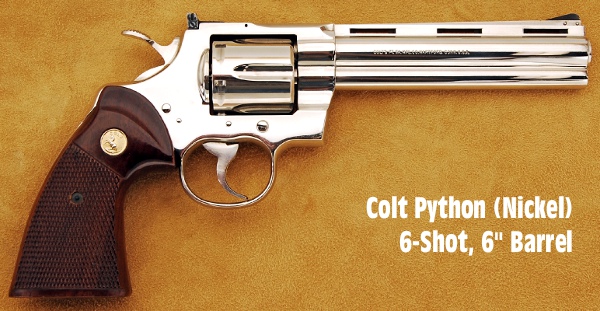
If you are considering acquiring a revolver for fun shooting, self-defense, or competition, you should definitely watch this YouTube video. In this 23-minute presentation, legendary shooter Jerry Miculek puts three .357/.38 SPL wheelguns through their paces. Jerry, one of the greatest revolver shooters in history, hosts a “Revolver Showdown” with three popular wheelguns: 1) S&W L frame (3″ bbl); 2) Colt Python (6″ bbl); and 3) Ruger Speed Six (2.75″ bbl).
Smith & Wesson Model 686 Plus, L-Frame, 7-rd .357 Magnum/38 SPL, 3″ Barrel.
Testing at 10 Yards and 50 Yards
In the video, Jerry shoots all three revolvers rapid-fire, double-action at 10 yards. Then he shoots the three guns single-action, slow-fire at 50 yards (starting at time mark 7:19).
After his range session, Jerry examines nine medium frame revolvers, comparing and contrasting design features. Jerry considers these factors:
1. Accuracy
2. Balance and Handling
3. Speed and Sureness of Trigger Return (watch video at 3:45″ re Colt.)
4. Reliability
5. Barrel Twist Rate
6. Strength of Construction/Durability
Yes, F-Classers, it’s time for the Nationals. Is your ammo loaded? Scope zeroed? The 2016 NRA F-Class Nationals will be held in Lodi, Wisconsin at the Winnequah Gun Club from September 23 through October 1, 2016. This will be a combined Mid-Range and Long Range event, with the Mid-Range activities running September 23-27, followed immediately by the Long-Range Nationals which conclude October 1, 2016. F-TR and F-Open shooters will compete for both individual and team honors. Here is the schedule:
Electronic Scoring at F-Class Championships This is big news. For the first time ever in the USA, electronic (sonic-sensor) targets will be used for both the Mid-Range and Long Range F-Class National Championships. NOTE: These are NOT like the self-contained Kongsberg target systems at the CMP’s Talladega Marksmanship Park.
At Lodi, Competitors will still aim at conventional paper target faces but sonic sensors on the target frames will allow instant shot plotting and scoring. This target system was developed by Silver Mountain Targets of Canada. The Silver Mountain system uses sonic sensors (essentially high-tech microphones) to triangulate shots with great precision. Monitors will be positioned at each firing station. The Silver Mountain system has been extensively tested and the match directors have hard-wired the target “brains” back to the scoring center to ensure reliable communications. Before the championship, match officials will be conducting a mandatory class on the operation of the electronic target monitors.
Looking downrange at Winnequah Gun Club in Lodi, WI:
2016 NRA F-Class National Championships FEE Schedule:
Mid-Range – Individual entries all individual matches – $230
Mid-Range – Each Team match (pay at range) – $80
Long Range – Individual entries all individual matches – $230
Long Range – Each Team match (pay at range) – $80
Combined Individual entry Mid-Range and Long Range – $400
STATE of the ART — F-TR and F-OPEN
Here is the sleek .308 Win rig Bryan Litz used to win the 2015 Mid-Range AND Long-Range F-TR Championship at the Ben Avery Range in Phoenix.
And here is the 7mm RSAUM F-Open rifle belonging to Kenny Adams. The reigning F-Open World Champion, Kenny will be one of the favorites in Lodi…
Kenny’s World-Beating 7mm RSAUM Load
For his 7mm RSAUMs Kenny loads Hodgdon H4350 powder and Federal 215m primers into Nosler or Norma RSAUM brass. In the RSAUM he runs Berger 180gr Hybrid bullets seated “just touching” the lands. Kenny is very precise with his charge weights. Using a Sartorius Magnetic Force Restoration scale, Kenny tries to hold his powder charges to within 1-2 kernels charge-weight consistency.
The National Shooting Sports Foundation and Cavern Cove Rimfire welcomes everyone to join us October 14 – 16, 2016 for the 2016 NSSF Rimfire Challenge World Championship! The event will be hosted at the Cavern Cove Rimfire facility in Woodville, Alabama.
Competitors will be challenged with both rimfire pistol and rifle stages. As with all NSSF Rimfire Challenge events, both novice and experienced shooters are encouraged to participate. This event is designed to be fun and enjoyable for all skill levels. For many shooters, a Rimfire Challenge represents their first competitive shooting experience.
Rimfire Challenge events are intended to be entertaining for the entire family. Whether you’re coming as a spectator or a competitor, side shooting activities are in the works so that everyone in attendance will have the opportunity to enjoy some trigger time. Come one come all to what will be a very exciting and fun weekend!
Brownell’s has prepared a useful video showing how to remove light rust from a firearm. This shows how to use soft cloths, polishes, and 0000 steel wool to eliminate light surface rust. CAUTION — if you have a very high gloss blued finish, ANY abrasive and even the finest grade of oiled steel wool can scratch or alter the finish. With something like a $1200.00 “Royal Blue” Colt Python, it may be better to tolerate a few small pits than to work it over with steel wool.
Watch Brownell’s Video on Rust Removal
Brownell’s technician, Steve Ostrem, notes that many things can promote rust — some you might not expect. In addition to moisture in the air, rust can be caused by the salts and oils from your hands, sweat, blood, or even insect repellent. Ostrem also observes that temperature changes can produce condensation which may lead to rust inside the gun that you don’t even notice: “In the real world we know that if you take the gun outside, sooner or later, it’s going to rust. When you come inside, wipe the gun down the first opportunity you get. If you bring a cold gun into a warm, humid house, you’re going to have an instant coating of moisture… make sure you get the gun dried off and you’ll avoid a lot of problems.”
Rust Prevention
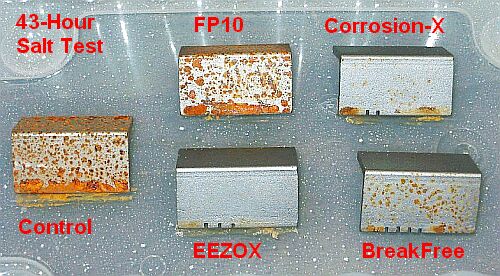
We’ve conducted a comprehensive test of corrosion-fighters. Among the best products to prevent rust are Boeshield T-9, Corrosion-X, and Eezox. Break-Free also works well, but it leaves a somewhat greasy residue, and it did not perform as well during long-term salt exposure as did the other three products.
For long-term storage, nothing beats a coating of Cosmoline, Rig or similar grease. This provides a barrier layer that blocks the oxidation process, which is how rust forms. These greases performed extremely well in a comparison test of Rust Preventative Products performed by Brownell’s. CLICK HERE for Comparison Test.
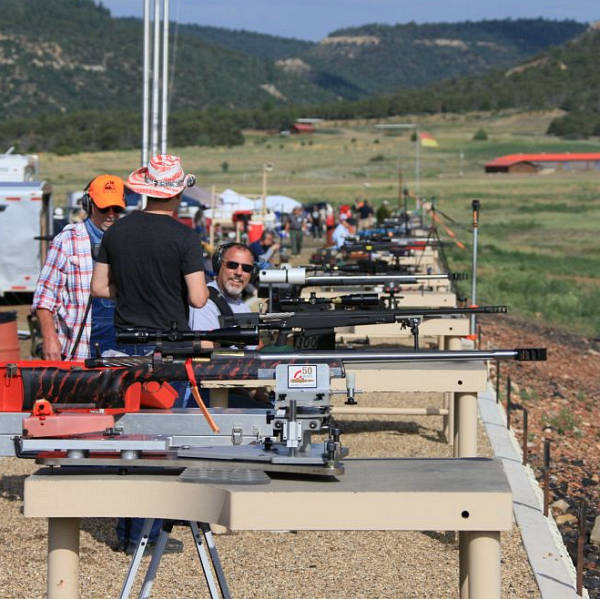
Are you a died-in-the-wool .50 BMG fan? Got a hankerin’ for heavy artillery? Then visit the FCSA Photo Gallery page. There you’ll find hundreds of photos from Fifty Caliber Shooting Association (FCSA) matches and 50 Cal fun shoots in eleven states plus Australia, Switzerland, and the United Kingdom. To access the photos from the Gallery Page, start by selecting a state/country and then click on the colored buttons for the event date (e.g. 2015-04).
Photo sets go all the way back to 2002, so you can see the evolution of the hardware over the years. Sample multiple archives to see the differences in terrain from one range to another — from Raton’s alpine setting to the hot, dry Nevada desert. This Gallery is really a treasure-trove of .50-Cal history. Here are a few sample images.
Story Tip from EdLongrange. We welcome reader submissions.
Leica has introduced a new Laser Rangefinder (LRF), the CRF 2000-B, with a claimed effective range of 2000 yards. Leica says upgrades to optics, internal software, and electronics have extended the range of Leica’s top-of-the-line LRF from 1600 yards to 2000 yards. We expect the new unit may indeed have reduced beam divergence or better error correction. In any event we don’t doubt the Leica CRF 2000-B will range farther than previous models, at least when clamped in immovable test fixtures.
However, in the real world LRFs are hand-held, and there’s the problem. We’ve never found ANYone who could hold the ultra-compact Leica LRFs steady enough to range deer-sized objects even at 800 yards. Consequently very few if any folks could really effectively use the claimed 1600-yard range of the previous model. The Leica CRF units are designed to be held vertically. That’s not great ergonomically and this unit was not designed to be fixed to a tripod for extra steadiness. Therefore, we doubt most humans will be able to range 2000 yards with the CRF 2000-B, except maybe with very large targets such as barns or huge storage tanks. It’s just too difficult to hold the little Leica CRFs rock steady.
But even if the new Leica Rangemaster 2000-B’s theoretical extended range doesn’t have much practical utility, there are some interesting new features that may make the 2000-B worth its $799.00 MSRP. First, the 2000-B has air pressure and temperature sensors, along with an on-board inclinometer. That last feature will appeal to Hunters, who often take angled shots. The new CRF 2000-B also offers a variety of ballistics readouts — users can select Equivalent Horizontal Range (EHR) up to 1200 yards or Inches of Holdover, and MIL & MOA corrections to .1 decimal point. The built-in microprocessor is fast — data is delivered to the shooter in only 0.3 seconds via the heads-up four digit LED display in the viewfinder.
As with previous Leica compact LRFs, the new CRF 2000-B is very light and easy to carry. It weighs just 6.5 ounces and really does fit in a shirt pocket. The 7-power (7X) optical lens is bright and sharp, and we appreciate the fact that Leica made this unit waterproof — it will withstand rainstorms though we certainly wouldn’t recommend dropping ANY rangefinder in a river.
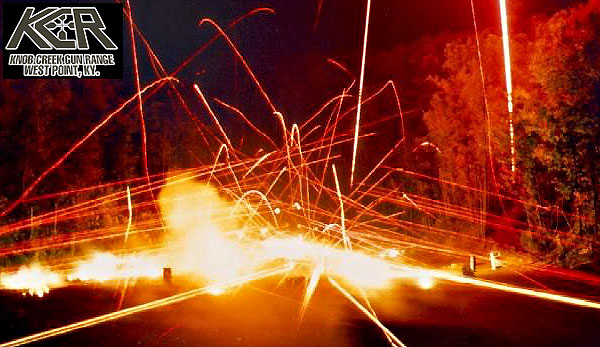
Twice a year, select-fire fans head to the Knob Creek Gun Range in West Point, Kentucky, for the nation’s largest Machine Gun Shoot. A bi-annual event, the Machine Gun Shoot is typically held on the second weekend of April and October. The next Machine Gun Shoot is coming up in one month. This year, the popular fall Shoot will be held October 14th through 16th. The highlight of every Machine Gun Shoot is the Saturday Night event, where scores of guns send regular and tracer bullets down-range. An estimated 1.25 million rounds will be expended during this year’s October 15th Night Shoot.
Click Triangle to Watch Knob Creek Machine Gun Shoot Video (Warning: Very Loud Audio)
Back in 2013, Top Shot Season 4 Champ Chris Cheng was on hand to record the firepower. Chris wrote: “About an hour before dark, folks are out on the range setting up all sorts of explosives while a crowd builds, anxiously awaiting what we all know is coming. The lights go out, and the next thing you know machine guns are going off for almost 20 straight minutes. This year’s October 2013 edition did not disappoint. Check out the video below — other than the beginning, my favorite part is at the 5:50 mark [when a Mini-Gun opens fire from the right].”
U.S. Rifle Team (F-TR) Selects New Berger 200.20X Bullet for 2017 World Championships
Berger Bullets has released new .30 caliber bullet that could be a game changer for the F-TR discipline — a bullet with exceptional accuracy and very high BC. Berger’s NEW 200.20X Hybrid Target Bullet is the result of extensive research and development in partnership with the U.S. Rifle Team (F-TR), world champion shooters, and accuracy enthusiasts within the long range shooting community.
The new 200.20X has a 0.640 G1/0.328 G7 BC compared to 0.616 G1/0.316 G7 for the older 200 grain .30 caliber Hybrid. That’s a significant reduction in drag. Recommended twist for the new bullet is 1:10″, same as with the earlier 200-grainer.
Berger Chief Ballistician and U.S. Rifle Team (F-TR) member Bryan Litz said, “This is the ideal bullet for F-TR and similar long-range disciplines. The 200.20X has a longer boat tail and nose, with shorter bearing surface which equates to less drag, a higher ballistic coefficient, and fewer points lost to the wind. The BC of the new 200.20X is 4% higher than the existing 200 grain Target Hybrid (G7 BC of 0.328 vs. 0.316). The shorter bearing surface also makes the 200.20X easy to load and shoot in standard chambers. New shooters won’t need special reamers or costly gunsmithing to make this bullet perform.” Bryan himself is switching to the new 200.20X: “After winning the 2015 National Mid-Range and Long Range F-TR Championships with the Berger 215 grain Target Hybrid, I’m switching to the 200.20X because it’s an even better option.”
Bryan tells us that new 200-20X bullet requires a 1:10″ twist to achieve full stability and performance (BC) in most conditions, but you can shoot it out of a 1:11″ twist with a minor decrease in BC. For a stability analysis, enter this bullet in the Berger Stability Calculator with a weight of 200.2 grains, and a length of 1.508″ to get stability results for your particular rifle and atmospheric conditions.
After extensive field testing, this new 200.20X bullet has been adopted as the official .30 caliber match projectile for the U.S. Rifle Team (F-TR). The team verified that this new bullet offers very impressive performance — the higher BC equates to less wind drift, and this bullet has shown exceptional ability to “hold waterline”. Check out this 1000-yard group by Team member Dan Pohlabel, as shown on an electronic target monitor.
To learn more about the new .30 caliber 200.20X Hybrid Target Bullet and its development, visit the Berger Bullets Blog for details. These 200.20X bullets are available right now through your favorite authorized Berger Bullets vendors.
About the U.S. Rifle Team (F-TR)
The two- time World Champion, U.S. Rifle Team (F-TR) is comprised of 30 shooters and coaches who have dedicated themselves to four years of training and preparation to represent the United States at the 2017 World Championships to be held in Canada. They compete all over the world at various ranges out to 1,000 yards.
Buy Bullets and Support U.S. Rifle Team (F-TR)
Eric Stecker, President of Berger Bullets said, “We are proud to be the Official Bullet of the U.S. Rifle Team (F-TR). To support our team, Berger Bullets will donate $1.00 for every box of 200.20X bullets sold towards U.S. Team expenses for the upcoming 2017 F-TR World Championships, which will be held at the Connaught Ranges in Ottawa, Canada.”
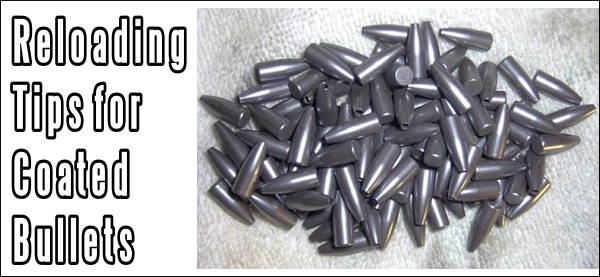
Coating bullets with a friction-reducing compound such as Molybdenum Disulfide (Moly) offers potential benefits, including reduced barrel heat, and being able to shoot longer strings of fire between bore cleanings. One of the effects of reduced friction can be the lessening of internal barrel pressures. This, in turn, means that coated bullets may run slower than naked bullets (with charges held equal). To restore velocities, shooters running coated bullets are inclined to “bump up” the load — but you need to be cautious.
Be Careful When Increasing Loads for Coated Bullets
We caution shooters that when your start out with coated bullets in a “fresh barrel” you should NOT immediately raise the charge weight. It may take a couple dozen coated rounds before the anti-friction coating is distributed through the bore, and you really start to see the reduced pressures. Some guys will automatically add a grain or so to recommended “naked” bullet charge weights when they shoot coated bullets. That’s a risky undertaking.
Instead we recommend that you use “naked” bullet loads for the first dozen coated rounds through a new barrel. Use a chronograph and monitor velocities. It may take up to 30 rounds before you see a reduction in velocity of 30-50 fps that indicates that your anti-friction coating is fully effective.
We have a friend who was recently testing moly-coated 6mm bullets in a 6-6.5×47. Moly had not been used in the barrel before. Our friend had added a grain to his “naked” bullet load, thinking that would compensate for the predicted lower pressures. What he found instead was that his loads were WAY too hot initially. It took 30+ moly-coated rounds through the bore before he saw his velocities drop — a sign that the pressure had lowered due to the moly. For the rounds fired before that point his pressures were too high, and he ended up tossing some expensive Lapua brass into the trash because the primer pockets had expanded excessively.
LESSON: Start low, even with coated bullets. Don’t increase your charge weights (over naked bullet loads) until you have clear evidence of lower pressure and reduced velocity.
Procedure After Barrel Cleaning
If you shoot Moly, and clean the barrel aggressively after a match, you may want to shoot a dozen coated “foulers” before starting your record string. Robert Whitley, who has used Moly in some of his rifles, tells us he liked to have 10-15 coated rounds through the bore before commencing record fire. In a “squeaky-clean” bore, you won’t get the full “benefits” of moly immediately.
To learn more about the properties of dry lubricants for bullets, read our Guide to Coating Bullets. This covers the three most popular bullet coatings: Molybdenum Disulfide (Moly), Tungsten Disulfide (WS2 or ‘Danzac’), and Hexagonal Boron Nitride (HBN). The article discusses the pros and cons of the different bullet coatings and offers step-by-step, illustrated instructions on how to coat your bullets using a tumbler.


 The .45 ACP is probably our favorite centerfire pistol cartridge. It is reliable, inherently accurate, and makes big, easy-to-see holes in paper. Here’s a good deal for .45 ACP shooters. Sportsmans Outdoor Superstore is selling 300 rounds of American Eagle .45 ACP 230gr FMJ ammo for $114.95 in a handy plastic ammo can. And with factory rebate, you can knock thirty bucks off that price. Through the end of 2016, Federal Ammunition is offering $30.00 cash back on this ammo. CLICK HERE for Rebate Form.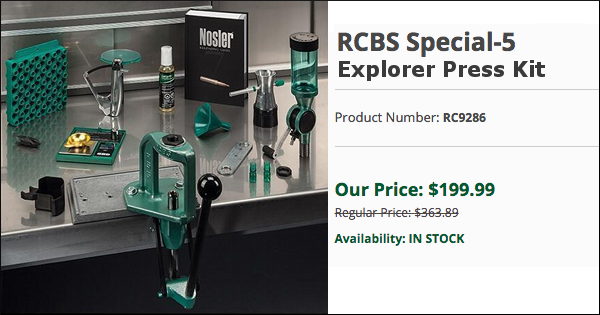



 Testing at 10 Yards and 50 Yards

 This is big news. For the first time ever in the USA, electronic (sonic-sensor) targets will be used for both the Mid-Range and Long Range F-Class National Championships. NOTE: These are NOT like the self-contained Kongsberg target systems at the CMP’s Talladega Marksmanship Park.