In years past, one of our favorite features on the NRA Blog was the Friday Feast Recipe of the Week. In the past, the NRA Blog offered up a new delicious food recipe each Friday. Sadly the Friday Feast has not been updated for quite some time, but you can still see dozens of past Friday Feast recipes with this link:
Today’s featured Friday Feast combines two things we love — Italian pasta and Elk meat. Article author Emily Rupertus shares our passion for pasta: “I love pasta. I can’t get enough of it! So when I came across this Classic Elk Lasagna, I couldn’t resist sharing with you! You have to try this perfect twist on a classic comfort food.” After assembling your Lasagna in a big cast-iron skillet and covering with tin-foil, bake the Elk Lasagna in a 400° oven for 30 minutes. Then remove the foil, add more cheese and continue to bake uncovered for ten more minutes.
Ingredients
1/2 Package of Lasagna Noodles
1 lb Ground Elk Meat (you can substitute ground venison or antelope)
1 Medium Sweet Onion (chopped)
2 Cloves Garlic (chopped)
2 tablespoons Olive Oil
3 Cups Tomato Sauce
32 oz. Ricotta Cheese
1 Cup Parmesan Cheese
1 8 oz. Fresh Mozzarella Cheese (sliced)
2 eggs
This year, for the NRA National Matches at Camp Atterbury, the High Power Rifle course will have electronic targets. This is good news for competitors as there will be NO PIT DUTY required. Relays can proceed much more quickly and efficiently, so matches can be completed in significantly shorter time-spans.
Big news for High Power rifle shooters — Electronic Targets will be employed at the 2022 High Power Rifle National Matches at Camp Atterbury, Indiana. That means faster relays, quicker scoring, and NO PIT DUTY!
Silver Mountain Targets Electronic Targets at Camp Atterbury This Summer
The Silver Mountain Targets electronic target system will be deployed for the High Power Rifle phases of the 2022 National Matches at Camp Atterbury, Indiana. The Silver Mountain Targets (SMT) technology, the “fourth generation of Electronic Target System”, is an OPEN SENSOR system fitted to conventional wood target frames. It uses four sensors to plot shot location (and score value) with great precision. Scores are transmitted via a WiFi network to mobile devices placed at each shooting station. Along with shot location, the score values are listed and recorded on the receiving devices.
The electronic target systems from Silver Mountain Targets provide instantaneous scoring, with scores instantly transmitted to WiFi monitors at each station on the firing lines. This shows competitors their shot locations immediately. That helps with wind calls. For the most part, the system has worked well this 2022 summer. Unfortunately, this year we have heard reports of some e-Target communication glitches, and some “missed” shots that were not recorded properly. It appears that there are still some bugs to work out.
“Silver Mountain Targets is very excited to be chosen for the very first deployment of this technology at the NRA National Matches. Our advanced modular architecture represents the latest in electronic target technology,” said SMT’s David Schnelle. “The system is designed to be easily expandable and provide a high level of reliability. System components are battery-powered to simplify deployment on a military range and allows the system to even operate if there is a power outage. Communications between targets and the firing line is a highly reliable WiFi connection, utilizing any WiFi-capable device to display competitors’ shots.”
Today we share some smart tips from a past F-Class and Sling Champion who is both a great shooter AND a ballistics wizard. In 2015, Bryan Litz won the F-TR Mid-Range AND Long-Range National Championships hosted at Ben Avery. And at the 2014 Berger SW Nationals (SWN), Bryan took top honors among all sling shooters. If you only know Bryan Litz from his Applied Ballistics Books and DVDs, you may not realize that this guy is a also great marksman along with being an actual rocket scientist!
Given his impressive track record in both F-Class and Palma (Fullbore) out to 1000 yards, we asked Bryan if he had any advice for other long-range competitors.
First Bryan provided three tips concerning Ballistics, his special area of expertise. Next Bryan offered three more general tips about long-range competition — how to analyze your shooting, how to choose your ‘wind strategy’, and how to avoid the most costly mistakes, i.e. how to avoid the “train-wrecks”.
Bryan Litz won the 2015 F-TR Mid-Range and Long-Range Championships with this sleek rig:
Litz Ballistics Tips
Ballistics TIP ONE. If you’re having trouble getting your ballistic software to match actual drops, you need to look at a number of possible reasons. Here are some common issues that can cause problems.
Click Values Are Not Exact. Scopes and iron sights don’t always produce accurate adjustments. In other words, if your ballistics program predicts 30 MOA of drop, and you dial 30 MOA but hit low, it might be that your sight actually only moved 28 MOA (for example). To see if your sight is adjusting accurately, shoot a tall target at 100 yards and measure group separation when dialing your sight.
Barometric vs. Station Pressure. This is a commonly misunderstood input to ballistics programs. You can avoid this pitfall by remembering the following: station pressure is the actual measured pressure at your location, and you don’t need to tell the program your altitude when using station pressure. Barometric pressure is corrected for sea level. If you’re using barometric pressure, you also have to input your altitude.
Muzzle Velocity. Chronographs are not always as accurate as shooters think they are — your true MV may be off by 10-20 fps (or more). If your drop is different than predicted at long range, it might be because your muzzle velocity input is wrong.
Mixing Up BC (G1 vs. G7). Knowledgeable long range shooters know that the G7 standard is a more representative standard for modern LR bullets. However, using G7 BCs isn’t just a matter of clicking the ‘G7′ option in the program. The numeric value of the BC is different for G1 and G7. For example, the G1 BC of the Berger 155.5 grain Fullbore bullet is .464 but the G7 BC is .237. If you were to enter .464 but click on G7, the results would be way off.
Ballistics TIP TWO. A properly installed level is absolutely essential for long range shooting. Without a good level reference, your long range wind zero will be off due to minor canting of the rifle from side to side. You can verify that your level is installed correctly on a 100-yard ‘tall target’. Draw a plumb line straight up the target and verify that your groups track straight up this line as you go up in elevation.
Ballistics TIP THREE. If your long range ballistic predictions aren’t tracking, always come back and verify your 100-yard zero. Sometimes a simple zero shift can be misconstrued as errors in long range ballistics predictions.
Litz Competition Shooting Tips
Competition TIP ONE. Improving your scores in long range competition is a constant process of self-assessment. After each match, carefully analyze how you lost points and make a plan to improve. Beginning shooters will lose a lot of points to fundamental things like sight alignment and trigger control. Veteran shooters will lose far fewer points to a smaller list of mistakes. At every step along the way, always ask yourself why you’re losing points and address the issues. Sometimes the weak links that you need to work on aren’t your favorite thing to do, and success will take work in these areas as well.
Competition TIP TWO. Select your wind shooting strategy carefully. For beginners and veterans, most points are typically lost to wind. Successful shooters put a lot of thought into their approach to wind shooting. Sometimes it’s best to shoot fast and minimize the changes you’ll have to navigate. Other times it’s best to wait out a condition which may take several minutes. Develop a comfortable rest position so you have an easier time waiting when you should be waiting.
Competition TIP THREE. Actively avoid major train wrecks. Sounds obvious but it happens a lot. Select equipment that is reliable, get comfortable with it and have back-ups for important things. Don’t load on the verge of max pressure, don’t go to an important match with a barrel that’s near shot out, physically check tightness of all important screws prior to shooting each string. Observe what train wrecks you and others experience, and put measures in place to avoid them.
Electronic High Power Targets for 2022 at Camp Atterbury
This year, for the first time, electronic targets will be used at Camp Atterbury during the NRA High Power National Championships. NRA Competitive Shooting Deputy Director Aaron Farmer posted: “We will have up to 40 targets using Silver Mountain electronic target systems. Competitors will be squadded on a target and then continue to shoot on the same target all week. The only thing that will change is the starting relay for the day. We will be running three relays. No pit duty!”
Report by Craig Arnzen, Area419.com
It’s easy to think about shooting your first precision rifle match and worry about all of the gear and trinkets that you may need to make it through. In reality, the old rules apply — keep it simple.
We wanted to put together for you a no-nonsense list of the Top Five Gear Items you need for your first match. This list focuses on the “must-have” items you’ll need for PRS-Style competitions.
1. A Rifle (That is Reliable and Sub-MOA Accurate)
Your rifle is the most obvious piece of kit, but we can give you a little more information. Most of the guys you’ll find out there are shooting 6.5 Creedmoor. Yeah, there are guys using .308 Wins and 6mm Dashers, but the 6.5 Creedmoor makes up more than half of the rounds shot in PRS competition, when looking at both national and club matches. Your comp rig needs to be mag-fed and shoot better than 1 MOA. It DOESN’T need to be better than 0.5 MOA (half-MOA). With most targets being 2-3 MOA in size, a half-MOA gun will do just fine. More accuracy is better of course, but you don’t need an exotic quarter-MOA rig to win.
[Editor’s NOTE: PRS does offer a Gas Gun division, but most guys start out with a bolt-action rifle, which will be less maintenance-intensive than an AR-platform rig.]
Muzzle brakes, like our Area 419 Hellfire, are also very popular as much of the PRS game is recoil management. If you can’t see your misses, you’re sure to have more of them.
The rifle also needs an optic with repeatable clicks and a reticle with Mil- or MOA-based hashmarks. The clicks can be either Mil system or MOA system (Mil is more common), so long as the click values match the reticle (i.e. you don’t want 1/4-moa clicks with a Mil-marked reticle). How much power do you need? Anything that zooms in the mid-teens will suffice. I could shoot a match with a fixed 12X scope and not feel disadvantaged. We love the Kahles K624i, if you’re looking for a suggestion.
Oh, and you’ll want a bipod — but the choice in bipod deserves a whole separate article by itself. Nothing wrong with starting out with a Harris swivel. Then you might look at different bipods on other competitors’ rifles for comparison.
2. Ammunition — Factory Ammo and Hand-loads
Good ammo is important, but as we discuss above, 0.5 MOA is good enough. Also, speed is great but it matters FAR less than you’d think. Drop can be calculated with precision, and distances are normally known, so a slightly flatter trajectory doesn’t really matter. Wind matters, but the difference you’ll find when eeking out that last 50 fps is very, very small.
Federal, Hornady, and Prime all make quality ammo that is widely used by shooters from local to national matches. Facebook photo by CReece.
Precision Handloads
If you want to run down the rabbit hole of finding that perfect ammo that shoots in the “twos” (0.2 MOA), get yourself an AutoTrickler and some of our billet aluminum accessories — you’ll love the setup.
3. A Versatile Support Bag
There are countless bag options. But there is ONE bag you’ll see everywhere, and for good reason. The Game-Changer from Armageddon Gear is aptly named. Many shooters use it as a barricade bag as well as a rear bag, meaning a guy could get away with using only this bag for an entire match. If you need another bag when you get there, ask someone in your squad, they’ll share. I promise.
4. Ballistics Calculator APP
All PRS/NRL shooters need reliable and accurate ballistic solutions. The software-enabled Kestrel is a very common item on the range, but you’ll also see lots of guys using mobile Apps such as Shooter or Applied Ballistics Mobile, and they have great results.
It’s also handy to have an armband or an item like the Hawk Hill data card holder for stages with various targets at differing ranges. Once the RO says “engage” and your mind stops working, you’ll appreciate having it written down.
5. Hearing Protection
PRS Competitors shoot with brakes and sometimes in enclosed spaces. That’s why you need serious hearing protection. We recommend NRR 33 earplugs, doubled up with Electronic Muffs to hear range commands. I have used the 33 dB NRR Mack’s foamies at matches for most of the last year, and the Howard Leight NRR 33 Max-1s are also very effective. The budget-priced (under $50) Howard Leight Impact Sport Electronic muffs work well, but premium electronic muffs may be more comfortable.
Growing in popularity are high-tech, in-ear digital units like the ESP Stealth. I have a set of linked ESP Steaths on the way and hope to evaluate them soon. These are supposed to be very good, but the ESP Stealths cost $2100.00 per pair!
Think we missed something? Have more questions? Let us know.
The NRA Hunters’ Leadership Forum (HLF) supports the Hunters for the Hungry (HFH) program. A total of $60,000 has been committed to fund affiliates throughout the country. An NRA-supported initiative, Hunters for the Hungry donates millions of meals to charities and programs focused on feeding the less fortunate every year.
“Last year, HFH affiliates across America applied for and received funding totaling $50,000″, said Joseph P. De Bergalis, Jr., Executive Director of NRA General Operations. “Due to the generosity of the NRA Hunters’ Leadership Forum, these subsidies went towards processing and distributing millions of pounds of harvested meat to feed those in need in our communities. We are grateful to HLF for again offering funding support for this meaningful program.”
Hunters for the Hungry utilizes state and independent programs that have provide millions of pounds of venison to homeless shelters, soup kitchens, and food banks across the USA. Working with the NRA, these programs connect interested individuals with programs in their area while fostering public awareness through education and fundraising. Available through subsidy awards up to $1,500, the fund covers the cost of processing, shipping, and distributing donated meat.
The NRA encourages all members and supporters to donate to those programs either financially or by donating harvested game meat. To find where you can donate in your area, or to support HFH, visit HFTH.nra.org.
This thought-provoking article has been one of the most popular Daily Bulletin features in recent years. We are republishing this story today for readers who may have missed it the first time around…
Here’s a little known fact that may startle most readers, even experienced gunsmiths: your barrel wears out in a matter of seconds. The useful life of a typical match barrel, in terms of actual bullet-in-barrel time, is only a few seconds. How can that be, you ask? Well you need to look at the actual time that bullets spend traveling through the bore during the barrel’s useful life. (Hint: it’s not very long).
Bullet-Time-in-Barrel Calculations
If a bullet flies at 3000 fps, it will pass through a 24″ (two-foot) barrel in 1/1500th of a second. If you have a useful barrel life of 3000 rounds, that would translate to just two seconds of actual bullet-in-barrel operating time.
Ah, but it’s not that simple. Your bullet starts at zero velocity and then accelerates as it passes through the bore, so the projectile’s average velocity is not the same as the 3000 fps muzzle velocity. So how long does a centerfire bullet (with 3000 fps MV) typically stay in the bore? The answer is about .002 seconds. This number was calculated by Varmint Al, who is a really smart engineer dude who worked at the Lawrence Livermore Laboratory, a government think tank that develops neutron bombs, fusion reactors and other simple stuff.
On his Barrel Tuner page, Varmint Al figured out that the amount of time a bullet spends in a barrel during firing is under .002 seconds. Al writes: “The approximate time that it takes a 3300 fps muzzle velocity bullet to exit the barrel, assuming a constant acceleration, is 0.0011 seconds. Actual exit times would be longer since the bullet is not under constant acceleration.”
We’ll use the .002 number for our calculations here, knowing that the exact number depends on barrel length and muzzle velocity. But .002 is a good average that errs, if anything, on the side of more barrel operating life rather than less.
So, if a bullet spends .002 seconds in the barrel during each shot, and you get 3000 rounds of accurate barrel life, how much actual firing time does the barrel deliver before it loses accuracy? That’s simple math: 3000 x .002 seconds = 6 seconds.
Gone in Six Seconds. Want to Cry Now?
Six seconds. That’s how long your barrel actually functions (in terms of bullet-in-barrel shot time) before it “goes south”. Yes, we know some barrels last longer than 3000 rounds. On the other hand, plenty of .243 Win and 6.5-284 barrels lose accuracy in 1500 rounds or less. If your barrel loses accuracy at the 1500-round mark, then it only worked for three seconds! Of course, if you are shooting a “long-lived” .308 Win that goes 5000 rounds before losing accuracy, then you get a whopping TEN seconds of barrel life. Anyway you look at it, a rifle barrel has very little longevity, when you consider actual firing time.
People already lament the high cost of replacing barrels. Now that you know how short-lived barrels really are, you can complain even louder. Of course our analysis does give you even more of an excuse to buy a nice new Bartlein, Krieger, Shilen etc. barrel for that fine rifle of yours.
The following article by Tom Alves describes a very practical approach to physical training for those of us who are not as young and spry as we once were. Tom shows us how to give our bodies at least some of the maintenance we give our rifles. While we all realize that our rifles will outlive us, let’s see if we can’t narrow the margin a bit with some personal maintenance that just might help the shooting too!
This article originally appeared in German Salazar’s Rifleman’s Journal, and appears with permission. Sadly, German passed away last month. This was a very sad loss of a great, triple-distinguished shooter and a great shooting sports writer.
A Suggested Training Approach for Older Shooters
By Tom Alves Most articles and discussions regarding competitive shooting center around equipment. Now and then one will come across an article about physical training such as the USAMU piece on Physical Conditioning for Highpower Shooting. If you break the articles down they often discuss “core strength” and durability. The purpose of this paper is to elaborate on those points with a bit different perspective. Many of the articles you will read in books about position shooting and the one mentioned before are directed more toward the younger generation of shooters in their 20s. If you look down the line at a typical high power match these days you are likely to see quite a few folks who are in their middle 30’s and up. Many people in that age range have had broken bones and wear and tear on their joints so a training program needs to take that into account. For instance, while jogging for an extended period for heart and lung conditioning — often called cardio exercises — may be the recommended approach for younger folks, it may be totally inappropriate for older people. The procedure to repair meniscus tears in knees is one of the most frequently performed operations in this country. Another approach one often sees in training to improve core strength is the use of weight machines which isolate certain muscle groups in their operation. I would like to suggest an alternative approach that not only does not require special equipment but uses the body’s muscles in a coordinated fashion in the same way they are used in our natural movements. So, let’s set down some criteria:
1. The approach has to be low impact to conserve joints.
2. One goal is to improve the strength of the core muscles which are the muscles of our trunk that keep us erect and from where all movements initiate.
3. Along with core strength we need flexibility and full range of motion.
4. We want to improve our lung and heart function so we can have a good flow of oxygen going to our organs and muscles to reduce the rate at which we become fatigued during a competitive event.
Before I continue I believe it is appropriate for the reader to understand that I am a fellow shooter and this is a program I have designed for myself based on considerable reading and experience over a number of years. I am not a medical doctor, a formally trained exercise professional or any other type of specialist in the field. Consequently, this information is offered with the advice that you consult your medical advisor or similar authority before you embark on this or any similar regimen.
I will start with core strength and flexibility. Pilates exercises are resistance exercises that can incorporate the use of resistance bands, light weights and the weight of your body parts in order to strengthen the muscles in the abdomen, back, hips, chest and shoulders. The exercises can be performed alone but I recommend attending classes put on by a certified instructor who will ensure that you perform a balanced routine meaning you work on the front and back and both sides of your trunk. As to flexibility, yoga complements Pilates exercises and they are often taught together. In practical terms yoga strengthens through resistance using the weight of the body and increases flexibility by stretching the various muscle groups in a coordinated fashion. Some yoga exercises also work on balance which is helpful in position shooting and life in general. Again, I suggest attending formal yoga classes since an instructor can help you address such things as a joint misalignment. As an example, my right leg healed improperly after the femur was broken and my right foot splays out putting undue load on my left knee. There are a number of books available on Pilates and yoga and some of them get pretty involved; I leave that to the reader to explore. I will list some reference material at the end of the article that I have found useful.
Finally, heart and lung improvement. In order to exercise the heart and lungs while not abusing the joints, particularly the knees and hips, one has to resort to something other than jogging. Walking, bicycling, elliptical machines and swimming may be alternative methods you’d like to consider. Based on my reading, in order to get the most benefit it is important to exercise so that the pulse rate becomes elevated for periods of time rather than kept at a constant rate. The process I use, called PACE, is promoted by Al Sears, MD, http://www.alsearsmd.com/. It is interval training for the non-athlete. In simple terms one exercises, using whatever equipment one desires, to achieve a heart rate in which you are slightly above your ability to bring enough oxygen into your body to sustain the activity for an extended period. This is similar to wind sprints for a sprinter or a football player. After each episode you must rest until you have achieved recovery, meaning you can catch your breath easily. A series of three sets is recommended which covers a total time of about 20 minutes.
Report from the Author — Yes, Training Helps
As a result of this training program I have experienced increased strength in my legs and trunk, less joint stiffness, lower blood pressure, and lower resting pulse rate. The Pilates/yoga classes are usually attended 2 to 3 times a week and the interval training performed twice a week. [The author was 64 when this was first published. He is now 75, and still shooting Palma and Smallbore prone.]
Before I close I would like to touch briefly on two other related subjects: hydration and visual training. When one is exerting oneself, the body produces perspiration to keep the body’s temperature at an acceptable level. As one perspires the blood gets thicker and the ocular fluid in one’s eyes thickens as well. The heart has to work harder to supply oxygen and nutrients to the body so visual and cognitive functions degrade and fatigue sets in rapidly. Essential chemicals called electrolytes are also carried out of the body with the perspiration. As a result, it is necessary to replace moisture and electrolytes to maintain basic health and a competitive level of performance. If one goes on the Internet there is a multitude of articles on hydration. Due to the kindness of my lead Pilates/yoga instructor, Ms. Annette Garrison, I have a pretty comprehensive article on various aspects of hydration that I have included, http://www.ideafit.com/fitness-library/hyponatremia-other-side-hydration-story , for your information.
Last I want to mention visual performance training. The New Position Rifle Shooting, A How-To Guide for Shooters and Coaches by Bill Pullum and Frank Hanenkrat mentions sports vision training amongst other aspects of vision in competitive shooting. If one goes on the Internet you will find training programs directed at golfers, baseball and football players. There is one site that has a demo which, if one looks at it for long, it is obviously very similar to a shooting gallery video game. The training involves rapid recognition and hand-eye coordination. Another source of visual training exercises, along with a wealth of other information, is the book Prone And Long Range Rifle Shooting by Nancy Tompkins.
Hopefully, I have provided some information which will be helpful in improving shooting performance and extending the time you can participate at a competitive level. It is important that you proceed at your own pace. I have pushed myself too hard in the interval training and now have to back off a bit. In closing I would like to thank Annette Garrison and GS Arizona for their help, patience and encouragement.
Additional Reference Material
1. Framework by Nicholas A. DiNubile, MD This is required reading for anybody who has suffered an injury like a torn meniscus or has muscular skeletal issues. This is the book that led me to Pilates/yoga
2 P.A.C.E., The Twelve Minute Fitness Revolution by Al Sears, MD The approach I use to interval training. I am sure there are other sources.
Brownells is running a major promotion this week from July 11 through July 15. During this Brownells PrimeTime Blowout Sale, there are significant savings (up to 50% off) on popular products. Brownells will unveil new deals every day during the PrimeTime Blowout Sale giving customers many chances for a great buy on that special something they’ve been waiting for.
Shoppers who visit Brownells.com through July 15 at 11:59 pm will find many products discounted steeply – some 50% off retail – from well-known names such as Colt, Hornady, Magpul, Law Tactical, Foxtrot Mike, Aero and many others. Want updates on the latest deals? Customers can receive instant notifications about exclusive deals by texting the word PRIME to 556223. You can also visit www.Brownells.com to see exclusive discount codes or sign up for email alerts.
Here are some current Brownells Discount Codes:
45off450 — Get $45 off purchase of $450.00 or more 35off350 — Get $35 off purchase of $350.00 or more 25off250 — Get $25 off purchase of $250.00 or more JULY55 — Get $55 off purchase of $500.00 or more 15off150 — Get $15 off purchase of $150.00 or more
The 2022 NRA National Matches at Camp Atterbury, Indiana, commenced Monday, July 11th, with the opening ceremony and the start of the High Power Rifle OTC National Championship. Held since 2017 at Camp Atterbury, a National Guard training facility, the 2022 NRA National Matches will continue through August 7, 2022. The photo above shows Denise Loring of Camp Valor Outdoors shooting on Day 1 of the High Power Rifle Championship.
Shooting Sports USA reports: “Opening the competition this year at Camp Atterbury was Indiana First Lady Janet Holcomb, NRA First Vice President Willes K. Lee, NRA Second Vice President David Coy, and Indiana State Rifle and Pistol Association President and new NRA Board Member Charlie Hiltunen. Indiana First Lady Janet Holcomb had the honor of firing the ceremonial first shot. She was shooting an AR-15 with a Compass Lake upper, Geissele trigger and Nightforce optic. For the first time, the first shot for the NRA National Matches at Camp Atterbury was fired on an electronic target.”
CLICK HERE for full 2022 NRA National Matches schedule. You can also follow the action this summer at Camp Atterbury by subscribing to Shooting Sports USA’s free Insider Newsletter.
2022 NRA National Matches Schedule at Camp Atterbury:
High Power OTC (Across the Course): July 10–15, 2022
High Power Mid-Range: July 16–21, 2022
Precision Pistol: July 17–23, 2022
High Power Long-Range: July 24–29, 2022
Smallbore 3-Position: July 25–29, 2022
Smallbore Prone: July 30 – August 7, 2022
Extreme Long-Range (ELR): August 5–7, 2022
Here’s a competitor’s first-hand video of 2018 High Power Championship at Camp Atterbury:
NRA Second Vice President David Coy, who will compete at Camp Atterbury during the Precision Pistol National Championships next week, thanked everyone who worked to support this event. David noted: “We as Americans are inherently competitive… This competition is an outgrowth of the original purpose of the NRA to teach marksmanship.”
Lodging Options at Camp Atterbury — Summer 2022
There are several housing options at Camp Atterbury. The most convenient are on-base, with Camp Atterbury offering hotel-style buildings with suites, along with standard rooms, and ‘open military squad bay’-style quarters available by reservation. Camp Atterbury also offers a limited number of RV spots, plus the MWR campground and cabins. NOTE: Lodging is controlled by the Camp Atterbury Lodging Office, not the NRA.
SSG Greg Markowski of the USAMU at Camp Perry, Ohio.
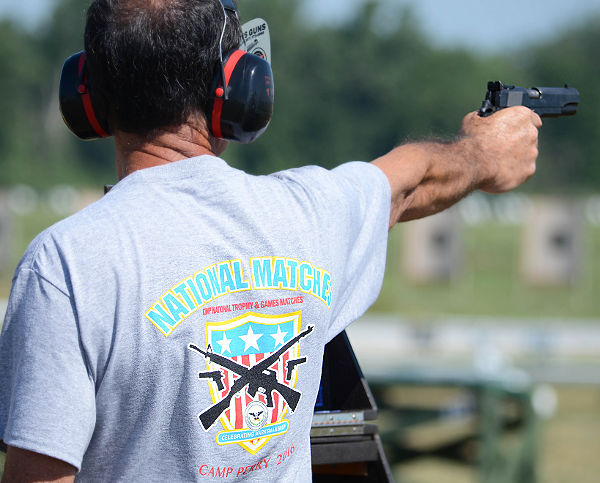
Today, July 12, 2022, pistol competition commences at the National Matches at Camp Perry. Many of the best pistol shooters in the country will be on the firing line, including members of the U.S. Army Marksmanship Unit Service Pistol team. After the last pistol match on Sunday, July 17th, trophies and awards will be presented to the top shooters.
If you want to compete in top competitions like this, you’ll need good ammo. The following USAMU article provides rock-solid reloading advice, explaining how to load accurate, reliable handgun ammo.
Camp Perry NM pistol firing line from CMP Photo Archives.
The U.S. Army Marksmanship Unit (USAMU) fields pistol teams as well as rifle and shotgun competition squads. Consequently the USAMU’s Reloading Shop loads tens of thousands of pistol rounds every year. In this article, the USAMU’s handgun experts talk about reloading for handguns — with smart tips on how to achieve superior accuracy with 100% reliability. This article, which offers important insights on COAL, primers, crimps and more.
Precision Pistol Reloading — Recommended Methods
Optimize the Taper Crimp
One often-overlooked aspect of handloading highly-accurate pistol ammunition is the amount of crimp and its effect on accuracy. Different amounts of taper crimp are used with various handloads to obtain best accuracy. The amount is based on bullet weight, powder burn rate and charge, plus other factors. It is not unusual for our Shop to vary a load’s crimp in degrees of 0.001″ and re-test for finest accuracy.
Use Consistent Brass
Brass is also important to pistol accuracy. While accurate ammunition can be loaded using brass of mixed parentage, that is not conducive to finest results, particularly at 50 yards. It is important for the serious competitor/handloader to use brass of the same headstamp and ideally one lot number, to maximize uniformity. Given the volumes of ammunition consumed by active pistol competitors, using inexpensive, mixed surplus brass for practice, particularly at the “short line” (25 yards), is understandable. However, for the “long line” (50 yards), purchasing and segregating a lot of high-quality brass to be used strictly for slow-fire is a wise idea.
Importance of Uniform COAL
Uniformity of the Case Overall Length (COAL) as it comes from the factory is also important to achieving utmost accuracy. More uniform case lengths (best measured after sizing) contribute to greater consistency of crimp, neck tension, ignition/burn of powder charge, and so on. Cartridge case-length consistency varies from lot to lot, as well as by maker. Some manufacturers are more consistent in this dimension than others. [Editor’s note: It is easy to trim pistol brass to uniform length. Doing this will make your taper crimps much more consistent.]
Primers and Powders — Comparison Test for Accuracy
Pay attention to primer brands, powder types and charges. Evaluating accuracy with a Ransom or other machine rest at 50 yards can quickly reveal the effect of changes made to handload recipes.
Bullet Selection — FMJ vs. JHP
Bullets are another vital issue. First, there is the question of FMJ vs. JHP. A friend of this writer spent decades making and accuracy-testing rifle and pistol bullets during QC for a major bullet manufacturer. In his experience, making highly-accurate FMJ bullets is much more difficult than making highly-accurate JHPs, in large part due to the way the jackets are formed. Small die changes could affect accuracy of FMJ lots dramatically.
The CMP now allows “safe, jacketed ammunition” in Excellence-in-Competition (EIC) Service Pistol matches, although wadcutter ammunition is prohibited. Thus, the option to use very accurate JHP designs simplifies the life of CMP Service Pistol shooters in pursuit of the prestigious Distinguished Pistol Shot badge.
Hopefully, these tips will be helpful to any pistol shooters interested in accurate handloads, not just “Bullseye” shooters. Small tweaks to one’s normal routine can pay big dividends in improved accuracy and make practice and competition more rewarding.
Stay safe, and good shooting!
TOP IMAGE: SSG Greg Markowski, a shooter/instructor with the U.S. Army Marksmanship Unit and native of Poland, fires his pistol during the 2018 Civilian Marksmanship Program’s National Pistol Matches at Camp Perry, Ohio July 13, 2018. At that event, Markowski claimed the General Mellon Trophy, General Patton Trophy and the General Custer Trophy. U.S. Army photo by Maj. Michelle Lunato/released by Defense Visual Information Distribution Service.


 The 2022 NRA


 Hunters for the Hungry utilizes state and independent programs that have provide millions of pounds of venison to homeless shelters, soup kitchens, and food banks across the USA. Working with the NRA, these programs connect interested individuals with programs in their area while fostering public awareness through education and fundraising. Available through
 Gone in Six Seconds. Want to Cry Now?
 Most articles and discussions regarding competitive shooting center around equipment. Now and then one will come across an article about physical training such as the USAMU piece on
 Last I want to mention visual performance training. The




 Use Consistent Brass


