Artistry in metal — Engraving has long been used to decorate fine firearms. The examples shown here prove that engraving is not a lost art. There still remain fine craftsman who can engrave beautiful designs into the metal components of pistols, rifles, and handguns. Above is a spectacular Dragon-engraved Korth revolver from Nighthawk Custom — an amazing example. Below are seven beautiful examples of engraved semi-auto pistols, from a tiny Colt .25 ACP to Chuck Yeager’s gold-plated Beretta.
Centennial 1911 from Colt — Marking 100 Years
In 2011, to celebrate the 100th birthday of the 1911 hangun, Colt created a spectacular, fully-engraved “Anniversary Edition” pistol. J.M. Browning’s 1911 pistol was officially adopted by the U.S. Army on March 29th, 1911. (The U.S. Marine Corps and U.S. Navy adopted the 1911 pistol roughly two years later). This Centennial 1911 is pimped to the max, complete with gold inlay and genuine ivory grips.
One-of-a-Kind Fully Engraved Walter Q5
On display at the 2019 IWA Outdoor Classics Show in Germany was this stunning fully-engraved Walther Q5 pistol. Note how even the magazine end plate is engraved. On the slide is an American Eagle and the quote “We the People”. Those rare wood grips are also very eye-catching and handsome. This may be the fanciest Walther pistol on the planet.
The Right Stuff — Chuck Yeager’s Gold-Plated Beretta
Here’s another pistol with a famous owner “The Right Stuff” Pilot, Chuck Yeager, the first human to break the sound barrier. This Beretta has extra value because it was owned by pilot Chuck Yeager. Photo NRA Museum.
Stunning Engraved Trio — Colt, Mauser, and Luger
Here is a matching set of three three beautifully engraved pistols by the late Indiana engraving wizard Ben Shostle — a Luger, a Mauser, and a diminutive Colt. By themselves, these three matching pistols would make a prized handgun collection. Photo courtesy Amoskeag Auction Company.
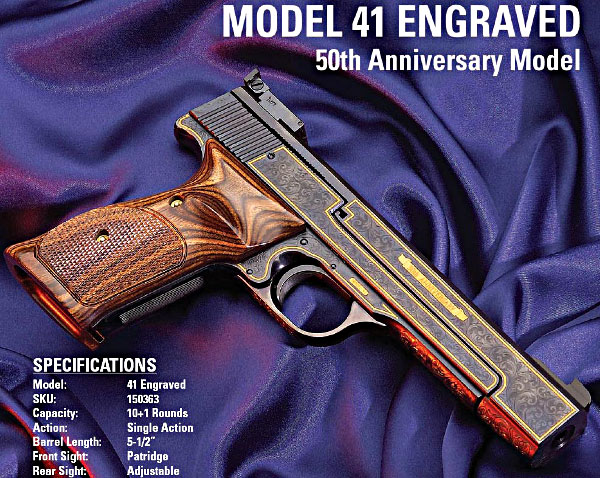
Smith & Wesson Model 41 — 50th Anniversary Edition
The .22 LR Smith & Wesson Model 41 is one of our favorite rimfire target pistol. First released in 2008, the engraved model 41 combines superior accuracy with stunning appearance.For $1700.00 to $2000.00 you can find the fully engraved, 50th Anniversary Model 41 in presentation case on Gunbroker.com.
If you are evaluating a firearm for self-defense use, you should consider three main factors: Reliability, Functionality (sights, trigger, ergonomics), and Effectiveness (ability to halt/neutralize threats). Regarding effectiveness, you need to consider what happens when the projectiles from your firearm reach the target. That involves penetration and terminal ballistics.
A 12ga shotgun is very effective inside 20 yards, with less risk of over-penetration* vs. a centerfire rifle.
You’ve probably heard the term “Terminal Ballistics”. But do you really know what this refers to? Fundamentally, “Terminal Ballistics” describes the behavior of a projectile as it strikes, enters, and penetrates a target. Terminal Ballistics, then, can be said to describe projectile behavior in a target including the transfer of kinetic energy. Contrast this with “External Ballistics” which, generally speaking, describes and predicts how projectiles travel in flight. One way to look at this is that External Ballistics covers bullet behavior before impact, while terminal ballistics covers bullet behavior after impact.
The study of Terminal Ballistics is important for hunters, because it can predict how pellets, bullets, and slugs can perform on game. This NRA Firearm Science video illustrates Terminal Ballistics basics, defining key terms such as Impact Crater, Temporary Cavity, and Primary Cavity.
External Ballistics, also called “exterior ballistics”, is the part of ballistics that deals with the behavior of a non-powered projectile in flight.
Terminal Ballistics, a sub-field of ballistics, is the study of the behavior and effects of a projectile when it hits its target.
*This Shooting Illustrated article discusses over-penetration risks with a variety of cartridge types. “A bullet passing through a threat and continuing with the potential to cause unintentional damage to a bystander or object is a situation commonly described as over-penetration.”
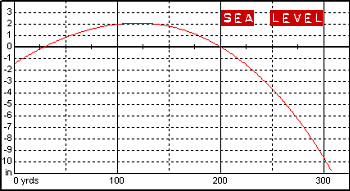
You can do your own experimental calculations using JBM Online Ballistics (free to use). Here is an extreme example, with two printouts (generated with Point Blank software), one showing bullet trajectory at sea level (0′ altitude) and one at 20,000 feet. For demonstration sake, we assigned a low 0.2 BC to the bullet, with a velocity of 3000 fps.
One of our readers asked “What effect does altitude have on the flight of a bullet?” The simplistic answer is that, at higher altitudes, the air is thinner (lower density), so there is less drag on the bullet. This means that the amount of bullet drop is less at any given flight distance from the muzzle. Since the force of gravity is essentially constant on the earth’s surface (for practical purposes), the bullet’s downward acceleration doesn’t change, but a bullet launched at a higher altitude is able to fly slightly farther (in the thinner air) for every increment of downward movement. Effectively, the bullet behaves as if it has a higher ballistic coefficient.
Forum member Milanuk explains that the key factor is not altitude, but rather air pressure. Milanuk writes:
“In basic terms, as your altitude increases, the density of the air the bullet must travel through decreases, thereby reducing the drag on the bullet. Generally, the higher the altitude, the less the bullet will drop. For example, I shoot at a couple ranges here in the Pacific Northwest. Both are at 1000′ ASL or less. I’ll need about 29-30 MOA to get from 100 yard to 1000 yards with a Berger 155gr VLD @ 2960fps. By contrast, in Raton, NM, located at 6600′ ASL, I’ll only need about 24-25 MOA to do the same. That’s a significant difference.
Note that it is the barometric pressure that really matters, not simply the nominal altitude. The barometric pressure will indicate the reduced pressure from a higher altitude, but it will also show you the pressure changes as a front moves in, etc. which can play havoc w/ your calculated come-ups. Most altimeters are simply barometers that read in feet instead of inches of mercury.”
As Milanuk states, it is NOT altitude per se, but the LOCAL barometric pressure (sometimes called “station pressure”) that is key. The two atmospheric conditions that most effect bullet flight are air temperature, and barometric pressure. Normally, humidity has a negligible effect.
It’s important to remember that the barometric pressure reported on the radio (or internet) may be stated as a sea level equivalency. So in Denver (at 6,000 feet amsl), if the local pressure is 24″, the radio will report the barometric pressure to be 30″. If you do high altitude shooting at long range, bring along a Kestrel, or remember to mentally correct the radio station’s pressure, by 1″ per 1,000 feet.”





 One of our readers asked “What effect does altitude have on the flight of a bullet?” The simplistic answer is that, at higher altitudes, the air is thinner (lower density), so there is less drag on the bullet. This means that the amount of bullet drop is less at any given flight distance from the muzzle. Since the force of gravity is essentially constant on the earth’s surface (for practical purposes), the bullet’s downward acceleration doesn’t change, but a bullet launched at a higher altitude is able to fly slightly farther (in the thinner air) for every increment of downward movement. Effectively, the bullet behaves as if it has a higher ballistic coefficient.


