


New ATF Policies on Purchasing Suppressors and NFA Items
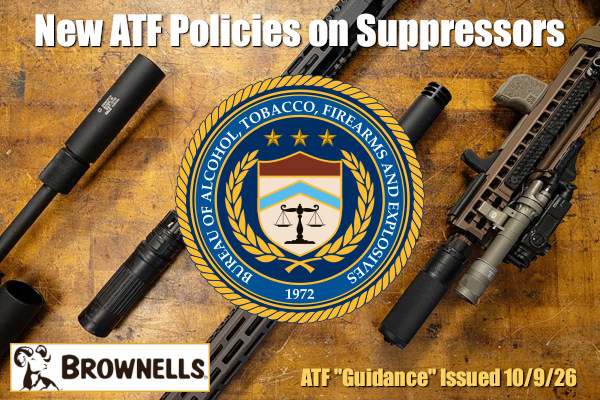
Good news for suppressor fans. The Federal Bureau of Alcohol, Tobacco, and Firearms (ATF), on Friday 10/9/2026, issued an important new official policy statement that confirms the elimination of federal fees and most paperwork when acquiring a suppressor. The 10/9 ATF statement also covers other NFA items including short-barreled rifles and short-barreled shotguns.
For additional details, review the official ATF Guidance Instructions and FAQ.
Here is the News Release from the ATF:
The Bureau of Alcohol, Tobacco, Firearms and Explosives today released an Open Letter and Frequently Asked Questions explaining how it will treat ownership, transfer, and transportation of the National Firearms Act firearms for which Congress eliminated the making and transfer taxes in the One Big Beautiful Bill.
The guidance follows an announcement by Attorney General Todd Blanche that the Department of Justice will not appeal an August decision made by the U.S. District Court for the Northern District of Texas, which held that certain provisions of the NFA were unenforceable. In that decision, the court enjoined enforcement of those NFA provisions only for the plaintiffs in the suit; however, using the Department’s enforcement discretion, the Attorney General … made the policy decision to apply the guidance to everyone, and not only to those covered by the injunction in Silencer Shop Foundation v. ATF[.]
Under ATF’s guidance, ATF will not enforce the requirements for individuals to apply and receive ATF approval before making or transferring short-barreled rifles, short-barreled shotguns, suppressors (silencers), and certain other concealable firearms known in the law as “any other weapons.” ATF also will not enforce the NFA’s registration, tax-stamp or related requirements for those covered items. The $200 tax remains in place for machine guns and destructive devices[.]
The guidance does not supersede state and local laws that restrict NFA firearms. Because many state laws require individuals to register NFA firearms, ATF will continue to process NFA applications that are submitted. The guidance also does not affect the Gun Control Act’s requirement to obtain ATF approval before transporting short-barreled rifles and short-barreled shotguns in interstate commerce.
Suppressor Purchasing under New ATF Policies (Brownells)
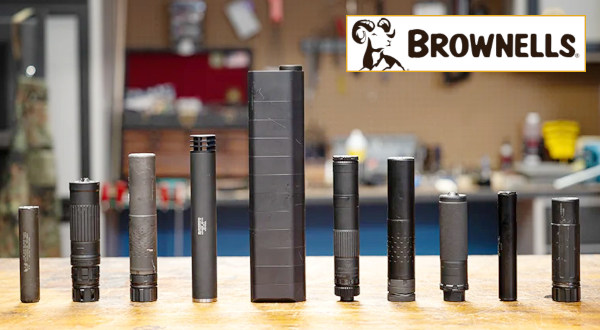
Image from Brownells Suppressor INFO page.
Based on the ATF “Guidance” letter issued 10/9/2026, Brownells has released a helpful summary of factors to consider when purchasing a suppressor.
Understanding the New ATF Suppressor and NFA Policies
Under the new ATF guidance, ATF will no longer enforce federal NFA approval and registration requirements before making or transferring certain NFA items, including suppressors, short-barreled rifles (SBRs), short-barreled shotguns (SBSs), and certain other regulated items.
For eligible purchases through an FFL, standard federal firearm transaction requirements still apply, including completing a Form 4473 and, unless exempt, passing a NICS background check. Additional requirements may apply to certain firearm types.
State and Local Laws Still Apply
These changes do not apply the same way in every state. State and local laws may restrict or prohibit certain items or require additional registration, documentation, or transfer procedures. Before making a purchase, customers should review their current state and local laws and regulations to understand what is legal and what requirements apply where they live.
Important Things to Know
— State and local laws are NOT superseded by this ATF guidance.
— Availability and transfer requirements vary by location.
— Federal, state, and local eligibility requirements still apply.
— Some transactions may require additional documentation.
— Customers may still voluntarily use applicable NFA forms and registration processes.
— The federal nonenforcement policy could change, and unregistered items are not guaranteed to be grandfathered if enforcement resumes.
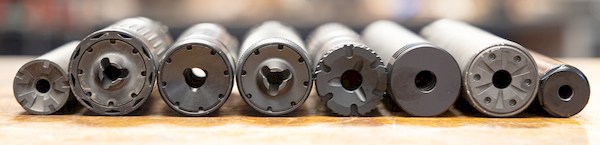
Suppressor Purchases by State
The following classifications outline general suppressor purchasing requirements under the current guidance and applicable state laws. Requirements may change and should be confirmed before purchase.Open States (27) — No NFA Process Required
Alabama, Arizona, Arkansas, Florida, Idaho, Indiana, Iowa, Kansas, Kentucky, Louisiana, Maine, Maryland, Minnesota, Missouri, Nebraska, New Hampshire, New Mexico, Oklahoma, South Carolina, South Dakota, Tennessee, Texas, Utah, Vermont, Virginia, West Virginia, and Wyoming. In these states, eligible customers can generally purchase a suppressor through the standard firearm transfer process, using applicable background checks and eligibility requirements, without completing an NFA Form 4.NFA States (15) — Form 4 Still Applies
Alaska, Colorado, Connecticut, Georgia, Michigan, Mississippi, Montana, Nevada, North Carolina, North Dakota, Ohio, Oregon, Pennsylvania, Washington, and Wisconsin. These states retain legal requirements tied to federal NFA registration or compliance. Customers should expect to complete the traditional Form 4 process where required under applicable state law.Banned (8 States + Washington, D.C.)
California, Delaware, Hawaii, Illinois, Massachusetts, New Jersey, New York, and Rhode Island, plus Washington, D.C. — Suppressors remain generally prohibited for civilian ownership in these locations, subject to limited legal exceptions.
Similar Posts:
- First Unregistered Suppressor Purchase in 92 Years in USA
- How to Legally Purchase and Register a Suppressor
- LAW INFO: How to Properly Acquire and Register a Suppressor
- How to Acquire a Suppressor — $200 NFA Tax Eliminated in 2026
- ATF Wait Times for NFA Form Processing Significantly Reduced
Tags: ATF Guidance Letter, Big Beautiful Bill, Brownells, NFA, NFA Forms, Short-barreled Rifle, Silencer, Suppressor


