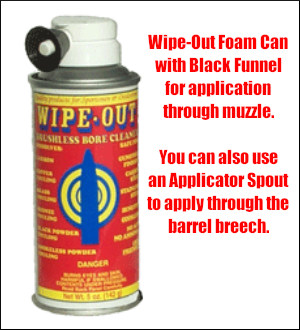
Wipe-Out brushless foam bore cleaner is a product we’ve used with great success on many rifles. With sufficient dwell time, it removes both carbon and copper fouling. You can combine it with Wipe-Out Accelerator or Patch-Out liquid to speed up cleaning time. Many shooters, including this editor, find that bore-brushing has been virtually eliminated with the regular use of Wipe-Out. (With some barrels however, you may still have to brush or use a bore paste if you notice stubborn carbon build-up in the throat area.)
CLICK HERE for full official instructions on use of Wipe-Out foam applied from the muzzle or the breech.
Method One: Apply Through Muzzle Our standard procedure with Wipe-Out is to insert an O-ring-sealed cleaning rod guide into the chamber and then squirt through the muzzle in short puffs. IMPORTANT: Put a towel or rag on the comb of your stock and watch for a little bit of foam to exit the rod guide. We usually wait 30 minutes for the bubbles to dissipate, then do a second foam application. Be sure to clean off any excess foam before it drips on your stock. It is important to keep the foam off fine wood or paint finishes.
Our actual routine normally starts with 3-4 wet patches with Carb-Out (to get the loose black stuff out), followed by the two foam cycles as explained above. Then we plug both ends of the barrel, drive home from the range and dry-patch out on arrival at the house. If the gun is going to be used again soon, that’s all we do. If there will be long-term storage we’ll run some Eezox down the bore.
Method Two: Apply Wipe-Out from Breech
You can also apply Wipe-Out from the breech. To allow breech-first application, Wipe-Out cans now come with a short plastic tube and a plastic tip that fits in your chamber. These can also be purchased separately for $2.50. However, we’ve found the plastic tip is too big for some chambers and it is not always easy to get a good, secure seal even if it does fit. Jason Baney has come up with a solution. READ Jason’s Wipe-Out Article.
Use Fitted Tubing for Breech-First Applications of Wipe-Out
You can apply Wipe-Out through the breech very effectively if you use fitted, plastic tubing. While this works well for bolt-actions, breech application is particularly handy for the Garand, M1A and other semi-autos. Jason Baney has written a short article describing this process. In a nutshell, you need one piece of tubing that fits the chamber tightly and then connects with a second, smaller diameter tube that attaches to the Wipe-Out can. This avoids any “over-spray” of foam in the action area, providing a clean, simple solution. Just squirt for a second or so, and wait for white foam to come out of the muzzle. Be sure to keep Wipe-Out off fine wood stocks.
Finnish gun manufacturer SAKO Ltd. crafted the impressive S20 series of “hybrid” rifles. These are offered in a Hunter model and a Precision model. Both feature an internal aluminum chassis, adjustable trigger, and integral Picatinny rail on top. Users can change fore-ends and rear sections to suit different disciplines. Use the rifle for a PRS match one weekend and hunt with it the next.
SAKO states: “The user will be able to switch between the stocks and fore-ends quickly and easily and can change the rifle from a tactical to a hunting rifle or vice versa in a matter of minutes with no need to re-zero optics after assembly. The stocks can be taken down easily by loosening up two screws between the rear stock and fore-end.” Both 20″ and 24″ barrel versions have been offered, with a wide variety of chamberings/calibers: .243 Win, 6.5 Creedmoor, 6.5 PRC, .270 Win, 7mm Rem Mag, .308 Win, .30-06 Springfield, .300 Win Mag.
The SAKO S20’s stainless steel action features a 3-lug, push-feed bolt with plunger ejection. The Cerakoted receiver of the S20 features a machined Picatinny rail for easy scope mounting. The trigger of the S20 is adjustable for pull weight and for position within the trigger guard (± 7mm) to ensure good length of pull for the shooter. The muzzle of the rifle is 5/8×24 threaded, allowing for the addition of muzzle devices such as suppressors or brakes (some models come with factory brakes installed).
The Picatinny rail is machined directly on the receiver. The S20 action features a 3-lug bolt with 60° bolt throw. SAKO says the “high locking-lug surface area increases both safety and performance.” The full length of the action mates with a matching V-bed in the aluminum chassis. S20 factory accessories include monopod, muzzle brake, barricade stop and a thumb rest add-on.
SAKO sells the S20 in a variety of configurations. You can buy a single stock system or with both stocks. The Hunter model is offered with a variety of camouflage finishes. The SAKO website lists six different camo options for the S20 Hunter model: First Lite Fusion, Roughtech Green, Roughtech Desert, Hunter Camo, Polyfade Gray, and Polyfade Gray/Green.
PHOTO: SAKO Hunter Model S20s are available with Camouflage stocks in multiple colors and patterns.
The SAKO S20 Precision model has a more vertical grip, wider fore-end (with rail mount), and a flat section in the buttstock that enhances bag riding. This can be used for tactical-style competition as well as varminting and hunting. M-Lok system allows mounting of bipods and other accessories.
SAKO S20 Review in GunsAmerica Digest
A few years ago GunsAmerica Digest published a very thorough SAKO S20 Hybrid field test and review. That article explained how to swap stocks and fore-ends and how to adjust the trigger. The reviewer, Jeff Cramblit, noted the smooth function of the action and gave high praise to the modular stock system:
“Sako was right all along, the S20 is a ‘Hybrid’ rifle. My favorite configuration after all the testing … is the Hunter buttstock and the Precision forearm. This gives me the ability to use all my rail mounted accessories and I like how the thumbhole stock feels even better than the Precision grip. It [was] 11 pounds 5.5 ounces when outfitted with the Leupold Mark 5HD 3.6-18x and the Hatch bipod[.]
The Sako S20 is an impressive rifle. It carries and balances well, shoots fantastic, has a great trigger, smooth action, reliable magazines, and the fact that you can have it your way is an added bonus.”
SAKO S20 Proves Very Effective for Hunting
The SAKO S20 is definitely a good hunting rifle. SAKO has offered the S20 with many popular hunting chamberings including: .243 Win, 6.5 CM, 6.5 PRC, .270 Win, 7mm Rem Magnum, .308 Win, .30-06 Springfield, .300 Win Magnum. The photo above was taken by a hunter in Europe who purchased the S20. He used it successfully to nail a wild hog.
SAKO S20 Specifications
Calibers/Chamberings: .243 Win, 6.5 CM, 6.5 PRC, .270 Win, 7mm Rem Magnum, .308 Win, .30-06 Springfield, .300 Win Magnum. Receiver: Grey Cerakoted Stainless Steel with integral scope bases Barrel: 20″ or 24″, Grey Cerakote, Cold Hammer-Forged (some models fluted); muzzle 5/8×24 threaded Trigger: Adjustable 2 to 4 pounds Stock: Chassis mounted Hunter or Precision model, adjustable cheek piece, adjustable length of pull Magazine Capacity: 5- or 10-rounds for standard cartridges, 3- or 7-rounds for magnum cartridges
Take-Down Stock with Modular Front and Rear Sections
The takedown stock of the SAKO S20 allows for great modularity, so that S20 rifles can be configured according to owner preferences with different rear stocks and fore-ends. The S20’s aluminum chassis is covered by a strong but comfortable outer shell material that SAKO calls H.I.R. – High Impact Resistant. The same H.I.R. material is used on car dashboards. The outer shell is currently offered in two styles — a thumbhole hunter and a more tactical style with straight toe and conventional grip.
Full Adjustability — Even Trigger Position
Adjustable ergonomics are a big part of the S20 design. The multi-adjustable trigger (available in both single-stage and two-stage variants) can be moved backwards or forwards to better fit different hand sizes. An adjustable cheek piece and LOP spacers help provide a proper fit.
M-Lok System Allows Easy Mounting of Accessories
The new SAKO S20 can accept a wide range of accessories, attached via aluminum M-LOK placements. SAKO-made accessories include Rear Mono-Pod, Barricade Stop, and Thumbrest. And yes SAKO threads the muzzles 5/8×24 for use with brakes and suppressors. This video shows how accessories mount:
Field Sports Unboxing Video of SAKO S20 with Hunter Stock
This S20 “first look” video was created by the UK Fieldsports channel. The reviewer was impressed with the S20’s interchangeable stock system: “The modularity allows the rifle to be configured to the shooter’s preferences with different rear stocks and fore-ends. At launch, SAKO introduced both the tactical precision stock and the ergonomic hunting stock, the latter being an improved version of a traditional thumbhole stock more like a pistol grip. Switching between rear stocks is fast and easy, virtually changing the rifle from a target rifle to a hunting rifle, or vice versa, with the correct grip, in a matter of minutes.”
The Fieldsports review added: “Overall, the adjustable ergonomics are a big part of the S20 design. The multi-adjustable trigger can be moved backwards or forwards to better fit different hand sizes and to achieve the optimal trigger position, and its weight and length of pull can be adjusted. The quick-adjustable cheek piece and spacer adjustable length of pull help to achieve the best possible shooting posture. Combined with a wide selection of M-LOK and QD compatible accessory options, S20 adapts to all body sizes and shooting situations.”
Field Test of SAKO S20 — Sub-MOA Accuracy with .300 Win Mag
In this test, using factory ammunition, the shooter achieved sub-MOA accuracy with a SAKO S20 Precision chambered in .300 Win Mag. The very first three shots out of the gun went into about 3/4″ with two shots touching (SEE 04:25 – 4:50 time-marks). The tester offered this rifle description: “Boasting a cold hammer-forged, fluted stainless steel barrel with a recessed crown and a durable Cerakote® finish, this precision rifle ensures impeccable accuracy in virtually any environment. The sculpted stock features an adjustable cheek pad and recoil pad for a customizable fit[.] An M-Lok monopod is easily fitted for added stability in the rear, while the adjustable trigger ensures a consistent, user-specific pull[.] The receiver is mounted to a full-length bedding for improved strength and durability. Plus, the oversized bolt handle ensures intuitive, snag-free manipulation, while a low throw profile easily clears your scope.”
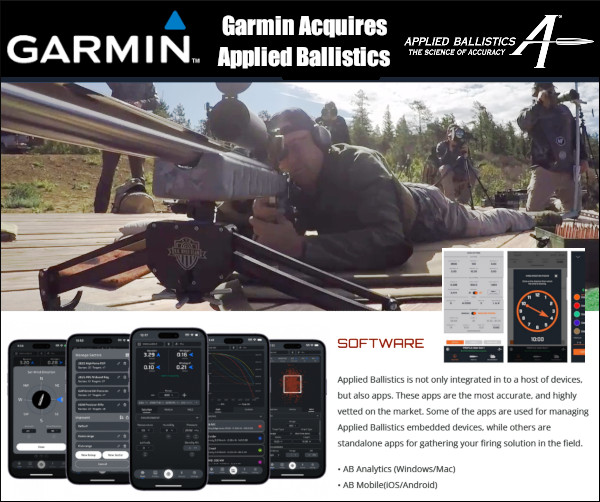
Garmin Acquires Applied Ballistics LLC
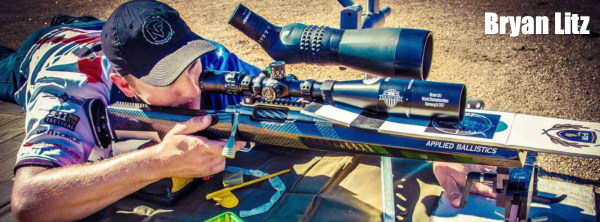
There was big news this week in the shooting industry. Garmin Ltd. has acquired Applied Ballistics LLC, the company founded and run by Bryan Litz, a top software engineer, ballistics guru, and world-class rifle shooter. Applied Ballistics has developed some of the most sophisticated and accurate ballistics software. It can run on your computers and tablets, and Applied Ballistics software has also been integrated into mobile devices, rangefinders, and Kestrel Weather Meter wind reading units.
To mark this important development for Applied Ballistics, today we feature eight notable videos. These include NSSF “Elements of Long Range Shooting” videos hosted by Bryan Litz of Applied Ballistics. In that multi-part series, Bryan covers a variety of topics of interest to precision shooters. Watch other informative Long Range Shooting and Ballistics videos with Bryan Litz on the NSSF YouTube Channel.
Understanding Muzzle Velocity
In this 55-minute video Bryan Litz explains how to measure muzzle velocity with various chronograph types and then explains some methods for optimizing your ES/SD. Bryan explains: “Muzzle velocity is an important variable for long range shooters. This video covers some key concepts for beginners and also goes into some advanced topics that are not normally encountered to keep it interesting for experienced shooters as well.”
How to Employ AB Quantum Software
This video is a very useful guide on getting started with AB Quantum™. Bryan Litz demonstrates the essential setup process: 1) quickly building an accurate profile; 2) establishing your zero, and 3) verifying the data at 100 yards. The proof is on the target. After creating a new ballistics profile, Bryan uses the verified profile to shoot a successful group at 1000 yards.
Standard Deviation INFO | Wind Speed and Direction
Powder Storage — Temperature and Humidity
In this video, Bryan Litz offers very helpful advice on how to store powder properly to ensure that you do not experience unpredictable velocities and higher-than-normal ES/SD. You want to keep your powder in a location which avoid high spikes in temperature and humidity. In addition powder bottles should not be stored in a thick-walled gun safe.
Bullet Ballistic Coefficients
A bullet’s ballistic coefficient (BC) basically expresses how well the bullet flies through the air. Higher BC bullets have less aerodynamic drag than lower BC projectiles. You will see BCs listed as either G1 and G7 numbers. These correspond to different bullet shape models. Generally speaking, the G7 model works better for the long, boat-tail bullets used for long-range shooting. Notably, a bullet’s drag is NOT constant in flight. The true BC can vary over the course of the trajectory as the bullet velocity degrades. In other words, “BC is dynamic”. That said, you can make very accurate drop charts using the BCs provided by major bullet-makers, as plugged into solvers. However, long-range competitors may want to record “real world” drop numbers at various distances. For example, we’ve seen trajectories be higher than predicted at 500 yards, yet lower than predicted at 1000.
Big Boomers — Large-Caliber Rifles for Long Range
Bryan Litz defines “Large Caliber” as .338 caliber and bigger. These rifles can shoot heavy bullets with high BCs. That’s great for ELR shooting. However there are trade-offs. It can be hard to maintain good fundamentals of marksmanship (trigger control, sight alignment) when you’re fighting heavy recoil and burning 100+ grains of powder. Accordingly, Bryan recommend a muzzle brake with any cartridge .338 or above. Also, when considering lathe-turned solid bullets, remember that these typically have less sectional density compared to lead-cored bullets with similar profiles. This affects ballistics as well as recoil energy.
BONUS: Bryan Litz Interview with Erik Cortina
Bryan Litz is arguably the leading ballistics expert on planet earth. A talented shooter who has won major F-Class, ELR, and Palma matches, Bryan is a high-IQ scientist who has developed the ballistics software many of us now use in Kestrels and other devices to calculate scope clicks with extreme precision. In this interview, Bryan explains basic ballistics principles and also corrects some popular misconceptions. This is a great interview that has received much praise from viewers, one of whom has noted: “Bryan is a walking science lab. He puts out amazing data-based info[.]” With 107,000 views, this is Erik Cortina’s second-most popular video ever.
Starline Brass offers a series of videos with helpful reloading tips. Focused primarily on pistol cartridges, these short videos can help anyone get started with metallic cartridge reloading. If you load pistol rounds on a progressive, this video series is particularly helpful. The on-camera host is Hunter Pilant, son of Carroll Pilant of Sierra Bullets.
Preventing Double Charges
Tip: Use a bulky powder that fills your case more than half way with a correct charge. This will overfill the case if it is double-charged, making it very difficult to seat a bullet.
Tumble New Brass Before Loading the First Time
Tip: Tumble new pistol cartridge brass in used media for 30 minutes before loading for the first time. This will add enough graphite (carbon residue) to smooth case entry into dies. You can also lube the case mouths with graphite, or use spray lube.
Powder Through Expander — How to Eliminate Hang-ups
Tip: When loading pistol brass with a progressive press, sometime the powder-through expander is hard to remove, especially with short cases. There are two fixes — first, try deburring the inside of the case mouth on your cases. Second, the radius of the powder through expander plug can be modified to smooth entry and exit (see photo). Starline will do this modification for free.
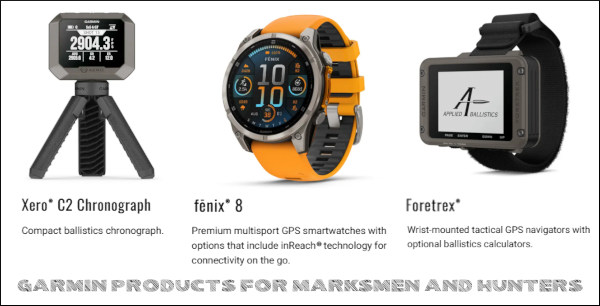
Garmin Ltd. (NYSE: GRMN) has acquired Applied Ballistics LLC, a leading provider of ballistic research, projectile data, and integrated solver technologies dedicated to enhancing accuracy. The acquisition will advance Garmin’s product offerings for tactical, shooting sports, and hunting markets.
Applied Ballistics LLC was founded by Bryan Litz, a scientist and software expert who is also a top-level marksman who has won major championships. Bryan is both a great shooter AND a ballistics wizard. In 2015, Bryan Litz won the F-TR Mid-Range AND Long-Range National Championships hosted at Ben Avery. And at the 2014 Berger SW Nationals (SWN), Bryan took top honors among all sling shooters. If you only know Bryan Litz from his Applied Ballistics Books and DVDs, you may not realize that Bryan is also a great rifle shooter along with being an actual rocket scientist.
“Applied Ballistics is a natural complement to Garmin’s outdoor and tactical product portfolio. Building on a successful relationship spanning nearly 10 years, this acquisition brings industry-leading software, proprietary projectile data and precision firing solutions in-house. By bringing our teams together, we can accelerate innovation and deliver even more capable, integrated solutions to customers who depend on accuracy.” — Brad Trenkle, Garmin Co-Chief Operating Officer
Applied Ballistics develops professional-grade ballistic solvers and radar-validated projectile models for hunters, competitive shooters and other long-range customers. The company continues to expand its ecosystem of connected products, helping users improve accuracy, better understand their equipment and share trusted ballistic data across devices and applications—providing an unparalleled, science-based approach to long-range shooting.
Headquartered in Howard City, Michigan, the Applied Ballistics portfolio includes the Applied Ballistics Quantum App, a premier ballistic solver and data management program favored by top shooters worldwide.
How to Employ AB Quantum Software — Getting Started
In this video, Bryan Litz offers an informative guide on getting started with AB Quantum™. Bryan demonstrates the essential setup process: building an accurate profile, establishing your zero, and verifying the data at 100 yards. Bryan then uses the verified profile to shoot a successful group at 1000 yards.
About Garmin International Inc.
Garmin products have revolutionized the aviation, automotive, fitness, marine and outdoor markets. Garmin produces hand-held GPS units, Vehicle GPS systems, Smart watches, Marine Radars, Flight Displays, and many other products used by hunters, marksmen, boaters, pilots, and outdoor enthusiasts.
Garmin International, Inc. is a subsidiary of Garmin Ltd. which is incorporated in Switzerland, with its principal subsidiaries are located in the United States, Taiwan, and the United Kingdom. Garmin is a registered trademark of Garmin Ltd., all rights reserved.
Today we share some smart tips from a past F-Class and Sling Champion who is both a great shooter AND a ballistics wizard. Founder of Applied Ballistics LLC, Bryan Litz is the author of multiple books and creator of advanced Ballistics Software.
Bryan is also a highly skilled competitor. In 2015, Bryan Litz won the F-TR Mid-Range AND Long-Range National Championships hosted at Ben Avery. And at the 2014 Berger SW Nationals (SWN), Bryan took top honors among all sling shooters. If you only know Bryan Litz from his Applied Ballistics Books and DVDs, you may not realize that this guy is a also great marksman along with being an actual rocket scientist!
Given his impressive track record in both F-Class and Palma (Fullbore) out to 1000 yards, we asked Bryan if he had any advice for other long-range competitors.
First Bryan provided three tips concerning Ballistics, his special area of expertise. Next Bryan offered three more general tips about long-range competition — how to analyze your shooting, how to choose your ‘wind strategy’, and how to avoid the most costly mistakes, i.e. how to avoid the “train-wrecks”.
Bryan Litz won the 2015 F-TR Mid-Range and Long-Range Championships with this sleek rig:
Litz Ballistics Tips
Ballistics TIP ONE. If you’re having trouble getting your ballistic software to match actual drops, you need to look at a number of possible reasons. Here are some common issues that can cause problems.
Click Values Are Not Exact. Scopes and iron sights don’t always produce accurate adjustments. In other words, if your ballistics program predicts 30 MOA of drop, and you dial 30 MOA but hit low, it might be that your sight actually only moved 28 MOA (for example). To see if your sight is adjusting accurately, shoot a tall target at 100 yards and measure group separation when dialing your sight.
Barometric vs. Station Pressure. This is a commonly misunderstood input to ballistics programs. You can avoid this pitfall by remembering the following: station pressure is the actual measured pressure at your location, and you don’t need to tell the program your altitude when using station pressure. Barometric pressure is corrected for sea level. If you’re using barometric pressure, you also have to input your altitude.
Muzzle Velocity. Chronographs are not always as accurate as shooters think they are — your true MV may be off by 10-20 fps (or more). If your drop is different than predicted at long range, it might be because your muzzle velocity input is wrong.
Mixing Up BC (G1 vs. G7). Knowledgeable long range shooters know that the G7 standard is a more representative standard for modern LR bullets. However, using G7 BCs isn’t just a matter of clicking the ‘G7′ option in the program. The numeric value of the BC is different for G1 and G7. For example, the G1 BC of the Berger 155.5 grain Fullbore bullet is .464 but the G7 BC is .237. If you were to enter .464 but click on G7, the results would be way off.
Ballistics TIP TWO. A properly installed level is absolutely essential for long range shooting. Without a good level reference, your long range wind zero will be off due to minor canting of the rifle from side to side. You can verify that your level is installed correctly on a 100-yard ‘tall target’. Draw a plumb line straight up the target and verify that your groups track straight up this line as you go up in elevation.
Ballistics TIP THREE. If your long range ballistic predictions aren’t tracking, always come back and verify your 100-yard zero. Sometimes a simple zero shift can be misconstrued as errors in long range ballistics predictions.
Litz Competition Shooting Tips
Competition TIP ONE. Improving your scores in long range competition is a constant process of self-assessment. After each match, carefully analyze how you lost points and make a plan to improve. Beginning shooters will lose a lot of points to fundamental things like sight alignment and trigger control. Veteran shooters will lose far fewer points to a smaller list of mistakes. At every step along the way, always ask yourself why you’re losing points and address the issues. Sometimes the weak links that you need to work on aren’t your favorite thing to do, and success will take work in these areas as well.
Competition TIP TWO. Select your wind shooting strategy carefully. For beginners and veterans, most points are typically lost to wind. Successful shooters put a lot of thought into their approach to wind shooting. Sometimes it’s best to shoot fast and minimize the changes you’ll have to navigate. Other times it’s best to wait out a condition which may take several minutes. Develop a comfortable rest position so you have an easier time waiting when you should be waiting.
Competition TIP THREE. Actively avoid major train wrecks. Sounds obvious but it happens a lot. Select equipment that is reliable, get comfortable with it and have back-ups for important things. Don’t load on the verge of max pressure, don’t go to an important match with a barrel that’s near shot out, physically check tightness of all important screws prior to shooting each string. Observe what train wrecks you and others experience, and put measures in place to avoid them.
Looking down-range with F-TR rifle at Ben Avery Shooting Facility in Phoenix, Arizona.
Bullet Stability and Twist Rates
In this video, Bryan Litz talks about bullet in-flight stability and how to calculate barrel twist-rate requirements for long-range bullets. Bryan explains that bullet stability (for conventional projectiles) is basically provided by the spinning of the bullet. But this spin rate is a function of BOTH the nominal twist rate of the barrel AND the velocity of the projectile. Thus, when shooting the same bullet, a very high-speed cartridge may work with a slower barrel twist rate than is required for a lower-speed (less powerful) cartridge. For match bullets, shot at ranges to 1000 yards and beyond, Bryan recommends a twist rate that offers good stability.
You’ll find more expert information on long-range shooting and ballistics on the Applied Ballistics website and the Bryan Litz Ballistics Facebook page. Bryan’s most recent Facebook post talks about the Coriolis effect — the apparent drift of a rifle trajectory due to the rotation of the earth.
To learn more, we recommend you subscribe to the Applied Ballistics Science of Accuracy — with in-depth articles, brilliant podcasts, exclusive videos and more.
Ever wondered what the air around a moving supersonic bullet really looks like? Check out this video from the Bryan Litz Ballistics Facebook page. This is a Schlieren video* of a 6mm 109gr Berger LRHT bullet at about 2800 fps as fired from Francis Colon’s PRS rifle at the Applied Ballistics Lab.
Bryan Litz notes: “You can clearly see the compression (shock) wave at the front of the bullet. A compression wave is formed when the air has to move faster than the speed of sound to get out of the way, which is certainly the case for this bullet which is moving about 2.5 times the speed of sound (Mach 2.5).
That shock wave is the ‘snap’ you hear when bullets fly past you if/when you’re downrange. Also, compressing the air into a shockwave takes energy, and that energy comes directly out of the forward velocity of your bullet and gets converted into heat and noise as the shock wave forms and dissipates.
The turbulent wake at the base of the bullet shows where/how base drag applies. The third and smallest component of drag for a supersonic bullet is skin friction drag, which is a viscous boundary layer effect, and is the least visible in this image. So as you head to the range or the hunting stand, think about the absolute violence your bullets are committing in the atmosphere, before they even reach the target!”
You can spend thousands on a rifle, but that expensive hardware won’t perform at its best if you have poor trigger technique. One key element of precision shooting is trigger control. Our friend Kirsten Joy Weiss has produced a good video that shows how to refine your trigger technique for better accuracy. In this video, Kirsten talks about the actual placement of a shooter’s index finger on the trigger. It is important to have the finger positioned optimally. Otherwise you can pull the shot slightly left or slightly right.
Kirsten tells us: “Finger placement on the trigger might not seem like a big deal, but it actually is. The reason for this is because, depending on where your index finger is placed on the trigger, [this] translates to different muscle interactions with the gun.” Watch this video to see Kirsten demonstrate proper finger placement (and explain problems caused by improper finger positioning).
When you pull the trigger, you only want to engage the last section of your finger, in order to avoid unwanted muscle engagement and to achieve a smooth shot. Remember there is a “sweet spot” between the crease (first joint) and the tip of the finger. If you position the trigger in that “sweet spot”, you should see an increase in your accuracy. Don’t make the mistake of putting the trigger in the crease of your finger, as shown below.
Effects of Incorrect Finger Placements
You want to place the trigger shoe between the end of your finger and the first joint. If you place the trigger on the very tip of you finger you’ll tend to push the rear of the rifle to the left when engaging the trigger, causing shots to go right (for a right-handed shooter). On the other hand, if you put the trigger in the crease (first joint), you’ll tend to bring the rear of the rifle to the right, causing shots to fall left. This is illustrated below for a right-handed shooter.
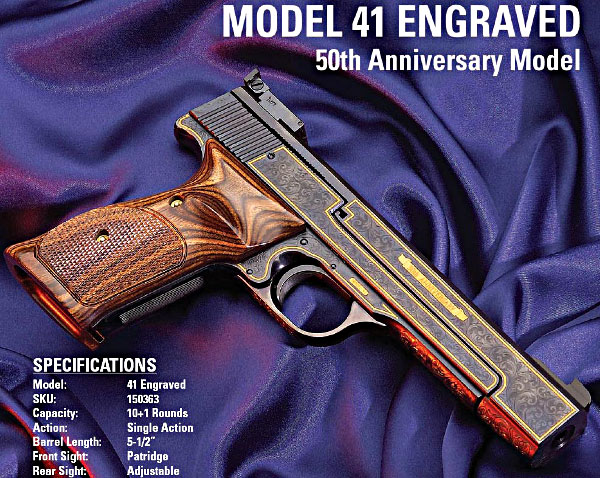
The Smith & Wesson Model 41 is a classic American rimfire target pistol. Beautifully crafted, the Model 41 boasts a superb trigger, comfortable grip, and excellent accuracy. New or used, a Model 41 is a fine addition to any firearms collection. We’ve shot a few Model 41s, and they will spoil you if you go back to a lesser rimfire pistol. First released commercially in 1957, a special 50th Anniversary Model (shown above top) came out in 2007 (hitting the market in 2008). Perhaps it should have been named the 60th Anniversary edition, as the first prototypes of the Model 41 were crafted way back in 1947. READ American Rifleman article about Model 41.
The Model 41 is one of those classic American designs that has stood the test of time. Many feel the Model 41 represents the apex of American .22 LR pistol design, much like the Colt Python is the “crown jewel” of double-action revolvers. One YouTube poster noted: “After [65] years the Model 41 is still near the top of the game in precision .22s. Very few if any of the current day pistols can match the workmanship, fit, and balance that makes having a Model 41 so enjoyable to own. S&W blew the center out of the 10 Ring with this one when they introduced it and continue to do so today.”
The Stunning 50th Anniversary Edition Model 41
Probably the most sought-after Model 41 is the handsome, machine-engraved 50th Anniversary Model, released in 2007. This was offered in a hardwood, glass-covered case. This would be a prized addition to any gun collection:
The 50th Anniversary Model was machine-engraved with Class A+ coverage, 24 carat gold striping, and special serial number range FYA0001 – FYA0500.
Of course, if you want a superb trigger in a .22 LR semi-auto pistol, look no further than the S&W Model 41. For $2000.00 to $3700.00 you can find the fully engraved, 50th Anniversary Model 41 in presentation case on various auction sights. First released in 2007, the engraved model 41 combines superior accuracy with stunning appearance.
Smith & Wesson Model 41 — An American Classic Rimfire Pistol
The Smith & Wesson Model 41 is an American classic — one of the great, iconic .22 LR target pistols. Accurate, well-balanced and built-to-last, model 41s have been in production for over 50 years. The Model 41 remains one of the most accurate pistols ever produced by Smith & Wesson.
Model 41 photo by Mightymoo01, creative commons released CC BY-SA 3.0.
Beautifully crafted, the Model 41 boasts a superb trigger, comfortable grip, and excellent accuracy. Whether an older classic or a newer model, the S&W Model 41 is something every gun owner would prize for target shooting. And “like new” high-grade models are now appreciating in value!
Smith & Wesson historian Roy Jinks recounts the development of the Model 41: “It was a difficult task to develop a competitive pistol that would meet the various needs of the top shooters. The final design was decided upon in 1956 and the new .22 target pistol was announced in Smith & Wesson’s 1957 Annual Report, stating: ‘Its design includes many advanced features, such as stocks equally suitable for right or left-hand shooters- a clean, crisp, trigger pull that is adjustable to individual preferences. The distribution of weight, together with the angle of the stocks, permits extremely steady off-hand holding. The precise micrometer sights are rigidly mounted on a one piece forged barrel to avoid any possible misalignment even after long usage.’ The handgun featured a 7 3/8-inch barrel equipped with a muzzle brake to help control recoil. The underside of the barrel was grooved to allow the addition of adjustable Olympic Style Barrel Weights. The trigger pull could be adjusted to allow for a 2-pound pull to meet the NRA Gallery Course requirement or increased to 3 pounds to meet the needs of the ISU International rules.
Smith & Wesson Model 41 with two extra slide/barrel assemblies, plus custom holster and mag holders. This sold on Cowan’s Auctions for $2640.00 in 2019.
Sales began in December of 1957 and the Model 41 was first cataloged in 1958. The factory was soon heavily back-ordered and [the Model 41] became the most popular auto-loading pistol offered by the company. In May of 1959 Smith & Wesson introduced a 5-inch lightweight barrel for the handgun to meet the demand of hunters[.] The line of Model 41s was further expanded in September of 1960 with the introduction of the Model 41-1 which fired .22 shorts for the International Rapid Fire Shooters. [I]n August of 1963 the company introduced the 5.5 inch heavy barrel. The last of the major barrel changes occurred in 1965 when the company produced the 5.5-inch heavy barrel with an extendable front sight to provide the shooter a longer sight radius. During the last 50 years the Model 41 has … established many records around the world. Today it is one of the classic target handguns[.]” READ MORE Model 41 History.
Field Test of Current Generation S&W Model 41
So how do modern production Model 41s shoot? Very well indeed, based on the results from popular gun Vlogger 22Plinkster. He took a new Model 41 to his test range and tested it for handling and accuracy. Watch the 22plinkster video below:
22plinkster runs of the most popular gun-centric YouTube channels. His videos have been watched by hundreds of thousands of firearms fans. Some of 22plinkster’s videos involve trick shots, but he’s actually a very competent marksman who has shot a vast collection of .22 LR/22 WMR pistols and rifles, making him a qualified rimfire expert.
Hickok45’s 30-Year-Old Model 41
Hickok45, a popular YouTube host, has been a fan of the S&W Model 41 since it was first released. In fact, back in 2020, Hickok45 celebrated his 30th year of ownership of this classic American rimfire. In this “Celebrating 30 Years” video, Hickok 45 demonstrates the qualities that have made the Model 41 so popular. He notes that it balances well, has an excellent trigger, and delivers superb accuracy. He observed: “What a great .22 LR pistol!”
Performance Center “Optics-Ready” Model 41
Do you prefer shooting pistols with a modern optic? Well check out the fully “Optics-Ready” S&W Performance Center Model 41. This modernized Model 41 PC has an integral Picatinny Rail mount for optics, plus adjustable target sights with a special skeletonized and removable front blade sight.
The Performance Center Model 41 sports an integral Picatinny-style equipment rail for easy installation of optics. Other standard features include an external thumb safety on the left side of the frame, custom wood target grips, and a blued finish. This full-size, 10-shot .22 LR pistol features a carbon steel frame and slide along with a 5.5-inch barrel. Measuring 10.5 inches in overall length, the Model 41 PC has an unloaded weight of 41 ounces. MSRP is $1763.00.
The S&W Model 41 History from Wikipedia
From Wikipedia: The Smith & Wesson Model 41 is a semi-automatic pistol developed by Smith & Wesson after World War II as a competitive target pistol. It was designed with a 105-degree grip angle, the same as the Colt M1911 pistol, to maintain a consistent grip angle.
Prototype and Production Models
In July 1947, two prototypes, numbered X-41 and X-42, were produced, tested, and improved for the next 10 years. In 1957, the Model 41 was made available to the public for sale when Smith & Wesson produced 679 units. At the end of 1958, they had built 9,875 Model 41 pistols. A lighter 5-inch (130 mm) barrel was offered in 1958 for field use. The Model 41-1 was introduced in 1960 and was chambered in .22 Short for International Rapid Fire competition. Only 1000 were made using light aluminum slides necessary for function with the lower powered .22 Short.
In August 1963, the 5-inch heavy barrel version came into the market. Stoeger’s Shooter’s Bible of 1964 shows a 7 3⁄8″ (190 mm) barrel grooved for Olympic center weights. The cocking indicator and 7 3⁄8″ barrel were dropped in 1978. The 7-inch (180 mm) barrel was introduced in 1978 with no provision for a muzzle brake. A 6-inch (150 mm) barrel was offered for a few months in 1991. In 1992, the Model 41 was dropped from production. In 1994, Smith & Wesson returned it to production as the Model 41 “New Model”.
The Model 41 Military Variant — S&W Model 46
In 1957, Smith & Wesson offered a “no frills” version of the Model 41, designated the Model 46. In 1959, it was selected by the U.S. Air Force for basic marksmanship training. About 4000 units were made in total: 2500 with a 7-inch barrel, 1000 with 5-inch barrels, and 500 with 5.5″ barrels. The pistol lacked the checkering, polished blue finish, and other refinements of the Model 41. It proved to be a commercial failure with consumers who preferred the more costly Model 41, and production ceased in 1966.
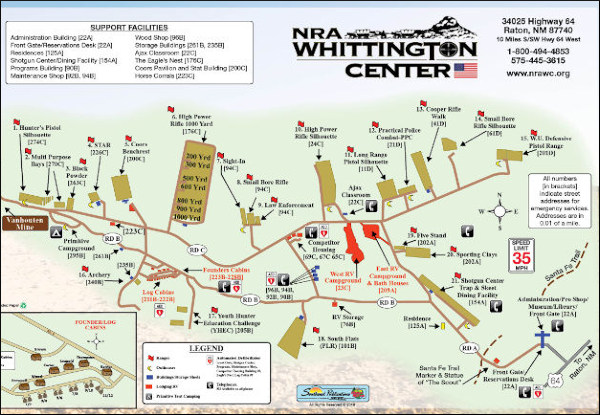
The 2026 Spirit of America NRA National Fullbore Championship is running September 11–17, 2026, at the NRA Whittington Center in Raton, New Mexico. Sponsored by the Bald Eagles Rifle Club, this individual and team championships event is open to Target Rifle (Fullbore), F-Open, and F-TR shooters. There are matches at 300, 500, 600, 900 and 1000 yards. CLICK HERE for 2026 Spirit of America Match Program.
The Spirit of America Championship is one of the flagship long-range rifle competitions at the NRA Whittington Center, offering a world-class fullbore rifle match experience on the renowned 1000-yard range. Since 2001 the Bald Eagles have hosted the Spirit of America Match and it has grown in reputation with every year of competition. It is one of the premier fullbore matches in the United States, and the range at Raton is one of the most challenging in the USA. 2026 Spirit of America Match Preview.
This video shows Day 2 of the Spirit of America individual championships. This shows the 300-yard line as the match got started. Brandon Green notes the winds were already pretty “sporty” blowing 10-12 mph and gusting a bit heavier.
This video was taken during practice. Brandon comments: “Practice Day for the Spirit of America Match. It is absolutely beautiful. This is one of the most awesome places in the world to shoot… it is gorgeous.” Brandon said some rains and “pretty big winds” were predicted. He noted it would be interesting to “see who could survive [the high winds].”
Here is a view of the 1000-yard range seen from the Founders Cabins up on the opposing hill. Raton is truly one of the most spectacular places you could ever shoot a match like this.


 Our standard procedure with Wipe-Out is to insert an O-ring-sealed cleaning rod guide into the chamber and then squirt through the muzzle in short puffs. IMPORTANT: Put a towel or rag on the comb of your stock and watch for a little bit of foam to exit the rod guide. We usually wait 30 minutes for the bubbles to dissipate, then do a second foam application. Be sure to clean off any excess foam before it drips on your stock. It is important to keep the foam off fine wood or paint finishes.
 Method Two: Apply Wipe-Out from Breech






 Of course, if you want a superb trigger in a .22 LR semi-auto pistol, look no further than the S&W Model 41. For $2000.00 to $3700.00 you can find the fully engraved,


 The Performance Center Model 41 sports an integral Picatinny-style equipment rail for easy installation of optics. Other standard features include an external thumb safety on the left side of the frame, custom wood target grips, and a blued finish. This full-size, 10-shot .22 LR pistol features a carbon steel frame and slide along with a 5.5-inch barrel. Measuring 10.5 inches in overall length, the Model 41 PC has an unloaded weight of 41 ounces. MSRP is $1763.00.