The 2010 U.S. F-Class Nationals concluded yesterday. It was a big success, drawing nearly 120 individual competitors and 18 teams. Young Derek Rodgers (Sharpshooter Class, 1330-57X) from Albuquerque, New Mexico, is the new Open Class Champion, and Californian Lane Buxton (1302-42X) won the F-TR division using a .308 Win Palma Rifle with Sierra #2156 bullets. Forum member Ken Dickerman finished second in F-Open posting a 1325-57X. Past multi-time F-TR Champ Danny Biggs shot F-Open this year, finishing third with a 1324-67X. While we are still waiting to receive ALL the final official results, it appears Danny set the high X-count for the match, while shooting with a Sinclair bipod equipped with a vertical adjustment knob. (The Open-class guns work amazingly well off the wide-base bipods.) Charles Ballard, the reigning (back to back) F-Open champ, finished seventh in F-Open.
New F-Open Champ Derek Rodgers was shooting a 300 WSM with 210-grain bullets. This heavy bullet/short magnum combo performed well in the windy afternoon conditions during Sunday’s afternoon matches. Most of the other top F-Open competitors were shooting a .284 Win or some other 7mm. Charles Ballard told us told us: “with so many guys shooting 7mms this year, the competition is tougher than ever. If I had a caliber advantage before… that’s gone. With the winds we had in the afternoons, I’m not surprised Derek Rogers did well with his 300 WSM and the heavy bullets. I want to congratulate Derek on his well-deserved win.”
The team event was hotly contested, with 18 teams on the line, most of which were in F-TR Class. In Open Class, the North American Shooters Team, coached by Bryan Litz won the Berger Trophy for the 600 + 1000-yard combined Aggregate, as well as the 1000-yard Team Match. The Sierra Spindle Shooters team took first place in the 600-yard Team Match. In F-TR Team shooting, Savage Shooters pulled off a clean sweep, winning the 600-yard match, the 1000-yard match, AND the Team Aggregate. Congrats to Savage Shooters!
NAS Team shooters (left to right): David Mann, Dean Morris, Bryan Litz (coach), Rick Jenson, Larry Tait.
F-Open Class Results
Winner: Derek Rodgers (Sharpshooter) – 1330-57X Nat’l Champion
Second: Ken Dickerman (High Master) – 1325-57X
Third: Danny Biggs – 1324-67X – High X Count?
Fourth: Jeff Cochran – 1324-28X
Fifth: Jeff Traylor – 1323-51X
High Woman: Brenda Hill – 1302-31X
High Senior: Larry Bartholome – 1321-51X
High Grand Senior: Danny Biggs – 1324-67X
F-TR Class Results
Winner: Lane Buxton – 1302-42X – National Champion
Second: Robert Lach – 1297-36X
Third: John Hayhurst – 1293-37X
Fourth: Jeffery Rorer – 1293-28X
High Senior: Robert Lach – 1297-36X
High Grand Senior: Peter Church – 1279-31X
Complete Results for Download
Check the attachments for all the scores. FCNAT2010OPEN.doc has all the F Open scores and FCNAT2010TR.doc has all the F-TR scores.
Marlin Firearms, now owned by Remington Arms (part of Cerberus Capital Management’s Freedom Group), is going to shut down its North Haven, Connecticut manufacturing facility. This marks the end of a legendary period of gun-making in New England. Marlin has produced firearms in Connecticut since 1870, when the company was founded by John M. Marlin.
A Marlin spokesman indicated that the plant will be closed by June, 2011, and all 265 employees will be terminated via phased lay-offs starting in May, 2010. The Marlin plant closure, announced late Thursday (March 24th), came as a surprise to both Marlin employees and North Haven community leaders. Marlin plant workers reported being “blindsided”. One worker told WTNH Channel 8 that: “We never saw this coming… we were told to attend a mandatory meeting at 3:30… And then boom [that was it].” Remington has not yet issued an official statement about the factory closure, but one insider speculated that the plant was closed to “avoid union wage pressure driving retail cost upward and making the product less competitive in the modern firearms market.”
Marlin is currently head-quartered in Madison, North Carolina. There is no indication that the production of Marlin rifles will be halted — production will likely be shifted to Freedom Group factories in other states. The Shooting Wire reports that: “According to Remington Arms sources, the facility is being decommissioned and the manufacturing relocated to Remington’s Ilion, New York facilities; the Marlin lines are not moving offshore.” The production relocation will apply to Marlin products, and, presumably, to the other brands made by Marlin: Harrington & Richardson, New England Firearms, and L.C. Smith.
Marlin’s founder, John M. Marlin, learned his trade during the Civil war, working at the Colt plant in Hartford, Connecticut. In 1870, according to Marlin’s website, Marlin “hung out his sign on State Street in New Haven, manufacturing his own line of revolvers and derringers.” The Marlin enterprise was purchased by Frank Kenna in 1924, and the Kenna family maintained ownership until Remington acquired Marlin in 2008.
Click Arrow Lower Left to Play Report from WTNH-TV Channel 8 in New Haven:
Team SIG shooter Max Michel won the IPSC Double Tap Championship for a fifth time this past week in Wichita Falls, Texas. This 6th Annual Double Tap Championship drew nearly 350 contestants, making it the second largest IPSC match of the year. A dominant force in IPSC competition, Max previously won the Double Tap in 2008, 2007, 2006 and 2005. (In 2009 Max had a scheduling conflict with the US Steel National Championship.)
“Winning the Double Tap Championship this year after missing the 2009 match is great,” Max declared. “The competition is first-class and this event draws the best in talent, as proven by the large number of competitors this year.” To see “top gun” Max Michel in action, watch the video below. Max demonstrates his speed shooting techniques and provides valuable tips on shooting fundamentals: Gun Grip and Shooting Stance.
Max Michel — From the USAMU to Team SIG — 10 years of Excellence
Max Michel first gained prominence in the competitive shooting arena with five USPSA® National Championships beginning in 2004 and three World Speed Shooting Championships in 2005, 2007 and 2009. As a representative of the United States, Max has competed in the last three International Practical Shooting Confederation (IPSC) World Shoots, returning home with team gold medals. Max was a top recruit for the U.S. Army Marksmanship Unit (USAMU) from 1999 to 2009 and served as the military Coach of the Action Pistol Team. Max Michel is currently the SIG SAUER Manager of Competitive Shooting Activities. Max will be competing this weekend, March 24-29 at the US Steel National Championship in Titusville, Florida. To follow Max Michel and Team SIG, visit the Sig Sauer Website, or log on to www.MaxMichel.com.
This week’s episode of Shooting USA covers END of TRAIL, the World Championship of Cowboy Action Shooting. The episode was filmed last June at the 2009 Championship. Based on the number of shooters, End of Trail is the second largest rifle/pistol competition in North America, topped only by the NRA National Championships at Camp Perry, OH. End of Trail is held each year at Founders Ranch, located near Albuquerque, NM. The next End of Trail will be held June 21-27, 2010.
The first part of Shooting USA will cover the SASS Championship, while the second-half Sighting-In segment will feature The Women of SASS. While most shooting sports are dominated by men, none seems to be as female-friendly as Cowboy Action Shooting.
Shooting USA’s SASS Special airs today, Wednesday March 24, on the Outdoor Channel:
Eastern Time 4:30 PM, 8:30 PM, 12:00 Midnight
Central Time 3:30 PM, 7:30 PM, 11:00 PM
Mountain Time 2:30 PM, 6:30 PM, 10:00 PM
Pacific Time 1:30 PM, 5:30 PM, 9:00 PM
The Shooting USA TV show on the Outdoor Channel presents its Annual SHOT Show Special today. The one-hour broadcast airs three times on Wednesday, March 17, starting at 4:00 pm Eastern Time. SHOT Show is the shooting industry’s largest annual event, attracting thousands of exhibitors and over 25,000 dealers and media attendees. Shooting USA interviews representatives of many leading companies, including Barrett, DPMS, Les Baer, Smith & Wesson, STI, and U.S. Optics.
For the 4-day event, held in Las Vegas from Jan. 18-22, Shooting USA brought its entire reporting team: Jim Scotten, John Scoutten, Mike Irvine, Brian Speciale, and videographer Greg Simmons. To preview the new products covered in the SHOT Show Special broadcast, visit the Shooting USA website.
Shooting USA SHOT Show Special Broadcast times
* Eastern Time: 4:00 PM, 8:00PM, 12:00 Midnight
* Central Time: 3:00 PM, 7:00PM, 11:00 PM
* Mountain Time: 2:00 PM, 6:00PM, 10:00 PM
* Pacific Time: 1:00 PM, 5:00PM, 9:00 PM
SHOT DAILY Digital Editions Available
You can still download digital (PDF) editions of the SHOT Daily print magazines distributed to SHOT Show attendees. Each of the four (4) issues contains a major product review, and many other shorter features. The Day 1 Daily features new Rifles for 2010, while the Day 2 Daily features new Optics and Ammo. In addition, you’ll find many other items of interest to rifle shooters.
The NCAA Rifle Championships are being broadcast LIVE right now on the NCAA.com Broadband channel for college sports. There will also be live broadcasts on March 14th and 15th. To access the future broadcasts, go to the NCAA TV website, click the “Event Guide” tab and search for “Coed Rifling”. Note: To view streaming video you may need to install the Microsoft “Silverlight” plug-in for your web browser. CLICK HERE for Live NCAA Rifle Championships Coverage.
Multi-Gun goes Hollywood. 3-Gun Nation, a new cable TV series, is set to launch in July 2010. Sponsored by FNH USA, 3-Gun Nation will cover a series of multi-gun matches hosted at venues nationwide. The first match runs March 25-28 at Superstition Mountain, Mesa, Arizona.
If you’re a 3-Gun shooter interested in competing, there is still time to sign up. You don’t even need guns and ammo. FNH provides all the firearms AND ammunition! To be eligible for the big money prizes, 3-Gun Nation shooters must compete in at least 3 out of the 5 qualifying events. The best three scores determine who qualifies for the FNH USA 3-Gun National Championship.
Overseen and run by the National 3-Gun Association (N3GA), 3-Gun Nation gives competitors a chance to win a $5,000 purse per event culminating in a championship prize of $25,000 for first place, $10,000 for second place, and $5,000 for third place. Each episode features a dramatic conclusion in which the top five competitors go head to head for the fastest stage time. Watch the video below to see 3-Gun Shooters in action.
The show will be hosted by country music star Mark Wills and American Rifleman magazine field editor Chad Adams. 3-Gun Nation will air on the Versus cable Network Mondays at 7:30 a.m. EST and Thursdays at 3:00 p.m. EST.
For more info, visit 3GunNation.com. There you’ll find the Event Description and Sign-Up Form. As soon as the matches start, 3GunNation.com will have news, feature stories, photos and professionally produced videos of the events and competitors.
2010 FNH USA 3-Gun Nation Schedule
1: March 25-28, 2010 Superstition Mountain Mesa, AZ
2: April 23-25, 2010 Blue Ridge Mt – 3 Gun Park City, KY
3: May 21-23, 2010 FNH USA Midwest 3-Gun Fayette, MO
4: June 10-12, 2010 MGM IronMan Parma, ID
5: Aug. 5-7, 2010 Rocky Mountain Raton, NM
CHAMPIONSHIP: September 13, 2010 USPSA Nationals Boulder City, NV
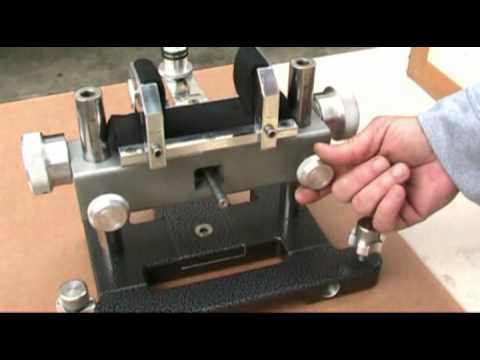
We recently received a prototype version of the new NEO rest from SebCoax.com. Designer Sebastian Lambang’s new rest is an engineering tour de force. Your editor can say, straight up, that this is the best joystick rest I’ve ever used. It is butter smooth in horizontal travel. The NEO does not suffer from the jerky, or jumpy vertical movement of some other joystick rests. With a 17-lb gun on the rest, yes there is more resistance in the vertical plane than in the horizontal, but you can still move the crosshairs up smoothly in one motion. You don’t have to “over-shoot” and then come back down on your aiming point. If you’ve used other coaxial rests, you know that the upward movement can be jerky if the resistance is set so that the joystick does not droop when you let go. Not so with the NEO. Seb Lambang has fitted the NEO rest with expensive, new German-made internal bearings. These new teflon liner bearings, plus two additional internal leaf springs for weight support, make all the difference.
The upward movement is MUCH smoother than before. In this Editor’s opinion, the NEO is smoother (with less jumpiness) than the Farley. It is also easier to set joystick tension on the NEO rest that on the previous (Gen 1) SEB rest. Before you had to fiddle with hex-head bolts. On the NEO rest, SEB has provided two, large diameter knobs. It is easy to set the tension so the joystick doesn’t fall on release, but travel is still smooth and positive in all planes.
Make no mistake, joystick movement on this rest is smooth and fluid, even in straight upwards motion with a 17-pound rifle. No more of the jumpiness or stacking found on lesser designs. SEB has got a winner here. Just as a top-fuel dragster lives or dies on quarter-mile speed, a coaxial rest is judged, foremost, on its ability to move quickly and precisely to point of aim in ONE MOVEMENT. Here the NEO rest shines. It may be the smoothest-functioning coaxial rest ever produced. And it also has the unique feature of adjustable front bag width (see videos). That’s great if you shoot both wide benchrest rigs and narrow-forearm rifles. Also, when disassembled, the NEO rest packs up very compactly — a big plus when traveling. If you didn’t like joystick rests before, the SEB NEO may make you a believer.
Triple-Sandbag Configuration and Vibration Damping
How about shooting performance? The rest is rock-solid, with no wobbly movement, so no mechanical flaws should prevent match-winning performance. However, the NEO rest has three separate, fairly thin bags. This configuration has been used with success in rimfire benchrest. Some European centerfire rests use a similar tri-bag arrangement. However, we are concerned that the smaller, separate bags could behave differently than a conventional front bag. There may be differences in vibration damping and how the bag responds under recoil. We have NOT done enough testing to judge how the NEO’s tri-bag system performs compared to a conventional one-piece sandbag. But it’s something to consider.
NEO Rest Offers More JoyStick Travel
The SEB NEO rest has a very wide range of travel. Running the joystick to max travel, we placed shots 43 MOA apart vertically and 48 MOA apart horizontally. That’s four FEET of horizontal travel at 100 yards using JUST the joystick! If you need more than 43 MOA of vertical travel, the whole coaxial carriage moves up and down on two large columns, delivering a bag height range from about 5″ to 10″ above the bench top. That’s a HUGE amount of travel. The gross height is adjusted with two large knobs, one on either side of the carriage. This movement is very smooth — as if the carriage is on ball bearings.
The geometry of the NEO Rest is somewhat unique. Although the NEO can be positioned in either direction (i.e. it is reversible), it is designed to have the long, narrow foot out front, on the target side. This opens up the entire area behind the rest, so there is no interference with the joystick’s movement. “But what about my vertical speedscrew?” you may be saying. Well, with the SEB NEO’s 43 MOA of vertical travel, you really don’t need a vertical adjustment screw on the shooter’s side of the rest when aiming your rifle. There ARE two adjustment screws on the left and right rear sides, but these are intended to level the rest only.
Overall, we were very impressed with the quality, range of adjustment, and versatility of the NEO rest. It has more than enough joystick travel to shoot an ARA rimfire target with 25 bulls. It has enough gross vertical adjustment for 1000-yard F-Class use, even if the target is way up on a hill or down in a valley. And, the rest is relatively easy to transport, with a fairly small footprint and a convenient carry handle built into the “back” side of the rest.
NEO Rest Specifications
- Reversible base configuration: Rest can work with joystick tension adjustments in front, or in rear, per user preference. If you want the single long foot on the “driver’s side”, that is also possible.
– Size assembled: Approx. 13″ wide x 14″ long, 8.6″ tall.
– MOA adjustment (joystick travel): At least 40 MOA (vertical) x 44 MOA (horizontal).
– Net weight: approx 9.3 kgs (20.5 lbs), with standard aluminum base and filled bags.
– Bag Width Range: 200 mm (approx 7.874″) between posts CTC. This allows a max forearm width of about 4″ (four inches).
– Height Range (from bottom of base to top of horizontal bag): Approx. 5″ (lowest) to 10″ (highest).
– Sand Bag Thickness: Approx. 3/4″ for the “horizontal’ bag, approx. 1/2″ for the side chambers.
– Construction: All metal throughout. Base is cast aluminum. Rack gear posts and pinion are stainless steel (SUS 420J). Coaxial body, rest top, forearm stopper are made from aircraft grade alumunium.
– Price: Not yet set, but probably $675.00 to $750.00 US.
NEO Rest vs. SEB Standard Rest
Seb told us: “The NEO rest is NOT designed to replace the regular SEB rest. It’s only for people that need faster elevation adjustment, and a rest that can be set to a lower level overall or a higher lever overall. On the production NEO rests, the ‘body’ of the coaxial unit will be polished, just like the current (Gen 1) rest. The current (Gen 1) rest will remain in production, so don’t worry if you prefer that design. I haven’t established the final price of the NEO rest yet, but I think it will be about $675.00 to $750.00. Yes, it will be somewhat more expensive because of the extended travel capability and increased cost of materials.”
Further Enhancements for Production Model?
The NEO we received is a prototype model and SEB tells us that he may add or modify some features in the final production version. What changes would we like? First, we think a front rest in the $700+ price range should have a built-in level. Obviously you can buy a bubble level and stick it on, but Seb should include one. Second, we’d like to see some variations on the side sand chambers. They tend to plump up in the middle. For stocks with side flats, such as the McMillan Edge, the thickest part of the side bags is a bit too high. Also the side tension knobs push the bags inwards well above the contact point with the stock. We also would like to have more forearm stop travel. As made, the front forearm stop has a good range of adjustment. But an optional, longer extension for the stop would better suit rifles that balance/shoot best with the rest placed well back on the forearm.
Included Cord Helps Rest Alignment
Included with the NEO rest is a nylon cord with metal ends. Just pop one end of the cord in a hole in the middle of the forearm stop and draw the cord back in line with the target, running the cord through the ears of your rear sandbag. This allows you to center and align the rear bag optimally. The cord is a thoughtful accessory provided by SEB.
Review Disclosure: SebCoax.com provided the Seb NEO rest for testing and evaluation. The rest’s manufacturer is not currently advertising with AccurateShooter.com.
GunsAmerica.com, a leading gun classifieds website, has launched a web magazine to complement its firearms for sale listing. Featured in the new webzine is a lengthy profile of the U.S. Army Marksmanship Unit, authored by Michael Molinaro, USAMU PAO. This article is full of interesting facts, and the video below is definitely worth watching.
Located at Ft. Benning, Georgia, the USAMU includes many current world and Olympic champions. Members of the unit compete in every major international shooting competition. They very often win, and for that reason the USAMU is referred to as “The Home of the Champions.” When not training, or competing in shooting events, USAMU soldiers serve as marksmanship trainers for other U.S. Army units and even allied forces overseas. Recently, a USAMU group was deployed to Afghanistan where they worked with allied Afghan (ANA) units to improve the ANA troops’ shooting skills.
The USAMU also conducts numerous clinics throughout the year. The USAMU teaches more than a thousand novice and experienced shooters at the small-arms firing school every summer at Camp Perry, Ohio. The International Rifle, International Pistol, and Action Shooting teams all host popular youth camps each summer.
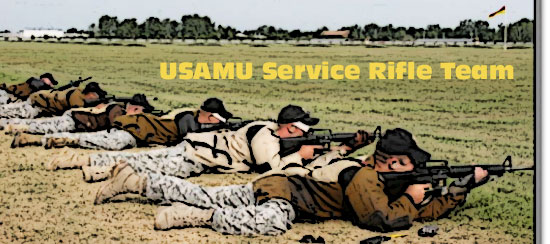
USAMU is composed of six competitive shooting sections: Service Rifle, Service Pistol, Action Shooting, International Rifle, International Pistol, and Shotgun. International Rifle, International Pistol, and Shotgun are Olympic sports. The USAMU’s world-class facilities (for both training and competition) consist of 260 acres with 7 ranges and 18 buildings.
Since 1956, members of the USAMU have won hundreds of individual and team national titles, more than 40 World Championships, and 23 Olympic medals. Two noncommissioned officers in the unit, Sgt. Vincent Hancock and Sgt. Glenn Eller, are current Olympic Champions. Sgt. 1st Class James Henderson is the reigning National Pistol Champion and holds countless records in service pistol shooting. Sgt. Daniel Horner is the National Multi-Gun Champion. Spc. Joe Hein is the National smallbore prone Champion.
We are pleased to see shooting featured in the Winter Olympics — as part of the biathlon competition. But for those accustomed to Hollywood action movies, biathlon events may seem a little slow… even boring. In the spoof video below, one TV producer shows how Biathlon events could be “spiced up”, Hollywood-style, to generate higher audience ratings:
Credit goes to Steve of The Firearm Blog for finding this YouTube gem. And folks, we know that shooting sports should always be taken very seriously… but we couldn’t resist passing this video along… everyone needs a chuckle now and then. Remember it is satire, designed to mock Hollywood’s fascination with violence. (Definition of satire: “trenchant wit, irony, or sarcasm used to expose and discredit vice or folly.”)


 Team SIG shooter Max Michel won the IPSC Double Tap Championship for a fifth time this past week in Wichita Falls, Texas. This 6th Annual Double Tap Championship drew nearly 350 contestants, making it the second largest IPSC match of the year. A dominant force in IPSC competition, Max previously won the Double Tap in 2008, 2007, 2006 and 2005. (In 2009 Max had a scheduling conflict with the US Steel National Championship.)