|
|
February 18th, 2010
A touching episode of Shooting USA aired yesterday on the Outdoor Channel. Luckily, it will be repeated this Saturday, February 20th. In this show, 84-year old WWII veteran Ted Gundy, who served as a U.S. Army sniper in the Battle of the Bulge, meets with the U.S. Army Marksmanship Unit (USAMU) at Fort Benning. For a week, the “old sniper” (and his son) were honored as VIP guests of the USAMU at Fort Benning. This story was broadcast on the “Impossible Shots” segment of Shooting USA. CLICK HERE for Full Story with details.

Gundy, who lost his right leg to an artillery shell, can still wear his WWII uniforms. He regularly puts on his “dress greens” when attending funeral services of Army veterans, a service he renders as a member of the Missouri Honor Guard.
At the end of the show Bundy received a new replica of the 1903 Springfield A4 Sniper rifle. The rifle, complete with vintage-type scope, was presented by Val Forgett of Navy Arms. Then, shooting from a rucksack rest, Bundy proceeded to hit steel at 300 yards.

This Shooting USA Special broadcast helps viewers remember our remaining WWII veterans, while showing the dedication and hard work of the modern-day USAMU. The show can be pretty emotional at times, but it’s well worth watching. If you missed the Feb. 17th broadcast, the show will be repeated on Feb. 20th at the following times: 4:30 PM EST, 3:30 CST, 2:30 MT, 1:30 PT (check your local listings). You can also purchase a DVD of the Old Sniper broadcast for $9.95.
February 14th, 2010
 Bryan Litz, Ballistician for Berger Bullets, is the author of the book Applied Ballistics for Long-Range Shooting. Before joining Berger, Bryan was a missile design engineer working with the U.S. Air Force. An NRA High Master, Bryan also happens to be one of the country’s top long-range shooters. Bryan (aka “bsl135″ in our Forum) has written many ballistics programs and technical papers dealing with long-range flight dynamics of projectiles. Bryan has recorded some very impressive match performances recently. At the 2008 NRA National Championships at Camp Perry, Bryan beat 258 other competitors to win the Palma Individual Trophy Match. Bryan shot a remarkable 450/26x, not dropping a single point. Bryan Litz, Ballistician for Berger Bullets, is the author of the book Applied Ballistics for Long-Range Shooting. Before joining Berger, Bryan was a missile design engineer working with the U.S. Air Force. An NRA High Master, Bryan also happens to be one of the country’s top long-range shooters. Bryan (aka “bsl135″ in our Forum) has written many ballistics programs and technical papers dealing with long-range flight dynamics of projectiles. Bryan has recorded some very impressive match performances recently. At the 2008 NRA National Championships at Camp Perry, Bryan beat 258 other competitors to win the Palma Individual Trophy Match. Bryan shot a remarkable 450/26x, not dropping a single point.
Palma Match — Caught on Video
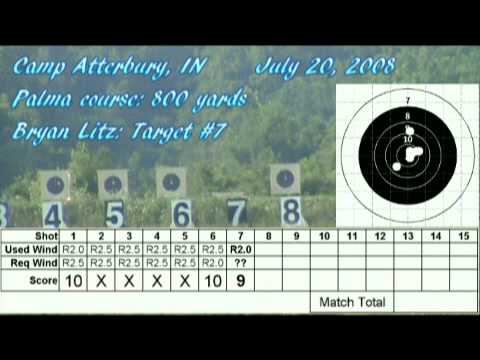
Bryan has crafted a cool video that puts the viewer “in the driver’s seat” as Bryan shoots an 800-yard match with his .308 Winchester, iron-sights Palma rifle. Watch as each shot is marked and scored. Bryan explains: “The inset target at upper right displays each shot location in sequence. The score card shows the windage used for each shot, as well as the windage that was ‘Required’ for that shot to be centered. Wind wasn’t very challenging in this string, only requiring between 2 and 3 MOA right. This particular match is the 800-yard phase of a Palma course fired in the summer of 2008 at Camp Atterbury, IN. NOTE: I’ve had to cut out some ‘pauses’, and speed up the film in order to meet YouTube’s size requirements, so that’s why we sound like chipmunks.”
CLICK SCREEN to WATCH VIDEO. Click Menu Button for High Quality (HQ) Option
Bryan also has his own website with a number of authoritative articles. Topics include: Bullet Design, Meplat Trimming, Gyroscopic and Coreolis Drift, Palma Bullet Analysis, How Ballistics Programs Work, and Ballistic Coefficient Testing. CLICK HERE to visit BRYAN LITZ Website.
February 12th, 2010
The 2010 Winter Olympics kick off tonight in Vancouver, BC, Canada. Shooting sports fans should follow the USA Biathlon team, which is considered the strongest group of American biathletes ever. Tim Burke, a top finisher in recent Biathlon World Cup events in Europe, is one of the favorites to collect a medal in Vancouver. That would be quite an accomplishment. Thus far, no American has ever won an Olympic Biathlon medal. Burke hope to change that. In the video below, Tim explains his training methods and his love for the sport. Definitely watch this video (produced by Time.com). Tim shows off his shooting skills and the reporter even tries out Tim’s Anschütz rifle. In an entire day of training, Tim only missed one target.
WATCH This Video — It Does a Great Job Explaining the Sport

While the American team is strong, it will face tough competition from the Europeans. Biathlon is far more popular in Europe than it is in the USA. In fact Biathlon is the #1 televised winter sport in Europe. Nonetheless, the American team has been training hard in hopes of a strong performance. The video below shows members of the USA Biathlon team doing off-season “dry land” training. In the summer months, Biathletes train with special short skis equipped with wheels. They shoot with the same rimfire rifles used in winter events.
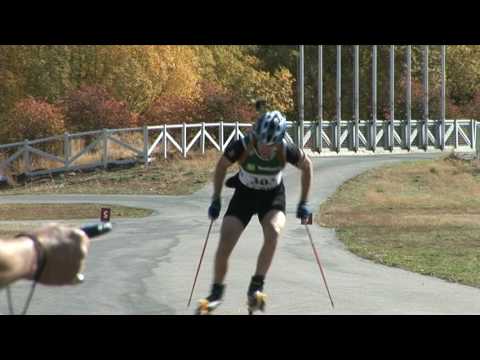
Over 90% of Olympic-level Biathletes use Anschütz rifles, most commonly fitted with a straight-pull Fortner action. These rifles are capable of 1/4 MOA accuracy at 50 meters. Of course, it’s not so easy to hold the guns steady after skiing many kilometers with no time to rest before engaging the targets. That’s what makes Biathlon so challenging. For more information on Biathlon competition, visit the TeamUSA.org website.

February 11th, 2010
Michael Bane, producer and host of the popular DownRange TV show on the Outdoor Channel, also creates a short video “podcast” each week. Michael’s weekly podcasts cover a variety of topics — product intros, major competitions, shooting tips, and gun industry news. This week (8 min, 30 sec into the video), Michael comments on the upcoming Supreme Court hearing in McDonald v. Chicago. That case will determine whether the landmark Second Amendment ruling in D.C. v. Heller shall be extended to state and local government actions. Bane also spotlights the FBI’s new 40sw AR15 carbines (from Rock River Arms) and the re-introduction of the classic Merwin-Hulbert revolver, now marketed as a compact CCW weapon. Notable Merwin-Hulbert design features included interchangeable barrels and auto-ejection of spent cartridges (when bbl assembly was unlocked).
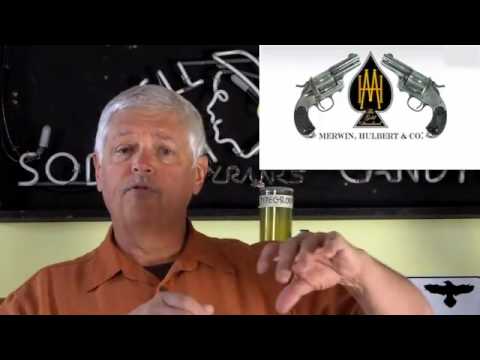
Details of Merwin Hulbert Revolver Design (NRA YouTube Video)

February 5th, 2010
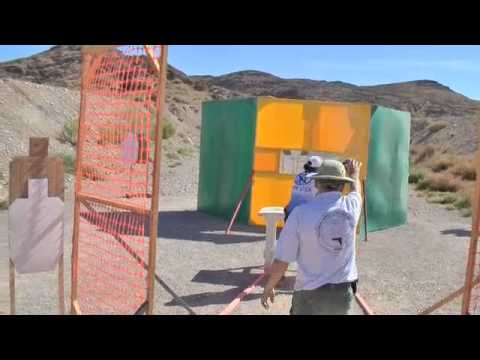
The U.S. Practical Shooting Association (USPSA) has announced the dates of its 2010 National Championships. Divided into four events, the Nationals are expected to draw more than 1,000 top shooters competing in a variety of divisions. Featured in the video below are “Women of USPSA” (including Team Glock’s Jessie Abbate) shooting at the 2009 USPSA Nationals. Be sure to watch this great video. Some very talented ladies demonstrate amazing shooting skills.
 The first event on the calendar, the USPSA Single Stack Nationals, will take place April 28 through May 1 at the PASA Park ranges in Barry, Ill. In 2009 this event drew 270-plus devotees of the venerable 1911 pistol. Next on the schedule is USPSA’s MultiGun Nationals which will take place in Las Vegas, Nev. at the Desert Sportsman’s Rifle & Pistol Club ranges September 9 through 12. The MultiGun championship draws close to 150 shooters using pistol, rifle and shotgun in the Open, Tactical, Limited and Heavy Metal divisions. The first event on the calendar, the USPSA Single Stack Nationals, will take place April 28 through May 1 at the PASA Park ranges in Barry, Ill. In 2009 this event drew 270-plus devotees of the venerable 1911 pistol. Next on the schedule is USPSA’s MultiGun Nationals which will take place in Las Vegas, Nev. at the Desert Sportsman’s Rifle & Pistol Club ranges September 9 through 12. The MultiGun championship draws close to 150 shooters using pistol, rifle and shotgun in the Open, Tactical, Limited and Heavy Metal divisions.
The USPSA championship season will wrap up with back-to-back handgun championships also held in Las Vegas from October 8 through 16, 2010. With over 600 shooters participating, the USPSA back-to-back handgun championships represent the largest gathering of Practical Shooting competitors in the USA. In addition to America’s top guns, the match will also draw some of the best shooters from South America, Europe and the Pacific Rim.
USPSA National Championship dates
April 28 – May 1: Single Stack Nationals (PASA Park, Barry, IL)
Sept. 9 – 12: Multi-Gun Nat’ls (Desert Sportsman’s Range, Las Vegas, NV)
Oct. 8 – 12: Open & Limited-10 Nat’ls (Desert Sportsman’s Range, Las Vegas, NV)
Oct. 13 – 16 Limited, Production & Revolver Nat’ls (Desert Sportsman’s Range, Las Vegas, NV)
To learn more about the USPSA National Championships and other major matches on the 2010 schedule, visit www.uspsa.org or call (360) 855-2245.
February 4th, 2010
Forum member Thomas Haugland (aka “Roe”) from Norway has created an excellent video comparing the features on four long-range scopes: Schmidt & Bender PMII 3-12x50mm, Schmidt & Bender PMII 12-50x56mm, Leupold MK IV, and Zeiss Diavari Victory 6-24x56mm. Thomas shows how the adjustments function, he records the available vertical elevation, and he takes apart the turrets to show how the weather seals work. While the Leupold MK IV has MOA clicks, the three Euro scopes tested by Thomas have mil-based or mil/cm adjustments. These mil-based clicks work well with first focal plane reticles that have mil or half-mil hash marks.
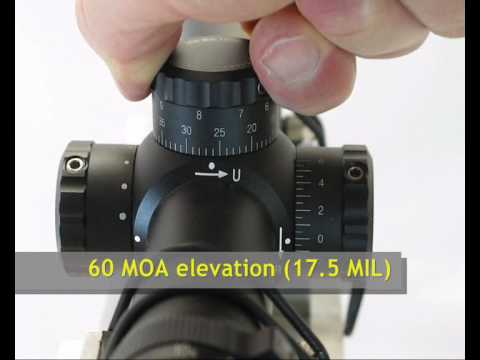
Thomas explains:
These films emphasize the shooter’s Point of View (POV) and ‘user friendliness’. ALL these scopes get the job done, but they have some similarities and differences in the details and your own personal preferences would decide what scope can be labeled ‘best’. The perfect scope doesn’t exist, you’ll have a compromise somewhere — be that economy, magnification, reticle, turret, optical quality, sturdiness…
In these films I’ve set the Schmidt & Bender PMII 3-12×50 as the benchmark for comparison. Not because it is ‘best’ (it isn’t!) but because S&B is one of the manufacturers which first recognized the needs of professional Long Range shooters and put together products [optimized to work well] in high stress environments. The features that are important are: First focal plane, MIL reticles and MIL turrets, plenty of adjustment and suitable magnification.
Note that S&B and Zeiss scopes are also available in the USA with MOA-based turrets and/or second focal plane (SFP) reticles, for those shooters who prefer the MOA system, and SFP. A first focal plane reticle is best for ranging, but a target shooter working at known distances will probably prefer a second focal plane reticle that doesn’t change in size with magnification.
February 2nd, 2010
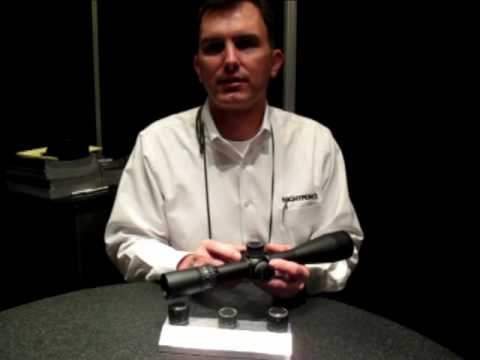
 Nightforce Optics has enhanced their elevation adjustments in this year’s lineup of high-magnification Nightforce scopes. Now you can get DOUBLE the elevation travel with a SINGLE TURN of the elevation knob. For an NXS with 1/4-MOA clicks, this means you can get a full 20 MOA of elevation travel with a single turn of the knob. Nightforce Optics has enhanced their elevation adjustments in this year’s lineup of high-magnification Nightforce scopes. Now you can get DOUBLE the elevation travel with a SINGLE TURN of the elevation knob. For an NXS with 1/4-MOA clicks, this means you can get a full 20 MOA of elevation travel with a single turn of the knob.
Bravo, Nightforce — this simple enhancement can make a BIG difference in the field. With most “high-performance” calibers, 20 MOA will get you to 700 yards or beyond. This means that the varminter can zero at all likely hunting yardages within the same revolution of the turret. That makes life much simpler, and reduces the chance of being way off in your elevation. No more confusion about which revolution you’re on….
Likewise, a tactical shooter, moving from near to far targets and back again, can likely stay on the same revolution at most target yardages. Even if you shoot out to 1000 yards, you will be able to get all the way out to 1K within two complete revolutions. This upgrade — doubling the elevation travel in each turret revolution — gives Nightforce scopes practical performance (inside 700 yards) similar to much more expensive scopes fitted with a single-turn or double-turn elevation systems (such as the U.S. Optics EREK knob). The new high-speed adjustment system will be offered in Nightforce’s 15x, 22x, 32x, and 42x series of scopes. Anticipated delivery date for scopes with the high-speed adjustment is May, 2010.
What About Retro-fitting Older NF Scopes?
Nightforce plans to provide an upgrade path for existing Nightforce scopes “eventually, but not right away”. The upgrade would allow installation of the “high-speed adjustment” system on older NF scopes. We don’t have any more specifics. Nightforce has NOT revealed how much the high-speed conversion would cost or when it might be available for pre-2010 scopes.
February 1st, 2010
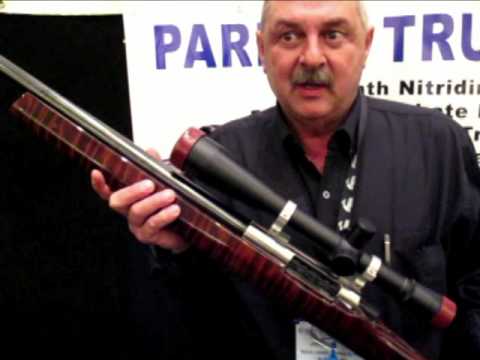
Many of our readers know Joel Kendrick, one of America’s top mid-range shooters. Joel is a two-time IBS 600-yard Shooter of the Year, and we have featured Joel’s match-winning 6×44 as one of our Guns of the Week. Joel now works with MMi-Trutec, specializing in the salt-bath nitriding process. This is a surface-hardening procedure for steel that creates a super-hard, low friction layer for the top 10-20 microns of the metal. Barrels treated with salt-bath-nitriding show much improved wear resistance and reduced friction.
For match rifles, varmint rifles, and hunting rifles, the most significant benefits of salt-bath nitriding are enhanced barrel life, and easier cleaning. Joel’s own F-Class rifle has a nitrided stainless barrel with over 5000 rounds — and it still holds 1/4 MOA at 100 yards. Other well-known shooters, such as John Whidden, have observed that nitrided barrels can shoot longer strings of fire between cleanings, with no reduction of accuracy. What is the cost of nitriding? As Joel explains in the video below, nitriding a single barrel costs $60.00, but there is a minimum first-time lot charge of $200.00. If you submit multiple barrels at the same time, the price per barrel can be reduced significantly. For more info, visit the MMI-Trutec website or contact Joel Kendrick by phone (704) 616-6442, or via email: joelkndrck [at] aol.com .
Is there a downside to nitriding? First, the nitriding process results in a BLACK matte or satin finish. If you like the natural silver finish of stainless steel, you shouldn’t nitride your barrel. Second, and most importantly, the salt-bath-nitriding process creates a surface so hard that you can NOT re-cut the chamber with normal reaming tools. Therefore, before nitriding, the barrel must be finished chambered. Basically the barrel should be fully finished, crowned, chambered and headspaced before nitriding. NOTE: MMi Trutec CAN mask the crown during nitriding so that the barrel can be re-crowned at a later time.

January 31st, 2010
On Media Day, just prior to SHOT Show 2010, our Assistant Editor Jason Baney headed straight to the biggest, baddest rifles he could find — a pair of serious-looking tactical rigs from Barrett Rifles. First off was the mighty semi-auto Barrett 82A1, chambered in .416 Barrett. a “beast of a cartridge” according to Jason. The .416 is a very powerful chambering, and you can see the recoil pushed Jason pretty hard. That’s serious energy — Jason’s a big boy, and the Barrett 82A1 weighs nearly 31 pounds. Want one? You may have to liquidate some investments. MSRP on the Barrett 82A1 is a whopping $9345.00.


Ninety-Eight Bravo in .338 Lapua Magnum
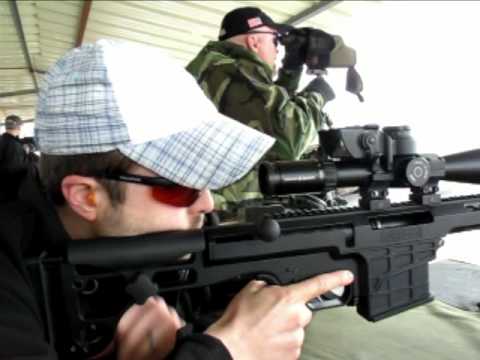
Next up was Barrett’s bolt-action model 98B (“Ninety-Eight Bravo”), chambered in .338 Lapua Magnum. At less than half the weight of the Barrett 82A1, the 98B was much easier to steer on the bench and the ergonomics were generally better according to Jason.
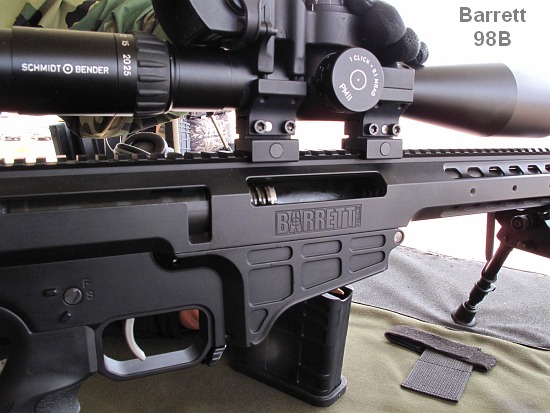
While recoil from the .338 Lapua Mag was stout, you can see in the video that the .338 LM kicked much less than the .416 Barrett, even in a gun with less than half the mass. The 98B gives you a good solid thump to the shoulder when firing. By contrast, the .416 Barrett in the 82A1 shakes your whole body. The 98B weighs 12.4-13.5 pounds (depending on configuration) and starts at $5039.99 without optics. Speaking of optics, the hooded display on top of the 98B is a Barrett Optical Ranging System (BORS). This $1500.00 gadget provides a digital read-out of your actual ballistics settings. It doesn’t control windage and elevation — that is still done manually with the scope knobs. BORS is an integrated electronic ballistic computer that mounts directly on the riflescope and couples to the elevation knob. Just turn the elevation knob until the LCD displays the target’s actual range (which must be pre-determined). The BORS’ three internal sensors automatically calculate a ballistic solution, compensating for up/down angle, temperature, and barometric pressure changes. It even tells you if the rifle is canted. It’s a handy device that eliminates the possibility that you loose track of your turret settings.

January 31st, 2010
The IBS recently announced that it would allow AR-platform rifles to compete in local IBS benchrest matches in their own class. If you plan to campaign your AR in this new class, you should definitely add a 3″-wide front sled and some kind of rear bag-rider to your gun. Without a flat fore-arm “sled” and rear bag-rider, ARs tend to be very wobbly, and the standard rear stock (with sling loop in place) is terrible in a rear sandbag.

 
Robert Whitley’s AR-X Enterprises has just what you need to improve your AR’s bench behavior. AR-X sells precisely-fitted Delrin bag-riders, crafted expressly for ARs by Evolution Gun Works (EGW). The 3″-wide front bag rider (aka “sled”) features a “twin rail” design and attaches to a tubular fore-arm via a swivel stud. The rear bag-rider mates to the bottom of a standard AR stock and attaches via the rear sling swivel anchor. This provides a smooth, straight surface to ride the bags.
These Delrin EGW bag-rider units were originally designed and prototyped for AccurateShooter.com’s 20 Practical AR project rifle. We tried many different designs, and the final production versions really work — as you can see in the video above. The AR bag-riders cost $40 front and $40 rear, or $75.00 for the set of two. To order, visit 6mmAR.com, or email Robert Whitley: rcw3 [at] erols.com .
|


