The Cawthon Cartridge Club (Millican, TX) hosts the 2010 LaRue Tactical Multi-Gun Match this weekend, May 8-9. More than 220 shooters will compete in eight (8) stages of fire using pistol, rifle, and shotgun. This is action shooting, with lots of movement. Shooters negotiate obstacles, run to firing positions, and engage targets from multiple positions, often firing through ports or around barricades. Targets are placed at distances from a few yards (pistol) to 500 yards (rifle).
With stage names such as “House of Pain,” “Jungle Run,” and “Tunnel Rat,” this match will challenge the competitors’ shooting skills and physical abilities. With temperatures predicted to reach the 90s, competitors must battle the heat and the sometimes high winds as they run through stages and take long shots with their rifles. Pre-match favorites include Taran Butler, Kelly Neal, and Bennie Cooley, but there are many lesser-known shooters who could end up on the podium.
The video below shows Stage 8 from the 2009 LaRue 3-Gun Match, held at the Tiger Valley Tactical Institute range near Waco, TX.
Berger Bullets has just released its new .338-caliber “hybrid” bullet, Berger’s first-ever projectile larger than .30 caliber. The new bullet has a very high ballistic coefficient (BC): 0.891 under the G1 model, and 0.455 under the newer G7 standard for boat-tail bullets. That high BC should translate into exceptional long-range performance. According to Berger, the BC of the new Berger .338 bullet BC is roughly 14% better than the BCs of other .338-caliber 300gr offerings from Sierra and Lapua. This claim is supported by testing done on all three bullets and published in a detailed Bullet Comparison Report (PDF). The new .338 Hybrid bullets will be sold in 50-count and 250-count boxes. To order, call Berger’s Tech-Line, (714) 447-5458.
The key design feature of the new .338 bullet is its hybrid ogive, i.e. a shape that combines both tangent and secant geometry. A tangent ogive meets the bearing surface very smoothly, whereas a secant ogive has an abrupt juncture with the bearing surface. The figure below shows the geometric differences between a tangent and a secant ogive, as well as the strengths and weaknesses of each.
Practical Considerations — Load Length and Twist Rate
The superior ballistic performance of the 300gr Hybrid .338 is primarily due to the very long ogive and boat tail. However, that super-long bullet length can create some issues. Berger’s new .338 Hybrid bullets are so long that loaded rounds may not fit some magazines comfortably, unless you deep-seat the bullets, which cuts down on usable case capacity. If your loaded rounds with the new .338s are too long for your magazine, single-feeding is recommended. In addition, and this is IMPORTANT, to get optimal performance with the new bullets, you may want to extend the throat in your chamber. This can be done relatively easily by a competent gunsmith using a throating reamer. We caution, however, once the throat is pushed out, you can’t go back to a shorter throat without setting back the entire barrel.
The new .338 Hybrid bullets should stabilize well with a 1:10″ twist at the velocities achievable with popular .338 magnum cartridges. However, according to Bryan Litz, Berger’s Ballistician, at extreme long ranges (beyond one mile), as the .388 bullet goes trans-sonic, it may need more spin. As the bullet slows down into the trans-sonic range, extra stability is required — something you get by spinning the bullet faster. So, for those guys planning to shoot at one mile or beyond, Berger recommends a faster twist-rate. The faster twist provides more spin-stabilization at very long ranges. But for 1000-yard shooting, you don’t need to be concerned about trans-sonic stability. As Bryan explains: “So as long as you keep your shots under 1 mile, the 1:10″ twist is plenty adequate.”
Berger Bullets Video Update (Eric Stecker talks about the new .338 Hybrid and other matters.)
On Wednesday, April 28, the Shooting USA TV show reprises its special “Old Sniper” broadcast. In this popular episode, 84-year old WWII veteran Ted Gundy, who served as a U.S. Army sniper in the Battle of the Bulge, meets with the U.S. Army Marksmanship Unit (USAMU) at Fort Benning. For a week, the “Old Sniper” (and his son) were honored as VIP guests of the USAMU at Fort Benning.
At the end of the show Gundy received a new replica of the 1903 Springfield A4 Sniper rifle. The rifle, complete with vintage-type scope, was presented by Val Forgett of Navy Arms. Then, shooting from a rucksack rest, Gundy proceeded to hit steel at 300 yards. CLICK HERE for Full Story with details.
This Shooting USA Special broadcast helps viewers remember our remaining WWII veterans, while showing the dedication and hard work of the modern-day USAMU. Broadcast times (on the Outdoor Channel) are shown below (check your local listings).
The 6mm Dasher is based on the 6mm BR cartridge with the shoulder blown forward about 0.100″ and “improved” to 40°. Case capacity is raised to about 41.0 grains. This allows the Dasher to drive 105-108gr bullets comfortably at 2970-3000 fps without over-stressing the brass. A popular load used by many successful Dasher shooters is 33.3 grains of Reloder 15, CCI 450 primers, with 105gr Berger VLDs, .010″ in the lands. This is a “warm load” and should only be used with fire-formed brass. As with any load, start 10% low and work up. You may also have good luck jumping the bullets .020″ or more.
Robert Hoppe, one of the top 600-yard shooters in the country, was the 2009 NBRSA 600-yard champion. In 2007, shooting a 6 Dasher, Robert nailed a 0.5823″, 5-shot group. At the time it was the smallest group ever shot in 600-yard registered benchrest competition. In 2008, John Lewis shot even smaller with an IBS Heavy Gun, but Robert’s 0.5823″ still remains the NBRSA 600-yard record, and we believe it is the smallest group ever shot at 600 (in registered BR competition) by a 17-lb class rifle. Robert has been very successful in the 600-yard game, and is one of the best 600-yard shooters in the West. He knows how to wring the best accuracy out of the 6mm Dasher cartridge. Here Robert offers some tips on load development and tuning for the 6mm Dasher.
Today, April 19th, is “Patriot’s Day”, the anniversary of the “Shot heard ’round the world.” Earlier today, in Washington, DC, supporters of Second Amendment gun rights rallied near the Washington Monument. Those dedicated rally attendees came from all parts of the country to demonstrate their support for the individual right to keep and bear arms. The DC rally, along with companion demonstrations in state capitols nationwide, drew the attention of the national print and television media. The reporters recorded plenty of stirring speeches on the subject of gun control and individual rights. Perhaps the TV cameras were seeking greater drama — but there were no fights, no violence, no guns fired into the air.
Those who attended the main DC rally were estimated at a “few hundred” to “as many as 2,000″ (Washington Post). Perhaps the rally could have drawn more attendees, but the landmark U.S. Supreme Court case of Heller v. D.C., which recognized an individual right to “keep and bear” arms, may have created a sense of complacency among firearms owners. Indeed, the Washington Post News Blog observed: “The March comes at a time when the trend appears to be toward normalizing carrying of firearms in public. Even before the U.S. Supreme Court’s 2008 decision in [Heller] recognized an individual’s constitutional right to possess firearms, an increasing number of states have allowed citizens to carry guns openly or conceal them on their person. Last year, 24 states loosened restrictions in firearms laws, and Iowa and Arizona passed laws this year easing restrictions on gun possession.”
We talked recently with our friend Darrell Jones, a talented benchrest shooter from Tennessee, who operates a brass processing business, DJ’s Brass Restoration Service. Darrell ultrasonically cleans old cartridge brass then carefully anneals each case, using temp-sensitive lacquers to ensure the brass is neither over-annealed or under-annealed. As far as we know, DJ’s Brass Restoration Service is the ONLY business in the country offering combined ultrasonic cleaning and annealing. And now Darrell can process your brass with even great efficiency.
Darrell told us he has just received his new, automated dual-torch, carousel annealing machine from Bench-Source. This microprocessor-controlled unit may be the most advanced bench-top annealing machine ever created. Two torches are used to provide intersecting flames for uniform heating. The micro-processor precisely controls the heating time, and a special motor spins each case around its axis while in the heating position. This ensures that the neck and shoulder are annealed evenly.
Combined Ultrasonic Cleaning and Case Annealing
If you have “tired” brass with inconsistent neck tension from case to case, give Darrell a call. His cleaning/annealing process will extend the useful life of your brass, and his service is quite affordable. Darrell’s Basic Service starts at $20.00 per hundred cases — and that includes ultrasonic cleaning AND annealing. (Flat rate USPS shipping is extra.) Note: very large cases (such as the .338 Lapua) or damaged, dented cases may cost more.
In addition to the Basic Service, Darrell offers a 4-Step Full Service starting at $25.00 per hundred cases (plus shipping). Darrell’s Full Service brass restoration includes: Uniforming primer pockets; Chamfering Case Mouths; Ultra Cleaning and polishing; Annealing case necks.
Ultrasonic Muzzle Brake Cleaning
In addition to cleaning and annealing cartridge brass, Darrell offers Ultrasonic Cleaning for muzzle brakes. This removes carbon buildup to restore critical bullet clearance requirements. The price is $15.00 per brake (plus shipping).
For more information, visit DJsBrass.com, or call Darrell at (901) 826-1503. IMPORTANT: Contact Darrell for shipping instructions BEFORE sending any brass for processing. ALL BRASS MUST BE DE-PRIMED before you send it.
Berger Bullets has just released a video report from Eric Stecker, Berger’s “master bulletsmith”. In this video update, Eric explains why Berger’s popular 6mm, 25 cal, and 7mm bullets are in short supply. Eric reports that production delays were caused by mechanical problems with the jacket-making presses. The good news is that the jacket presses have now been fixed (this required a complete rebuild of the 7mm press), so production should be back on schedule very soon. You’ll find more current news and match reports on Berger’s new Facebook Page.
Berger also announced that, in order to better respond to customer inquiries, Berger has added a new representative to the customer service staff, Teresa Collins. You can contact Teresa by phone at 714-447-5456 or send email to: teresa.collins [at] bergerbullets.com.
From April 30 – May 2, the Original Pennsylvania 1000 Yard Club will host a multi-day, long-range benchrest school at its Williamsport range. For $250, up to 36 students will enjoy 1 night and 2 days of training under the tutelage of some of the nations’ top 1000-yard shooters. There are still some spots available for the Spring class, so get your applications in before the April 25th sign-up deadline.
On Friday night (April 30), students will meet their mentors. Saturday (May 1), the class moves to the range for a full day of hands-on technical training. Topics include precision reloading, load development, gun handling, use of chronograph, analysis of shooting results, gun cleaning, and target analysis. The Williamsport Club will provide the rifles and all reloading components. Saturday’s sessions are followed by a steak dinner, included in the $250 seminar price.
On Sunday (May 2), after an early training session covering bench set-up and match strategies, students will shoot a 1000-yard match, spending time both behind the trigger and in the pits. The program wraps up before 4:00 pm on Sunday. The 1000-yard Benchrest School is limited to 36 students (with less than 3 students per advisor). Intructors include Gunsmiths Bruce Baer and Mark King, our Asst. Editor Jason Baney, and many Williamsport Hall of Fame shooters. For more info, email School Director Frank Grappone, frankgrappone [at] sbcglobal.net.
1000-Yard Benchrest School Slide Show
Sebastian Reist attended the 2009 Williamsport 1000-yard BR school. A talented professional photographer, Sebastian captured the highlights of his Williamsport 1K training weekend in the slideshow below, provided courtesy www.sreistphotography.com.
Last month we profiled the new, affordable Savage Edge hunting rifle. Though starting MSRP is just $329.00, this new Savage has many nice features, including a detachable box magazine, free-floated barrel, and handy thumb safety on the tang. The bolt copies the Savage 10/110 floating-head design and the Edge uses the familiar Savage barrel nut to secure the barrel and set headspace.
Jeff Quinn of Gunblast.com got his hands on the new Savage Edge. He was impressed with the gun, which he called “an excellent rifle at an amazing price.” Despite its low cost, Quinn’s test gun delivered sub-MOA accuracy with a variety of .243 Winchester factory loads: “Several [three-shot] groups were fired that measured under one-half inch, but the five-eighths inch group shown was typical for the day. No groups measured in excess of the magical one-inch mark.”
Overall, writer Jeff Quinn praised the Edge as a good, solid hunting rifle that offers great value: “There were no surprises in the handing of the Edge; it balances and handles very well. There were no surprises in the accuracy of the Edge; it shoots where you point it. There were no surprises in the reliability of the Edge; it fed, fired, and ejected perfectly. The surprise is in the price. As of this writing, the Edge has an MSRP of only $329 US. For only fifty bucks more, you can get the Edge with a 3 to 9 power scope already mounted and bore-sighted.”
2010 F-Open Class Champion Derek Rodgers, a young shooter from Albuquerque, New Mexico, proved that youth and skill can triumph over age and experience. Though Derek had placed third in F-TR class at the 2009 Nationals, this was Derek’s very first year competing in Open Class at the Nationals, and his NRA Classification was “Sharpshooter”. Derek’s win was a great victory for an unheralded newcomer. On the last day of the competition, Derek put together three superb 1000-yard matches, out-shooting High Masters and past National Champions to secure the Open Class title. Derek finished with 1330-57X, five points ahead of runner-up Ken Dickerman (1325-57X).
Ironically, Derek only decided to shoot in Open Class only because his favorite F-TR rifle is currently being upgraded by his gunsmith, and so the rifle wasn’t ready for the Nationals. (We suspect some F-Open competitors wish that gunsmith had finished Derek’s F-TR rifle a bit sooner).
Derek brought a 300 WSM to the Nationals, a “big boomer” by F-Class standards. A fan of “heavy bullets”, Derek loads his 300 WSM with high-BC, 210gr JLK bullets. In Derek’s home state of New Mexico, strong winds are the norm. Shooting in those conditions has shown Derek the effectiveness of heavy 30-caliber bullets at long range. Derek’s load certainly shot well in the windy conditions during the final 1000-yard match on Sunday. While some of Derek’s success can be attributed to his wind-bucking WSM (built by Score High Gunsmithing in New Mexico), he also is a careful reloader who “goes the whole nine yards” to produce the best possible ammo. Derek anneals, weight-sorts and neck-turns his Remington brass. He weight-sorts and ogive-sorts his 210gr JLK bullets, and he points up the tips for uniformity. He spared no effort in loading for the Nationals because he knew “those other guys are really, really good.”
The Sierra Cup (at left) is presented each year to the U.S. F-Open Class National Champion. This year Derek Rodgers’ name will be placed on the trophy alongside other F-Open Champions including John Brewer (2004), Jeff Cochran (2005), Eric Bair (2006), Robert Bock (2007), and Charles Ballard (2008, 2009).


 The Cawthon Cartridge Club (Millican, TX) hosts the 2010 LaRue Tactical Multi-Gun Match this weekend, May 8-9. More than 220 shooters will compete in eight (8) stages of fire using pistol, rifle, and shotgun. This is action shooting, with lots of movement. Shooters negotiate obstacles, run to firing positions, and engage targets from multiple positions, often firing through ports or around barricades. Targets are placed at distances from a few yards (pistol) to 500 yards (rifle).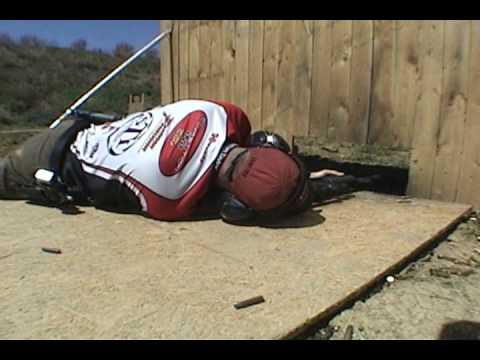



 Today, April 19th, is “Patriot’s Day”, the anniversary of the “Shot heard ’round the world.” Earlier today, in Washington, DC, supporters of Second Amendment gun rights rallied near the Washington Monument. Those dedicated rally attendees came from all parts of the country to demonstrate their support for the individual right to keep and bear arms. The DC rally, along with companion demonstrations in state capitols nationwide, drew the attention of the national print and television media. The reporters recorded plenty of stirring speeches on the subject of gun control and individual rights. Perhaps the TV cameras were seeking greater drama — but there were no fights, no violence, no guns fired into the air.



 On Friday night (April 30), students will meet their mentors. Saturday (May 1), the class moves to the range for a full day of hands-on technical training. Topics include precision reloading, load development, gun handling, use of chronograph, analysis of shooting results, gun cleaning, and target analysis. The Williamsport Club will provide the rifles and all reloading components. Saturday’s sessions are followed by a steak dinner, included in the $250 seminar price.


 Derek brought a 300 WSM to the Nationals, a “big boomer” by F-Class standards. A fan of “heavy bullets”, Derek loads his 300 WSM with high-BC, 210gr


