The Tactical Rifle Shooters Facebook Group recently showcased tools used to measure case headspace before and after “bumping” the shoulder. After a case is fired, hand-loaders who full-length size their cases will typically bump the shoulders back anywhere from .001″ to .0035″, depending on the rifle and application. With our 6mmBR and Dasher cases we like about .0015″ bump.
You want the amount of case sizing and bump to be the same for all your brass. To ensure uniformity, it makes sense to measure your cases before and after the FL sizing process. When we have time, we check every case. Other folks will simply check the first 3-4 cases coming out of the FL sizing die to ensure the FL die setting is correct and delivering desired headspace/bump.
1. Whidden Gunworks Shoulder Bump Gauge
There are a variety of tools that can be used to measure shoulder bump. Our favorite is a special cartridge-specific bushing made by Whidden Gunworks. The Whidden Shoulder Bump Gauge enables you to adjust your sizing die to the desired measurement. The bump gauge is attached to your calipers with a set screw and determines the measurement from the base to the shoulder of the case. The photo below, from Tactical Rifle Shooters, shows the Whidden Bump Gauge for the .375 CheyTac cartridge.
2. Dave Manson Vertical Comparator with Dial Read-Out
Dave Manson states: “This tool was designed to make life easier for the advanced shooter and re-loader by allowing precise measurement of ammunition, case, and chamber headspace. With this information, the re-loader will be able to fine-tune clearances and fits between his ammunition and chamber, with resultant improvements in accuracy and case life.” The functions of the Manson Comparator are:
1. Measure headspace of factory or reloaded ammunition
2. Quantify chamber headspace by measuring headspace of a fired case
3. Ensure minimal shoulder set-back when setting up re-loading dies
4. Compare base-to-ogive length to ensure consistent bullet-to-rifling relationship.
In addition to the Dial Indicator and Stand, the $130.00 Vertical Comparator is supplied with multiple Datum Blocks of precise length and inside diameter (.3300″/.3750″/.4000″/.4375″). MORE INFO HERE — Catalog page 20.
3. Hornady L-N-L Headspace Comparator System
Hornady’s Lock-N-Load Headspace Comparator system is easy-to-use and handy. You can get a kit with Red bushing-holder body and 5 bushings for $40.12. Hornady explains: “The Lock-N-Load® Headspace Comparator… gauge measures variations in brass before and after firing or re-sizing. It allows for headspace comparison between fire-formed brass and re-sized brass.” IMPORTANT: Hornady states: “To determine the proper bushing diameter for your cartridge, simply add the neck diameter and the shoulder diameter and divide that number by two. Use the bushing closest to that number.” Hornady offers five: .330″, .350″, .375″, .400″, and .420″.
One tip — We have found the Hornady gauges may vary a little from unit to unit even with the same nominal size. If you have more than one gauge for the same cartridge, test each on your brass — you may then note a slight difference in your bump measurements. There is also an Anvil Base Kit that mounts to the opposite blade on the caliper. This provides a more stable surface for the base of your case.
4. L.E. Wilson Case Gage Depth Micrometer
If you are looking for precise “bump” measurements without having to mess with calipers and clamp-on gauge blocks, you may want to consider the L.E. Wilson Case Gage Depth Micrometer. This takes very precise, repeatable measurements, but you need to know your starting point. The manufacturer explains: “Every reloader should know exactly how much your Full Length Sizing Die is pushing back the shoulder. With the NEW Case Gage Depth Micrometer you can do just that! It has never been easier to measure you cases headspace before and after sizing. The Depth Mic allows you to slip the micrometer perfectly over the top of the Gage with your case inserted into the Gage and take a measurement. Micrometer has graduations of .001″. The Case Gage Depth Micrometer is set to a zero of .100″ on the scale at our factory. Because of differences in ‘feel’ and temperature, we include a the Gage Block for you to test Zero and to adjust if necessary.”
5. Pistol Brass Case DIY Bump Gauge
Last is a “field expedient” set-up if you do not have any of the comparator tools shown above. A sized .45 ACP case (or other suitable pistol case) can be used to measure shoulder bump. The mouth of the pistol case sits on the shoulder of your rifle cartridge brass.
Make sure the .45 ACP case is trimmed square and that it is round. We recommend you first run it through an expander, then size it, trim it and chamfer. Next, take the .45 ACP case and slip it over the neck of a fired, unsized rifle case with the primer removed. Align the two cases between the jaws of your calipers and note the length from rim to rim (See left photo below).
OK, now you have the length for a fired rifle case BEFORE sizing. Next, take a full-length sized rifle case (without primer) and do the same thing, placing the .45 ACP case over the neck of the FL-sized case (Right Photo). The difference between the two numbers is the amount of “bump” or set-back you are applying to the shoulder. Here the difference is .0015″. The amount of bump you need varies with your chamber and your load, but .0015-.002″ is a good initial setting.
Good news for folks in the middle of the country — Vortex, the optics-maker, has built a very impressive new training facility in Wisconsin. This new 55,000 square-foot Vortex EDGE facility boasts indoor and outdoor ranges, with shooting outdoors to 1000 yards. The modern EDGE 100-yard range is one of only a few 100-yard indoor ranges in the country, and the only one in the Midwest. The impressive new Vortex EDGE training center is part of the Vortex campus located in Barneveld, Wisconsin. The EDGE buildings are “just across the parking lot from the Vortex HQ” in Barneveld.
Vortex has just released a video “sneak preview” showing the new EDGE facility, with the multiple indoor ranges, “shoot rooms”, and simulator training center. Check it out below:
VIDEO – Behind the Scenes of Vortex EDGE – First Look!
Vortex posted: “If you can’t travel to our campus, you can still experience Vortex EDGE. We’ll be regularly releasing videos and content, and we’ll be active on social media celebrating all things firearms training.”
The 100-yard Indoor Range is ideal for load development and accuracy testing. Three-time F-TR National Champion Ian Klemm, who works for Vortex, told us: “If someone asked me to describe my dream job, I’d probably depict some magical place where I could do serious 100-yard indoor load development and rifle tuning whenever I wanted. Well, for the last three years while the Vortex EDGE facility was being completed, that’s exactly what it’s been like and we’re all excited to finally be able to share it with the rest of the Vortex Nation. I’m extremely grateful to work for the kind of company that would want to build this facility in order to share it with our customers. Come visit us and I bet you’ll at least leave with the best ‘no wind zero’ you’ve ever had on your rifle!”
There is a 1000-yard outdoor range, plus multiple indoor facilities including a 100-yard range, 50-yard indoor “tactical” range, 25-yard tactical range, a LEO/Military “Shoot House”, and even a simulator room with VirTra 300® interactive video.
Along with the training areas, the EDGE center includes a classroom, cleaning/locker area, and a commercial showroom. Go to VortexEdge.com to learn more about the facility and class offerings. On that website, you’ll also find EDGE Instructor Bios.
If you have been waiting to purchase a chronograph… now is a great time to buy. You can get the affordable MagnetoSpeed Sporter for under $180.00 from Brownells. You can set up this device in a few minutes, and you never have to go downrange to fiddle with a tripod or fuss with wires. The MagnetoSpeed Sporter is simple and effective — a no-hassle solution. Be aware, however, that the placement of the Sporter Chrono ON the barrel can affect barrel harmonics. Therefore you should do your final load testing without the Sporter attached.
See MagnetoSpeed Sporter Chronograph Features Reviewed in Video
We’re impressed by the Sporter chrono, as are other shooters — this unit is very popular. Like the MagnetoSpeed V3, the Sporter faithfully records shots, even in complete darkness. Shot strings are recorded digitally and can be transferred to a smart phone via MagnetoSpeed’s XFR accessory (and Apps).
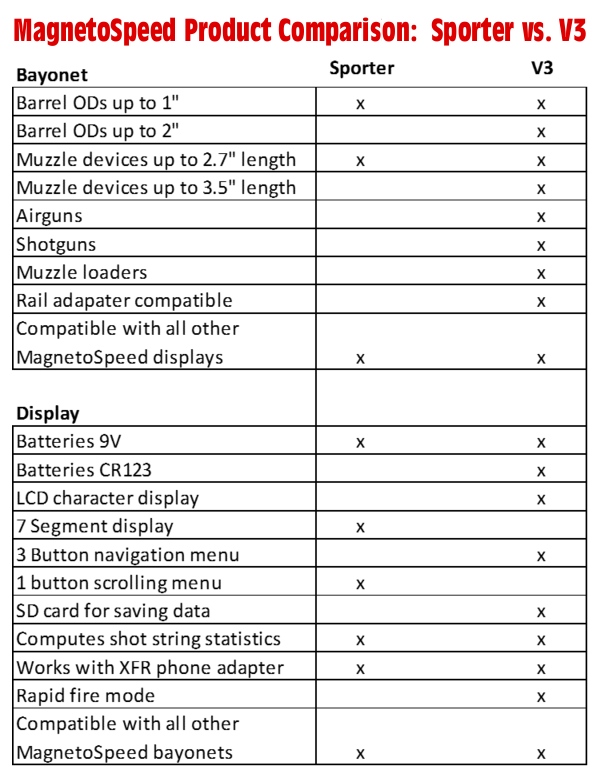
The Magnetospeed Sporter offers most of the features of the more expensive models (see chart below for details) and has a updated sensor. MagnetoSpeed says the Sporter is “Ideal for contoured rifle barrels (sporter barrels) and long-barreled revolvers.” The Sporter Chronograph Kit (shown above) includes: Bayonet Sensor, 3.5 foot Data Cable, Remote Display (with Battery), Strap with thumb nut, Two V-block spacers, and compact storage box.
Q: Will the Sporter Chrono work with thicker barrel (i.e. greater than 1″ diameter)?
A: The manufacturer recommends the $399.00 V3 model for thicker barrels. But, wink-wink, if you have a 1.25″ barrel you can get this to work, based on what we’ve seen. If you have a really fat barrel (up to 2.0″ diameter), get the V3. Magnetospeed also says the V3 is needed for airguns, shotguns, and muzzleloaders.
Click Image for Full-Screen Photo
The Sporter Chrono attaches quickly and easily. It has a 3.5-foot-long cord, and will work with Muzzle Brakes and Flash-hiders up to 2.7″ long.
While this site focuses primarily on accurate rifles, we know that most of our readers also own pistols (and many shoot them competitively). After rimfire pistols, probably the most popular handguns in America are 9mm semi-auto pistols. Here are five products we use with our favorite 9mm semi-autos — H&K P7M8 and SIG Sauer P226. You’ll find a great carry case, high-quality electronic muffs, a pistol “range station”, affordable 9mm ammo, and two cool training targets.
1. Mantis Systems — X2 for Dry-Fire, $99.99
Built for dry-fire use only, the Mantis X2 ($99.99) provides real-time, shot-by-shot feedback for both pistol and rifle users. You can track multiple training sessions with data-driven insights, and monitor your progress. This unit has earned high user reviews such as: “As a new gun owner the Mantis X is a game changer for me. I have not been able to get to the range during the lockdowns and being able to practice at home [is great].” And another: “Easy to install[.] The App is free and easy to use.”
The Mantis X2 is a good value. The manufacturer states: “There is nothing at this price point that will give you this level of feedback for dry fire.” There are actually four Mantis models: X2 ($99.99), X3 ($169.99), X7 Shotgun ($199.99) and X10 Elite ($249.99). The X3 adds live fire functionality. MORE INFO HERE.
2. CaseCruzer Handgun Cases
A California company, CaseCruzer, makes the nicest multi-pistol hard cases we’ve ever seen. With capacities from 3 pistols to 6 pistols, these lockable range cases hold handguns securely in angled “quick-draw” slots. In addition to the molded pistol carriers, there are slots for magazines together with a separate compartment for muffs, ammo, and other accessories. Starting at $240.00 MSRP for the Quick Draw 3-Pack, these boxes are expensive, but they offer great protection with great usability. Water-tight and dust-proof, CaseCruzer cases are airline approved (ATA 300).Now that you’ve spent thousands of dollars on the new benchrest, PRS, ELR, or hunting rifle (and thousands more on optics), how are you going to get it to the range or hunting grounds? It’s important to transport your valuable firearms in very high quality gun cases. Good padded soft cases can work, but for long-distance hauling (and all air transport), we recommend hard cases with quality foam inside.
3. Impact Pro Electronic Muffs 30 dB Noise Reduction Rating
When shooting pistols indoors we recommend quality muffs with earplugs underneath, offering double protection. When inside an enclosed range, with other shooters blasting away right next to you, you really need effective hearing protection. But you also need to hear range commands and be able to communicate with your fellow shooters. That’s why we recommend electronic muffs with good foam plugs underneath. That gives you serious hearing protection during live fire, with the ability to hear voices and converse.
For pistol shooting, we like the latest Howard Leight Impact Pro Muffs. These offer an impressive 30 dB Noise Reduction Rating (NRR), an exceptional NRR. In addition, these muffs are pretty comfortable and offer Headphone Functionality so you can connect to your smartphone, MP3 player, or other device. These quality muffs are currently $62.23 on Amazon.com.
4. MTM AC4C Ammo Crate with 4 Ammo Boxes
The versatile MTM AC4C Ammo Carrier features four lockable polymer ammo cans in a fitted, four-slot 23.5″ x 11.3″ x 7.5″ carry crate. This makes it easy to haul four full ammo cans. Actual purchasers have raved: “Moments after I received this storage box set I ordered another. Very well-built and great design — a steal at the price.” This popular product is available now at Midsouth for $32.66. The system includes four lockable, O-Ring 11.3″ x 7.2″ x 5″ ammo cans (AC30T) for multi-caliber ammo storage. The crate even includes tie-down points for transport in a cart or ATV.
5. High Contrast Pistol Training Targets
Here are two of our favorite pistol targets. The Splatterburst 12″ x 12″ sight-in target works great for handguns in indoor ranges. Bullet holes appear as bright neon yellow halos. And the contrasting grid lines let you quickly estimate your group size. Each target has five diamonds, and the top of each diamond provides a precise aim point for your front sight. The 12″ Bullseye Pistol Diagnostic Target diagnoses common problems based on shot impact zones. While this target is designed for righties, left-handed shooters can use the target too. Just observe the opposite tips.
Forum member Martin Tardif (aka “Killick” in our Forum) competes with a very accurate .284 Win F-Open rig fitted with a Barnard action, Brux barrel, and Eliseo F1 chassis. Unlike some F-Class shooters, Martin has tried many disciplines over the years, including service rifle and Mid-Range and Long Range sling competition. But he told us, “After experiencing arthritis in my hands and wrists, I decided I would dabble with F-Class. And that has turned into a happy obsession.” Today’s story features the object of that happy obsession — Martin’s tack-driving .284 Win he calls the “Red Rocket”.
F-Open Match Rifle — .284 Winchester “Red Rocket”
by Martin Tardif
This is the story of the new “Red Rocket”, my new F-Open rifle. It’s chambered in .284 Winchester (.317″ neck, .220″ freebore). This rifle features Barnard P action, Barnard single-stage trigger (4 oz.), and Brux 30″ one-inch straight-taper, 1:8.5″-twist barrel fitted with Blake Tuner. The barreled action rides in a Gary Eliseo Competition Machine (CMI) F1 F-Open metal chassis with Marine Corps Red powder coat. On top is March 48x52mm fixed-power High Master scope. In a previous incarnation, this same Barnard action served in a wood-stocked F-Class rig, a Red Retromod built from a modified Anschutz stock. I still have the Barnard action (and trigger), but mostly everything else is new.
Here’s the .284 Win “Red Rocket” with CMI F1 Stock, Barnard action, Brux barrel, and Blake Tuner on my SEB Mini at Burbank Rifle and Revolver Club in SoCal.
My previous F-Class rifle started out as a Palma rifle back around 2008. With a modified Anschutz prone stock, that .308 Win Palma sling gun served me well, helping me earn the 2009 California State Palma Championship. Much later I grafted more wood on and whittled that same stock into an F-Open specimen (shown below). That did get me to Long Range High Master but it definitely had limitations. For one it had annoying flex in the fore-end and the buttstock was not aligned with the barrel channel.
I wanted to upgrade my stock to get a more consistent, better-shooting F-Open performer. So in April of 2020 I contacted Gary Eliseo of Competition Machine and ordered one of his streamlined, F1 “boom-stick” chassis units. These feature a very low Center of Gravity. I sent Gary my Barnard action and had Brux send him a barrel that I had won at the 2020 SWN raffle.
This video shows Martin shooting the “Red Rocket” in California
This rifle has been a success from the very start. At its first big match, the 2020 California State Championships, the Red Rocket tied for First Place on points but finished second overall on X-count.
Martin tells us: “The new red Eliseo stock is phenomenal and far surpasses the old red stock on my RetroMod project previously featured on the Daily Bulletin. The three things I like best about this Eliseo F1 chassis system are:
1. The lean, clean, efficient engineering and styling.
2. Easy manipulation of buttstock and cheek piece adjustments, ease of bolt removal.
3. Inherent confidence in its straightness and the durability of all the parts and finish.”
“I’m extremely impressed with the potential of this rig and I have still yet to fiddle with the tuner and test some of my Wolf/KVB primers. It’s all gravy now.” — Martin Tardif
I received the finished rifle in September and was impressed with its stark and consummate functionality and there is no doubt as to that function. The collinear aspect from any angle suggests a Red Rocket Car on the Bonneville Salt Flats, so that’s what I call this rig.
Reloading Methods and Load Development
My virgin brass prep starts with a .284 neck mandrel with the occasional squirt of WD-40, then to the drill press to turn the necks to 0.014″ wall thickness with my PMA Model B turner. After a quick dip in the media tumbler I run the whole batch through my DIY cake pan annealer and they’re ready for sizing. I like the Whidden Gunworks full length bushing dies. I use a .310″ bushing and a loaded round measures .312″. After sizing, I run the cases through the tumbler for 10-15 minutes to clean them up and then they are primed. I’m using my stash of S&B primers with an RCBS benchtop primer seater with a Holland Perfect Primer Seater add-on. I do point my 180-grain Berger Hybrid bullets with a Hoover die (see below).
Here is Martin’s reloading bench. From left to right: A&D FX-120i Force Restoration Scale with Auto-Trickler V3, Hoover Bullet-Tipping Die, Whidden .284 Win FL Sizing Die with PMA click-adjust lock ring, Hodgdon H4350 powder. Martin reports: “I’m also using some of F-Class John’s Auto Trickler Methods — using two powder cups to speed up the process, hash marks on Auto Trickler gear drive, and minimal openings on FX-120i wind guards. These all improve the powder measuring.
Load Development and Accuracy Testing in Competition
I started load testing in November 2020. I tried both H4831sc and H4350 at 100 yards. I usually have excellent results with H4831sc but the Brux tube stubbornly preferred H4350. So I took a preliminary recipe (52.2 grains) to the California Long Range Championship and tied for First Place on points but got beat on Xs. Having seen a little too much vertical at the state match, I went with a lighter load that looked good for vertical at 100 yards (51.8 grains — see photo below). That load got me an overall win at our 1000-yard club match.
I wanted to fine tune that load so I started a seating depth test. I did a final head to head test, comparing .015″ jump (away from first lands contact) and .018″ jump at 1000 yards. The .015″ jump load was the clear winner. This 15-round group was shot at 1000 yards with no flags on an overcast day with no mirage.
The ShotMarker screenshot above shows 15 shots at 1000 yards with bullets seated .015″ out, switching winds and no flags, just watching the mirage. I added .25 MOA up after the first round ‘9’ (me fighting a clean barrel on first shot) and went to town.
Advice for New F-Class Shooters — by Martin Tardif
1. Watch a Top Competitor — Find a good shooter that you respect and watch and take note of their equipment, how they set up to shoot, how they shoot, what conditions they shoot in or don’t. Ideally you should ask to be squadded with them (if possible) so you can score for them. That way you’re not dividing your attention from the shooter you’re supposed to be scoring for. Be mindful not to pester them while they are setting up. Best to wait until they have finished shooting and try to ask questions off the firing line, others still shooting need to concentrate.
2. Cartridge Selection for F-Open– Go to Accurate Shooter’s 7mm Cartridge Guide and scroll to the .284 Winchester section by Charles Ballard. You can read further about the 7mm WSM and 7mm SAUM but for a caliber that’s not fussy you should stick with the .284 Win.
3. Reloading Equipment — To win, you really need ammo as perfect as you can make it. You should be able to find out everything you need to know about reloading equipment via the Accurateshooter Forum’s Reloading and Competition areas. It’s a one-stop shopping brain trust for everything F-Class, Sling, and Benchrest. And the Forum Marketplace is literally a never ending ‘Gun Show’ of For Sale items. It’s a great place to buy quality used stuff for newbies.
As a final bit of advice — BELIEVE the wind — it’s smarter than you are!
Commentary on Metal Chassis vs Wood Stock
I previously had a wood F-Class stock so flexible you could easily pinch the barrel to the fore-end with one hand and hold it there. My Eliseo metal chassis is MUCH more rigid. I don’t think there is any argument that a metal stock is more rigid than wood. I also think a metal stock with its monolithic properties has a more consistent cross-sectional density along its length than a wood stock would have due to the vagaries of grain structure. However I have no experimental data to support that theory, or how that might positively affect shot to shot consistency. I CAN say that the gun shoots better, with smaller groups and higher scores, than the previous wood stock version.
The CMI F1 chassis has three main sections: rear assembly, main assembly, and fore-end. The main assembly is a 27″-long solid billet section with milled cavities for the rear assembly and trigger group. This also supports the action V-Block which cradles the full length of the action. The V-Block is mated to the top of the billet in a milled channel but doesn’t touch the sides to avoid uneven harmonics. The rear assembly hold the LOP-adjustable butt pad/bag rider and “easy off” cheek piece. The 3-piece fore-end is fitted to the main section with screws. The complete F1 chassis with grip and cheek piece weighs 6 pounds.
F1 Chassis Maker Gary Eliseo Talks about His Design
The F1 was designed to incorporate the most important features needed in an F-Open rifle system. Top priority was placed on how the rifle tracked. The chassis had to be perfectly straight, and immune to weather so it will stay straight. On the F1, the fore-end is designed to keep the centerline of the barreled action as low as possible. This super-low center of gravity, along with the tall vertical sides, keep torque to a minimum, so the gun doesn’t twist or hop, but instead comes straight back.
The F1 chassis can be fitted with bedding blocks to accommodate any action. These action bedding blocks are carefully epoxy-bedded to the chassis so the customer’s barreled action is perfectly in line with the central axis of the chassis. In addition to optimizing tracking, I also took a look at how the shooter interfaced with the rifle. I wanted the cheek piece to be narrow so that the shooter would not be forced into applying side pressure on the stock to get their eye behind the scope. The cheek piece is also easy to remove for those who shoot without one. This also facilitates bolt removal.
If you’re interested in an F1 F-Open Chassis, contact Gary via the Competition Machine eMail page. The current price for an F1 Chassis with Cerakote finish (any color) is $1150.00. Lead time is about 12 weeks.
Green Tools for Red Rocket — Martin uses an RCBS Rock Chucker single-stage press on an Inline Fabrication UltraMount. Primers are seated with an RCBS Bench Primer fitted with Holland’s Gunsmithing Perfect Primer Seater Adapter. This provides ultra-consistent primer seating.
F-Class Match Strategies for California Ranges
My strategy for a match clearly depends on the specific location. For instance, at my home range, the Burbank Rifle and Revolver Club, which has several cuts and gullies crossing the canyon, the wind comes primarily from NNE and since the range faces slightly NNE the predominant condition will be a head or right wind so I’m looking for R to L mirage and left angled flags.
By contrast, Coalinga CA is a much more open/exposed range which can make it much more challenging. When you see all the flags going against the mirage for the majority of the string (after you’ve gone for record of course) that can be tough. So I like to watch the wind while I’m scoring and for a few minutes during sighters and shoot them in a few ‘looks’ if I can get them. But sometimes you have to go with your gut if your sighters whisper “go-for-record-you-knucklehead” and so it’s off to the races. It often seems like I should have just chased the spotter when I’m waiting out a fishtail or let-up there.
To get the best accuracy out of any benchrest rifle, you need to find the optimal position of front rest and rear bag. The important point to remember is that each rig is different. One gun may perform best with the front rest right at the tip of the forearm (Position ‘D’ in photo), while another gun will work best with the rest positioned much further back. This Editor’s own 6mmBR rifle has a laminated stock that is pretty flexy in the front. It shoots best with the front rest’s sandbag located a good 6″ back from the forearm tip (position ‘A’).
Here’s some benchrest advice that can help you reduce vertical and shoot tighter groups… without spending another penny. Many benchrest shooters spend a fortune on equipment and devote countless hours to meticulous handloading, but they never experiment with their rifle’s position/balance on the bags. This article explains why you should test your rifle in various positions. What you learn may surprise you (and improve your scores).
Next time you go to the range, experiment with the position of your rifle on the front rest, and try a couple different positions for the rear bag. You may find that the rifle handles much better after you’ve made a small change in the placement of your gun on the bags. Recoil can be tamed a bit, and tracking can improve significantly, if you optimize the front rest and rear bag positioning.
This competitor has the front rest positioned fairly far forward but not all the way out. Note the stop on the front rest — this limits forward stock travel.
A small change in the position of the forearm on the front rest, or in the placement of the rear bag, can make a big difference in how your gun performs.
Balance Your Gun BEFORE You Spend Hours Tuning Loads
In the pursuit of ultimate accuracy, shooters may spend countless hours on brass prep, bullet selection, and load tuning. Yet the same shooters may pay little attention to how their gun is set-up on the bags. When you have acquired a new rifle, you should do some basic experimentation to find the optimal position for the forearm on the front rest, and the best position for the rear bag. Small changes can make a big difference.
Joel Kendrick, past IBS 600-yard Shooter of the Year, has observed that by adjusting forearm position on the front rest, he can tune out vertical. He has one carbon-fiber-reinforced stock that is extremely rigid. When it was placed with the front rest right under the very tip of the forearm, the gun tended to hop, creating vertical. By sliding the whole gun forward (with more forearm overhang ahead of the front sandbag), he was able to get the whole rig to settle down. That resulted in less vertical dispersion, and the gun tracked much better.
Fore/aft stock position is important even with very wide fore-ends.
Likewise, the placement of the rear bag is very important. Many shooters, by default, will simply place the rear bag the same distance from the front rest with all their guns. In fact, different stocks and different calibers will NOT behave the same. By moving the rear bag forward and aft, you can adjust the rifle’s overall balance and this can improve the tracking significantly. One of our shooters had a Savage 6BR F-Class rifle. By default he had his rear bag set almost all the way at the end of the buttstock. When he slid the rear bag a couple inches forward the gun tracked much better. He immediately noticed that the gun returned to point of aim better (crosshairs would stay on target from shot to shot), AND the gun torqued (twisted) less. The difference was quite noticeable.
A small change in the position of the forearm on the front rest, or in the placement of the rear bag, can make a big difference in how your gun performs. You should experiment with the forearm placement, trying different positions on the front rest. Likewise, you can move the rear bag back and forth a few inches. Once you establish the optimal positions of front rest and rear bag, you should find that your gun tracks better and returns to battery more reliably. You may then discover that the gun shoots smaller groups, with less vertical dispersion. And all these benefits are possible without purchasing any expensive new gear.
I absolutely love using this press stand. I use it with my Forster Co-Ax as well as my Dillon 550. The stand mounts those presses at the right height to minimize fatigue and maximize torque. Some products I merely review and return but this one is a keeper and won’t be leaving my bench anytime soon. — F-Class John
Lyman Universal Press Stand REVIEW
Product Review by F-Class John
Positioning your press at the optimal height is one of the oldest problems in reloading. Most presses sit low off the edge leading to uncomfortable arm strain or inconsistent pressure being applied while using. Lyman has set out to fix that problem with a reasonably-priced ($54.99 at Midsouth) press riser that works with the vast majority of reloading presses. This unit will raise just about any press up off your bench securely, allowing you to working more comfortably from a standing position. This also frees up vital bench space UNDER the press. Unfortunately this press stand is so popular it is back-ordered at most vendors.
I have used a variety of presses over the years. At times I’ve run into issues mounting a press at a level that doesn’t promote arm or hand strain during normal operations. In the past I’ve used blocks of wood or even tried other brands’ proprietary stands. But I had very limited success with those options. Accordingly, I was very excited to give the Lyman Universal Press Stand a chance.
Lyman’s Universal Press Stand comes complete with side plates, two different top plates, and a large collection of mounting hardware. The two top plates are pre-drilled for numerous popular Single Stage or Progressive presses. Helpful diagrams and instructions show which side of the top plate you need to use. The pre-drilled holes accommodate a variety of presses from RCBS, Dillon, Lyman, Redding, and Hornady. But surprisingly, the plates are not pre-configured for the Forster Co-Ax Press.
CLICK to WATCH VIDEO Showing Lyman Universal Press Stand
Setting up the stand was very simple. The two sides bolt to the lower shelf unit at which point you attach the top plate. All the supplied bolts made this a breeze and once everything was snugged down, I was able to place it on my bench where I wanted it and mark the drill holes to mount it. After securing the stand to my bench it was time to mount my press.
Lyman Universal Press Stand with Dillon 550 Press
Adapting Lyman Universal Press Stand for Forster Co-Ax
At the time of testing I was primarily using a Forster Co-Ax press. With no pre-drilled Co-Ax configuration for either Lyman top plate, I decided to customize the blank side of one of the top plates. I opted to position the mounting holes so that the press could sit 100% on top of the mounting plate and not just off one edge. I found this process simple to execute. Mark your drill holes, then drill the plate. This can easily be done with regular drill bits although using a step-bit worked faster and cleaner to help enlarge the holes just a little when I needed some extra clearance.
Lyman Universal Press Stand Is Stable and Strong
Once set-up, I found the stand to be incredibly stable. The design allows for full force to be applied to the press no matter what the operation. Having used this Lyman Press stand regularly over the past few months with both my Co-Ax and a Dillon 550c, I still find myself loving it. The height is perfect and allows me to load as much as I like without straining my arm or getting fatigued. With an attractive price point (under $55.00 street price) and a simple design, I feel this is a great system for those looking for a secure and raised platform for their reloading presses.
The Universal Press Stand comes with two plates. If you have different presses that fit each plate you could easily swap presses just by changing plates while leaving the presses attached. It’s less functional if you have two presses that share one plate and would require removing one press before installing the next one.
Lyman Press Stand Unboxing and Set-Up (KFW Video Review):
As any handloader knows, popular reloading powders have become difficult to find. And when you do locate the powder you want, the price might be twice what you paid a year ago (or even more on auction sites). Across the nation, shooters are asking “What gives? Why are powder prices so high? And when are the shortages going to end?”
Hodgdon Powder Company (“Hodgdon”), supplier of Hodgdon, IMR, and Winchester powders*, has attempted to answer these questions with a “Powder Update” posted yesterday. Along with addressing the shortage issues, Hodgdon explains the challenges involved in increasing production in the USA and/or increasing imports from overseas. The ultra-popular H4198, H4895, Varget, H4350, and H4831 family of powders are produced by ADI in Australia**. So Hodgdon can’t ship more Varget or H4350 in the USA unless Hodgdon can get more from Australia.
In the Powder Update reprinted below, Hodgdon answers many key questions, and debunks some misconceptions. For example, Hodgdon is NOT selling its powders on auction sites such as Gunbroker. That is completely false.
POWDER UPDATE from Hodgdon Powder Company
WHY CAN’T HODGDON SHIP MORE POWDER?
The current powder situation is due to a record demand for all reloading components and NOT a reduction in the supply of powder. With long-time handloaders looking to stock up and new gun owners looking for ammunition, there is an unprecedented demand for powder and other reloading components. We shipped a record amount of powder in 2020 and will ship even more in 2021. We are doing everything in our power to get the most powder into consumer hands this year. We are running overtime in our facilities, have hired additional staff and have leveraged relationships with shipping partners to add new shipping options.
WHY CAN’T HODGDON BUILD ANOTHER POWDER PLANT?
The “normal” powder demand for the United States would not support an additional plant. Hodgdon, like most companies, cannot afford to build a new production facility then have it sit idle until demand spikes.
WHY IS HODGDON SELLING POWDER TO THE GOVERNMENT?
Hodgdon does NOT sell powder directly to the government. We sell some powder to manufacturers making ammunition for our military, but that is a small part of our business.
WHY IS HODGDON SELLING POWDER TO AMMUNITION MANUFACTURERS?
The heart of our business is smokeless powder for the handloading enthusiast. Yes, we sell some powder to ammo manufacturers, but that is a small part of our business. Every day, we receive calls from potential OEM customers looking for powder to load in ammunition. We politely decline so we can focus on our long-term, handloading customers.
WHY IS HODGDON SELLING POWDER ON AUCTION SITES?
We don’t. Period. We recently began selling a limited amount of powder on our OWN websites but prioritize our shipments to our traditional sales channels to maximize powder availability at sporting goods and gun shops. [Editor: If you see Hodgdon powder on auction sites, that is listed by third party vendors.]
WHY IS THE PRICE OF POWDER SO HIGH ON THE INTERNET?
We do not set sale prices or MSRPs for the price of our powders at retail, nor do we encourage any of our retailers or dealers to sell on auction sites, but we cannot control what happens AFTER we sell to our traditional sales channels.
* Hodgdon also sells certain Ramshot, Accurate, and Blackhorn powders along with Goex black powder.
** Here’s a list of ADI to Hodgdon Powder equivalents from the ADI FAQ Page:
ADI / Hodgdon Propellants Equivalents
ADI Powder
Hodgdon/IMR Name
Trail Boss
AR2207
AR2219
BM2
Bench Mark 8208
AR2206H
AR2208
AR2209
AR2213H/AR2213SC
AR2217
AR2225
AR2218
The Great Northern Gun Grab is About to Begin
Article By Larry Keane, NSSF Gen. Counsel and Sr. VP (Gov’t Affairs)
New Gun Control Measures
Prime Minister Trudeau fulfilled his ill-advised promise by announcing the introduction of a bill in Canada’s Parliament, labeled C-21, that would usher in crushing gun restrictions. Included in the bill is everything from a provision to allow anyone to petition a police chief to revoke a firearm license and the courts to seize firearms for up to 30 days. The bill includes a magazine ban for handguns with a capacity greater than 10 rounds and centerfire rifle magazines with a capacity greater than five rounds. It would impose a strict regimen for those who choose not to participate in the confiscation program with onerous and nearly impossible requirements to keep their firearms. A two-year amnesty period for owners of these now-banned firearms will expire in April 2022.
Gun Confiscation
The biggest concern of this gun control push is the outright confiscation of firearms by the government. Prime Minister Trudeau and his allies are labeling it as a government “buyback.” However, this is using Canadian taxpayer funds for the government to buy back something it never owned in the first place.
More shocking is that no government official will put a price tag on what this would cost. Public Safety Minister Bill Blair said the government will have a better picture of the cost when it knows how many owners want to “sell” their firearms and for how much, according to a Canadian Broadcasting Channel (CBC) report. Minister Blair guessed it would run between $300-400 million if 150-200,000 gun owners demand $1,300 per firearm. Minister Blair earlier pegged the cost at $600 million.
Critics argue the cost would be much higher. Those critics were right about Canada’s previous gun registration scheme being a colossal failure with an enormous price tag. That was pitched at costing only $2 million but ran over $2.7 billion before being scrapped. The same critics are pointing to New Zealand’s confiscation model and [estimate] the Canadian cost at $1.6-$5 billion in just the first year. That’s just administrative costs, not including the bounty Prime Minister Trudeau would pay for each firearm.
Noncompliance — Are There Alternatives?
Canadians who don’t participate in surrendering their firearms to the government will be forced to endure a rigorous set of rules and inspections to keep their firearms – while they can and while they’re alive. Those who don’t hand over their firearms could keep them under strict conditions to not use, import, further acquire, sell or bequeath them. Those individuals would also be required to complete the Canadian Restricted Firearm Safety Course and upgrade their licenses to a “Restricted Possession and Acquisition Licence.” Of course, this would incur all associated course and license fees, along with registering any firearms with the Firearms Registrar, complying with enhanced storage requirements and periodically providing information on firearm storage to ensure compliance.
But Wait, There’s More
The proposed confiscation law would be so much more than just a gun grab. It would also give municipalities the option of enacting their own local ban on handguns. Some local laws might not go that far. Local laws might only regulate home storage of handguns, requiring them to be stored at shooting clubs and ranges. This would create a patchwork of differing gun control laws and pitfalls for Canadian gun owners. Enforcement would become a nightmare.
Matt DeMille of Ontario Federation of Anglers and Hunters, told the CBC, “Adopting measures across the province in a patchwork is going to be very difficult for people to understand.” Conservative public safety critic Shannon Stubbs added, “This part of the bill doesn’t address the major problem, which is the illicit use of illegal guns in crime.”
Another provision in the bill would make it illegal to advertise a firearm that depicts violence against a person. Read strictly, that would make it a crime to advertise a gun as a self-defense tool. Instead of taking on the criminals who misuse firearms, Prime Minister Trudeau would lock up advertisers who tell his citizens they don’t have to be willing victims and can use firearms to defend themselves.
“Gun ownership in Canada is a privilege… not a right.” — Public Safety Min. Bill Blair
This sounds like a dystopian fairy tale, but the reality is this is happening on the doorstep of the United States. Minister Blair made it clear why Prime Minister Trudeau is able to get away with it: “Gun ownership in Canada, in this country, is a privilege and not a right,” Minister Blair explained to Canada’s Global News. It’s a privilege that’s predicated on the strict adherence to our laws, our regulations, and our restrictions.”
Opposition to Confiscation Program
That’s not stopping opponents from saying Prime Minister Trudeau is overstepping. The Canadian Association of Chiefs of Police said it won’t support a plan for handgun bans. Vancouver police chief Adam Palmer heads the organization and previously said there are laws against the illegal use of handguns. Further gun control laws won’t solve this problem.
Manitoba Premier Brian Palliste said the handgun ban is “not going to work.” Saskatchewan Premier Scott Moe is critical of Prime Minister Trudeau’s gun grabs. Alberta Premier Jason Kenney denounced the moves for targeting law-abiding gun owners and not criminals. Ontario’s Premier Doug Ford said the national government should focus on enforcing laws and putting criminals behind bars, not seizing guns from law-abiding citizens.
In light of President Joe Biden’s gun control wish list, it’s worth nothing the importance of the 27 words of the Second Amendment. It’s also worth watching the cost of dollars and rights an out-of-control gun control agenda can do to a nation’s citizens.
If you are a F-Class competitor or use machine tools, chances are you know Shiraz Balolia. Shiraz is one of America’s top F-Class shooters, an all-star competitor who has won major titles, including three straight Canadian F-Open National Championships. Shiraz also owns Grizzly Industrial Inc., a large, successful enterprise he founded in 1983. For 38 years, Grizzly has provided quality tools to wood-workers and metal workers. Grizzly’s catalog is now over 700 pages.
Shiraz’s life story is an interesting one. He came to the USA from Kenya, and then became a very successful businessman, building Grizzly Industrial into a major player in the tools/parts/machinery business. Shiraz also founded Bullets.com, which sold firearms accessories and reloading components for some years. Shiraz’s effort to start Bullets.com was an outgrowth of his desire to “give back” to the shooting sports, the hobby he loves.
To cover his noteworthy business career and life, Shiraz has written an impressive 288-page autobiography, entitled A Bad Case of Capitalism (referring to his love for the world of selling products). This book covers Shiraz’s early years though the present, providing a “tale of travel through war-torn countries, courtroom battles, success, failure, and everything in between.” It explains the challenges of starting direct-to-consumer businesses, first via mail-order and then adapting to the new online world.
We enjoyed the book because it provides a clear inside look at the challenges of starting a business. And we are grateful that Shiraz, through his businesses, has been a strong supporter of AccurateShooter.com for more than a decade. Balolia’s autobiography has been described as “equal parts business primer, history, and collection of life lessons”. The book shows how vision and determination can create a true American success story.
Readers have enjoyed the book and the lessons it offers on how to build a business:
“As someone who loves to create things with his hands, I was immediately drawn to this book, as Mr. Balolia is basically the father of machinery for woodworkers like me. It’s a great read that opens your eyes to a place and time I’d never heard of before, and it paints a great picture of determination and grit…. This book is certainly a motivating tale, and it shows that with a supportive family and vision (and a ton of hard work) you can do anything you dream.” — Jameson H.
“This is as much a story of Mr. Balolia as it is of Grizzly Industrial. In this book, and probably real life, the two are inseparable. From humble beginnings to a substantial empire of industrial equipment you have to admire and applaud the success story and this chronicle of hard work and perseverance. Impressive, very impressive.” — Own One
Grizzly Lathes for Gunsmiths
In this video, Shiraz talks about Gunsmithing Lathes sold by Grizzly.com:
Shiraz Uses the Machines That He Sells
Shiraz is not just a talented business leader and ace marksman. He is also a very skilled fabricator and woodworker. He has crafted guitars, and worked on his own gunstocks. This shows an F-Class Stock Shiraz upgraded using Grizzly Industrial machinery. The modified stock has a significantly lower Center of Gravity, riding 1/2″ lower in the front bag. Shiraz says the modified stock performed great.
Shiraz Balolia (left) and Norma Managing Director Paul-Erik Toivo.







 When shooting pistols indoors we recommend quality muffs with earplugs underneath, offering double protection. When inside an enclosed range, with other shooters blasting away right next to you, you really need effective hearing protection. But you also need to hear range commands and be able to communicate with your fellow shooters. That’s why we recommend electronic muffs with good foam plugs underneath. That gives you serious hearing protection during live fire, with the ability to hear voices and converse.




 Gun Confiscation


