Every year the NRA Publications group announces Golden Bullseye winners for various product categories (rifle, handgun, shotgun, optics, gear etc.). These awards are like the Oscars for the shooting industry. There are many Golden Bullseyes given out each year because there are separate awards given by different NRA Magazines — including American Rifleman, Shooting Illustrated, and American Hunter. Here are the 2021 Rifles of the Year (Golden Bullseye Winners) as chosen by each of those three publications.
American Rifleman 2021 Golden Bullseye Award Winner
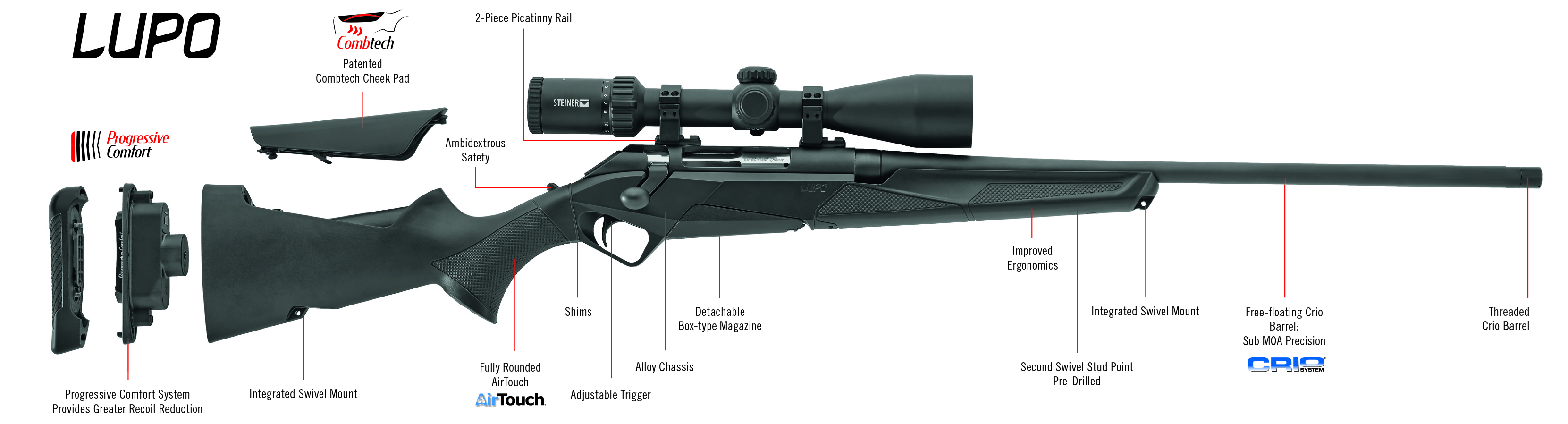
Rifle of the Year — Benelli LUPO
The LUPO is Benelli’s first bolt-action rifle (“Lupo” is Italian for “wolf”). This new chassis-style hunting rifle allows for user fitting/customization out of the box. The LUPO design boasts no less than seven exclusive Benelli patents. It offers a built-in recoil reduction system, adjustable trigger plus grip-to-trigger “reach” customizable via receiver/stock spacers. The Airtouch Grip surfaces allow for a firm, comfortable hold on the rifle. The action comes with rails and an ambi-safety. Fort its innovative LUPO Benellit offers a 3-shot sub-MOA guarantee.
American Hunter 2021 Golden Bullseye Award Winner
Rifle of the Year — Springfield Armory Model 2020 Waypoint
We’re in the thick of hunting season now, so we’re featuring an impressive new hunting rig from Springfield Armory. The new Model 2020 Waypoint rifles feature advanced carbon-wrapped barrels*, TriggerTech triggers, and carbon-fiber, hand-painted camo stocks. The actions are pretty impressive too — with precision machining, enlarged ejection port, and integral recoil lug. These Waypoint rifles rival full-custom hunting rigs, yet are reasonably affordable. Starting price is $1699.00 with stainless barrel, while the deluxe model with carbon-wrapped barrel and adjustable cheekpiece is still under $2,400.00.
Handsome Hand-Painted Carbon-Fiber Stocks
Minimum gun weight with carbon-wrapped barrel and fixed cheek is just 6.6 pounds.
Shooting Illustrated 2021 Golden Bullseye Award Winner
Rifle of the Year — Savage Axis II Precision
The Savage AXIS II has has been given a Precision Series upgrade with a MDT Chassis designed for Savage AXIS II platform. The MDT black aluminum chassis features an olive drab injection-molded skin. It has adjustable comb height while length of pull adjusts via spacers. An MLOK™ fore-end allows easy fitting of accessories. This rifle features a black-finished action fitted to 22″ carbon steel, button-rifled heavy barrel with threaded muzzle. The Savage AccuTrigger adjusts from 2.5 to 6 pounds pull-weight.
About the Golden Bullseye Awards
Now in their 19th year, the NRA Publications Golden Bullseye Awards acknowledge the finest products available in the shooting sports. The winners are selected by a seven-member committee consisting of editors, graphic designers and veteran NRA Publications staff, representing more than a century of collective experience in the shooting and hunting industry.
To qualify for consideration for a Golden Bullseye Award, a product must have been:
— Recently introduced and available to consumers.
— Used/tested by a staff member or magazine contributor.
— Reliable in the field, meeting or exceeding the evaluator’s expectations
— Innovative in design and function.
— Readily perceived as a value to the purchaser.
— Styled in a manner befitting the shooting and hunting industry.
“In the uncertain year of 2020, companies with in the firearm industry continued to innovate”, said American Rifleman Editor-in-Chief (EIC) Mark Keefe. American Hunter EIC J. Scott Olmsted added: “Companies in the firearm and outdoor trade industry continued to provide innovation, quality and value to us all. American Hunter is proud to honor these companies’ dedication to our pastime with 2021 Golden Bullseyes.”
With ammunition in short supply these days, we know ammo production is on people’s minds. Top industry leaders have said the USA will face ammo shortages well into 2021. So ammo-makers big and small are ramping up production to meet demand. If you’re curious how ammunition is created on the assembly by a relatively small, speciality manufacturer, watch the video below to see the entire process, start to finish.
This video from Fog Ammunition reveals how .223 Rem ammo is made. Starting with boxes of bullets and bags of cartridge brass, this video shows how components are bulk-sorted, then .223 Rem ammunition is produced on a modern, linear multi-stage loading machine. In assembly-line fashion, cases are primed, powder is added, bullets are placed, final seating depth is set, and then the case is crimped.
If you’ve never seen an automated loader in action you should definitely watch this video. With this kind of machine, a new round is produced every second or so (see video 1:15 to 1:55). The .223 Remington ammunition featured in this video is loaded with Sierra BlitzKing bullets. Fog offers both rifle and pistol ammo loaded with quality components.
Video Shows Automated Loading Process Start to Finish (Worth Watching):
Remember when primers were plentiful and priced affordably?
The NRA Convention will be in the Lone Star State next year — in September. Originally slated for May 2021, the National Rifle Association’s 2021 Annual Meetings & Exhibits are now scheduled for September 3-5, 2021 at the George R. Brown Convention Center in Houston, Texas. The 2021 NRA Annual Meetings will celebrate NRA’s 150th anniversary as the oldest civil-rights organization in the country. The Exhibits Hall will be full of product and outfitter displays. More than 850 exhibitors will provide show-goers with a look at the latest firearms, ammunition, and accessories.
Due to the uncertainties surrounding COVID-19 restrictions in 2021 and the impending rollout of a vaccine, NRA made the decision to reschedule its 150th anniversary celebration to give members and exhibitors a chance to make necessary plans. To date, more than 850 exhibitors will provide show-goers with a look at the latest firearms, ammunition and accessories available.
The NRA Annual Meetings & Exhibits is free for all NRA members, while some special events do require tickets. The organization plans to have a powerhouse lineup of political speakers, as well as an event exclusively for women exploring their right to keep and bear arms. Country music artists, seminars, workshops and more are available for the celebration of a lifetime.
Get the latest information on the 150th NRA Annual Meetings & Exhibits at NRAAM.org.
Our friend Ernie Bishop (SEB Rests USA) has been busy in the Wyoming backcountry. Bishop is a big fan of specialty pistols, and one of his favorite XP-100 bolt-action pistols showed its capabilities recently, harvesting a whitetail doe that will provide meat for the Bishop family and friends.
Ernie reports: “Dan Ekstrom and I did some whitetail hunting earlier this week, and tonight our families enjoyed some smoked backstrap and grilled sausage, a bunch of other fixings. We were in the foothills of the Big Horn mountains, outside of Story, Wyoming. Yes, we have whitetail here.”
Ernie’s Remington XP-100 bolt-action pistol features a 14.5″ HS Precision barrel chambered in .308 Winchester, fitted with a Mac’s Gunworks muzzle brake. The scope is a Burris 3-15x50mm XTR2. The field support consists of a BOG Tripod, with the original BOG PSR top and Holland’s small field bag. Ernie reports that, unfortunately, the PSR Top has been discontinued.
The Story of the Successful Whitetail Hunt — Report from the Field Report by Ernie Bishop
My center-grip .308 Winchester XP-100 drew first blood Friday afternoon (12/11/2020). It was a hurried, double-kneeling short shot at around 50-60 yards, using my BOG tripod with PSR top. I was doing the sneaky sneak on my way to place where I was going to sit for the rest of the day (no artificial blind). The doe was either just coming out of cover or was just inside cover. We seemed to discover each other at about the same time. I was in the open though.
Even though I had the XP-100 in one hand and my BOG tripod in the other, I could not get set up quickly enough to make a shot. She turned around and walked back into cover, and then threw up her flag and waved it a few times going away for me and to the left. Now, I need to get about another hundred yards so I can try to get set up on a two-track that’s going to my right and wait there, hoping that she will cross and give me a shot opportunity. As I was walking faster to get to that spot to set up, I look to my right and there she was (or a different one, I’m not quite sure) just inside cover — basically broadside.
Given the spookiness of these deer here this year, I didn’t think I was going to get a shot opportunity. But you don’t know unless you try, so I kneeled, spread the tripod legs and centered up as quick as I could and took the shot. I didn’t range distance before or check afterwards. The whitetail doe dropped on the spot. The 168 grain Hornady A-MAX TAP Precision .308 Win ammo performed admirably.
Ernie’s Tips for Wyoming Whitetail Hunters
There are two different ways that I hunt this area of Wymoming. First is doing the slow sneaky sneak, which has given some good results, but it also ends up with the “just wasn’t able get it done” before they move into cover (which happened more than one time on Thursday and Friday morning). The second way, is to put yourself in a place to where you have a reasonable view, of where you can tell they have crossed, in semi-open areas. I usually am sitting with my back against a tree.
About Ernie Bishop — Specialty Pistol Guru
Ernie tells us: “For those who know of me in the shooting world, you would probably know me in one of two ways — Dealer for SEB Rests or someone who does most of his competing, varminting, and or hunting with specialty pistols. These are typically bolt-action, single-shot rigs that can be used with a bipod. They are similar to a pistol-grip rifle, but without a conventional buttstock. My interest in all things specialty pistols (Remington XP-100, TC Contender, MOA Maximum, Pachmayr Dominator, H-S Precision HSP, etc.) goes back to the early 1980s. Sadly, some of these are no longer made.
There are many reasons you might want to make a chamber cast. You may have acquired an older rifle and need to verify the chamber dimensions. Or, if you have a new reamer, you may want to check the exact “cut” dimensions against the blueprint specs. A chamber casting is also valuable if you run across a firearm that you believe has a custom barrel on it and you want to find out the dimensions of the chamber. Lastly, you may want to prepare a chamber casting to be used in the making of custom dies. (Most reloading die makers know how to work from Cerrosafe chamber casts.)
Cerrosafe is a metal alloy that has some unique properties which make it ideal for chamber casting. First, it has a relatively low melting point of 158 to 190° Fahrenheit. This makes it easy for the handloader to melt the Cerrosafe in his home shop. Second, it shrinks slightly during cooling which allows it to be extracted from the chamber easily. It then re-expands to the chamber’s original size after about one hour at room temperature. After cooling for about 200 hours, the chamber cast will expand to about .0025″ larger than the actual chamber size.
One of our Forum members has done many Cerrosafe castings and he offers this smart advice:
1. Remove the barrel from the action to make the pour much easier. If you don’t remove the barrel, it can be hard to pour through the action (even with a funnel) and can make a mess if you’re not careful.
2. Pre-heat the barrel for 5-10 minutes in the oven on the very lowest setting (170° F in my oven). (DON’T overdo it!). Allow to cool for a couple minutes so you can pick it up and it is under 120° F. Pre-heating the barrel helps the Cerrosafe stay liquid as you pour the casting. This helps ensure a good, complete fit to the chamber.
How to Use Cerrosafe for Chamber Casting
The basic ingredient of Cerrosafe is bismuth. Bismuth is a heavy, coarse, crystalline metal which expands when it solidifies, up to 3.3% of its volume. When bismuth is alloyed with other metals, such as lead, tin, cadmium and indium, this expansion is modified according to the relative percentages of bismuth and other components present. As a general rule, bismuth alloys of approximately 50% bismuth exhibit little change of volume during solidification. Alloys containing more than this tend to expand during solidification and those containing less tend to shrink during solidification.
What all this means for the gunsmith is that you can make chamber castings using only Cerrosafe and a few, simple hand tools. To make a chamber casting, first clean and degrease the chamber. Use a tight-fitting, cotton patch that’s wrapped around a bore mop or brush to plug the bore just ahead of the throat. I usually leave the cleaning rod attached to the plug until it’s time to remove the plug. Melt the entire bar of Cerrosafe in a heatproof container that you can easily pour the hot Cerrosafe out of. You can use a propane torch or heat over a hot plate or the burner of a stove. Cerrosafe melts easily at 158°-195° F. While the casting metal is still liquid, stir very well, skim off the dross, and pour your chamber. The real trick with Cerrosafe is not to overheat it. If you heat the solid slowly, and keep it within the required temperature range, you shouldn’t get any dross.
Note the time the casting was poured. The casting will take only a very short time to solidify, usually within a minute. Wait 30 minutes and then remove the plug from the bore. Turn the muzzle upward and the casting will fall from the chamber. At 30 minutes after initial solidification, Cerrosafe shrinks slightly, so removal is very easy. Allow the new casting to cool thoroughly then measure the casting exactly one hour from the time it was cast. The casting will give you an exact measurement of the chamber. Cerrosafe casting metal can be used over and over. Remelt the entire amount back together and pour the Cerrosafe into a small mold of the appropriate size. Always melt the entire Cerrosafe ingot to make a chamber casting. For best results, never cut off, or use, just a part of the ingot.
Gander Outdoors in Kenosha, WI — reader-submitted photo on GMToday.com
The ammo and primer shortage is real, and it’s here to stay — well into 2021. That’s what industry experts tell us: “With [ammunition] demand far outstripping supply and inventory levels in the channel at all-time lows, we see strong demand continuing[.]” — Christopher Metz, CEO of Vista Outdoor
Certain types of ammunition, 9mm Luger for example, are very difficult to find these days. And what IS available is often marked up 300-400% over 2019 prices. Demand has far exceeded supply. And the ammo shortage won’t end any time soon. Vista Outdoor’s CEO Metz added: “Despite us producing flat-out for six months, there is no buildup of inventory at any of our customers. In fact, every one of them would like significantly more. Simply put, consumer demand continues to outpace our ability to supply.”
Ammunition Shortage Impacts Primer Supply
Rifle and pistol primers are nearly sold out everywhere, with some less-than-reputable vendors now charging 4-5 times the normal price. So what’s going on here — why can’t you find primers? One reason is that primer producers such as Federal and CCI are using the vast majority of the primers they make to complete their loaded ammunition, which is flying off the shelves.
What is causing the ammo panic buying and primer shortage?
There are a number of key reasons:
1. Concerns over the recent election and potential Democratic Party control of U.S. House of Representatives, U.S. Senate, and the White House;
2. General worry and paranoia caused by the COVID-19 pandemic;
3. Fear of new legislation banning guns and restricting ammunition purchases;
4. Social unrest and rioting led by BLM and left-wing activists and tolerated/encouraged by Blue State government officials; and perhaps most importantly,
5. The vast increase in the number of new gun buyers.
Huge Increase in Gun Purchasing in 2020
2020 will probably set an all-time record for gun purchasing in the USA. This spike in gun buying has been propelled by the greatest annual increase in gun ownership in U.S. history. According to data from the NSSF, roughly 6.2 million Americans purchased their first firearm in 2020. A NSSF dealer survey estimates that 40% of all gun sales were conducted to purchasers who have never previously owned a firearm. And women accounted for 40.2% of first-time gun purchases. We’ve never seen that kind of spike in gun ownership in a single year. This is unprecedented.
Ammo Shortage Will Continue for Many Months, Well into 2021
What are the prospects for greater availabilty of loaded ammo in the months ahead? Not so good according to Vista Outdoor CEO Christopher Metz whose company operates Federal, CCI, RCBS, Alliant, Blazer and many other shooting industry brands. Metz declared: “We currently have over a year’s worth of orders for ammunition.” That value of those back-orders exceeds ONE BILLION dollars. “This is unprecedented for our company. With demand far outstripping supply and inventory levels in the channel at all-time lows, we see strong demand continuing[.]”
There is some good news however — the former Remington ammo factory will start cranking out ammunition again. The American Rifleman reports: “Vista Outdoor has purchased the [Remington Outdoor] ammunition factory in Lonoke, Arkansas [and will resume] production at or near full capacity. The Northwest Arkansas Democrat Gazette reports 300 employees furloughed by the former owner of the plant will soon be recalled to join nearly 400 still working at the facility.”
Image Courtesy NSSF. This story is based on an NSSF Article.
‘Tis the season of gift-giving (and Christmas Day is nearly here). Perhaps you’re considering giving a a first rifle to your grandson or perhaps a carry pistol to a spouse. When making a gun gift to a friend or family member, however, there are some very important legal considerations. Also the rules on firearms gift transfers vary from state to state. Bottom line here — you need to know the law BEFORE you deliver that shiny new firearm to a family member, close friend, or relative.
The first thing to remember if you’re thinking about giving someone a gun is that … it’s a gun! You already know that ownership of a firearm brings with it some serious legal and ethical obligations that other consumer products don’t. So let’s look at some questions you may have about giving a firearm as a gift.
Image Courtesy NSSF
The first question you have to ask is whether the intended recipient can legally own the firearm where he or she lives. With more than 20,000 different gun laws on the books, even the kinds of firearms that law-abiding citizens can own vary from place to place. For example, juveniles (under age 18) generally speaking are precluded by law from possessing a handgun. Check out the Bureau of Alcohol, Tobacco, Firearms and Explosives (ATF) website for an overview of local laws and, whatever you do, don’t forget that you can never under any circumstances transfer a firearm to someone you know — or have reasonable cause to believe — legally can’t own one. That’s a federal felony, so be careful.
There’s no federal law that prohibits a gift of a firearm to a relative or friend who lives in your home state. Abramski v. United States, a recent Supreme Court decision involving a “straw purchase” of a firearm did not change the law regarding firearms as gifts. The following states (California, Colorado, Connecticut, Delaware, New York, Oregon, Rhode Island, Washington State) and the District of Columbia require you to transfer a firearm through a local firearms retailer so an instant background check will be performed to make sure the recipient is not legally prohibited from owning the gun. Maryland and Pennsylvania require a background check for private party transfer of a handgun. There are exceptions, so it’s important to check the law of your state or ask your local firearms retailer.
Consider a Gift Card Instead of Direct Gift
The ATF recommends that if you want to give someone a new firearm, rather than going to a gun store and buying the gun on your own, consider instead purchasing a gift certificate/card from your favorite gun retailer. Then give that gift card as the present. That way the recipient can choose the exact gun he or she wants, and there’s no question about who is “the actual buyer of the firearm,” which is a question any purchaser must certify on the Federal Form 4473 at the time of purchase. The Gift Card option avoids any “straw purchaser” issues.
Nosler has just released the Nosler Reloading Guide #9, the latest in a respected series of hardback Nosler load manuals. This 800-page guide covers 101 cartridge types. New in this edition you’ll find the popular 6mm Creedmoor, 6mm XC, 6.5 PRC, and 7.62×39, along with 20 Nosler, 22 Nosler, 24 Nosler, 27 Nosler and 33 Nosler. This new guide draws from thousands of hours in the Nosler Ballistic Lab, along with the experience of many respected experts.
The book is available right now for $24.99 at Grafs.com. In addition, much of the book’s latest load data is available for free on the Nosler.com online LOAD DATA Center. But to get ALL the data, PLUS the technical article, you’ll need to buy the book.
The Nosler Reloading Guide 9 Reloading Manual provides load data for 101 rifle and handgun cartridges with hundreds of new powder additions. A comprehensive data set for today’s reloader, this manual is current with every bullet that Nosler offers through 2020 from 17 caliber up to 458 caliber in the rifle section and 9mm up to 45 caliber in the handgun section. Nine new cartridges were added to this manual. These include: 20 Nosler, 22 Nosler, 24 Nosler, 6mm Creedmoor, 6mm XC, 6.5 PRC, 27 Nosler, 7.62×39 and 33 Nosler. Also new for the Nosler Reloading Guide #9 are cartridge introductions written by veteran outdoor writers and industry tech experts. The 800-page book also has helpful “how-to” sections such as “Getting Ready to Reload”.
Q. Why Buy a Book when Load Data is Available Online from Powder Makers?
There are good, solid reasons to buy print-format loading guides produced by bullet-makers. If you go to the Hodgdon online Reloading Data Center you’ll only find loads with Hodgdon, IMR, and Winchester powders — the key brands they sell. In a book such as this Nosler #9 or the Sierra Reloading Manual, you will find loads with a much wider selection of powders including Vihtavuori, Alliant, Accurate, Norma, Ramshot, and other brands. You won’t find a Reloder 16 or VV N140 load on Hodgdon’s website.
In addition, it is handy to have loads in a print edition which is easy to access on your load bench. You don’t need a computer or an internet connection. And using a book is often faster than a web interface when quickly scanning through a variety of bullet choices for a cartridge.
Along with the new Nosler #9 Manual, here are four other recommended Reloading Manuals:
With the current acute shortages of ammo and reloading components (particularly primers), many shooters are doing more dry-fire training. This method allows you to practice your hold, aiming, and trigger-pulling skills without using precious components and/or barrel life. Here are three systems employed for Dry Fire Training. The first device, the Mantis X Series, fits on a Picatinny rail and has a full-featured App that records your sessions and offers training tips. The Strikeman, used primarily by pistol shooters, features an in-chamber laser and a smartphone App that “reads” a proprietary target. The third device, the SCATT MX-02, is favored by top air rifle Olympic shooters and smallbore marksmen, but it can also be effectively used with centerfire rifles also. AND it can work for LIVE-fire as well as dry-fire training.
Mantis Systems — X2 for Dry-Fire, $99.99
Built for dry-fire use only, the Mantis X2 ($99.99) provides real-time, shot-by-shot feedback for both pistol and rifle users. You can track multiple training sessions with data-driven insights, and monitor your progress. This unit has earned high user reviews such as: “As a new gun owner the Mantis X is a game changer for me. I have not been able to get to the range during the lockdowns and being able to practice at home [is great].” And another: “Easy to install[.] The App is free and easy to use. I can’t make it to the range very often so I love being able to improve at home. It holds its charge for a long time.”
Guns America Digest has reviewed the Mantis X2. Tester Edgar Sherman says it offers good functionality for the $99.99 MSRP: “[The X2] is a clip-on attachment you can put on your handgun or rifle to test your accuracy [and see] how much movement you produce when breaking your shot. I use this system for myself to check my grip and trigger press [and] help new shooters eliminate variables. This tool will link up to your phone via Bluetooth and a free [Android App].” The Mantis X2 is a good value. The manufacturer states: “There is nothing at this price point that will give you this level of feedback for dry fire.”
There are actually four Mantis versions for firearms: X2 ($99.99), X3 ($169.99), X7 Shotgun ($199.99) and X10 Elite ($249.99). The X3 adds live fire functionality, allowing you to delve into and compare performance improvements between dry and live fire sessions. The capabilities of each system are found on the Mantis Model Comparison Page. NOTE: If your pistol/rifle lacks a standard accessory rail, Mantis offers a variety of Clamp-on Rail Adapeters.
Strikeman Training System
In this video Dustin Ellerman shows how to use the Strikeman Dry Firing System.
The Strikeman system is designed for dry-fire training primarily with handguns. This $99.99 system has four components: 1) a laser cartridge (similar to a bore-sighter) that fits in your chamber; 2) a special target; 3) a mount for your smartphone; and 4) a smartphone App that records your aiming. During practice, you set up your smartphone to point at the target, and the App record the laser movement, effectively tracking your muzzle movement. The manufacturer explains: “By using our signature target, laser cartridge and smartphone holder in unison with our phone App, you can safely practice your shot in the comfort of your home. The target includes a removable mount and suction cups. Our custom designed smartphone holder allows you to adjust your smartphone effortlessly.” Users seem to like this system, and Strikeman even offers a 15-day sastisfaction guarantee: “The Strikeman Training System is guaranteed to improve your shot accuracy, or your money back. Try it risk free for 15 days!”
The Strikeman is currently offered for seven (7) different cartridge types: .380 ACP, 9x19mm, .357 SIG, .38 SPL, .40 SW, .45 ACP, .223 Rem/5.56. The manufacturer’s video below shows how to place the Strikeman laser cartridge in your pistol and set up your smartphone and the special target:
SCATT MX-02 for Dry-Fire and Live-Fire
The SCATT MX-02 ($1799.99) is an electronic shooter training system that can be used effectively for dry-fire training. However, it it is also capable of operating outdoors with live, centerfire ammunition, at distances from 25 yards to 600 yards. Tony Chow tested this product for AccurateShooter.com. As fitted to his AR-15 Service Rifle, Tony found this is a very useful tool that can help High Power competitors refine their technique and shoot higher scores. CLICK HERE for MX-02 3000-word Review. There is a newer SCATT MX-W2 model ($1899.00) that offers all the same capabilities with a Wireless configuration.
How the SCATT MX-02 Works
The SCATT sensor mounted on the end of the barrel has a digital camera that recognizes the black bullseye in the target, even in broad daylight outdoors. Using the bullseye as a reference, the SCATT software tracks the movement of the muzzle relative to the center of the target. The unit can plot these movements as a continuous trace, which appears on a monitor as a squiggly, colored line. By sensing the exact moment of shot release, the SCATT can also interpolate relative shot placement (for a single shot or series of shots) — but this is not the same as an electronic target which actually records the exact shot impact location on the target.
Emil Praslick III is widely recognized as one of the greatest wind wizards on the planet — a master at identifying wind value and direction, and predicting wind cycles. As coach of the USAMU and top civilian teams, Emil has helped win many high-level championships. In the three videos we feature today, Emil, who works with Capstone Precision Group (Berger, Lapua, SK, Vihtavuori) and Team Applied Ballistics, explains how to determine wind direction and velocity using a variety of indicators. Praslick, now retired from the U.S. Army, was an 18-time National and 2-time World Champion coach with the USAMU.
Video ONE: Wind Theory Basics — Understanding “Wind Values”
In this video from UltimateReloader.com, Emil explains the basics of modern wind theory. To properly understand the effect of the wind you need to know both the velocity of the wind and its angle. The combination of those variables translates to the wind value. Emil also explains that the wind value may not be constant — it can cycle both in speed and velocity. Emil also explains some of the environmental conditions such as mirage that can reveal wind conditions.
Video TWO: Determining the Direction of the Wind
Key Point in Video — Find the Boil
Emil explains how to determine wind direction using optic. The method is to use spotting scope, riflescope, or binoculars to look for the “Boil” — the condition in mirage when the light waves rising straight up. The wind will generate that straight-up, vertical boil in your optics when it is blowing directly at you, or directly from your rear. To identify this, traverse your scope or optics until you see the boil running straight up. When you see that vertical boil, the direction your optic is pointing is aligned with the wind flow (either blowing towards you or from directly behind you).
Video THREE: The No Wind Zero Setting
In this second video, Emil defines the “No-Wind Zero”, and explains why competitive shooters must understand the no-wind zero and have their sights or optics set for a no-wind zero starting point before heading to a match. In order to hit your target, after determining wind speed and direction, says Emil, “you have to have your scope setting dialed to ‘no wind zero’ first.”
Coach of Champions — Emil Praslick III
SFC Emil Praslick III, (U.S. Army, retired) works with Berger Bullets and Applied Ballistics. Emil served as the Head Coach of the U.S. National Long Range Rifle Team and Head Coach of the USAMU for several years. Teams coached by Emil have won 33 Inter-Service Rifle Championships. On top of that, teams he coached set 18 National records and 2 World Records. Overall, in the role of coach, Praslick can be credited with the most team wins of any coach in U.S. Military history.


 Every year the NRA Publications group announces Golden Bullseye winners for various product categories (rifle, handgun, shotgun, optics, gear etc.). These awards are like the Oscars for the shooting industry. There are many Golden Bullseyes given out each year because there are separate awards given by different NRA Magazines — including American Rifleman, Shooting Illustrated, and American Hunter. Here are the 2021 Rifles of the Year (Golden Bullseye Winners) as chosen by each of those three publications.






 About Ernie Bishop — Specialty Pistol Guru
 Cerrosafe is a metal alloy that has some unique properties which make it ideal for chamber casting. First, it has a relatively low melting point of 158 to 190° Fahrenheit. This makes it easy for the handloader to melt the Cerrosafe in his home shop. Second, it shrinks slightly during cooling which allows it to be extracted from the chamber easily. It then re-expands to the chamber’s original size after about one hour at room temperature. After cooling for about 200 hours, the chamber cast will expand to about .0025″ larger than the actual chamber size.


 The first question you have to ask is whether the intended recipient can legally own the firearm where he or she lives. With more than 20,000 different gun laws on the books, even the kinds of firearms that law-abiding citizens can own vary from place to place. For example, juveniles (under age 18) generally speaking are precluded by law from possessing a handgun. Check out the
  Consider a Gift Card Instead of Direct Gift


