Written by Sierra Bullets Ballistic Technician Duane Siercks
One of the first things new reloaders notice is that load data varies between reloading manuals. The Sierra Bullets Technicians frequently get inquiries asking us to explain why the load data appears to be inconsistent. This article explains five key factors that can influence published load data.
Example of load data variances for two 168 grain bullets:
Here are five reasons why the load data varies:
The Bullet
Basically, the similarities in the .30 caliber 168 grain Match bullets (for example) end with weight and diameter. The bullets likely have dimensional differences such as bearing surface length. Bearing surface has a large effect on pressure and velocity. There are also differences in boat tail, flat base, ogive and over-all lengths, which each help determine the cartridge over-all-length (COAL). With different COAL’s, we can expect changes in pressure and velocity also. In some calibers there are differences in bullet diameter with different bullet manufacturers.
It is also worth noting that bullet manufacturers do not all use the same copper alloy for their jackets. This produces more or less friction that results in load pressures and velocities. The solid copper bullets also vary quite a bit in comparison to a lead core and copper jacketed bullet.
The Gun
Each gun is unique, even if you are using the same make, model, and caliber. Special consideration should be used to consider that not all firearm chambers are the same either, creating more variables that need consideration. There can be drastic differences in the throat length. This controls the amount of “jump” that a bullet experiences when the cartridge is fired.
The Powder
Within normal manufacturing tolerances, you can see some variation in a given powders burn rate between different lots of the same powder. So naturally when two different Manuals are produced, it would be doubtful that the same lots would be tested.
The Cartridge Cases
New cases are almost always near minimum specs in dimension. A load fired in a new case would likely have slightly more pressure that when fired in a re-sized case. This would certainly be true if we were loading into fire-formed cases that have had minimal re-sizing done. Fired cases that are full length resized most of the time be slightly larger than the new unfired cases. This gives you differences in case capacity. The same powder charge placed within a new case and a full length resized case will produce different pressure levels and probably different velocities.
Conditions
Temperature can cause pressure increases or decreases. Hot temperatures tend to cause pressures to increase, while cold temperatures will usually do the opposite. Humidity and altitude can impact pressures and velocities likewise.
Conclusion
As you can see, an amazing number of variables effect any load combination. With the differences in the manuals, you’re just seeing firsthand examples of what took place when the data was collected with that particular set of components and firearm. Think of a reloading manual as a report. In essence, a reloading manual says, “We tried this particular component combination, and these are the results we obtained.”
Remember that you may or may not reach the same maximum load safely. There is no “one load fits all bullets.” The minimum load data offers a safe place to start. The maximum load data listed should always be regarded as a safety guideline and not necessarily a goal! Your gun should shoot accurately without breaching the maximum load data. The best advice is: always start low and work your load up!
If you have questions about variances in load data or other reloading questions, please call our ballistic technicians at 1-800-223-8799 or send us an email at sierra [at] sierrabullets.com.
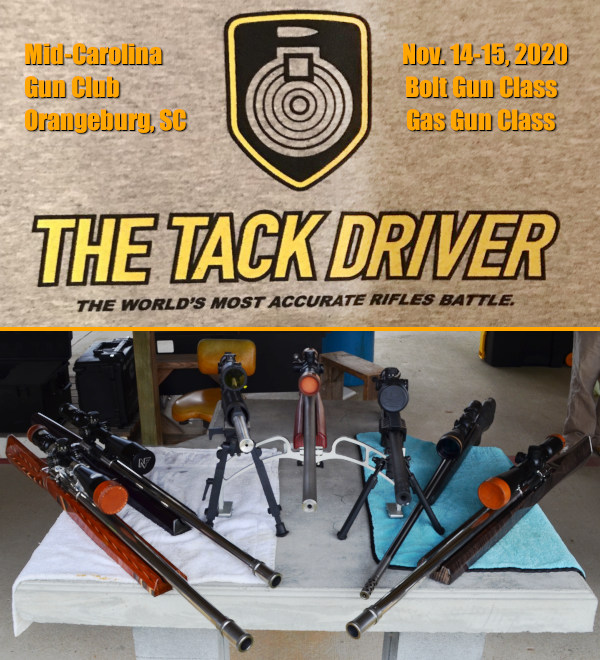
The Tack Driver Showdown is a one-of-a-kind “all comers” rifle match. This match is long overdue — we will finally get to see what rifle types are truly the MOST accurate, at least out to 300 meters. The Tack Driver Showdown match will be held November 14-15, 2020 at the Mid-Carolina Gun Club in Orangeburg, South Carolina. Co-Sponsored by the IBS, the organizers have invited virtually any type of rifle (except railguns) to compete at 300 meters for group and score honors. There are 100+ competitors pre-registered for the event this weekend. No organization membership is required.
Unlike any other rifle match in the world, on the firing line you will see 6 PPC LV/HV rifles, 30 BR score rigs, 17-lb 600-yard and 1000-yard benchrest guns, F-TR rifles, F-Open rifles, Palma rifles, PRS rifles, and maybe even an AR15 or two.
The concept behind the event is to settle the unending arguments about which guns are TRULY the most accurate. The 6PPC is king in 100/200 group competition, the 30BR rules 100/200 score, 6mmBRs and 6BR Improveds dominate in 600-yard Benchrest, the .284 Win is the leading F-Open cartridge, and various 6mms and 6.5mms win PRS matches. It will be interesting to see which chamberings and bullet weights will “rule the roost” at 300 meters. Match Director Jim Cline will post match results throughout the weekend on the AccurateShooter.com Forum.
Tack Driver Showdown targets will be placed at 300 meters (328 yards). That’s not even “mid-range” by benchrest standards, but it should be far enough that the higher BCs of the bullets shot by F-Class and 600/1000-yard benchrest rigs could come into play.
Basic Information on the Tack Driver Shoot:
There are two divisions — bolt-action rifles and semi-auto gas guns. There are no specific design limits other than a 22-lb maximum weight, and a .338 maximum caliber. IBS President Jeff Stover tells us: “We envision the full array of the world’s most accurate rifles on the line: short and long range benchrest rifles, F-Class, AR, other tactical, egg-shoot rifles, whatever…[.]” Key rules are listed below. Semi-autos will need chamber flags, otherwise bolts must be out at all times. You do not have to be a member of the IBS to shoot. The range will be open Friday, November 13th starting at 12:00 noon for practice and flag setting.
Cash Payouts for the Winners in both Group and Score
Match Director Jim Cline tells us: “1st place through 3rd place will be paid in both score, group, and Grand Aggregate finishing positions. Team Cash option also available- 4 man teams $100. The Grand Aggregate team winner takes all.”
2020 Tack Driver Showdown Rules Overview
1. No membership in any organization is required.
2. Any gun .338 caliber and under is legal (other than rail guns), with a 22-pound weight maximum.
3. There are two divisions: 1) Bolt Guns; and 2) Gas Guns.
4. All shooting will be done off benches.
5. Shooters may use bipod, bags, or rest combination but no one-piece rests.
6. You have to shoot the same gun at all targets. If you have a catastrophic failure, you have to continue with a gun of the same caliber and cartridge.
7. No electronic equipment of any type will be allowed on the bench or downrange.
8. No spotting scopes are allowed on the bench.
9. No people may coach or spot for competitors.
10. Chamber flags and brass catchers are required for gas guns.
2020 Tack Driver Showdown Match Course of Fire
1. There will be 5 group targets and 5 IBS 200-yard score targets placed at 300 METERS.
2. Targets will alternate between Score and Group each day: Day 1 Score/Group/Score/Group/Score; Day 2 Group/Score/Group/Score/Group.
3. All relays will be 7-minute matches with one 3-minute sight-in period on Saturday first target only.
4. Benches will be rotated for the second day’s course of fire.
5. Winner will be determined by place of finish at each discipline.
Covered Firing Line at Mid-Carolina Gun Club. Photo from 2019 100/200m Score Nationals.
For more information, including camping/RV details at the Mid-Carolina Gun Club venue, contact Jim Cline at 843-957-6546, or post questions on this Accurateshooter Forum Thread.
“On that day, let us solemnly remember the sacrifices of all those who fought so valiantly, on the seas, in the air, and on foreign shores, to preserve our heritage of freedom, and let us reconsecrate ourselves to the task of promoting and enduring peace so that their efforts shall not have been in vain.”
– 1954, President Dwight D. Eisenhower, Veterans Day proclamation.
102 Years Later…
On the 11th hour, of the 11th day, of the 11th month of 1918, bugle calls signaled the ‘cease fire’ ending the First World War. (The official Armistice was signed earlier that morning.) To those who endured it, WWI was the “Great War”, “the War to End All Wars.” Tragically, an even greater conflict consumed the world just two decades later.
Today, 102 years after the end of WWI, Americans mark the anniversary of the WWI Armistice as “Veterans Day”. In Canada it is known as Remembrance Day. On this solemn occasion we honor all those who have served in the military in times of war and peace.
While more WWII veterans pass away each year, there are still over 20.4 million veterans in the United States. Take time today to honor those soldiers, sailors, and airmen who have served their nation with pride. Today we remember that… “All gave some, and some gave all.” History of Veterans Day.
Former Secretary of Veterans Affairs Dr. James Peake asked Americans to recognize the nation’s 20.4 million living veterans and the generations before them who fought to protect freedom and democracy: “While our foremost thoughts are with those in distant war zones today, Veterans Day is an opportunity for Americans to pay their respects to all who answered the nation’s call to military service.”
On Veterans Day we especially need to remember the seriously wounded combat veterans. These men and women summon great courage every day to overcome the lasting injuries they suffered in battle. Some of these soldiers have lost limbs, yet volunteered to return to combat duty. That is dedication beyond measure — true patriotism.
National Veterans Day Ceremony
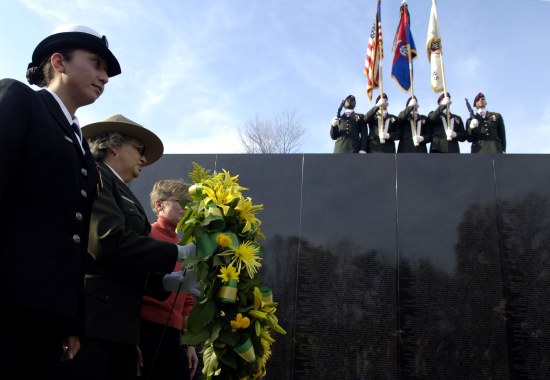
The Veterans Day National Ceremony is held each year on November 11th at Arlington National Cemetery. The ceremony commences precisely at 11:00 a.m. with a wreath laying at the Tomb of the Unknowns and continues inside the Memorial Amphitheater with a parade of colors by veterans’ organizations. The ceremony is intended to honor and thank all who served in the U.S. Armed Forces. Major regional ceremonies and events are also held throughout the country.
This stunning Westley Richards & Co. shotgun was made for the 1981 nuptials of Lady Diana Spencer and HRH Prince Charles. It is rare, has a unique history of ownership, and is also elaborately decorated.
Jim Supica, Director of the NRA Firearms Museum, has written a trio of articles about gun collecting. If you are thinking of starting your own collection of firearms, you should read Supica’s informative articles. The first talks about the basics of gun collecting, the second explains the five key factors that govern gun values, and the third article explains where to find rare and valuable arms. Today we want to highlight the five factors that contribute most to a gun’s value, according to Supica:
Make and Model, Condition, Rarity, History, Art — These are the five factors that … appeal to collectors and help determine the value of collectible guns.
Make and model tends to be the starting point for evaluating collectible guns for most collectors and will be a basic threshold requirement for those with specialized collections.
Factors here include the quality of a particular manufacturer’s products, the historical usage of the guns in question, and the brand’s aura of romance. As an example of that last (and most intangible) factor, consider that Colt Single Action Army revolvers were for several decades the most prevalent focus for collectors interested in full-size revolvers from the post-Civil War to turn of the 20th Century-era, and there is no question that Colts were widely used during that time. In recent years, there has been a refreshing trend in gun collecting to look at a broader range of guns than the traditional blue chip Colts, Winchesters, and Lugers.
Colt Single Action Army Revolvers remain among the most prized (and collectible) firearm.
2. Condition (and Originality)
Obviously, condition plays a major role in the value of a collectible firearm. The classic advice to new collectors in this regard has always been to hold out for guns in the best condition and pay the extra premium they demand. This condition-emphasis seems to have developed in the 1970s and 1980s. In the early post-WWII years of gun collecting there was more interest in rare variations and history, and fewer collectors to whom a few percentage point difference in remaining original finish was of much concern.
Although the highest-condition guns continue to bring record prices, it seems that the pendulum is beginning to swing back the other way, a trend met with my hearty approval. The appeal of “mint” guns has been largely lost on me, and seems to be more appropriate to coin or stamp collecting than a field in which the possible historic usage of the artifact holds so much interest and significance. There is a definite segment of the collector market that is not overly concerned with perfect condition, so long as the gun is original and has not been messed with in a more recent (and, in my opinion, usually misguided) attempt to enhance its desirability.
3. Rarity
In terms of rarity, the well-worn saying that “just because a gun is rare doesn’t mean it’s valuable” remains true to a certain extent. There may only be five known examples of a particular gun, but if only three people care about it, the market is saturated. However, there does seem to be more interest in cornering the rare variations within established collecting fields. There is a bit of a resurgence of the collecting philosophy of completing a punchlist of models and variations within a specialization, and this lead to vigorous competition for the rarest examples in these fields. In emerging collecting fields, when new research is published revealing the rarity of certain variations there can develop a brisk interest in those guns.
4. History
Individual guns with a known history of ownership by a specific individual or usage in a specific historical event have always captured the fascination of collectors, as well as historians and the general public. This seems to reflect a basic human interest and shows no sign of abatement. A positive trend here seems to be an increase in general understanding of the type of documentation which must accompany a historically attributed firearm to give it the credibility to justify a premium price, and the importance of creating and preserving such documentation.
This Beretta has extra value because it was owned by pilot Chuck Yeager. Photo NRA Museum.
5. Art (Decorative Embellishment)
Fine engraved guns are collected more for their artistic value than for their worth as firearms. Here the market for classic works by the great engravers of the 19th and early 20th Centuries remains strong, as well as for factory-engraved pieces from more recent years. Interest in recent non-factory engraving seems to have diminished, as has… the trend of adding modern engraving to older firearms.
Here is a matching set of three three beautifully engraved pistols by the late Indiana engraving wizard Ben Shostle — a Luger, a Mauser, and a Colt. Photo courtesy Amoskeag Auction Company.
Factory-custom engraving should not be confused with mass-produced, factory-made commemorative firearms, which flooded the market in the 1960s and 1970s. A couple of major manufacturers worked this genre to death, and prices on commemoratives have been stagnant for many years now, although the market for these shows some signs of renewal.
CAUTIONARY WORDS about RESTORATION
With prices for high-condition original finish guns running away from the budgets of many collectors, period-of-use refinished guns and older factory-refinished guns are finding more enthusiastic buyers than they did a few years ago.
The availability of excellent-quality restoration services is another factor that I anticipate may impact collector preferences in the future. The top restoration artists are reworking guns to “as new” condition with such skill that it has become increasingly difficult for even knowledgeable collectors to distinguish mint original finish guns from the best restorations.
When such restoration is disclosed to a prospective buyer (as it ethically should be), the prices the gun will bring are significantly below a similar gun with original finish, and may be less than the original cost of the pre-restoration gun plus the cost of the rework. This creates a mighty incentive for deception by a motivated seller, either by active misrepresentation (a.k.a. “fraud”) or passively by simple failure to mention the modification.
A good, quick-access safe can keep your handgun secure, but also readily accessible. There many factors to consider when buying a small, rapid-access pistol safe: reliability, locking mechanism type, case metal strength/thickness, need for battery, ease of installation, internal capacity, built-in lighting, attack resistance, and overall quality. If you are considering getting a small safe for handguns, we recommend you watch all three videos below. Each shares some valuable observations, and it’s good to have three different reviewers covering wide selection of pistol safes with many different features.
Seven Quick-Access Handgun Safes Reviewed by Lucky Gunner
Not all small handgun safes are created equal. In this 11-minute video, Lucky Gunner reviewer Chris talks about what to look for in a small pistol safe, setting out the pros and cons of the seven safes with which he has done “hands on” testing.
Fort Knox Original Pistol Box
Fort Knox handgun safes feature 10-gauge Uni-body construction and reliable Simplex mechanical locking mechanism. Low-tech but reliable. The vertical lid FTK-PB Pistol Box is $257.00 at Amazon.
V-Line Hide-Away Two-gun Pistol Safe
The V-Line safe with Simplex mechanical lock and slide-out drawer holds two handguns. Sold with mounting bracket, this is designed for under-tabletop or under-shelf installation. It is $272.76 on Amazon.
ShotLock Handgun 200M Solo-Vault
Shotlock’s 200M safe with slide-out drawer, reliable mechanical lock, and mounting plate costs $165.75 on Amazon. Also available is an electronic version for $134.99 on Amazon.
Vaultek VT20i Biometric Pistol Safe
This is a modern two-handgun safe with electronic lock and Biometric (fingerprint scan) instant-access system. Crafted of 16-gauge steel, the VT20i has a rechargeable Lithium-Ion battery. $269.99 on Amazon.
Hornady RAPiD Safe 2600KP
The Hornady RAPiD 2600KP safe offers very fast RFID access for a modest $151.86 on Amazon. This small safe meets TSA requirements for handgun storage in checked luggage. Good choice for travel.
Stack-On PDS-1500 Drawer Safe
This is a basic safe with electronic locking mechanism. Just 4.5″ high, it can store in a drawer easily. Good value at $97.93 on Amazon.
GunVault MicroVault XL
A top-seller for many years, the Gunvault Microvault XL is offered in standard ($169.99) and Biometric MVB1000 versions. There have been some negative reviews of the $299.99 biometric version.
Smart Advice for Handgun Safes from AccurateShooter
With any small pistol safe, there are some important points to remember.
1. Keep the safe out of plain view — Don’t place it on top of a bedside table. Burglars often go straight to the bedroom looking for valuables. We recommend attaching your pistol safe to a secure surface using bolts. Or use a steel cable.
2. With electronic handgun safes, you should change/charge the batteries regularly. It is pointless to have a self-defense pistol in a safe you can’t open because the battery is dead. Electronic safes should always have back-up key-locks.
3. Don’t put important valuables such as car keys, credit cards, and jewelry in compact pistol safes. Even when screwed down, these small safes are known targets for thieves.
4. Remember the KISS principle. Some of the latest pistol safes are WiFi enabled so they can talk to a smart-phone APP. This may provide entertainment for tech types, but simpler may be better. You want a safe that will open/close without WiFi and without a battery.
Ten Handgun Safes Reviewed by Survival Gear
This video is titled “TOP 10 Best Gun Safe”, but it should be more accurately titled “10 Pistol Safes”. None of these safes will hold a long-gun, and most will hold just two handguns. The largest safe reviewed, the Vaultek MX high-capacity, will hold six pistols on the lower level, and a couple more on the upper, internal shelf. This is a well-made, professionally-produced video that shows “hands-on” operation of 10 safes.
SentrySafe QAP1E Handgun Safe with digital keypad. Top-opening gas-strut supported lid. Circular key override. Single pistol safe $107.11 on Amazon. Larger model with 2-gun capacity and interior light $169.99 on Amazon.
GunBox 2.0 “Smart” Motion Sensor Gun Safe. Modern exterior design. Safe has audible motion alarm that sounds if moved. $299.99 from Gunbox.com.
Titan Pistol Vault Safe with mechanical, push-button lock, 14-gauge steel with mounting brackets for vehicle or home installation. $379.00 on Amazon.
Vaultek VT10i Biometric Smart Pistol Safe with Auto-Open Lid and Rechargeable Battery and backlit keypad, $244.99 on Amazon.
Verifi Smart.Safe. Worth a look if you want a Biometric pistol safe. This has the largest and only FBI-certified fingerprint sensor. There is back-up key access, but no keypad. User reviews are good so far. $329.99 on Amazon.
BILLCONCH Biometric Gun Safe. This offers four access modes: keypad, biometric, phone App, and keyed entry. User reviews have been good. If you want a biometric safe on a budget, this is a logical choice for just $139.99 on Amazon.
Vaultek MX WiFi High Capacity Smart Handgun Safe. Auto-open Door and rechargeable battery. This 15″x 11.5″x 11.6″ safe can hold up to 8 handguns on two levels. Available as Biometric ($559.99 on Amazon or non-Biometric $489.99 on Amazon.
Liberty HDX-250 Smart Vault Biometric handgun safe. We like the large Liberty gunsafes and this is a new Biometric safe that holds up to 15 fingerprint codes. $219.99 on Amazon.
Handgun Safes for Bedside at Home — Pew Pew Tactical Reviews
A rapid-access bedside safe is a great way to keep your pistol secure, but also readily available, close at hand. Not all rapid-access pistol safes are created equal, however. In this video, John of Pew Pew Tactical explains what to look for in a small pistol safe, and points out the pros and cons of the four safes tested:
Fort Knox FTK-PB Simplex Pistol Box
Strong case, reliable no-battery locking system. Very good safe, but expensive ($257.00 on Amazon).
Vaultek Electronic Pistol Safes
Multiple styles, thin profile, 5-button electronic ($139.99 on Amazon), or Biometric VT10i + 5-button ($244.99 on Amazon), both with rechargeable batteries.
GunVault SpeedVault Handgun Safe
Designed for vertical mount under desk on vehicle, One gun only, requires batteries, $121.00 on Amazon
GunVault NanoVault Handgun Safe
Small, thin, lightweight — designed for travel or vehicle use. Simple combination lock. Not recommended for home. $56.38 on Amazon.
Story based on Report by Bryan Blake, Blake Machine Company
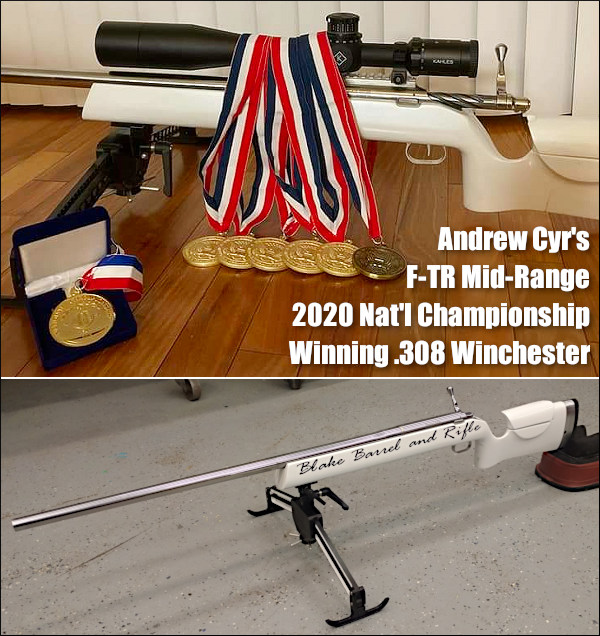
Here’s the gold medal-winning .308 Win rifle of the 2020 F-TR National Mid-Range Champion, Andy Cyr. Arizona native Cyr won the F-TR Mid-Range Championship with an impressive score of 1761-72X out of a possible 1800 points. At this three-day Mid-Range event at Ben Avery in Phoenix, all 180 rounds were shot at 600 yards. Andrew delivered a convincing victory, winning by NINE points over runner-up James Crofts, a past national champion himself. We congratulate Andrew on his impressive win. And today’s Sunday GunDay feature examines the details of Andrew’s impressive .308 Win F-TR rifle.
Cyr Overcame Incredibly Tough Conditions at Ben Avery
After Day One of the Mid-Range Nationals, Andy was in 5th place. Andy made up some serious ground on the next two days despite winds that were well into the 20 MPH+ range. In fact, many experienced shooters took misses (not hitting the scoring ring) because the winds were so fierce. Interestingly, Andy’s 1761-72X score beat all but eight F-Open shooters.
Andrew Cyr’s .308 Win F-TR rifle during load development and accuracy testing.
F-TR Mid-Range Championship-Winning .308 Win Rifle Specifications:
Blake Barrel and Rifle 32″ .30 Caliber, 1:11″-twist barrel with custom specs
McMillan XIT Stock (lightened with ports on butt area)
Borden BRM Action
Kahles K1050 10-50x56mm Scope
Phoenix Bipod with F-Class Products lowering kit and skeleton legs
Andrew Cyr’s Championship-winning F-TR rifle was built by Phoenix-based Blake Barrel and Rifle (BBR) in 2018. Interestingly, this rifle was originally built for Andy’s daughter Jessica. The rifle was used by Andy a few months later. The rifle features a severely-lightened XIT stock with the grip smoothed out. Andy was actually the first customer of Blake Barrel and Rifle back in 2018. He has always been willing to try out new rifling profiles, twist rates, and barrel configurations as recommended by BBR.
Bryan Blake tells us: “Many customers demand exact specs and there is no way of changing their mind, even if it is factual-based. With Andy he was always willing to try new things, some things didn’t work well, but some things worked very well, just like the barrel used to win the Nationals.” Andy preferred a heavier barrel in the chamber area than most TR shooters. The shank diameter is 1.350″ rather than 1.250″. What this does is keep as much material around the chamber, which is the hottest area of the barrel. That way the barrel is less affected by heat over a string of fire, since the heat can be dissipated into a larger area.
Andy used a 32″ barrel, a length not commonly used in F-TR anymore. Most are running 30″ or even 28″ now. Many folks think a shorter barrel is more accurate so these competitors do not use a 32″ barrel. Well as you can see by his results, Andrew’s 32″ tube shot great. The extra length was NOT a handicap. We should remember that longer barrels can normally produce higher velocities than shorter barrels or deliver equivalent speeds with less pressure.
Many people also believe that a 1:9-10″ twist is needed to shoot 200-grain class bullets out of a .308 Win accurately. However, Andy took the advice of Blake Barrel and Rifle, and went with a 1:11″-twist Blake cut-rifled barrel. Many would say this twist is too slow, and some online calculators say a 1:11″-twist won’t fully stabilize 200-grain bullets. Obviously this is also not the case. Andy’s 11-twist and Berger 200-grain Hybrid bullets (NOT 200.20X bullets) work very well with this combination. NOTE: Andy uses an F-Class Products barrel tuner to tune his load. He will sometimes even alter tune between relays to compensate for changing barometric conditions.
Winning .308 Win Load — Lapua Palma Brass, VV N550, CCI 450s, Berger 200gr Hybrids
Andy Cyr took the Mid-Range title loading Vihtavuori N150 powder, CCI 450 primers, Berger 200gr Hybrids, and Lapua .308 Win Palma brass. Andy does not push his bullets very fast and finds a big accuracy node at the mid-2600 FPS range. He jumps his bullets .015″ off the lands. One thing Andy consistently does is test, test, test. He will test different powders, charge weights, seating depths nearly every time he is at the range. He will shoot a different load for each string to see what works best.
Profile of 2020 F-TR Mid-Range National Champion — Andrew Cyr
Father and Daughter Compete Together
Andy started shooting F-Class in 2012 to help him shoot better in the PRS series. He hoped to learn to read the wind better and get more experience in long-range shooting in general. After shooting F-Class he was hooked and found he enjoyed it more than PRS. Andy and his daughter Jessica have shot many state matches together, with both of them shooting F-TR. Jessica owned the Mid-Range 20-shot woman’s Aggregate record for years with a score of 200-11X. Interestingly Andy shot his very first clean at 1000 yards at the Nationals in Raton, NM in 2018 with a score of 200-11X also. This year Andy started using a spotting scope to help read mirage and it has helped him tremendously he reports.
The “Master” Beat the “High Masters”
Andy is currently classified in Mid-Range as a Master for F-Class, not yet High Master. Even after winning the F-Class Mid-Range Nationals, the most prestigious F-Class match of the year, he is still classified as a Master. Andy’s 1761-72X score works out to 97.8% of a perfect 1800. But the requirement for F-Class High Master is 98%. That just shows you how tough the conditions were at Ben Avery this year. But still the Master beat ALL the High Masters — if you look at the score sheet above, all the other Top 10 F-TR competitors were High Masters. Impressive. And we believe Andy is the first Arizona resident to ever win a national F-Class Championship in either F-Open or F-TR.
About Blake Barrel and Rifle Blake Barrel and Rifle (BBR) has been in business since 2018. BBR built the rifle that Brian Bowling used to win the 2019 F-Open National Championship. And now another ultra-accurate BBR-built rifle has won the 2020 F-TR Mid-Range Championship. Bryan Blake tells us that Blake Barrel and Rifle has recently upgraded BBR’s rifle barrel building equipment. There are advanced CNC lapping machines, CNC bore-honing machines, and all-new, proprietary rifling cutter designs that no one else in the barrel business uses.
Blake Barrel and Rifle produces cut-rifled, 6-groove barrels with a unique rifling profile no other barrel manufacturer is using. Blake barrels have an impressive winning record in recent major competitions — earning National Championships, plus many match wins and podium performances. Bryan Blake tells us that “The time and quality control spend on Blake barrels is second to none and the proof in the results.” For more information, visit Blakebarrel.com.
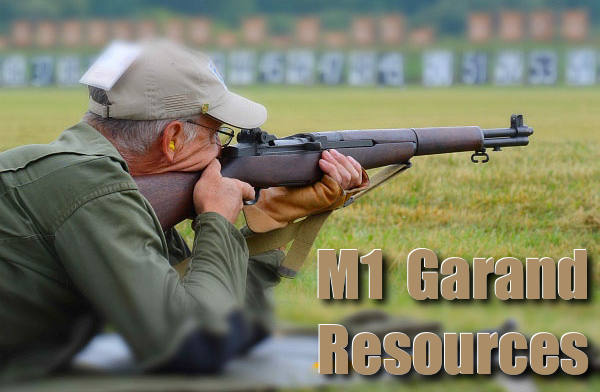
Do you own an M1 Garand? Or perhaps you’re thinking of ordering a Garand, now that the CMP has acquired 99,000 of these classic battle rifles from Turkey and the Philippines. An M1 Garand is a great addition to anyone’s firearms collection. It is a piece of living history — plus it can be used in Vintage Military rifle matches. Here are some great resources for M1 Garand owners. We list two useful articles on general maintenance. In addition, we’ve included three excellent videos covering M1 Garand Disassembly, Cleaning, and Lubrication. Finally there are links to recommended print manuals available from the CMP.
M1 Service and Maintenance Shooting Sports USA (SSUSA) recently published an excellent article on Service and Maintenance of M1 Garand Rifles. This offers some smart tricks, such as using smoke from burning masking tape to darken the front sight post. There is also an older SSUSA article that covers basic cleaning and servicing and also explains how to upgrade the performance of your Garands. READ Article HERE.
Recommended M1 Garand Manual
Among the many M1 Garand manuals available, we recommend the CMP’s U.S. Rifle, Caliber .30, M1: ‘Read This First’ Manual. This booklet covers take-down, reassembly, cleaning, lubrication, and operation. The manual comes with CMP rifles or can be purchased for $3.25 from the CMP eStore. The author of Garand Tips & Tricks says: “It’s one of the best firearms manuals I’ve seen and I highly recommend it.” The CMP also offers many other M1 Garand print resources including:
Are you looking to get started in PRS and tactical/practical competitions? Here are three videos that can help you improve your game. These videos feature two top PRS competitors, and George Gardner of G.A. Precision, considered one of the founding fathers of the PRS game. You’ll find other PRS-focused videos on the Long Range Precision Shooters YouTube channel.
PRS Ace Shows Skills Barricade Technique — with POV Video
This first video features 2015 PRS Champion David Preston shooting the PRS Skills barricade. Dave Preston is widely considered the best in the nation running this PRS stage. Dave nearly always shoots 100% with the fastest recorded time. In this video you’ll see him successfully engage all eight shots in under 43 seconds — that’s crazy fast. This includes a POV sequence (4:35 time-mark) showing the actual view through Dave’s scope.
The PRS Skills Barricade is an 8-round, 4-position stage featured at most PRS matches. It’s called a “Skills Stage” as it is run the same way at every national match and gives shooters the ability to compare skill levels based on hit percentage and speed. The target is a 10″ plate at 400 yards. There are four different positions, with two shots each. Most people run this stage in about 70 seconds, some in the mid-60s, while Dave does it in the low 40s!
Know Your Limits PRS Stages — Pro Tips
The Second video showcases how 2018 Oklahoma PPS Champion Clay Blackketter approaches Know Your Limit Stages. With these particular type of stages you have to make judgment calls about your rifle’s accuracy and your ability to hold on target. You can boost your score by shooting the smallest target(s), but you risk losing points if you miss. Clay explains how best to manage a Know Your Limits stage.
Cartridge Choice for PRS and Tactical Competition
Today’s third video reviews many of the different caliber selections popular for PRS-style competition. The video examines pros and cons of various cartridge choices, focusing on accuracy, recoil, mag-feeding, and value for money. This segment features G.A. Precision owner/founder George Gardner.
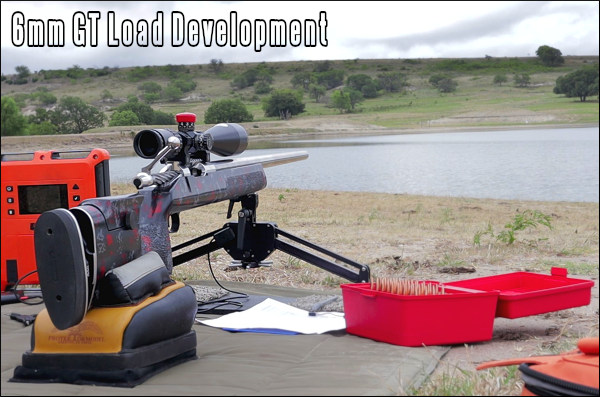
Most Top PRS shooters are using 6mm catridges these days. These deliver excellent accuracy with lower recoil and cheaper bullet cost. Popular choices include 6 Dasher, 6mm Creedmoor, 6XC, 6-6.5×4 and the new 6GT cartridge, which is sort of a stretched version of a 6mmBR. It has a bit more case length for better feeding, and greater case capacity than a 6BR so you can shoot 105-108 grain bullets at the 2950 fps node.
CLICK HERE for a full write-up on a 6GT rifle build by Mike McCasland (Texas Precision). This includes load development suggestions and a 6GT reamer print. The most common 0.120″ freebore chamber allows for the majority of high-BC 6mm projectiles found in both F-Class and PRS. Mike had good luck with the pointed 107gr Sierra Match Kings (SMK), as well as the 110gr Hornady A-Tips in his rifle, shown below:
Practical Shooter’s Guide
Thinking of getting started in the Practical/Tactical shooting game? Looking for ways to be more stable when shooting from unconventional positions? Then you may want to read Marcus Blanchard’s Practical Shooter’s Guide (A How-To Approach for Unconventional Firing Positions and Training). Unlike almost every “how to shoot” book on the market, Blanchard’s work focuses on the shooting skills and positions you need to succeed in PRS matches and similar tactical competitions. Blanchard provides clear advice on shooting from barricades, from roof-tops, from steep angles. Blanchard says you need to train for these types of challenges: “I believe the largest factor in the improvement of the average shooter isn’t necessarily the gear; it’s the way the shooter approaches obstacles and how they properly train for them.”
Annie Oakley Profile by T. Logan Metesh
Annie Oakley learned to shoot at a young age. It started as a skill developed to help feed her family when she was still known as Phoebe Ann Mosey (or possibly “Moses”). Annie began shooting and hunting by age eight, to support her siblings and her widowed mother. She honed her skills, adopted the stage name Annie Oakley, and earned the nickname of “Little Miss Sure Shot” for her expert marksmanship.
Annie Oakley’s trick-shooting and marksmanship skills were so good that she toured the world as part of Buffalo Bill’s Wild West Show for more than a decade and a half. It was rumored that she was one of the highest paid performers in the show. Annie was known for making some truly astounding shots: hitting dimes in midair, aiming backwards through a mirror, and more. She traveled overseas with Buffalo Bill and performed for royalty in England, France, Italy, and Germany. Annie even shot the ashes from a cigarette held by Kaiser Wilhem II!
Biographers say Annie met her husband, Frank Butler, at a shooting competition when she was just 15. Young Annie beat Butler in a one-on-on shooting match, and they later married.*
Here is rare 1894 footage of Annie Oakley shooting, filmed in the Edison Black Maria studio.
“Annie Oakley was arguably America’s first female superstar, touring the U.S. and the world in the late 1800s and early 20th century and demonstrating her legendary Wild West sharp-shooting skills.”
— Tom Slater, Historian for Heritage Auctions.
Annie Oakley’s Favorite Firearms
Annie Oakley’s sharpshooting feats were impressive in their own right, but the equipment she used to accomplish these things made them even more impressive. Annie favored basic, commonly available firearms. She didn’t need modified guns to make her shots.
She enjoyed shooting her Parker Bros double-barrel shotgun, but it wasn’t fancy in appearance. It had just standard grade wood and, aside from the standard scrollwork on the locks, it was just a normal gun.
She also owned a Smith & Wesson Model No. 2 revolver. The gun was nickel-plated and had mother-of-pearl grips, but those were options that anyone could have had on their own revolver. Another one of her pistols, a Stevens single-shot tip-up, was gold-plated and had mother-of-pearl grips, but it had not been modified or accurized in any way to improve its performance. Annie simply didn’t need the help.
Annie’s firearms may not have been modified for trick shooting, but she did own a number of one-off specials. For example, she owned one of the 800 Remington Beals rifles made between 1866 and 1866, but hers is the only known example to bear factory engraving.
Of course, many arms makers saw Annie’s fame as a way to promote their guns, so a large number of engraved and/or gold-plated guns were gifted to her. Some of these include a Winchester Model 1892 carbine and a Stevens Model 44 rifle.
Annie Oakley Continued to Perform at Age 60+ during the 1920s
A consummate performer, Annie continued to wow crowds even as her craft took its toll on her body. A lifetime of exposure to gunpowder residue and smoke led her to experience repeated eye infections. Despite the advent of smokeless powder, she had spent years using blackpowder beforehand. Even if it had all been smokeless, the quality we know today was not the quality they had back then. Plus, the sheer amount of powder she encountered certainly added up.
Her public appearances required lots of travel, which wasn’t without its own dangers. She underwent spinal surgery from a train accident in 1901 while travelling with the Wild West Show. Years later, she had to wear a steel brace on her leg due to a car accident in 1922, but she got back to performing and continued to set records in 1924 at the age of 64. By this time, though, her health had begun to decline. Annie Oakley passed away in 1926 at the age of 66. Her husband, Frank Butler, was so fraught with grief that he stopped eating and died of starvation just 18 days later.
Annie Oakley Championed Women’s Rights
While most of the world remembers Annie for her accomplishments with a firearm, she used her fame in a different way during her lifetime. She was an advocate for women’s rights and shooter education. She is quoted as having said, “I would like to see every woman know how to handle guns as naturally as they know how to handle babies.” It’s believed that she taught some 15,000 women how to shoot during her lifetime. Today, educational shooting experiences geared towards women often use her name to their advantage. After all, what shooter wouldn’t want to be as well regarded as Annie Oakley?
About Author T. Logan Metesh
T. Logan Metesh is a firearms historian and consultant who runs High Caliber History LLC. Logan has more than a decade of experience working for the Smithsonian Institution, the National Park Service, and the NRA Museums. Logan has been a frequent guest on the “Curator’s Corner” program for NRATV and has served as an historic firearms facilitator for American Rifleman TV and other shows.
*On Thanksgiving Day 1875, the Baughman & Butler shooting act was performing in Cincinnati, Ohio. Traveling show marksman and former dog trainer Frank E. Butler, an Irish immigrant, placed a $100 bet per side (equivalent to $2,300 in 2019) with Cincinnati hotel owner Jack Frost that Butler could beat any local fancy shooter. The hotelier arranged a shooting match between Butler and the 15-year-old Annie, saying, “The last opponent Butler expected was a five-foot-tall, 15-year-old girl named Annie.” After missing on his 25th shot, Butler lost the match and the bet. He soon began courting Annie and they married. They did not have children.
Here at AccurateShooter.com, we’re more about rifles than pistols. But we know that the majority of our regular readers own handguns, and many also have concealed carry (CCW) permits. And with the prospect of social unrest following the election, we expect more reader than ever will be “packing” a sidearm. Accordingly, we’ve found a great resource for CCW holders that can help you select a holster. On the Shooting Illustrated website you’ll find a detailed review of 30 different holster types. Each holster is illustrated, with pros and cons explained. These are all EDC holsters, meaning those designed for “Every Day Carry”.
Shooting Illustrated calls this article “HolsterPallooza” and it really does provide a ton of helpful information. Most other holster reviews on the web may feature a half-dozen holsters at the most. In this Holsterpallooza article you can see 30 holsters, with a wide variety of materials, designs, and applications. There are small molded IWB holsters for CCW, conventional on the belt holsters, leather shoulder holster rigs, and even ankle holsters. This is a great place to start if you are in the market for a holster.
Here’s sample of the many holster options reviewed, an innovative hybrid IWB holster constructed with leather over Kydex. That gives you the “best of both worlds” — the secure fit/retention of a molded Kydex shell, with an attractive leather exterior.
Shooting Illustrated explains: “As the interface between your gun and your body, the holster is a vital component of your carry rig. In many cases, the circumstances of your daily life will determine the method of carry you choose. This, in turn, will determine what type of holster you need, which may end up determining the handgun you carry. Therefore, choosing the method and type of holster may be as, or even more important than, choosing a firearm.”
MORE Reviews — Hickok 45 Reviews 15 CCW Holsters:
If you want to see even MORE holsters for “Every Day Carry” (EDC), check out this video from Hickok 45. This popular YouTube host looks at 15 different IWB holsters from a number of manufacturers. Hickok 45 examines many hybrid holsters that combine Kydex or plastic with leather for increased comfort. He has his favorites… and they might not be what you’d expect. NOTE: As this video has been watched over 900,000 times, you may also want to read the viewer comments. There are many helpful suggestions from CCW holders who carry daily.