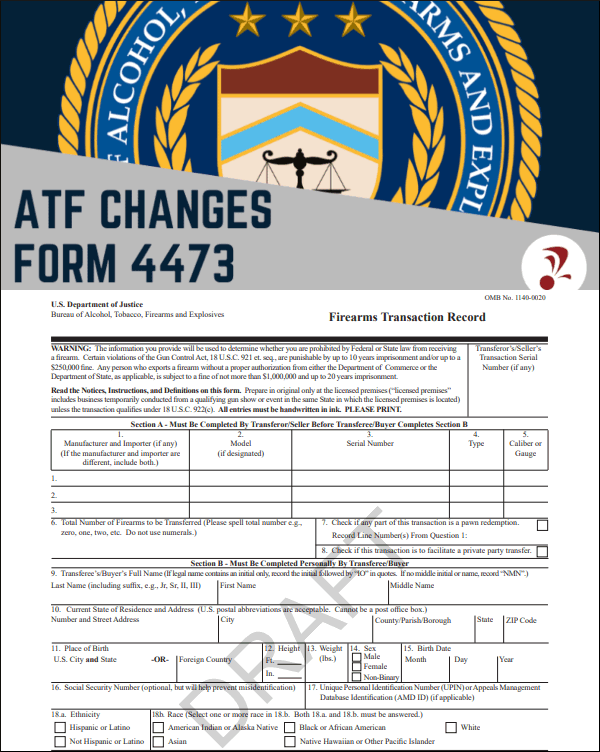
The Federal Bureau of Alcohol, Tabacco, Firearms and Explosives (ATF) is set to release its newest version of the Form 4473. The Updated Form 4473 is used by all Federal Firearm License (FFL) holders to record pertinent information from persons seeking to purchase a firearm or firearms prior to the FFL performing a background check via the National Instant Criminal Background Check System (NICS) or state-approved point-of-contact law enforcement agency. FFLs may start using the new Form 4473 immediately. The FBI intends to start shipping these new forms in July 2020.
IMPORTANT: Use of the updated Forum 4473 becomes MANDATORY as of November 1, 2020, for paper applications (not using the FBI E-Check system).
The May 2020 Form 4473 includes several changes from the previous version, including:
— The warning at the top of the form includes information about illegal exportation.
— Information on the firearm/s to be transferred is now Section A, which must be completed before the transferee completes Section B.
— The Citizenship information (Country of Citizenship and US-issued alien or admission number) has been moved to precede the prohibitor questions.
— The “County” block has been changed to “County/Parish/Borough” to accommodate Louisiana and Alaska, respectively.
— The “Sex” box has been revised to include a third option of “Non-Binary”. [Comment: Really? And how does this prevent crime? Thank you SJWs.]
— Item 26b, which previously applied to situations in which the identification document did not show the current residence address of the transferee, has been updated to include situations in which the identification document does not include the full legal name of the transferee.
— New item 26c has been included for the recording of official military orders establishing permanent change of station.
OTHER Changes: A detailed summary of ALL Form 4473 changes has been prepared by Orchid Advisers, which provides ATF and ITAR compliance services to manufacturing, distribution, and retail FFLs.
Expected Delivery Dates and Pre-Order Links
Use of the May 2020-approved Form 4473 will be mandatory for all FFLs beginning November 1, 2020. FFLs may use supplies of their current Form 4473s (October 2016 version) until that date. The new Form 4473 and continuation sheets are available for preorder in both English and Spanish. FFLs can expect their preorders to begin shipping in late July 2020. In addition, ATF expects to ship 50-quantity starter packs of the new Form 4473 to all FFLs in late July 2020, and the agency intends to have an updated eForm 4473 up and running during that same time period for those FFLs utilizing the FBI’s NICS E-Check system instead of the paper Form 4473.
NSSF has ordered both Spanish and English overlays for the new Form 4473 and we will notify our members when they are in stock and available through the member portal. These overlays, which complement an FFL’s compliance best practices, help improve accuracy and completion of this critical form and are available free to NSSF members.
Wyoming-based Gunwerks LLC is a highly visible producer of high-grade rifles, modern optics, and rifle accessories. Gunwerks had its own television show and operated upscale long-range shooting clinics and guided hunts. Now the company may be in tough financial straights.
K2radio.com reports that: “Wells Fargo Bank has sued the Cody-based custom-rifle maker Gunwerks, LLC, for $2.8 million for unpaid loans and wants the company’s equipment, according to federal court records filed Wednesday. Gunwerks … also owes $1 million to creditors and and for unpaid sales taxes, according to the complaint by the bank and Wells Fargo Equipment Finance, Inc., through its attorneys[.]”
For full details, we recommend you read the full 5/20/2020 news story from Wyoming Radio Station KTWO (K2) in Casper, Wyoming. That report provides extensive details of the legal claims by Wells Fargo. The lawsuit was filed in U.S. District Court for the District of Wyoming. View Court Documents HERE.
Wells Fargo’s complaint alleges that Gunwerks owes the bank roughly $2.8 Million. Wells Fargo further alleges that a Gunwerks financial report reveals that Gunwerks owes approximately $622,000 in creditors’ bills. The complaint also alleges Gunwerks owes $365,000 in unpaid state sales taxes.
Wells Fargo’s Motion for a Receiver states the loan amount owed is $2,783,757.82, with interest accumulating at more than $20,000 a month.
Wells Fargo is seeking to recover and secure inventory and other Gunwerks property used as collateral for the bank’s loans. The complaint filed in Federal Court alleges: “These circumstances require the immediate appointment of a receiver to recover, salvage, and retain the value of the Collateral.”
Wells Fargo has alleged that Gunwerks has already sold part of the collateral inventory and deposited the proceeds in different banks: “The Borrower has taken control of Wells Fargo’s collateral, refuses to disclose the names and addresses of account obligors for accounts that constitute collateral for Wells Fargo and has removed and refused to remit proceeds of Wells Fargo’s collateral to prevent such collateral from being applied to the Borrower’s loans[.]”
Gunwerks has not made a public statement about the situation: “What all this means for the company’s future and its employees is unknown. A Gunwerks’ spokesman did not return calls seeking comment.” (Source KTWO Report.)
All shooters, even rimfire enthusiasts, should always wear ear protection when at the range. A typical rifle gunshot is very loud — in the region of 140 to 170 decibels (the pain threshold is 130-140 db). Without ear protection, you can permanently damage your hearing during a single shooting session. We all know older shooters who are partially deaf, or who suffer from Tinnitus, because they didn’t use earplugs or muffs when they were younger.
How Humans Hear Sounds — Amazing Video Reveals All
The human sense of hearing involves multiple delicate internal membranes, bones, organs, and nerves. Shooters understand the importance of protecting their hearing, but they may not understand the bio-mechanics of human hearing. We hear sounds through Auditory Transduction. Sound waves vibrate the ear drum (tympanic membrane), but that is only the beginning. These vibrations are passed along via tiny rocker-arm-like bones to be “processed” in a spiral chamber, the cochlea.
This remarkable VIDEO explains how humans hear sounds. We strongly recommend you take the time to watch and learn. The hearing you save may be your own!
Click Speaker Icon to turn on the video’s soundtrack.
Vibrations moving through the cochlea are separated into frequencies and then sent as neural messages to the brain. It is an astonishingly complex process, one that truly seems miraculous when you examine the bio-engineering involved. In the Video above, the process of human Auditory Transduction is explained and illustrated with 3D animation. You really should watch this amazing video. By the end you will have a new-found appreciation for your ability to hear.
Every shooter should own a pair of Electronic muffs, even if you prefer shooting with earplugs and/or standard muffs. Electronic muffs are great when you are spotting for other shooters or are working near the firing line. They let you hear ordinary conversations while still providing vital hearing protection. You can also wear ear-plugs under muffs for extra sound attenuation.
Plugs PLUS Ear-Muffs — The Benefits of “Doubling-Up” Your Hearing Protection
According to OHS Online: “The combined attenuation of an ear plug and an ear muff is not simply the algebraic sum of the performance of each individual protector. This is due to an acoustic and vibratory interaction between the ear muff and the ear plug that causes them to behave together as a system rather than as independent hearing protectors.
Generally speaking, when you combine two hearing protectors, ear muffs over ear plugs, you can expect an increase [in noise reduction] of between 3 and 10 dB over the higher-performing hearing protector. OSHA [now advises] 5 dB as the [typical] benefit offered by combining hearing protectors.” Source: OHSonline.com
Shooting Sports USA (SSUSA) has a good article on the origins and history of the National Rifle Association. This timeline feature covers the first 36 years of NRA history from 1871 to 1907. The NRA was founded in 1871, and 1907 marked the first year of Matches at Camp Perry, Ohio.
SSUSA explains the NRA’s original mission: “The NRA’s program during its youthful years centered mainly on improving marksmanship among the military. Rifle tournaments at ranges in Creedmoor (NY), Sea Girt (NJ), and Camp Perry (OH) captured the country’s spirit of nationalism and resulted in key improvements in rifles and target scoring. NRA also set standards for military rifle training and even inspired the federal government to form its own segment within the War Department to focus on promoting rifle practice among soldiers as well as civilians.”
1871 — A group of New York National Guardsmen founded the National Rifle Association to promote marksmanship training. Figures such as Capt. George Wingate had called for better rifle marksmanship to support the nation’s defense.
1872 — The NRA acquires Creed’s Farm in Long Island, New York for $26,250. Renamed “Creedmoor”, this becomes the NRA’s first range. The first match was held in 1873.
1874 — The NRA hosts its first International Match, shot at the Creedmoor Range in New York.
The First-Ever Creedmoor Challenge Match in 1874
The Irish International Shooting team arrived in New York on the 16th of September and proceeded to “take in the sights”, which was understandable, before some practice at the Creedmoor range. On September 26th they presented themselves for the match with confidence and in high spirits. The crowds that day were reported to be between 5,000 and 10,000 strong, which showed the huge support already growing for the fledgling sport in America.
The course of fire was 15 shots to each man at 800, 900, and 1000 yards. Unfortunately, the details of each mans scores at the individual distances have been lost to time but we do know that the Americans were well ahead after the 800-yard shoot. The Irish then caught up after the 900-yard and finished the 1000-yard shoot ahead by 1 point. The Americans still had one man left to shoot and it came down to his very last shot with which he scored a 4 giving the American team the win over the Irish by 3 points.
1892 — The NRA moves its Annual Matches to the Sea Girt Range in New Jersey, which was less than 60 Miles from New York City, NY. The Sea Girt Range was maintained by the New Jersey State Rifle Association, founded in 1878.
1903 — The U.S. War Department sets up a National Board for the Promotion of Rifle Practice (NBPRP). In 1903, an amendment to the War Dept. Appropriations Bill established the NBPRP to promote both Military and Civilian marksmanship. This government advisory board became the predecessor to today’s Corporation for the Promotion of Rifle Practice and Firearms Safety that now governs the CMP.
1907 — The NRA commences National Matches at Camp Perry, Ohio.
History of Camp Perry
The National Matches have been held at Camp Perry since 1907. The range is located along the shores of Lake Erie in northern Ohio near Port Clinton. The site was first acquired in 1906, in response to the need for a larger facility for military training and the NRA’s shooting programs. In 1906 Gen. Ammon B. Crichfield, Adjutant General of Ohio, ordered construction of a new shooting facility on the shores of Lake Erie, 45 miles east of Toledo, Ohio. The original land for Camp Perry was purchased in 1906, and the reservation was named after Commodore Oliver Hazard Perry, the American naval commander who won the Battle of Put-in-Bay during the War of 1812.
On August 19, 1907, Cpl. L. B. Jarrett fired the first shot at the new Camp Perry Training Site. And that year, 1907, Camp Perry held its first National Pistol and Rifle Championship events. This location has hosted the annual NRA National Matches ever since. Today, over 4,000 competitors attend the National Matches each year, making it the most popular shooting competition in the western hemisphere.
Federal legislation originally launched the National Matches. The 1903 legislation also established the National Matches, commissioned the National Trophy and provided funding to support the Matches.
Looking downrange at the Ojai Valley Gun Club in Ventura County, California, where our Editors shoot.
In California, Democratic Governor Newsom has allowed local city/county officials to shut down FFLs and gun retailers by local order. Some California counties allowed gun stores to operate, but most did not, creating legal confusion and inconsistency. And because of strict California laws on ammunition sales, this has meant that the majority of Californians could not purchase ammunition, a clear violation of their Second Amendment Constitutional rights.
The Firearms Policy Coalition (FPC), Second Amendment Foundation (SAF) and California Gun Rights Foundation (CGF) challenged these gun store closures. And today we’re happy to report a big victory. After being sued in Federal District Court, the County of Ventura (population 846,000) has allowed firearm and ammunition dealers to open again. Effectively County officials conceded that their orders were unjustified and unconstitutional. See filings in the case of McDougall v. County of Ventura.
Just days before a hearing on a motion for preliminary injunction against orders banning gun stores from operating, lawyers for the County of Ventura filed documents saying the defendants* have issued a new order to re-open firearm and ammunition dealers throughout the county.
Gun Store Closures Violated Citizens’ Second Amendment Rights
“County of Ventura officials were either outrageously ignorant or arrogant to think they had the authority to redline fundamental, individual rights”, said FPC President Brandon Combs. “They should remember that they are just local officials on a power trip, not dictators, and we will continue to seek justice for their abusive constitutional violations”. Adam Kraut of the FPC added: “Ultimately, they have already admitted in court that they violated constitutionally enumerated rights”. Other Federal Courts have recently held that the Second Amendment DOES protect citizens’ right to buy guns and ammunition. (See McCarthy v. Baker, in Massachusetts District Court.)
“The facts are that the Ventura County defendants made it a crime for individuals to patronize … firearm and ammunition retailers, and worse, these government officials banned travel for firearms and ammunition as ‘non-essential’. Those are precisely the kinds of actions our Constitution was designed to protect against, so we look forward to the next phase of litigation in this lawsuit,” said the plaintiffs’ co-counsel, attorney Raymond DiGuiseppe.
“The county choosing to re-open firearm and ammunition transactions rather than face our motion in court is a victory for gun owners and the Second Amendment”. — SAF Exec. V.P. Alan Gottlieb.
Ronda N. Baldwin-Kennedy, an attorney for the plaintiffs, said that the County’s latest filing was a move to avoid losing the case early. “The defendants were obviously wrong on the law… We are delighted that this lawsuit moved the County to issue another order so that our clients and the people of Ventura County can exercise their constitutional rights”.
“Onerous California laws make access to operating gun stores a requirement to exercise your Second Amendment rights”, explained CGF Chairman Gene Hoffman. “The right to self-defense is only more important during times of crisis[.]” Individual firearm or ammunition purchasers, retailers, and ranges affected by ‘stay-home’ or shutdown orders are encouraged to report their concerns and potential civil rights violations to Firearm Policy Coalition COVID-19 Issue Hotline at FPChotline.org.
* Defendants in the case include Ventura County Sheriff William “Bill” Ayub, William T. Foley, the Director of the Ventura County Public Health Care Agency, Robert Levin, the Public Health Medical Director and Health Officer for Defendant County of Ventura, and the County of Ventura, California.
For this Sunday GunDay feature, we’re presenting a new, made-in-USA rifle system for rimfire competitors. If you’re a Palma shooter and want to shoot rimfire with a rifle with identical ergonomics and “feel” as your centerfire tubegun, Gary Eliseo’s new Universal Match Rimfire Rifle (UMRR) is your logical choice. Or if you are looking for a high-quality bolt-action chassis rifle for NRL22 (rimfire tactical) competition, this is a great option. Running a smooth Tikka T1x action, the UMRR offers match-grade performance at an attractive price — $1699.00 for Sport-Target model (without sights or scope).
Gary Eliseo, head honcho of Competition Machine in Arizona, explained the features of his new UMRR: “Our newest addition to our rifle series, the Universal Match Rimfire Rifle system has all the features of its big brother the Universal Match Rifle System (UMRS) and will accept all the same accessories and attachments. The rimfire UMRR is identical in size to the centerfire version so it’s possible to have your centerfire and rimfire rifles set up exactly alike.” That’s ideal for guys who compete in both centerfire and smallbore matches, and likewise it is ideal for cross-training using lower-cost rimfire ammo.
The UMRR is built around the excellent Tikka T1x platform. Gary notes: “We have accurized and tuned the T1x to give the best possible performance from factory barrel and trigger. The UMRR can also be customized with a high-end match barrel and trigger. By just changing the attachments, the UMRR can be used in multiple shooting disciplines like NRL22 and NRA rimfire competitions.”
Centerfire Accesories Work on UMRR
All the centerfire Universal Match Rifle attachments will fit the UMRR — handstop, rear balance weights, Picatinny rail, ARCA accessory rail, rear bag-rider, bipod mount, and front bag riding attachments. This easy adaptability makes the UMRR a true multi-discipline system for smallbore matches, NRL22 competition, and cross-training.
Sport-Target UMRR Shows Excellent Accuracy with Factory Barrel
Eliseo confirms that the Sport-Target UMRR with factory Tikka barrel and trigger is easily capable of sub-MOA precision. Check out those five-shot groups shot at 50 yards. The smallest group (.210″) works out to 0.40 MOA, while the largest group (0.39″) is 0.74 MOA. Remember this is with Tikka factory barrel!
The UMRR can be easily configured to NRL or NRA rimfire competitions by just changing the attachments. The UMRR is built on the excellent Tikka T1x barreled action that’s been accurized and bonded into the UMRR chassis system. Gary says the UMRR feeds .22 LR rounds flawlessly from the Tikka 10-round magazine. The UMRR is currently available in two basic configurations, both of which can be customized to your specifications.
Two Versions — Sport-Target and Match-Target
The Sport-Target version of the UMRR uses the factory 20″ Tikka barrel with threaded muzzle. Gary can tune the excellent Tikka T1x trigger down to a pull weight of around one pound, though for tactical work he says you may want to leave it stock. Gary tells us the Sport-Target is a great choice as an XTC/LR prone trainer or NRL22 competition rifle. And the price is very reasonable — $1699.00 (before optics).
Match Target UMRR with Benchmark Custom Barrel
The Match-Target version comes with a top-of-the-line Benchmark match barrel and Eley match chamber with the muzzle configured for your application to accept a front sight, tuner, or suppressor. There are several aftermarket single- or two-stage match triggers available.
Tikka T1x — Quality Rimfire Technology from Finland
Gary Eliseo’s impressive UMRR is based on the smooth, reliable Tikka T1x rimfire action shown below. Note the nice craftsmanship of action, bolt, mag system, and trigger group. There is an extensive review of the T1x (.17 HMR version) on Britain’s GunMart.net website.
Gary Eliseo of Competition Machine. Here is UMRR designer Gary Eliseo at the 2017 Berger SW Nationals. Gary is a talented rifle marksman who competes in both smallbore and high power disciplines.
Story tip from ELR Researcher. We welcome reader submissions.
Gun sales are up, way up. So far in 2020, there have been 32% more NICS gun background checks run than there were in the same time period in 2019. And April 2020 saw the fourth-highest number of monthly NICS checks in history, after March 2020 set an all-time monthly record for background checks conducted through the FBI’s National Instant Criminal Check System (NICS). The FBI conducted 2,911,128 NICS background checks last month — a nearly 25% increase from the previous April.
More than 2.9 million NICs checks were run in April 2020. By the numbers, there were 984,872 checks related to the transfer of a handgun; 508,122 checks related to the transfer of a long gun; 68,746 checks related to “other” transfers; and 34,779 checks related to multiple transfers. There were also 311,568 permit checks and an additional 888,385 permit rechecks.
April continued the 2020 trend of record-setting months for the NICS office. January was (at the time) the sixth-busiest month ever. February saw even more checks than January, making it the third-busiest month ever (at the time). March 2020 reset the all-time record with more than 3.7 million checks.
NRA-ILA Comment on the Significant Rise in Gun Sales
This is not an emerging trend. December 2019 saw more than 2.9 million NICS checks and was the second-busiest December ever. Before that, each of these months in 2019 had set the record for that respective month: April, May, June, August, September, October, and November. Of course, April 2020 and May 2020 shattered those respective records.
There were more NICS checks run in 2019 than in any other year[.] The four busiest years for the NICS offices have been the last four years. So far this year, there have been 32% more NICS checks run than there were in the same time period in 2019.
To Protect Their Rights, Gun Owners Must Vote!
We respect the millions of Americans who have decided to become law-abiding gun owners in 2020, but their rights may be revoked if they do not vote this November. Protecting our rights will take every one of us. Every single American that applied for a permit and/or purchased a firearm this year must do everything they can to help us protect our rights. Volunteer. Spread the word. Get your family and friends registered to vote. Vote and make your friends and family vote, too.
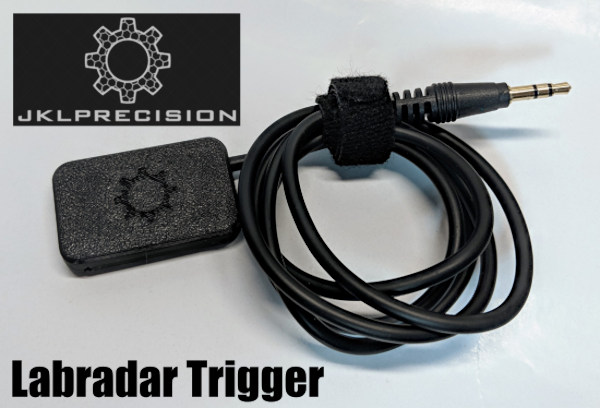
SUMMARY: This article reviews a device that “triggers” the LabRadar chronograph to register bullet speed. Rather than activate by sound or Doppler reading, this $35 JKL Inertial Trigger works from the rifle’s instantaneous recoil pulse when a shot is fired. After some frustration with his LabRadar when shooting at a range with reflective surfaces, our tester is now reporting that 100% of his actual shots are being captured correctly by his LabRadar chrono equipped with the JKL Inertial Trigger. He won’t use his LabRadar without it now. Other users have become instant fans of this inertial LabRadar trigger as well. It is very affordable and it works great. VIEW LARGE PHOTO.
JKL Inertial Trigger for LabRadar Chronograph
Product Review by F Class John
The LabRadar chronograph has been one of the most revolutionary tools in the shooting world because of how it collects velocity data, how it reports (and stores) that data, and, ultimately, the ease with which it can be positioned and operated. However, it’s not a perfect system. A majority of the complaints come from users whose LabRadar’s sometimes fail to record all the shots fired in a string. For the average plinker, this may not be an issue. But for serious shooters trying to do ladder tests or load development requiring all shots to be reported, it can be frustrating when a shot is missed.
Traditionally, LabRadar has recommended trying different settings that compensate for the gap between the unit and muzzle as well as well as having different options for how the unit recognizes a shot fired. While these options work to some degree, they aren’t a guaranteed fix especially when shooting at ranges with concrete baffles or with roofs, walls, and dividers that can alter sound waves. While nobody can precisely explain why shots are lost under certain circumstances, the fact remains it DOES happen. In addition, the default system can sometimes pick up stray shots from nearby rifles.
Not willing to give up on this sophisticated chronograph, many shooters have looked for a foolproof way to prevent such failures from happening. In fact, for this shooter, the frustration was so high that I actually sold my first LabRadar and went back to another chronograph before ultimately buying another LabRadar almost a year later. But I made that repeat purchase only after vowing to finding a way to make the LabRadar work — EVERY time, for EVERY shot.
See How JKL Inertial Trigger Works in this Video
JKL Inertial Trigger — Outstanding Product That Works Great
Enter the JKL Trigger for the LabRadar. This is an easy-to-use, inertial-driven trigger that activates simply from the recoil of your gun. The unit consists of a small rectangular pad attached to a long audio cable. All you do is plug in the audio cable, attach the pad to your gun with the provided hook and loop (Velcro) material. Then (important), you must change the LabRadar trigger settings from “Doppler” to “Trigger”. The unit works great and is easy to set up. In my experience, the unit will activate no matter where you place it on a stock. However the recoil of every gun is slightly different, so you will need to make sure you find a location that doesn’t interfere with your shooting setup.
An unexpected benefit of using the JKL trigger is that it gives you a larger area in which to place your Labradar unit, making it more convenient to setup on benches or range stations. I found this a welcome relief since the LabRadar originally seemed somewhat fussy about where I placed it. Now I can place the LabRadar in more convenient locations — as long as it’s still near my gun and pointed at the target correctly, I get consistent bullet speed data.
Are There Issues with “False Positives”?
If there is any downside to using the JKL Inertial Trigger, it’s that a very hard bump or aggressive working of the action can trigger a false reading. However these are easy to identify in your data, because the speed value is way lower than true fired shot values. Simply remove that low entry or otherwise ignore it in your calculations. To be fair, this “bump activation” really doesn’t happen very often once you get used to using the inertial trigger.
SUMMARY — Outstanding Accessory for LabRadar Users
Bottom line — if you own a LabRadar, then definitely get a JKL Inertial Trigger. Priced at just $35.00 this device is not expensive, yet it’s one of the most effective accessories you can buy for the LabRadar. I’ve recommended these inertial triggers to dozens of shooters. Every one of those guys who did buy a JKL trigger says they can’t imagine using a LabRadar without one. If you love what the LabRadar can do, but have been frustrated with shots not getting recorded 100% of the time, then definitely get yourself a JKL Inertial Trigger. It turns a good system into an amazing system. JKL Industries states that its inertial trigger “will work on anything from a .22 LR to a suppressed system or with standard rifle and brake.”
Emily was just 8 years old when this photo was taken back in 2017. She’s now 11 but still enjoying shooting. Emily has won many awards — including a screamer at 1000 yards — and her accomplishments have not gone unrecognized.
English Emily and Her Record-Breaking 6mmBR Stolle
Report by Vince Bottomley
Turning back the clock a decade or so to 2006 and Accurateshooter’s Gun of the Week #71 you will see my smiling face and my 7mm WSM BAT which had just set a new UK Light Gun record for 1000-yard benchrest with a 5-shot group measuring 2.67 inches. That record has now been broken — sadly not by me but by Emily’s Grandfather with a gun I built for this talented schoolgirl. Here’s the story of the precocious Emily and her record-setting rifle…
In 2006, when I set the record, young Emily Lenton wasn’t even born but, a couple years later she arrived – into the shooting-mad Lenton family. Both father Bruce Lenton and Granddad Tony have represented their Country at European and World Benchrest Championships and it was no surprise to see Emily, at just eight years old in 2017, shooting in her first 1000-yard benchrest competition.
Emily Shoots 6mmBR Heavy Gun at 1000 Yards.
Recoil is always going to be a problem for a very young shooter, so Emily’s first bench-gun was Granddad’s 1000-yard Heavy Gun chambered for the 6mmBR cartridge. It hardly moves when Emily pulls the trigger and she soon became a serious contender. [Emily was 8 when she started, and is now 11 years old.]
Under her father Bruce Lenton’s careful supervision, Emily loads all her own ammunition.
Of course, she wanted her own gun and who better to ask to build it than the current record holder — me of course! Emily chose a Stolle action RBLP as this was to be a 17-lb Light Gun, bedded into a UK-made Joe West laminate stock. The barrel was a heavy-profile 1:8″-twist Krieger chambered in 6mm BR Norma (6BR) with a ‘no-turn’ neck (reamer from Pacific Tool & Gauge) and fitted with a UK Tier One muzzle-brake.
Emily’s Light Gun begins to take shape…
It was down to Granddad to help Emily with load-development and of course, he could also shoot it in competition — after all Emily had just about shot-out Granddad’s Heavy Gun with a full season of rapid-fire 10-shot groups!
Granddad Tony gets ready to shoot Emily’s gun.
Then something happened – Granddad went and broke my ten-year old record with Emily’s gun! Well, I suppose there was some consolation — at least I’d built the record-breaking gun. The new UK Light Gun 1000-yard five-shot record now stands at 2.462 inches. For those who like load details, Emily uses Lapua brass, Vihtavuori N150 powder, CCI 450 primers, and Berger 105 grain VLD bullets loaded with Wilson hand dies.
Tony Lenton with Emily’s gun just after he broke my 1000-yard record. I’m doing my best to smile!
Emily in New Zealand at 2017 World Benchrest Championships Down Under
Emily traveled down under to New Zealand in 2017 with her family. She helped her father and Granddad who were part of the United Kingdom squad competing at the 2017 World Benchrest Shooting Championships in Nelson, NZ.
Vince Bottomley reports: “Emily was a huge hit over in NZ — she was given the honor of hoisting the New Zealand flag at the opening ceremony, she drove the target changer’s buggy, did some impressive shirt-swapping”. Here she is wearing a Team Canada Jersey — a bit big for pint-size Emily.
The folks at Sierra Bullets asked a few staff bulletsmiths a classic question about guns: “If you could own only one firearm which one would you choose?” There were many interesting answers including a “cheater” response — the drilling — which is really two guns in one. The most-often mentioned chambering was the venerable .30-06. Respondents cited its versatility, hunting prowess, and ready availability of ammo. The popular .308 Winchester, as expected, got mentions as did its cousins the .243 Win and 7mm-08. There were quite a few votes for classic lever guns, as well as 12-gauge shotguns. Two bulletsmiths cited the .22 LR, and we can certainly see the logic in that answer. The little rimfire cartridge is versatile, quiet, and inexpensive.
We ask our readers the same question — if you could only have one long gun, what type of firearm would it be? List the gun type and chambering in the comments section.
If You Could Have Just One Long-Gun — ANSWERS:
Media Relations Manager Carroll Pilant answered: “I would NEVER own only one gun. If I HAD to pick one, it would be a drilling in 12 gauge over .30-06.”
Ballistic Technician Rich Machholz answered: “The early tang safety Ruger M77s pretty much have all you could want in a bolt gun, but I do like the Winchester lever guns and the combination guns, particularly the drillings. Since I have the first two, I’m going for a Doug Turnbull 1886 or a side by side 20 gauge over .223 drilling.”
Ballistic Technician Philip Mahin answered: “More than likely it would have to be a bolt action .30-06. The reliability is legendary on a wide range of game animals and factory ammunition has still been available at my local stores even in these tough times.”
Ballistic Technician Duane Siercks answered: “If I had to boil it all down to one gun, it would probably be a .30-06. I have a Remington 700C (custom shop gun) that has worked very well for anything and everything I have ever wanted to do with it.”
Ballistic Technician Paul Box answered: “A .22 Rimfire.”
Chief Ballistician Tommy Todd answered: “Remington 700 in .308 Winchester.”
VP – Sales & Marketing Matt Reams answered: “A light weight Kimber in 25-06.”
Production Toolsetter Brad Vansell answered: “Savage weather warrior 7mm-08 is my rifle of choice.”
Production Toolsetter Dan Mahnken answered: “The .308 Winchester rifle — [based on the] wide range of bullets made and the wide range of things that one can hunt with it.”
Process Engineer David Palm answered: “Savage action 243 Winchester.”
Ballistic Technician Gary Prisendorf answered: “Probably a .22 LR. It may not be the best choice, but you could use it for about anything if you really had to.”
Production Manager Chris Hatfield answered: “Beretta A300 Outlander 12 gauge.”




 All shooters, even rimfire enthusiasts, should always wear ear protection when at the range. A typical rifle gunshot is very loud — in the region of 140 to 170 decibels (the pain threshold is 130-140 db). Without ear protection, you can permanently damage your hearing during a single shooting session. We all know older shooters who are partially deaf, or who suffer from
 Plugs PLUS Ear-Muffs — The Benefits of “Doubling-Up” Your Hearing Protection




 The Firearms Policy Coalition (FPC), Second Amendment Foundation (SAF) and California Gun Rights Foundation (CGF) challenged these gun store closures. And today we’re happy to report a big victory. After being sued in Federal District Court, the County of Ventura (population 846,000) has allowed firearm and ammunition dealers to open again. Effectively County officials conceded that their orders were unjustified and unconstitutional. See filings in the case of