In the world of F-Class, PRS and other precision rifle disciplines, scope manufactures such as Nightforce, Kahles, and Vortex currently dominate the firing lines. However, Oregon-based Leupold has set out to change all that. Long known for premier hunting and military scopes, Leupold has set its sights squarely on the long-range competition market with the Mark 5HD series scopes. With these scopes (available in both MIL and MOA versions), Leupold now has a clear, repeatable, versatile scope in a wide range of magnifications, all the way up to 7-35X. We tested the Leupold Mark 5HD 7-35x56mm MOA second focal plane (SFP) optic. Though it features a very large 35mm (yes thirty-FIVE mm) main tube, it is one of the lightest scopes in its class — a bonus for guys struggling to make weight with their comp rifles.
Leupold Mark 5HD 7-35x56mm Field Test Report by F-Class John
The Mark 5HD is a beast of a scope packed into a great-looking and sturdy form factor. While mounting and bore-sighting the scope, I immediately like the size, shape and feel of the elevation and windage knobs. The knobs have a solid, positive feel with distinct, lovely clicks every time they were turned. I was happy to see that Leupold designed the elevation to actually go under zero which can be helpful in some situations.
Scope Box Test in Tunnel
I ran a box test while shooting in a 100-yard tunnel going clockwise then counterclockwise around the corners. I found that the repeatability to be “spot on” with each 5 MOA adjustment landing me basically back on top of the previous shots. After five passes back and forth I was left with four ragged holes in each corner. That’s impressive.
The power ring became one of my favorite features, with its incredibly functional throw lever. Actually more of a throw knob, this allows for quick and smooth change of power. Combine these features with 100 MOA of vertical adjustment and 50 MOA of windage and you have just about everything need to achieve your goals.
Reticle Options for Mark 5HD 7-35x56mm — TMOA Plus on Test Scope
Leupold currently offers two reticle options for its second focal plane (SFP) Mark 5HD 7-35X scope: the TMOA Plus (above) and the Impact-60 (right). The Impact-60 reticle features Xmas Tree-type vertical and horizontal hold-offs. My test scope had the TMOA Plus reticle, a much simpler design with an open aiming point in the center of the reticle for precise shot placement.
The TMOA Plus takes a little getting used to especially if you’re coming from a center dot or crosshair like I did. This is because there’s nothing dead center in your reticle, only four small hold squares at 3, 6, 9, 12 o’clock around center. You can use the aiming center to center up on a bullseye or any of the points around the center as hold off points. A side benefit is that the center set of squares are designed to perfectly fill the X ring at 1000 yards for easy aiming. I will say that once you get used to the reticle configuration it starts to become more intuitive and you can find different ways to use it when holding off for different conditions.
Leupold Mark 5HD Delivers Outstanding Brightness and Clarity
As I got behind the scope, I was surprised by the amount of light coming in through the large 35mm main tube. I tested the scope in the early morning just after dawn, during mid-day, and also at night. Where I shoot there is often a good amount of head-on light coming over the hills in the morning. With my current premium scope, I often see a faint glare (often seen as a haze or whiteness) that will ultimately resolve itself by mid-day but nonetheless bothers me in those early relays. The Mark 5 had NONE of this. The first time I thought it was a fluke but after countless mornings without the annoying haze I was convinced it was the glass. Leupold told me that the Mark 5HD’s superior haze- and glare-free morning performance was a function of how the lens coatings are applied.
While many top-end scopes have quality coatings, the method of applying coatings can produce micro flaws. Leupold explained that such flaws, under certain light conditions, can create a hazy view through the lens. Leupold has clearly mastered this process, achieving a visually clear scope no matter what direction the light comes from, even head-on.
HD Glass Eliminates Chromatic Aberration
Optical performance during mid-day was bright and clear. Importantly, I did notice the absence of chromatic aberration which I have experienced with some other popular-brand scopes. Chromatic aberration usually manifests as fringes of color around hard edges and can be seen even in some of the better scopes. This can affect your ability to see mirage, or to see details on a long-range target. With the Leupold Mark 5HD, chromatic aberration was noticeably absent.
The Leupold Mark 5HD also worked great during an evening shooting session. My club has night shooting for our 600-yard matches. We do it every Tuesday night, so I had lots of time to test the scope in the evening. Our club has lit targets, and even with the rest of the range dark, the targets were clear and bright, making it easy to aim precisely.
SUMMARY — Great Sharp, Clear Scope — More Magnification Would be Welcome
The majority of my testing was in F-Class and while I found nearly every aspect of the scope enjoyable, I did find myself wanting just a little more magnification. I have no doubt that in other disciplines such as PRS and ELR the 7-35X is more than enough and in fact perfectly suited. However, in the current F-Class world, 35X max magnification is on the low end, as other leading optics-makers offer scopes in the 50-60x range.
Overall, I really enjoyed this scope and think it’s going to become the favorite for a lot of shooters. It is easy to use and incredibly clear. Despite its beefy look it actually weighs less than many scopes in this category. Leupold says the Mark 5HD is “up to 20 ounces lighter than other scopes in its class”. That’s great for disciplines with tight weight limits. If you’re in the market for a new competition optic you should give one of the new Mark 5HD scopes a try.
The U.S. Army Marksmanship Unit (USAMU), in cooperation with Shooting USA TV, has created a series of instructional Pro Tip pages covering a wide range of shooting disciplines. All totaled, there are more than 50 USAMU Pro Tips. Most relate to rifle marksmanship but there are also numerous tips for shotgunners and pistol shooters. Each Pro Tip entry includes multiple photos and 6-15 paragraphs, in an easy-to-follow format. Many Pro Tips also include an instructional video produced by Shooting USA. Here are three Pro Tip videos, and links to seven more Pro Tip web pages.
USAMU TOP TEN PRO TIPS
1. Reading the Wind with SGT Sherri Gallagher.
Apart from gravity, wind has the most pull on the bullet as it travels down range. Being able to accurately read the wind and mirage will greatly enhance your performance on the rifle range. National Champion, SGT Gallagher gives you some of her tips.
2. Angle Shooting with SFC (Ret.) Emil Praslick.
SFC Praslick shows you how to determine the angle to your target, and then how to include that to change your data necessary to hit your target on the first shot.
3. Rifle Grip, Stance and Body Position for 3-Gun with SFC Daniel Horner.
Professional 3-gun marksman SFC Daniel Horner, U.S. Army Marksmanship Unit (USAMU), give tips on how to properly handle a semi-automatic rifle, including grip, stance and body position.
Happy New Year to all our readers worldwide, and especially the 48,120+ members of our AccurateShooter Forum. We hope 2020 brings you happiness in your lives and success in your endeavors. And we wish for small groups, good scores, and successful hunts in the New Year.
Forum Members — Upgrade Your Membership to Get Unlimited Classifieds for 12 Months.
Looking Forward to 2020 Every year we work to improve AccurateShooter.com. In 2016 we completely overhauled the Forum, making it faster and more mobile-friendly. In 2017 we upgraded our servers. In 2018 we started vetting every new sign-up to prevent scammers. In 2019 we added more security measures, expanded our popular Deals of the Week, and commenced our first-ever exclusive Promos for Gold and Silver members. We hope you’ll continue to enjoy our feature articles, our Daily Bulletin, our match reports, and our Forum Classifieds. The formula seems to be working — our audience is bigger than ever.
Forum Membership Increased 11.5% in 2019
Our Shooters’ Forum grew significantly in 2019. Our membership grew by 11.5% as Forum ranks swelled to 48,120+ members! More people are successfully buying and selling in our Forum Classifieds section than ever before. Silver and Gold members get unlimited Classifieds for 12 months. Gold members also get custom Avatars and other privileges.
We need your support. For 16 years the site has relied largely on volunteer efforts. But as the site grows, we need the assistance of Forum moderators, product testers, web gurus, and computer software experts. Those guys don’t work for glory alone.
Consider this — you’ll pay $25 for a couple movie tickets and a large popcorn these days. For the same twenty-five dollars you can become a Silver Forum member for a YEAR and help this site provide info, tests, tech tips, bargains, and shooting news.
And consider the benefits — Silver or Gold Members get unlimited classifieds for 12 months. If you were to sell just ONE $1500 rifle through Gunbroker.com, you would pay $58.75 in fees! That’s more than our Gold Membership — just to sell one single rifle.
In the last quarter of 2019 about 470 site users have donated or upgraded their Forum membership to Silver or Gold Levels. That’s less than 1% of the membership. We thank all those who have generously contributed. But that still leaves tens of thousands of users who access the site every week without contributing. With more donations we can deliver more premium content and offer more services to our members.
How to Contribute
If you are a Forum member, you can help the site by UPGRADING your membership. CLICK HERE to UPGRADE.
If you’re not a member, making a donation to the site is simple and easy. Just click on the orange “Donate” button at right. If you have a credit card, you don’t need a Paypal account to contribute.
IMPORTANT: After you click on the orange button a PayPal screen will load. You’ll also see a field that says “0.00”. For desktop users that field will be on the right (with other pre-set amount buttons on the left). Fill in the amount you want to give. For example, to give $25, type 25.00 in the amount field.
Help Support this Site by Making a Secure Donation.
If You Don’t Like PayPal, You Can Send a Check.
Make the check payable to: Jeff Williams. Please list your Shooters’ Forum Log-In Name (if any), and mail the check to:
Jeff Williams
P.O. Box 240
Solon Springs, WI 54873
Winter testing image from Alex Wheeler and TM — That’s dedication!
There’s a nice article in the Western Powders Blog that any varminter will enjoy. In this hare-raising tale, gunwriter Jim Waddell explains how he used a self-loading Savage A17 rifle to take care of a serious jack-rabbit problem on a rancho in California. “[My friends] purchased a huge amount of acreage that had some existing alfalfa fields and [surrounding sagebrush]. Sagebrush is home to jack rabbits. Lots of jack rabbits. The previous owner of this property didn’t do any varmint or predator control[.] The ink wasn’t dry on the escrow papers before [my friends] started asking for help shooting rabbits. A problem in taking these critters is it has to be done at night when they come out to feed as they lay low in the bush during the daylight hours.”
Savage A17 Comes to the Rescue
Initially Waddell and some friends took on the jack-rabbit hordes using Ruger 10/22s and a .44 Magnum Marlin lever gun. Neither option was ideal. The .44 Magnum just couldn’t keep up the desired shooting pace (it took too long to reload) ant the .22 LRs were too anemic. So Waddell decided to give the more potent 17 HMR a try. He acquired a Savage A17 and went back for a second bunny-busting session. He came away convinced that the 17 HMR cartridge in the modern semi-auto Savage works great for small varmint control.
Waddell writes: “I wanted more than a .22 after seeing the problems my pals had with their [10/22] bullets not anchoring the rabbits. Armed with my new Savage A17 it was time to head back to the alfalfa fields. This time my hunting partner was Dan, my son-in-law from Seattle. We hunted for four nights. Each night was either raining, windy or both. My question about whether or not rabbits would be out in the weather was answered immediately. They were everywhere. As miserable as the weather was, we got all the shooting we wanted and that Savage rifle was up to the task. We got so many rabbits it was impossible to count.” CLICK HERE for the full account of Waddell’s jack-rabbit adventures on the California rancho. It’s worth a read. Here is a sample:
Wabbits, Wabbits Everywhere — Even Running Right at You
I couldn’t believe my eyes when I saw a sea of rabbits as far as the lights would shine and when the light beams hit the bunnies, they became confused and as often as not, would run right at the lights so a good percentage of our shots were literally in spitting distance. It was also a new experience shooting at targets that are running TOWARD you. Most of us who’ve done much hunting for game or varmints have experienced moving targets but how many of those targets are coming at you?
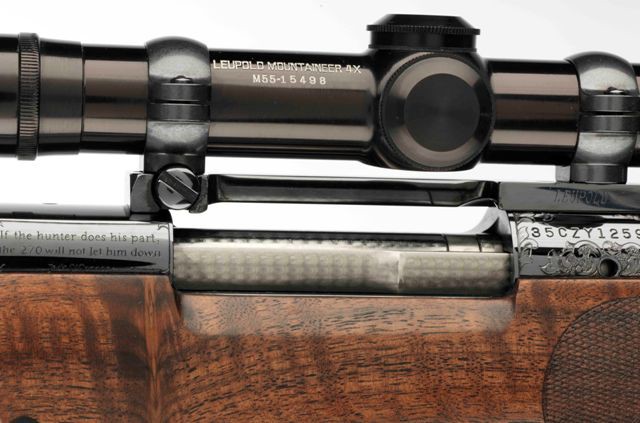
“If the hunter does his part, the .270 will not let him down” — Jack O’Connor.
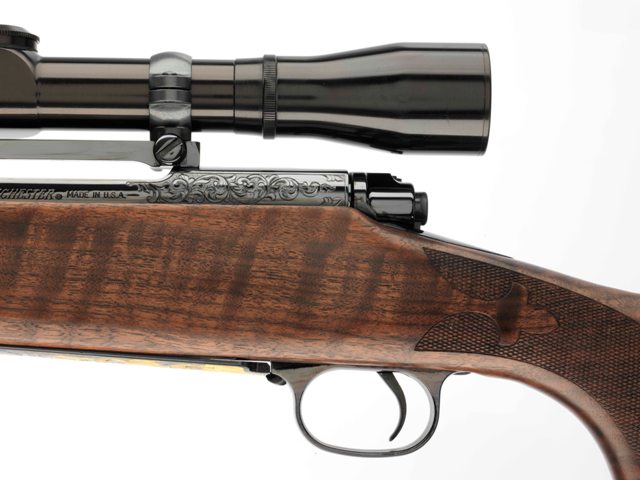
Classic hunting rifles never go out of style. We thought our readers would enjoy this very special high-grade Jack O’Connor Tribute rifle in .270 Winchester. This unique Model 70 was a SHOT Show featured rifle back in 2013. It was auctioned off with the proceeds benefiting hunting and shooting sports. Jack O’Connor, a legendary outdoorsman and hunting writer, would have been proud. In his 1964 classic work The Rifle Book, O’Connor wrote: “I like a handgun. I hold a shotgun in high regard; but rifles — well, I love the darn things…”
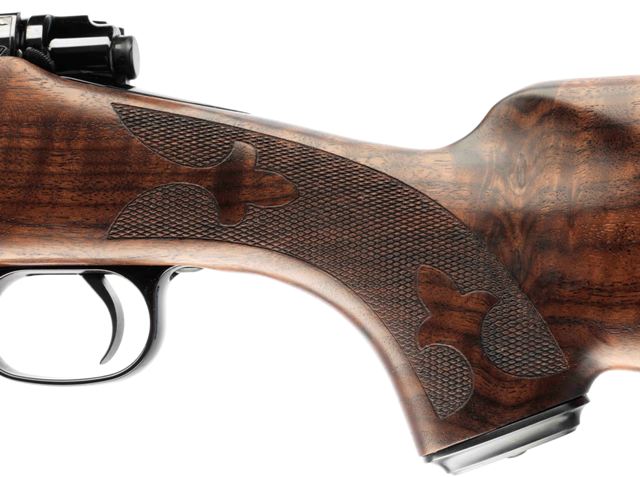
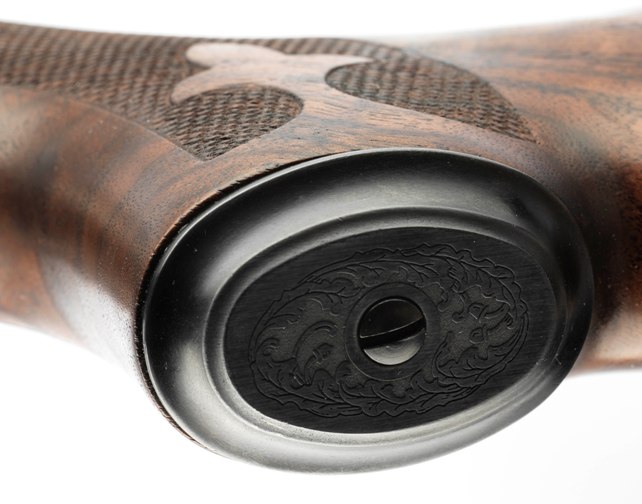
Winchester Repeating Arms declared that this 2013 SHOT Show Winchester Model 70 would be the last-ever Jack O’Connor Tribute rifle. The stock for this rifle is AAA grade Claro Walnut with Ebony forearm tip and shadowline cheekpiece. The rifle’s metalwork has been hand-engraved by the artisans at Baron Engraving. The rifle features a featherweight contour, free-floating barrel with target crown. Interestingly, the Leupold 4X Mountaineer riflescope mounted on this rifle is an original 1950s-era Mountaineer from the vaults of Leupold & Stevens.
Click each image to see larger version with detail.
“A good sporting stock should enable the shooter to get a shot off quickly and accurately, and it should also be a thing of beauty. Many fine sporting stocks are handsome but of little aid in accurate shooting. Many others that hold and shoot well are homely and clumsy.
The very best sporter stock design results in a stock with handsome, graceful lines and one which also enables the man behind it to do his best work.” — Jack O’Connor, The Big Game Rifle (1952).
About Jack 0’Connor “Dean of Outdoor Writers”
Jack O’Connor, sheep hunting, and the Model 70 Winchester in .270 are linked in our collective subconscious. In 1939, O’Connor was appointed new guns editor for Outdoor Life, and in 1941, he took over the Arms and Ammunition column. In those days, Coues deer and desert sheep were his passions, and a lot of rifles came and went through his hands. By the end of 1946, O’Connor had hunted enough North American sheep to complete three grand slams.
By 1954, he thought he had his ultimate rifle, a custom Model 70 in .270 Winchester that he had taken to Wyoming for elk, to India for blackbuck, and to Iran for red sheep and ibex. He liked the rifle so much, he called it his No. 1 and set out to build a second to give his favorite a break from testing new bullets and developing loads.
Sporting Classics offers a collection of great Jack O’Connor stories from the pages of Outdoor Life, Field & Stream, Petersen’s Hunting and other popular magazines of his day. This 440-page book, entitled Classic O’Connor: 45 Worldwide Hunting Stories, is a sequel of sorts to Sporting Classics’ popular compendium, The Lost Classics of Jack O’Connor.
In this collection, Jack O’Connor recounts his worldwide hunting adventures, during which he pursued everything from ducks to grizzlies, pheasants to kudu. Classic O’Connor presents several of the author’s greatest gun stories and a large selection of never-before-published photographs of the celebrated sportsman and his family on hunting adventures around the world. The book is illustrated with 40+ drawings by acclaimed artist Ron Van Gilder. This excellent O’Connor collection is available on Amazon in hardcover or paperback, starting at $38.99 (used) or $59.98 (new).
The Hunting Rifle by Jack O’Connor
Another O’Connor title worth reading is The Hunting Rifle, still considered one of the definitive works on selecting a hunting rifle and cartridge. One owner of The Hunting Rifle explains:
“It would benefit every hunter to take the time and read this book. It offers a corrective to the spirit of things that have gripped the hunting scene lately. Today, if one reads a hunting magazine, [one is] offered the view that you need the fastest and loudest cartridges, rifles with special finishes and the most expensive of anything. Ole Jack reminds us that many have killed game with ‘lesser’ guns for a very long time, and that these new gimmicks will not make you a more lethal hunter.”
In our Shooters’ Forum, one member recently asked: “What makes an AR accurate? What parts on an AR can really affect accuracy — such as free-floating handguards, barrels, bolts, bolt carriers?” He wanted an honest, well-informed answer, not just sales pitches. Robert Whitley posted a very comprehensive answer to this question, based on his experience building and testing dozens of AR-platform rifles. Robert runs AR-X Enterprises, which produces match-grade uppers for High Power competitors, tactical shooters, and varminters.
Building an Accurate AR — What is Most Important
by Robert Whitley
There are a lot of things that can be done to an AR to enhance consistent accuracy, and I use the words “consistent accuracy” because consistency is a part of it (i.e. plenty of guns will give a couple great 5-shot groups, but won’t do a very good 10- or 20-shot groups, and some guns will shoot great one day and not so good on others).
Here are 14 key things we think are important to accuracy.
1. Great Barrel: You’ll want a premium match-grade barrel, well-machined with a good crown and a match-type chambering, true to the bore and well cut. The extension threads must also be cut true to the bore, with everything true and in proper alignment.
2. Rigid Upper: A rigid, heavy-walled upper receiver aids accuracy. The typical AR upper receiver was made for a lightweight carry rifle and they stripped all the metal they could off it to make it light to carry (which is advantageous for the military). The net result are upper receivers that are so thin you can flex them with your bare hands. These flexible uppers are “strong enough” for general use, but they are not ideal for accuracy. Accuracy improves with a more rigid upper receiver.
3. True Receiver Face: We’ve found that truing the receiver face is valuable. Some may argue this point but it is always best to keep everything related to the barrel and the bore in complete alignment with the bore (i.e. barrel extension, bolt, upper receiver, carrier, etc.).
4. Barrel Extension: You should Loctite or glue the barrel extension into the upper receiver. This holds it in place all the way front to back in the upper receiver. Otherwise if there is any play (and there typically is) it just hangs on the face of the upper receiver completely dependent on the face of the upper receiver as the sole source of support for the barrel as opposed to being made more an integral part of the upper receiver by being glued-in.
5. Gas Block: You want a gas block that does not impose pointed stress on the barrel. Clamp-on types that grab all the way around the barrel are excellent. The blocks that are pinned on with tapered pins that wedge against the barrel or the slip on type of block with set screws that push up from underneath (or directly on the barrel) can deform the bore inside of the barrel and can wreck the accuracy of an otherwise great barrel.
6. Free-Float Handguard: A rigid, free-float handguard (and I emphasize the word rigid) really makes a difference. There are many types of free-float handguards and a free-float handguard is, in and of itself, a huge improvement over a non-free-float set up, but best is a rigid set-up. Some of the ones on the market are small diameter, thin and/or flexible and if you are shooting off any type of rest, bipod, front bag, etc., a rigid fore-end is best since ARs want to jump, bounce and twist when you let a shot go, as the carrier starts to begin its cycle before the bullet exits the bore.
7. Barrel Contour: You want some meat on the barrel. Between the upper receiver and the gas block don’t go real thin with a barrel (we like 1″ diameter if it’s workable weight-wise). When you touch off a round and the bullet passes the gas port, the gas system immediately starts pressuring up with a gas impulse that provides vibrations and stress on the barrel, especially between the gas block back to the receiver. A heavier barrel here dampens that. Staying a little heavier with barrel contour through the gas block area and out to the muzzle is good for the same reasons. ARs have a lot going on when you touch off a round and the gas system pressures up and the carrier starts moving (all before the bullet exits the bore) so the more things are made heavier and rigid to counteract that the better — within reason (I’m not advocating a 12-lb barrel).
8. Gas Tube Routing Clearance: You want a gas tube that runs freely through the barrel nut, through the front of the upper receiver, and through the gas key in the carrier. Ensure the gas tube is not impinged by any of them, so that it does not load the carrier in a stressed orientation. You don’t want the gas tube bound up so that when the gas tube pressures up it immediately wants to transmit more force and impulse to the barrel than would normally occur. We sometimes spend a lot of time moving the gas block with gas tube on and off new build uppers and tweaking gas tubes to get proper clearance and alignment. Most gas tubes do need a little “tweaking” to get them right — factory tubes may work OK but they typically do not function optimally without hand-fitting.
9. Gas Port Tuning: You want to avoid over-porting the gas port. Being over-gassed makes the gas system pressure up earlier and more aggressively. This causes more impulse, and increases forces and vibration affecting the top end and the barrel. Tune the gas port to give the amount of pressure needed to function properly and adequately but no more.
10. Front/Back Bolt Play: If accuracy is the game, don’t leave a lot of front/back bolt play (keep it .003″ but no more than .005″). We’ve seen factory rifles run .012″ to .015″ play, which is OK if you need to leave room for dirt and grime in a military application. However, that amount of play is not ideal for a high-accuracy AR build. A lot of front/back bolt play allows rounds to be hammered into the chamber and actually re-formed in a non-consistent way, as they are loaded into the chamber.
11. Component Quality: Use good parts from a reputable source and be wary of “gun show specials”. All parts are NOT the same. Some are good, some are not so good, and some aftermarket parts are simply bad. Don’t be afraid to use mil-spec-type carriers; by and large they are excellent for an accuracy build. Also, remember that just because a carrier says “National Match” or something else on it does not necessarily mean it’s any better. Be wary of chrome-plated parts as the chrome plating can change the parts dimensionally and can also make it hard to do hand-fitting for fit and function.
12. Upper to Lower Fit: A good upper/lower fit is helpful. For quick and dirty fit enhancement, an Accu-Wedge in the rear helps a lot. The ultimate solution is to bed the upper to a specific lower so that the upper and lower, when together, are more like one integral unit. For the upper receivers we produce, we try to get the specs as close as we can, but still fit the various lowers in the market place.
13. Muzzle Attachments: Don’t screw up the muzzle (literally). Leave as much metal on the barrel at the muzzle as you can. People like to thread the muzzle for a flash hider, suppressor, muzzle brake, or some other attachment, but if you really want accuracy, leave as much metal as you can there. And, if you have something that screws on, set it up so that it can be put on and have it stay there without putting a lot of torque and stress on it right where the bullet exits the bore. If you are going to thread the end of the barrel, make it concentric with the bore and make sure what you screw on there is as well. For all muzzle attachments, also ensure that the holes through which the bullet passes through are dead true to the bore. Many aftermarket screw-on things are not so good that way. Anything that vents gas should vent symmetrically (i.e. if it vents left, it should vent equally right, and likewise, if it vents up, it should vent down equally). Uneven venting of gas can wreck accuracy.
14. Quality Ammunition: Ammo is a whole story by itself, but loads that are too hot typically shoot poorly in an AR-15. If you want accuracy out of an AR-15, avoid overly hot loads. Shown below are test groups shot with four (4) different uppers, all with moderate loads. These four uppers all pretty much had the same features and things done to them as explained in this article, and they all shot great.
When Annealing Made Perfect (AMP), a New Zealand-based company, first unveiled its original induction annealing machine at SHOT Show 2015, it was big news in the reloading world. This was a real breakthrough — an induction annealer running on electricity that was fully programmable. No more flames to fuss with. The advent of the AMP annealer was a true “game-changer” for the shooting enthusiasts who reloaded their ammo.
The AMP system is based on smart science and modern technology. Right from the start, AMP invested in advanced lab equipment (such as gear for Micro-Vickers hardness testing). AMP also worked with independent outside metallurgical laboratories. And AMP invited shooters from around the world to send in sample cartridge cases. AMP accumulated a huge archive of cartridges from .17 Hornet to an array of .50 BMG wildcats and everything in-between. AMP’s archive includes multiple brands and even different lot numbers of the same cartridge. AMP now offers the most highly developed and precise consumer annealing system on the planet. That is because of the amazing amount of R&D behind the product, plus the use of advanced technologies.
Annealing Under the Microscope — Informative Articles
Alex and Matt Findlay have produced a series of articles called “Annealing Under the Microscope”. The first of these was released in July 2017. Part 1 was a general explanation of annealing, and busted a number of myths. It examined the repeatability of annealing over multiple reloads, and conducted a series of tensile bullet pull tests.
Annealing Different Brands of Brass
Part 2 of Annealing Under the Microscope covered an important topic — annealing for different brands of brass. This article examines the reasons why different brands of the same cartridge can require different annealing settings. The article also reveals that lot to lot variations of the same brand of brass can make a big difference.
AZTEC Annealing System — AMP Annealers become Smart Machines
In late 2017, Alex and Matt started the development of their revolutionary AZTEC system, which in effect transformed AMP annealers into SMART annealers. It meant that individual customers could analyse their own cases with laboratory grade accuracy without the need to send samples to the AMP lab for calibration.
Part 3 of Annealing Under the Microscope was released in July 2018 after nearly 12 months of R&D on AZTEC. It focused on how to best utilize this new self-calibration capability. It also highlighted the difference between several “premium” brands of brass compared to cheaper alternatives.
Benefits of Precision Annealing — Accuracy and Repeatability
Part 4 of the series was released in September 2019. It focused on the true benefits of accurate annealing, and the arguments for annealing every reload. The study identified sizing accuracy and repeatability as the key factor. This article also revealed the first prototype of AMP’s new auto bullet seater with seating pressure data capture.
Proof on the Target — Down-Range Benefits of Annealing
In Part 5 of the series, AMP’s experts focus on the real world, down-range benefits of annealing, turned out to be a much more complex process than AMP initially planned. Accordingly, Part 5 was conducted in three stages, with three detailed write-ups.
The Part 5, Stage 1 paper examined sizing accuracy of annealed vs un-annealed cases, taking two sets of three identical Peterson Cartridge .308 Winchester cases through twenty (20) reloading cycles. For every cycle, cases were measured both fire-formed and as re-sized. With each cycle the cases were measured for case length, shoulder bump, neck OD, and head OD.
Field Testing in Tennessee — Proof on Target
The Part 5, Stage 2 article covered detailed ballistic testing using multiple rifles, cartridges, and shooters at the Strategic Edge range in Tennessee.
The Tennessee testing sessions accumulated a wealth of data on velocity spreads and group sizes right out to 1,000 yards. The evidence showed a clear advantage for annealed brass, both for average group size and average Extreme Spread for the groups shot with AMP-annealed cases.
Underground Testing with Lou Murdica
Lastly, AMP’s Part 5, Stage 3 paper featured testing by Lou Murdica at an underground range in California. We have previously shown a video of Lou shooting one case, then reloading it and shooting the same case into the same hole at 100 yards.
This time he repeated the feat, shooting one un-annealed case twenty times into the one hole. Then Lou produced another even smaller 20-shot group, shot with a case which he annealed before every shot.
Enjoy These Technical Articles from AMP Annealing
Collectively AMP’s “Annealing Under the Microscope” series represents a remarkable body of outstanding work. Whether you anneal your cartridge brass now, or just want to learn more about the benefits of annealing, we recommend you take a look at this series of informative articles.
These days, online gun Auctions and Classifieds attract more attention than ever. With so many folks accessing the internet daily, many gun owners find it easier to sell their firearms online rather than in the local gun store. Online selling opens up a much larger audience. With nearly 50,000 members in the AccurateShooter Forum, we have a very active gun Classifieds area. And then of course, there are the big dogs — Gunbroker and GunsAmerica. You’ll find tens of thousands of guns for sale on those big sites.
Before selling your stuff online, you should survey the major online sales and auction sites, comparing their fees and features. The costs are NOT all the same. For example, though you can list an item on Gunbroker for free, if the gun sells you may end up paying a LOT of money. Confirm this with the Gunbroker FEE Calculator. Using Gunbroker’s Fee Calculator we determined that, for a $2500.00 gun, the seller will pay $93.75 in fees! Yes, that’s for a single sale. That’s why many sellers prefer to list their rifles on Benchrest.com, or right here on AccurateShooter.com for FREE. Currently, basic members get five (5) free adverts in a 12-month period, while Gold and Silver members get unlimited classifieds for 12 months.
SEVEN TIPS for Selling Your Gear Online
1. Include Good, Sharp Photos: A custom rifle or expensive optic will sell two to three times as quickly, at a higher price, if you include good sharp photos. We can’t over-emphasize the importance of good photos. For all products, show multiple angles, and include the original boxes if you still have them. For a rifle, include detail shots as well as a photo of the complete gun.
2. Resize Your Photos Before Posting: Remember that many readers have monitors that only display 800-1000 pixels in screen width. We recommend you size your photos down to 600×480 pixels, or 800×600 at the most.
3. Be Fair and Complete in Your Description: Buyers appreciate honesty and thoroughness in product descriptions. Potential buyers want details. For a rifle, list the gunsmith, barrel-maker, round count, and provide the specifications. If the rifle has a winning competition history, say so. Always highlight the positives in your description, but you should disclose significant flaws. A buyer will be more willing to purchase if he thinks the seller is 100% honest.
4. Don’t Forget Contact Info: We’re amazed by how many adverts omit key contact info. In a forum classified ad, include a first name, e.g. “Ask for Dan.” We also suggest you list your residence city and state. Some buyers will prefer to buy from a seller in their home state. When communicating with a buyer, provide your phone number and email address. We recommend that all buyers and sellers actually talk live on the phone before concluding high-value deals.
5. Make the Price Attractive: Buyers, everywhere, are looking for good deals. If you want your item to move quickly, set the price accordingly and don’t expect top dollar. Check comparable listings and then discount by 10-15% if you want the item to move fast.
6. Include a Call to Action: Advertisements can be twice as effective if they include a “Call to Action”, i.e. a statement that directly inspires the potential buyer to respond. Sample calls to action are: “Free Shipping — today only.” Or, you can use a time limit: “Special Sale Price good ’til the end of the month”.
7. Always Follow ALL Applicable Laws: Even in states where private face-to-face gun sales are allowed, we recommend ALWAYS using an FFL for firearms transfers. This will protect YOU the seller. In addition, do your homework. Don’t sell to a buyer in a city or state (such as California) state or city where the particular firearm (such as an AR15) may be restricted
Classified Advert vs. Auctions For benchrest, F-Class, Silhouette, Tactical or High Power rifles, you may get the best results posting a For Sale ad on a Forum that caters to the right discipline. You want your ad to reach the right audience. On the other hand, a GunBroker.com auction will have tens of thousands of potential buyers. Realistically, however, if you price your rig attractively, it should sell quickly in a Forum Classified Advert. Plus with conventional Classifieds, you can sell immediately — you don’t have to wait for the auction to end. For scopes and reloading equipment (but not firearms, actions, barrels etc.), also consider eBay, which still allows many gun-related items.
“Ultimate PPC” by Speedy with engraved Stiller Viper action. Titanium Rest by John Loh (R.I.P.).
Just in time for Christmas, today we feature a beautiful red rifle built by West Texas gunsmith Thomas “Speedy” Gonzalez many seasons back. With an eye-catching, one-of-a-kind engraved Stiller Viper action, and gorgeous red/black gelcoat finish, we think this rifle is one of the prettiest benchrest rigs ever made — and the color scheme fits the holiday season.
When Speedy set out to build the “ultimate PPC” for his own use, he wanted it to be as handsome as it was accurate. This stunning 6 PPC combines some very trick components with old-world detailing. When was the last time you saw an engraved receiver on a “race gun”? This rig combines modern high-tech components with classic good looks — the best of both worlds.
This competition benchrest rig features an engraved Stiller Viper action, with integral scope rail, SAKO Extractor and non-fluted bolt. The action sits in a new Millenium BR-X carbon-fiber stock built by Robertson Composites (now closed). The bold red-on-black marbled finish is how the gelcoat came from Ian Robertson’s factory — the stock has not been painted. The slick front rest is a titanium Ultra-Rest machined by the late, great John Loh with design input by Speedy. John built only two of these in titanium, one for himself and one for Speedy. We’re sad to say John recently passed. R.I.P. John. The Leupold Competition scope sits in quad-screw bedded rings from S.G.& Y. Precision Rifles.
Speedy picked a very special barrel for this project–a 1:14 twist, 20.5″, 6-groove barrel, the last original Pat McMillan-crafted barrel in Speedy’s inventory. Speedy runs a .263″ neck. Bushing size depends on the load and the condition of his brass. Speedy’s match load is about 29.2 grains of the IMR 8208 “ThunderBird” powder (he stockpiled this great propellant years ago). Speedy feels that T-Bird may be the most user-friendly BR powder ever made: “Once you have a good load worked up with T-Bird, you can shoot it at most any location in the country, and in almost any conditions. It’s not fussy about temperatures or humidity.”
A Very Unique Viper Action, Two Years in the Making
This is no ordinary Viper action. The full engraving attracts your attention, but there are some slick “performance mods” Jerry Stiller added at Speedy’s request.
First, the action features a plain-Jane unfluted bolt, with a slight taper in the middle, a bit of a wasp-waist. Speedy prefers an unfluted design because it has superior wear characteristics. He’s found, when working with an aluminum action such as the Viper, the sharp flutes on the bolt will wear the inside of the action faster. In the interest of reduced wear, Speedy also requested a smaller-sized loading/ejection port. This provides for a larger front and rear receiver ring, which enhances bolt bearing surface. More bearing surface reduces point loading for less internal wear.
We were surprised that Speedy did not order a drop port for his Viper. He explained: “I’m a bag squeezer, so I keep my forearm right where the cases would exit the drop port. I’ve used the drop ports, but given my shooting style, I prefer a conventional port.” Speedy did decide to fit the bolt with a SAKO-style extractor. He believes this is easier to tune and can contribute to accuracy. Speedy told us: “With a conventional sliding plate extractor, like you find on the Stolle actions, there can be a bit of a side push as you chamber the round. I think this can affect the way the bullet enters the chamber. With the SAKO extractor there is no side-push so I can reduce the possibility of bullet misalignment.”
BR-X Stock — American Design, Canadian Craftsmanship
The BR-X carbon fiber stock represents a third-generation design. The original Millenium, built by Lee Six, was a hollow shell. This modern BR-X is carbon fiber over a foam core. In Light Varmint trim, it weighs just 1.5 pounds. Speedy tells us: “this BR-X has a low center of gravity, slight pistol grip, and the angles are really straight and true. It tracks well in the bags, and won’t lift out of the rear bag during recoil. That’s one of the purposes of the wedge-shaped rear section.”
Speedy looked at the various benchrest stocks, and, with input from Tony Boyer, he worked out a design that mirrored many of the better features of existing designs with some significant enhancements. The first thing you’ll notice is that the geometry is very uniform. The flats on the side of the fore-arm are perfectly parallel. The underside of the fore-arm is seamless and completely flat. Speedy explained “one problem we’ve seen with stocks that have a mold seam in the middle is that sometimes the two halves of the mold don’t mate perfectly. Sometimes the mold is mismatched so one side is on a different plane. That creates all kinds of handling issues. If the bottom of the stock is convex, even a little bit, you lose a lot of stability.”
Much thought went into the rear section of the stock. Speedy and Tony found that many stocks would start off tracking well, but by the end of the string they were pulling themselves out of alignment. Speedy noted that with some more conventional designs, they tended to ride up out of the rear bag after two or three shots. The BR-X works differently. It uses a wedge design, rather than a radius, so it tends to drive itself down into the bag on recoil. The BR-X is not the only stock to use a wedge in the rear, but it is different than other wedge designs. According to Speedy: “On most other wedge stocks, the wedge tapers towards the pistol grip, making the ‘V’ wider towards the end of the buttstock. This will change point of aim as the stock moves. The BR-X has a wedge that is a constant ‘V’, with no taper from the end to the pistol grip. This does make the gun track better and stay on target better.”
Competition Benchrest Terminology
Bughole: Very small group.
Mothball: The 10-ring on the standard Benchrest Target.
Tomato Stake: A worn out or otherwise inaccurate rifle barrel.
Screamer: A group measuring less than 0.100″ at 100 yards or less than 0.250” at 200 yards.
Weather Report: A Group “scattered” as a result of poor wind doping.
Wailing Wall: Place where targets that have been scored can be viewed by competitors.
Dope the Wind: Ccompensate for the effects of wind by shifting aiming points on the target.
Barrels–The Hunt for a ‘Hummer’
Top 6 PPC competitors often run through a number of barrels in the quest for a “hummer” that performs optimally. In addition to the Pat McMillen tube on this gun, Speedy uses barrels from Hart, Krieger, and Shilen. He’s tried a few from some other boutique barrel makers and they shot well, but he wasn’t satisfied with the barrel life. Some of them lost their competitive edge after just 500-600 rounds. He won’t name names in print, but you can call and ask. When choosing a barrel, Speedy recommends that you invest the time and call a few well-known smiths who regularly compete in high-level BR matches. Find out what’s working real well currently.
Speedy says, “you can read the equipment lists from the big shoots, but the printed results can be deceiving. That winning barrel might have been produced a couple of years ago. Barrel-makers do have good runs and not-so-good runs. Do your homework and find out what’s working best right now.” Speedy prefers 6-groove barrels: “I’ve shot em all one time or another. It seems that the 6-groove barrels are easier to get to shoot. It seems at 200 yards bullets from a 4-groove barrel move more than from a 6-groove barrel. Both windage and elevation. I think Tony Boyer feels the same way.” [Editor’s Note: Speedy’s groove observations were made many seasons ago. Today, many top shooters are using 4-groove and 5-groove barrels, and 3-grooves have been successful in score competition.]
We asked about Speedy’s signature “SpiderWeb finish”. While the web design has esthetic appeal, there is a functional side as well: “Tests have shown that a bead-blasted barrel will shed heat faster than a highly polished barrel. With the SpiderWeb, we leave most of the bead-blast finish on the barrel, but the web effect gives the tube some visual appeal.”
Speedy Speaks — How to Succeed in Benchrest Competition
Let me begin by saying that benchrest competition is the most difficult sport I’ve ever tried. For the newcomer, it can be daunting. From the very word “go” you are thrown to the wolves. Most new competitors have about a two and a half or three-year window. After that, if they are not meeting their expectations, they get fed up and leave the sport. Considering the time, effort, and money they may have expended in that time, that’s an unfortunate outcome.
So, how does one improve as a shooter and get to the point where you are meeting your goals? First you need to break down the shooting process into its parts–gun handling, loading technique, wind awareness, time management, bag set-up, and what I call ‘bench management’. Then you need a mentor. Benchrest is like golf–you can have the best equipment (best action, best stock, best rest) but you won’t get far without a knowledgeable veteran to monitor your progress and observe your technique. Without a mentor, benchrest is a rough game to play and you can reach a frustration point after a couple of years.
If you don’t have somebody who can sit and evaluate your loading style, bolt-working, follow-through, and wind-reading etc., you can develop bad habits that are hard to break. If there’s no one to monitor your shooting and see what you’re doing wrong, you’ll keep making the same mistakes. So how does one find a mentor? Well it’s not a bad idea to attend one of the shooting schools. But one-on-one training is best. Look for someone with a strong record in competition, but a person who is also patient. And when you find that person, show some loyalty. With most people who have been involved in the sport a while, if you show them allegiance, they will return that allegiance.
6mm PPC Basics — About the Cartridge
Developed by Louis Palmisano and Ferris Pindell (left and right in photo), the 6 PPC is the “King of the Hill” in short-range benchrest competition, the most accurate cartridge ever invented. It still completely dominates 100- and 200-yard Group BR Shooting. If you want to win in that game, you pretty much have to shoot a 6 PPC, or some close variant of the 6 PPC cartridge design.
Easily made from Lapua 220 Russian brass, the 6mm PPC has a small primer and small flash hole. The small flash hole/primer accounts for much of the 6 PPC’s superior accuracy, though nobody really knows precisely how or why. The “short, fat” shape and nearly straight body contribute to efficient, consistent combustion and good “chamber behavior”.
While SAKO has created an official SAAMI 6mm PPC round, called the 6PPC USA, most American 6 PPC shooters run tight match chambers cut with custom reamers. There will be variations from one reamer to another, enough so that custom dies are generally recommended for match guns. Here is a PT&G reamer spec’d by Speedy a while back. He prefers a .263″ neck because that works better than .262″ when he needs to use his tightest bushings to get more neck tension.
The 6 PPC’s case capacity, case size to bore ratio, and combustion properties seem to be just about ideal for the short 6mm match bullets. A 6BR can come close, but when the goal is shooting “zero” groups at 100 and 200 yards, the 6 PPC is the clear winner. Currently most 6 PPC shooters form their cases from Lapua 220 Russian brass. Norma also makes factory-formed 6 PPC cases, but Norma brass is not commonly used as most shooters believe it is less “tough” than Lapua brass and accordingly won’t last as long with very stout match loads.
Field Test by Colton Reid, AccurateShooter Hunting Editor
As a solo backcountry hunter, I try to carry as little weight as possible. Each step is a reminder to bring only the most essential/effective equipment. Each item in my pack must earn its precious backpack real estate. That’s why I favor gear that serves multiple purposes — and binoculars are no exception. In a previous optics review, I field-tested Zeiss Victory RF 10×42 ranging binoculars and the results were beyond expectation — they are outstanding. However, such superior, upper-eschelon ranging optics from Zeiss cost over $3000.00. And Leica Geovid HD-B 3000 ranging binoculars cost around $2500.00.
For those looking for a more affordable option, there are several mid-range binoculars with integrated ranging capability. One popular choice is the Vortex Fury HD 5000 10×42 LRF Binoculars. Priced at around $1200 on Amazon, the Fury HD 5000 is half the price of some European LRF Binoculars. Yet the Fury HD 5000 LRF Binos still combine two optical systems (magnification and laser ranging) into one that is more valuable than the sum of the parts.
Vortex Fury HD 5000 Look and Feel
The Fury binoculars are compact and relatively light — a modest 2 pounds. They are covered by a rubber armor exterior that feels sturdy enough to survive some hard falls, but is also comfortable to hold. The compact size did offer a challenge in determining how best to place my thumbs (see top photo). The rangefinder controls (Measure, Menu) are easy to access and are distinguishable by the braille-like bumps that cover them. Considering that these buttons are going to be located and pressed without looking at the top of the binoculars each time, it was perhaps a poor design choice to place the raised Vortex logo adjacent to the controls. But after a little practice I was able to quickly locate the measure button when ranging in the field.
The eye cups are comfortable and offer four discrete eye relief positions. The focus and diopter knobs are large and easy to turn but also provide resistance to rotation. Resistance is useful for maintaining the previous positional setting.
Vortex Fury 5000 — Rangefinding Performance
The Vortex Fury’s rangefinder function, along with its menu, is simple and intuitive. In my humble opinion, simple is better. The display is a red LED projection in the right optic. As noted in another review, the red display can be difficult to distinguish against a tan/brown image, so I used max brightness at all times to ensure display visibility. The display menu covers the core items: distance (line of sight or angle compensated), measurement units (yards/meters), brightness, and the ability to display either the strongest “Best” signal or the “Last Result” to help range objects behind trees or brush. The rangefinder also enables scan mode (continuous ranging) that updates displayed distance every three-quarters of a second as you sweep over the terrain.
In the field, rangefinder performance was good. I could consistently range objects at distances out to around 1500 yards. Beyond that, the rangefinder struggled with hills, trees, and brush. Ranging Longer distances required a rock or something more reflective. I will likely never shoot targets at or beyond 1500 yards, but the ability to range objects at those distances is extremely useful when scouting in the field. I routinely use my rangefinder to measure the distance to my next vantage point or staging area for a stalk, which can be over a mile away.
Optics — How Good is the Glass?
I should first note that it is difficult to quantitatively compare optical systems without objective data from sophisticated scientific measurement systems used in optics labs. Consequently, I must rely on a qualitative comparison with a known reference. In this case I compared the Fury HD against my tried and true Swarovski Habicht porro-prism binoculars.
With that disclaimer, I would rate the Vortex Fury optics as good to very good. In ample daylight, the Fury and Habicht binoculars were comparable. The main difference being that the Fury required a more precise adjustment of the focus knob in order to capture a crisp image. In low light, the Habichts had the advantage. The Fury images appeared slightly darker than the Habichts and the image sharpness in the Fury seemed to degrade more quickly with the fading light.
That may be partially linked to lower light transmission but also to the more sensitive focus knob of the Fury. With that sensitivity it could be difficult to tell which knob position yielded the best image. That being said, I was still able to spot deer with the Furys in low light (see image). What is more, I didn’t have to switch between my binoculars and a rangefinder to determine distance or suffer the reorientation of a different magnification and field of view. That is a huge benefit!
The Verdict
Overall, I was happy with the Vortex Fury’s performance. Both the optics and rangefinder were what I would consider mid-range in terms of performance. But for a street price of about $1200.00, that is a good value. Yes you can do better, but you’ll have to pay more than twice as much. Considering my recommendation is always to buy the best optics you can afford, the Vortex Fury HD 5000 would be a good choice for serious hunters on a budget. These are solidly made. Vortex states the aluminum alloy body is nitrogen-purged, and O-ring sealed to provide a waterproof, fogproof and shockproof product.


 Leupold currently offers two reticle options for its second focal plane (SFP) Mark 5HD 7-35X scope: the TMOA Plus (above) and the Impact-60 (right). The Impact-60 reticle features Xmas Tree-type vertical and horizontal hold-offs. My test scope had the TMOA Plus reticle, a much simpler design with an open aiming point in the center of the reticle for precise shot placement.




 5. Gas Block: You want a gas block that does not impose pointed stress on the barrel. Clamp-on types that grab all the way around the barrel are excellent. The blocks that are pinned on with tapered pins that wedge against the barrel or the slip on type of block with set screws that push up from underneath (or directly on the barrel) can deform the bore inside of the barrel and can wreck the accuracy of an otherwise great barrel.


 These days, online gun Auctions and Classifieds attract more attention than ever. With so many folks accessing the internet daily, many gun owners find it easier to sell their firearms online rather than in the local gun store. Online selling opens up a much larger audience. With nearly 50,000 members in the
 For benchrest, F-Class, Silhouette, Tactical or High Power rifles, you may get the best results posting a For Sale ad on a Forum that caters to the right discipline. You want your ad to reach the right audience. On the other hand, a GunBroker.com auction will have tens of thousands of potential buyers. Realistically, however, if you price your rig attractively, it should sell quickly in a Forum Classified Advert. Plus with conventional Classifieds, you can sell immediately — you don’t have to wait for the auction to end. For scopes and reloading equipment (but not firearms, actions, barrels etc.), also consider eBay, which still allows many gun-related items.
 Just in time for Christmas, today we feature a beautiful red rifle built by West Texas gunsmith Thomas “Speedy” Gonzalez many seasons back. With an eye-catching, one-of-a-kind engraved Stiller Viper action, and gorgeous red/black gelcoat finish, we think this rifle is one of the prettiest benchrest rigs ever made — and the color scheme fits the holiday season.
 First, the action features a plain-Jane unfluted bolt, with a slight taper in the middle, a bit of a wasp-waist. Speedy prefers an unfluted design because it has superior wear characteristics. He’s found, when working with an aluminum action such as the Viper, the sharp flutes on the bolt will wear the inside of the action faster. In the interest of reduced wear, Speedy also requested a smaller-sized loading/ejection port. This provides for a larger front and rear receiver ring, which enhances bolt bearing surface. More bearing surface reduces point loading for less internal wear.
 Much thought went into the rear section of the stock. Speedy and Tony found that many stocks would start off tracking well, but by the end of the string they were pulling themselves out of alignment. Speedy noted that with some more conventional designs, they tended to ride up out of the rear bag after two or three shots. The BR-X works differently. It uses a wedge design, rather than a radius, so it tends to drive itself down into the bag on recoil. The BR-X is not the only stock to use a wedge in the rear, but it is different than other wedge designs. According to Speedy: “On most other wedge stocks, the wedge tapers towards the pistol grip, making the ‘V’ wider towards the end of the buttstock. This will change point of aim as the stock moves. The BR-X has a wedge that is a constant ‘V’, with no taper from the end to the pistol grip. This does make the gun track better and stay on target better.”
 Speedy says, “you can read the equipment lists from the big shoots, but the printed results can be deceiving. That winning barrel might have been produced a couple of years ago. Barrel-makers do have good runs and not-so-good runs. Do your homework and find out what’s working best right now.” Speedy prefers 6-groove barrels: “I’ve shot em all one time or another. It seems that the 6-groove barrels are easier to get to shoot. It seems at 200 yards bullets from a 4-groove barrel move more than from a 6-groove barrel. Both windage and elevation. I think Tony Boyer feels the same way.” [Editor’s Note: Speedy’s groove observations were made many seasons ago. Today, many top shooters are using 4-groove and 5-groove barrels, and 3-grooves have been successful in score competition.]
 So, how does one improve as a shooter and get to the point where you are meeting your goals? First you need to break down the shooting process into its parts–gun handling, loading technique, wind awareness, time management, bag set-up, and what I call ‘bench management’. Then you need a mentor. Benchrest is like golf–you can have the best equipment (best action, best stock, best rest) but you won’t get far without a knowledgeable veteran to monitor your progress and observe your technique. Without a mentor, benchrest is a rough game to play and you can reach a frustration point after a couple of years.
 Developed by Louis Palmisano and Ferris Pindell (left and right in photo), the 6 PPC is the “King of the Hill” in short-range benchrest competition, the most accurate cartridge ever invented. It still completely dominates 100- and 200-yard Group BR Shooting. If you want to win in that game, you pretty much have to shoot a 6 PPC, or some close variant of the 6 PPC cartridge design.


