Do you like black rifles? Do you suffer from an irrepressible desire to modify, tweak, and upgrade every little component on your ARs? Then check out “Everything AR” in the GUNS Magazine Combat Special Edition. From upgrades and accessories to brand reviews and insight into AR operating systems, the Fall/Winter 2014 GUNS Magazine Combat Special Edition is a cover-to-cover AR love-fest.
This 194-page Special Edition includes a helpful review of direct gas versus piston operating systems by Richard Mann. Another article by this same writer, “Pistol Caliber Carbine Perfection”, explores the evolution of pistol-caliber AR carbines, discussing pros and cons of several pistol calibers. Publisher/editor Roy Huntington contributes a story on Black Rain Ordnance, a company known for its high-quality AR-platform rifles, and lifetime warranty.
Want gadgets for your AR? In “Ten Got-To-Have Accessories For Your MSR,” contributing editor Dave Douglas spotlights some of the best bolt-ons for “Modern Sporting Rifles”, from sling mounts and LED lasers to sights and rubber grips.
The Fall/Winter 2014 issue of GUNS Combat includes the all-new 2015 Buyer’s Guide. This 128-page, comprehensive catalog features hundreds of products ranging from all types of handguns and long guns, to knives, lights and lasers
Waterloo Labs is a group of engineers from National Instruments and other self-declared “nerds” from Austin, Texas. These folks conducted an interesting demonstration using electronic accelerometers to plot bullet impacts from a suppressed Ruger MKIII .22LR pistol. The accelerometers respond to vibrations caused when the bullets hit a drywall target backer. By triangulating data from multiple accelerometers, each shot’s exact point of impact can be plotted with great precision. These point-of-impact coordinates are then fed into a computer and super-imposed into a Flash version of the Half-Life video game (which is projected on the drywall board). The end result is being able to “play” a video game with a real firearm.
Do-It-Yourself Electronic Target System?
Now, we are NOT particularly interested in shooting Zombies in a video game. However, the technology has interesting potential applications for real shooters. Waterloo Labs has published the computer code, used to triangulate bullet impacts from multiple accelerometers. Potentially, a system like this could be built to provide display and scoring of long-range targets. Sophisticated electronic target systems already exist, but they use proprietary hardware and software, and they are very expensive. The Waterloo Labs experiment shows that shooters with some computer and electronic skills could build their own electronic scoring system, one that can be adapted to a variety of target sizes and materials.
In addition, we imagine this system could be utilized for military and law enforcement training. The walls of structures used for “live-fire” room-clearing exercises could be fitted with accelerometers so the bullet impacts could be plotted and studied. Then, later, the impact plots could be combined with a computer simulation so that trainees could “replay” their live-fire sessions, viewing the actual location of their hits (and misses).
A narrowly-divided U.S. Supreme Court has ruled that the federal ban on “straw” purchases of guns can be enforced even if the ultimate buyer is legally allowed to own firearm. In Abramski v. United States, the justices ruled 5-4 that the law applied to a man who purchased a firearm on behalf of his uncle, using funds provided by the uncle, with the intention of giving the gun to his uncle who was not prohibited from owning firearms. The case began after Bruce James Abramski bought a handgun in Virginia, in 2009 on behalf of his uncle using his uncle’s money and later transferred it to him in Pennsylvania through a firearms retailer after a background check of the uncle. Abramski, a former police officer, had assured the Virginia dealer he was the “actual buyer” of the weapon even though he was really acting on his uncle’s behalf but buying the gun using a police discount available to him.
Background of the Case
The case of Abramski v. United States, arises from the prosecution of Bruce James Abramski, Jr., a former Virginia police officer, for allegedly making a “straw purchase” of a Glock handgun. Abramski had lawfully purchased a Glock pistol in Virginia, then later resold the Glock to his uncle, a resident of Pennsylvania. Both purchases were conducted through FFLs, with full background checks, and both parties were legally entitled to own a handgun. Abramski arranged the sale in this fashion to take advantage of a discount available to him as a law enforcement officer.
Abramski was indicted and prosecuted for violating Federal laws against “straw purchases”, specifically making a false declaration on BATFE Form 4473, a violation of 18 U.S.C. § 922(a)(6). Abramski challenged the indictment, but the District Court ruled against him and the U.S. Fourth Circuit Court of Appeals upheld the District Court. However, the Fourth Circuit found a split of authority among the Circuits as to whether § 922(a)(6) applied where the ultimate recipient of the firearm was lawfully entitled to buy a gun himself. The Fourth Circuit’s ruling conflicts with previous decisions by the Fifth Circuit holding that “straw purchaser” laws are NOT violated if both the original purchaser and secondary buyer are legally entitled to own a firearm. See United States v. Polk, 118 F.3d 286 (5th Cir. 1997).
The key issue was whether Abramski committed a crime by buying a gun, and then promptly re-selling it to another person who was legally entitled to own the firearm. The government argued that Abramski broke the law when he checked a box on Form 4473 indicating he was the “actual transferee/buyer of the firearm”.
Phase I Nearing Completion at CMP Talladega Marksmanship Park By Ashley Brugnone, CMP Writer
Construction continues at the CMP Talladega Marksmanship Park as Phase I has reached 95% completion. The first phase is expected to be complete in September 2014. Clearing of brush, trees and other natural foliage is 100% complete, with 95% of the 600,000 cubic yards of dirt moved. The only earth that remains to be moved is in the action pistol bay areas. The second phase of the project is expected to be complete in March 2015, with the range’s official opening to the public in April 2015.
Berms have taken shape as 95% of the 600,000 cubic yards of crimson Alabama dirt has been moved.
This concrete slab will be home to the CMP Clubhouse. The building will overlook the 600-yard range.
Phase II of the project is around 10% finished, with pavement down on the main entrance road and the concrete foundation for the main building complete. It may be another month before workers begin to stand steel and pour concrete slabs for the other buildings on the property. Workers are also preparing to place footings on the 600-yard range.
The 600-yard and 300-yard ranges will be equipped with state-of-the-art, all-weather electronic targets.
Electronic Targets at Talladega
Back at CMP’s south offices, the state-of-the-art electronic targets that will be featured at the new park have been under construction. The wooden frames for the 600-yard range are already complete, while construction on the 300-yard frames will soon be underway.
The electronically-powered target lifters are being crafted in Ohio. Once completed, the frames and the lifters will be attached to rubber-faced targets that will be able to withstand all weather conditions and multiple shots. The targets resemble the electronic targets used at CMP’s air gun ranges, only on a much, much larger scale.
An aerial view shows the trees that will serve as natural dividers between each range.
The main goal of the new park will be to provide a place where beginning and experienced marksmen can practice firearm safety through clinics and courses, as well as participate in CMP Games matches. The park will also be open for year-round open public shooting. Mark Johnson, Deputy Chief Operating Officer, reports: “It’s impressive. It’s going to be a lot more impressive looking with the grass, the woods and the rolling hills. People are going to really like it.”
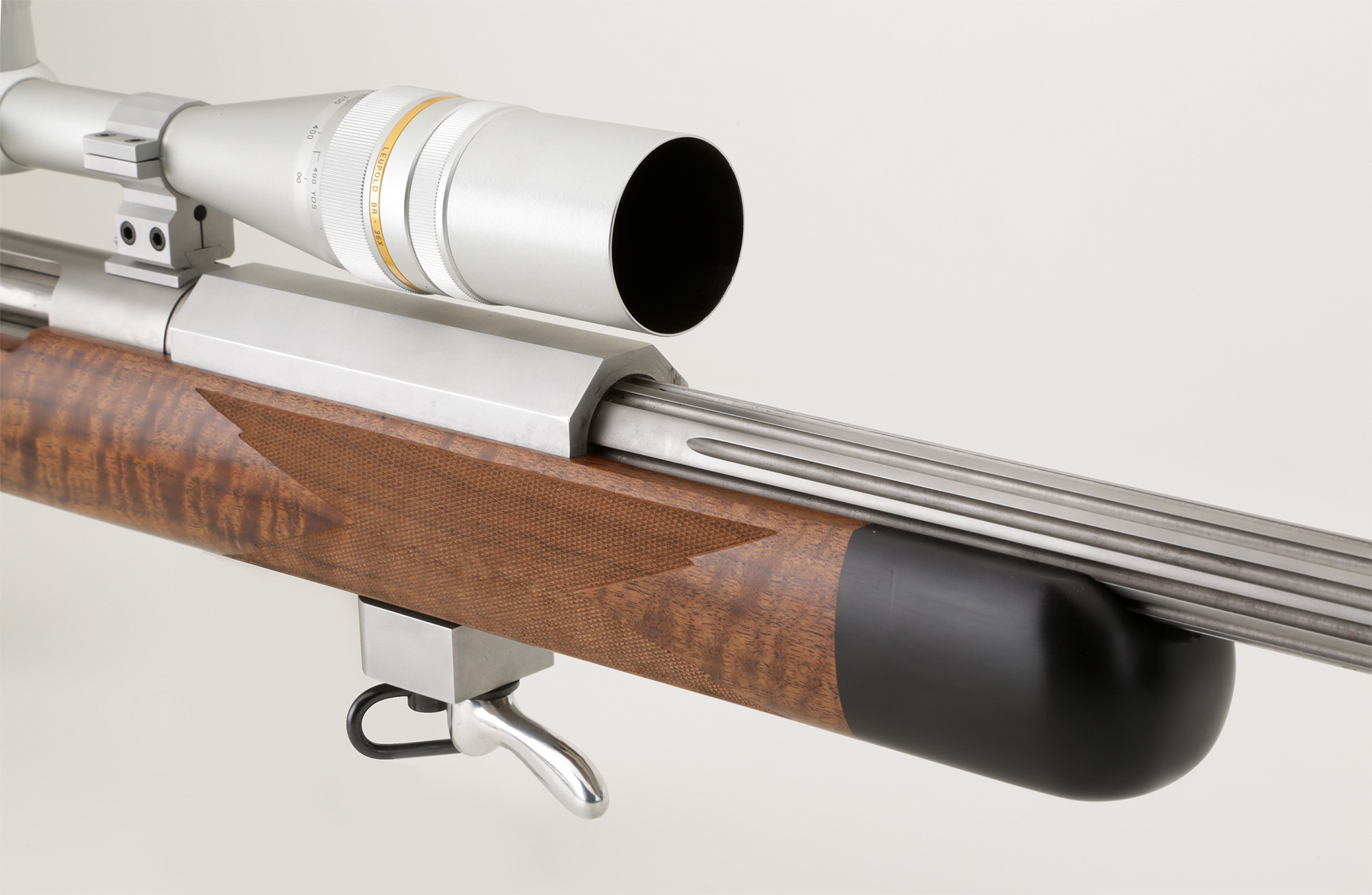
Last week we ran a story on revered stock-maker Jim Cloward of Washington State. Well here’s a story about a very special rifle, featuring one of the finest hand-crafted, custom stocks Cloward ever made. This stunning, heirloom rifle was crafted two decades ago for Shiraz Balolia, President of Grizzly Industrial. Since he hasn’t been shooting it, he initially thought about putting it up for sale. But our Forum members argued: “Don’t sell it Shiraz — that gun should be in a museum or stay in the family!” Shiraz listened and decided to keep the rifle as a family treasure: “It’s off the market and will wait for the grandkids to grow up to decide which one gets it.”
The Balolia Baer/Cloward Heirloom Rifle by Shiraz Balolia
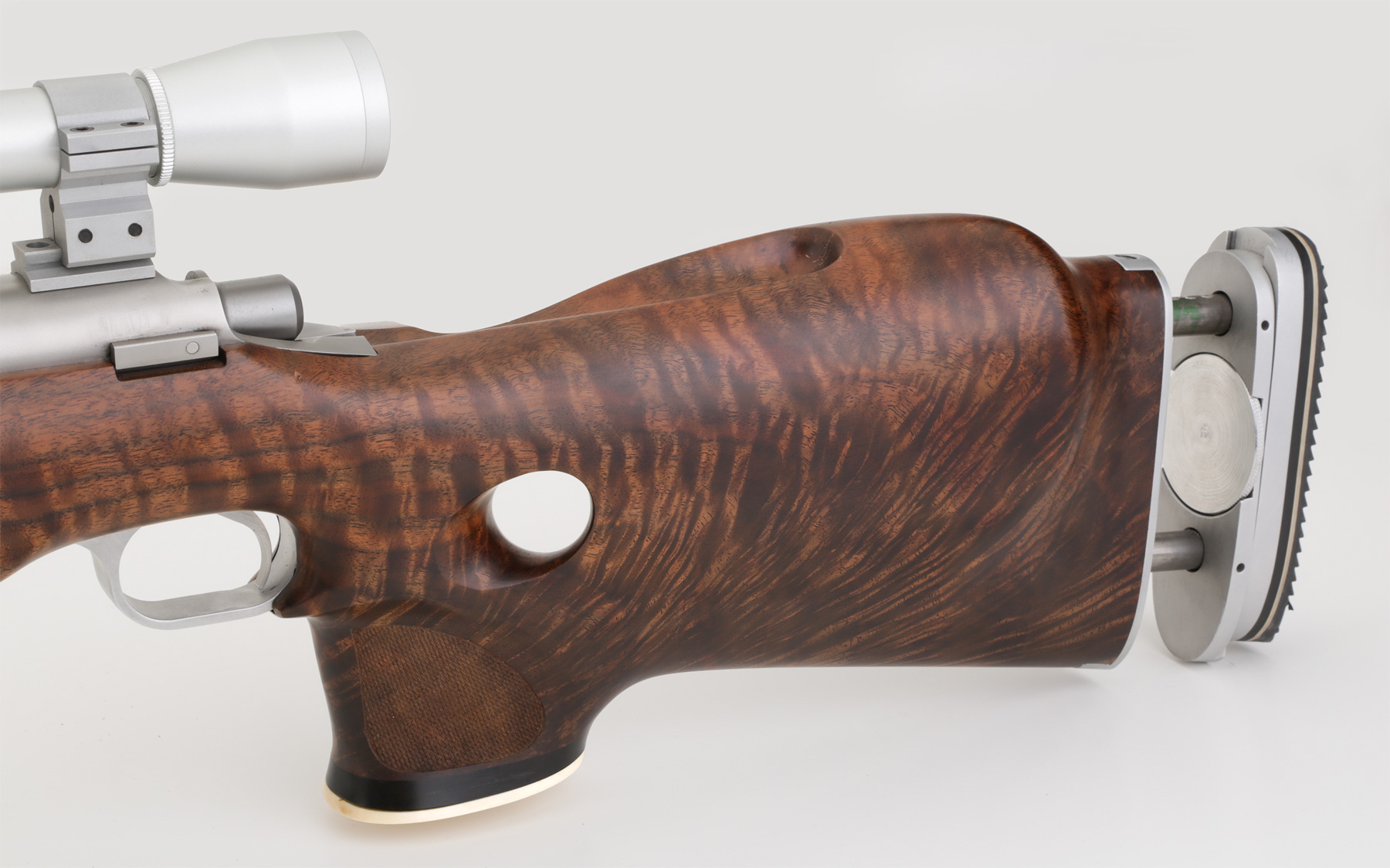
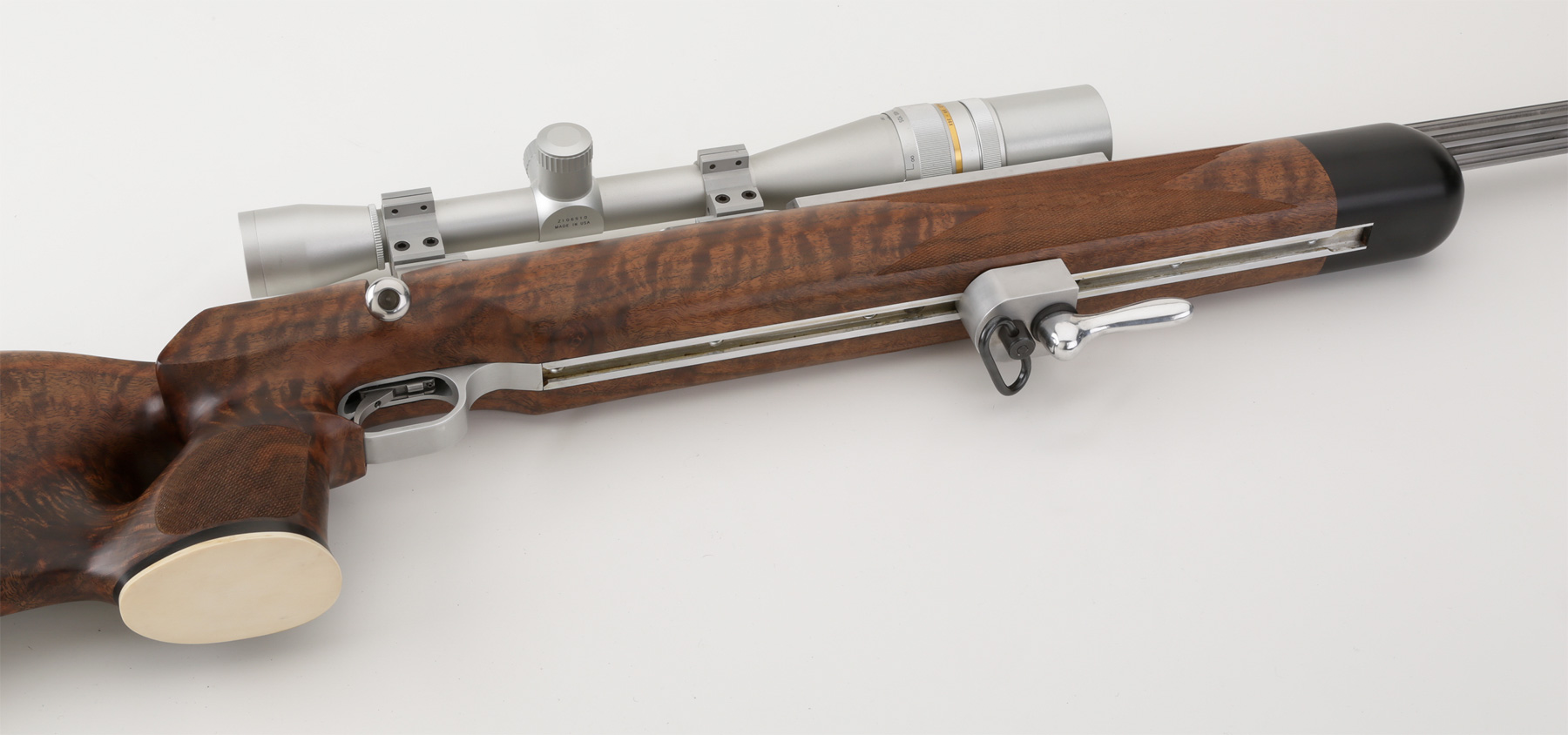
I commissioned this rifle over 20 years ago and am ashamed to say that it has less than 50 rounds down the barrel! This is a super-custom, one-of-a-kind rifle that was built by Bruce Baer and the stock work was done by Jim Cloward. This was a “money no object” gun. The stock was a special highly-figured walnut piece that I had saved for years to build “that special gun”, thinking I would pass it on to one of the kids. It has an Ebony fore-end and an Ebony and Ivory grip cap. The barreled action rides in a barrel block in that beautiful Cloward-crafted stock.
Click Images to See Full-screen Version
Caliber — .308 Baer, made for 1000-yard shooting.
Action — Hall, single shot with Jewell trigger.
Barrel — Obermeyer, fluted, 29″, 1:10″ twist, throated to shoot up to 220gr Sierras.
Stock — Jim Cloward custom with 3-way adjustable buttplate and barrel block.
Scope — Rare silver Leupold 36X Benchrest model in mint condition.
The super-comfortable thumbhole stock is an absolute work of art by Jim Cloward, who did the lovely checkering as well. Jim has done some nice stocks for me, but this one is probably the best. He outdid himself on this stock — I do not think you will ever see another Baer/Cloward rifle like this!
Click Images to See Full-screen Version
One More Cloward-Stocked Rifle
Shiraz has a few other treasured Cloward-stocked rifles, including this stunning break-down hunting rifle in fitted travel case. Click image to see the rifle, full-screen, in all its highly-figured glory. We’ve asked Shiraz to to photograph some of his other “Clowardian” beauties so we might showcase them in the future — stay tuned.
One of our Shooters’ Forum readers, Trent from Louisiana, asked for help deciding between a .260 Remington and a 6.5×55 for his latest gun project. In the Forum thread, respected UK gun writer Laurie Holland provided a good summary of the differences between the two chamberings. Laurie writes:
“The 6.5×55 case has 6 or 7% more capacity than the .260s, even more in practice when both are loaded to standard COALs with heavy bullets, which sees them having to seated very deep in the .260 Rem using up quite a lot of powder capacity. So loaded up for reasonable pressures in modern actions, the 6.5×55 will give a bit more performance.
The issue for many is what action length is available or wanted, the 6.5 requiring a long action. So sniper rifle / tactical rifle competitors will go for the .260 Rem with the option of the many good short-bolt-throw designs around with detachable box magazines. If a bit more performance is needed, the .260AI gives another 100-150 fps depending on bullet weight.
Brass-wise, you’ve got really good Lapua 6.5×55 off the shelf that needs minimum preparation, and it’s strong and long-lived. There is an Ackley version too that was popular in F-Class in Europe for a while that isn’t too far short of 6.5-284 performance. If you go for .260 Rem, the American brass isn’t as good but you can neck-up Lapua or Norma .243 Win and trim them (or neck-down .308 Win or 7mm-08). This has the downside that doing so usually creates a noticeable ‘doughnut’ at the case-shoulder junction, that may cause problems depending on how deep bullets are seated. [Editor’s Note: After Laurie wrote this, Lapua began producing high-quality .260 Remington brass.]
For purely target shooting, I think I’d go with 6.5×55 if I was making the choice again today for performance and brass-preparation reasons. In fact, I’ve considered going back to the gunsmith to have the barrel rechambered.
You want a multi-purpose rifle though and that makes things trickier depending on the bullet weight(s) you want to use. The [typical] 6.5×55 and 6.5-08 throats are really designed for 140s, so 90-120s make a long jump into the rifling. If you’re always going to use 130s and up, it’s less of an issue. If you want to use the lighter stuff, I’d say go for .260 Rem and discuss the reamer with the gunsmith to come up with as good a compromise as you can depending on the mix of shooting. 1:8.5″ twist is the norm and handles all the usual sporting and match bullets; you can go for a little slower twist if you won’t use the heavies.
Over here in the UK, in Scotland to be precise, we have a top sporting rifle builder (Callum Ferguson of Precision Rifle Services) who almost specializes in .260 Rem usually built on Borden actions. He throats the barrel ‘short’ so it’s suited to varmint bullets, but will still handle the 100gr Nosler Partition which he says is more than adequate for any British deer species including Scottish red stags.
Accuracy-wise, I don’t think there’s anything between them if everything else is equal. The 6.5 has a reputation for superlative accuracy, but that was high-quality Swedish military rifles and ammunition matched against often not-so-high-quality military stuff from elsewhere. Put the pair in custom rifles and use equally good brass and bullets and you’ll be hard pressed to tell them apart.” – Laurie Holland
After Laurie’s helpful comments, some other Forum members added their insights on the .260 Rem vs. 6.5×55 question:
“To me, the .260 Remington has no advantage over the 6.5×55 if one is going to use a long action. Likewise, the only advantage the .260 has in a modern rifle is it can be used in a short-action. There is more powder capacity in the 6.5×55 so you have the potential to get more velocity plus there is a lot of reloading data available to you for loading at lower velocity/pressure if you choose. The Lapua brass is great and Winchester brass is pretty good at low pressures. Having loaded a good bit for both, the 6.5×55 would always get the nod from me. To me, if someone wants to use a short-action, the 6.5×47 Lapua is even a better option than the .260 for a target rifle.” — Olympian
“There is just one small item that has been missing from this conversation — the 6.5×55 has a non-standard rim diameter of .479″ vs. the standard .473″ of a .308 and all of its variants. Depending on your bolt this may be an issue, or it may not.” — Neil L.
Shooting Industry Magazine has released a helpful blog article concerning airline travel and firearms. Written by well-known shooting instructor, gun writer (and part-time police officer) Massad Ayoob, the article covers key points travelers must understand before carrying firearms into an airport zone. In his article Flying with Firearms, Ayoob warns travelers that “State gun laws change frequently” and that “our country is a 50-piece patchwork quilt of gun laws”.
Here are some of the recommended resources gun-toting travelers should consult before they head to any airport in the United States:
Flying with Firearms — Familiarize Yourself With The Laws by Massad Ayoob
State gun laws change frequently, including reciprocity on concealed-carry permits even in the gun-friendly “red states.” Here are a few sources I recommend for you and your customers.
Online, the best and most up-to-date source of gun laws I’ve found is www.Handgunlaws.us. For smart phones, the best app I can recommend is Legal Heat (www.mylegalheat.com).
The Transportation Security Administration (TSA) and the Federal Aviation Administration (FAA) are the authoritative sources on flying with firearms.
The controlling TSA regulation can be found at www.tsa.gov, search “Firearms.” The FAA’s controlling regulation is 108.11. To view the FAA’s controlling regulation, visit the U.S. Government Printing Office: www.gpo.gov/fdsys, click “Advanced Search” and enter “14 CFR 108.11” — the first result contains the report.
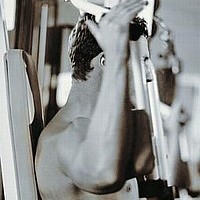
In the archives of The First Shot (the CMP’s Online Magazine), SGT Walter E. Craig of the USAMU discusses physical conditioning for competitive shooters, particularly High Power competitors. Fitness training is an important subject that, curiously, is rarely featured in the shooting sports media. We seem to focus on hardware, or esoteric details of cartridge reloading. Yet physical fitness also matters, particularly for High Power shooters. In his article, Craig advocates: 1) weight training to strengthen the Skeletal Muscle System; 2) exercises to build endurance and stamina; and 3) cardiovascular conditioning programs to allow the shooter to remain relaxed with a controlled heart beat.
SGT Craig explains: “An individual would not enter a long distance race without first spending many hours conditioning his/her body. One should apply the same conditioning philosophy to [shooting]. Physical conditioning to improve shooting skills will result in better shooting performance…. The objective of an individual physical training program is to condition the muscles, heart, and lungs thereby increasing the shooter’s capability of controlling the body and rifle for sustained periods.”
In addition to weight training and cardio workouts (which can be done in a gym), SGT Craig advocates “some kind of holding drill… to develop the muscles necessary for holding a rifle for extended periods.” For those with range access, Craig recommends a blind standing exercise: “This exercise consists of dry-firing one round, then live-firing one round, at a 200-yard standard SR target. For those who have access only to a 100-yard range, reduced targets will work as well. Begin the exercise with a timer set for 50 minutes. Dry-fire one round, then fire one live round and without looking at the actual impact, plot a call in a data book. Continue the dry fire/live fire sequence for 20 rounds, plotting after each round. After firing is complete, compare the data book to the target. If your zero and position are solid, the plots should resemble the target. As the training days add up and your zero is refined, the groups will shrink and move to the center.”
Fitness training and holding drills help position shooters reach their full potential.
Training for Older Shooters
Tom Alves has written an excellent article A Suggested Training Approach for Older Shooters. This article discusses appropriate low-impact training methods for older shooters. Tom explains: “Many of the articles you will read in books about position shooting and the one mentioned above are directed more toward the younger generation of shooters in their 20s. If you look down the line at a typical high power match these days you are likely to see quite a few folks who are in their middle 30s and up. Many people in that age range have had broken bones and wear and tear on their joints so a training program needs to take that into account. For instance, while jogging for an extended period for heart and lung conditioning may be the recommended approach for younger folks, it may be totally inappropriate for older people.”
Forum Member Roy B. has found a website with scores of well-researched articles about guns and shooting. The Firearms History, Technology & Development Blog features a wide variety of posts on myriad subjects, from early black powder firearms to modern match rifles. The latest entry is a fascinating story on the Richardson R5 gun, an ultra-simple shotgun modeled on home-made, slam-fire weapons used by Filipino guerrilla forces. (David Richardson was a PT-boat officer who fought with resistance forces in the Philippines for three years. Hollywood made a movie based on his wartime activities in the Philippines.)
Richardson R5 Philippine Guerrilla Gun
On the Firearms History Blog, you’ll find tons of information on gun design, barrel-making, action types, and firearms testing equipment. To access hundreds of articles, click on the Firearm History Blog Archive Menu on the left side.
Berger Twist-Rate Stability Calculator
On the Berger Bullets website you’ll find a handy Twist-Rate Stability Calculator that predicts your gyroscopic stability factor (SG) based on mulitiple variables: velocity, bullet length, bullet weight, barrel twist rate, ambient temperature, and altitude. This very cool tool tells you if your chosen bullet will really stabilize in your barrel.
LIVE DEMO BELOW — Just enter values in the data boxes and click “Calculate SG”.
How to Use Berger’s Twist Rate Calculator
Using the Twist Rate Calculater is simple. Just enter the bullet DIAMETER (e.g. .264), bullet WEIGHT (in grains), and bullet overall LENGTH (in inches). On its website, Berger conveniently provides this info for all its bullet types. For other brands, we suggest you weigh three examples of your chosen bullet, and also measure the length on three samples. Then use the average weight and length of the three. To calculate bullet stability, simply enter your bullet data (along with observed Muzzle Velocity, outside Temperature, and Altitude) and click “Calculate SG”. Try different twist rate numbers (and recalculate) until you get an SG value of 1.4 (or higher).
Gyroscopic Stability (SG) and Twist Rate
Berger’s Twist Rate Calculator provides a predicted stability value called “SG” (for “Gyroscopic Stability”). This indicates the Gyroscopic Stability applied to the bullet by spin. This number is derived from the basic equation: SG = (rigidity of the spinning mass)/(overturning aerodynamic torque).
If you have an SG under 1.0, your bullet is predicted not to stabilize. If you have between 1.0 and 1.1 SG, your bullet may or may not stabilize. If you have an SG greater than 1.1, your bullet should stabilize under optimal conditions, but stabilization might not be adequate when temperature, altitude, or other variables are less-than-optimal. That’s why Berger normally recommends at least 1.5 SG to get out of the “Marginal Stability” zone.
In his book Applied Ballistics For Long-Range Shooting, Bryan Litz (Berger Ballistician) recommends at least a 1.4 SG rating when selecting a barrel twist for a particular bullet. This gives you a safety margin for shooting under various conditions, such as higher or lower altitudes or temperatures. Try changing the altitude and temperature in the calculator and you will see that the SG can increase or decrease when these environmental factors change. Under optimal circumstances you should aim for a 1.4, that way if you change circumstances you are still over 1.1.
Erik Dahlberg rifling illustration courtesy FireArmsID.com.
Story idea from EdLongrange. We welcome reader submissions.


 Do you like black rifles? Do you suffer from an irrepressible desire to modify, tweak, and upgrade every little component on your ARs? Then check out “Everything AR” in the GUNS Magazine Combat Special Edition. From upgrades and accessories to brand reviews and insight into AR operating systems, the Fall/Winter 2014 GUNS Magazine Combat Special Edition is a cover-to-cover AR love-fest.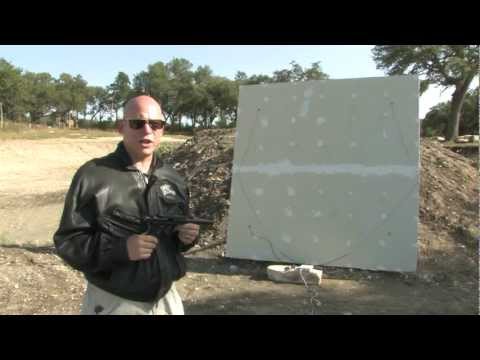
 Do-It-Yourself Electronic Target System?
 A narrowly-divided U.S. Supreme Court has ruled that the federal ban on “straw” purchases of guns can be enforced even if the ultimate buyer is legally allowed to own firearm. In
  Abramski was indicted and prosecuted for violating Federal laws against “straw purchases”, specifically making a false declaration on BATFE Form 4473, a violation of 18 U.S.C. § 922(a)(6). Abramski challenged the indictment, but the District Court ruled against him and the U.S. Fourth Circuit Court of Appeals upheld the District Court. However, the Fourth Circuit found a split of authority among the Circuits as to whether § 922(a)(6) applied where the ultimate recipient of the firearm was lawfully entitled to buy a gun himself. The Fourth Circuit’s ruling conflicts with previous decisions by the Fifth Circuit holding that “straw purchaser” laws are NOT violated if both the original purchaser and secondary buyer are legally entitled to own a firearm. See United States v. Polk, 118 F.3d 286 (5th Cir. 1997).


 Electronic Targets at Talladega
 Last week we ran a story on revered stock-maker




 “The 6.5×55 case has 6 or 7% more capacity than the .260s, even more in practice when both are loaded to standard COALs with heavy bullets, which sees them having to seated very deep in the .260 Rem using up quite a lot of powder capacity. So loaded up for reasonable pressures in modern actions, the 6.5×55 will give a bit more performance.
 For purely target shooting, I think I’d go with 6.5×55 if I was making the choice again today for performance and brass-preparation reasons. In fact, I’ve considered going back to the gunsmith to have the barrel rechambered.
 After Laurie’s helpful comments, some other Forum members added their insights on the .260 Rem vs. 6.5×55 question:
 In the archives of
  Fitness training and holding drills help position shooters reach their full potential.


 If you have an SG under 1.0, your bullet is predicted not to stabilize. If you have between 1.0 and 1.1 SG, your bullet may or may not stabilize. If you have an SG greater than 1.1, your bullet should stabilize under optimal conditions, but stabilization might not be adequate when temperature, altitude, or other variables are less-than-optimal. That’s why Berger normally recommends at least 1.5 SG to get out of the “Marginal Stability” zone.


