AR-platform rifles can be maintenance-intensive beasts. They need regular inspection, cleaning, and lubrication. But some AR owners make the situation worse by not regularly cleaning important small parts, or by using too MUCH oily/greasy lubricants in the wrong places. A properly maintained and lubricated AR15 can shoot hundreds of rounds (between cleanings) without a problem. If you learn where (and where not) to apply lubricant, you’ll find that your AR will run more reliably and the task of cleaning the bolt, bolt carrier, and upper receiver internals will be less of a burden.
Here we showcase videos that show how to field-strip an AR-15, inspect the key parts, clean components, and lubricate internal parts as needed. Along with these videos, we recommend you read the comprehensive AR-15 Gun Cleaning Clinic article on the Brownells website. This explains in detail important procedures that the videos might only cover in a few seconds.
If you want to keep your black rifle running smoothly and reliably, you must clean it regularly and follow the correct maintenance procedures. Here are five videos that explain how to properly disassemble and clean AR-platform rifles.
1. How To Clean Your AR-15 | Cleaning and Maintenance Tips
This is a quick 90-second starter video that may help new AR owners. Ricky Lehnhardt of OTIS Technology demonstrates the basics of cleaning and maintaining your AR-15. Lehnhardt does a good job identifying the points that need cleaning on the inside of ARs. However he works very quickly in the video. You may want to pause the video at some points. Also, Lehnhardt employs a cable for pulling patches and brushes through the barrel. Yes this is fast and easy. However, for match AR rifles, we recommend that you instead use a cleaning ROD with fitted bore guide.
2. Take-Down and Full Cleaning of AR-15 by Jerry Miculek
Here ace shooter Jerry Miculek takes down and cleans an AR-platform rifle belonging to his daughter Lena. This is a good video because Lena’s rifle was “run hard and packed up dirty” so you can see where carbon and grease build up. This 35-minute video is very thorough. Jerry is one of the nation’s top action carbine shooters, so listen carefully to his advice on cleaning and lubrication.
3. AR-15 Maintenance: Field-strip, Clean and Lubricate an AR-15
Gunsite Academy instructor and gunsmith Cory Trapp demonstrates the proper way to field-strip, clean, and lubricate an AR-15 carbine. In this 30-minute video, Trapp offers several important technical tips and hints. For example, at 11:05 Trap demonstrates how to determine if your bolt needs new gas rings. Along with cleaning procedures, this video explains how to inspect key components and how to function-test your AR before each shooting session.
4. AR-15 Dissassembly and Cleaning Guide
This video does a good job, with close-ups, showing how to remove the bolt carrier and clean the inside of the upper receiver. Then you can see how to work with various tools to clean the bolt, bolt carrier, and inside of chamber. We also recommend that you inspect the ejector recess and extractor recess. When we’ve inspected ARs that failed to cycle properly, we have often found nasty gunk (mixture of carbon, greasy lube, and brass particles) in these areas.
5. Basic AR-15 Quick and Easy Field Maintenance
In this NSSF-sponsored video, pro shooter Ryan Muller demonstrates basic, quick field maintenance of his AR-15. This would be for a quick cleaning and lubrication of the reciprocating parts. This covers rapid maintenance in the field. For full field-stripping and thorough cleaning, watch the previous videos.
Handy Mat for Cleaning AR Rifles
When working on an AR-15, it’s smart to have a pad that can absorb solvents and cushion your upper and lower. The $24.99 Real Avid Smart Mat is a good choice. This features printed take-down instructions and it has a handy parts tray on the right side. The mat rolls up for convenient storage. Click HERE to learn more.
Vital Inspections You Should Do After Disassembly
Last but not least, here are recommended inspections you should do every time you do a full field-strip and cleaning of your black rifle:
by Sierra Bullets Ballistic Technician Gary Prisendorf
Occasionally someone will ask, “Why did I get a flyer that didn’t go in with the rest of my group?” If I had an answer that would stop flyers from happening, I would be rich.
There are many reasons why this can happen. Everything from gripping a forearm differently to variations in the brass casing, the list goes on and on. Most of the time the flyer is usually shooter induced and sometimes what you may think is a flyer, is just part of your group. There are a lot of shooters, that go out and test a load and they may shoot a 3/8” group at 100 yards and think that load is good. But I have seen far too many times that you can shoot another group, same load, same rifle and the next time you may get a 1 ¼” group.
The total opposite can also occur. You may shoot a 1 ¼” group and turn around and follow it with a 1/2″ group without changing anything. If you only shot the one group, you might decide that load wasn’t any good and move on to something else without really knowing what that load was capable of.
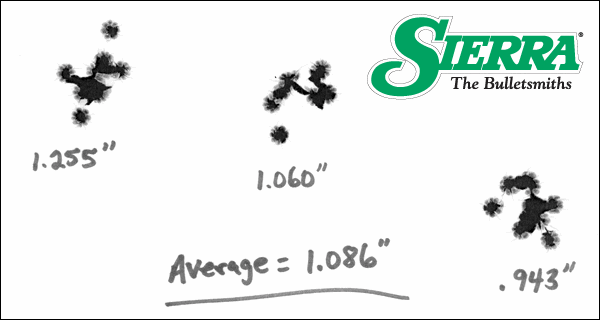
To really determine how a particular load is performing we need to shoot multiple groups and take an average of the group sizes to really see what that rifle/load combination is really capable of.
I suggest shooting a minimum of three 5-shot groups and averaging the group sizes before deciding if the load is acceptable or not. Obviously the more rounds you shoot for a group and the more groups that you shoot, you will get a much better representation of what that particular combination can do.
Now I’m not saying to go out and shoot 30 groups with 50 rounds in each group to determine how well your load is shooting. That would be a bit pointless, in some cases it would be time to re-barrel your rifle before your load development was finished.
In most cases, I feel that three to five, 5-shot groups will give you a pretty good representation of how a load will perform in that specific firearm.
The National Shooting Sports Foundation (NSSF) is challenging California’s firearm industry liability law, AB 1594, passed in 2022 and signed into law by Gov. Gavin Newsom. The law, which goes into effect on July 23, 2023, encourages civil suits against the firearm industry for the illegal actions of criminals with guns. This law is an affront to the U.S. Constitution and is an attempt to circumvent the will of the U.S. Congress when it passed the Protection of Lawful Commerce in Arms Act (PLCAA).
The litigation, NSSF v. Bonta, was filed in the U.S. District Court for the Southern District of California. The NSSF now seeks a preliminary injunction to halt enforcement of AB 1594 as challenges to the unconstitutional law progress through the courts.
NSSF Files Motion to Enjoin Unconstitutional California Firearm Industry Liability Law
The NSSF filed a motion for a preliminary injunction in its legal challenge, NSSF v. Bonta, seeking to enjoin California’s firearm industry liability law, AB 1594. The unconstitutional law permits and encourages civil suits against members of the firearm industry for the damages/injuries caused by the actions of criminals. The law goes into effect next month on 7/23/23.
NSSF’s motion argues that California’s firearm industry liability law is preempted by the Federal Protection of Lawful Commerce in Arms Act (PLCAA) which was passed with bipartisan support in Congress and subsequently signed into law by President George W. Bush in 2005. The PLCAA was specifically enacted to stamp out frivolous lawsuits sought by activist politicians, gun control lawyers and greedy trial lawyers seeking to bankrupt the lawful firearm industry by blaming them and their lawfully-sold and non-defective products for the violence and harm caused by criminals who misuse firearms to commit their crimes.
“It’s no surprise California’s rabidly antigun General Assembly would pass and Governor Gavin Newsom would sign into law a blatantly unconstitutional attack on the lawful firearm industry instead of looking in the mirror to see how their own policies are leading to historic levels of criminal violence and endangering law-abiding and innocent Californians every day,” said NSSF Senior Vice President and General Counsel Lawrence G. Keane. “NSSF will not stand by and allow the Second Amendment rights of law-abiding Americans … to be trampled upon while criminals committing acts of violence are handled with kid gloves by soft-on-crime prosecutors. California’s industry liability law is in blatant defiance of the U.S. Supreme Court’s decision in Bruen and is preempted by the PLCAA.”
In addition to the firearm industry liability provision, California’s AB 1594 bans the manufacture, sale, and marketing of firearms the state deems “abnormally dangerous” regardless of if they are commonly-owned. It allows civil lawsuits against a firearm industry member to be filed by a person who has suffered harm in California, the Attorney General, or even city or county attorneys for the harm caused by the criminal misuse of a firearm by a remote third party. The law unconstitutionally invades the sovereignty of sister states by directly regulating lawful commerce occurring entirely and wholly outside the state of California in violation of the Commerce Clause and the United States system of federalism.
NSSF’s challenge explains that AB 1594 is a law that was drafted prior to the Bruen decision and signed just weeks AFTER the Supreme Court published the landmark ruling. Rather than re-examining the legislation to ensure AB 1594 complied with Supreme Court precedent, California legislators ignored the Supreme Court’s decision and pushed AB 1594 through defiantly.
The NSSF argues that AB 1594 not only infringes on Second Amendment rights but chills First Amendment rights by restricting advertising of Constitutionally-protected products that are lawfully made and sold — even when that advertising takes place outside of California’s borders.
In recognition of June as National Safety Month, the NSSF reminds guns owners that their most important responsibility is to store their firearms securely when not in use. New and long-time gun owners sometimes underestimate the danger of leaving firearms unsecured, which can potentially lead to such risks as: A child getting into a bedside table or closet and finding a loaded gun; A criminal stealing an unsecured firearm from one’s home or vehicle; or a teen at risk for suicide obtaining an adult’s firearm.
With schools closing soon for the summer and kids spending more time at home, firearms safety is more important than ever. Given that fact, the NSSF reminds gun owners to keep their guns locked up so they cannot be accessed by children. The NSSF urges gun owners to keep firearms safety a top priority. All gun owners must remember that it is vital to use gun locks and secure storage at all times.
We also know that stolen firearms contribute to violent crime in the U.S. Gun thefts from cars, in particular, are a persistent source of stolen guns. This means that gun owners—if they fail to secure their firearms in their vehicles—could have their gun stolen and potentially used in a crime—and no one wants their gun used by a criminal.
That’s why it’s so important, as a responsible gun owner, to make sure you’re practicing secure firearm storage and to encourage fellow gun owners to do the same. You have many choices of safety devices to fit your needs and lifestyle — from free Project ChildSafe® cable gun locks available at local law enforcement agencies to lockable gun cases, lock boxes, and full-size safes.
Firearms Security and Safety in Vehicles
“More parents are assuming the role of educators in their homes, so it’s a good to time have a talk with your kids about gun safety, even if you don’t own a gun”, states Joe Bartozzi, NSSF President and CEO. “If you do own a firearm, be sure your family understands the safety rules regarding firearms in your home, and always store guns responsibly when not in use.”
In today’s high-inflation economy, FREE is good. Here’s a list of classic, older shooting books that can be downloaded for FREE from Google Books. This list includes many classic treatises on rifle marksmanship that still have value for today’s competitive shooters. In addition, we’ve included notable, illustrated firearm histories, such as Townsend Whelen’s fascinating book, The American Rifle, and The Gun and its Development (9th Ed.), by William Wellington Greener.
In the list below, the title link will take you to the Google Books page for each book. You can read the entire book online, or (in most cases) you can download it to your computer as a PDF file and save it (or print it). You can also create your own Google Library and save the books there for access from any computer.
To download a book, first click the title from the list above. Then, on the Google book page, look for the row of buttons under the book title. Click the “Download PDF” Button. This will load the full book as a PDF into your browser. You can then save this to your computer or tablet hard drive. Choose a location to hold your new e-book, and click “save”. Alternatively, click the blue “READ for Free” button and the book will appear right on the Google site, with navigation (forward/back) arrows at the top of the page.
In this episode of the NSSF Bullet Points podcast, NSSF’s Managing Director State Affairs Jake McGuigan discusses fending off “woke” corporate agendas and anti-gun policies. Jake explains recent successes in state houses around the U.S. including, addressing financial discrimination against the firearm industry by enacting the Firearm Industry Non-Discrimination (FIND) Act and successful restrictions on credit card processing companies that are attempting to track firearm purchases with new Merchant Category Codes.
0:00 Intro
0:42 Round up of pro-gun bills being passed in state houses
2:03 FIND Act
6:39 Pushing back on “woke” agendas and policies (ESG)
8:59 Restricting credit card processor’s ability to track firearm purchases
13:23 Outlook
1700+ Gun-Related Bills in State Legislature in Past 12 months
More than 1,700 firearm-related bills have been introduced in state legislatures since last May. Ninety-three of those bills were passed by legislatures and signed into law. Of those, 56% “expanded access to firearms or benefited the firearms industry by allowing manufacturing in the state or protecting them from liability lawsuits.” On the flip side, nearly 44% of the bills “restricted access to firearms or supported victims/potential victims in gun-related cases.”
Some states have been tougher than others. Several states like Washington, Oregon, California, Illinois, New York and Connecticut have supermajorities that skew toward gun control. Other states, like Arizona, Nevada and Virginia are slim majorities or split between the parties controlling one side of the legislature or the other. Still, other states like Florida moved aggressively to protect the firearm industry.
Success in Halting Firearms-Related Credit Card Tracking
Several legislatures have passed laws that prohibit the use of a firearm retailer-specific Merchant Category Code (MCC) by credit card companies to track lawful sales. That tracking could lead to backdoor gun control and firearm ownership lists by government agencies. Florida’s Gov. Ron DeSantis recently signed this law, as did Montana’s Gov. Greg Gianforte and North Dakota’s Gov. Doug Burgum. West Virginia’s Gov. Jim Justice, Mississippi’s Gov. Tate Reeves and Idaho’s Gov. Brad Little have signed laws barring the use of a MCC on firearm purchases earlier this year. Similar legislative efforts are ongoing on the federal level.
It is important to halt the use of Merchant Codes to track gun-related purchases, because this data could, potentially, be used to create a national Firearms Registry, something expressly prohibited by Federal law.
Enjoy the Shooting Sports USA Archives
As we head into summer, many Americans will be spending more time at the range. And competitors will be shooting in rimfire and centerfire rifle matches throughout the country. Here’s an opportunity to learn competition skills, gun tuning methods, and reloading techniques from leading experts. A vast resource of great gun-related content available online for FREE. Check out the Shooting Sports USA Articles Archive. SSUSA maintains a vast digital library with hundreds of articles going back to June 2009.
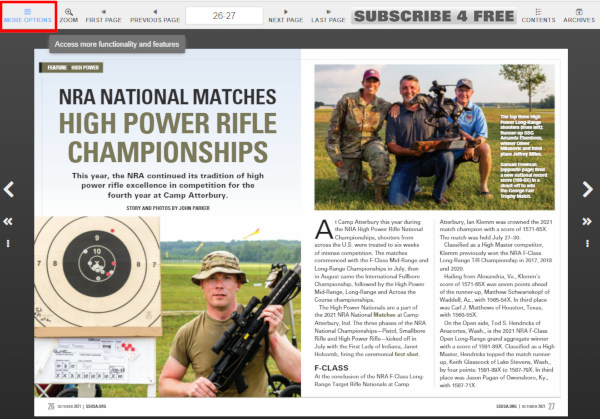
It’s easy to find back issues of Shooting Sports USA magazine. Here’s how: First, navigate to the current SSUSA Online Issue. Then click on the “ARCHIVES” icon in the upper right area (indicated with red arrow). When you click on “ARCHIVES”, a window will open with a selection of Shooting Sports USA magazine covers/dates in a vertical column. The most recent issue (June 2023) will appear at the top. You can then scroll down — use the vertical scroll bar to go from September 2022 (the latest issue) all the way back to June 2009. Click any issue cover to read.
How to Find and Save Articles
To search back issues, select “MORE OPTIONS” from the toolbar (top left). Then click the “SEARCH” button. When that opens, select either “Search Archives” for ALL back issues or “Search Only this Issue”. When you’ve made your choice, enter your search term(s). For example, you can search for “Camp Perry” or “Palma” or “F-Class Championship”. You can also save any archived issue as a PDF for viewing offline. Just click “SAVE” to download the article you’re currently viewing/reading.
Read Sample Articles
Here are a couple of our favorite SSUSA feature stories from recent years. There are hundreds of other informative articles worth reading.
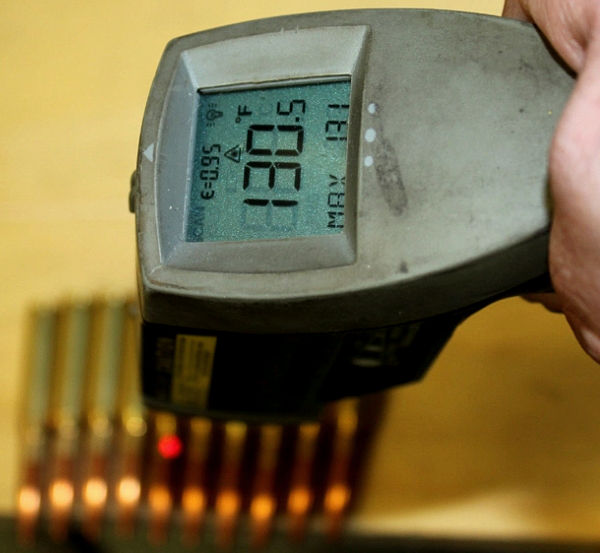
In this .308 Win test, 70° F ammo shot 96 FPS slower than ammo heated to 130.5° F. And the 130.5° ammunition was 145 fps faster than ammo taken right out of the freezer (at 25.5° F). That’s a huge difference…
Summer Solstice is just two weeks away, so most parts of the country will soon be encountering peak summer heat. Some ranges in the Western states have already recorded temperatures well over 100 degrees F during matches. When dealing with extreme summer heat, you should make a serious effort to keep your ammo at reasonable temperatures. When possible, keep ammo in a cooler in the shade.
Never leave boxes of ammo out in the hot sun. Even with powders advertised as “temp stable” you can see significant velocity increases when ambient temps reach 90 degrees and above. This article explains how temperature extremes (both hot and cold) can alter bullet velocities. The velocity differences between very cold ammo and very hot ammo can be very large, as this article explains.
EDITOR’s NOTE: The Sierra tester does not reveal the brand of powder tested here. Some powders are much more temp sensitive than others. Accordingly, you cannot extrapolate test results from one propellant to another. Nonetheless, it is interesting to see the actual recorded velocity shift with ammo temperature variations in a .308 Win.
Written by Sierra Chief Ballistician Tommy Todd This story originally appeared in theSierra Bullets Blog
A few weeks ago I was attending the Missouri State F-Class Match. This was a two-day event during the summer and temperatures were hot one day and hotter the next. I shot next to a gentleman who was relatively new to the sport. He was shooting a basically factory rifle and was enjoying himself with the exception that his scores were not as good as he hoped they would be and he was experiencing pressure issues with his ammunition. I noticed that he was having to force the bolt open on a couple of rounds. During a break, I visited with him and offered a couple of suggestions which helped his situation somewhat and he was able to finish the match without major issues.
He was shooting factory ammunition, which is normally loaded to upper levels of allowable pressures. While this ammunition showed no problems during “normal” testing, it was definitely showing issues during a 20-round string of fire in the temperatures we were competing in. My first suggestion was that he keep his ammunition out of the direct sun and shade it as much as possible. My second suggestion was to not close the bolt on a cartridge until he was ready to fire. He had his ammo in the direct sunlight and was chambering a round while waiting on the target to be pulled and scored which can take from a few seconds to almost a minute sometimes.
This time frame allowed the bullet and powder to absorb chamber [heat] and build pressure/velocity above normal conditions. Making my recommended changes lowered the pressures enough for the rifle and cartridge to function normally.
Testing Effects of Ammunition Temperature on Velocity and POI
After thinking about this situation, I decided to perform a test in the Sierra Bullets underground range to see what temperature changes will do to a rifle/cartridge combination. I acquired thirty consecutive .30 caliber 175 grain MatchKing bullets #2275 right off one of our bullet assembly presses and loaded them into .308 Winchester ammunition. I utilized an unnamed powder manufacturer’s product that is appropriate for the .308 Winchester cartridge. This load is not at the maximum for this cartridge, but it gives consistent velocities and accuracy for testing.
I took ten of the cartridges and placed them in a freezer to condition.
I set ten of them on my loading bench, and since it was cool and cloudy the day I performed this test I utilized a floodlight and stand to simulate ammunition being heated in the sun.
I kept track of the temperatures of the three ammunition samples with a non-contact laser thermometer.
The rifle was fired at room temperature (70 degrees) with all three sets of ammunition. I fired this test at 200 yards out of a return-to-battery machine rest. The aiming point was a leveled line drawn on a sheet of paper. I fired one group with the scope aimed at the line and then moved the aiming point across the paper from left to right for the subsequent groups.
NOTE that the velocity increased as the temperature of the ammunition did.
The ammunition from the freezer shot at 2451 fps.
The room temperature ammunition shot at 2500 fps.
The heated ammunition shot at 2596 fps.
The tune window of the particular rifle is fairly wide as is shown by the accuracy of the three pressure/velocity levels and good accuracy was achieved across the board. However, notice the point of impact shift with the third group? There is enough shift at 200 yards to cause a miss if you were shooting a target or animal at longer ranges. While the pressure and velocities changed this load was far enough from maximum that perceived over pressure issues such as flattened primer, ejector marks on the case head, or sticky extraction did not appear. If you load to maximum and then subject your ammunition to this test your results will probably be magnified in comparison.
This test showed that pressures, velocities, and point-of-impact can be affected by temperatures of your ammunition at the time of firing. It’s really not a bad idea to test in the conditions that you plan on utilizing the ammo/firearm in if at all possible. It wouldn’t be a bad idea to also test to see what condition changes do to your particular gun and ammunition combination so that you can make allowances as needed. Any personal testing along these lines should be done with caution as some powder and cartridge combination could become unsafe with relatively small changes in conditions.
Back in 2014, Forum member Robert Chombart posted this message from his home in Normandy, France: “On the occasion of the 70th anniversary of D-Day, I … salute the memory of the thousands of American soldiers who sacrificed their youth to liberate France, with … particular [respect] for those who rest in Normandy ground.” Today, 79 years after that historic day, it is important we never forget the sacrifice of those who gave their lives on the beaches of Normandy.
Today we should remember those who crossed the Channel to begin the liberation of Europe. Thousands of soldiers, sailors, and aviators gave their lives on June 6, 1944. Their sacrifice on “The Longest Day”, allowed people throughout Europe to enjoy freedom. We should remember those brave warriors, and never forget that freedom is not free — it requires continuing vigilance and sacrifice.
With over 240 shooting-related videos, the Alabama Arsenal YouTube Channel is a remarkable resource. This video channel provides detailed field tests of tactical-type rifles, ARs, and pistols. The testers have access to some very impressive ranges, and many of the tests are far more thorough than you’ll typically find with most gun magazines and gun-centric YouTube channels. For example, Alabama Arsenal (AA) has a series of 1000+ round pistol test videos. These are well worth watching if you are considering purchase of a defensive handgun.
Today we showcase multiple rifle videos covering two centerfire rifles, and three precision rimfire rigs. After these field test videos, you’ll find an interesting technical video which investigates how suppressors can affect muzzle velocity.
Barrett MRAD .300 PRC at 2200 Yards — Extreme Long Range
Here’s a rugged tactical rifle put to the test at Extreme Long Range. This video, featuring a Barrett MRAD chambered for the .300 PRC cartridges, features accuracy testing out to 2200 yards (1.25 miles). There is some good drone footage covering the long path to the target. The shooter noted that the bullets fired from his .300 PRC “go sub-sonic somewhere between 1800 and 1900 yards”, creating additional ballistics challenges at this yardage.
Savage 110 Elite Precision for PRS Production Class
In this video AA’s team reviews the Savage Elite Precision Rifle with MDT ACC Chassis. Retailing for about $1810.00 in 6mm Creedmoor, this is one of the better production class options for PRS and NRL competition. Starting at the 3:10 time-mark, the video shows how all the adjustments function on the MDC ACC Chassis. Guns America Digest did a full review of this rifle, and was quite impressed.
Rimfire .22 LR Bergara B-14R in WOOX Furiosa Hybrid Chassis
Alabama Arsenal recently tested a .22 LR Bergara B-14R rimfire rifle fitted with the WOOX Furiosa hybrid chassis system, an Italian-made product featuring wood sections over a strong aluminum core chassis. The bolt operation and ergonomics of the B-14R simulate a Remington 700 very closely, making this rifle good for rimfire cross-training. The B14-R model tested was the version with carbon-wrapped barrel.
The WOOX Furiosa is an innovative, unique aftermarket replacement chassis. This high-tech hybrid stock/chassis combines wood sections over a full-length, aerospace-grade aluminum skeleton chassis, giving it the “feel” of a wood stock with the strength and stability of a metal stock. We like the way the stock feels on the trigger hand in particular and the smooth wood cheekpiece is also very nice. Made in Italy, the Furiosa is offered in three versions all with wood sections on the forearm, grip area, and cheekpiece. Choose natural Walnut Brown, Micarta Black, or Midnight Grey. Alabama Arsenal tested a B14-R fitted with the Micarta Black version. Below are photos of a centerfire rifle in a WOOX Furiosa hybrid chassis, with the Brown Walnut elements.
CZ 457 Varmint Precision Trainer and Chassis
In this video, Alabama Arsenal compares two higher-end versions of the popular CZ 457 rimfire rifle, a great choice for the NRL22 and PRS 22 disciplines. The test compares the CZ 457 in a Manners composite stock with a CZ 457 version in a Varmint Precision aluminum chassis. Right now basic CZ 457 rifles start at about $540.00, with the Varmint Precision models running $930 for the metal chassis version and $1130 for the Manners carbon-fiber composite stock model.
Informational Video about Rifle and Pistol Suppressors
Alabama Arsenal regularly tests its firearms with suppressors. Over time, the testing team has leaned much about modern sound moderators, comparing features and learning how to install and maintain quality suppressors. Here is an interesting video that shows how suppressors affect shot velocities.
Field Testing — Do Suppressors Change Bullet Velocity
Want to see more content like this? Here are LINKS…
Alabama Arsenal has nearly 300 videos on its YouTube channel. In addition, you’ll find dozens of firearms photos and other shooting-related content on Alabama Arsenal’s social media pages: Facebook; Instagram; and Twitter. You can support the Arsenal’s gun testing by subscribing to the Alabama Arsenal’s PATREON Page.




 In recognition of June as National Safety Month, the NSSF reminds guns owners that their most important responsibility is to store their firearms securely when not in use. New and long-time gun owners sometimes underestimate the danger of leaving firearms unsecured, which can potentially lead to such risks as: A child getting into a bedside table or closet and finding a loaded gun; A criminal stealing an unsecured firearm from one’s home or vehicle; or a teen at risk for suicide obtaining an adult’s firearm.


 In today’s high-inflation economy, FREE is good. Here’s a list of classic, older shooting books that can be downloaded for FREE from Google Books. This list includes many classic treatises on rifle marksmanship that still have value for today’s competitive shooters. In addition, we’ve included notable, illustrated firearm histories, such as Townsend Whelen’s fascinating book, The American Rifle, and The Gun and its Development (9th Ed.), by William Wellington Greener.




 Summer Solstice is just two weeks away, so most parts of the country will soon be encountering peak summer heat. Some ranges in the Western states have already recorded temperatures well over 100 degrees F during matches. When dealing with extreme summer heat, you should make a serious effort to keep your ammo at reasonable temperatures. When possible, keep ammo in a cooler in the shade.