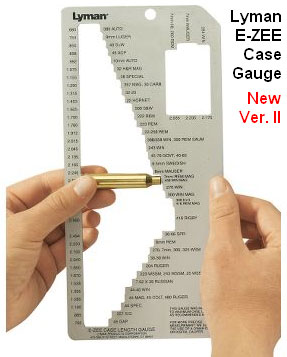
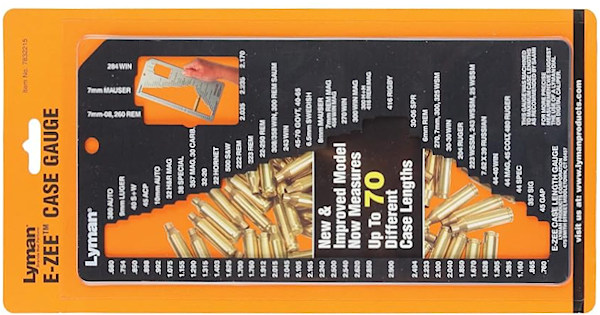
A good case trimmer is an essential tool for precision hand-loading. To ensure consistent loads, you want your cases to be the exact same length. Today’s Saturday Showcase features five trimming tools, both powered and manually operated, that can trim your sized brass with great precision. In addition, some of these tools will also chamfer case necks inside and out. The powered case trimmers will save you considerable time (and effort) when working will large batches of brass.
Lead photo shows the Henderson Gen 2 trimmer from Panhandle Precision video review.
Henderson Gen 3 Power Trimmer — Ultimate Reloader Review
Gavin Gear of UltimateReloader.com has tested the impressive Henderson Gen 3 (V3) Trimmer. You’ll find a full write-up on Gavin’s website, and you can watch Gavin’s 18.7-minute video review above.
Gavin states: “The Henderson Gen 3 case trimmer is built on an adjustable tri-trim 3-way cutter with different pilots to accommodate different case necks. Three-way cutters trim to length and chamfer the inside and outside all at once. This trimmer has a 1700 RPM spindle and a custom DC motor made in the USA. The Henderson trimmer works much like a milling machine. You do not need much torque because of the way the taper works. The Henderson Gen 3 trimmer delivered outstanding cartridge length consistency after trimming. This trimmer is fast and easy to use and most importantly, returns consistent results.”
CLICK HERE for Henderson Gen 2 Trimmer video review, which shows how to how to set trim length and change cutter heads, using 6.5×47 Lapua, .260 Remington, and .300 Winchester Magnum cases.
Giraud Power Case Trimmer — Full Review by Erik Cortina
In this video, Erik Cortina of CortinaPrecision.com offers some very clever and useful tips that will help you get the most from your Giraud powered case trimmer. The Giraud trimmer is very precise. When set up correctly, it can trim brass with amazing consistency.
In the video, Erik trims 5 pieces of brass in 15 seconds (6:32 mark). He then measures all five with precision calipers (7:00-8:08). All lengths are exact within .0005 (half a thousandth). Erik notes that the Giraud trimmer indexes off the case shoulder. As long as you have fire-formed brass with consistent base-to-shoulder dimensions, you should get very consistent trim lengths.
Lyman Powered Case Trimmer Review
The Lyman Case Trim Xpress is an efficient, precise unit that allows easy adjustment of trim length with a click-adjustable collar. The trimmer comes with a set of cartridge-specific bushings that index off the case shoulder. One nice feature is a variable speed control. For the price, $146.20 on Amazon, this trimmer delivers excellent performance. To see more details, check out F-Class John’s video review of the Lyman Case Trim Xpress which shows set-up and operation.
Frankford Arsenal Universal Case Trimmer (for Power Drills)
This video features a handy tool that attaches to a portable drill. Used with various diameter collets, this can trim most popular sizes of shouldered brass. The universal collet system indexes on case shoulders for precise and consistent trimming (this does NOT work with straight-walled cartridges). The built-in depth micrometer allows for quick and precise micro-adjustments. There is a handy brass shaving ejection port. The system works well, particularly if you can stabilize your power drill in one position. This Frankford Arsenal trimmer, under $65.00 on Amazon, is an affordable alternative to the top-end powered case trimmers. It comes with a handy plastic case that holds the trimmer and collets.
L.E. Wilson Manual Case Trimmer
L.E. Wilson, makers of hand dies, case trimmers and other precision reloading tools, makes a popular and precise stainless steel case trimmer with micrometer adjustment. The above video explains the operation of the Wilson trimmer and shows how to trim cases and use the micrometer case length control positioned opposite the hand crank. We definitely like the micrometer control. This feature allows you to set the cartridge overall trim length with great precision. If you are trimming a variety of different cartridge types, the micrometer cut length control comes in very handy.
If you own a L.E. Wilson case trimmer, you should watch the official Accessories Video from L.E. Wilson. This video shows accessories for the L.E. Wilson trimmer. These include: Power Adapter for trimming (replaces hand crank), Titanium Case Trimmer Cutter (longer life), Inside Case Neck Reamer, Primer Pocket Reamer (removes military crimps), Uniform De-Burring Tool, Neck Chamfer Tool (30° and 45°), and handheld inside/outside deburring tool (and power adapter).
BONUS Video: How Important is Consistent Case Length?
This Primal Rights video explains why it is important to maintain precise case lengths if you want best accuracy and most consistent ES/SD. You’ll want to size your cases BEFORE trimming if your trimmer indexes off the case shoulders.
This Gun Digest book has become a “go-to” resource for NRL22 and PRS Rimfire shooters. Key topics included in this 2021 Edition full-color Gun Digest book include: rimfire semi-autos and how they work; bolt-action accuracy; match shooting skills; DIY precision gunsmithing; hunting with rimfires; and the future of the rimfire market.
With the growth of rimfire tactical competition, the .22-Caliber rimfire rifle is more popular than ever. Every major gun manufacturer has brought at least one new .22 LR rimfire rifle to the market in the last two years. Gun Digest’s Rimfire Revolution has extensive coverage of new models from major manufacturers.
The .22 Long Rifle (.22 LR) is the planet’s most popular ammunition type and firearm chambering. The .22 LR is used in the Olympics by 3P marksmen, but it also serves benchrest competitors, NRL22 shooters, backyard plinkers, small-game hunters, and tactical trainers. With the expansion of NRL22 matches (and the PRS equivalent), the humble .22 LR is undergoing a major resurgence in the USA. And with centerfire reloading components being so costly and difficult to find, many folks are shooting less centerfire, but way more rimfire.
Plus Coverage of .17-Caliber Rimfire Rifles — 17 HM2, 17 HMR, 17 WSM
This 272-page book also covers .17-caliber rimfire cartridges: 17 HM2 (Mach 2), 17 HMR, and 17 WSM. These are all excellent varmint rounds, with the 17 WSM effective out to 250 yards. The 17 HM2 will run in a normal .22 LR action and feed from standard .22 LR magazines. So, for most rifles, all you need to do a .22 LR to 17 HM2 conversion is a barrel switch. That gives your rimfire rig twice the versatility. Shoot .22s and .17s with the same gun.
NRL22 — Challenging Practical Competition with .22 LR Rifles
The USA has seen a big growth in rimfire tactical matches over the last five years. Right now there are probably ten times as many rimfire tactical matches as sanctioned PRS and NRL centerfire matches. The reason is simple — rimfire ammo is much less costly, and clubs can run challenging rimfire tactical matches at nearly any outdoor gun range that allows shooting out to 200+ yards.
NRL22 Competition — Tactical Rimfire Matches
The NRL22 match format is a great shooting discipline. NRL22 offers a high fun factor at relatively low cost. You don’t have to reload match ammo. A couple of 50-round boxes of .22 LR ammo will get you through the match. While some people bring lots of gear to matches, that’s by choice and not by necessity. You can keep it simple and still be competitive (and win).
Tips for NRL22 Competitors by Jonathan Ocab
I am a match director at my gun club and run our local NRL22 matches. People often ask me for tips for competing in NRL22. First, I recommend getting the course of fire for the month in advance and practicing those stages at the range. Here are other specific tips that should help NRL22 competitors improve their gun-handling and match results.
1. Dry Fire Practice — If you are not able to do live fire practice at the range, I encourage shooters to practice their shooting positions at home via dry fire. Setup props or barricades with pasters or other faux targets on a wall in the garage or inside the house and run through each stage.
2. Scope Magnification Level — The most common issue I see with newer shooters in NRL22 is the tendency to maximize their scope magnification. The timer will start, and the shooter gets into position on a target, but the scope is set to 15x or higher and the shooter can’t find the target. The shooter lowers the magnification, locates the target, and then increases the magnification again, takes the shot, transitions to another target, and repeats the process of decreasing magnification, locating target, etc. Novice NRL22 shooters should try using the mid-range magnification. Try shooting 7x-12x and learn to balance field of view and target image.
We’ve found eight great discount/rebate programs. These specials can save you big bucks on pistols, long guns, suppressors, optics, ammunition, targets and more. Some of these rebates are worth big bucks. For example you can Save $75 on a new Browning rifle or shotgun, Save $100 on a new Colt pistol, get a $100 Credit with a SIG Sauer pistol, or get Free Meprolight Optic with the purchase of an IWI firearm. Note: Quite a few of these rebate offers expire at the end of August or early September, so check the dates — you snooze, you lose.
Find More Rebates at Gundeals.com and Sportsman’s Outdoors. Note: There are Federal, Remington, and Speer Ammo Rebate Offers that expire at 11:59 pm today, July 31, 2025.
At the request of our readers, we provide select “Deals of the Week”. Every Sunday afternoon or Monday morning we offer our Best Bargain selections. Here are some of the best deals on firearms, hardware, reloading components, optics, and shooting accessories. Be aware that sale prices are subject to change, and once clearance inventory is sold, it’s gone for good. You snooze you lose.
NOTE: All listed products are for sale to persons 18 years of age or older. No products are intended for use by minors.
1. EuroOptic — Leupold Sale, up to 45% Off Blem Items
⏺️ » HUGE discounts on Leupold scopes, spotters, binoculars
This week, at EuroOptic, Leupold scopes with a slight blemish are on sale at huge discounts — up to 43%. These are not used — they are new optics with the full Leupold Lifetime warranty. If you need a scope for your hunting, varmint, or competition rifle, this is great savings opportunity. In addition, regular (non-blem) Spotting Scopes and Binoculars are on sale at big discounts. For example the Leupold 15-45x65mm SX-4 spotter is now $449.99, a 44% saving off the $779.99 list price.
⏺️ » Huge 43% discount on good quality 1911 handgun
An American classic, the model 1911 pistol offers excellent accuracy, and a great single-action trigger. Right now at KYGUNCO you can save 43% on a Taurus stainless model 1911 pistol that ships with two 8-round magazines. A quality stainless 1911 is a great addition to any gun collection, both for target shooting and defensive use. With this 43% discount you are saving over $312.00 compared to regular list price.
3. Powder Valley — Varget Special 8.8-lb Cannister
⏺️ » Great super-size value for popular Varget powder
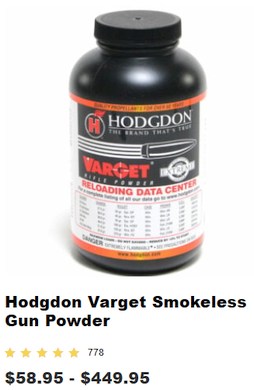
Varget is one of the very best powders for many popular cartridges including .223 Rem, 6mmBR, 6XC, 6mm Creedmoor, 6GT, .243 Win, .308 Win and others. Right now you can get an 8.8-lb cannister of Varget for $409.95. That works out to just $46.59 per pound — a great value. If you load a lot of Varget, we recommend this deal from Powder Valley Outdoors. NOTE: A single 1-lb container of Varget is $55.95 at Powder Valley. So the big 8.8-lb cannister offers considerable savings.
4. Amazon — Lyman 8-station Turret Press, $265.90
⏺️ » 8-station turret press is great for loading multiple cartridge types
The 8-station Lyman Brass Smith All-American 8 Press (#ad) is an impressive product. This sturdy turret press is made from heavy-duty cast iron. The 8-die station turret will hold up to four 2-die sets. Below the turret is a rigid cast iron frame, housing a 1″-diameter ram and compound linkage. NOTE: With a $269.97 price on Amazon, the 8-station Lyman is $130 cheaper than the $399.99 7-station Redding T-7. No question, that’s a significant price advantage.
5. Amazon — Folding 4-Wheel Gear Cart, $44.99
⏺️ » Great deal on folding cart that can handle all your shooting equipment
The F-Class Nationals starts next week in Wisconsin. Along with heavy rifles, competitors must haul rests, heavy rear bags, spotting scopes, ammo, shooting mats, and other gear. Moving all that gear could require multiple trips. But with this Collapsible Foldable Beach Wagon (#ad) you can haul your gear way more efficiently. Often used at matches to haul rifles, rests, mats, windflags, spotting scopes etc., these handy carts make life easier. The large oversized wheels traverse rough terrain and roll through sand with ease. This cart is offered in black for $44.99, or with blue color (as shown) for $50.99.
6. Precision Reloading — FREE HazMat on $149+ Orders
⏺️ » FREE HazMat through 7/31/25 on $149+ orders
Here’s a good way to save $20-$35 on your next order of Powder and/or primers. Now through Wednesday, July 31, 2025 Precision Reloading is offering FREE HazMat on powder and primer orders over $149.00 total. That can save you significant fees compared to other vendors. In addition, Precision Reloading has very competitive prices on popular powder and primer types.
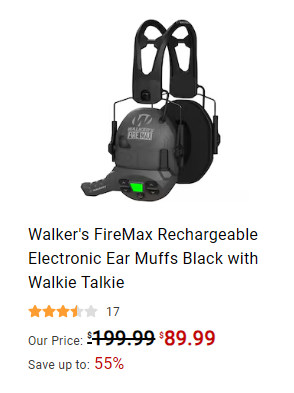
7. Midway USA — Walker’s Electronic EarMuffs on Sale
⏺️ Major savings on popular electronic hearing protection
8. Palmetto SA — PSA Bundle 9mm Ammo, Bag, Targets, $220.00
⏺️ » 500rds 9mm ammo plus targets, range bag, and more
Here’s a great package for pistol shooters. The $220.00 PSA Range Day Bundle includes: 500 rounds of AAC 9mm 124gr Ammo in transport case; Walker’s PSA Electronic Muffs and Glasses Combo Kit; PSA Black Range Bag; Birchwood Casey Shoot-N-C 12″x18″ Silhouette Targets, 5 Pack; and Birchwood Casey Target Stapler (with staples). That’s all you need for fun days at the range — just bring your 9mm firearm(s).
9. Amazon — 52″ Double Rifle Case, $39.99
⏺️ » Good price for versatile case that can hold long-barrel rifles
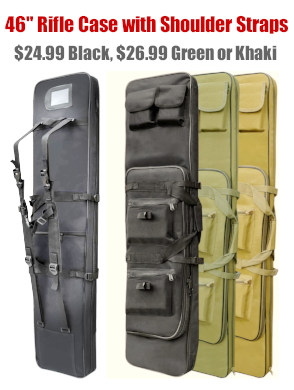
Here’s a very affordable rifle case that can hold long competition rifles. The Huntsen 52″ Double Rifle Case features a removable divider that enables the carrying of one or two rifles up to 50″ OAL. This case includes a large zipper pocket, 3 magazine pouches, plus MOLLE straps for other accessories. For the same $39.99 sale price, this 52″ case is offered in black (#ad), green (#ad), or tan digital camo (#ad) colors.
As an Amazon affiliate, this site can earn revenues through sales commissions.
Today’s Sunday GunDay article features modern magnum cartridge types favored by F-Open competitors. These cartridges will soon be in the hands of top F-Open shooters. The 2025 F-Class National Championships commence next week at the Winnequah Gun Club in Lodi, Wisconsin. The Mid-Range Championships run August 2-5, 2025, while the Long Range F-Class Championships start on the 6th and run through August 9, 2025. At the Nationals top F-Open and F-TR shooters are aiming their rifles at 600-yard targets. VIEW 2025 F-Class Nationals Match Program HERE.
2025 NRA F-CLASS NATIONAL CHAMPIONSHIPS
NRA F-CLASS MID-RANGE NATIONAL CHAMPIONSHIP AUGUST 2-5, 2025
NRA F-CLASS LONG RANGE NATIONAL CHAMPIONSHIP AUGUST 6-9, 2025
Event hosted by Winnequah Gun Club and sponsored by Brux Barrels, Criterion Barrels, Krieger Barrels, and Silver Mountain Target.
There will be two divisions at The F-Class National Championships: F-Open and F-TR. In F-Open the rifles can shoot any cartridge type (up to .35 caliber) and have a 22-lb (10kg) weight limit. A front rest is allowed, and most shooters favor a rest with a joystick control.
In F-TR, two cartridge types are allowed: .223 Remington (5.56×45) or .308 Winchester (7.62×51 NATO), with no restrictions on bullet weight. F-TR rifles are fired off a bipod attached to the rifle’s fore-end. The F-TR weight limit is 8.25 kilograms, or about 18 pounds. This includes the weight of the rifle, scope, and bipod. A sandbag can be used under the rear of the stock. Because of the lower weight limit, which includes the bipod, F-TR stocks tend to be much slimmer and lighter than F-Open stocks which have wide fore-arms to work with the front rests.
F-Open Cartridge Options — Modern Magnum Options
For Today’s Sunday Gunday Story we feature an article about F-Open chamberings by respected rifle builder and past F-Open National Champion Emil Kovan. In this article, Emil reviews some of the new magnum cartridge options that are being employed by F-Open competitors. Many shooters are still using the .284 Winchester (or variants), but an increasing number are shooting 7mm and .30-caliber cartridges based on magnum cartridge types. The 7mm is probably still the favored caliber for F-Open because 7mm bullets offer great ballistics with less recoil than heavier .30-caliber projectiles.
Cartridges for F-Class Part II — Rise of the Magnums
A few seasons back, I wrote an article on cartridge choices for F-Class shooters. CLICK HERE to READ ARTICLE. Since the first article I wrote, F-Class has continued to grow, and push the limits of precision and accuracy. While the .284 Win and its variants are still the most common F-Open cartridges, more and more top F-Open shooters are using magnum cartridge types to win competitions and set new records. In this article, I will list some of the advantages and disadvantages of the most commonly used magnums, and will cover the strengths and weaknesses of each one of them.
Performance factors we will consider for magnum F-Open cartridges include:
1. Equal or better accuracy than standard chambers
2. Better ballistic performance
3. Enhanced case life
4. Barrel life
Accuracy Potential of Magnum Cartridges for F-0pen Competition
John Meyrs has won four National Mid-Range Championships using the .300 WSM. Tim Vought used the same cartridge to win two Mid-Range Nationals and used a 7-6.5 PRC to win the long range Nationals. Standard .437″ case head (.308 Win head size) cartridges still have more Nationals wins overall, but the magnums are quickly catching up, and my prediction is that magnums will dominate soon.
The accuracy and precision potential of magnums used in F-Class (.300 WSM, 7-270 WSM, 7mm RSAUM or “7 SAUM”, 7-6.5 PRC) is better than non-magnum cartridges because their shapes are closer to the ideal “fat/short” body associated with wider nodes and extreme precision. For example a .300 WSM is proportionally much closer to the 6 PPC, 6 Dasher, and 6 BRA than is the .284 Winchester.
Stunning F-Open rifle with SEB Mini front rest with Blake Machine accessories.
The first thing that comes to mind when magnums are discussed is power and speed. In my humble opinion most shooters are missing out on accuracy because they push their magnums right past the most stable and accurate nodes. Recently I met my good friend from the Army Marksmanship Unit, SFC Brandon Green, at a shooting competition. We discussed the latest and greatest in long-range shooting. I knew that the USAMU had switched from 6.5-284 Norma to 7mm RSAUM several years back, but didn’t know what load they are currently using. Brandon told me that the load featured Berger 180gr hybrids in Nosler cases at 2820 fps. We all know that the 7 SAUM is capable of much higher speeds, “but at around 2820 fps the load/rifle combo will hammer the X-Ring anywhere under any conditions” SFC Green said.
F-Open rifles on the firing line at the Ben Avery Shooting Facility in Phoenix, Arizona.
Most shooters jump right into magnum territory velocities when testing, missing out on better precision at standard chamber speeds. For example, my 30 KMR can easily reach 2880 fps with 230gr Hybrids, and it actually shoots pretty good. But the same rifle at around 2770 fps will absolutely hammer the X-Ring in any condition anywhere. When it’s all said and done, F-Class is a long-range shooting competition at a known distance which requires extreme precision and accuracy. It is not a speed race.
IMPORTANT — Case-Head Dimensions Do Make a Difference
Magnums, when shot within reasonable velocities, on average will give better case life due to the bigger case + lower pressure and “more meat” in the case-head area. For example a 7 SAUM case will outlast a .284 Win case when both are loaded to around 2900 fps.
Disadvantages of Magnum F-Open Cartridges
Perhaps the biggest disadvantage linked to magnums is recoil. Some people complain about developing the “gun shy” syndrome after shooting a magnum for a while. Muzzle blast and recoil are significantly more pronounced in magnums, but that can be easily managed with a properly-built rifle equipped with appropriate recoil mitigation hardware such as RAD and the various butt plates.
F-Open rifle equipped with recoil reduction buttpad system.
Barrel Life — “Barrels are Expendable Components”
It is true that certain magnums can torch a barrel in just a few hundred rounds. But the same is true when improving a 6BR to 6 Dasher for example — barrel life might be reduced significantly. More powder = more heat = diminished accuracy after a certain round count. In my experience, a F-Open magnum’s barrel life is very close to high-performance standard cartridges such as the .284 Shehane or .284 KMR. I “retire” my barrels around 1200 rounds regardless of the cartridge being a magnum or not. After that many rounds most barrels will still shoot OK but will copper up, and you will start seeing those unexplained vertical 9s. The bottom line is this, barrels are expendable components very much like brass. You can’t get the performance of .300 WSM and the barrel life of the .308 Win at the same time. If you want to race in NASCAR, fuel mileage should not be the top priority!
Top Magnum Cartridge Types Used in F-Class Open Division
.300 Winchester Short Magnum
The .300 WSM (Winchester Short Magnum) tops the popularity chart in F-Class Open division. It has been used to win numerous National championships and has set many National records. The .300 WSM’s short/fat case shape, with minimal body taper and 35-degree shoulder, contribute greatly to its outstanding performance at long range. Components are readily available as well. Best brass remains to be Norma, although ADG is just as good and some would even say better, but it is more expensive and harder to get at this time.
The .300 WSM has been described as a “super-sized Dasher”.
For the .30-cal magnums, in my opinion, the best bullets by far are made by Berger. If your rifle does not shoot 215gr, 230gr hybrids, or 210gr VLDs well, you likely have a rifle problem, NOT a bullet issue. My “go to” bullet is the Berger 230gr Hybrid. The 215-grainer is a close second, followed by Berger’s accurate but ballistically inferior 210gr VLD, which I use in calm and steady conditions.
Top powders for the .300 WSM are Hodgdon H4831SC and H4350. I know there are many more powders suitable for the .300 WSM cartridge, but none I have used can match Hodgdon’s consistency when shot in different geographical locations and weather conditions.
7mm Remington Short Action Ultra Magnum
The 7mm RSAUM (aka 7 SAUM) used to be the darling of F-Open. Its case capacity and shape are about perfect for launching 180gr pills with great ballistics and precision. Its popularity faded a little, due to the lack of good brass, and the rise of the improved versions of the .284 Win which can almost match the RSAUM performance. Norma still makes 7 RSAUM brass which is pretty good but little on the soft side and hard to find. ADG is arguably producing the best RSAUM brass right now. It is very uniform, reasonably priced, and seems to hold up very well even when pushed hard. The best bullets are again made by Berger, and those are the 180gr hybrid, 184gr hybrid, and 180gr VLD. Best powders are H4831sc, H4350, and Alliant Reloder 16 and Reloder 23.
7-270 WSM, 7-300 WSM, and 7 WSM
The first two are pretty much identical, the only difference being that the 7-270 WSM is necked up .270 WSM while the 7-300 WSM is a .300 WSM necked down to 7mm. I personally prefer the first one since necking-up is easier than necking-down (with fewer doughnut issues).
The WSM case-based 7mms will give you great velocity flexibility as well as superb precision when tuned well. In the 2013 world championship in Raton NM, I was scoring for a gentleman from Canada who was shooting 7-270 WSM. The wind was blowing pretty hard that day. On one of his shots, just before he pulled the trigger the wind gusted. I remember thinking that’s going to be an 8 for sure. The target came up a line 10! I asked him after the match what he was shooting, and he replied 180s at 3100fps. Although capable of such speeds, I think that potentially better and more consistent accuracy can be achieved at much slower speeds. The best powders and bullets are again Hodgdon and Berger respectively. Best cases are made by Norma and ADG, with Winchester being a third option.
7-6.5 PRC — Popular Wildcat
Last but not least on our chart is the 7-6.5 PRC. This particular cartridge is actually a wildcat. It is a 6.5 PRC necked up to 7mm. It is pretty much identical to the 7 RSAUM with the only differences being a shorter neck and .01″-narrower body. Currently the 7-6.5 PRC is the most requested cartridge that I offer when building new rifles. It seems to fill the gap between the .284 Win and the larger magnums very nicely. It is capable of reaching 3000fps but most shooters are getting their best results around 2920-2950 fps. The biggest advantage of this wildcat is brass. Lapua makes super high-quality, readily-available 6.5 PRC brass. Best powders are H4831sc, H4350, Reloder 16, and Vihtavuori VV 555. The best bullet in my opinion is the 180gr Berger. I am yet to hear about a better-performing bullet in this chamber.
Conclusion In conclusion, magnums are not perfect but their performance advantages should be very seriously considered when building a rifle for long-range F-Class. In part three, I will list the most common wildcat magnums, and present the KMR magnums which will make you (if you haven’t already) buy a magnum action and get a magnum build for sure!
– 2014 F-Class Open National Champion
– 2015 F-Class Open National Championship, Silver Medal
– F-Class Open National Championship Teams, 2015, 2014, 2013, Shooting Team Member
– Over 15 wins in Regional and State Championships in Palma, F-TR, F-Open
– 2013 U.S. National Team Member
– 2023 F-Open Gold Medal Team USA Member, 2023 World Championship in South Africa
Today’s Saturday movie showcase features eight videos about F-Class marksmanship, gear selection, and reloading methods. The 2025 NRA F-Class National Championships take place next week at the Winnequah Gun Club range in Lodi, Wisconsin. The F-Class Nationals start on August 2nd and run through August 9th. There are two divisions: F-Open and F-TR. The F-Class Championships have two segments, Mid-Range and Long Range. The Mid-Range competition runs August 2-5, while the Long Range competition is scheduled for August 6-9. Competitors can register for the 2025 F-Class Nationals through the NRA Shooters Portal. Learn more about the range at Winnequahgunclub.org.
WICKED WINDS — At Ben Avery with 18-30 mph Winds
Long-range F-Class shooters will tell you that the winds can be the biggest challenge in a match. And things can get pretty wild at times as the Ben Avery range in Phoenix, site of the 2022 NRA F-Class National Championships. In this video, shooters fight through extremely strong 18-30 mph winds at 600 yards. In these kind of extreme conditions, a major unexpected gust can send your bullet off-target.
Wind-Reading for Long-Range Competition
In this excellent video Keith Glasscock, who has finished second overall at multiple F-Class Nationals, explains how to read the wind and even predict wind changes in cycling conditions. Keith notes that you should look at environmental features and mirage, not just wind flags. Keith is one of America’s best wind gurus — he was a team wind coach and he has finished second three times in F-Open division at the F-Class National Championships.
F-0pen rifle at the Berger SW Nationals at the Ben Avery Shooting Facility in Phoenix, AZ.
Load Development Procedures for F-Class — Seating Depth
In this video, 2023 NRA Mid-Range National Champion John Masek (aka “F-Class John”) explains how he does load development in an efficient and reliable manner. He specifically focuses on testing for optimal seating depth. With 318,000 views, this is the most-watched video on F-Class John’s popular YouTube channel. Viewers have praised this video: “This was a great video, really appreciate the explanation about how you bracketed the jump and why you chose the closest.”
Front Rest Options for F-Open (and Benchrest) Competition
If you are shopping for a front rest, definitely watch this comprehensive 42-minute video from start to finish. This is probably the most informative video about premium shooting rests available on YouTube. Top F-Class shooter and video-maker F-Class John covers a wide selection of front rests, with some observations about coaxial bipods as well. John covers the impressive new SEB NEO-X, the easy-to-transport SEB Mini-X, the excellent Rodzilla Rest, the innovative 21st Century Hybrid Rest, the sleek Italian Lenzi Rest. At the end of the video John reviews the very affordable Caldwell Fire Control Rest ($269.99 on Amazon), explaining how it can be a decent choice for shooters on a limited budget.
Reloading for F-Class — Interview with Erik Cortina
In this Precision Rifle Network video, Erik Cortina of Team Lapua-Brux-Borden covers the reloading process for his F-Class rifle. All phases of reloading are noted — brass prep, annealing, primer seating, precision powder measuring (to the kernel), and bullet seating. Erik also talk about load testing and use of barrel tuners. Erik produces the EC Barrel Tuner which is used by many top competitors.
Trigger Trio — Evaluation of Three Trigger Types for F-Class Rifles
In this video, F-Class John evaluates three triggers that are popular with F-Class competitors: Bix’N Andy, Flavio, and TriggerTech Diamond. John talks about the pros and cons of each trigger type and offers advice for mounting and pull-weight adjustment. The Italian Flavio triggers are sold by Bruno Shooters Supply, Bix’N Andy triggers can be purchased from Bullet Central, and the TriggerTechs are offers by MidwayUSA and Area 419.
F-Class Shooting at Bisley Range in the United Kingdom
F-Class competition is popular around the world, and the UK is a major center of F-Class shooting in Europe. The Bisley range is justly famous, with a long heritage of shooting competitions. This video features the European F-Class Championship held at Bisley in 2015.
Building a Modern F-Open Stock for Competition
In this video, our friend F-Class John explains the process for building two custom laminated stocks for his F-Open rifles. John selected handsome, highly-figured African hardwoods, which were then laminated into layers with purple-tinted heart-wood and dark Wenge wood stringers in the middle. The stock-maker then sliced the wood into layers (1:02) and then glued the layers together (1:40). After final cutting, the stocks are shown at 2:00, and then the video shows how the stocks received their final finish. Both stocks are fitted with the R.A.D. recoil-reduction system. See the bedding at 19:00 and the fully finished rifles at 19:12 with barreled actions fitted.
Here is another beautiful F-Open stock, on the firing line at Ben Avery, Arizona with a SEB Mini front rest. Note the metal side-bars on the front of the forearm. These metal fittings extend the stock’s “wheelbase” while also lowering the rifle’s center of gravity.
Widener’s Reloading & Shooting Supply has published a helpful introduction to reloading powders. Widener’s online Guide to Smokeless Powders shows the various types of powders, and explains how the differences in powder kernel/flake size and shape, and burn rate affect performance. We recommend you visit Widener’s website and read the Powder Guide in full.
Take a close look at these illustrations which show the key differences between the four main powder types: extruded (stick) powder, ball (spherical) powder, flattened ball powder, and flake powder.
Burn Rate Basics
Widener’s Guide to Smokeless Powders also has a useful discussion of Burn Rate (a confusing topic for many hand-loaders). Wideners explains: “While a gun powder explosion in the cartridge seems instantaneous, if you slow it down you will actually find that each powder has a different ‘burn rate’, or speed at which it ignites.” This video shows powders with two very different burn rates. Watch closely.
Different burn rates suit different cartridge types notes Widener’s: “In general a fast-burning powder is used for light bullets and low-speed pistols and shotguns. Medium-rate powders are used for magnum pistols, while high-velocity, large bore rifle cartridges will need slow powders[.]
It should be noted that burn rate does not have a standardized unit of measurement. In fact, burn rate is really only discussed in comparison to other powders; there is no universal yardstick. Specifics will change by cartridge and bullet types[.]”
by Sierra Bullets Ballistic Technician Paul Box
One thing that plays a major role in building an accuracy load is neck tension [one of the factors that controls the “grip” on a bullet]. I think a lot of reloaders pretty much take this for granted and don’t give that enough thought.
So, how much neck tension is enough?
Through the years and shooting both a wide variety of calibers and burn rates of powder, I’ve had the best accuracy overall with .002″ of neck tension. Naturally you will run into a rifle now and then that will do its best with something different like .001″ or even .003″, but .002″ has worked very well for me. So how do we control the neck tension? Let’s take a look at that.
First of all, if you’re running a standard sizing die with an expander ball, just pull your decapping rod assembly out of your die and measure the expander ball. What I prefer [for starters] is to have an expander ball that is .003″ smaller than bullet diameter. So for example in a .224 caliber, run an expander ball of .221″. If you want to take the expander ball down in diameter, just chuck up your decapping rod assembly in a drill and turn it down with some emery cloth. When you have the diameter you need, polish it with three ought or four ought steel wool. This will give it a mirror finish and less drag coming through your case neck after sizing.
Tips for Dies With Interchangeable Neck Bushings
If you’re using a bushing die, I measure across the neck of eight or ten loaded rounds, then take an average on these and go .003″ under that measurement. There are other methods to determine bushing size, but this system has worked well for me.
Proper Annealing Can Deliver More Uniform Neck Tension
Another thing I want to mention is annealing. When brass is the correct softness, it will take a “set” coming out of the sizing die far better than brass that has become too hard. When brass has been work hardened to a point, it will be more springy when it comes out of a sizing die and neck tension will vary. Have you ever noticed how some bullets seated harder than others? That is why.
Paying closer attention to neck tension will give you both better accuracy and more consistent groups.
At the request of our readers, we provide select “Deals of the Week”. Every Sunday afternoon or Monday morning we offer our Best Bargain selections. Here are some of the best deals on firearms, hardware, reloading components, optics, and shooting accessories. Be aware that sale prices are subject to change, and once clearance inventory is sold, it’s gone for good. You snooze you lose.
NOTE: All listed products are for sale to persons 18 years of age or older. No products are intended for use by minors.
1. EuroOptic — GRS Riflestocks up to 43% Off
⏺️ » Amazing discount prices on modern, ergonomic stocks
If you need a modern ergonomic stock for hunting, varmint shooting, or tactical competitions, here’s your chance to get premium GRS stocks at big savings. Crafted in Hornindal, Norway, these GRS stocks have very comfortable grips, mate well with rear bags, and have tailored inletting for specific action types. There are both laminated wood and fiberglass models offered, plus designs with metal M-LOK fore-ends for PRS/NRL. Right now EuroOptic is running a super sale on GRS stocks with most discounted 30%. In addition, some GRS close-out model stocks are discounted a whopping 43%.
2. Natchez — LEE Reloading Products Sale with Major Discounts
⏺️ » Great sale on presses, dies, accessories and more
Natchez is running a major sale on LEE reloading products — various press kits, dies, powder measures, priming systems, and much more. Over 1000 products are on sale. For a limited time you get LEE Products at significant discounts. This is a good opportunity if you need dies, a reloading press, or complete reloading kit with press, scale, powder measure, and priming tool.
⏺️ » Great price on good ammo for ARs and service rifles
Here’s a great deal for AR owners. Midsouth offers 1000 rounds of Winchester 5.56mm M193 Lake City ammo for just $424.49. That works out to just 42.5 cents per round. This ammo is loaded with 55gr FMJ bullets — good for defense as well as target shooting. Winchester White Box ammo is very reliable and offers great “bang for the buck”. This is a good low-cost ammo choice for service rifle training.
4. Graf & Sons — Unis GINEX Primer Sale, $222.30 for 5000
⏺️ » Save 50% on primer costs with good, reliable Unis-Ginex primers
Primer prices are finally starting to moderate as primer production has increased. But some primer types, such as large rifle, are still not widely available at reasonable prices. But there’s good news — Graf’s has obtained a large inventory of Unis GINEX primers in most popular sizes, all offered at significant discounts. These Unis GINEX primers typically run $222.30 for 5000, which works out to just $44.46/1000, a great deal. This is a fine time to stock up before things change again.
5. Amazon — RCBS Auto Priming Tool, $129.99
⏺️ » Handy reliable tool with vertical primer stack tubes
If you’re tired of priming brass with hand tools consider the RCBS Automatic Bench Priming Tool (#ad). It is fast and very consistent, and its single-stage lever system provides good seating “feel”. Primers feed through the auto primer feed tube one by one, preventing potential contamination by oily fingers. You can seat both small and large primers with this bench tool — Two primer rod assemblies and two primer feed tubes are included.
6. Amazon — High Grade Bullet & Headspace Comparator, $45.00
⏺️ » Good product with precise bushings
How would you like an all-in-one bullet, brass, and loaded round comparator kit for an affordable low price? The High Grade Bullet & Headspace Comparator Set (#ad) by Derraco Engineering costs $45.00. This tool features a screw-on stainless steel bushing system that provides better concentricity and consistency than most comparators. High-grade CNC machining ensures precise dimensions. The color-coded bushings make it easy to identify caliber size. These bushings have a ceramic-like Type II hard anodic coating for durability.
7. Palmetto SA — Beretta Model 84 BB .380 ACP Pistol, $299.99
⏺️ » Good, handsome, metal carry pistol at bargain price
Every gun collector eventually may want a nice Italian pistol. Used by Italian “Polizia”, the Beretta 84 is compact, reliable, and nicely crafted. Right now Palmetto State Armory offers police trade-in Beretta Model 84 Pistols for the low price of $299.99. These pistols are chambered for the .380 ACP cartridge and come with one 13-rd magazine.
8. EuroOptic — MDT Send-It Level, $163.99
⏺️ » Smart device that signals when rifle is level for shot
The Send iT MV3 Electronic Level lets you rapidly and precisely level your rifle for more accurate long-range shooting. The Send iT MV3 overcomes the shortcomings of traditional spirit levels, which forced the shooter to look away from the target and wait for the bubble to move. Instead of a bubble, the Send iT MV3 uses five LEDs to determine the cant/angle of the rifle. When the green middle light appears you know your rifle is perfectly level. When the blue or red LEDs appear, that indicates the rifle needs to be adjusted.
9. Amazon — Pelican 40″ Vault Case, $169.95
⏺️ » Strong impact-resistant case good for air travel
Looking for a crushproof, high-impact multi-purpose case? Consider the Pelican 40″ Vault Case (#ad). It features heavy duty handles, push-button latches and stainless steel lock hasps. While only 40″ long, it works well if you remove your barreled action from the stock before traveling. Or it can hold a 16″-bbl AR or shotgun plus mags, binoculars and rangefinder. This TSA-compliant case offers strong construction. If you need a larger case, Amazon offers a 51″-long version for the same $169.95 price (#ad).
As an Amazon affiliate, this site can earn revenues through sales commissions.
If you want to use an AR-platform rifle in the varmint fields, consider getting a 20-caliber barrel chambered for the efficient, low-recoil 20 Practical cartridge. The 20 Practical is simply a .223 Remington necked down to 20 caliber. The parent .223 Rem cartridge of course works great in an AR, but the 20 Practical offers some notable advantages for high-volume varmint shooters. The 20 Practical delivers very high velocity with very low recoil while still providing outstanding accuracy. The 20 Practical is great option for folks who favor “fast and light” — smaller, lower-mass bullets traveling at very high velocities. This little cartridge can launch 40-grainers at over 3900 fps, and 32-grainers even faster. This makes the 20 Practical a great choice for an AR-based varmint rifle.
20 Practical Ultimate Varminter
Over a decade ago, as a “proof-of-concept”, AccurateShooter.com created a 20 Practical AR15 Ultimate Varminter with a custom 20-caliber upper from Robert Whitley of AR-X Enterprises, LLC. That project rifle was ultra-accurate — every 5-shot group out of the gun was less than the size of a dime. That gun was auctioned off, but Robert Whitley produced many other 20 Practical AR15 uppers. (The 20 Practical cartridge is simply the .223 Rem necked down to 20 caliber — you can use standard .223 brass and load with standard.223 Rem dies. Just swap in a smaller expander and use smaller neck bushings.)
Robert learned that the accuracy of the first 20 Practical AR15 was no fluke. After building six (6) more 20 Practical uppers, he tested them for accuracy and they all shot great. These uppers featured DPMS low-pro receivers with side-charging handles. They are fitted with PacNor 1:11″ twist, 3-groove stainless barrels. Three of the uppers had 24″ barrels, two had 20″ barrels, and one had an 18″ barrel (See below).
Robert reports: “We [made] more 20 Practical AR15 uppers and I have to say I am astounded by the accuracy of [all those uppers]. For shooting little tiny groups out of an AR15 with bullets going 3500+ fps, it’s hard to beat the 20 Practical cartridge.”
In four of these uppers I shot re-sized Winchester brass using 25.3 grains of WC844 powder with Berger 40gr BTHP bullets loaded at 2.225″ OAL (about .015″ off the lands). WC844 is inexpensive military surplus powder that is nearly identical to H335. I tried three different primers and the choice did not seem to matter (CCI BR4, Rem 7 1/2s and Win Small Rifle — the old silver ones). All these four uppers shot great.”
Below is an animated GIF with targets from uppers #6, 10, and 11. All groups are mag-fed, 5-shot groups shot at 100 yards using a front rest and rear bag.
Targets Shot with Three Different 20 Practical AR Uppers
20 Practical Shooters Explain Why They Love this Little Cartridge
A popular thread in our Shooters’ Forum focuses on favorite variants of the .223 Rem cartridge. The thread asks: “What is your favorite and most versatile round that you have made from a .223 Rem parent case?” Many cartridges were named, but the wildcat cartridge cited most often was the 20 Practical. Here are some comments by Forum members, who explain the appeal of this great little 20-caliber cartridge:
“The 20 Practical is just a hoot to shoot. Outstanding precision, minimal recoil, easy case forming and inexpensive to shoot. What’s not to like?” — JLT
“The 20 Practical for me. Never had as much fun shooting a rifle as I did with the 20 Practical. Also, [it is] the easiest wildcat to form. Just get cases, a couple of bushings to get the right neck tension, and you are shooting.” — NMKid
“My favorite was and is the 20 Practical. No fire-forming, no neck-turning, and with the increased BC of the 20 Cal bullets, it’s hard to wipe the smile off your face in a prairie dog town[.]” — Region Rat
“20 Practical and the [original] .223 Rem are my favorites. Accurate, cheap to shoot. The 20 Prac allows you to see your hits and it’s fast.” — Alguapo
Smart Tips on Forming 20 Practical Cases
Varmint ace Warren B, aka “Fireball” in our Forum, explains how to form 20 Practical Cases. “Forming 20 Practical cases is very easy and no fire-forming is required. Start with any good quality .223 Rem brass. One can simply run the case into your bushing die with the appropriate bushing and call it done. I however like to make it a little more involved by doing the neck reduction in steps. I find that taking steps doesn’t overwork the brass as much as one step does. Also, if you resize the neck in too large of a step, sometimes, depending on the neck thickness, the neck will not be dimensionally what you would expect when finished. This is especially important towards the last step when one is getting close to the final required neck diameter.
For my cases the first thing I did was to run them into an old RCBS .223 Rem full length die with the decapping assembly removed. This will take care of any dented necks on the raw cases and bring the necks down to around 0.243″. Since all standard full-length dies oversize the necks way too much, starting with a .223 FL die actually reduces the neck diameter quite a bit — and obviates the need to buy an extra bushing for the first step. I then use my Redding Type-S die with two bushing sizes to get down to where I need to be. In other words, I start with the FL sizer, then move to a Type-S with a 0.233″ bushing and finish with a 0.228″ bushing. I use progressively smaller increments in size between the reductions.”
Efficient Loading of 20 Practical Cartridge
The beauty of the 20 Practical as a cartridge is its simplicity. You can start with .223 Rem brass, and use .223 Rem dies with minor modifications. No special case-forming dies are necessary. To prepare the brass, all you need is a .223 Rem bushing die with .233″ and .225″ bushings, plus a 20 Cal decapping rod assembly, Redding part #14206. First remove the .223 Rem decapping assembly and replace it with the 20 Cal decapping rod assembly (the same assembly used with Redding .204 Ruger dies). Put the .233″ bushing in a Redding Type ‘S’ bushing die and run your cases through for a first pass. Then swap in the smaller .225″ bushing for the second pass. Now your brass is sized and ready for loading.
You can seat bullets using a regular Redding, Whidden, Lee, or Hornady .223 Rem seating die with no mods. Use the .225″ bushing for neck sizing for all subsequent loadings once the cases have been necked down the first time. It is simple and easy.
In the above video, Robert Whitley shows how to neck down .223 Rem brass using two bushings in sequence. Then seats a bullet with the Redding Comp Seater die. To save time in the video, Robert skipped the steps of adding primer and powder. But those steps require no special equipment for the 20 Practical.
20 Practical vs. 20 Tactical
Varminter Kevin Weaver, who shoots both the 20 Practical and 20 Tactical, states that: “Both the 20 Tactical and the 20 Practical are fine .20 caliber cartridges. However, my favorite would be the 20 Practical. The 20 Practical gives the SAME performance as the 20 Tactical without fire-forming, or having to buy expensive forming dies.
So with the 20 Practical you do less work, you shell out a lot less money, yet you give up nothing in performance. What’s not to like? To create 20 Practical cases, just buy a .223 Rem Redding Type “S” Bushing Die set with a .230 or .228 bushing and have fun with this great little cartridge.
The 20 Practical and the 20 Tactical are almost identical cartridges. There are only slight differences in case outside diameter, shoulder angle, and case body length. Neck length on the 20 Tactical is a bit longer, but there is still plenty of neck on the 20 Practical to grip the popular bullets, such as the 32gr V-Max.”
20 Practical and 20 Tactical Specifications:
Cartridge
Bolt face to shoulder
Shoulder O.D.
Shoulder Angle
Total length
20 Practical
1.5778″
.3553
23°
1.760″
20 Tactical
1.5232″
.360
30°
1.755″
Parting Shot — Yes the 20 Practical works in Bolt Guns too!
“Favorite .223 Rem Wildcat? The 20 Practical hands down for me. I have two of them built on Savage actions right now. One has a 20″ BHW barrel and the other has a 26″ Criterion. It is my go-to caliber for shooting up a Prairie Dog town and the ones I have are insanely accurate. Here are some typical 100- and 200-yard groups with my 20 Practicals.” — IA_Shooter