Berger Twist-Rate Stability Calculator On the Berger Bullets website you’ll find a handy Twist-Rate Stability Calculator that predicts your gyroscopic stability factor (SG) based on mulitiple variables: velocity, bullet length, bullet weight, barrel twist rate, ambient temperature, and altitude. This cool tool tells you if your chosen bullet will really stabilize in your barrel.
How to Use Berger’s Twist Rate Calculator
Using the Twist Rate Calculator is simple. Just enter the bullet DIAMETER (e.g. .264), bullet WEIGHT (in grains), and bullet overall LENGTH (in inches). On its website, Berger conveniently provides this info for all its bullet types. For other brands, we suggest you weigh three examples of your chosen bullet, and also measure the length on three samples. Then use the average weight and length of the three. To calculate bullet stability, simply enter your bullet data (along with observed Muzzle Velocity, outside Temperature, and Altitude) and click “Calculate SG”. Try different twist rate numbers (and recalculate) until you get an SG value of 1.4 (or higher).
Gyroscopic Stability (SG) and Twist Rate
Berger’s Twist Rate Calculator provides a predicted stability value called “SG” (for “Gyroscopic Stability”). This indicates the Gyroscopic Stability applied to the bullet by spin. This number is derived from the basic equation: SG = (rigidity of the spinning mass)/(overturning aerodynamic torque).
If you have an SG under 1.0, your bullet is predicted not to stabilize. If you have between 1.0 and 1.1 SG, your bullet may or may not stabilize. If you have an SG greater than 1.1, your bullet should stabilize under optimal conditions, but stabilization might not be adequate when temperature, altitude, or other variables are less-than-optimal. That’s why Berger normally recommends at least 1.5 SG to get out of the “Marginal Stability” zone.
In his book Applied Ballistics For Long-Range Shooting (3rd Ed.), Bryan Litz (Berger Ballistician) recommends at least a 1.4 SG rating when selecting a barrel twist for a particular bullet. This gives you a safety margin for shooting under various conditions, such as higher or lower altitudes or temperatures.
Story idea from EdLongrange. We welcome reader submissions.
Many of our readers have been interested in learning how modern bullets are made. While a “boutique” bullet-maker, supplied with appropriate cores and jackets, can craft bullets using relatively simple hand dies and manual presses, factory production is different. The major bullet-makers, such as Barnes, employ huge, complex machines to craft their projectiles on an assembly line.
Modern hunting bullets are made with a variety of sophisticated (and expensive) machines, such as Computer Numerical Control (CNC) lathes, giant multi-stage presses, and hydraulic extruding machines that draw lead ingots into lead wire. Barnes offers an “inside look” at the bullet production process in a series of videos filmed at its Mona, UT factory. We’ve embedded four videos from the series here. These videos can also be viewed on the Barnes Bullets YouTube Channel.
Milling Slots in TSX All-Copper Bullet
This video shows how the slots (between the drive bands) in the TSX all-copper bullet are cut. The slots reduce the bearing surface that contacts the rifling. This helps reduce friction and heat, extending the life of barrels used with all-metal, drive-band bullets:
Varminator Bullets Produced in Jumbo Transfer Press
Here is the transfer press used in the production of Varminator and MPG Bullets. The process begins with a giant spool of flat copper material. The copper is stamped into jackets and eventually the formed Varminator bullets are ejected one by one into a bucket.
CNC Lathe Turns Bullets Automatically
In the video below, a Bar-Feed CNC crafts mono-bloc bullets from metal bar stock. Barnes uses a small CNC lathe to turn .50-caliber bullets from brass bar stock. We’re not sure which bullet is being made in this video. The material looks to be sintered metal. In the close-ups you can gold-colored shavings from when the machine was previously used for CNC-turned brass bullets.
Accuracy Testing in 100-yard Tunnel
Barnes regularly tests bullet samples for accuracy. In the video below, a Barnes technician loads sample rounds and tests them for accuracy in a 100-yard tunnel. The rounds are shot through a special fixture — basically a barreled action connected to parallel rods on either side. This allows the testing fixture to slide straight back on recoil (see it move back at 1:07-08 minute mark).
Upside-Down Trigger — Application for Unlimited Benchrest Competition?
Note how the tester actuates the trigger, which points UPWARDS, just the opposite of a normal rifle. The technician lightly taps the upward-pointing trigger shoe with a metal rod. Could this upside-down trigger work in benchrest shooting — perhaps with railguns? It could make for an interesting experiment.
Story suggestion by EdLongrange. We welcome reader submissions.
Here is a clever DIY tool we learned about from Frank Shuster, a Forum member, who, sadly, passed away in 2015. Frank was a very knowledgeable shooter who was always willing to help others. Here is one of Frank’s smart inventions. He devised a way to measure the length of a rifle’s chamber using a fired cartridge case. Frank’s system works by cutting a “collar” from part of the case neck. This then slips over a bullet seated in a case loaded without powder or primer. As you chamber the dummy round, the collar will move back to indicate the full length of the chamber. (Make sure the bullet is seated well off the lands so the dummy round can chamber fully.)
The pictured gauge can be home made (for free) with components you already have on hand. Frank explained: “I used a Dremel cut-off wheel to cut the front half of the case neck off. A jewelers needle file to de-burr both rough-cut edges. The cut-off surface does not need to be perfectly square, because you are using the original straight mouth to make contact at the front of the chamber. Seat any old bullet to the approximate normal seating length. Next apply a tiny drop of oil on the ogive of the bullet, and slide the ‘collar’ over the bullet. Then chamber the dummy round and close the bolt. Extract the round slowly and carefully and take the measurement with calipers (see top photo).”
Frank’s DIY chamber length gauge works well. In a related Shooters’ Forum thread, Frank posted: “I’ve compared length dimensions doing it this way and with the chamber length shown on my chambering reamer drawings, and the Sinclair gauge, and they are all within .001″ or so.”
Commercial Chamber Length Gauges May Not Work with Custom Chambers
Frank did use Sinclair chamber-length gauges for some applications. These bullet-shaped gauges slip into a cartridge, but “it’s inconvenient to order that little gauge only… without spending $6 shipping for a $7 item.” Moreover, the Sinclair gauges may not fit a custom chamber with a tighter neck dimension because the diameter of the ring at the end is too large.
As an alternative to commercial gauges, the collar-type, homemade gauge will function properly in a custom chamber. The homemade gauge will work with smaller-than-standard chamber neck dimensions, as long as you use a piece of appropriately-turned fired brass that fits your chamber.
When we first ran this story a while back, it generated great interest among readers. By popular request, we’re reprinting this story, in case you missed it the first time around. — Editor
Precision Benchrest and F-Class shooters favor premium brass from Lapua, Norma, Peterson, or RWS. (Lake City also makes quality brass in military calibers.) Premium brass delivers better accuracy, more consistent velocities, and longer life. Shooters understand the importance of good brass, but many of us have no idea how cartridge cases are actually made. Here’s how it’s done.
The process starts with a brass disk stamped from strips of metal. Then, through a series of stages, the brass is extruded or drawn into a cylindrical shape. In the extrusion process the brass is squeezed through a die under tremendous pressure. This is repeated two or three times typically. In the more traditional “draw” process, the case is progressively stretched longer, in 3 to 5 stages, using a series of high-pressure rams forcing the brass into a form die. While extrusion may be more common today, RWS, which makes some of the most uniform brass in the world, still uses the draw process: “It starts with cup drawing after the bands have been punched out. RWS cases are drawn in three ‘stages’ and after each draw they are annealed, pickled, rinsed and subjected to further quality improvement measures. This achieves specific hardening of the brass cases and increases their resistance to extraordinary stresses.” FYI, Lapua also uses a traditional draw process to manufacture most of its cartridge brass (although Lapua employs some proprietary steps that are different from RWS’s methods).
After the cases are extruded or drawn to max length, the cases are trimmed and the neck/shoulder are formed. Then the extractor groove (on rimless cases) is formed or machined, and the primer pocket is created in the base. One way to form the primer pocket is to use a hardened steel plug called a “bunter”. In the photos below you see the stages for forming a 20mm cannon case (courtesy OldAmmo.com), along with bunters used for Lake City rifle brass. This illustrates the draw process (as opposed to extrusion). The process of draw-forming rifle brass is that same as for this 20mm shell, just on a smaller scale.
River Valley Ordnance explains: “When a case is being made, it is drawn to its final draw length, with the diameter being slightly smaller than needed. At this point in its life, the head of the draw is slightly rounded, and there are no provisions for a primer. So the final drawn cases are trimmed to length, then run into the head bunter. A punch, ground to the intended contours for the inside of the case, pushes the draw into a cylindrical die and holds it in place while another punch rams into the case from the other end, mashing the bottom flat. That secondary ram holds the headstamp bunter punch.
The headstamp bunter punch has a protrusion on the end to make the primer pocket, and has raised lettering around the face to form the headstamp writing. This is, of course, all a mirror image of the finished case head. Small cases, such as 5.56×45, can be headed with a single strike. Larger cases, like 7.62×51 and 50 BMG, need to be struck once to form a dent for the primer pocket, then a second strike to finish the pocket, flatten the head, and imprint the writing. This second strike works the brass to harden it so it will support the pressure of firing.”
Thanks to Guy Hildebrand, of the Cartridge Collectors’ Exchange, OldAmmo.com, for providing this 20mm Draw Set photo. Bunter photo from River Valley Ordnance.
We know our readers like gun-related bargains. Our Monday Deals of the Week story is usually the most popular article of the week. Well we’ve found another internet resource that can steer you to bargains on firearms, optics, reloading tools, ammo, bullets, brass and more. That resource is GunDelio.com.
The folks at GunTalk created GunDelio.com to help you save money when purchasing guns, ammo, and accessories. GunDealio.com finds current special offers, discounts, and promotions.
Here are six current bargains valid this week. There are dozens of more deals on the Gundelio.com website. You’ll want to check back regularly to find up-to-date listings of the best current bargains.
Gundelio Smartphone App is Available
There is also a Gundelio APP available for both Android and iOS smartphones. This can send current deals directly to your smart phone. And it can target regional deals that may be available exclusively at local stores in your area. More information can be found at GunDelio.com/get-app.
So, are you feeling lucky? If so, head over to the NSSF’s Gearbox Giveaway webpage. To celebrate National Shooting Sports Month (NSSM), gun and gear manufacturers are offering big prize packages — the Gearbox Giveaways. Enter to win rifles, pistols, ammo, and other valuable prizes. Total Product Value is over $15,250! Many of the Gearbox packages are worth over $2500. Enter as many of the Gearbox Giveaways as you like, but time’s running out — the last day to enter is August 31, 2021.
Shown below are the 6 Gearbox Giveaways starting with the most valuable products offered in the prize packages. You’ll find more details of the prize packages on the NSSF website. NOTE: You need to enter separately for each Gearbox Giveaway prize package. Good luck!
1. SIG Sauer Gearbox GiveAway — Total MSRP: $3638.98
What’s in the Gearbox:
SIG SAUER CROSS (.308 Win or 6.5 Creedmoor): $1,649.99
SIERRA3 BDX KIT (includes scope and rangefinder): $1429.00
This combo kit includes:
– SIERRA3 4.5-14x50mm Riflescope
– KILO1800 Rangefinder
– Features BDX 2.0 for app-free pairing
– Smart BDC reticle with pre-loaded ballistic groups
ELITE HUNTER TIPPED Ammo (10 boxes): $459.99
SIG SAUER GEAR: $100.00
Total MSRP: $3638.98
2. Mossberg Gearbox GiveAway — Total MSRP: $2,695.97
What’s in the Gearbox:
Mossberg MC2c Compact 9mm, w/ Night Sights ($613)
Mossberg 500 12 Gauge Retrograde ($553)
Mossberg MVP Precision Bolt Action, 6.5 Creedmoor ($1,450)
Mossberg Soft Case ($24.99)
Mossberg Aluminum Water Bottle ($19.99)
Mossberg T Shirt ($19.99)
Mossberg Baseball Hat ($15)
Total MSRP: $2,695.97
3. Primary Arms Gearbox GiveAway — Total MSRP: $2,863.90
What’s in the Gearbox:
Geissele Automatics Super Duty Rifle Gray 16″ ($2,225.00)
Primary Arms SLx Advanced Rotary Knob Microdot Red Dot Sight ($129.99)
Reptilia Corp DOT Mount for Aimpoint Micro Black ($98.96)
SureFire M640DF Scout Light Pro Dual Fuel Weapon Light 1500 Lumens ($296.00)
Arisaka Defense M-LOK Indexer ($30.00)
Blue Force Gear Vickers Push Button Sling Wolf Gray ($83.95)
DURAMAG .223 Steel Magazine Orange Follower 30 Round ($81.50)
Tru-Spec 24/7 Series Original Tactical Pant ($49.95)
Primary Arms Logo T-Shirt ($24.99)
Total MSRP: $2,863.90
4. Bear Creek Arsenal Gearbox GiveAway — MSRP: $1,418.89
What’s in the Gearbox:
AR15 16″ bbl 5.56×45 complete rifle ($639.99)
5.56 Gen 2 16″ upper ($264.99)
7.62 gen 2 10.5″ upper ($233.99)
Canted Flip up sights ($39.99)
Standard Scope ($129.99)
BCA Trucker Hat ($11.99)
BCA Shirt ($14.99)
Oval BCA Bear Sticker, bumper sticker, BCA Decal ($10.00)
5.56 Cleaning Kit ($9.99)
Cerus Gear BCA Mat ($23.99)
Gat Monkey BCA Sling ($34.99)
BCA Slack Pack ($3.99)
Total MSRP: $1,418.89
5. Winchester Gearbox GiveAway — Total MSRP: $1,140.00
What’s in the Gearbox:
Choice of Winchester Ammunition (Subject to Availability) – $500
30” Red Swivel Bar Stool (2) – $190
Winchester Red Floor Mat (Choice of Vertical or Horizontal) – $79.95
Winchester Gun Cleaning Mat Only (Pistol & Rifle) – $27
Winchester Gun Cleaning Kit (Choice of Pistol & Rifle or Shotgun) – $23
Winchester Stormtech Duffle Bag – $70
Winchester Red Gun Case (2) – $96
Team Winchester Solar Charger – $20
Winchester Super X 100th Anniversary T-Shirt – $18
Winchester Super X 100th Anniversary Hat (2) – $36
Winchester Black Hoodie – $30
Winchester USA Valor T-shirt – $25
Winchester USA Valor Hat (2) – $50
Total MSRP: $1,140.00
6. Glock Gearbox GiveAway — Total MSRP: $3,500.00 claimed*
What’s in the Gearbox:
G43X 4 Pistol Range Bag MOS – $582
6 Multi-Mag Pouch
Quadcamo Hat
Carry Confidence Shirt
Training course from GLOCK’s Director of Training
All expenses paid trip to tour Glock USA factory
Personalized fan video from Chuck Norris: Priceless
Personalized letter from Mr. and/or Mrs. Glock with both autographs: Priceless
* This $3500.00 stated value is based largely on expenses-paid trip to U.S. Glock Factory. The actual retail value of good is less than $1000.00
At the request of our readers, we provide select “Deals of the Week”. Every Sunday afternoon or Monday morning we offer our Best Bargain selections. Here are some of the best deals on firearms, hardware, reloading components, optics, and shooting accessories. Be aware that sale prices are subject to change, and once clearance inventory is sold, it’s gone for good. You snooze you lose.
1. Krieger Barrels — Overstock Barrels in Inventory Now
⏺ Great Krieger barrels with no waiting — overstock inventory
Since Krieger barrels are so highly sought-after, there can be a long lead time to get a made-to-order Krieger barrel. Here’a little known secret, Krieger Barrels has an overstock barrels section on its website. There you’ll find a wide selection of calibers, contours, and lengths, with inventory updated approximately once per week. In stock are many of the most popular barrel types for PRS, F-Class, Benchrest, High Power, Service Rifle and Hunting, centerfire and rimfire. Call Krieger at (262) 628-8558 for price and availability. There just may be a barrel you need, and you’ll have your barrel in days, not months.
⏺ Killer Deal — fine SFP varmint scope, 80 MOA windage and elevation
Looking for a great general purpose or Varmint hunting Second Focal Plane scope? This Vortex Strike Eagle 6-24x50mm scope is a great value. Our friend Jason at EuroOptics told us: “these were insanely popular before. This is a killer scope deal. We just got a large load of them after almost a year being out of stock.” Save $220 with this sale!
3. Amazon — Garmin Tactix GPS Watch with Applied Ballistics
⏺ Amazing tech packed in small package — Applied Ballistics Solver + GPS
This watch is one of the most amazing pieces of technology we have ever encountered. This watch has full Applied Ballistics solver capabilities so you can get drop and wind drift read-outs for your rifles. In addition, the watch is GPS-enabled so it displays navigation maps. In fact it can access multiple global navigation satellite systems (GPS, GLONASS, and Galileo). And with solar charging you never have to worry about battery life.
Mind you, this technology is NOT cheap. The Garmin Tactix Delta Solar watch with Applied Ballistics is $1399.99 on Amazon. But for the guy who wants the ultimate ballistics-savvy watch, it may be worth it. Bryan Litz wears this watch every day, and he used it to help win the 2021 Nightforce ELR Steel Challenge. There is a lesser version with GPS but no Applied Ballistics for $1099.99 on Amazon.
4. BarrelCool and RifleKuhl Portable Cooling Units
⏺ Get Barrel Coolers for hot summer months, extend Barrel Life
In summer it can be tough to keep your barrel at moderate temperatures. But a compact cooling fan device can really help. Two of the best barrel coolers on the market are the original yellow BarrelCool at $39.99 and the red Magnetospeed RifleKuhl at $54.99. Both cooler units double as empty chamber indicators, feature high power fans, and can cool your barrel down to a usable temperature in about 10 minutes.
5. KYGUNCO — Federal .22 LR Ammo, 800 rounds $89.99
⏺ Good quality .22 LR Ammo, $0.11 per round effective cost
Good, major-brand .22 LR rimfire ammo is still hard to find at a decent price. But KYGUNCO is offering a great deal on Federal 40gr .22 LR ammo. The $89.99 price for 800 rounds works out to just 11.2 cents a round or $5.62 for 50 rounds. That’s quite affordable. Grab a couple 800rd boxes for your rimfire training and plinking sessions. This ammo has earned very solid reviews from purchasers.
6. Amazon — Teslong Borescope with Monitor
⏺ Chose Rigid or Flexible model — every rifle shooter needs a good borescope
Seeing inside your barrel can provide clues to how well you’re cleaning and the bore’s overall health. One of the best tools we’ve found is the Teslong Rigid Borescope. This features a solid rod for easy use in barrels. It comes with an self-contained high-definition viewing monitor so no phones or pads are needed. If you’re looking for something more portable and a bit more versatile, try the Teslong Flexible Borescope, $99.99 including monitor. Our Forum members give high praise to both models.
⏺ Excellent hard case, $50 savings, great for air travel
This is one of the best large hardshell rifle cases on the market. The Pelican Vault V800 compares well to other hard cases costing up to $350.00 but right now it is just $149.96 at MidwayUSA. Choose Desert Tan or Black. NOTE: You must ADD TO CART to see this $149.96 price (same for either model). This case will hold two large match rifles securely. It features five layers of customizable foam, along with six (6) push-button latches. This same V800 53″ case sells elsewhere for $219.00, and is normally $199.95 at MidwayUSA. With this deal you save $50.00! Note you can also get the Black version on Amazon for $149.96, but the tan model is currently $199.95 on Amazon. Shipping should be cheaper with Amazon.
8. Midsouth — RCBS ChargeMaster Lite, $234.99
⏺ Best Deal on popular, speedy electronic Scale/Dispenser
Do you need an electronic powder scale/dispenser? Many vendors charge up to $289.00 for the popular RCBS ChargeMaster Lite. But now you can get it for just $234.99 at Midsouth. Or purchase from Amazon for $239.99 with Free Shipping. Either way it’s a good deal. The ChargeMaster Lite features an easy-to-use LCD touchscreen and claimed precision of plus/minus 0.1 grains. The unit comes with twin check weights and a convenient plastic cover for the powder pan.
9. Amazon — 10000mAh Dual USB Battery Charger Packs, $19.99
⏺ Recharge your smartphones and tablets — good for Labradar too
Do you have a cellphone, tablet, LabRadar, barrel cooler or other device that needs mobile power? If so, we found a killer deal on a pair of Miady 10000mAh Dual USB Portable Chargers. Yes you get TWO (2) charging packs for just $19.99 total! Featuring USB and USB-C ports and fast 2 amp charging capability, this pair of portable power banks is one of the best deals we’ve seen.
10. Amazon — The Wind Book for Rifle Shooters, $22.99
⏺ Best Wind-Reading Book — NEW Edition, Released May 2020
Readers often ask: “Is there a good, easy-to-comprehend book that can help my wind-reading?” Many of our Forum members have recommended The Wind Book for Rifle Shooters by Linda Miller and Keith Cunningham. Other books cover wind reading in a broader discussion of ballistics or long-range shooting. But the Miller & Cunningham book is ALL about wind reading from cover to cover, and that is its strength. The book focuses on real world skills that can help you accurately gauge wind angle, wind velocity, and wind cycles. Here’s a video review explaining what makes this book so good.
11. MidwayUSA — Neon Green 1″ Target Dots, 1008 for $5.99
⏺ Incredible deal on stick-on targets, great for precision practice
Less than a penny a paster — now that’s a great deal. Right now you can get a pack of 1008 1″-diameter fluorescent lime green stick-on target dots for just $5.99 at MidwayUSA. NOTE: With such a low-priced item you may want to add it to a bigger order to save on shipping.
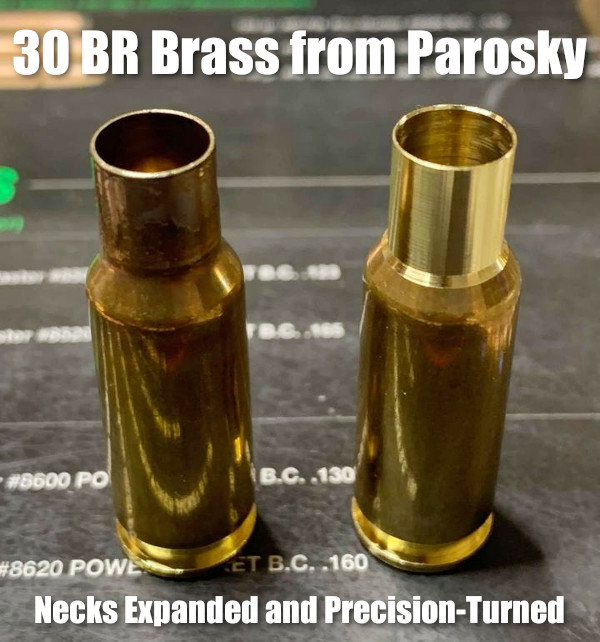
Here’s good news for 30BR shooters. Paul Parosky, maker of the excellent PRP Custom Bullets, is now offering 30BR neck-turned brass. This can save you considerable time and effort forming 30BR cases from Lapua 6mmBR brass. And the neck-turning is superb, again representing time save (and no tools to buy). You will soon be able to order this 30BR brass from Bruno Shooters Supply. If you communicate with Amy at Bruno’s, Paul may be able to neck-turn to your specific thickness. Paul notes: “Here are necks turned for a 0.330 neck. I’ll try my best to accommodate anyone’s neck dimensions as they wish. Just message Amy Bruno Parosky (at Bruno’s) for details.”
About this Neck-Turning set-up — Paul Parosky notes: “For neck-turning I’m using an old drill press that has been re-worked. The cutter and spindle are all indicated before neck turning to ensure no runout. The RPM is around 520. The lube I use is a mixture of royal and mystery oil.”
Why the 30 BR Dominates 100/200 Benchrest for Score Competition
The 30BR, along with some wildcat variants, remains the dominant cartridge in short-range (100/200) benchrest-for-score competition. The 30BR’s .308″-diameter bullets are larger than the 6mm bullets used by the 6PPC (which rules group BR competition). The bigger 30-Cal diameter has an advantage in touching scoring rings. In addition, the 30BR is also relatively easy to tune, and barrel life is considerably better than with smaller-caliber benchrest cartridges. For more information, see our AccurateShooter 30BR Cartridge Guide.
Cases are Expanded, Then Neck-Turned
To produce his 30BR brass, Parosky first uses a series of expander mandrels. Then he neck-turns with power using a converted drill press. Paul tells us: “This is done the old school way, I use three different tapered expander mandrels, then neck-turn it to the proper neck chamber, then run them up through a FL expander mandrel to ensure necks are straight. Then I clean all the cases.”
Paul Parosky Can Also Neck-Turn 6PPC Brass
Paul Parosky also expands and neck-turns 6PPC cases that are made from parent Lapua .220 Russian cartridge brass. Here, illustrating his 6PPC neck-turning operation, is a recent Paul Parosky post on the USA Benchrest & Extreme Precision Shooters Facebook page.
There’s a good episode of Gun Talk Radio this Sunday, 8/8/2021. Today Black Hills Ammunition’s Jeff Hoffman explains the ballistic differences between 9mm, .40 S&W, and .45 ACP. If you’re considering the pros and cons of these calibers you’ll want to listen to the show. In addition Rick Ector from Detroit talks about CCW Training. The show also features Springfield Armory’s Rob Leatham talking about the new 1911 Emissary pistol (see below). Call 866-TALK GUN (866-825-5486) to talk with Tom live during the show!
This broadcast airs Sunday August 8, 2021 from 2:00 PM to 5:00 PM Eastern time on 270+ radio stations nationwide. Listen on a radio station near you or via LIVE Streaming.
NOTE: Past podcasts can be heard online via the GUNTALK PODCAST Site and Apple iTunes. The Gun Talk podcast archive has many informative shows. Check out this August 1, 2021 episode which offers smart Long Range Shooting Tips.
Gun Talk Range Ready Giveaway Contest
Gun Talk has launched its latest “Range Ready” giveaway contest. There are seven valuable prize packages, with three shown below, leading off with a Benelli SB3 shotgun plus ammo. Enter now through August 27th by visiting https://www.guntalk.com/win. To enter you must provide an email address.
Here is an important safety reminder for readers who employ hand priming tools with trays of multiple primers. In this instance a primer detonated while being seating in a pistol cartridge case. This caused a “flash-over” which instantly ignited multiple other primers in the tray. That, in turn, caused a small explosion which broke the tray and Hornady Handheld Priming Tool. The user, a Forum member, posted this report this morning in our Shooters’ Forum.
Report by Forum Member about Primer Flash-Over Incident
I had a small scare the other day while reloading. My experience might be a helpful reminder to people to keep safe and follow proper procedures and not be sloppy.
A primer popped (went off) when being seated and (while hot) flashed over into the tray causing other primers in the tray to detonate. That, in turn, broke my Hornady Handheld Priming Tool and injured my hand.
Here is my loading area after the incident. Note the damage to the hand priming tool. I’m not not sure where the rest of the pieces are.
Injuries to User — Multiple Cuts on Hand and Forearm
This photo shows the resulting cuts to hand. Fortunately they seem superficial. Note — I was wearing latex gloves so my hand had some protection.
The blast also blew my glasses off my face and they landed about six feet away. Be careful folks and wear your eye protection! EDITOR: Guys — This is yet more compelling evidence why handloaders should always wear eye protection!
More Details — Primers Were Federal LP, Case Primer Pockets Had Been Checked
The forum member noted: “Just in case people are interested, I didn’t notice anything different from usual. Cases were Privi Partizan (PPU) factory brass on their fourth firing. The primers were Federal Large Pistol. The cases had been ultrasonic cleaned and the primer pockets checked prior to priming. I had primed around 50 cases during this session before the accident.”
Here is a close-up of “flashed” primers — note the empty but dented cups and triangular “anvils”:
Two other Forum members reported feeding issues with this particular handheld priming tool and one other member, Kiwi Greg, suffered a multi-primer detonation causing injury: “I had the same thing happen a few years ago now with the same Hornady hand primer with 50-75 [Federal 215M primers] in the tray. Made a bit of a mess of both my hands, blew primers and tray all around my large workshop. Scared the [heck] out of my employee who was near me at the time. Some stitches, bandages and it was all good, [but with] some wicked scars… I think a primer had turned side-on when being put into Bertram .408 CT brass which had nice tight pockets and required more force than usual. I use RCBS [priming tools] now with a flat bar that slides across to prevent sympathetic detonations. I hadn’t heard of it before, but found out it wasn’t that uncommon after it happened.”


 On the Berger Bullets website you’ll find a handy Twist-Rate Stability Calculator that predicts your gyroscopic stability factor (SG) based on mulitiple variables: velocity, bullet length, bullet weight, barrel twist rate, ambient temperature, and altitude. This cool tool tells you if your chosen bullet will really stabilize in your barrel.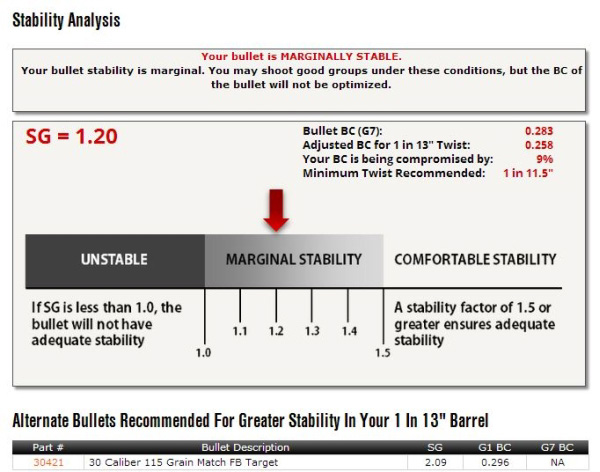

 Many of our readers have been interested in learning how modern bullets are made. While a “boutique” bullet-maker, supplied with appropriate cores and jackets, can craft bullets using relatively simple hand dies and manual presses, factory production is different. The major bullet-makers, such as


 Commercial Chamber Length Gauges May Not Work with Custom Chambers
 Precision Benchrest and F-Class shooters favor premium brass from


 The headstamp bunter punch has a protrusion on the end to make the primer pocket, and has raised lettering around the face to form the headstamp writing. This is, of course, all a mirror image of the finished case head. Small cases, such as 5.56×45, can be headed with a single strike. Larger cases, like 7.62×51 and 50 BMG, need to be struck once to form a dent for the primer pocket, then a second strike to finish the pocket, flatten the head, and imprint the writing. This second strike works the brass to harden it so it will support the pressure of firing.”




 Report by Forum Member about Primer Flash-Over Incident


