Is a ZERO extreme spread possible? Yes. Lou Murdica proved that, with AMP-annealed cases, and advanced reloading methods, you can achieve the exact same muzzle velocity — 2924 FPS for two shots in a row. Oh, and the accuracy wasn’t too bad either. Shooting in a tunnel with an F-Open rig on the bench, Lou put two rounds within 0.1 inch. Note, the rounds were fired with the wood-stocked F-Open/Benchrest rifle on the left, not the Rail Gun on the right. The full annealing and reloading process is shown in the video below:
See Complete Testing and Reloading Process in 3-minute Video!
We highly recommend you watch this video ALL the way through, and then watch it again. You will see one of the best shooters in the world loading precision ammo. Lou is a world-class short-range benchrest, long-range benchrest, and F-Class shooter. In this video you can see Lou load a cartridge start to finish, beginning with annealing using a computer-controlled AMP induction annealing machine.
After firing, the 6.5 Creedmoor case was annealed with the AMP induction annealer.
Here is Lou Murdica’s Reloading Procedure Used in this Test:
1. Anneal 6.5 Creedmoor cartridge in AMP Mk II Annealer.
2. Lubricate case with Imperial Case Wax.
3. Full-length size case with Redding FL bushing die in single-stage RCBS Big Max Press.
4. Apply Moly dry lube to inside of case-neck with brush.
After FL Sizing, and before bullet seating, Murdica applies dry Moly lube inside the case-neck.
5. Seat Primer with Bald Eagle Precision Primer Press.
6. Throw charge to within 1 kernel with Auto-Trickler System and Force Restoration Lab Scale.
7. Drop charge in case with precision funnel.
8. Seat bullet with hand die and Sinclair Arbor Press.
Two Rounds, Same Case, Both with Exact Same Velocity — 2924 FPS
If you watch the video, you can see that, for the second 6.5 Creedmoor round, the velocity is 2924 FPS. That is exactly the same velocity as shot number 1. So the two-shot Extreme Spread (ES) is Zero. The second shot was 0.1″ from shot number one — pretty close to one hole. Lou was using Vihtavuori powder and Berger AR bullets. On the screen, Oehler Ballistic Instrumentation software displays bullet velocities and impact locations using inputs from chronograph and acoustic target sensors.
Credit Boyd Allen for identifying Oehler System and RCBS Big Max Press.
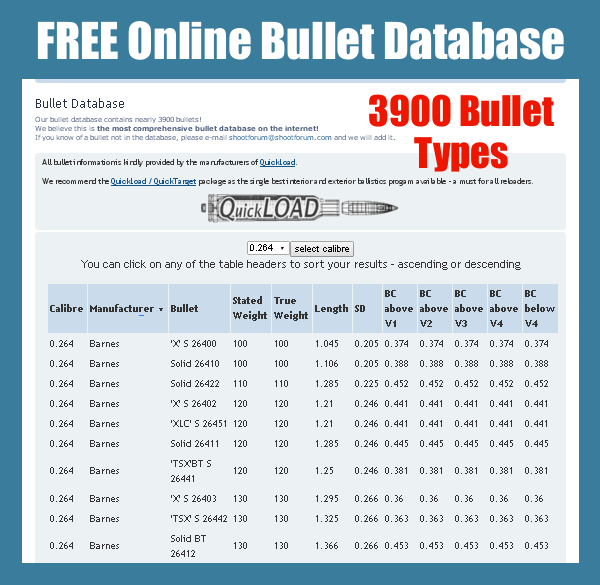
Did you know that there’s a free online resource that provides key data for thousands of bullet designs? The ShootForum Bullet Database provides profiles with weight, length, SD, and Ballistic Coefficient for nearly 3900 bullet types from all the major manufacturers. You can access all this info for free. This is a great place to start when you’re considering bullet options for a new rifle, or a new chambering for an existing rifle. To be fair, not all the latest, greatest match bullets are listed here. Could the database benefit from updates — yes, but it is still a great info source. You should definitely bookmark this resource for easy access in the future.
The massive ShootForum.com Bullet Database includes over 3900 bullet designs in all. We counted nearly 200 different 6mm bullets! The bullet info comes from the makers of QuickLOAD Software. Access to the online database is FREE. Most database entries include Caliber, Manufacturer, Stated Bullet Weight, True Bullet Weight, Length, Sectional Density (SD), and Ballistic Coefficient. In many cases multiple BCs are provided for different velocity ranges. Having bullet length lets you know right away if your cartridge/bullet combo can fit your magazine.
The database is great if you’re looking for an unusual caliber, or you want a non-standard bullet diameter to fit a barrel that is tighter or looser than spec. You’ll find the popular jacketed bullets from major makers, plus solids, plated bullets, and even cast bullets. For those who don’t already own QuickLOAD software, this is a great resource, providing access to a wealth of bullet information.
by Sierra Bullets Ballistic Technician Gary Prisendorf
Occasionally someone will ask, “Why did I get a flyer that didn’t go in with the rest of my group?” If I had an answer that would stop flyers from happening, I would be rich.
There are many reasons why this can happen. Everything from gripping a forearm differently to variations in the brass casing, the list goes on and on. Most of the time the flyer is usually shooter induced and sometimes what you may think is a flyer, is just part of your group. There are a lot of shooters, that go out and test a load and they may shoot a 3/8” group at 100 yards and think that load is good. But I have seen far too many times that you can shoot another group, same load, same rifle and the next time you may get a 1 ¼” group.
The total opposite can also occur. You may shoot a 1 ¼” group and turn around and follow it with a 1/2″ group without changing anything. If you only shot the one group, you might decide that load wasn’t any good and move on to something else without really knowing what that load was capable of.
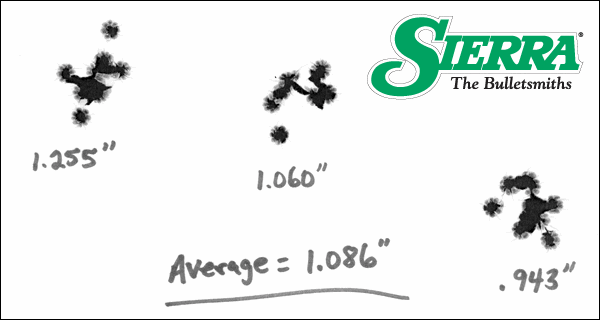
To really determine how a particular load is performing we need to shoot multiple groups and take an average of the group sizes to really see what that rifle/load combination is really capable of.
I suggest shooting a minimum of three 5-shot groups and averaging the group sizes before deciding if the load is acceptable or not. Obviously the more rounds you shoot for a group and the more groups that you shoot, you will get a much better representation of what that particular combination can do.
Now I’m not saying to go out and shoot 30 groups with 50 rounds in each group to determine how well your load is shooting. That would be a bit pointless, in some cases it would be time to re-barrel your rifle before your load development was finished.
In most cases, I feel that three to five, 5-shot groups will give you a pretty good representation of how a load will perform in that specific firearm.
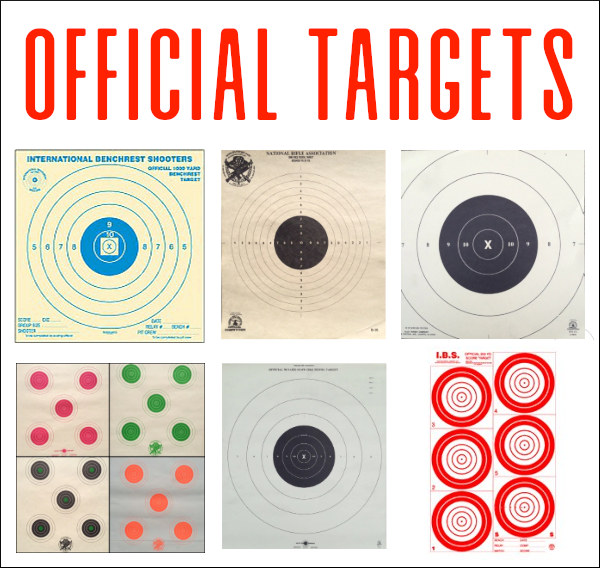
Need targets — not just any old targets, but the correctly-sized targets for specific shooting disciplines (such as NRA Smallbore, F-Class, and 1K Benchrest)? Well you won’t find them at your neighborhood Wally World store. Precise, dimensionally-correct competition targets are producted by a half-dozen specialty printers. In this article we provide links to the leading target sellers, with a chart showing “who’s got what”. Look for your particular discipline and the vendors will be specified.
Sources for Official Shooting Competition Targets:
AccurateShooter.com offers dozens of FREE, printable targets for target practice, load development, and fun shooting. We also offer a few of the most popular NRA Bullseye targets. One or more of these printable targets should work for most training purposes. However, some readers have asked: “Where can we get the real targets… exactly like the ones used in NRA, IBS, and NBRSA shooting matches?”
All these vendors carry nearly all the NRA High Power and Smallbore targets, including the new, smaller F-Class targets. National Target has the F-Class and High Power targets, including 100-yard reductions of the 200, 300, and 600-yard military targets.
Germany’s Kruger Targets sells all the important NRA targets, and international (ISSF) air rifle and smallbore targets too.
Orrville Printing currently sells IBS targets for rimfire (50 yard) benchrest, short-range centerfire Benchrest (100, 200, 300 yards), Hunter BR Rifle (100, 200, 300 yards), plus the official 600-yard and 1000-yard IBS targets. National Target Company also has most of the IBS targets. NBRSA short-range, 600-yard, and 1000-yard benchrest targets are available directly from the NBRSA Business Office. Call (307) 655-7415 to order for the season.
Need Steel, Cardboard Silhouettes or specialty targets? ALCO Target Company in Duarte, California is the USA’s leading producer of the full spectrum of shooting targets including paper targets, cardboard targets, steel targets, and target stands.
At the request of our readers, we provide select “Deals of the Week”. Every Monday morning we offer our Best Bargain selections. Here are some of the best deals on firearms, hardware, reloading components, optics, and shooting accessories. Be aware that sale prices are subject to change, and once clearance inventory is sold, it’s gone for good. You snooze you lose.
This Stack-On Sentinel Security Cabinet holds 18 rifles up to 54″ tall or nine firearms with extra storage. Adjustable, padded shelves can be placed on either right or left side. This unit features a 3-point locking system for greater security. No this safe is NOT as strong or secure as a quality, thick-walled gun-vault, but this 55″x21″x18″ Security Cabinet can work well as a secondary safe for your workroom, vacation cabin, or even an RV. Right now Walmart has “Roll-Back” pricing — $159.99 with FREE delivery. That’s right — pay just $159.99 for the safe delivered to your home or the nearest Walmart.
2. Bruno Shooters Supply — Berger Bullets at Great Prices
Match season is in full swing — so make sure you don’t run short on bullets. One of our go-to sources for reloading components is Bruno Shooters Supply. Bruno’s just recently updated its website, so you should check out the new features. While you’re there, look at Bruno’s selection of Berger bullets advertised at “lowest prices on the internet”. Berger match bullets are in high demand, but Bruno’s is offering great prices on many popular calibers and bullet weights.
3. EuroOptic — Sale on Vortex Strike Eagles, $299.99
Need a good basic optic for your hunting or varmint rifle? Have a tight budget but still need good glass and adjustable parallax? Then check out these Vortex Strike Eagles. Save $140-$150 now at EuroOptic.com. Sale price is just $299.99 for the 4-24x50mm and also $299.99 for the 3-18x44mm. EuroOptic’s Jason says these scope are a “killer value” with “target turrets, parallax adjustment close enough for rimfire, and good zoom range”. These Strike Eagles are also fairly short and light-weight, so they are good for hunters. Both these Second Focal Plane scopes offer 1/4-MOA clicks and nice EBR-4 illuminated reticles.
4. Bullet Central — Kelbly Atlas Tactical Action, $895
Kelbly actions are excellent. The Atlas series are rugged actions for practical/tactical and hunting use. This action features a Black Nitride finish so you can run minimal lubrication. The Atlas action comes with +20 MOA integral Picatinny Rail plus a nice fluted bolt. We also like the super-reliable TG mechanical ejector. This mag-fed Kelbly Atlas action takes Accuracy International and AI-type single-stack magazines. This fine Kelbly Atlas Tactical Action is now on sale at Bullet Central for the low price of $895.00.
Versatile and totable, this compact Samsung Galaxy 7″ tablet computer is just what you need at the range to run your Ballistics Apps, get WiFi images from your Target Cam, or “talk” to your LabRadar. The Galaxy Tab A 7.0 inch can also get internet weather reports and email. This is a modern device with myriad capabilities — all for under $130.00. It has a micro-SD slot so you can easily add more storage. You won’t find more bang for the buck in a digital device, and it even comes with free Tech support. NOTE: This is WiFi only — it is NOT a like a cellphone. It works via an internet connection (and blue-tooth).
6. Walther — PPQ and PPS Pistols, 30-Day Money Back Guarantee
We’ve heard of money-back guarantees on household products, and even pizzas. But never firearms. This is quite a unique offer. Walther is so confident that you will fall in love with Walther PPQ or PPS pistols that the German gun-maker is offering a 30-Day Money Back Guarantee.
Shoot it, if you like it, keep it. But if you don’t, you can send it back to Walther for a full refund. Walther even pays shipping! For more info visit www.WaltherArms.com. This offers applies to ALL Walther PPQ and PPS models.
7. Grizzly — Bald Eagle Priming Press, $80.97
Any serious competitor will tell you that consistent primer seating is one of the most critical steps in reloading. There are lots of choices out there for bench and hand-held primers but NONE of then match the Grizzly priming press which can be found for $80.97. It features a beautifully-made system that is click adjustable to .002″ and incredibly repeatable. If you’re in the market for something that’s easy on the hands and works like units that cost hundreds more give this one a look.
If you have been waiting to get a Magnetospeed… wait no longer. Priced at just $153.74 at MidwayUSA, the Magnetospeed Sporter model costs less than half as much as Magnetospeed’s V3 models. This chronograph attaches directly to your barrel so you don’t have to go downrange to position tripods and set up skyscreens. For most people the Sporter Model contains all the features they need. Using Magnetospeed’s XFR adapter (sold separately), data can be transferred easily from the display module to your mobile device. READ Magnetospeed Sporter Review. NOTE: You need to add the item to cart to see the $153.74 price. This typically sells elsewhere for around $180.00.
This versatile funnel system works with nearly all cartridge types, from 17 Remington up to 500 S&W. Even if you have a fancy metal funnel, it’s worth having one of these RCBS Kits on your reloading bench. The RCBS Quick Change Powder Funnel Kit features five (5) adapters that match case mouth diameter for specific cartridge ranges: 17-20 caliber, 22-264 caliber, 27-284 caliber, 30-375 caliber, 40 caliber and higher. The Funnel Kit includes a handy 4-inch drop tube. Price is $11.04 at Amazon with free shipping on orders over $25 total.
10. Amazon — Two Rolls of 3″ Neon Target Stickers, $12.99
We like these bright, Neon EasyShot 3″ target stickers. They are big enough to see easily at 600 yards, giving you a 1/2 MOA target center at that distance. For $12.99 at Amazon.com, you get 250 3″-diameter self-adhesive centers (125 targets per roll) that stick to almost any surface The high-contrast fluorescent red/orange color provides an excellent HI-VIZ aiming point, along with good contrast for bullet holes that fall within the 3″ circle. To help line up your reticle cross-hairs, the target centers feature black markers at 3, 6, 9, and 12 0’Clock. NOTE: These stickers qualify for FREE Shipping.
The folks at Applied Ballistics have a new toy — a large trailer filled with all the latest and greatest tech gear for testing long-range ballistics. Bryan Litz reported: “The maiden voyage for the AB Mobile Lab in Texas this week was a huge success! We look forward to supporting more long range shooting events.” Mitchell Fitzpatrick was there in the Lone Star state with fellow Applied Ballistics staffer Christopher Palka. The Applied Ballistics team will be trailering the Mobile Lab to Indiana where it will be on hand for the NRA National Championships at Camp Atterbury this month.
Ten rifles, heaps of cables, huge Doppler Radar unit, military-grade Laser RFs on tripods, spare barrels, safety gear — all ready for action in Texas.
About the Applied Ballistics Mobile Lab
Q: What is the basic purpose of the Applied Ballistics Mobile Lab?
Mitchell Fitzpatrick: The Mobile Lab allows us to effectively carry out ballistics testing in the field and at events. It has most of the capabilities of our normal lab, but on wheels.
Q: What hardware and electronics are carried in the Mobile Lab? What are its capabilities?
Bryan Litz: The Mobile Lab will transport most everything that’s in the main lab including the Doppler radar. This rig is new and we haven’t fully outfitted it yet. The load-outs will be somewhat flexible depending on the venue we are supporting.
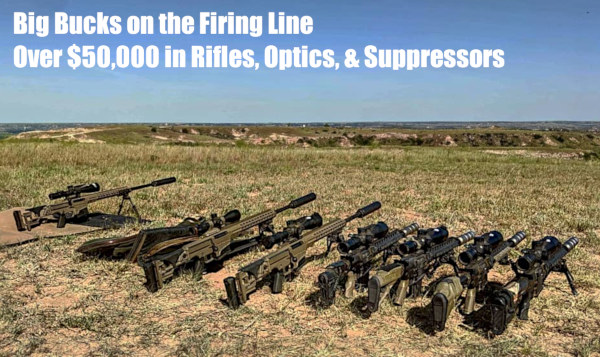
The three rifles on the left are Barrett MRADS, $6000-$6154 MSRP, before optics.
NOTE to Readers — Check back at the end of the day. We will have more technical information from Bryan Litz and the Applied Ballistics team…
To help celebrate National Shooting Sports Month (NSSM), rifle and gear manufacturers are offering big prize packages — the Gearbox Giveaways. Enter to win rifles, pistols, ammo, and other valuable prizes. Many of the Gearbox packages are worth over $3000 with the most valuable package worth over $5000! Enter as many of the Gearbox Giveaways as you choose. You can’t win if you don’t enter.
You’ll find all the Gearbox Giveaways on the NSSF website. Shown below are TEN current Gearbox Giveaways ranked in order of value — starting with the most valuable prize package. Good luck!
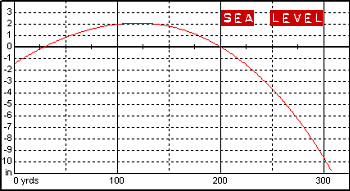
You can do your own experimental calculations using JBM Online Ballistics (free to use). Here is an extreme example, with two printouts (generated with Point Blank software), one showing bullet trajectory at sea level (0′ altitude) and one at 20,000 feet. For demonstration sake, we assigned a low 0.2 BC to the bullet, with a velocity of 3000 fps.
One of our readers asked “What effect does altitude have on the flight of a bullet?” The simplistic answer is that, at higher altitudes, the air is thinner (lower density), so there is less drag on the bullet. This means that the amount of bullet drop is less at any given flight distance from the muzzle. Since the force of gravity is essentially constant on the earth’s surface (for practical purposes), the bullet’s downward acceleration doesn’t change, but a bullet launched at a higher altitude is able to fly slightly farther (in the thinner air) for every increment of downward movement. Effectively, the bullet behaves as if it has a higher ballistic coefficient.
Forum member Milanuk explains that the key factor is not altitude, but rather air pressure. Milanuk writes:
“In basic terms, as your altitude increases, the density of the air the bullet must travel through decreases, thereby reducing the drag on the bullet. Generally, the higher the altitude, the less the bullet will drop. For example, I shoot at a couple ranges here in the Pacific Northwest. Both are at 1000′ ASL or less. I’ll need about 29-30 MOA to get from 100 yard to 1000 yards with a Berger 155gr VLD @ 2960fps. By contrast, in Raton, NM, located at 6600′ ASL, I’ll only need about 24-25 MOA to do the same. That’s a significant difference.
Note that it is the barometric pressure that really matters, not simply the nominal altitude. The barometric pressure will indicate the reduced pressure from a higher altitude, but it will also show you the pressure changes as a front moves in, etc. which can play havoc w/ your calculated come-ups. Most altimeters are simply barometers that read in feet instead of inches of mercury.”
As Milanuk states, it is NOT altitude per se, but the LOCAL barometric pressure (sometimes called “station pressure”) that is key. The two atmospheric conditions that most effect bullet flight are air temperature, and barometric pressure. Normally, humidity has a negligible effect.
It’s important to remember that the barometric pressure reported on the radio (or internet) may be stated as a sea level equivalency. So in Denver (at 6,000 feet amsl), if the local pressure is 24″, the radio will report the barometric pressure to be 30″. If you do high altitude shooting at long range, bring along a Kestrel, or remember to mentally correct the radio station’s pressure, by 1″ per 1,000 feet.”
Sierra Bullets has recently released load data for the 6mm Creedmoor cartridge, a necked-down version of the 6.5 Creedmoor, a popular PRS, tactical, and hunting cartridge. Sierra has released very comprehensive 6mm Creedmoor load data, covering fifteen (15) different bullets from 55 to 110 grains. NOTE: Hornady-brand brass was used for Sierra’s 6mm Creedmoor load tests, not the newer, stronger Lapua 6.5 CM brass with small primer pockets. Hand-loaders using Lapua 6.5 Creedmoor brass necked to 6mm may have to adjust their loads.
Sierra writes: “As soon as the 6.5 Creedmoor was released in 2007, a 6mm version was being envisioned. After the 6mm Creedmoor demonstrated its worth at 1000 yards it began to catch the attention of Precision Rifle Series (PRS) competitors. The 6mm/6.5 Creedmoor is a great fit for those looking for an AR platform-friendly cartridge. It delivers velocities very similar to the .243 Win and yet fits the AR10 magazine length[.] The 30-degree shoulder makes this a very efficient case and helps prolong case life as well. The 6mm/6.5 Creedmoor works well with powders such as H4350, RE-17, and Ramshot Hunter for heavier long-range bullet weights. Slightly faster powders such as RE-15, Win 760, and Vihtavuori N540 work well with lighter weight bullets.”
Sierra Bullets Tested for 6mm Creedmoor Load Data
55gr BlitzKing (#1502)
60gr HP (#1500)
70gr HPBT (#1505)
70gr BlitzKing (#1507)
75gr HP (#1510)
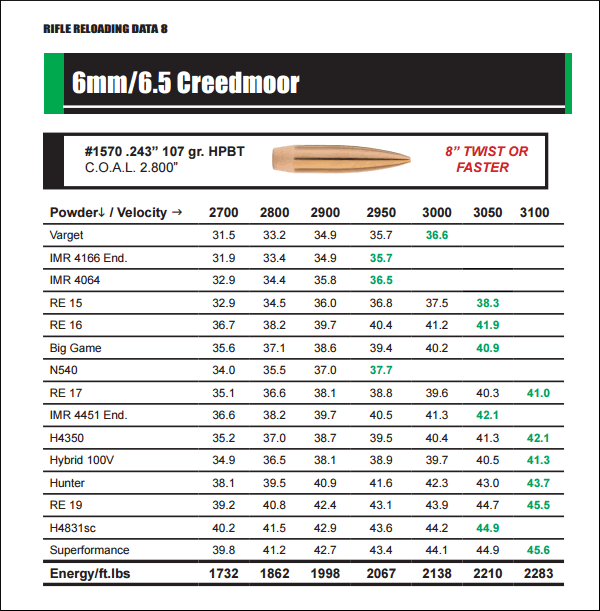
In developing its 6mm Creedmoor load data, Sierra tested a very wide selection of propellants, two dozen overall. For the smaller bullets, fast-burning powders such as Benchmark, H4895, and CFE223 were tested. For the heavier 100+ grain bullets, Sierra tested a selection of medium-burn-rate powders including H4350, Reloder 16, Reloder 17, Varget, and Superformance. Sierra did a very thorough job. We know this information will be welcomed by 6mm Creedmoor shooters.
Don’t know what powder to try first? For the 107-110 grain bullets, if you want best accuracy and low ES/SD, our Forum members recommend Alliant Reloder 16 and Hodgdon H4350. If you are seeking max velocity with the 110-grainer, look at Hodgdon Superformance and Reloder 19.
Here are Sierra’s 6mm Creedmoor Load Data Charts for the 107gr MK and 110gr MK. There are a half-dozen other tables for lighter-weight bullets.
At the request of our readers, we provide select “Deals of the Week”. Every Monday morning we offer our Best Bargain selections. Here are some of the best deals on firearms, hardware, reloading components, optics, and shooting accessories. Be aware that sale prices are subject to change, and once clearance inventory is sold, it’s gone for good. You snooze you lose.
1. Palmetto State Armory — Complete AR Lowers $120-$150
Guys, this is the lowest price we’ve seen for non-blem, name-brand AR-15 platform complete lowers. If you are building an AR for varminting, 3-Gun, or home defense, check out Palmetto’s Going Overboard Sale. Get the MOE FDE Edition for just $119.99. Or for $30 more choose the STR Edition or ACS-L edition, both offered for $149.99. All these models have quality Magpul stocks and grips and include full trigger groups. Use the money you save with these bargain lowers to buy a top-grade barrel for your upper.
2. Brownells — Lapua Scenar-L Bullets
Lapua Scenar-L match bullets are extremely consistent in weight and base to ogive length. In our experience they shoot great, and they definitely deserve a try-out along with Bergers and Sierras. We’ve seen success in various calibers and even found some barrels prefer them over anything else. If you want to try these excellent Lapua projectiles, right now Brownells is selling Lapua Scenar-L bullets at up to 28% off! These discounted Scenar-Ls are offered in .224, 6mm, 6.5mm, 7mm and .308 (30 Caliber) — all the most popular match calibers.
3. Amazon — Tipton Ultra Gun Vise, $125.99
Cleaning and working on your guns requires a solid platform. Most gun cleaning stands aren’t adjustable enough, or are too flimsy. Not so the Tipton Ultra Gun Vise. Weighing-in at about 10 pounds, this beefy gun vise provides a steady base. The frame is metal for strength. It features stout adjustable jaws, specialized AR holder, and several accessory trays. Threaded feet allow the vise to be leveled on your bench (or the ground). With this system you can work on just about anything including bolt-action rifles, AR-platform rifles, shotguns, pistols, and even compound bows and crossbows. To fit 3″-wide forearms you may have to remove or modify the front pad(s). Our Deals Editor, who owns this gun vise, reports: “this is a phenomenal vise — the best anybody makes — it is well worth the $125.99″.
As optics technology advances, scope performance-for-the-price improves too. A good example is Vortex Optics, which offers fine scopes at very reasonable prices. The Vortex 3-9x40mm Tactical has good features and a rock-solid warranty. It’s a lot of scope for $279.99 but now you can grab this versatile Vortex for the crazy low price of $189.49 at Natchez.
5. Bruno Shooters Supply — Berger Bullets at Great Prices
Match season is in full swing — so make sure you don’t run short on bullets. One of our go-to sources for reloading components is Bruno Shooters Supply. Bruno’s just recently updated its website, so you should check out the new features. While you’re there, look at Bruno’s selection of Berger bullets advertised at “lowest prices on the internet”. Berger match bullets are in high demand, but Bruno’s is offering great prices on many popular calibers and bullet weights.
6. EuroOptic — 50% Off Minox with Mauser Rifle Purchase
The Mauser M18 is a proven hunting rifle offered in many popular hunting calibers/cartridge types. If you’re looking for a fine, affordable hunting rifle definitely consider the M18. And for added incentive, right now you can get 50% off a Minox scope with the purchase of a Mauser M18 rifle from EuroOptic.com. CLICK HERE to get the Mauser coupon which you can redeem with Minox USA after your purchase. This is a great promo that can save you a ton of money.
7. Grizzly — 60″ Padded Rifle Case, $40.97
Do you cringe every time you place expensive rifles into old cases that are dirty or damaged? Here’s a great case for long match rifles at a great price. Grizzly is now selling excellent 60″ Bald Eagle rifle cases for just $40.97. These cases are well made, heavily-padded with lots of pockets. They compare favorably to other soft cases costing $65 or more. It can be hard to find quality cases that hold very long rifles. NOTE: Grizzly has other case colors and sizes on sale for a few bucks more.
8. Midsouth — Nosler 6.5 Creedmoor 140gr Ammo, $24.99 per box
Nosler 6.5 Creedmoor ammunition features top-of-the-line 140gr ballistic tip bullets (0.509 G1 BC). These B-Tips feature tapered jackets to control expansion and allow good penetration and a deep wound cavity. These are excellent hunting bullets for deer, antelope, and hogs. Nosler used top-quality brass, powders, and primers for its 6.5 Creedmoor B-Tip ammo. These cartridges have a 2550 FPS Muzzle Velocity.
9. Amazon — Frankford Arsenal Rotary Tumbler Lite, $99.99
Lots of people love wet-tumbling their brass in stainless pins but not everyone want to do it in a giant unit. We found a sweet deal on the Frankford Arsenal Rotary Tumbler Lite. Amazon has this unit on sale for $99.99. This tumbler is small enough to fit on a counter but still big enough to hold 300 pieces of .223 Rem brass. For folks on a limited budget who want to get started with wet tumbling, this is a solid choice.
10. Amazon – Proster Wind Meter, $16.99
This Proster wind meter is a great bargain. The previous model had a very impressive 4.2 star overall rating (with 300+ reviews), and the latest version has some improvements (including a square base so it can stand). Now on sale for just $16.99, this is a very useful tool for a bargain basement price. To provide reliable wind inputs for ballistics calculations, you really do need a Wind Meter. And unlike a costly Kestrel, with this budget wind meter, you won’t feel too bad if it gets lost or misplaced.













 One of our readers asked “What effect does altitude have on the flight of a bullet?” The simplistic answer is that, at higher altitudes, the air is thinner (lower density), so there is less drag on the bullet. This means that the amount of bullet drop is less at any given flight distance from the muzzle. Since the force of gravity is essentially constant on the earth’s surface (for practical purposes), the bullet’s downward acceleration doesn’t change, but a bullet launched at a higher altitude is able to fly slightly farther (in the thinner air) for every increment of downward movement. Effectively, the bullet behaves as if it has a higher ballistic coefficient.