What is “Overbore”? That’s a question rifle shooters can debate to no end. This article from our archives proposes one way to identify “overbore cartridges”. We think the approach outlined here is quite useful, but we know that there are other ways to define cartridges with “overbore” properties. Whenever we run this article, it stimulates a healthy debate among our readers — and that is probably a good thing.
Forum Member John L. has been intrigued by the question of “overbore” cartridges. People generally agree that overbore designs can be “barrel burners”, but is there a way to predict barrel life based on how radically a case is “overbore”? John notes that there is no generally accepted definition of “overbore”. Based on analyses of a wide variety of cartridges, John hoped to create a comparative index to determine whether a cartridge is more or less “overbore”. This, in turn, might help us predict barrel life and maybe even predict the cartridge’s accuracy potential.
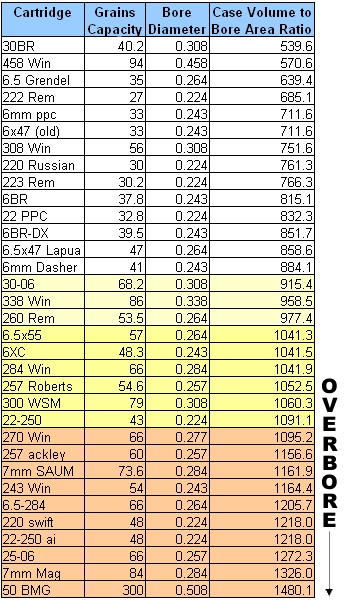
John tells us: “I have read countless discussions about overbore cartridges for years. There seemed to be some widely accepted, general rules of thumb as to what makes a case ‘overbore’. In the simplest terms, a very big case pushing a relatively small diameter bullet is acknowledged as the classic overbore design. But it’s not just large powder capacity that creates an overbore situation — it is the relationship between powder capacity and barrel bore diameter. Looking at those two factors, we can express the ‘Overbore Index’ as a mathematical formula — the case capacity in grains of water divided by the area (in square inches) of the bore cross-section. This gives us an Index which lets us compare various cartridge designs.”
OVERBORE INDEX Chart
So what do these numbers mean? John says: “My own conclusion from much reading and analysis is that cartridges with case volume to bore area ratio less than 900 are most likely easy on barrels and those greater than 1000 are hard on barrels.” John acknowledges, however, that these numbers are just for comparison purposes. One can’t simply use the Index number, by itself, to predict barrel life. For example, one cannot conclude that a 600 Index number cartridge will necessarily give twice the barrel life of a 1200 Index cartridge. However, John says, a lower index number “seems to be a good predictor of barrel life”.
John’s system, while not perfect, does give us a benchmark to compare various cartridge designs. If, for example, you’re trying to decide between a 6.5-284 and a 260 Remington, it makes sense to compare the “Overbore Index” number for both cartridges. Then, of course, you have to consider other factors such as powder type, pressure, velocity, bullet weight, and barrel hardness.
Overbore Cases and Accuracy
Barrel life may not be the only thing predicted by the ratio of powder capacity to bore cross-section area. John thinks that if we look at our most accurate cartridges, such as the 6 PPC, and 30 BR, there’s some indication that lower Index numbers are associated with greater inherent accuracy. This is only a theory. John notes: “While I do not have the facilities to validate the hypothesis that the case capacity to bore area ratio is a good predictor of accuracy — along with other well-known factors — it seems to be one important factor.”
Inspect your cases — every time you reload. A tiny flaw could lead to a split neck, case-head separation or worse. The Sierra Blog has a good article this week on case inspection, with many eye-catching examples. Sierra Bullets Ballistic Technician Duane Siercks shows a variety of problem cases and explains the issues he found. Duane states: “Careful case examination is one of the most important safety aspects of the reloading process.”
We recommend that you read the full article. Here are three examples…
Incipient Case-Head Separation
This is a Winchester .308 Win case that has a real issue. This case has a very obvious incipient case head separation in the process of becoming a complete failure.
This is most commonly caused by over-sizing the case causing there to be excess headspace on the case. After a few firings and subsequent re-sizing, this case is just about ready to come completely apart. Proper die adjustment is certainly a requirement here. Of course this case is not safe to reuse.
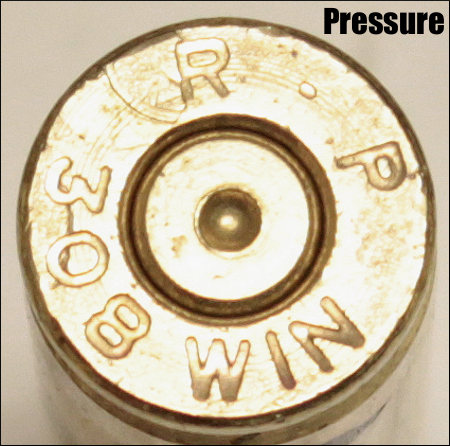
Excessive Pressure (Load Too Hot)
If you will notice in the picture of the case rim, there are two pressure signs to notice. First, look at the primer. It is basically flattened to about the max of what could be considered safe. If this was the only pressure sign noted, I would probably be fine with this load, but would constantly keep an eye on it especially if I was going to use this load in warmer temperatures. This load could easily cross into the “excess pressure” realm very quickly.
There is another sign of pressure that we cannot ignore. If you’ll notice, there is an ejector mark apparent that is located over the “R” of the R-P headstamp. This absolutely tells us that this load would not have been in the safe pressure range. If there were any of these rounds loaded, they should not be fired and should be dis-assembled. This case should not be reloaded.
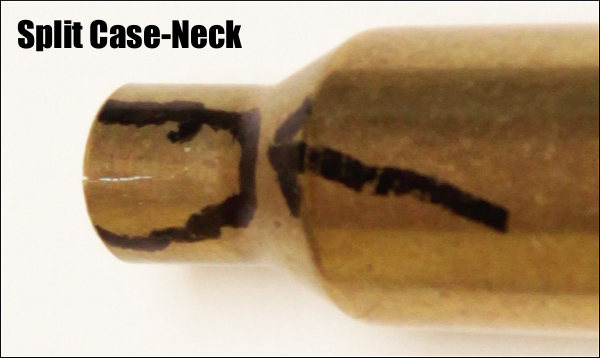
Split Case-Neck
Here we have an R-P .22-250 case that has died the death. Everything looks fine with this case except the neck is split. This case must be tossed.
A split neck is a normal occurrence that you must watch for. It is caused by work-hardening of the brass. Brass cases get harder with age and use. Brand new cases that are stored for a period of time can become hard enough that they will split like this case within one to two firings. I have had new factory loads do the same thing. Then as we resize and fire these cases repeatedly, they tend to get harder and harder. Eventually they will split. The life of the case can be extended by careful annealing practices. This is an issue that would need to be addressed in an article by itself. Of course this case is no longer usable.
In the classes that I teach, I try to use examples like this to let the students see what they should be looking for. As always, if we can assist you, whether you are new to reloading or very experienced, contact us here at Sierra Bullets by phone at 1-800-223-8799 or by email at sierra [at] sierrabullets.com.
Here’s a great search service that can help you locate hard-to-find ammunition and reloading components — while saving money in the process. Ammoseek.com monitors more than a dozen online vendors — checking current pricing and available inventory, for pistol, rifle, and shotgun ammunition. Need .45 acp ammo for your 1911? Just select “.45 ACP” from the “Quick Seek” list on the right. Likewise you can find .223 Rem and .308 Win Rifle ammo with one click.
Find .22 LR Ammo Quickly
Looking for hard-to-find .22 LR rimfire ammunition? Well AmmoSeek makes it easy — you don’t even have to enter any search words. Simply click on the highlighted links for AmmoSeek’s 22LR Page.
Use Ammoseek.com to Find Reloading Components Too
Ammoseek.com also lets you search for reloading components, including powder, primers, brass, and bullets. This is a huge time-saver. You can instantly check a dozen or more vendors to see if a particular type of powder is in stock. Likewise, you can quickly check for primer availability. If you have a big match coming up and are short on primers — this could solve the problem.
Story Tip by Boyd Allen. We welcome reader submissions.
Take a good look at this unusual ammunition. We think you are looking at the future of handgun ammo — at least for range and practice work. This patent-pending ammunition features a 100% lead-free bullet blended from polymer (plastic) and copper powder. The polymer-copper matrix (PCM) composition offers three major benefits: 1. the bullets do not ricochet; 2. the bullets are lighter and therefore faster than conventional projectiles; and 3. the bullets are environmentally friendly. We think this is a big deal — we predict matrix pistol bullets will become extremely popular in the years to come.
At the 2016 SHOT Show Media Day, we shot ammo with PCM bullets in a half-dozen handguns. The ammo performed flawlessly, without a hitch. In .40 SW and .45 ACP pistols, the felt recoil was considerably less than with conventional lead-core ammo (the difference was less noticeable with .380 ACP and 9mm Luger).
Ruger is now offering Ruger-branded ARX ammo with polymer-copper matrix bullets. This ammo will be produced under a licensing agreement with PolyCase Ammunition, the Georgia-based business that originally developed this bullet technology.
While Ruger is touting this ammo as a self-defense solution, we think the most common use of this new ammo will be for indoor practice, plinking, gun games such as IDPA, and use on steel and reactive targets. If you like to shoot steel, matrix bullets make sense. The polymer-copper matrix bullet basically disintegrates into very small fragments when it hits metal.
This video includes extensive tests of Ruger 9mm ARX ammo:
Ruger ARX Ammo with Injection-Molded Matrix Bullets
The fluted projectiles are injection-molded from a polymer-copper matrix. This offers many advantages. First, being completely lead-free, these bullets can be used at indoor facilities that prohibit lead-based ammo. Second, because the composite bullets weigh 30% less than comparable lead-based projectiles, shooters experience less recoil (even though velocities are higher). Third, the composite matrix bullet has low-ricochet properties. When these bullets strike metal, they are designed to disintegrate, rather than ricochet. This makes them well-suited for indoor use, or use with metal plates.
Ruger’s new ARX line of lead-free ammo features injection-molded bullets that are much lighter than conventional projectiles, caliber by caliber: 56 grains for .380 ACP, 74 grains for 9x19mm, 107 grains for .40 SW, and 114 grains for .45 ACP. The lighter bullets fly faster, but ARX ammo still offers reduced perceived recoil.
Shooting Wire Editor Jim Shepherd reports that ARX ammo delivers on its low-recoil promise: “Having spent time testing the PolyCase ammunition (largely in Ruger firearms), I know the reduction in felt recoil isn’t just hype. While firing PolyCase ARX ammunition in calibers ranging from .380 in small concealed carry pistols (including a Ruger’s LCP) up to .458 SOCOM in modern sporting rifles, the lessened felt recoil was noticeable.”
Polymer-Copper Matrix Bullets Show Good Penetration
Despite their lighter-than-average weight, ARX bullets show good penetration in ballistics gelatin, thanks to their unique, fluted-tip design. This video shows penetration tests:
When we first ran this story a year ago, it spurred a hot debate, with strong opinions on both sides of the issue. Some guys argued vehemently that volumetric powder dispensing was best — citing the experience of short-range benchresters, most of whom still throw their charges. Others say weighing your charges is best, so long as you have a very precise, and very repeatable scale. We know some of the top 1000-yard shooters weigh their charges to the kernel.
The Great Debate: Volume vs. Weight
Most competitive long-range shooters weigh powder charges for their handloads. Some even use ultra-precise magnetic force restoration scales to load to single-kernel tolerances. But is weight-based measuring always the best way to fill a case with powder? Another option is volumetric charging. This method fills a precisely-sized cavity with powder and then dumps the charge into the case. A Harrell’s rotary powder measure works this way, as does the sliding powder filler on a Dillon progressive press.
Lower ES/SD with Precise Weighing
For long-range applications, most people believe that precise weighing of powder charges is the best way to achieve optimal accuracy and low ES/SD. Our testers have definitely seen ES/SD go down when we started weighing charges with a lab-grade force restoration scale. However, those short-range Benchrest guys still do pretty darn well with their thrown charges, at least at 100 and 200 yards.
Our friend Dennis Santiago recently observed something that made him scratch his head and wonder about weighing charges. His AR-15 match rifle shot better with volumetric (cavity-measured) charges than with weighed charges dispensed by an RCBS ChargeMaster. Here’s what he reports:
Cavity vs. Dribble (Dennis Santiago Report) I had the chance to compare nominally identical ammunition loaded two ways. These were all .223 Remington match loads using 77gr Sierra Match Kings over 23.4 grains of Hodgdon Varget. Same gun. However I loaded some ammo with charges dispensed with a Lee cavity-style powder measure while other rounds were loaded with powder weighed/dispensed by an RCBS Chargemaster. The cavity-drop ammo (with powder dropped from the Lee unit) was consistently better than the weighed-charge ammo. I have no idea why…
So, ladies and gentlemen — what do you think? Why did Mr. Santiago’s volumetrically-charged ammo shoot better than ammo filled with weighed charges? What’s your theory? Gary Eliseo suspects that Dennis’s Chargemaster might have been drifting. What do you think? Post your theories in the comments area below.
Bullets as art? Here’s an interesting product — a collection of fully-expanded hollowpoint bullets. If you’re shopping for self-defense ammo, take a gander at these projectiles in “full bloom”. The $69.95 Boom Box includes five (5) popular hollow-point bullet types in three different calibers: 9mm, .40 S&W, and .45 ACP. That’s a total of fifteen bullets. Bullet types are: Barnes TAC-XPD, Federal HST, Hornady XTP, Sig Sauer V-Crown, and Speer Gold Dot. All 15 bullets have been live fired, cleaned, clear-coated, and labeled.
Does the .45 ACP really more stopping power than 9mm? Which manufacturer makes the best self defense bullet? What bullet design expands most reliably? These are common questions among gun owners. The Boom Box bullet samples can help answer your questions about expansion, terminal ballistics, and lethality. Plus, let’s face it — these fired, fully expanded bullets just look cool.
The Story Behind Boom Box Bullets…
Anthony Zambai, mechanical engineer and owner of BulletsBouquets.com, started the business shooting Federal HSTs into a tall bucket of water, then turning the expanded bullets into desktop ornaments, jewelry and magnets. After a year of improving on processes and techniques, Bullet Bouquets gets consistent expansions that closely mimic established terminal ballistic test results. They shoot each round, one by one, and recover them. After some cleanup, they spray a durable clear coat on the exposed lead to keep it from oxidizing and discoloring, as well as helping to keep the lead off of fingers. Finally, the expanded bullets are each labeled with caliber, brand, and bullet weight, then placed in the display box.
We often get questions about the 6.5 Creedmoor Cartridge — folks ask where they can find good resources for this cartridge, which is popular with Across-The-Course, High Power, and tactical shooters. We did some searching and found that the August 2011 digital edition of Shooting Sports USA has a good article for all fans of the 6.5 Creedmoor.
Development of the 6.5 Creedmoor Cartridge
In the August 2011 Edition of Shooting Sports USA you’ll find a lengthy feature on the 6.5 Creedmoor cartridge. This story covers the origin of the cartridge and its performance both as a match cartridge and as a hunting round. Hornady Chief Ballistician Dave Emary explained: “the original intent of the cartridge was as an across-the-course match cartridge. We envisioned it as an off-the-shelf round that would produced the accuracy and ballistics to compete in all match disciplines right out of the box. At the same time we realized that the same characteristics would make an exceptional hunting cartridge with the right bullets.”
6.5 Creedmoor Brass No Longer Washed After Annealing
Here’s an interesting update on Hornady 6.5 Creedmoor brass and loaded ammo. In a move to improve case quality and neck uniformity, Hornady recently changed the 6.5 Creedmoor production process, eliminating the case-washing step after annealing. So now you will see annealing coloration on 6.5 Creedmoor brass, just like on Lapua brass. Dennis DeMille of Creedmoor Sports wanted to improve the consistency/uniformity of 6.5 Creedmoor case-necks. At Dennis’ suggestion, Hornady conducted tests which showed that the “standard industry practice” of washing brass could potentially alter the necks in undesirable ways. Bottom line, unwashed annealed brass was determined to have an accuracy edge over washed brass. Looking at these results, Hornady decided to forgo the post-anneal washing process. As a result, the latest 6.5 Creedmoor brass now displays the distinctive coloration left by neck/shoulder annealing. Learn something new every day, eh?
Looking for a great job in the Shooting Sports industry? Well Vista Outdoor, America’s largest firearms/ammo/optics/sporting accessories maker, has some key job offerings. Vista Outdoor (formerly the sporting unit of ATK) is a corporate giant operating dozens of major brands including: Alliant Powder, Bushnell, CCI, Federal Premium, RCBS, Savage Arms, Simmons, Speer, and Weaver.
Key Vista Outdoor Jobs Available Now…
1. Product Manager — Ammunitions/Pistols
Position is responsible for managing all aspects of product development, from concept development to commercialization, for firearms product categories. He or she will aggressively grow the business by thoroughly understanding the marketplace, competition and by developing products that address global consumer and retailer needs.
2. Senior Marketing Manager — Firearms
The Senior Marketing Manager for Firearms at Vista Outdoor will have full responsibility for all marketing within the Firearms Global Product Lane. This position will report to the V.P. of Marketing and New Product Development for Shooting Sports. This position will manage all aspects of consumer marketing for all firearms brands.
3. Senior Product Manager — Optics
Vista’s Overland Park, KS location is seeking a Senior Product Manager — Optics to add to our team. The Senior Product Manager is responsible for managing all aspects of product development from concept development to commercialization for our line of Sports Optics.
4. Product Manager — Tactical Products
The Product Manager will achieve annual top and bottom line metrics through new product development in support of the global tactical strategy. This position will be responsible for leading all aspects of R&D, concept and product development, commercialization, and launch.
5. New Product Development Engineer — Federal Ammunition
This role will work alongside Product Development Engineers, Product Marketing and Insights Staff, members of the Product Innovation Team and will map out and pursue future new products for Vista Outdoor Shooting Sports Ammunition Company.
In addition to the positions presented above, Vista Outdoor currently lists over 70 more job opportunities on its corporate Careers webpage. Vista Outdoor is headquartered in Utah and employs approximately 5,800 workers. Current Vista Outdoor opportunities include: Project Manager III, Legal Business Manager, Purchasing Manager, Export/Import Specialist, Senior Tax Analyst, Pistol & Rifle Product Line Specialist, Senior Database Developer, Manufacturing Engineers (I, II, III), Financial Analyst, Environmental Lead, Community Relations Specialist, and many more.
Here’s a great Do-It-Yourself (DIY) project from Martin Tardif. Build your own height-adjustable ammo caddy for under ten bucks. This is a great project for F-Open competitors as well as anyone who shoots with a pedestal front rest, either on the ground or from a bench. The ammo caddy attaches, via a flexible arm, to your front rest. The flexy arm allows you to position your ammunition close to your rifle’s feeding port. That makes it easy to grab cartridges and load them into the chamber without shifting your shooting position. Nice job Martin! The total cost of the whole project, according to Martin, was just $8.00!
Martin Explains How to Build the Ammo Caddy
Here are some pics of my DIY P.L.A.B. (Port Level Ammo Block). I cannibalized the goose neck from a Craftsman bendy-style utility light and bought a 3.5″x 1″ Acetal disk on eBay. I then drilled out the disk to accept twenty .284 Winchester rounds and screwed the disk to the bendy arm. The arm, by itself, wasn’t sturdy enough to support my fully loaded ammo block, so I inserted a 1/8″-diameter steel rod cut to length into the arm before I screwed it to the disk. On this Bald Eagle rest, I wasn’t using the windage adjustment cable. That allowed me to secure the bottom end of the arm to the unused 5/16″ x 18 bolt hole for the cable. [Editor’s Note: For other pedestal rest types/brands you may need to drill a hole for the base of the flexy arm.]
At the request of our readers, we have launched a “Deals of the Week” feature. Every Monday morning we offer our Bargain selections. Here are some of the best deals on hardware, reloading components, and shooting accessories. Be aware that sale prices are subject to change, and once clearance inventory is sold, it’s gone for good. You snooze you lose.
1. Bud’s Gun Shop — Howa Mini Action .223 Rem
This is a great little rifle. I checked out the Howa Mini Actions at SHOT Show, and was so impressed I ordered one. The bolt opens and closes VERY smoothly (way better than most mass-produced bolt guns). The two-stage HACT trigger is excellent — it’s plenty light with a crisp release and no annoying spring-loaded blade in the middle. The Mini Action is nearly an inch shorter than a Rem 700 short action, making for a nice, compact carry-around varminter (OAL length is just 39.5″). The standard Howa Mini Action rifle weighs 6 pounds without scope. This particular model comes with a quality Hogue synthetic stock and 10-round detachable box magazine. The Howa Mini on sale is a .223 Remington, but other chamberings are available at a higher price. BudsGunShop.com has this rifle in OD Green for $380.07 or Matte Black for $384.19. That’s a very good deal — other online retailers are selling this same Howa Mini Action rifle for $510.00 or more.
2. Sportsmans Guide — Anderson AR Stripped Lower, $45.99
Have an AR project in the works? Maybe you’re building a new XTC rifle or an AR-based varmint slayer. Here’s a great deal on an Anderson Mfg. stripped lower — Just $45.99 at Sportsmans’ Guide. Just add your favorite aftermarket trigger and other drop-in parts. Anderson lowers are well-made, with good dimensional standards.
3. Midsouth — 195gr Berger EOL 7mm Bullets
Midsouth has the impressive new 195-grain 7mm (.284) Berger EOL Elite Hunter bullet. While not designed for match purposes, we know some guys are using this new 195-grainer on paper with good results. The bullet has an ultra-high BC: “The 195gr EOL bullet has the highest ballistic performance of any 7mm bullet currently in existence, and is truly the first of its kind for a number of reasons. Typically, 180 grains is the heaviest weight available in 7mm. This bullet adds 15 grains to that. The additional weight is split between the bearing surface and longer nose. Compared to the 7mm 180 grain Target Hybrid, the bearing surface is 0.096″ longer, and the nose is 0.022” longer. With a sectional density of 0.345 lb/in², the performance of this bullet on game is impressive. By comparison, the Berger .30 caliber 210 grain Hunting VLD has a sectional density of 0.316 lb/in².”
4. Grafs.com — Hornady 17 HMR Ammo $10.99 for 50 Rounds
This is one of the best prices we’ve seen in recent years on 17 HMR ammo. We really like the V-Max bullets in 17 HMR ammunition — you get excellent accuracy plus the tipped design is very effective on small varmints. Grafs.com is having a big ammo sale right now, so you can get this quality Hornady 17 HMR ammo for just $10.99 per 50-round box. You could easily pay $16.00/box at a local gunstore. This is a GREAT deal — stock up while you can.
5. Cheaper Than Dirt — BX-Trigger for Ruger 10/22, $55.13
Ruger 10/22 owners should definitely consider a trigger upgrade. And now there is a superior, factory-made, drop-in trigger for the 10/22 that has earned rave reviews. Ruger’s new BX-Trigger has a pull weight of 2.5-3.5 pounds with a smooth, crisp break. Installation is easy. Many online vendors offer the Ruger BX-Trigger for around $70.00. The best price we found was $55.13 at CheaperThanDirt.com.
6. Bullets.com — NEW March Scope Rings $169.95 on Sale
March rings are made 7075-T6 Aluminum so they are HALF the weight of steel. They are precisioned machined in matched pairs to ensure perfect alignment. Each scope ring has a special groove cut on the inside that basically creates two “mini” rings in one. This provide four contact points to hold the scope securely. Often, lapping is eliminated due to the extremely precise matched machining. Right now these superb rings are being offered at an introductory SALE price of $169.95 per pair. They are available in a variety of heights, with either 30mm or 34mm interior diameter.
7. Buck Knives — Model 110 Folding Hunter
Read the nearly 1000 customer reviews on Amazon.com, and you’ll understand why the Model 110 Folding Hunter is one of the most popular knives ever produced by Buck Knives. The USA-made, lifetime-warrantied Model 110 features a 3.75″ blade, Dymondwood handle, polished brass bolsters, and leather carrying sheath. It’s a bargain at $27.99.
8. Amazon — $4.95 Handgun Hangers 4-Pack
Save shelf space with these handy Handgun Hangers. These hangers provide the most efficient way to store a large handgun collection. Pistols hang below the shelf, opening up all the space above the shelf for other items. A four-pack of hangers costs just $4.95. WARNING: Before putting pistols on hangers, make sure your handguns are UNLOADED, with no round in the chamber.






 The Great Debate: Volume vs. Weight
 Bullets as art? Here’s an interesting product — a collection of fully-expanded hollowpoint bullets. If you’re shopping for self-defense ammo, take a gander at these projectiles in “full bloom”. The


 6.5 Creedmoor Brass No Longer Washed After Annealing


