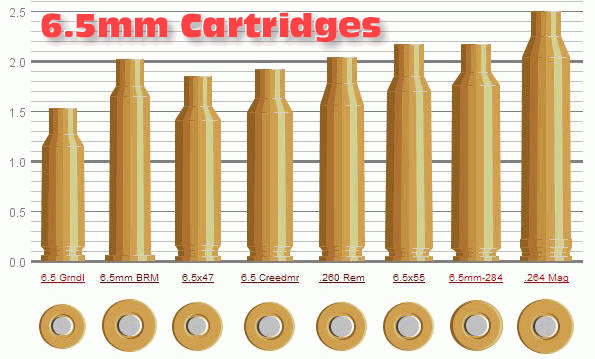
Chart created with Ammoguide’s Visual Comparison Tool. Visit Ammoguide.com to learn more.
One of our forum members was looking for a very accurate, mid-sized 6.5mm cartridge for target working and coyote hunting. There are many great options including the 6.5 Grendel, 6.5×47 Lapua, 6.5 Creedmoor, and Remington .260 (a 6.5-08). If you are considering the 6.5×47 you should read our 6.5×57 Cartridge Guide authored by the 6.5 Guys. This and other 6.5mm cartridges are covered in this introduction to 6.5 mm cartridges prepared by Eben Brown, President of Eabco.com.
Guide to 6.5mm Cartridges
by Eben Brown, EABCO.com, (E. Arthur Brown Co. Inc.)
The current popularity of 6.5mm cartridges in the USA has been a long time in coming. I won’t go into my opinions on why it took so long to catch on. The important thing is that it finally HAS caught on and we’re now so fortunate to have a wide selection of 6.5mm cartridges to choose from!
6.5mm Grendel – Developed by Alexander Arms for the AR15 and military M4 family of rifles. The Grendel fits the dimensional and functional requirements of these rifles while delivering better lethality and downrange performance. There are now similar cartridges from other rifle companies. We chamber for the Les Baer “264 LBC-AR”. Designed for velocities of 2400-2500 fps with 123gr bullets, it shoots the 140-grainers at about 2000 fps (for comparison purposes).
6.5mm BRM – Developed by E. Arthur Brown Company to give “Big Game Performance to Small Framed Rifles” — namely our Model 97D Rifle, TC Contender, and TC Encore. Velocities of 2400-2500 fps with 140gr bullets puts it just under the original 6.5×55 Swede performance.
6.5mm x 47 Lapua – Developed by Lapua specifically for international 300m shooting competitions (with some interest in long-range benchrest as well). Case capacity, body taper, shoulder angle, and small rifle primer are all features requested by top international shooters. You can expect velocities of 2500-2600+ with 140 gr bullets.
6.5mm Creedmoor – Developed by Hornady and Creedmoor Sports, the 6.5mm Creedmoor is designed for efficiency and function. Its shape reaches high velocities while maintaining standard .308 Winchester pressures and its overall length fits well with .308 Win length magazines. You can expect velocities of 2600-2700+ fps with 140gr bullets.
.260 Remington – Developed by Remington to compete with the 6.5mmx55 Swedish Mauser that was (finally) gaining popularity in 1996. By necking down the 7mm-08 Remington to 6.5mm (.264 cal), the .260 Remington was created. It fit the same short-action [receivers] that fit .308 Win, .243 Win, 7mm-08 Rem, etc. You can expect velocities of 2600-2700 fps with 140gr bullets in the 260 .Remington.
[Editor’s Note: In the .260 Rem, try the Lapua 120gr Scenar-Ls and/or Berger 130gr VLDs for great accuracy and impressive speeds well over 2900 fps.]
6.5mm x 55 Swedish Mauser – This was the cartridge that started the 6.5mm craze in the USA. It is famous for having mild recoil, deadly lethality on even the biggest game animals, and superb accuracy potential. Original ballistics were in the 2500 fps range with 140gr bullets. Nowadays handloaders get 2600-2700+ fps.
[Editor’s Note: Tor from Scandinavia offers this bit of 6.5x55mm history: “Contrary to common belief, the 6.5×55 was not developed by Mauser, but was constructed by a joint Norwegian and Swedish military commission in 1891 and introduced as the standard military cartridge in both countries in 1894. Sweden chose to use the cartridge in a Mauser-based rifle, while Norway used the cartridge in the Krag rifles. This led to two different cartridges the 6.5×55 Krag and 6.5×55 Mauser — the only real difference being safe operating pressure.”]
6.5-284 Norma — This comes from necking the .284 Winchester down to .264 caliber. Norma standardized it for commercial ammo sales. The 6.5mm-284 was very popular for F-Class competition and High Power at 1,000 yards. However, many F-Class competitors have switched to the straight .284 Win for improved barrel life. 6.5-284 velocities run 3000-3100+ fps with 140gr bullets.
.264 Winchester Magnum – Developed by Winchester back in 1959, the .264 Win Mag never really caught on and may have delayed the ultimate acceptance of 6.5mm cartridges by US shooters (in my opinion). It missed the whole point and original advantage of 6.5 mm cartridges.
The Original 6.5mm Advantage
The special needs of long-range competition have skewed things a little. However the original advantages of 6.5mm cartridges — how deadly the 6.5mms are on game animals, how little recoil they produce, and how easy they are to shoot well — still hold true today.
In some parts of the country, hunters are now required to use lead-free bullets. Expect restrictions on lead-based ammo to become more widespread in the years to come. Recognizing this, Lapua has upgraded its line of Naturalis bullets. Fitted with a distinctive green polymer tip, Naturalis bullets employ lead-free 99% copper construction. A hollow cavity provides reliable, uniform expansion, and the solid copper bullet body offers excellent knock-down power and weight retention.
The latest lead-free Naturalis bullets boast less drag and enhanced expansion. These third-generation Naturalis projectiles have been streamlined for better aerodynamics. In addition, Lapua has lowered the velocity threshold for consistent expansion by roughly 100 fps. This significantly broadens the velocity range in which the bullets will reliably expand.
Naturalis bullets feature extremely high weight retention, as demonstrated in the video above. (Note: the video has graphic sequences showing game flesh). The mushrooming of the bullet starts immediately on impact. The expansion process is started by the green polymer “valve” at the tip of the bullet, leading the bullet to expand symmetrically and without fragmentation. Watch the video for a demonstration of Naturalis bullet performance in ballistic media and game animals.
Naturalis lead-free bullets are available as components for handloaders, or loaded into Lapua factory-made cartridges. The Naturalis bullet line ranges in weight from 90 grains (6mm) up to 250 grains (9.3 mm). Bullets are offered in most popular calibers: 6mm, 6.5mm, 7mm, .308 (7.62mm), 8mm, .338, and 9.3 mm. Naturalis bullets and factory ammo are available from major retailers such as Grafs.com.
At SHOT Show 2016 we visited the Sellier & Bellot pavilion. You may not have heard of this company, but it is one of Europe’s older ammunition manufacturers. The video below shows ammunition being made from start to finish, starting with raw materials. This is a fascinating video that is well worth watching. It shows some amazing machines in operation:
Based in in Vlašim, Czech Republic, Sellier & Bellot was founded in August 5, 1825 by a German businessman of French origins called Louis Sellier. His family were royalists who fled France during the French Revolution. Louis Sellier began manufacturing percussion caps for infantry firearms in a factory in Prague, Bohemia on the request of Francis I, the Emperor of Austria. Sellier was joined by his countryman Jean Maria Nicolaus Bellot.
At the S&B booth, we also saw an interesting CGI video that shows what happens inside a rifle chamber and barrel when a cartridge fires can’t be seen by the naked eye (unless you are a Super-Hero with X-Ray vision). But now, with the help of 3D-style computer animation, you can see every stage in the process of a rifle round being fired.
In this X-Ray-style 3D animation illustrates the primer igniting, the propellant burning, and the bullet moving through the barrel. The video then shows how the bullet spins as it flies along its trajectory. Finally, this animation shows the bullet impacting ballistic gelatin. Watch the bullet mushroom and deform as it creates a “wound channel” in the gelatin.
Watch Video – Cartridge Ignition Sequence Starts at 1:45 Time-Mark
At the request of our readers, we have launched a “Deals of the Week” feature. Every Monday morning we offer our Bargain selections. Here are some of the best deals on hardware, reloading components, and shooting accessories. Be aware that sale prices are subject to change, and once clearance inventory is sold, it’s gone for good. You snooze you lose.
1. Midsouth — Vortex Diamondback Scopes under $200.00
Vortex scopes are probably the most popular optics used by Precision Rifle Series competitors. The reason is that Vortex optics offer good performance and great value for money. Here’s a killer deal on mid-power variable Vortex scopes suitable for hunting or plinking rifles. The Vortex Diamondbacks are very rugged, and are supported by a no-BS Lifetime warranty.
2. Natchez — RCBS Special-5 Reloading Kit
This kit is easily worth the $199.99 just for the press, primer tool, and powder measure (not to mention all the other stuff you get). We like the compact Reloader Special press as a secondary press for range use or special tasks such as bullet-pointing. This $199.99 RCBS Kit (which qualifies for a $10.00 RCBS Rebate) includes: Reloader Special-5 Press, Uniflow Powder Measure, RCBS Priming Tool, RCBS Loading Block, Deburring Tool, RCBS Powder Trickler, Powder Measure Stand, Funnel, and Nosler Loading Manual. Even if you already own a basic reloading press, this Kit is a great overall value.
3. MidwayUSA — Sierra BlitzKing Bullets, $105.99 for 500
Varmint slayers rejoice. Here is a super deal on Sierra’s plastic-tipped BlitzKing bullets. Right now you can get 500 BlitzKing bullets for just $105.99. Get this low price on the .204-caliber 39gr boattail, or the .224-caliber 50- or 55-grain boattails. MidwayUSA also has other Sierra BlitzKing Bullets on sale, with big saving off the regular price. For example, the 6mm, 70gr BlitzKing is now just $134.99 for 500.
4. Cabela’s — Combo Tactical Hard Case and Soft Case Duo
Get two (2) cases for the price of one. Here’s a sweet clearance deal from Cabelas.com. Right now you can get a tactical hard case PLUS a padded nylon soft case for just $79.88 (marked down from $119.99). The hard case measures 36″L x 13.25″W x 4.5″ on the inside. It features a high-density foam interior plus 4 steel external latches. The soft case features a water-resistant polyester shell and polyester lining.
5. MidwayUSA — Norma .22 LR Rimfire Ammo on Sale
This Norma .22 LR rimfire ammo is good stuff. We’ve shot hundreds of rounds of the Tac-22 and it has performed well for cross-training and tactical rimfire games. We like this Norma rimfire ammo much better than the Remington and Federal bulk packs — and the price is very competitive. Right now MidwayUSA is offering 500-round boxes of Tac 22 for $59.95 (that’s just 12 cents a round).
6. Sportsman’s Guide — Henry AR-7 Packable Survival Rifle
Here’s a unique item to add to your collection. The Henry AR-7 Survival rifle breaks down and stows in its own buttstock. Weighing just 3.5 pounds, this little semi-auto rimfire can perform pest-control duties for a farmer or rancher, or serve as a utility rifle carried in a truck or ATV. The cleverly-designed AR-7 is affordably priced at $227.99 ($216.59 for Sportsman’s Guide Club Members).
Burris Signature Zees are our “go-to” rings for use with benchrest rifles. Right now Amazon has the 1″-diameter High Sig Zee rings on sale for $34.00 (Matte Black) or $38.00 (Nickel). Burris also offers medium height 1″-diameter Sig Zees. The 30mm Signature Zee rings are somewhat more expensive (about $50.00), but still well worth the price in our view. This Editor uses 30mm Signature Zee Rings for his personal 6mmBR rifle. The polymer inserts allow you to pre-load elevation, and also eliminate the need to lap your rings.
We will be interviewing Bryan Litz of Applied Ballistics tomorrow at SHOT Show in Las Vegas. As a sneak preview of some of the topics we’ll cover, here are some highlights of some important, original research conducted by Bryan and his Applied Ballistics team. Bryan wanted to know how much velocity was altered by twist rate. The “real world” test results may surprise you….
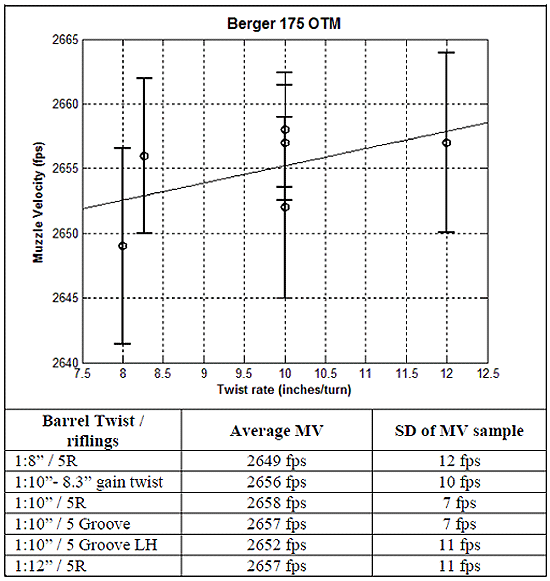
The Applied Ballistics team tested six (6) same-length/same-contour Bartlein barrels to observe how twist rate might affect muzzle velocity. This unique, multi-barrel test is featured in the book Modern Advancements in Long Range Shooting. That book includes many other fascinating field tests, including a comprehensive chronograph comparison.
Barrel Twist Rate vs. Velocity — What Tests Reveal by Bryan Litz
When considering barrel twist rates, it’s a common belief that faster twist rates will reduce muzzle velocity. The thinking is that the faster twist rate will resist forward motion of the bullet and slow it down. There are anecdotal accounts of this, such as when someone replaces a barrel of one brand/twist with a different brand and twist and observes a different muzzle velocity. But how do you know the twist rate is what affected muzzle velocity and not the barrel finish, or bore/groove dimensions? Did you use the same chronograph to measure velocity from both barrels? Do you really trust your chronograph?
Savage Test Rifle with Six Bartlein Barrels
Most shooters don’t have access to the equipment required to fully explore questions like this. These are exactly the kinds of things we examine in the book Modern Advancements in Long Range Shooting. In that book, we present experiments conducted in the Applied Ballistics lab. Some of those experiments took on a “Myth Buster” tone as we sought to confirm (or deny) popular pre-conceptions. For example, here’s how we approached the question of barrel twist and muzzle velocity.
Six .308 Win Barrels from Bartlein — All Shot from the Same Rifle
We acquired six (6) barrels from the same manufacturer (Bartlein), all the same length and contour, and all chambered with the same reamer (SAAMI spec .308 Winchester). All these barrels were fitted to the same Savage Precision Target action, and fired from the same stock, and bench set-up. Common ammo was fired from all six barrels having different twist rates and rifling configurations. In this way, we’re truly able to compare what effect the actual twist rate has on muzzle velocity with a reasonable degree of confidence.
Prior to live fire testing, we explored the theoretical basis of the project, doing the physics. In this case, an energy balance is presented which predicts how much velocity you should expect to lose for a bullet that’s got a little more rotational energy from the faster twist. In the case of the .30 caliber 175 grain bullets, the math predicts a loss of 1.25 fps per inch-unit of barrel twist (e.g. a 1:8″ twist is predicted to be 1.25 fps slower than a 1:9″ twist).
Above, data shows relationship between Twist Rate and Muzzle Velocity (MV) for various barrel twist rates and rifling types. From fast to slow, the three 1:10″ twist barrels are: 5R (canted land), 5 Groove, 5 Groove left-hand twist.
We proceeded with the testing in all 6 barrels from 1:8” to 1:12”. After all the smoke cleared, we found that muzzle velocity correlates to twist rate at the rate of approximately 1.33 fps per inch of twist. In other words, your velocity is reduced by about 5 fps if you go from a 1:12” twist to a 1:8” twist. [Editor: That’s a surprising number — much less than most folks would predict.] In this case the math prediction was pretty close, and we have to remember that there’s always uncertainty in the live fire results. Uncertainty is always considered in terms of what conclusions the results can actually support with confidence.
This is just a brief synopsis of a single test case. The coverage of twist rates in Modern Advancements in Long-Range Shooting is more detailed, with multiple live fire tests. Results are extrapolated for other calibers and bullet weights. Needless to say, the question of “how twist rate affects muzzle velocity” is fully answered.
Other chapters in the book’s twist rate section include: · Stability and Drag – Supersonic
· Stability and Drag – Transonic
· Spin Rate Decay
· Effect of Twist rate on Precision
Other sections of the book include: Modern Rifles, Scopes, and Bullets as well as Advancements in Predictive Modeling. This book is sold through the Applied Ballistics online store. Modern Advancements in Long Range Shooting is also available in eBook format in the Amazon Kindle store.
Here’s an item of interest to hunters (and maybe a few F-Open shooters). Nosler has just introduced a new magnum-type cartridge, the 30 Nosler. Sharing the same parent case as the 26 and 28 Nosler® cartridges, the 30 Nosler® has the case capacity to launch big 30-caliber bullets at impressive velocities (3000 FPS for a 210-grainer). Nosler says the 30 Nosler combines the best qualities of other 30-cal magnums: “The 30 Nosler® easily meets the velocity of the 300 Weatherby, headspaces on the shoulder like a 300 RUM, has an efficient powder column like the 300 WSM and fits in the same standard length action of a 300 Winchester Magnum.” 30 Nosler Will Function in a Standard Length Action
The 30 Nosler has a C.O.A.L. of 3.340″ allowing this cartridge to be operated in a standard length action for lighter weight and shorter bolt throw when compared to magnum-length actions.
The 30 Nosler is a SAAMI-standardized cartridge so there will be standardized dimensions for brass, dies, and chamber reamers. Nosler will support this new cartridge with Nosler Brass, Trophy Grade™ Ammunition and a series of M48 hunting rifles. The initial offerings in Nosler’s Trophy Grade™ Ammunition will be:
Nosler® Trophy Grade™ Ammunition: 180gr AccuBond® 3200 fps
Nosler® Trophy Grade™ LR Ammunition: 210gr AccuBond® LR 3000 fps
A unique, comprehensive Cartridge Comparison Guide is available as a 340-page, spiral-bound book. Covering over 250 cartridges, the updated Second Edition of the Cartridge Comparision Guide is the product of many years of labor by Andrew Chamberlain, a Utah-based hunter. Andrew says his Guide “compares every factory available cartridge from the 17 calibers up to the 50 caliber cartridges”. (Sorry, most wildcat cartridges are not covered.) Chamberlain’s Guide also compiles cartridge data from major ammunition manufacturers such as Barnes, Federal, Hornady, Norma, Nosler, Remington, Sierra, Swift, Weatherby, and Winchester. It shows the optimal velocity achieved for each bullet weight and calculates bullet energy, recoil, and powder efficiency. Large color photos illustrate handgun and rifle cartridges.
The Cartridge Comparison Guide provides data for thousands of cartridge/bullet/velocity combos. Quick reference data sheets and ballistics charts cover Trajectory, Velocity, and Energy out to 500 yards. The Cartridge Comparison Guide also offers a firearms lexicon, plus Appendices covering Cartridge Selection for Game Animals, Bullet Selection/Design, Bullet Expansion, Wound Channel Characteristics and more.
New Content in Second Edition of Cartridge Comparison Guide
The Cartridge Comparison Guide (Second Edition) costs $32.95 plus shipping and tax. CLICK HERE to visit the Online Store where you can order the 340-page book. Here’s what’s new in the Second Edition:
Addition of Shotgun Ammunition (Both Slug and Shot loads).
Momentum Calculation for all Rifle, Shotgun and Handgun loads.
Integration of Shotgun Slug Ammunition with Center Fire Rifle Data Tables.
Factory Load Summary Added (Shows manufacturers and loads produced).
One factory load and one hand load for every bullet weight available in each cartridge.
Over 90 pages of additional ballistics content (roughly 35% more than in First Edition).
Award-Winning Content
The Cartridge Comparison Guide has been awarded the POMA Pinnacle Award for Excellence. (POMA, the Professional Outdoor Media Association, is the trade association for outdoor writers).
Great Resource for Hunters
One of Chamberlain’s main goals in creating the Cartridge Comparison Guide was to help hunters select the “right cartridge for the job.” According to Chamberlain: “This started as a personal project to gather information on the more popular cartridges commonly used for hunting. I began comparing cartridge performance, versatility, bullet selection, powder efficiency, recoil generation vs. energy produced, standing ballistic data for different environments, etc.” Chamberlain adds: “I wanted to find the best all-around performing cartridge and rifle that a guy on a budget could shoot.”
Giant Cartridge Poster for Computer Wallpaper (1665×1080 pixels)
Here’s a great illustration of hundreds of cartridges and shotshell types. For dedicated reloaders, this would work great as desktop “wallpaper” for your computer. CLICK HERE for full-size image.
Hey guys, you’ll probably want to download this new Powder Burn Rate Chart issued by Hodgdon/IMR. This new table shows the latest IMR powders including the Enduron series (IMR 4166, 4451, 4955, 7977), shown in green below. This chart provides useful information for all hand-loaders. When doing load development, and testing one powder versus another, it’s generally wise to choose propellants that share the same relative burn rate, as least for starters. NOTE: Hodgdon powders are shown in blue, while IMR standard powders are shown in yellow. DOWNLOAD Chart HERE.
If you have ever turned a large quantity of case-necks using power assist, you know that a carbide mandrel can make the job go easier, with better end results. In our experience, when using carbide mandrels (as opposed to ordinary steel), the cases move more smoothly with less heat build-up. Pat Reagin of PMA Tool explains why carbide neck-turning mandrels work better:
Carbide offers several advantages over conventional steel and stainless steel when making any tooling, specifically neck-turning mandrels:
Dimensional Stability — Carbide maintains its dimensions indefinitely during heating and cooling. This eliminates the need to allow the mandrel time to cool every few cases.
Coefficient of Friction and Wear-Resistance — Carbide exhibits a low coefficient of friction value as compared to all steels and wears up to 100 times longer. This reduces (but does not eliminate) the amount of lubricant required.
Galling Resistance — Carbide has exceptional resistance to galling and welding at the surface. This basically eliminates the chance of getting a case stuck on a mandrel due to insufficient lubrication.
Given the benefits of carbide neck-turner mandrels, you may be asking “where can I get one?” Sinclair Int’l offers carbide mandrels for Sinclair neck-turners for $49.99, in a full range of calibers: 17, 20, 22, 6mm, 25, 6.5mm, 270, 30, and 338.
$49.95 Carbide Mandrels from PMA Tool
PMA Tools now also offers carbide mandrels in a full variety of sizes. At $49.95 each, PMA’s carbide mandrels are priced competitively with Sinclair’s mandrels. PMA offers carbide mandrels in .17, .20, .22, 6mm, 6.5mm, 7mm and .30-caliber. These will work with Sinclair Int’l and 21st Century neck-turners, as well as PMA neck-turners. PMA tells us: “We now have carbide neck-turning mandrels in stock. These mandrels are made with high-tech CNC grinding-machinery, and should give you excellent results. We hope to be add other larger-caliber carbide mandrels to our lineup in the future.”
This important video shows what really happens when loaded ammunition burns. You will probably be surprised. Contrary to Hollywood notions, the ammo doesn’t ignite in a massive explosion. Far from it… basically the rounds “cook off” one by one, and the bullets release at relatively low velocity. We’ve featured this SAAMI research project before, but it is worth reprising for those who have not yet seen the burn tests.
A couple years back, SAAMI released an important video concerning ammo and fire. With professional fire-fighters standing by, over 400,000 rounds of ammo were incinerated in a series of eye-opening tests. If you haven’t had the chance to view this video yet, you should take the time to watch it now
The Sporting Arms and Ammunition Manufacturers’ Institute (SAAMI) has produced an amazing 25-minute video that shows what actually happens to sporting ammunition involved in a fire. This video shows the results of serious tests conducted with the assistance of professional fire crews. We strongly recommend you watch this video, all the way through. It dispels many myths, while demonstrating what really happens when ammunition is burned, dropped, or crushed.
Watch SAAMI Ammunition Testing Video
Video Timeline
2:10 Impact Test (ignited outside firearm)
3:40 65-foot Drop Test
5:08 Bullet Impact (.308 Win firing)
7:55 Blasting Cap Attacks
9:55 Bulldozer and Forklift Tests
12:20 Boxed Ammo Bonfire
15:37 Bonfire without Packaging
17:21 Retail Store Simulation Burn
20:55 Truck Trailer Burn
Over 400,000 rounds of ammunition were used in the tests. Some of the footage is quite remarkable. Testers built a bonfire with 28,000 rounds of boxed ammo soaked in diesel fuel. Then the testers loaded five pallets of ammo (250,000 rounds) in the back of a semi-truck, and torched it all using wood and paper fire-starting materials doused with diesel fuel.
The video shows that, when ammo boxes are set on fire, and ammunition does discharge, the bullet normally exits at low speed and low pressure. SAAMI states: “Smokeless powders must be confined to propel a projectile at high velocity. When not in a firearm, projectile velocities are extremely low.” At distances of 10 meters, bullets launched from “cooked-off” ammo would not penetrate the normal “turn-out gear” worn by fire-fighters.
We are not suggesting you disregard the risks of ammo “cooking off” in a fire, but you will learn the realities of the situation by watching the video. There are some amazing demonstrations — including a simulated retail store fire with 115,000 rounds of ammo in boxes. As cartridges cook off, it sounds like a battery of machine-guns, but projectiles did not penetrate the “store” walls, or even two layers of sheet-rock. The fire crew puts out the “store fire” easily in under 20 seconds, just using water.
Additional Testing: Drop Test, Projectile Test, Crush Test, Blasting Cap Test
Drop Test
The video also offers interesting ammo-handling tests. Boxes of ammo were dropped from a height of 65 feet. Only a tiny fraction of the cartridges discharged, and there was no chain-fire. SAAMI concludes: “When dropped from extreme heights (65 feet), sporting ammunition is unlikely to ignite. If a cartridge ignites, it does not propagate.”
Rifle Fire Test
SAAMI’s testers even tried to blow up boxes of ammunition with rifle fire. Boxes of loaded ammo were shot with .308 Win rounds from 65 yards. The video includes fascinating slow-motion footage showing rounds penetrating boxes of rifle cartridges, pistol ammo, and shotgun shells. Individual cartridges that were penetrated were destroyed, but adjacent cartridges suffered little damage, other than some powder leakage. SAAMI observed: “Most of the ammunition did not ignite. When a cartridge did ignite, there was no chain reaction.”
Bulldozer Crush Test
The test team also did an amazing “crush-test” using a Bulldozer. First boxes of loaded ammo, then loose piles of ammo, were crushed under the treads of a Bulldozer. A handful of rounds fired off, but again there was no chain-fire, and no large explosion. SAAMI observed: “Even in the most extreme conditions of compression and friction, sporting ammunition is unlikely to ignite. [If it does ignite when crushed] it does not propagate.”
Blasting Cap Test
Perhaps most amazingly, the testers were not able to get ammunition to chain-fire (detonate all at once), even when using blasting caps affixed directly to live primers. In the SAAMI test, a blasting cap was placed on the primer of a round housed in a large box of ammo. One cartridge ignited but the rest of the boxed ammo was relatively undamaged and there was no propagation.



 6.5mm Creedmoor – Developed by Hornady and Creedmoor Sports, the 6.5mm Creedmoor is designed for efficiency and function. Its shape reaches high velocities while maintaining standard .308 Winchester pressures and its overall length fits well with .308 Win length magazines. You can expect velocities of 2600-2700+ fps with 140gr bullets.




 A unique, comprehensive
  Great Resource for Hunters

 $49.95 Carbide Mandrels from PMA Tool
 The Sporting Arms and Ammunition Manufacturers’ Institute (
 We are not suggesting you disregard the risks of ammo “cooking off” in a fire, but you will learn the realities of the situation by watching the video. There are some amazing demonstrations — including a simulated retail store fire with 115,000 rounds of ammo in boxes. As cartridges cook off, it sounds like a battery of machine-guns, but projectiles did not penetrate the “store” walls, or even two layers of sheet-rock. The fire crew puts out the “store fire” easily in under 20 seconds, just using water.


