Efficient cartridges make excellent use of their available powder and case/bore capacity. They yield good ballistic performance with relatively little recoil and throat erosion.
Cartridge Efficiency: A Primer (pun intended!)by USAMU Staff
Each week, the U.S. Army Marksmanship Unit (USAMU) publishes a reloading article on its Facebook Page. In this week’s article, the USAMU discusses cartridge case efficiency and its benefits. While this is oriented primarily toward NRA High Power Rifle and Long Range (1000-yard) competition, these factors also apply to medium/big game hunters. Assuming one’s rifle and ammunition are accurate, key considerations include ballistic performance (i.e., resistance to wind effects, plus trajectory), recoil, and throat erosion/barrel life.
Efficient cartridges make excellent use of their available powder and case/bore capacity. They yield good ballistic performance with relatively little recoil and throat erosion. A classic example in the author’s experience involved a featherweight 7x57mm hunting/silhouette rifle. When loaded to modern-rifle pressures, just 43-44 grains of powder pushed a 139gr bullet at 2900 fps from its 22” barrel. Recoil in this light rifle was mild; it was very easy to shoot well, and its performance was superb.
An acquaintance chose a “do everything” 7mm Remington Magnum for use on medium game at short ranges. A larger, heavier rifle, it used ~65 grains of powder to achieve ~3200 fps with similar bullets — from its 26″ barrel. Recoil was higher, and he was sensitive to it, which hampered his shooting ability.
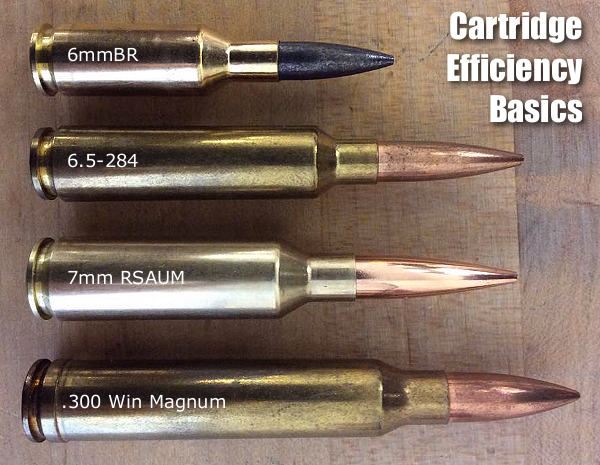
Similarly efficient calibers include the 6mm BR [Norma], and others. Today’s highly-efficient calibers, such as 6mm BR and a host of newer developments might use 28-30 grains of powder to launch a 105-107gr match bullet at speeds approaching the .243 Winchester. The .243 Win needs 40-45 grain charges at the same velocity.
Champion-level Long Range shooters need every ballistic edge feasible. They compete at a level where 1″ more or less drift in a wind change could make the difference between winning and losing. Shooters recognized this early on — the then-new .300 H&H Magnum quickly supplanted the .30-06 at the Wimbledon winner’s circle in the early days.
The .300 Winchester Magnum became popular, but its 190-220gr bullets had their work cut out for them once the 6.5-284 and its streamlined 140-142gr bullets arrived on the scene. The 6.5-284 gives superb accuracy and wind performance with about half the recoil of the big .30 magnums – albeit it is a known barrel-burner.
Currently, the 7mm Remington Short Action Ultra-Magnum (aka 7mm RSAUM), is giving stellar accuracy with cutting-edge, ~180 grain bullets, powder charges in the mid-50 grain range and velocities about 2800+ fps in long barrels. Beyond pure efficiency, the RSAUM’s modern, “short and fat” design helps ensure fine accuracy relative to older, longer cartridge designs of similar performance.
Recent design advances are yielding bullets with here-to-fore unheard-of ballistic efficiency; depending on the cartridge, they can make or break ones decision. Ballistic coefficients (“BC” — a numerical expression of a bullet’s ballistic efficiency) are soaring to new heights, and there are many exciting new avenues to explore.
The ideal choice [involves a careful] balancing act between bullet BCs, case capacity, velocity, barrel life, and recoil. But, as with new-car decisions, choosing can be half the fun!
Factors to Consider When Evaluating Cartridges
For competitive shooters… pristine accuracy and ballistic performance in the wind are critical. Flat trajectory benefits the hunter who may shoot at long, unknown distances (nowadays, range-finders help). However, this is of much less importance to competitors firing at known distances.
Recoil is an issue, particularly when one fires long strings during competition, and/or multiple strings in a day. Its effects are cumulative; cartridges with medium/heavy recoil can lead to shooter fatigue, disturbance of the shooting position and lower scores.
For hunters, who may only fire a few shots a year, recoil that does not induce flinching during sight-in, practice and hunting is a deciding factor. Depending on their game and ranges, etc., they may accept more recoil than the high-volume High Power or Long Range competitor.
Likewise, throat erosion/barrel life is important to competitive shooters, who fire thousands of rounds in practice and matches, vs. the medium/big game hunter. A cartridge that performs well ballistically with great accuracy, has long barrel life and low recoil is the competitive shooter’s ideal. For the hunter, other factors may weigh more heavily.
Cartridge Efficiency and Energy — Another Perspective
Lapua staffer Kevin Thomas explains that efficiency can be evaluated in terms of energy:
“Cartridge efficiency is pretty straight forward — energy in vs. energy out. Most modern single-based propellants run around 178-215 ft/lbs of energy per grain. These figures give the energy potential that you’re loading into the rifle. The resulting kinetic energy transferred to the bullet will give you the efficiency of the round. Most cases operate at around 20-25% efficiency. This is just another way to evaluate the potential of a given cartridge. There’s a big difference between this and simply looking at max velocities produced by various cartridges.”
Berger has released two important informational updates for its line-up of bullets. First, the Ballistics Coefficients (BCs) have been updated for the vast majority of bullets Berger sells. In addition, G7 model BCs are being provided for most of the bullets. You will want to use the updated BC data, which is based on actual testing of recent production lots of bullets.
Second, Berger is now providing a dual twist-rate recommendation for most bullets. Berger is now lists a “minimum” barrel twist rate as well as an “optimal” twist rate. To get maximum long-range performance from your bullets, use a barrel with the “optimal” rate of twist.
CLICK HERE for the latest Berger Quick Reference Sheets with updated BCs and new Optimal Twist Rates. Eric Stecker, Berger President says: “We have tested every lot of bullets produced in the last several years to bring you these updated numbers for all of our bullets.”
Ballistic Coeffificent (BC) Updates with G7 Data
Berger notes: “We have updated all of our Ballistic Coefficients to be even more accurate.
Prior to 2008, all of Berger Bullets’ BCs were calculated using a computer prediction. Early in 2009, we began measuring BCs with live-fire testing. As a result, Berger’s BCs were updated and G7 BCs were also made available. This represented a dramatic improvement in the accuracy of performance data at that time. Since 2009, the BCs assessed for Berger Bullets have not been updated. As part of our ongoing effort to provide shooters with the best information possible, Berger has been testing every lot of bullets produced for the last several years. The result is updated and highly accurate running averages of BCs for recent production lots.
Here are some of the Updated BC Values for popular Berger Target (Match) Bullets:
G7 Form Factor Addition
Berger also added the G7 form factor to the Ballistics Quick Reference Sheet. The analysis of form factors can be very useful when considering a bullet’s long range performance potential. Going by BC alone can be deceptive since BC includes the weight and caliber of the bullet. Form factor indicates how much drag the bullet has, which is a very important consideration for all bullets of all calibers.
NEW Dual Twist-Rate Recommendations
Recommended twist rates for bullets are commonly listed as a single value, such as 1:12” (one rotation in 12″ of barrel travel). This may be overly simplistic. There is a big gray area of marginal stability in which bullets can fly with good accuracy, but with a reduced (i.e. sub-optimal) Ballistic Coefficient. Recognizing this reality, Berger is now listing two twist rates for each bullet it makes. The first is the minimum twist needed for good accuracy, which Berger has always recommended. The second is the new optimal twist rate, which is the twist that will stabilize the bullet to a level which achieves its full performance (BC) potential. CLICK HERE For more information.
Redding Reloading is now providing Advanced Handloader’s Data Sheets in printable PDF format. This FREE form allows hand-loaders to document their tool settings, bushing size, powder charge, load specs (COAL etc.), and case prep status. In addition, the form allows you to enter your load testing information, complete with chronograph data, group size, zero range, and wind/temp conditions. With this single, handy form you can document all the vital information for a particular cartridge and load.
We’ve seen various reloading log templates, but this Redding form (shown below) is better than most because it combines both reloading data AND range-test data in one place. You can see all key details of the reloading process (tool settings etc.) plus the end results — how the load actually performed over the chronograph and on paper. This form allows the user to capture a large amount of information for later use, while accurately track load development. Go to Download Page.
FREE Ammunition Box Label Template Redding Reloading has also developed a printable template for your ammo boxes (see photo at top of article). This lets you put all vital load info on your ammo boxes. There are fields for: Date, Cartridge, Powder, Grains, Bullet, Weight, Primer, Case type. Designed for Avery 5260 (or similar) label sheets, this template allows you to print 30 labels at one time. You can purchase the Avery 5260 peel-off printable label sheets at any office supply store.
Applied Ballistics LLC will release updated editions of two popular resource books: Applied Ballistics for Long-Range Shooting (3rd Edition) and Ballistic Performance of Rifle Bullets (2nd Edition). Retail price is $54.95 for each title, or $94.95 if purchased together. Pre-orders are now being accepted with a $5 discount per book. You can pre-order the new editions through the Applied Ballistics store. The new editions are expected to ship by the second week of December.
Applied Ballistics for Long Range Shooting (ABLRS), Bryan Litz’s “Magnum Opus”, will have significant enhancements. New for the Third Edition is content on Weapon Employment Zone (WEZ) analysis. WEZ analysis is the study of hit percentage, and how that will be affected by the uncertainties in your environment. Existing academic material is augmented with modern experimental findings. The Third Edition also includes a CD-ROM disc with Applied Ballistics’ latest version of its ballistic software. NOTE: The third edition of ABLRS does NOT include the library of bullet data. That bullet library now exists as a separate reference book: Ballistic Performance of Rifle Bullets.
Ballistic Performance of Rifle Bullets — Data for 533 Bullets AND Rimfire Ammo
The updated, Second Edition of Ballistic Performance of Rifle Bullets contains the current library of all modern bullets tested by the Applied Ballistics Laboratory. Expanding on the First Edition, which had data on 400 bullets from .22 to .408 caliber, this Second Edition contains data on 533 bullets from .22 through .50 caliber. In addition to the centerfire bullet data, the Second Edition contains live fire data on 90 types of rimfire ammo which were all tested for muzzle velocity and BC through five different barrels of various twist/length configurations. This library of experimental test data is the most extensive and accurate resource ever assembled for small arms bullets. Numerous modern ballistics programs draw from the library of tested BCs that are published in this book.
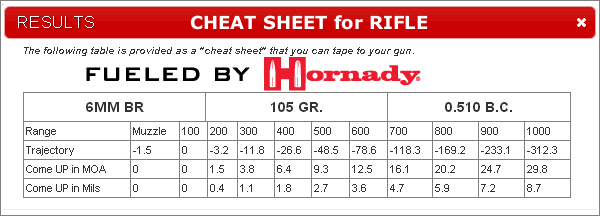
Need a simple, easy-to-use drop chart for your rifle? Something you can tape right to the buttstock? Then check out Hornady’s handy Online Ballistics Calculator. This user-friendly calculator will compute your drops accurately, and output a handy “Cheat Sheet” you can print and attach to your rifle. Simply input G1 or G7 BC values, muzzle velocity, bullet weight, zero range and a few other variables. Click “Calculate” and you’re good to go. You can select the basic version, or an advanced version with more data fields for environmental variables (altitude, temperature, air pressure, and humidity). You can also get wind drift numbers by inputing wind speed and angle.
Conveniently, on the trajectory output, come-ups are listed in both MOA and Mils — so this will work with either MOA clicks or Mil-based clicks. There are more sophisticated ballistics solvers available on the web (such as the outstanding Applied Ballistics Online Calculator), but the Hornady Calculator is very simple and easy to use. If you just want a basic drop chart, you may want to check this out.
Norma has released a fascinating video showing how bullet, brass, and ammunition are produced at the Norma Precision AB factory which first opened in 1902. You can see how cartridges are made starting with brass disks, then formed into shape through a series of processes, including “hitting [the cup] with a 30-ton hammer”. After annealing (shown at 0:08″), samples from every batch of brass are analyzed (at multiple points along the case length) to check metal grain structure and hardness. Before packing, each case is visually inspected by a human being (3:27″ time-mark).
The video also shows how bullets are made from jackets and lead cores. Finally, you can watch the loading machines that fill cases with powder, seat the bullets, and then transport the loaded rounds to the packing system. In his enthusiasm, the reporter/narrator does sometimes confuse the term “bullets” and “rounds” (5:00″), but you can figure out what he means. We definitely recommend watching this video. It’s fascinating to see 110-year-old sorting devices on the assembly line right next to state-of-the art, digitally-controlled production machinery.
Video tip by EdLongrange. We welcome reader submissions.
This article first appeared in 2014. We are reprising it at the request of many readers who are fans of the .30-06 cartridge.
The “Old Warhorse” .30-06 Springfield cartridge is not dead. That’s the conclusion of Forum member Rick M., who has compared the 1000-yard performance of his .30-06 rifle with that of a rig chambered for the more modern, mid-sized 6.4×47 Lapua cartridge. In 12-16 mph full-value winds, the “inefficient and antiquated” .30-06 ruled. Rick reports:
“I was shooting my .30-06 this past Sunday afternoon from 1000 yards. The wind was hitting 12-16 mph with a steady 9 O’clock (full value) wind direction. My shooting buddy Jeff was shooting his 6.5×47 Lapua with 123gr Scenar bullets pushed by Varget. Jeff needed 13 MOA left windage to keep his 6.5x47L rounds inside the Palma 10 Ring. By contrast I only needed 11.5 MOA left windage with my .30-06. I was shooting my ’06 using the 185gr Berger VLD target bullet with H4350. I managed the same POI yet the .30-caliber bullet only needed 11.5 MOA windage. That’s significant. From this experience I’ve concluded that the Old Warhorse ain’t quite dead yet!”
Rick likes his “outdated” .30-06 rifle. He says it can deliver surprisingly good performance at long range:
“To many of the younger generation, the Old Warhorse .30-06 is ‘outdated’ but I can guarantee that the .30-06 Springfield is a VERY ACCURATE cartridge for 1000-yard shooting (and even out further if need be). With some of the advanced powders that we have today, the .30-06 will surprise many shooters with what it’s capable of doing in a good rifle with the right rate of twist. My rifle has a 1:10″ twist rate and I had it short-throated so that, as the throat erodes with time, I could just seat the bullets out further and keep right on shooting. My recent load is Berger 185gr Target VLDs pushed by IMR 4350. This is a very accurate load that moves this bullet along at 2825 fps.”
BIG news in the shooting sports industry — Ruger has entered the ammo business. Ruger now offers high-tech handgun ammunition, using licensed polymer-composite, lead-free bullet technology. According to the Shooting Wire: “Ruger’s new lead-free ammunition will be produced under a licensing agreement with Savannah, Georgia-based PolyCase Ammunition.”
Ruger’s new ARX line of lead-free ammo features injection-molded bullets that are much lighter than conventional projectiles, caliber by caliber: 56 grains for .380 ACP, 74 grains for 9x19mm, 107 grains for .40 SW, and 114 grains for .45 ACP. The lighter bullets fly faster, but ARX ammo still offers reduced perceived recoil.
Ruger ARX Ammo with Injection-Molded Matrix Bullets
The fluted projectiles are injection-molded from a copper/polymer matrix. This offers many advantages. First, being completing lead-free, these bullets can be used at indoor facilities that prohibit lead-based ammo. Second, because the composite bullets weigh 30% less than comparable lead-based projectiles, shooters experience noticeably less recoil (even though velocities are higher). Third, the composite matrix bullet has low-ricochet properties. When these bullets strike metal, they are designed to disintegrate (into a powder), rather than ricochet. This makes them well-suited for indoor use, or use with metal plates.
Shooting Wire Editor Jim Shepherd reports that ARX ammo delivers on its low-recoil promise: “Having spent time testing the PolyCase ammunition (largely in Ruger firearms), I know the reduction in felt recoil isn’t just hype. While firing PolyCase ARX ammunition in calibers ranging from .380 in small concealed carry pistols (including a Ruger’s LCP) up to .458 SOCOM in modern sporting rifles, the lessened felt recoil was noticeable.”
PolyCase Molded Bullet Design Technology
For over a century most bullets have been mass-produced with a process called cold-forming. Lead and copper were shaped with brute force in punches and dies to create projectiles. While this is still a viable and effective way to produce bullets, other manufacturing methods are now available. By applying injection-molding technology, Polycase has developed a new type of bullet that has many advantages, as least for handgun applications. Bullets weigh approximately 70% as much as lead bullets with similar profiles. Lighter weight means higher velocities and less recoil. In addition, PolyCase bullets are lead-free, and low-ricochet — two qualities important for indoor and close-range training. The injection-molding process also reduces weight variations (compared to cast lead bullets), and ensures excellent concentricity. Molding also allows unique shapes that are impossible to produce with conventional bullet-making methods (see photo).
These four photos show the substantial changes in the shock wave and turbulence patterns for the same 7.5mm bullet at different velocities. The “M” stands for Mach and the numerical value represents the velocity of the bullet relative to the speed of sound at the time of the shot. Photos by Beat Kneubuehl.
“Going transonic” is generally not a good thing for bullets. The bullet can lose stability as it enters the transonic zone. It can also become less slippery, losing BC as a consequence of dynamic instability. In this video, Bryan Litz of Applied Ballistics analyzes what happens to bullet stability (and BC) as projectiles approach the speed of sound. Transonic effects come into play starting about Mach 1.2, as the bullet drops below 1340 fps.
Transonic Ballistics Effects Explainedby Bryan Litz
What happens when the bullet slows to transonic speed, i.e. when the bullet slows to about 1340 feet per second? It is getting close to the speed of sound, close to the sound barrier. That is a bad place to fly for anything. In particular, for bullets that are spin-stabilized, what the sound barrier does to a bullet (as it flies near Mach 1) is that it has a de-stabilizing effect. The center of pressure moves forward, and the over-turning moment on the bullet gets greater. You must then ask: “Is your bullet going to have enough gyroscopic stability to overcome the increasing dynamic instability that’s experienced at transonic speed?”
Some bullets do this better than others. Typically bullets that are shorter and have shallow boat-tail angles will track better through the transonic range. On the contrary, bullets that are longer… can experience a greater range of pitching and yawing in the transonic range that will depress their ballistic coefficients at that speed to greater or lesser extents depending on the exact conditions of the day. That makes it very hard to predict your trajectory for bullets like that through that speed range.
When you look at transonic effects on stability, you’re looking at reasons to maybe have a super-fast twist rate to stabilize your bullets, because you’re actually getting better performance — you’re getting less drag and more BC from your bullets if they are spinning with a more rigid axis through the transonic flight range because they’ll be experiencing less pitching and yawing in their flight.
To determine how bullets perform in the “transonic zone”, Bryan did a lot of testing with multiple barrels and various twist rates, comparing how bullets act at supersonic AND transonic velocities. Bryan looked at the effect of twist rates on the bullets’ Ballistic Coefficient (BC). His tests revealed how BC degrades in the transonic zone due to pitching and yawing. Bryan also studied how precision (group size) and muzzle velocity were affected by twist rates. You may be surprised by the results (which showed that precision did not suffer much with faster barrel twist rates). The results of this extensive research are found in Bryan’s book Modern Advancements in Long Range Shooting.
Bryan notes: “A lot of gunpowder was burned to get these results and it’s all published in layman’s terms that are easy to understand”. If you’re interested in learning more about transonic bullet stability, you may want to pick up a copy of Bryan’s book.
Tech Tip by Doc Beech, Applied Ballistics Support Team
I am going to hit on some key points when it comes to bullet pointing. How much pointing and trimming needed is going to depend on the bullet itself. Specifically how bad the bullets are to begin with. Starting out with better-quality projectiles such as Bergers is going to mean two things. First that you don’t need to do as much correction to the meplat, but also that the improvement is going to be less. NOTE: We recommend you DO NOT POINT hunting bullets. Pointing can affect terminal performance in a bad way.
NOTE the change in the bullet tip shape and hollowpoint size after pointing:
Don’t Over-Point Your Bullets
What is important here is that you never want to over-point. It is far better to be safe, and under-point, rather than over-point and crush the tips even the slightest bit. To quote Bryan Litz exactly: “Best practice is to leave a tiny air gap in the tip so you’re sure not to compress the metal together which will result in crushing. Most of the gain in pointing is taking the bullet tip down to this point. Going a little further doesn’t show on target”. So in essence you are only bringing the tip down a small amount… and you want to make sure you leave an air gap at the tip.
Also keep in mind, bullet pointing is one of those procedures with variable returns. If you only shoot at 100-200 yards, bullet pointing will likely not benefit you. To see the benefits, which can run from 2 to 10% (possibly more with poorly designed bullets), you need be shooting at long range. Bryan says: “Typically, with pointing, you’ll see 3-4% increase in BC on average. If the nose is long and pointy (VLD shape) with a large meplat, that’s where pointing has the biggest effect; up to 8% or 10%. If the meplat is tight on a short tangent nose, the increase can be as small as 1 or 2%.” For example, If you point a Berger .308-caliber 185gr Juggernaut expect to only get a 2% increase in BC.
Should You Trim after Pointing?
Sometimes you can see tiny imperfections after pointing, but to say you “need” to trim after pointing is to say that the small imperfections make a difference. Bryan Litz advises: “If your goal is to make bullets that fly uniformly at the highest levels, it may not be necessary to trim them.” In fact Bryan states: “I’ve never trimmed a bullet tip, before or after pointing”. So in the end it is up to you to decide.
Pointing is Easy with the Right Tools
The process of pointing in itself is very simple. It takes about as much effort to point bullets as it does to seat bullets. We are simply making the air gap on the tip of the bullet ever-so smaller. Don’t rush the job — go slow. Use smooth and steady pressure on the press when pointing bullets. You don’t want to trap air in the die and damage the bullet tip. You can use most any press, with a caliber-specific sleeve and correct die insert. The Whidden pointing die has a micrometer top so making adjustments is very easy.
Bryan Litz actually helped design the Whidden Bullet Pointing Die System, so you can order the Pointing Die and Inserts directly from Applied Ballistics. Just make sure that you pick up the correct caliber sleeve(s) and appropriate insert(s). As sold by Applied Ballistics, the Whidden Bullet Pointing Die System comes with the die, one tipping insert, and one caliber-specific sleeve. To see which insert(s) you need for your bullet type(s), click this link:





 Redding Reloading has also developed a


 Norma has released a fascinating video showing how bullet, brass, and ammunition are produced at the


