These days, when gun owners get together, the hot topic is: “Where did all the rimfire ammo go?” For the past couple of years, .22 LR rimfire ammo has been very hard to find, and what you can purchase is priced much higher than before. Is there some conspiracy? Have ammo-makers cut back production? Mark Keefe, Editor of American Rifleman, recently addressed these questions, and the related issue of production capacity.
Keefe observes that, if “normal” demand for rimfire ammo has increased substantially (and permanently), we may not see a big improvement in the availability of rimfire ammo until such time as ammo-makers increase production capacity. But that would require the construction of very expensive new ammo manufacturing facilities. According to Keefe, that’s not likely to happen any time soon because manufacturers will not spend hundreds of millions chasing a short-term demand “bubble”. In Keefe’s view, until the panic buying subsides, and ammo-makers can reliably determine the true, “normal” long-term demand for rimfire ammo, it is unlikely that they will invest in new factories.
Click Graphic to Read Full Article:
Here are some highlights of the Keefe Article on Rimfire Ammunition:
U.S. Rimfire Ammo Factories Really Are Running at Full Capacity
Keefe: “I have been in two of the major rimfire plants in the United States since this ‘crisis’ hit. They are, indeed, running three shifts, full out. But there are not that many rimfire plants in the [USA].”
Increased Rimfire Gun Sales May Justify Increased Production Capacity
Keefe: “There are, literally, millions more .22 Long Rifle firearms owned and shot that have entered civilian hands in recent years…. Variables such as a substantial increase in the number of .22s sold and a change in the type of .22s being shot … may make a new rimfire plant worth it. Time will tell.”
Construction of New Factories is Very Expensive
Keefe: “Would it be worth it to go to the expense of, say, building a $250 million rimfire plant to make your company’s money back at a penny a round over the next 10 to 20 years? The answer, so far, has been a resounding ‘No’.”
Manufacturers Can’t Assess True Demand Levels Until the Panic Buying Ceases
Keefe: “At some point, ammunition demand will reach its real level[.] At that point, the major ammo makers will look and see if there is sufficient demand for [bringing] a new rimfire plant on-line.”
Grafs.com is now featuring some hard-to-find products that are very popular with our Forum members. These are items that sell out quickly, or may be back-ordered for months. Grab ‘em while you can.
Berger 7mm 180gr Hybrids
Graf’s has the ultra-accurate, high-BC 7mm 180gr Berger Hybrid bullet. This 7mm Hybrid is probably the most popular projectile in use by top F-Class Open shooters. Yes, 7mm Hybrids are in stock now and ready to ship for $45.99 per 100.
Forster Co-Ax Reloading Press
Graf’s has the superb Forster Co-Ax Press in stock and ready to ship. This unique product is the “Cadillac of reloading presses”. Sizing and seating dies slide into universal jaws for quick die changes. The dies can also self-align in the press for reduced run-out on your loaded rounds. If you’ve been wanting a Co-Ax, grab one now as they can be hard to find between production runs.
Magnetospeed V3 Chronograph
Graf’s now sells the remarkable Third Generation Magnetospeed Chronograph. The original Magnetospeed was a “game-changer” in the shooting industry. This compact chrono attaches directly to your barrel so you don’t need to set up a tripod, and fiddle around aligning sky-screens or diffusers. You also don’t have to worry about putting a bullet hole (or two) in the middle of your chronograph. The latest “V3″ model Magnetospeed features an improved attachment system, an upgraded display/control module, plus software enhancements. And Magnetospeed now provides a rugged polymer case that holds the “bayonet” sensing unit, display module, and all other components. Price is $379.99
NOTE: All these prices include shipping with one $7.95 flat fee per order.
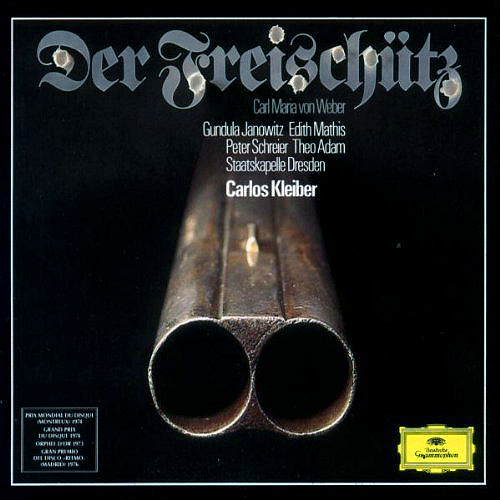
Not an opera fan? Well you should be. Here’s an interesting bit of trivia. Did you know that one of the most famous German operas is all about competitive rifle shooting? Believe it or not, the popular von Weber opera Der Freischütz (“The Marksman”), features shooting matches and precision bullet-making.
The opera’s story should “strike a chord” with our readers. In order to win an important shooting match, the hero, Max, casts seven “Magic Bullets”. He is lured into this occult reloading practice by a fellow shooter with a hidden, not-so-nice agenda. (Sound familiar you guys?) But what our hero Max doesn’t realize is that the devil is at work, and if Max uses the magic bullets at the big match he will forfeit his soul and suffer eternal damnation. Lesson to our readers — don’t try to win matches with Magic Bullets. CLICK HERE for the full story…
The overture and the Jägerchor (“Hunters’ Chorus”) from Act 3 of Der Freischütz are often performed as concert pieces. Listen to a stirring performance of the Jägerchor in the video below. This features full orchestra, mass male choir, and the ‘Jagdhornverein Edelweiss’ horns. You’ll enjoy it…
Jägerchor (Hunters’ Chorus) from Der Freischütz by Carl Maria von Weber
Andre Rieu with the ‘Jagdhornverein Edelweiss’ and the Männerchor ‘Maastrichter-Staar’.
Der Freischütz (usually translated as “The Marksman” or “The Freeshooter”) is an opera in three acts by Carl Maria von Weber, with libretto by Friedrich Kind. It premiered on 18 June 1821 at the Schauspielhaus, Berlin. It is considered the first important German Romantic opera. The plot is based on the German folk legend of the Freischütz and many of its tunes were inspired by German folk music. Despite its daring innovations, it quickly became an international success, with some 50 performances in the first 18 months after the premiere. Among the many artists influenced by Der Freischütz was a young Richard Wagner.
Jägerchor (Hunters’ Chorus) — full version with procession of ‘Jagdhornverein Edelweiss’ in Maastricht.
Top Der Freischutz illustration from a Gruselkabinette CD (Episode 15) sold byTitania Medien.
Do you shoot a .308 Winchester (and who doesn’t)? Well here’s a great deal on Lapua .308 Win brass, the best you can buy. Ultra-consistent, Lapua brass stays strong for many reloading cycles, even with stout loads. Lapua is the choice of most F-TR competitors who shoot the .308 Win in competition.
The .308 Win Palma version brass (item BL11071) features small primer pockets. Some people believe the small primer pockets help the cases deliver a lower Extreme Spread (ES) and (maybe) withstand high pressures for more loading cycles. YMMV, but we do like the small-primer-pocket .308 Win Lapua brass and it’s our first choice for target applications.
Both types of Lapua .308 Winchester brass are now available at very attractive prices from Bullets.com: $61.95 for large primer pocket brass, $69.95 for small pocket brass. This cartridge brass is in stock today and ready to ship. CLICK HERE to order.
10/1/2014 Update: Sale Inventories of the Small Primer Pocket .308 Win Palma brass are sold out. You can still buy this brass, but the regular price is $79.95 per 100 cases.
If you haven’t visited the Norma website recently, you should click over to www.norma.cc/en/ (the ‘en’ is for English version). There you will find Norma’s “Ammo Academy”, a technical resource that provides information on: Ballistics, Powder Storage, Barrel Wear, and Bullet Expansion. In addition, the Ammo Academy now links to Norma’s Reloading Data Center, where you’ll find loads for nearly 70 cartridge types including: .223 Rem, .22-250, 6mmBR Norma, 6XC, 260 Rem, 6.5-284, 6.5×55, 7mm-08, .270 Win, .284 Win, .308 Win, .30-06, 300 Win Mag, .338 Lapua Mag and dozens more.
The Ammo Academy’s Ballistics section contains some fascinating technical facts:
After the trigger is pulled, it takes around 0.005 seconds before the firing pin reaches the primer.
From the firing of the primer it takes 0.0015-0.002 seconds until the bullet exits the muzzle.
When the bullet leaves the muzzle, the hot gases surround and overtake the bullet, continuing the acceleration for a few centimeters.
Because the barrel is always angled slightly upwards, the bullet’s flight starts about 3-5 cm below the line of sight.
Norma also offers some good advice about Powder and Cartridge Storage:
To maintain the product quality for as long as possible, you have to keep the powder in a suitable place under suitable conditions. Where possible, store the powder at a constant temperature, ideally between 12 and 15°C (54°F to 59°F), and a relative humidity of 40–50%. If the air is too dry, it will dry out the powder, which will cause the pressure to be higher, thus affecting performance. Also make sure that you close the powder container properly afterwards. Cartridges should be stored under the same ambient conditions to maintain their quality.
If you’re looking for loaded ammunition at affordable prices, WikiArms.com can help you find a good deal. WikiArms constantly searches the listings of ammo vendors across the web. Then WikiArms ranks the offerings by cost per round, low to high. This way you can instantly compare prices from multiple vendors including Ammoland, Brownells, Cabelas, Lucky Gunner, MidwayUSA, Natchez, Sinclair Int’l, Slickguns, Sportsmans Guide, and Wideners. Search bots refresh pricing constantly so listed prices are normally current within five minutes. WikiArms even displays the amount of product currently in stock for each vendor.
Using WikiArms is easy. Just click your choice of caliber (such as 9mm, .22LR, or .308 Win) on the navigation bar, or hit the Good Deals link to see a variety of cartridge types all at one time. WikiArms is fast, and it is FREE to use. Check it out.
One of our Forum Members has a .308 Win load that dips into the transonic speed range at 1000 yards. He is concerned that his bullets may lose accuracy as they slow to transonic speeds: “My target is at 1000 yards. How important to accuracy is it to keep the bullet supersonic (Mach 1.2) all the way to the target? How does slowing to transonic speeds in the last 100 yards or so affect accuracy?”
TargetShooter Magazine and AccurateShooter.com contributor Laurie Holland offers some practical answers to this important question, based on his his experience with .223 and .308-caliber bullets.
Thoughts on Accuracy and Transonic Bullet Speeds by Laurie Davidson.
There is no simple answer to the question “How do transonic speeds affect accuracy”. Some bullets manage OK, some not so well, some fail entirely, and I’ve never seen a guide as to which models do and which don’t. But we do have the ‘boat-tail angle rule’, anyway. Bryan Litz says the ideal boat-tail angle is 7-9°. Go much above 10° and it’s too steep for the air to follow the bullet sides around to the base. This seems to manifest itself as much increased drag and turbulence leading to instability in transonic flight.
It is this effect that has led to the common advice of “Don’t use 168gr 30-caliber bullets at 1000 yards”. That is misleading advice as it resulted from use of the 168gr Sierra ‘International’ (aka MatchKing) bullet with its 13-deg BT angle. (This was, originally, a specialized 300m design — there are various near copies on the market from Speer, Hornady and Nosler.) By contrast, Berger 168-grainers are designed as long-range bullets with 8.9, 8.5 and a really nice 7° angle on the BT, VLD and Hybrid respectively. Hornady A-Max 30-cal projectiles (other than the 208-grainer) fall into this enforced shorter-range bracket too thanks to their 12.6° (and greater) boat-tail angles. (155gr = 13.5°, 168gr = 12.87°, and 178gr = 12.6°.)
Even this boat-tail angle ‘rule’ doesn’t always seem to apply. Many older long-range Service Rifle shooters talk about good results at 1000 yards with some batches of 7.62mm match ammo in their 20″-barreled M14s using the 168gn SMK. I’ve successfully used Hornady and Sierra 168s at 1000 yards in 30-cal magnums which drive the bullets fast enough to keep out of trouble at this distance. This is still not recommended of course thanks to their low BCs compared to better long-range speciality bullets.
These four photos show the substantial changes in the shock ware and turbulence patterns for the same bullet at different velocities. The “M” stands for Mach and the numerical value represents the velocity of the bullet relative to the speed of sound at the time of the shot. Photos by Beat Kneubuehl.
Transonic Issues with .223 Rem in F-TR
I was much exercised by [concerns about transonic instability] in the early days of F-Class, when I was shooting a .223 Rem with 80-grainers at 2,800 fps MV or even a bit less. Even the optimistic G1 ballistic charts of the time said they’d be subsonic at 1000 yards. (Bryan Litz’s Point Mass Ballistic Solver 2.0’s program says 1,078 fps at 1000 yards at 2,800 fps MV in standard conditions for the SMK; below 1.2 MACH beyond a point somewhere around 780 yards.) In fact they shot fine in a large range of conditions apart from needing around 60% more windage allowance than 6.5mm projectiles [shot with a larger cartridge]. The biggest problem apart from my wind-reading skills was constantly getting out of the rhythm to call to have the target pulled as the pits crew didn’t hear the subsonic bullets and had trouble seeing their little holes.
In the early days of F-TR I used a 24″ barrel factory tactical rifle that was billed as F-TR ready — it wasn’t! The much touted 175gr Sierra MatchKing, as used in the US military M118LR sniper round, was allegedly good at 1000 yards at .308 velocities — but it wasn’t! It would group OK in [some calm] conditions, but any significant change would cause a much greater deflection on the target than the ballistic charts predicted, so transonic flight was obviously making it barely stable. I also suspect conditions on the day had a big effect as Litz’s program says [the 175gr SMK] is just subsonic at 2,650 fps MV at 1,000 in standard conditions. Throw in MV spread and there was a risk of some round remaining supersonic, while others went transonic. Plus warmer or colder air moving onto the range under some conditions might change things.
I used the combination on Scotland’s notorious Blair Atholl range at 1000 yards in one competition in a day of cold headwinds from the north and frequent rain squalls. The temperatures plummeted during the squalls (and the wind went mad too!) and what was an ‘interesting group pattern’ outside of squall conditions changed to seeing me do well to just stay on the target frame at all. On ranges other than Blair (which is electronic, so no pits crew), target markers reported they heard faint supersonic ‘crack’ and saw round holes on the paper, so the bullets appeared to remain stable and just supersonic in summer shooting conditions.
Transonic Problems with M118LR 7.62×51 Ammo
Confirmation of this transonic performance phenomenon has since come from USMC snipers who say the M118LR’s performance ‘falls off a cliff’ beyond 800m (875 yards), which is just what I found when shooting the bullet at slightly higher than M118LR muzzle velocities. A move to the 190gr SMK with Vihtavuori N550 keeping the MVs reasonable gave a vast improvement in 1000-yard performance.
Practical Advice — Use a Bullet That Stays Supersonic
The ‘easy’ / better answer to all this is to use a design such as the 30-caliber, 185gr Berger LRBT with a reputation for good long range performance and to load it to achieve or exceed 1,350 fps at 1000 yards. If I can get the combination I’m using to be predicted to hold 1,400 fps at this range in a G7-based program calculation, I’m happier still.
Incidentally, the old long-range, 30-cal Sierra bullets (the venerable 190gr, 200gr, and 220gr MatchKings), with their extra length boat-tail sections, have a superb reputation for stable transonic / subsonic flight. They were used by GB and British Commonwealth ‘Match Rifle’ shooters at 1000, 1100, and 1200 yards for many years before the current bunch of 210gr and up VLDs and Hybrids appeared.
Transonic vs. Supersonic
The term “Transonic” refers to velocities in the range of Mach 0.8 to 1.0, i.e. 600–768 mph. It is formally defined as the range of speeds between the critical Mach number, when some parts of the airflow are supersonic, and a higher speed, typically near Mach 1.2, when the vast majority of the airflow is supersonic. Instability can occur at transonic speeds. Shock waves move through the air at the speed of sound. When an aircraft goes transonic and approaches the speed of sound, these shock waves build up in front of it to form a single, very large shock wave. This is dramatically illustrated in this Space Shuttle photo.
If you want to see how a muzzle brake really works, definitely watch this remarkable slow-motion video compiled by Proof Research.
This amazing video features a variety of firearms: suppressed 9mm pistol, .338 Norma rifle, .300 WinMag rifle, 12ga comp’d shotgun, plus an AR15 and AR10.
This Must-Watch Video Has Some Amazing Ultra-Slow-Motion Segments
Watch the ultra-slow motion segment at the 2:55 mark and you can actually see a .30-cal bullet spin its way through the muzzle brake, leaving trail of flame that blows out the ports. Interestingly, at the 3:10 mark, you can also see a bright “afterburn” ball of fire that forms a few inches ahead of the muzzle milliseconds after the bullet has left the barrel. Perhaps this is late ignition of unburned powder?
Proof Research (PR) sells high-grade hunting and tactical rifles built with PR-made actions and carbon-wrapped barrels. For more information, visit ProofResearch.com.
Credit Steve of TheFirearmBlog.com for this YouTube video. Footage by JNZ for Proof Research.
Here is a simple technique that can potentially help you load straighter ammo, with less run-out. It costs nothing and adds only a few seconds to the time needed to load a cartridge. Next time you’re loading ammo with a threaded (screw-in) seating die, try seating the bullet in two stages. Run the cartridge up in the seating die just enough to seat the bullet half way. Then lower the cartridge and rotate it 180° in the shell-holder. Now raise the cartridge up into the die again and finish seating the bullet.
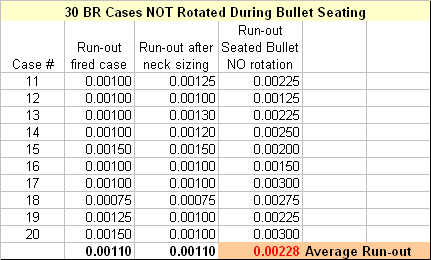
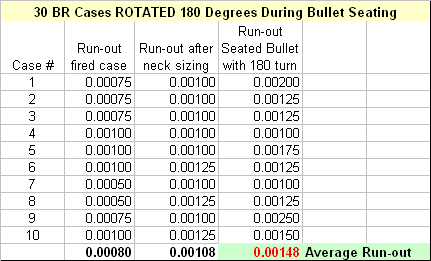
Steve, aka “Short Range”, one of our Forum members, recently inquired about run-out apparently caused by his bullet-seating process. Steve’s 30BR cases were coming out of his neck-sizer with good concentricity, but the run-out nearly doubled after he seated the bullets. At the suggestion of other Forum members, Steve tried the process of rotating his cartridge while seating his bullet. Steve then measured run-out on his loaded rounds. To his surprise there was a noticeable reduction in run-out on the cases which had been rotated during seating. Steve explains: “For the rounds that I loaded yesterday, I seated the bullet half-way, and turned the round 180 degrees, and finished seating the bullet. That reduced the bullet runout by almost half on most rounds compared to the measurements from the first test.”
Steve recorded run-out measurements on his 30BR brass using both the conventional (one-pass) seating procedure, as well as the two-stage (with 180° rotation) method. Steve’s measurements are collected in the two charts above. As you can see, the run-out was less for the rounds which were rotated during seating. Note, the change is pretty small (less than .001″ on average), but every little bit helps in the accuracy game. If you use a threaded (screw-in) seating die, you might try this two-stage bullet-seating method. Rotating your case in the middle of the seating process won’t cost you a penny, and it just might produce straighter ammo (nothing is guaranteed). If you do NOT see any improvement on the target, you can always go back to seating your bullets in one pass. READ Forum Thread….
Randy Robinett, founder of BIB Bullets, is a highly respected custom bullet-maker. In recent years, Randy’s 30-caliber projectiles have won countless benchrest-for-score matches, and captured many National titles. If you want to “run with the big dogs” in score competition, campaigning a 30BR with BIB bullets is a very smart way to go. In this article, Randy talks about the process of creating highly uniform cores for benchrest bullets.
This article originally started as an exchange of posts in Stan Ware’s Bench-Talk Forum. Stan, a gifted gunsmith, converted the Forum posts into an article, which first appeared on Stan’s Bench-Talk.com Website.
How to Make Benchrest-Quality Bullet Cores by Randy Robinett, BIB Bullets
OK, Stan “made me do it”! A while back, Stan Ware asked if I’d submit a ditty on bullet-making. Here is the “picture is worth a few words” version. Below is a photo of a spool of lead wire. This is the first step in making benchrest-quality bullets. This spool of .250″ diameter lead wire will be cut into approximately 130 pieces, each about thirty inches long.
The Core Cutter
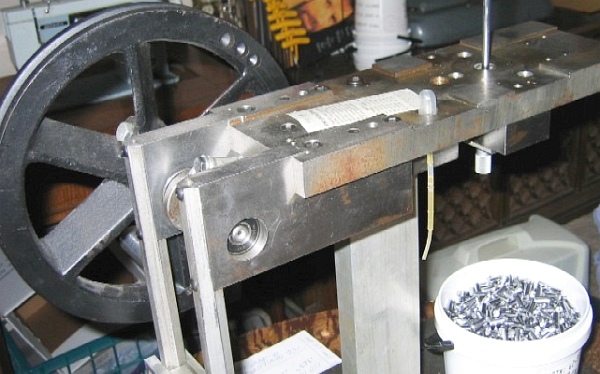
Here’s a really neat machine built by my Uncle and BIG MIKE. This is the core cutter. We made it using scrap steel and borrowed the crank shaft out of a 1966 Yamaha motorcycle to get the desired reciprocating-motion slide. When properly “juiced”, this machine can cut more than 3000 cores per hour.
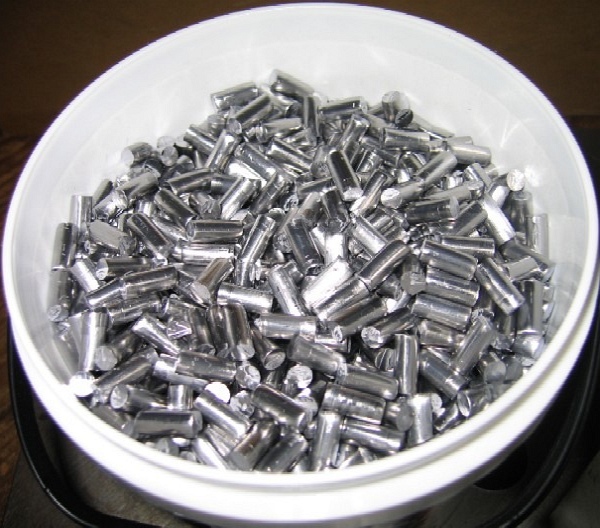
As you doubtless deduced, the “sticks” are inserted, then fed via gravity — straightness is a virtue here! The crank, for now, is powered by the human hand. The bucket contents are the result of loading the cutter and turning the crank wheel. This photo shows cores for 112 grain, .30-caliber bullets. There are about 2500 cores to the bucket.
Here’s a close-up of the business end of the core cutter. Using recorded micrometer settings, this clever design allows us to get very repeatable length when changing through the length/weight cycle.
The photo below provides a closer look at the just-cut cores. Note the relatively clean shanks and square, unflared ends. This bucket contains roughly 2500 cores. By contrast, a tour of the Hornady plant will reveal cores being cut and squirted via a single operation, and deposited into 50-100 gallon livestock watering tanks!
Upon my first tour of a commercial plant, I lost all feelings of guilt about the cost of custom, hand-made bullets. When one totals the amount of labor, “feel” and “culling” that goes into them, custom hand-made bullets represent one of the best bargains on the planet!
At Hornady, each press produces 50-55,000 finished bullets per 10-hour shift. By contrast, a maker of hand-crafted bullets, at best, may make 3% of that number during a 10-hour span! Yep, hand-made benchrest-quality bullets are a labor of love and should be purchased with these criteria in mind: 1) QUALITY; 2) availability; 3) price. There is no reason for a maker of hand-made benchrest-quality bullets to negotiate on price. His time is worth what one receives from the bargain!
Core-Making Q & A Randy’s original Bench-Talk Forum posts inspired some questions by Forum members. Here are Randy’s answers to spedific questions about core-making.
Question by Stan Ware: Randy, a post or two back you said the cores were cut into 30″ lengths first and straightened. Why do you cut to 30″ lengths? What is the reason for this?
Answer by Randy: Stan, the wire is cut into 30″ lengths (sticks) and then straightened, following which it is fed into the core cutter and cut into the individual individual “cores”. If you look at the core cutter photo above, you’ll see a stick of lead wire sticking up -it’s toward the right hand end of the contraption. The cut cores are also “ejected” by gravity — the white “tickler” brushes the cores as the slide moves forward and dislodges the core from the cutter bushing.
Q by GregP: Randy, How do you straighten the 30″ sticks? Roll them between metal plates?
Answer by Randy: Greg, BIG MIKE may kill me for letting out the secret. WE “roll” the wire between an aluminum plate, which is equipped with handles, and the “plate” which you can see in the pic of cutting the wire. The straightening is really a drag. Eventually, we will have the new cutter hooked up to a “feeder/straightener” and the wire will be cut into core slugs right off the roll! Well, that’s the Dream….
Question by Jim Saubier: How much of a nub do you use at the end of the 30″ section? I imagine that every section you will lose a little from the feed end. Your cutter looks real slick, we are using the manual deal and it isn’t quick by any means.
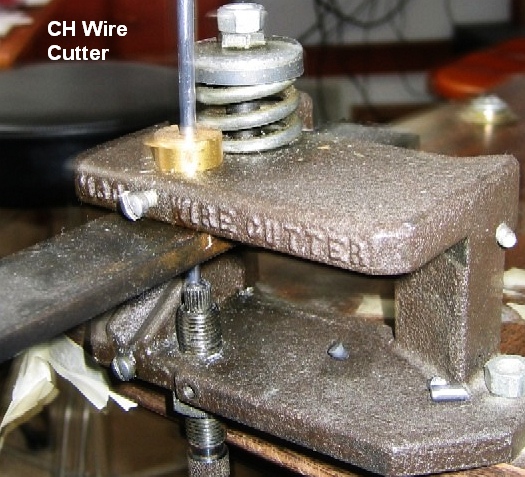
Answer by Randy: Jim, Since I cut all of the sticks using diagonal-cutting pliers, the ends are, indeed, waste. However, only about 1/8th inch on the beginning end — the final core may be too short. I have attached a pic of my old reliable CH cutter. I still use this cutter for .22-cal and 6mm cores and, occasionally, an odd lot of thirties. The CH cuts very square ends which are free of bulges and/or flaring.
Stan Ware Retires
Stan Ware has announced that he is retiring effective September 1, 2014. We are sad to see Stan hang up his tools. He was superbly capable smith who also always delivered the highest level of personal service to his customers. We worked with Stan on a couple projects and we have the highest regard for his skills, professionalism, and his dedication to doing the job right… the first time. We’re sorry to see Stan close shop at SGR Custom Rifles, but we wish him well in retirement and we hope he will enjoy his years of freedom with his friends and family members. Stan wants to thank all his customers: “The one thing I have found out in thirty-one years working for gun enthusiasts is that the are the finest people in the world to work for, and I mean that from the bottom of my heart.”


 Der Freischütz (usually translated as “The Marksman” or “The Freeshooter”) is an opera in three acts by Carl Maria von Weber, with libretto by Friedrich Kind. It premiered on 18 June 1821 at the Schauspielhaus, Berlin. It is considered the first important German Romantic opera. The plot is based on the German folk legend of the Freischütz and many of its tunes were inspired by German folk music. Despite its daring innovations, it quickly became an international success, with some 50 performances in the first 18 months after the premiere. Among the many artists influenced by Der Freischütz was a young Richard Wagner.





 If you’re looking for loaded ammunition at affordable prices,


 Transonic vs. Supersonic
 If you want to see how a muzzle brake really works, definitely watch this remarkable slow-motion video compiled by
 Here is a simple technique that can potentially help you load straighter ammo, with less run-out. It costs nothing and adds only a few seconds to the time needed to load a cartridge. Next time you’re loading ammo with a threaded (screw-in) seating die, try seating the bullet in two stages. Run the cartridge up in the seating die just enough to seat the bullet half way. Then lower the cartridge and rotate it 180° in the shell-holder. Now raise the cartridge up into the die again and finish seating the bullet.