|
|
October 31st, 2014
NEW PRODUCT REPORT by Dennis Santiago
At the recent Western CMP Games and Creedmoor Cup Matches in Phoenix, I received a box of the all-new .30-06 Match-Grade ammunition from Dennis DeMille of Creedmoor Sports. My job was to test the ammo (at the Games) and write about it. This box was part of Creedmoor’s 3-million-round production run for the Civilian Marksmanship Program (CMP). CLICK HERE for Ammo Sales.
Author Dennis Santiago (right) with Dennis Demille of Creedmoor Sports (left).

The new .30-06 “Match-Grade” ammunition from Creedmoor is impressive. This ammo is made from top-quality components: brand new Lapua .30-06 brass and 167gr Lapua Scenar bullets. The ammo, optimized for 200-yard CMP Games tournaments, runs at 2720 fps. DeMille says the Standard Deviation (SD) is very tight with this ammo — comparable with precision hand loads. The low SD reflects great attention to detail in ammo assembly. Creedmoor’s industrial loader is run at half-speed to improve consistency. Charges are thrown precisely — I believe in two (2) half-charges.

When you hold the ammunition up to the light, each round appears a perfect clone of each other round — something that cannot be said for some other factory ammo (even so-called “match ammo”). This is about a close as one is likely to get to a precision hand load. The good news is that Creedmoor plans to produce similar ammunition in other chamberings.
The economics of the ammunition are equally intriguing. This ammo is being sold by the CMP for $1.30 per round. Think about that — new .30-06 Lapua brass sells for around $100.00 per hundred cases. So, you get to fire a precision match round for about 30 cents and have premier once-fired brass for future use. The price per rounds tells me that CMP isn’t making money on this — it is being sold at near cost to promote marksmanship.
Great Ammo at a Great Price
In offering this new .30-06 ammo at an affordable price, the CMP is making it possible for non-reloading competitors to have the same quality of ammunition as those who handload with premium components. This will be a major improvement for shooters of m1903s and M1 Garands. I think this ammo can be real equalizer for those who do not currently hand-load their own .30-06 ammunition. The CMP and Creedmoor Sports are to be commended for collaborating on this game-changing product introduction.
Where to get the Creedmoor Sports CMP .30-06 Ammo
The CMP is now selling the Creedmoor-produced .30-06 ammo on the CMP website, item #4C3006CS167-100 (click the “e-Store” button to launch shopping cart). The retail price is $130.00 per 100-round case (i.e. two boxes). That works out to $1.30 per round.*

.30-06 Ammo Performance
When someone hands you a box of ammo with a challenge how can you not throw all your match plans out the door and play? I was planning to fire the CMP GSM match with my M-1 Garand the next day using 150gr SMK handloads but I said, “What the heck. Let’s go for it.” You get five sighters in a GSM match which is plenty to zero with new ammo.
The ammo is optimized for shooting 200-yd CMP matches with rifles like my as-issued DCM M-1 Garand.

I shoot the M-1 Garand matches with a rebuilt 5-digit receiver gun with a 1950s barrel refurbished at Anniston Armory that I got from the DCM back in the day when the postman delivered them. It shoots true and has garnered its share of Western Games trinkets over the years including a number of golds and one of those coveted M-1 EIC 4 points medals. It’s a good platform for the test. Sighters revealed the Creedmoor ammo shoots about two minutes higher impact versus my pet load. The tale of the tape said 96-2X slow prone, 93-1X rapid prone and 81-1X offhand totaling 270-4X. The DCM machine took home a bronze in 2014.
Accuracy and Consistency
This Creedmoor ammo is indeed amazingly consistent. The slow prone stage was a pure joy to shoot. This ammunition is “brutally honest”. It will reveal every little error you make be it defocusing on your front sight drenching in sweat under the Phoenix sun, not being fast enough to reset your NPA mid-string in your rapid as the big gun moves you around or just being jittery on your feet during the back half of your offhand. With this ammo I felt confident to trust that any error was mine after each shot. There was no wondering about the ammo. I knew its feedback was accurate. That is a huge thing to be that confident in one’s gun and ammunition. I never felt that confident with HXP or even my handloads. If anything, I now know that even my ammo for the M1 Garand and M1903A3 will benefit from the same careful case preparation and assembly as my tactical rifle or long range ammo.
*At the Western CMP Games this Creedmoor .30-06 ammo was sold at a discounted price of $1.15 per round. That’s an example of the great deals one can get by attending CMP competitions.
October 28th, 2014
 In discussions of ballistics, you’ll see references to “tangent” and “secant” bullet shapes. We know that, for many readers, these terms can be confusing. To add to the confusion, bullet makers don’t always identify their projectiles as secant or tangent designs. This article provides a basic explanation of tangent and secant designs, to help you understand the characteristics of both bullet shapes. In discussions of ballistics, you’ll see references to “tangent” and “secant” bullet shapes. We know that, for many readers, these terms can be confusing. To add to the confusion, bullet makers don’t always identify their projectiles as secant or tangent designs. This article provides a basic explanation of tangent and secant designs, to help you understand the characteristics of both bullet shapes.
Tangent vs. Secant vs. Hybrid
Most match bullets produced today use a tangent ogive profile, but the modern VLD-style bullets employ a secant profile. To further complicate matters, the latest generation of “Hybrid” projectiles from Berger Bullets feature a blended secant + tangent profile to combine the best qualities of both nose shapes. The secant section provides reduced drag, while the tangent section makes the bullet easier to tune, i.e. less sensitive to bullet seating depth position.
Berger Bullets ballistician Bryan Litz explains tangent and secant bullet ogive designs in a glossary section of his Applied Ballistics website, which we reprint below. Bryan then explains how tangent and secant profiles can be combined in a “hybrid” design.
How Bullet Ogive Curves are Defined
While the term “ogive” is often used to describe the particular point on the bullet where the curve reaches full bullet diameter, in fact the “ogive” properly refers to the entire curve of the bullet from the tip to the full-diameter straight section — the shank. Understanding then, that the ogive is a curve, how is that curve described?
LITZ: The ogive of a bullet is usually characterized by the length of its radius. This radius is often given in calibers instead of inches. For example, an 8 ogive 6mm bullet has an ogive that is a segment of a circular arc with a radius of 8*.243 = 1.952”. A .30-caliber bullet with an 8 ogive will be proportionally the same as the 8 ogive 6mm bullet, but the actual radius will be 2.464” for the .30 caliber bullet.
For a given nose length, if an ogive is perfectly tangent, it will have a very specific radius. Any radius longer than that will cause the ogive to be secant. Secant ogives can range from very mild (short radius) to very aggressive (long radius). The drag of a secant ogive is minimized when its radius is twice as long as a tangent ogive radius. In other words, if a tangent ogive has an 8 caliber radius, then the longest practical secant ogive radius is 16 calibers long for a given nose length.”

Ogive Metrics and Rt/R Ratio
LITZ: There is a number that’s used to quantify how secant an ogive is. The metric is known as the Rt/R ratio and it’s the ratio of the tangent ogive radius to the actual ogive radius for a given bullet. In the above example, the 16 caliber ogive would have an Rt/R ratio of 0.5. The number 0.5 is therefore the lowest practical value for the Rt/R ratio, and represents the minimum drag ogive for a given length. An ogive that’s perfectly tangent will have an Rt/R ratio of 1.0. Most ogives are in between an Rt/R of 1.0 and 0.5. The dimensioned drawings at the end of my Applied Ballistics book provide the bullets ogive radius in calibers, as well as the Rt/R ratio. In short, the Rt/R ratio is simply a measure of how secant an ogive is. 1.0 is not secant at all, 0.5 is as secant as it gets.
 Hybrid Bullet Design — Best of Both Worlds? Hybrid Bullet Design — Best of Both Worlds?
Bryan Litz has developed a number of modern “Hybrid” design bullets for Berger. The objective of Bryan’s design work has been to achieve a very low drag design that is also “not finicky”. Normal (non-hybrid) secant designs, such as the Berger 105gr VLD, deliver very impressive BC values, but the bullets can be sensitive to seating depth. Montana’s Tom Mousel has set world records with the Berger 105gr VLD in his 6mm Dasher, but he tells us “seating depth is critical to the best accuracy”. Tom says a mere .003″ seating depth change “makes a difference”. In an effort to produce more forgiving high-BC bullets, Bryan Litz developed the hybrid tangent/secant bullet shape.
Bryan Litz Explains Hybrid Design and Optimal Hybrid Seating Depths
Story sourced by Edlongrange.
October 26th, 2014
 Effects Of Cartridge Over All Length (COAL) And Cartridge Base To Ogive (CBTO) – Part 2 Effects Of Cartridge Over All Length (COAL) And Cartridge Base To Ogive (CBTO) – Part 2
by Bryan Litz for Berger Bullets.
Part One of this series focused on the importance of COAL in terms of SAAMI standards, magazine lengths, seating depths, and pressure levels. Another measure of length for loaded ammunition is highly important to precision, namely Cartridge Base to Bullet Ogive Length (CBTO).
Figure 2. Chamber throat geometry showing the bullet jump to the rifling or lands.

Look at Figure 2. Suppose the bullet was seated out of the case to the point where the base of the bullet’s nose (ogive) just contacted the beginning of the riflings (the lands) when the bolt was closed. This bullet seating configuration is referred to as touching the lands, or touching the riflings and is a very important measurement to understand for precision hand-loading. Due to the complex dynamics of internal ballistics which happen in the blink of an eye, the distance a bullet moves out of the case before it engages the riflings is highly critical to precision potential. Therefore, in order to systematically optimize the precision of his handloads, it’s critically important that the precision hand-loader understands how to alter bullet seating depth in relation to the barrel rifling. Part of the required knowledge is understanding how to accurately and repeatably measure the Cartridge Base To Ogive (CBTO) dimension. This is explained in the FULL ARTICLE.
Bryan Litz offers an extended discussion on how to measure CBTO using different tools and methods, including the Hornady OAL gauge. You can read this discussion in the full article found on the Berger Bullets website. CLICK HERE to Read Full Article.
Why Not Use CBTO as a SAAMI Standard?
If CBTO is so important to rifle accuracy, you might ask, “Why is it not listed as the SAAMI spec standard in addition to COAL?” There is one primary reason why it is not listed in the standard. This is the lack of uniformity in bullet nose shapes and measuring devices used to determine CBTO.
Figure 4. Two different bullet shapes, seated to the same CBTO length, but different COAL. Note the shiny scratches on the bullets made by the comparator tool which indicates a point on the bullet ogive near where the ogive will engage the riflings.

Benefits of Having a Uniform CBTO
There is another aspect to knowing your CBTO when checking your COAL as it pertains to performance. With good bullets, tooling, and carefully-prepared cases you can easily achieve a CBTO that varies less than +/- .001″ but your COAL can vary as much as .025″ extreme spread (or more with other brands). This is not necessarily bad and it is much better than the other way around. If you have a CBTO dimension that varies but your COAL dimension is tight (within +/- .002″) then it is most likely that your bullet is bottoming out inside the seater cone on the bullet tip. This is very bad and is to be avoided. It is normal for bullets to have precisely the same nose shape and it is also normal for these same bullets to have nose lengths that can vary as much as .025″.
|
Summary of Cartridge Base To Ogive (CBTO) Discussion
Here are four important considerations regarding bullet seating depth as it relates to CBTO:
1. CBTO is a critical measurement to understand for handloaders because it’s directly related to precision potential, and you control it by simply setting bullet seating depth.
2. Tools and methods for measuring CBTO vary. Most of the measurement techniques have pitfalls (which may give rise to inconsistent results) that you should understand before starting out.
3. A CBTO that produces the best precision in your rifle may not produce the best precision in someone else’s rifle. Even if you have the same rifle, same bullets, same model of comparator gauges, etc. It’s possible that the gauges are not actually the same, and measurements from one don’t translate to the same dimension for another.
4. Once you find the CBTO that produces the best precision in your rifle, it’s important to allow minimal variation in that dimension when producing quality handloads. This is achieved by using quality bullets, tooling, and properly preparing case mouths and necks for consistent seating.
CLICK HERE to Read Full Article with More Info |
Article sourced by EdLongrange. We welcome tips from readers.
October 26th, 2014
Here’s a feel-good story, particularly for those of us getting up in years. Walt Berger recently proved you are as young as you feel — and you can enjoy shooting success at any age. Walt Berger, well into his 80s, won a big benchrest victory last month, taking the Sporter Class 100-yard Aggregate at the 2014 NBRSA Score Nationals. In so doing, Walt earned his 20th Hall of Fame Point. That’s a great accomplishment for the Elder Statesman of Benchrest. Congrats to Walt! And, yes, of course, Walt was shooting a projectile made by Berger Bullets — the 6mm 65gr BT Target bullet.

About Walt Berger
Walt Berger started making rifle bullets in 1955 because he believed he could make better bullets than those that were available at the time. He regularly participated in benchrest shooting competitions (and still does today), which requires the highest levels of precision in all components. In 1987, Walt grew his bullet making operation beyond a part time hobby after encouragement from his second wife Eunice (Walt lost his first wife Mary to cancer). Together, they grew the business into a large-scale precision rifle bullet-making operation.
Walt was born at the end of the Golden Twenties and the beginning of the Great Depression. His story is about overcoming great odds and seeing things through to success when almost everyone around him was convinced he would fail.
Walt Berger with two younger generation Berger Bullets employees at the 2014 NRA Annual Meeting.

October 22nd, 2014
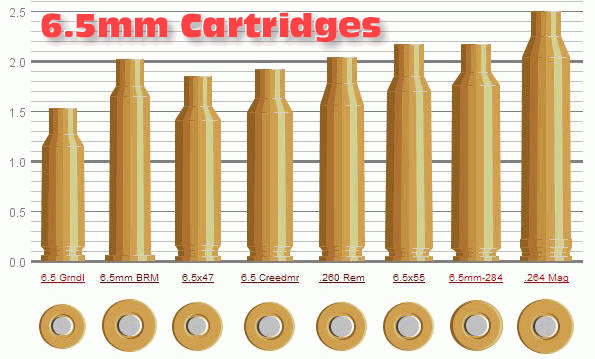
Chart created with Ammoguide’s Visual Comparison Tool. Visit Ammoguide.com to learn more.
by Eben Brown, EABCO.com, (E. Arthur Brown Co. Inc.)
The current popularity of 6.5mm cartridges in the USA has been a long time in coming. I won’t go into my opinions on why it took so long to catch on. The important thing is that it finally HAS caught on and we’re now so fortunate to have a wide selection of 6.5mm cartridges to choose from!
6.5mm Grendel – Developed by Alexander Arms for the AR15 and military M4 family of rifles. The Grendel fits the dimensional and functional requirements of these rifles while delivering better lethality and downrange performance. There are now similar cartridges from other rifle companies. We chamber for the Les Baer “264 LBC-AR”. Designed for velocities of 2400-2500 fps with 123gr bullets, it shoots the 140-grainers at about 2000 fps (for comparison purposes).
6.5mm BRM – Developed by E. Arthur Brown Company to give “Big Game Performance to Small Framed Rifles” — namely our Model 97D Rifle, TC Contender, and TC Encore. Velocities of 2400-2500 fps with 140gr bullets puts it just under the original 6.5×55 Swede performance.
6.5mm x 47 Lapua – Developed by Lapua specifically for international 300m shooting competitions (with some interest in long-range benchrest as well). Case capacity, body taper, shoulder angle, and small rifle primer are all features requested by top international shooters. You can expect velocities of 2500-2600+ with 140 gr bullets.
 6.5mm Creedmoor – Developed by Hornady and Creedmoor Sports, the 6.5mm Creedmoor is designed for efficiency and function. Its shape reaches high velocities while maintaining standard .308 Winchester pressures and its overall length fits well with .308 Win length magazines. You can expect velocities of 2600-2700+ fps with 140gr bullets. 6.5mm Creedmoor – Developed by Hornady and Creedmoor Sports, the 6.5mm Creedmoor is designed for efficiency and function. Its shape reaches high velocities while maintaining standard .308 Winchester pressures and its overall length fits well with .308 Win length magazines. You can expect velocities of 2600-2700+ fps with 140gr bullets.
.260 Remington – Developed by Remington to compete with the 6.5mmx55 Swedish Mauser that was (finally) gaining popularity in 1996. By necking down the 7mm-08 Remington to 6.5mm (.264 cal), the .260 Remington was created. It fit the same short-action [receivers] that fit .308 Win, .243 Win, 7mm-08 Rem, etc. You can expect velocities of 2600-2700 fps with 140gr bullets in the 260 .Remington.
[Editor’s Note: In the .260 Rem, try the Lapua 120gr Scenar-Ls and/or Berger 130gr VLDs for great accuracy and impressive speeds well over 2900 fps.]
6.5mm x 55 Swedish Mauser – This was the cartridge that started the 6.5mm craze in the USA. It is famous for having mild recoil, deadly lethality on even the biggest game animals, and superb accuracy potential. Original ballistics were in the 2500 fps range with 140gr bullets. Nowadays handloaders get 2600-2700+ fps.
[Editor’s Note: Tor from Scandinavia offers this bit of 6.5x55mm history: “Contrary to common belief, the 6.5×55 was not developed by Mauser, but was constructed by a joint Norwegian and Swedish military commission in 1891 and introduced as the standard military cartridge in both countries in 1894. Sweden chose to use the cartridge in a Mauser-based rifle, while Norway used the cartridge in the Krag rifles. This led to two different cartridges the 6.5×55 Krag and 6.5×55 Mauser — the only real difference being safe operating pressure.”]
6.5-284 Norma — This comes from necking the .284 Winchester down to .264 caliber. Norma standardized it for commercial ammo sales. The 6.5mm-284 was very popular for F-Class competition and High Power at 1,000 yards. However, many F-Class competitors have switched to the straight .284 Win for improved barrel life. 6.5-284 velocities run 3000-3100+ fps with 140gr bullets.
.264 Winchester Magnum – Developed by Winchester back in 1959, the .264 Win Mag never really caught on and may have delayed the ultimate acceptance of 6.5mm cartridges by US shooters (in my opinion). It missed the whole point and original advantage of 6.5 mm cartridges.
The Original 6.5mm Advantage
The special needs of long-range competition have skewed things a little. However the original advantages of 6.5mm cartridges — how deadly the 6.5mms are on game animals, how little recoil they produce, and how easy they are to shoot well — still hold true today.

October 19th, 2014
What would it be like to have a tracer round fly right past your eyeball? You’d never want to experience that in real life. But here’s an amazing short video that lets you see a “target-eye’s view” (POV) of an incoming tracer round. If you look carefully, you can actually see the bullet spinning (throwing off radial sparks) before it strikes the target.
Watch Incoming .22 LR Tracer Round:
YouTube shootist “22 Plinkster” placed a miniature video camera behind bullet-proof glass then fired a .22 LR tracer round right at the camera. With slo-mo playback, you can see the tracer leave the rifle barrel and fly directly at the camera, showing bright red sparks all the way. In this video, 22 Plinkster shoots a .22 LR tracer round at a camera protected by a layer of bulletproof glass. After the impact, there is a dark black crater left in the glass (lower photo).
Freeze Frame 1: Tracer Round Comin’ at You…

Freeze Frame 2: Tracer Round Milli-Seconds from Impact

Freeze Frame 3: Impact Crater on Bulletproof Glass Shielding Camera.

October 14th, 2014
ELEY Limited, the English producer of high-quality rimfire ammunition, has been acquired by LDC in a £42 million deal. LDC is a well-established private equity firm specializing in management buy-outs, equity release (cash out), development (DevCap) and acquisition finance transactions.

Eley Will Expand Production and Launch a New Ammo Product
With the LDC take-over, Eley ammo production will increase, thanks to fresh capital expenditures by LDC. In exciting news for shooters, “a new round will be launched” according to Andrew Lane, Managing Director of Eley/LDC. This new ammo product is a big mystery. We can’t speculate whether this is a completely new rimfire cartridge, or simply another variant of .22 LR or other popular rimfire round. (Might Eley be producing 17 HMR in the future?) Along with the expanded production, Eley plans to open a new test facility for “the strategically important Scandinavian market-place.” We presume that will be located in Norway or Sweden, but no location has been revealed as yet.
Andrew Lane explained the benefits of the LDC deal: “While Eley’s growth has been strong over the past few years, IMI is now focused on specialist flow control activities. In LDC we have found an investor that has similarly ambitious targets and who fully buys into our business plan and development strategy.”
In the competitive arena, Eley has been extremely successful in recent years. Notably, all Gold medalists at the recent 2014 World Championships in Spain shot Eley ammo, and current Number 1-ranked shooters are using ELEY ammunition.

ELEY has grown in recent years and it now has 122 employees, mainly in operations, manufacturing and distribution. Eley was founded in 1826 by the Eley Brothers and moved to the Birmingham area after World War I. A division of Nobel Explosives, it eventually became a subsidiary of ICI in 1926. It later formed part of the IMI metals division that was separated from ICI in 1977. Following this deal with LDC, it is once again an independent company.

Story tip by EdLongrange. We welcome reader submissions.
October 11th, 2014
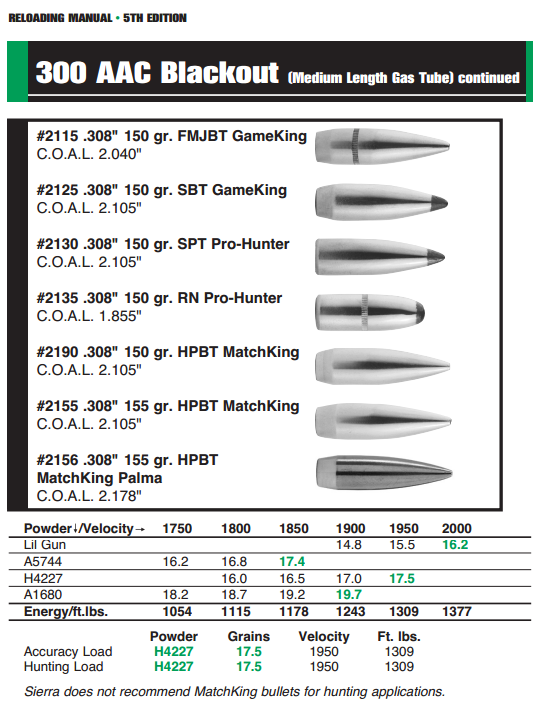
Sierra Bullets has just added extensive load data for the 300 AAC Blackout (300 BLK) cartridge. Developed for the AR15 platform, the 300 BLK offers AR shooters a large-caliber option in both subsonic and supersonic variants. The 300 BLK can be made from modified .223 Rem brass or necked-up .221 Fireball cases. We like to form our .300 BLK brass by necking-up the excellent Lapua .221 Fireball brass.
CLICK HERE for Sierra Load Data for 300 AAC Blackout (PDF File)
Sierra Has 5 Pages of Load Data for the 300 AAC Blackout. Here is one sample page:
Sierra Cartridge Comments: 300 AAC Blackout
The 300 AAC Blackout (300 BLK, or 7.62x35mm) was created by Advanced Armament Corp. and Remington in order to provide the military with a way to shoot .30 caliber bullets from the M4 platform with only a barrel change. It has since become popular for a wide range of uses including hunting and home defense.

The cartridge shares case-head dimensions and body taper with the .223 Remington. Not only does this allow for compatibility with existing magazines and bolts, but it allows reloaders to form 300 BLK brass from the vast supply of 5.56mm or .223 cases. However, since .223/5.56 cases need to be cut-down and reformed, it can be simpler to neck up .221 Fireball brass.
The 300 AAC Blackout is similar to previous wildcats, such as the .30-221 and .300 Fireball, as well as the proprietary 300 Whisper®. However the 300 BLK was the first SAAMI-approved (and standardized) cartridge of this type. Moreover, any company is free to make firearms or ammunition for the 300 BLK.
300 AAC Blackout is popular with hunters, who may not be allowed to legally hunt with .223 in their state, and who prefer .30-caliber bullets for medium-sized game. It provides similar effectiveness to the 7.62×39mm or the slightly more powerful 30-30 cartridges, while working in the more up-to-date AR15 platform. Effective range for hunting is about 100-150 yards.
October 6th, 2014
In the “good old days”, if you needed rimfire ammo for fun shooting, you could just head over to Walmart (or a local sporting goods store) and find a wide variety of offerings, including low-cost bulk packs from Federal, CCI, and Remington. These days, there are “slim pickings”, even at Wally World. You need to “cast a bigger net” to find rimfire ammo these days.
One of the most efficient ways to locate rimfire ammunition nationwide is to use Ammoseek.com, a specialized search engine. On its home page, Ammoseek has a handy 22LR PAGE link. With just one click you can search dozens of ammo vendors.

If you click the 22LR Page link, Ammoseek instantly calls up current ammo inventories located by Ammoseek’s automated search bots. Then Ammoseek plots ALL the available rimfire ammo, sorted from least expensive to most expensive. Here are search results from this morning, October 6, 2014. We found some CCI Blazer at $4.99 per 50-rd box (40gr LRN). That’s just want we needed for a plinking session at the range.
Click Image to see full-screen version.

October 4th, 2014
 Have a good look at the photos below — this may be one of the most noteworthy target strings we’ve ever published. What you can see is the effect of barrel tuner position on point of impact (POI). You can clearly see that the tuner position alters the up/down POI location in a predictable fashion. Have a good look at the photos below — this may be one of the most noteworthy target strings we’ve ever published. What you can see is the effect of barrel tuner position on point of impact (POI). You can clearly see that the tuner position alters the up/down POI location in a predictable fashion.
This remarkable 15-shot sequence was shot by French benchrester Pascal Fischbach using his 6 PPC fitted with a CG (Carlito Gonzales) action and a Bukys barrel tuner.
Pascal reports: “After [bullet] seating and load validation, I put the Bukys tuner on, screwing it out 10 turns. According to Carlito, the CG’s super stiff action-to-barrel fit gives a faster vibration modulus that is detrimental below 10 turns [position of the tuner].” Pascal’s procedure was to screw out the tuner 1/4 turn progressively from one shot to the next. He shot one bullet at each tuner position, with a total of 15 shots.
15-Shot Sequence with Tuner Changes

CLICK HERE to SEE Large Version of Complete Test Strip (All 15 shots in a row).
Left Half of Target Strip (shots with 1/4 rotation change of tuner in sequence)

Right Half of Target Strip (shots with 1/4 rotation change of tuner in sequence)

Pascal observed: “Note the point of impact displacement [from shot to shot] tracks clearly along a sinusoide (sine wave curve).” This is indeed notable and significant! This shows how the tuner’s ability to change barrel harmonics can alter the position of the muzzle as each bullet exits, resulting in a higher or lower POI. Pascal sent his results to Carlito Gonzales in Argentina for analysis.
Pascal poses this question to readers: “Guess which three positions Carlito recommends to try?”
Editor’s Note: While this target sequence clearly shows how tuner position can alter bullet point of impact, this, by itself, does not tell us which tuner position(s) are best for accuracy. That will require further multi-shot group testing, involving careful experimentation with tuner position (and powder charge weights). But for those folks who doubt that a tuner can make a difference on a short, fat barrel, just take another look at the photos. The up/down changes are undeniable, and noteworthy in the wave pattern they follow.

|


