|
|
December 1st, 2014
A while back, Forum member BigBlack had an experience at the gun range that reminds us of the importance of safety when shooting. He encountered evidence that someone had fired the wrong cartridge in a 7mm WSM rifle. The problem is more common than you may think. This editor has personally seen novices try to shoot 9mm ammo in 40sw pistols. BigBlack’s story is along those lines, though the results were much more dramatic. It’s too bad a knowledgeable shooter was not nearby to “intervene” before this fellow chambered the wrong ammo.
7mm-08 is Not the Same as a 7mm WSM
BigBlack writes: “I know this has probably been replayed a thousand times but I feel we can never be reminded enough about safety. This weekend at the range I found a ruptured case on the ground. My immediate thoughts were that it was a hot load, but the neck area was begging for me to take a closer look, so I did. I took home the exploded case and rummaged through my old cases until I found a close match. From my investigative work it appears someone shot a 7mm-08 in a 7mm WSM. Take a look. In the photo below I’ve put together a 7mm WSM case (top), the ruptured case (middle), and a 7mm-08 case (bottom).”

You can see from the photo what probably happened to the 7mm-08 case. The shoulder moved forward to match the 7mm WSM profile. The sidewalls of the case expanded outward in the much larger 7mm WSM chamber until they lacked the strength to contain the charge, and then the case sides ruptured catastophically. A blow-out of this kind can be very dangerous, as the expanding gasses may not be completely contained within the action.
November 26th, 2014
Black Friday is just around the corner. That means big holiday season promotions are about to kick off. Many vendors will be offering significant savings, and/or free shipping on firearms accessories, gun stocks, reloading gear, bullets and more. Here are some of the upcoming Black Friday offerings we’ve found. Warm up your credit cards and get ready for some very cool deals.
Graf & Sons — Free Lapua T-Shirt with Lapua Brass, Bullets, or Centerfire Ammo.

Midsouth Shooters Supply — Big Discounts — Prices Announced 11/27/2014 at 10:00 PM CT.

EuroOptic.com — Big Savings on Nightforce, Leica, Vortex, Steiner and other Major Brands.

NOSLER — FREE Shipping and FREE Nosler Hat at Shop.Nosler.com

November 25th, 2014
 F-Open shooter Kenny Adams has enjoyed a spectacular 2013-14 season. Over the past 12 months “King Kenny” enjoyed a string of successes that established Adams as the man to beat in the ultra-competitive F-Open ranks. After finishing second at the 2013 F-Class Nationals, Kenny won the 2013 World Championship. He then won a series of regional matches heading into the 2014 National Championship. There he finished on the podium with a 3rd Place finish in the individual competition. He then earned gold as a member of the winning 4-man F-Open squad, Team Grizzly. We don’t think any other F-Open pilot has put together a stronger season. F-Open shooter Kenny Adams has enjoyed a spectacular 2013-14 season. Over the past 12 months “King Kenny” enjoyed a string of successes that established Adams as the man to beat in the ultra-competitive F-Open ranks. After finishing second at the 2013 F-Class Nationals, Kenny won the 2013 World Championship. He then won a series of regional matches heading into the 2014 National Championship. There he finished on the podium with a 3rd Place finish in the individual competition. He then earned gold as a member of the winning 4-man F-Open squad, Team Grizzly. We don’t think any other F-Open pilot has put together a stronger season.
Kenny attributes his success to great team-mates, great equipment, and great ammo. He’s a huge fan of Berger’s 7mm hybrid bullets: “The [Berger] 7mm 180 hybrids have made load testing much easier, and needless to say, raised my scores considerably!” Kenny also gave credit to his gunsmith: “I want to thank my gunsmith, Stick Starks from S&S — he got me going in this thing in the right direction four and a half years ago. Working with Stick has probably shaved a couple of YEARS off my learning curve.” Kenny’s world-championship rifle features a Panda F-Class action, Krieger barrel, and a Robertson F-Class stock. Kenny likes this combo so much he actually owns four complete red rifles with similar configurations. Check them out:
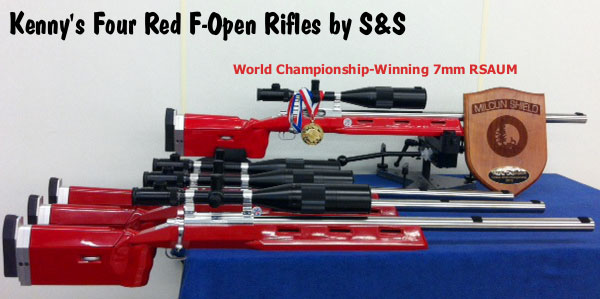
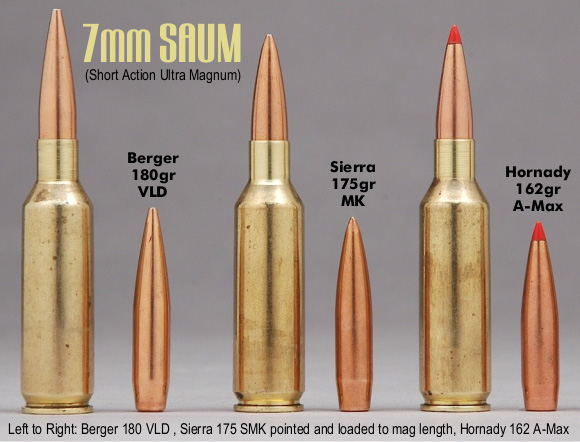
Kenny pushes those 180gr hybrids with the 7mm Remington SAUM (RSAUM) cartridge. A “new-generation” magnum, the RSAUM resembles a 6mm BR Norma on steroids. It has the same short, fat appearance, just scaled up — way up. This gives the 7mm RSAU the capacity to drive the big Berger 180-grainers at optimal velocities. The image below shows the older Berger 180gr VLD. Kenny shoots the newer 180gr Hybrid. They are both very, very accurate.

 Banner Year for King Kenny Banner Year for King Kenny
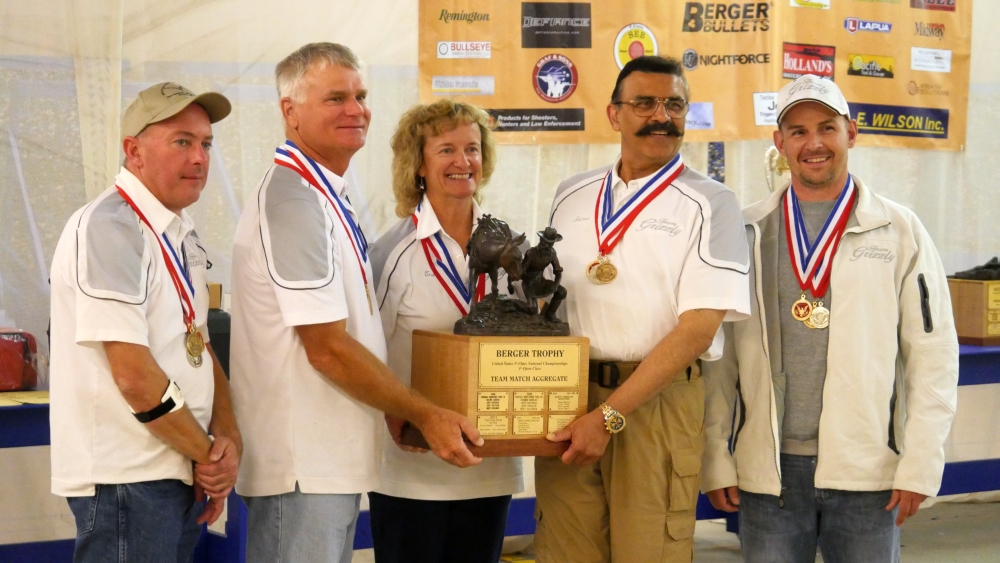
Pictured above is Kenny Adams holding his 1st Place Plaque from the 2013 F-Class World Championship. To the right, Ken (with fellow Team Grizzly members) is pictured at the 2014 F-Class Nationals accepting the Berger Trophy for the First Place F-Open 4-Man Team.
Below are Kenny Adams’s major shooting accomplishments from the past 12 months:
2013 – F-Class Nationals – 2nd Place F-Open.
2013 – F-Class World Championship – 1st Place F-Open.
2013 – Christmas Match in Florida – 1st Place F-Open.
2014 – Southwest Nationals – 1st Place F-Open 4-Man Team Grizzly (Set National record).
2014 – Orange Blossom Regional – 1st Place F-Open.
2014 – Sinclair East Coast Fullbore Nationals – 1st Place F-Open and set new Fullbore national record.
2014 – Mid West Palma – 1st Place F-Open 1200-yard match and set 1200-yard record.
2014 – F-Class Nationals – 3rd Place F-Open.
2014 – F-Class Nationals – 1st Place F-Open 4-Man Team Grizzly.

Kenny’s World-Beating 7mm RSAUM Load
For his 7mm RSAUMs Kenny loads Hodgdon H4350 powder and Federal 215m primers into Nosler or Norma RSAUM brass. In the RSAUM he runs Berger 180gr Hybrid bullets seated “just touching” the lands. Kenny is very precise with his charge weights. Using a Sartorius Magnetic Force Restoration scale, Kenny tries to hold his powder charges to within 1-2 kernels charge-weight consistency.

When you get it all correct, when every phase of the reloading process has been carried out perfectly, then you have rounds that can set records and win world titles. So what does championship-grade ammo look like? Take a look at the photo above. This is the 7mm RSAUM ammunition used by Kenny Adams at the 2014 Berger Southwest Nationals (SWN). Kenny is the 2013 F-Class World Champion.
November 23rd, 2014
The .308 Winchester, a shortened version of the .30-06, has almost completely replaced the .30-06 in NRA competition. The .308 is required for Palma shooting, so it is also used by many Palma competitors in other long-range and mid-range prone matches. However, with the exception of M1 Garand matches, you won’t see many .30-06 rifles on the firing lines. Does that mean the .30-06 is obsolete? Is the .308 Win really much more accurate? Or does it just offer the advantages of reduced recoil and reduced powder consumption?

Cartridge photos courtesy Deuce45s.com, a leading source of specialized military cartridges.
In his Sibling Rivalry: .308 vs. .30-06 article on the Rifleman’s Journal website, German Salazar argues that the .30-06 remains a viable competition cartridge, particularly for the long-range game. This isn’t just a subjective opinion. German has data to back up the argument that the .30-06 can still do the job.
German compares the actual scores produced by his .308 Win rifles with the scores from his .30-06 rifles. German analyzes scores, over a two-year period, shot by “matched pair” rifles (one in each caliber) with similar actions, stocks, sights, and barrels. For comparison purposes, German also includes score data from his 6XC, a modern low-recoil chambering.

RESULTS: .308 Has Small Edge at Middle Distance, But .30-06 Is Better at Long Range
Surprisingly, the .30-06 performed nearly as well as the .308 at middle distances. The .30-06 delivered 99.2% of max possible scores vs. 99.5% for the .308 Win. Notably, at 1000 yards, the .30-06 racked up 97.7% of max scores vs. 97.3% for the .308 Win. So, at 1000 yards, the .30-06 actually proved superior to the .308 Win. German explains: “This isn’t too surprising when one considers [the .308’s] limited case capacity for the bullet weights typically used in Long-Range shooting. They just run out of steam and dip perilously close to the transonic range as they approach 1000 yards of flight. The extra 150 fps or so that can be safely obtained from the .30-06 case really pays off at 1000 yards.”
|
Mid-Range Comparison
In NRA Mid-Range matches (500 and 600 yards), the average score and percentage of possible score for each cartridge was as follows:
.308 – 597-36X (99.5%), 960 rounds fired
6XC – 596-35X (99.3%),1260 rounds fired
.30-06 – 595-31X (99.2%), 2580 rounds fired
If we look at the score averages, the .308 comes out on top at the Mid-Range distances… by 0.3% of the possible score. By the way, notice that the 6XC, as good as it is, simply straddles the .30 caliber cartridges; it is not the winner.
Long-Range Comparison
German rarely shoots the .308 in matches that are only 1000 yards; most of his 1000-yard .308 shooting is done in Palma matches which include 800, 900 and 1000 yards. To make the comparison useful, the Long-Range results are presented only as a percentage of the possible score and the 800- and 900-yard stages of Palma matches were NOT included.
In NRA Long-Range and Palma matches, the average percentage of possible score for each cartridge at 1000 yards was as follows:
6XC – 98.9%, 360 rounds fired
.30-06 – 97.7%, 460 rounds fired
.308 – 97.3%, 490 rounds fired
Editor’s Note: Among the three cartridges German studied, the 6XC actually proved best at 1000 yards, delivering 98.9% of the maximum possible scores. The .30-06 was second-best with 97.7%, slightly better than the .308 Win at 97.3%.
|
You’ll want to read German’s full Sibling Rivalry article, which includes an interesting history of the .30-06 and .308 in High Power shooting, along with tables showing German’s actual scores with his .30-06, .308 Win, and 6XC rifles. German’s story first ran in 2011.
November 22nd, 2014
 Book by Michael Bussard (edited by S.P. Fjestad) Book by Michael Bussard (edited by S.P. Fjestad)
If you’re a serious shooter, the latest 5th Edition of the Ammo Encyclopedia (released in August, 2014), belongs in your library. This 1008-page book is probably the most comprehensive and up-to-date book in print covering current and obsolete cartridges and shotshells. Bussard’s Ammo Encyclopedia is a massive resource work. The 5th Edition now boasts 105 chapters, covering thousands of handgun, rifle, and shotgun cartridges from the past century and a half.
One of the best features is a 12-page color section depicting actual size drawings of 265 current rimfire/centerfire cartridges and shotshells. You won’t find that many “life-size” cartridge drawings in one place even on the internet. Cartridge profiles and ballistic charts have been expanded to include all new factory cartridges. The authors have even included air rifle pellets and historical images and charts. Softcover, 1008 pages.
| Comments from guys who bought the book:
“This book contains a vast array of information on many modern and even obsolete ammunition. Definately recommend for any modern reloader novice or experienced.” – Duggaboy460
“It’s a great reference book for individuals who reload their own ammunition. There is a lot more info in this Edition. Everyone who likes this information should have it in their library.” – Reloader
“I like the general and technical comments that are available for each and every cartridge. Information that predicts if a cartridge will stay in production for many more years or rapidly become obsolete.” – RSL1 |
|
November 19th, 2014
Many shooters, particular those who shoot vintage military rifle matches, reload once-fired military cartridge brass. This brass may be high-quality and stout, but you may encounter a primer crimp* that interferes with the seating of a new primer. There are a variety of dedicated, military-crimp tools on the market, such as Dillon’s excellent Super Swage 600 tool that “rolls the crimp away”. But the Dillon tool costs $100.95 and takes quite a bit of room on your reloading bench. If you don’t want to drop a C-note and give up valuable bench space — here’s another (much cheaper) solution.
If you already have a Wilson case trimmer set-up, you can ream away those military crimps using an affordable Wilson accessory — the Primer Pocket Reamer (large #PPR-210, small #PPR-175). This $32.99 accessory is used in conjunction with a Wilson case trimmer and case-holder as shown below.
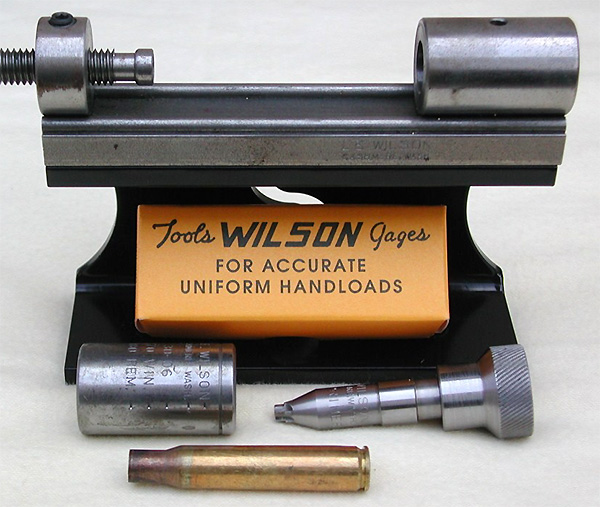
 In the older Riflemans Journal website, the Editor, “GS Arizona”, shows how to use the Wilson primer pocket reamer to remove military crimps on Lake City .30-06 cartridge brass. He explains: “The case goes into the Wilson case-holder, the same one used for case trimming, and the reamer replaces the trimmer head in the tool base. The threaded rod on the left side, which is normally used to regulate trim length has no use for this operation and it is simply backed out. Hold the case-holder as you turn the reamer into the primer pocket, it cuts easily and quickly. The reamer will stop cutting when the proper depth is reached.” In the older Riflemans Journal website, the Editor, “GS Arizona”, shows how to use the Wilson primer pocket reamer to remove military crimps on Lake City .30-06 cartridge brass. He explains: “The case goes into the Wilson case-holder, the same one used for case trimming, and the reamer replaces the trimmer head in the tool base. The threaded rod on the left side, which is normally used to regulate trim length has no use for this operation and it is simply backed out. Hold the case-holder as you turn the reamer into the primer pocket, it cuts easily and quickly. The reamer will stop cutting when the proper depth is reached.”
 
Do you really need to do this operation with military-crimped brass? Yes, and here’s why: “any attempt to prime the case without removing the crimp will simply result in a mangled primer that cannot be expected to fire and certainly won’t fire reliably.”
Read Full Article on Riflemans’ Journal Website (more photos and detailed write-up).
*Why does military brass has a primer crimp? GS Arizona answers: “The crimp is nothing more than an intentional deformation of the case around the primer pocket, the purpose of which is to retain the primer in the case despite high pressure situations in machine guns and other automatic weapons where a loose primer may cause a malfunction. As reloaders, our task is to get rid of the remnants of the crimp in order to allow re-priming the case.”
November 17th, 2014
Sierra Bullets has released Version 7 of its respected Infinity Exterior Ballistics software, available now for $39.95 for Windows computers. Renowned Sierra Ballistic Consultants Ted Almgren and Dr. Bill McDonald, who have written all Sierra Software since 1970, also wrote Infinity Version 7. Both are retired scientists from a major aerospace company. Infinity Exterior Ballistics Software version 7 is a sophisticated solver that can output multiple trajectory charts. A built-in database includes bullets and cartridges offered by 15 manufacturers, both U.S. and foreign.
This 13-minute Video Demonstrates the Many Features of Infinity 7 Ballistics Software:
This sophisticated program computes the effects on the bullet trajectory of variations in firing conditions. For example, you can change altitude of the firing point, target angle (uphill/downhill), wind speeds, or even modify the Ballistic Coefficient. In fact, you can change any inputted firing condition or combination of conditions.
One very handy function is the “back-to-zero” calculation. Infinity 7 software will compute where your gun is zeroed if you know that it shoots high by a measured amount at a known range.

Compare Trajectories with Five Different Bullets
One very powerful feature of Infinity 7 is its trajectory comparison capability. With most ballistics programs (such as the JBM online ballistics calculator), you can only view one bullet’s trajectory (and associated drop chart) at a time. Not so with Infinity 7. This software handles up to five different bullets at a time. You can compare downrange velocity, energy, drop, bullet path height, or crosswind drift with results shown in bolt tabular and graphical format. That helps you select the best bullet for your gun and application. The ability to compare downrange ballistics of five different bullets at once is particularly helpful for hunters, who can compare the “hitting power” of different projectiles at various distances.
You can purchase Infinity 7 Ballistics Software as a standalone product for $39.99, or you can buy the Infinity 7 Suite for $59.95, which includes the Sierra Bullets 5th Edition Reloading Manual on CD-ROM. If you prefer a printed loading Manual, a combo pack with Infinity 7 software CD-ROM plus published (hard-back) Reloading Manual is offered for $64.95.
November 15th, 2014
How much can you save reloading your own ammo? Well that depends on the cost of components and how much you have invested in your reloading gear. UltimateReloader.com has created a handy online Reloading Costs Calculator that lets you quickly compare the cost of reloaded ammo vs. factory ammo. Just enter the costs of powder, primers, bullets, and brass, and the Calculator will tell you the cost per round, per 20-rd box, per 50-rd box, and cost per thousand. Note — when setting the price of the brass you need to divide the initial cost by the number of predicted reloads. For example if you have 500 pieces of brass that cost $40/100 to buy ($200 total), but you get 8 reloads per case, then you put $25.00 in the Calculator ($200 total brass cost divided by 8).

True Reloading Cost Should Include Amortized Tool Expenses
Ah… but there is a catch. To understand the true cost of reloading, you also need to consider the costs of your tools and accessories, amortized over the tools’ loading lifespan. Let’s say you have $1000.00 invested in presses, dies, tumblers, measuring tools and other accessories, with a residual value of $500.00 (upon resale). If you load 5,000 rounds with those tools over their lifespan, you need to add $0.10 per round for tooling costs (your investment minus residual value, divided by the number of rounds loaded). The UltimateReloader.com Calculator does not include amortized tooling costs, but that’s something you can easily figure out on your own.
Excellent Resource for Reloading Videos
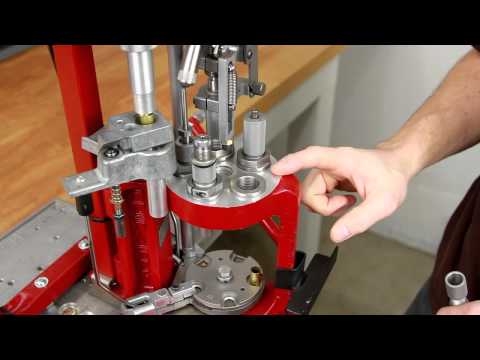
After you’ve tried out the Reloading Costs Calculator, check out the other content on UltimateReloader.com. This site features some of the best gun-related “how-to” videos on the internet. With sharp video and clear audio, the production quality is very high. If you use a progressive press (Dillon, Hornady, RCBS), you should definitely watch UltimateReloader.com’s videos — you’ll probably learn a new trick or two. In the sample video below, you can see how Hornady’s new Bullet Feeder works with its Lock-N-Load Progressive press.
November 14th, 2014
Gear Review by GS Arizona
This article originally appeared in the Rifleman’s Journal website.
Many of you have doubtlessly read Bryan Litz’s articles in our Daily Bulletin and on his Applied Ballistics website about various current long-range bullets. Bryan’s work carries a great deal of weight in the world of ballistics, so his comments (and mathematical proofs) regarding the benefits of bullet pointing certainly caught my attention. Bullet pointing, like meplat trimming, is an effort to reduce the ballistic inconsistency created by the somewhat jagged tip of the jacket where the bullet forming dies bring it to a point in the manufacturing process. Of course, we could eliminate this problem altogether by shooting closed-tip, open-base bullets like the Lapua D46, but that merely shifts the jacket problem to the other end of the bullet.

In any event, hollow point bullets rule the accuracy world today, so John Whidden, multi-time National Long Range Champion at Camp Perry and a talented gunsmith and designer to boot, came up with a very handy tool to let us make those hollow points pointier. Let’s have a look at John’s tool and see how it works.

The Whidden Bullet Pointing Die System uses a Forster bullet seating die body as its basic structure and that’s a good choice given the quality machining Forster does on these. The real heart of the tool comes in two parts: the caliber sleeve and the pointing die that fits inside the sleeve. In fact, to point up different caliber bullets, you only need to change the caliber sleeve, everything else remains the same. The last item is the bullet base that slips into a standard .308 shellholder and supports the bullet as it goes into the die body.
 It took me less than five minutes to get everything set up, including changing the caliber sleeve from 6mm to .30 caliber. John’s instruction sheets are well illustrated and clearly written; you should have no problem getting up and running. It took me less than five minutes to get everything set up, including changing the caliber sleeve from 6mm to .30 caliber. John’s instruction sheets are well illustrated and clearly written; you should have no problem getting up and running.
Pointing the bullets is as easy as sizing a piece of brass. You can see in the top photo the difference between a few pointed bullets and a few un-pointed ones. The innermost pointed bullet in the picture was my first attempt and I adjusted the die a little after that, you can see that the others are closed a little more. John even includes a couple of sample bullets so that you can see one done right and one done wrong. That is a nice addition that can help you achieve the desired results.
I think Bryan’s work supports the validity of this concept and John’s tool puts it into practice in a simple-to-use manner that makes it just about impossible to do any damage to the bullet. I have shot pointed bullets in various calibers at many matches now. Pointing is not a “miracle cure”, but I believe that pointing bullet tips can produce long-range accuracy gains, through reduced vertical dispersion, for many popular types of match bullets. The Whidden Bullet Pointing Die System retails for $220.00 (with one insert). Additional die inserts are $42.00 each. Extra caliber sleeves are also $42.00. You can purchase directly from Whidden Gunworks, or from Sinclair International.

November 3rd, 2014
Applied Ballistics has just announced Ballistic Performance of Rifle Bullets. This new book is chock full of “mission critical” data on hundreds of popular projectiles. This latest reference book from Bryan Litz contains live fire test data on 400 modern rifle bullets. The data pages contained in this book are similar to the 225 bullet data pages found in Applied Ballistics for Long Range Shooting. The Ballistic Coefficient data is based on live fire testing methods which are repeatable within +/- 1%. If you’re looking for “rock-solid” info on the ballistic performance of today’s most popular rifle projectiles, this work is the definitive print resource. Scroll down to see a sample page from the new book.
 CLICK HERE to see the full list of bullets covered in this new resource book. CLICK HERE to see the full list of bullets covered in this new resource book.
Visit the Applied Ballistics Online Store to pre-order your copy and save $5. Note: Pre-orders are expected to ship and arrive at USA destinations in time for Christmas. Retail price is $54.95, with a $5.00 pre-order discount.
More about the Book
“Modern rifles have reached an unprecedented level of accuracy. In many cases, the weak link in the chain of hitting targets is the trajectory modeling, which is based on bullet performance,” stated author Bryan Litz. Unfortunately, shooters can’t always rely on advertised Ballistic Coefficients (BCs) being accurate. Slight errors in BC modeling can be the cause of missing your target. Furthermore, a meaningful apples-to-apples comparison of bullet performance is not possible when the BCs are determined differently by various brands.
This book provides highly accurate ballistic performance data for 400 modern long range bullets from .224 to .408 caliber. By employing a common testing method for bullets of all brands, shooters are provided with consistent and accurate performance data which can be used to compare and select bullets, as well as to calculate accurate trajectories which put your shots on target at long range. It is claimed that the BC data is accurate (and repeatable) to +/- 1% for all bullets tested.
Detailed stability data is also included which can be used to determine suitable twist rates for bullets in various environments.
View Sample Page from Ballistic Performance of Rifle Bullets:

NOTE: This is a reference book which contains mostly data pages. There is a single chapter in the beginning which talks about how to use the data. For a more thorough understanding of the science of external ballistics, readers are referred to: Applied Ballistics for Long Range Shooting (2d Edition).
|


