Along with his gunsmithing and barrel-making enterprises, Clay Spencer of Spencer Rifle Barrels operated a very successful bullet-making business. Clay’s bullets are in high demand by top competitors. Clay has made a variety of bullet types, from a 52gr .22 caliber up to a 118gr .30 caliber, with four different 6mm bullet types (65gr, 68gr, 95gr VLD, 103gr VLD). All his designs have proven themselves in competition. In particular, the 103-grainer has won many matches and set a few world records in the process.
If you have ever shot Spencer bullets you know how good they are. Unfortunately, the era of Spencer-branded bullets is coming to a close. Clay has decided to sell his bullet-making operation. The good news for shooters is that Clay’s bullet-making expertise will be passed on to a new owner/operator, Tom Jacobs, who will employ Clay’s bullet dies and presses to carry on the tradition of Spencer bullets. Clay’s bullet designs will now be produced in Missouri by Vapor Trail Bullets. Here’s the official announcement:
Vapor Trail Bullets is pleased to announce the acquisition of Spencer Bullets. Clay Spencer, long known for his world record-setting, hand-made bullets, has sold his bullet-making equipment and personally trained Vapor Trail Bullets owner Tom Jacobs in the manner and methods to continue this successful tradition. The bullet making operation has been moved to Spickard, Missouri. Vapor Trail Bullets looks to expand the product line while continuing to produce the bullets Clay Spencer is known for. For bullet orders please contact Tom Jacobs at 660-748-8111.
How Custom Bullets Are Made on Hand Presses
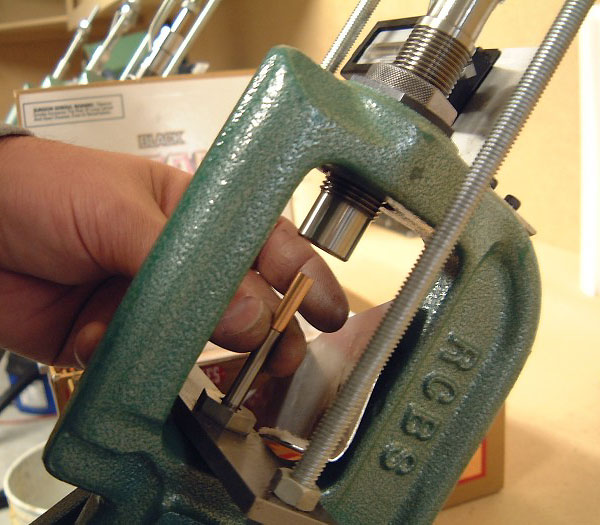
If you’ve ever wondered how custom, match-grade bullets are made, here are images of bullets being made in Clay Spencer’s shop. The images show bullet cores being seated and bullets being “pointed up”. These same presses (modified RCBS Rockchuckers), dies, and other tools have been moved to Missouri to be used by Vapor Trail Bullets.
Story tip by EdLongrange. We welcome reader submissions.
When we first ran this story a while back, it generated great interest among readers. By popular request, we’re reprinting this story, in case you missed it the first time around. — Editor
Precision shooters favor premium brass from Lapua, Norma, or RWS. (Lake City also makes quality brass in military calibers.) Premium brass delivers better accuracy, more consistent velocities, and longer life. Shooters understand the importance of good brass, but many of us have no idea how cartridge cases are actually made. Here’s how it’s done.
The process starts with a brass disk stamped from strips of metal. Then, through a series of stages, the brass is extruded or drawn into a cylindrical shape. In the extrusion process the brass is squeezed through a die under tremendous pressure. This is repeated two or three times typically. In the more traditional “draw” process, the case is progressively stretched longer, in 3 to 5 stages, using a series of high-pressure rams forcing the brass into a form die. While extrusion may be more common today, RWS, which makes some of the most uniform brass in the world, still uses the draw process: “It starts with cup drawing after the bands have been punched out. RWS cases are drawn in three ‘stages’ and after each draw they are annealed, pickled, rinsed and subjected to further quality improvement measures. This achieves specific hardening of the brass cases and increases their resistance to extraordinary stresses.” FYI, Lapua also uses a traditional draw process to manufacture most of its cartridge brass (although Lapua employs some proprietary steps that are different from RWS’s methods).
After the cases are extruded or drawn to max length, the cases are trimmed and the neck/shoulder are formed. Then the extractor groove (on rimless cases) is formed or machined, and the primer pocket is created in the base. One way to form the primer pocket is to use a hardened steel plug called a “bunter”. In the photos below you see the stages for forming a 20mm cannon case (courtesy OldAmmo.com), along with bunters used for Lake City rifle brass. This illustrates the draw process (as opposed to extrusion). The process of draw-forming rifle brass is that same as for this 20mm shell, just on a smaller scale.
River Valley Ordnance explains: “When a case is being made, it is drawn to its final draw length, with the diameter being slightly smaller than needed. At this point in its life, the head of the draw is slightly rounded, and there are no provisions for a primer. So the final drawn cases are trimmed to length, then run into the head bunter. A punch, ground to the intended contours for the inside of the case, pushes the draw into a cylindrical die and holds it in place while another punch rams into the case from the other end, mashing the bottom flat. That secondary ram holds the headstamp bunter punch.
The headstamp bunter punch has a protrusion on the end to make the primer pocket, and has raised lettering around the face to form the headstamp writing. This is, of course, all a mirror image of the finished case head. Small cases, such as 5.56×45, can be headed with a single strike. Larger cases, like 7.62×51 and 50 BMG, need to be struck once to form a dent for the primer pocket, then a second strike to finish the pocket, flatten the head, and imprint the writing. This second strike works the brass to harden it so it will support the pressure of firing.”
Thanks to Guy Hildebrand, of the Cartridge Collectors’ Exchange, OldAmmo.com, for providing this 20mm Draw Set photo. Bunter photo from River Valley Ordnance.
Federal has created an award-winning Bullet Breakdown Video (below) that demonstrates how various hunting bullets perform in ballistic gelatin. This and other videos are found on Federal Premium Ammunition’s YouTube Channel. The Bullet Breakdown Video features four bullet types used in Federal Ammo: Nosler Ballistic Tip; Sierra GameKing; Trophy Bonded Tip; and Barnes Triple-Shock X-Bullet. (Note: you may want to turn down the volume before playback.)
Federal’s high-resolution, slow-motion video-graphy helps demonstrate which loads are the best for specific uses. The ultra-slo-mo footage provides a detailed view of each bullet penetrating ballistic gelatin blocks. These blocks closely mimic animal tissue and clearly display performance characteristics.
“The Bullet Breakdown Video is a great tool for hunters trying to decide on ammunition type,” said Federal’s Jason Nash. “Properly preparing for the hunt is crucial-and not all bullets are made the same. The bullet is the one link between hunter and game and can be the difference between success and failure. This video helps show hunters how different bullet construction affects terminal performance[.]” For more info, visit www.FederalPremium.com.
What’s more fun that a barrel of monkeys? Well a barrel of ammo of course. Here’s an item for the man who has everything, or maybe the prepper who needs enough 5.56x45mm ammo to defeat a horde of zombies, plus their undead friends and relatives. For a mere $5999.99 you can get a barrel containing 12,500 rounds of Federal 5.56x45mm 62gr “Green Tip” ammunition. No joke — this is a real item offered for sale by Grafs.com. When you’re not shooting, your ammo barrel can do double duty as a handy side-table in your living room or man-cave. Just the thing to hold a plate of snacks and your favorite beverage.
In all seriousness, this is impressive Mil-Spec FMJ ammunition right off the production line. The 62-grain green-tipped bullets feature a hardened steel penetrator core. The boxer-primed cases are fully reloadable (though the miltary primer crimps would have to be removed). The ammo is delivered in a heavy-duty steel drum, with steel clamp-on lid with rubber seal. Each container is plastic-lined and packed (from the factory) with dessicant pouches for long term storage.
NOTE: In some jurisdictions there may be restrictions on this product (based on the quantity of rounds or other factors). Check your local laws and regulations.
Where did all the .22 LR ammunition go? Why are the prices so high? Why can’t the rimfire ammo-makers step up production? Across the country, firearm owners are asking these questions, and demanding answers.
Part of the explanation comes down to production capacity. America’s rimfire ammo production facilities are already running at full capacity. There is no easy way in increase production. In the video below, the crew from Shooting USA Television visits the ATK production facility in Lewiston, Idaho. This plant can produce 4,000,000 rounds of CCI rimfire ammo in one 24-hour period. This informative video shows the complete process of rimfire ammunition production from start to finish.
This is a ‘must-watch’ video that reveals some very interesting things. Did you know that 1200 cases (in one large tray) are filled with powder in a single operation? (See 05:45 mark). Likewise, bullets are also lined up in a matching 1200-count tray (See 6:00 mark). This way 1200 bullets can be seated into 1200 rimfire cases in one efficient procedure.
When you watch the video, and see the complex, expensive machinery involved, you’ll realize that it’s no easy thing to increase rimfre ammo production. The rimfire plants are already running at full capacity. To produce significantly greater quantities of .22 LR ammunition, manufacturers would have to make huge capital investments.
Creedmoor Sports will be producing high-quality loaded ammunition very soon. This will be crafted with top-quality bullets, and premium-grade Lapua brass. General Manager Dennis DeMille tells us: “We received four pallets of brass today and we have 13,005 pounds of powder waiting for production.”
Here’s a preview of what will be on the market very soon:
Oh, the beauty of it — all that Lapua brass. From Finland with love….
What does 13,005 pounds (6.5 tons) of powder look like? That would last most reloaders a few seasons. Hoarders, eat your hearts out….
Remington Outdoor Company (formerly the Freedom Group), announced some big changes yesterday. A half-dozen product lines were consolidated, some small manufacturing facilities were targeted for shut-down, and a host of jobs are being “relocated” to Remington’s new Huntsville, Alabama factory. In addition, certain product lines now being made in Ilion, New York, will be shifted to Alabama.
Remington spokesman Teddy Novin declared: “[On May 15, 2014] we announced the consolidation of multiple company plants into our Huntsville, Alabama facility. This was a strategic business decision to concentrate our resources into fewer locations and improve manufacturing efficiency and quality. We are working hard to retain as many [workers] from the affected facilities as possible.”
Doors Closing at Small Plants Around the Country
Numerous production facilities (currently operated by Remington sub-brands) will be shut down in multiple states, with business functions moved to Remington’s new 500,000-square-foot facility in Huntsville, Alabama. Most importantly, Bushmaster rifle production and the Remington 1911 production lines will be relocated from Ilion, New York to Huntsville. The DPMS plant in St. Cloud, Minnesota will be shuttered, with production shifted to Huntsville. Suppressor-maker Advanced Armament Corp. (AAC) will close its Lawrenceville, Georgia facility. Para-Ordance pistol production will halt in North Carolina and be shifted to Huntsville. Likewise,the Montana Rifleman (Kalispell, MT), TAPCO (Kennesaw, GA), and LAR Manufacturing (West Jordan, UT) production facilities will all be closed, with future production moved to Alabama. Below is a complete list of the consolidations and plant closures:
Sweet Home, Alabama — These Operations Will Be Moved:
Advanced Armament Corporation (AAC, moved from Lawrenceville, GA)
Bushmaster (moved from Ilion, NY)
DPMS – Panther Arms (moved from St. Cloud, MN)
LAR Manufacturing (moved from West Jordan, UT)
Montana Rifleman (moved from Kalispell, MT)
Para-Ordnance (moved from Pinevile, NC)
Remington 1911 (moved from Ilion, NY)
Tapco (moved from Kennesaw, GA)
We are also informed that some of the operations currently conducted at Remington’s Elizabethtown, Kentucky firearms plant and R&D facility will be moved to Huntsville, GA. However, we don’t have more specifics at this time.
The original Remington Arms Company was founded in 1816. Today’s Remington Outdoor Company, Inc. produces firearms, ammunition, and related outdoor products. The Firearms segment manufactures and sells sporting shotguns, rifles, handguns, modular firearms, and airguns under numerous brands including Remington, Bushmaster, Dakota, DPMS, Harrington & Richardson, Parker Gun, Marlin, Nesika, and Para-Ordnance. The Ammunition segment produces loaded ammo and bullets under Remington, UMC, Barnes, Dakota, and other brands. According to Businessweek, Remington Outdoor Company currently has 3,800 employees. George K. Kollitides is the Chief Executive and Chairman of the Board.
The U.S. Army has seen the benefits of the hard-hitting .300 Winchester Magnum (.300 Win Mag) round, and now it wants more — a lot more. The Army has ordered twenty million dollars worth of .300 Win Mag ammo from ATK, to be used primarily in the Army’s M2010 sniper rifle.
ATK has announced a five-year, fixed-price, indefinite delivery/indefinite quantity contract with the U.S. Army for the production of Mk248 Mod 0, 190-grain and Mk248 Mod 1, 220-grain .300 Winchester Magnum (Win Mag) rifle ammunition. The Army has selected this ammunition for primary use in its M2010 Sniper rifle. According to ATK’s press release, the award has an estimated maximum value of $20 million over the life of the contract. The ammunition will be manufactured at ATK’s Anoka, Minnesota, Federal Premium Ammunition factory. Said ATK’s Sporting Group President Jay Tibbets, “We are proud the U.S. Army has selected our 300 Win Mag ammunition.”
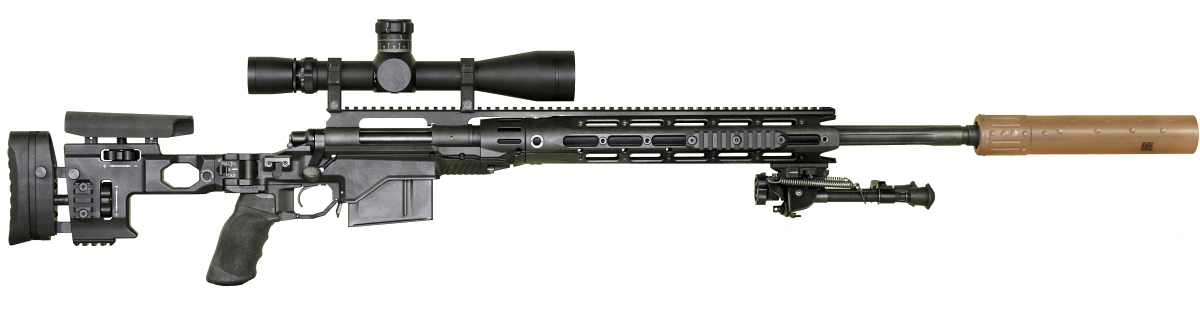
M2010 Sniper Rifle with Suppressor (Click to Zoom)
The U.S. Army first issued M2010s to snipers at the U.S. Army Sniper School in January 2011. Army snipers have been using the M2010 in combat in Afghanistan since March 2011. The M2010’s .300 Win Mag round extends the engagement range over the M24 from 800 meters to 1,200 meters, enhancing lethality and standoff. The M2010 fires .300 Winchester Magnum ammunition to provide approximately 50% greater effective range compared to the M24’s 7.62x51mm NATO. The U.S. Army hopes that the additional effective range helps their snipers in engagements in mountainous and desert terrain in which the war in Afghanistan is fought. Note: As originally developed by Remington, the rifle was called the XM2010. As officially adopted by the U.S. Military, it is now designated the M2010.
For a few years now, Lyman has offered the Case Prep Xpress, an all-in-one case prep center that chamfers necks (inside and out), cleans and uniforms primer pockets, brushes the inside of case-necks, and uniforms flash holes. The unit can also ream out the crimps on military brass. However, the Lyman Case Prep Xpress does NOT trim cases.
The Lyman Case Press Xpress comes with all the necessary tools and attachments (listed below), so you don’t have to purchase extra accessories. The 5 gear-driven heads on the unit are powered by a high torque, low-speed motor ideal for case prep operations. Lyman’s Case Prep Xpress features handy storage areas for accessories, a removable brass shavings dump pan, and a handy clean-up brush.
Lyman Case Prep Xpress Includes:
Inside Deburr (VLD) Tool
Outside Deburr Tool
Flash Hole Uniformer
Primer Pocket Uniformer (Large & Small)
Primer Pocket Reamer (Large & Small)
Primer Pocket Cleaner (Large & Small)
Case Neck Brushes (25, 30, 38 & 45 Cal)
Case Neck Lube (Mica)
Removable Brass Shavings Dump Pan
Clean-up Brush
In the two years that this product has been on the market it has been a hot seller. We’ve used the Case Prep Xpress. If you’re prepping hundreds of cases, this unit will save considerable time and reduce hand/finger fatigue. While the Case Prep Express is not as sturdy as the metal-bodied Hornady prep center, the Lyman unit offers a lot of functionality for the price ($108-$125 at various vendors).
Video clearly illustrates all case prep functions. Worth watching.
You can find Lyman’s Case Prep Xpress for under $120.00, making it much less expensive than the larger Hornady Case Prep Center, which runs about $400.00. The Hornady unit is beefier, and will trim cases. However, we think the compact Lyman unit makes sense for guys who already have a good case trimmer, such as a Forster or Wilson. The Lyman Case Prep Xpress is hundreds of dollars less than the Hornady prep center. The money you save will buy lots of bullets and brass.
Case Prep Xpress $108.08 at Midsouth
The Lyman Case Prep Xpress is sold by most of the big vendors. The best current price we found was at Midsouth Shooters Supply, which sells the Lyman unit for $108.08.
Here’s good news for varmint hunters. Hornady just announced that it is ramping up production of the 17 Hornet: “For those of you who love the 17 Hornet, we are manufacturing ammunition right now and you should see it back in stores soon!” The 17 Hornet is a fun, fast cartridge that is ideal for ground squirrels and other small varmints. It has light recoil similar to a 22 WMR, but with the ability to reach out to 300 yards and beyond. Since the 17 Hornet is a centerfire cartridge with reloadable brass, it can actually be more economical to shoot than the 17 HMR, provided you “roll your own”.
Speed Kills — 3650 FPS
Based on the 22 Hornet cartridge case, the 17 Hornet can drive a 20-grain V-MAX bullet at 3,650 fps. At this velocity, the 17 Hornet can match the trajectory of a 55-grain .223 Remington load, but with much less noise and recoil. Take a look at the chart below. You can see that the 17 Hornet’s trajectory (blue line) is almost an identical match for the larger .223 Rem (red line) all the way out to 400 yards or so. The 17 Hornet is an economical, fun .17 caliber centerfire cartridge with way more “reach” than a 17 HRM or 22 WMR.
17 Hornet — Trajectory Comparison
3,650 fps muzzle velocity with a 20 grain V-MAX bullet.
Same C.O.L. as the 22 Hornet – uses the existing action.
Trajectory comparable to a 55 grain 223 Rem, but the felt recoil of a 22 WMR.
Lower cost and comparable quality to the 17 Fireball and .223 Remington.


 Along with his gunsmithing and barrel-making enterprises, Clay Spencer of Spencer Rifle Barrels operated a very successful bullet-making business. Clay’s bullets are in high demand by top competitors. Clay has made a variety of bullet types, from a 52gr .22 caliber up to a 118gr .30 caliber, with four different 6mm bullet types (65gr, 68gr, 95gr VLD, 103gr VLD). All his designs have proven themselves in competition. In particular, the 103-grainer has won many matches and set a few world records in the process.

 Precision shooters favor premium brass from


 Federal’s high-resolution, slow-motion video-graphy helps demonstrate which loads are the best for specific uses. The ultra-slo-mo footage provides a detailed view of each bullet penetrating ballistic gelatin blocks. These blocks closely mimic animal tissue and clearly display performance characteristics.
 What’s more fun that a barrel of monkeys? Well a
 Where did all the .22 LR ammunition go? Why are the prices so high? Why can’t the rimfire ammo-makers step up production? Across the country, firearm owners are asking these questions, and demanding answers.




 You can find Lyman’s Case Prep Xpress for under $120.00, making it much less expensive than the larger
  Here’s good news for varmint hunters. Hornady just announced that it is ramping up production of the 17 Hornet: “For those of you who love the 17 Hornet, we are manufacturing ammunition right now and you should see it back in stores soon!” The 17 Hornet is a fun, fast cartridge that is ideal for ground squirrels and other small varmints. It has light recoil similar to a 22 WMR, but with the ability to reach out to 300 yards and beyond. Since the 17 Hornet is a centerfire cartridge with reloadable brass, it can actually be more economical to shoot than the 17 HMR, provided you “roll your own”.


