|
|
August 4th, 2013
 The 13th Edition of Cartridges of the World is a handy reference that contains illustrations and basic load data for over 1500 cartridges. The latest edition (released in October 2012) includes 55 new cartridges. This important reference guide can be ordered through Amazon.com for $24.73. Cartridges of the World, the most widely-read cartridge reference book, is now even more comprehensive, with 55 new cartridges added since the last edition including popular wildcats and new offerings for AR-platform rifles. The 13th Edition of Cartridges of the World is a handy reference that contains illustrations and basic load data for over 1500 cartridges. The latest edition (released in October 2012) includes 55 new cartridges. This important reference guide can be ordered through Amazon.com for $24.73. Cartridges of the World, the most widely-read cartridge reference book, is now even more comprehensive, with 55 new cartridges added since the last edition including popular wildcats and new offerings for AR-platform rifles.
The 13th Edition of Cartridges of the World (ISBN: 9781440230592) includes updated cartridge specs, plus essays by leading writers on the topics of SAAMI guidelines, wildcatting, and new cartridge design trends. Cartridges of the World is the most authoritative cartridge reference guide in print. If you are a cartridge collector or are interested in the history of cartridge development, this book is a “must-have” resource.

|
Cartridges of the World by author Frank C. Barnes was first published in 1965. The 13th Edition is edited by Richard Mann, a contributing editor for Shooting Illustrated and American Rifleman magazines. Frank Barnes (1918-1992) began collecting information on handgun cartridges at the early age of 12, thanks to his father, a police officer. Frank Barnes was an innovative cartridge designer, who invented the original 308 x 1.5″ Barnes, predecessor of the 30BR case. Before Frank began a law enforcement career, he was a college professor. Frank was also a pilot, and a race-car driver. Learn more about Cartridges of the World (13th Ed.) at www.gundigest.com. |
|
July 26th, 2013
 Kestrel 4500 Shooter’s Weather Meters with integrated Applied Ballistics software are finally shipping. Bryan Litz, founder of Applied Ballistics LLC, reports: “Long range shooting just got a little easier. We are pleased to announce that the Applied Ballistics Kestrels have arrived! They are now available for immediate shipment. Pre-orders will ship today.” To order, follow this link for the Applied Ballistics Store. Kestrel 4500 Shooter’s Weather Meters with integrated Applied Ballistics software are finally shipping. Bryan Litz, founder of Applied Ballistics LLC, reports: “Long range shooting just got a little easier. We are pleased to announce that the Applied Ballistics Kestrels have arrived! They are now available for immediate shipment. Pre-orders will ship today.” To order, follow this link for the Applied Ballistics Store.
These Kestrel 4500 Shooter’s Weather Meters include a full-featured ballistics solver and databases of bullets so you can accurately plot trajectories. The Applied Ballistics software accesses the environmental data (wind speed, humidity, altitude etc.) recorded by the Kestrel to provide a more precise trajectory.

Features of Kestrel 4500 with Applied Ballistics Software
With integrated Applied Ballistics software, Kestrel users are now able to select from either G1 or G7 ballistic coefficients (BC) when calculating a trajectory. The new Kestrel 4500 Shooter’s Weather Meter also offers the very extensive “Litz”-measured BC library of over 225 bullets. In addition to these features, users can “train” the software to match a specific rifle based on observed impacts at long range with the ballistics calibration feature. With more accurate BC data, shooters are empowered to make more precise trajectory calculations. The new Kestrel Shooter’s Weather Meter can also receive data from wind sensor arrays designed and sold by Applied Ballistics. Like all Kestrels, the Shooter’s Weather Meter is IP67 waterproof and ruggedized to MIL-STD-810F standards.
Every Kestrel meter is pocket-sized, rugged, accurate, waterproof, easy-to-use, and backed by an industry-leading, five-year warranty.
July 23rd, 2013
 On the Applied Ballistics Facebook page, Ballistician Bryan Litz regularly offers a “Tuesday Trivia” question about ballistics. Today’s brain-teaser is a true/false question about bullet stabilization. On shooting forums you often find heated arguments about “over-stabilization”. Bryan wants readers to consider the issue of over-stabilization and answer a challenge question… On the Applied Ballistics Facebook page, Ballistician Bryan Litz regularly offers a “Tuesday Trivia” question about ballistics. Today’s brain-teaser is a true/false question about bullet stabilization. On shooting forums you often find heated arguments about “over-stabilization”. Bryan wants readers to consider the issue of over-stabilization and answer a challenge question…
Is This Statement TRUE or FALSE?
“The problem with ‘over-stabilizing’ a bullet (by shooting it from an excessively fast twist rate) is that the bullet will fly ‘nose high’ on a long range shot. The nose-high orientation induces extra drag and reduces the effective BC of the bullet.”
True or False, and WHY?
Click the “Post Comment” link below to post your reply (and explain your reasoning).
Bullet Movement in Flight — More Complicated Than You May Think
Bullets do not follow a laser beam-like, perfectly straight line to the target, nor does the nose of the bullet always point exactly at the point of aim. Multiple forces are in effect that may cause the bullet to yaw (rotate side to side around its axis), tilt nose-up (pitch), or precess (like a spinning top) in flight. These effects (in exaggerated form) are shown below:

Yaw refers to movement of the nose of the bullet away from the line of flight. Precession is a change in the orientation of the rotational axis of a rotating body. It can be defined as a change in direction of the rotation axis in which the second Euler angle (nutation) is constant. In physics, there are two types of precession: torque-free and torque-induced. Nutation refers to small circular movement at the bullet tip.
Diagram from the University of Utah Health Sciences Library Firearm Ballistics Tutorial
July 23rd, 2013
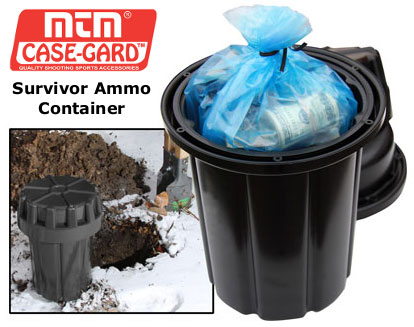 In-Ground Storage In-Ground Storage
With the price of ammo at all-time highs, folks are looking for ways they can stash ammo reserves securely, without using up precious space in their gunsafes. Additionally, there are important reasons why a locked, steel-walled gunsafe is not recommended for long-term ammo storage (see local fire regulations on the subject of ammo storage). MTM CaseGard now offers a heavy-duty, drum-style PVC container for underground storage of ammunition or other important items.
MTM’s Survivor Ammo Container features a rugged, bucket-style body with a double-O-Ring sealed lid and protective outer cap. The inner lid is held down with multiple screws to provide a secure seal. Then the larger “mushroom head” top fits in place over the whole assembly. Each container includes a heavy-duty Vapor Corrosion Inhibitor (VCI) plastic bag plus a moisture-absorbing desiccant pack. The 13.5″ x 10″ drum costs $22.10 at Midsouth Shooter’s Supply. That’s less than the cost of a box of bullets these days. Internal capacity is equivalent to a .50-Cal metal ammo can. The MTM Survivor will hold up to 600 rounds of .45 ACP or 223 ammo. It can also hold about 15-20 AR-15 magazines.
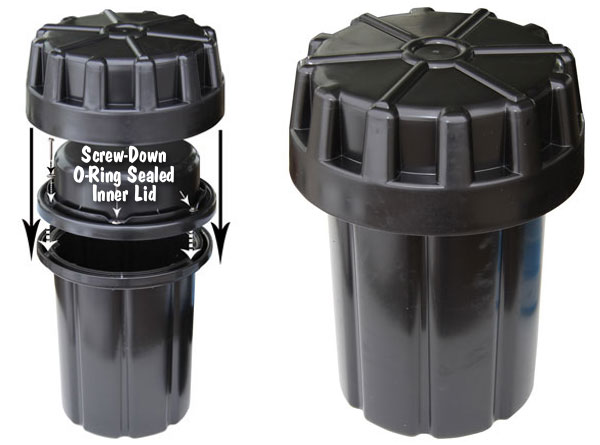
Outside Dimensions: 13.5″ (H) x 10″ (D) | Inside Dimensions: 12.4″ (D) x 7″ (H)
This is a convenient way to hide ammunition, bullets, copies of important documents, emergency money, coins and other small items. Just make sure of two things. First, remember exactly where you buried your Survivor container. You may want to include a small notation on a site plot that you place in a safe-deposit box or give to trusted family members. Second, don’t just dig a hole, drop the unit in the ground and shovel some fresh dirt over the top. Restore a “natural look” to the vegetation or ground cover over the hole. Otherwise your prominent round dirt pile may attract unwanted attention.
July 18th, 2013
 This article by Corey Swantz originally appeared in The Reloading Press, the Sinclair Int’l Blog. This article by Corey Swantz originally appeared in The Reloading Press, the Sinclair Int’l Blog.
Much less precision is required to get good scores in 3-gun competition than in strictly accuracy-oriented disciplines like F-Class or Benchrest. In 3-gun, [the game is] about hitting targets in the shortest amount of time, not how close to the center of the target you can get or how small the group can be. Ammunition that’s accurate to 1-2 MOA is more than sufficient for 3-gun competition, as the targets tend to be 4-6 MOA in size.
For my personal 3-gun load testing, I used three powders: Varget, IMR 8208 XBR, and Accurate 2230. All three powders gave me good results, but the 8208 XBR was the leader of the pack. I settled on a moderate charge that pushes a 73gr Berger BTHP at about 2,500 fps through my 16″-barreled AR15. While I’m sure I could obtain a higher velocity with these bullets, this speed yielded the best accuracy results in my initial testing with fully prepped brass.
With the high volume of ammunition that I need for 3-gun matches and practice, I wanted to eliminate as many case prep steps as possible and still end up with ammunition that was accurate enough for 3-gun. I fully prepped some once-fired brass from primer pocket to case mouth and everything in between. I also took some once-fired cases that had simply been trimmed to length, and loaded them without doing any other prep work. With these loads in hand, I headed out to the range to shoot some groups. Below are the results from my 200 yard group tests:
Prepped Brass Delivered Higher Score on Bullseye Target

As you can see from the photos, the groups yielded results along the lines of what I expected. The fully-prepped brass produced five 10s , whereas the un-prepped brass produced only two 10s, and both of those just touched the outer edge of the 10-ring.
However, the un-prepped brass kept all the shots inside the 8-ring, which is plenty precise for shooting the large targets used in 3-gun matches.
National Defense Match at Camp Perry
I decided to further test my un-prepped brass loads by shooting them in the National Defense Match (NDM) at Camp Perry and the Rockcastle 3-Gun Pro-Am Championship. At the NDM, the target used in the longer-range stages was a standard-size NRA Tombstone target, similar to the targets used in most 3-gun matches. Using the un-prepped brass loads, I was able to keep all my shots on the tombstone targets from 100-300 yards, and had only one miss from the 400-yard line. That one miss was my fault, as I jerked the trigger on the last shot, pulling it off to the left. Un-prepped brass held up quite well under Camp Perry NDM conditions.
Un-Prepped Good Enough for Class Win at Rockcastle 3-Gun Pro-Am Championship
Two weeks after the NDM, I traveled to Kentucky for the Rockcastle 3-Gun Pro-Am Championship. There were seven stages in this match, two of which required long-range rifle shots with my AR15. The longest stage of the match had eight steel targets sized from 4″ to 10″ in diameter, placed from 75 to 265 yards. My ammunition proved accurate enough at these distances to neutralize all the steel targets with single shots, something few other shooters were able to do. I finished over two seconds ahead of the nearest competitor on this stage and ended up winning the event. Clearly un-prepped brass was plenty good for the Rockcastle 3-Gun Pro Am, too!
Because of the results I’ve gotten on the practice range, and two very solid performances in competition last year, I feel confident that my loading process for the upcoming 3-Gun Nation Semi-Pro Series will consist of simply sizing and trimming brass, then loading it with my preferred recipe. While the fully prepped brass was indeed more accurate, the un-prepped brass loads were accurate enough to allow me to hit 3-gun targets . Now, I can take the time I save in the reloading room and spend it out on the practice range.
Corey Schwanz, Sinclair Reloading Technician
July 13th, 2013
You’ve probably heard of the 6.5 Creedmoor, an excellent round for High Power and tactical applications. Well there’s a 6mm (.243) version of this cartridge — the 6mm Creedmoor. It has the same external dimensions (other than neck diameter) as the 6.5 version, but it lets you shoot the High-BC 6mm bullets at higher velocities. With a long barrel, you can push 105gr bullets an honest 3070-3100 fps with this cartridge. The 6mm Creedmoor has a large primer pocket and large flash hole (unlike Lapua’s 6.5×47 which has a small primer pocket, and small flash hole — like the 6mmBR).
 6mm Creedmoor Brass 6mm Creedmoor Brass
If you’re interested in the 6mm Creedmoor, Hornady-brand brass is available right now at reasonable prices. Yesterday, GA Precision received 110,000 pieces of 6mm Creedmoor brass. Prices are:
$65.00 for 100 pieces
$325.00 for 500 pieces
$620.00 for 1000 pieces
That works out to sixty-two cents per unit if you buy 1000 cases. CLICK HERE to Order.
We have not tested the 6mm Creedmoor cartridge yet, but we know some shooters have had good luck with it. In design, the 6mm Creedmoor is quite similar to the 6XC, which is a proven High Power cartridge that has won many championships. If you want a mid-size 6mm cartridge, with brass that doesn’t cost $1.00 per case, the 6mm Creedmoor may be an option to consider. GA Precision says this about the cartridge: “The 6mm Creedmoor is an ideal cartridge for large-platform, semi-auto rifle for shooters who wish to utilize the long, high-BC modern 6mm projectiles. Compared to the .243 Winchester, the 6mm Creedmoor case is just under .130 of an inch shorter, perfect for the confines of a short-OAL AR-style magazine. This is an ideal cartridge for competitive shooters — charges easily reach 3050-3100 FPS while coming closer to the 100% volume capacity for powder charge, often resulting in lower standard deviations recorded.”
July 9th, 2013
We reported yesterday that Hornady, in an effort to increase overall production, will suspend production of 150 bullet types and 150 ammunition types for the balance of 2013. Upon reading this story, many readers grew concerned, perhaps because they did not realize that Hornady is actually stepping up production of its most popular bullets and ammo types. By temporarily suspending production of less-popular products, Hornady can reduce assembly line change-overs and thereby increase production. Hornady explains that this strategy allows it to: “focus our efforts on the most popular and highest-demand products and ship more total product.” In the months ahead, Hornady will continue to produce over 270 different projectiles and over 140 types of loaded ammo. As Steve Hornady says: “There is something in there for everyone….”
 Upon seeing ten-page-long list of suspended products, readers may have become overly concerned because they did not realize that Hornady will continue to churn out hundreds of bullet types and ammo types — and, in fact, the most popular products will now be manufactured in greater-than-ever quantities. Readers asked “So what products will Hornady continue to produce?” On its website, Hornady now lists all the high-demand bullets and ammo types that remain in production for the balance of 2013. Upon seeing ten-page-long list of suspended products, readers may have become overly concerned because they did not realize that Hornady will continue to churn out hundreds of bullet types and ammo types — and, in fact, the most popular products will now be manufactured in greater-than-ever quantities. Readers asked “So what products will Hornady continue to produce?” On its website, Hornady now lists all the high-demand bullets and ammo types that remain in production for the balance of 2013.
CLICK HERE to View Updated Bullet and Ammunition Production List
CLICK HERE to DOWNLOAD Updated Bullet and Ammunition Production List PDF File
Steve Hornady Talks to Customers
In this video, Hornady President Steve Hornady explains the decision to suspend production of some items in order to increase production of Hornady’s high-demand bullet types and ammunition types.
Steve Hornady Explains New Production Strategies (July 8, 2013):
On its website, Hornady has posted a Product Availability Update, which explains why Hornady is suspending production of some products:
One area that we have identified that will enable us to increase production, is the minimization of machinery downtime. The largest period of downtime our machines experience is during change over and retooling to convert a machine from manufacturing one bullet or cartridge to another. Under normal market conditions, we can keep the supply chain full by making popular items on a regular basis and keeping specialty or less-used products on a seasonal basis. However, with demand at record levels, it has become difficult to justify shutting down a machine to change it over to produce a product of less demand. Therefore, we are temporarily suspending some items in order to focus our efforts on the most popular and highest demand products and ship more total product.
We realize that many of the suspended items are going to disappoint some of our customers. We have painstakingly reviewed our order status and order history and unfortunately had to make some tough decisions. It wasn’t easy, but we know that we will do a better job of servicing the industry as a whole by focusing on the items of highest demand.
We are not alone; this is effectively already happening throughout our industry, but is accomplished through selective manufacture with no notification to the industry. We are simply making every effort to be up-front about our plans to maximize production.
Again, this is only temporary. This is not a permanent suspension. We will continue to push as hard as we can to meet the demand of our industry and will produce our full catalog of items as soon as we can. Please know that nobody wants to produce more and get our product to into your hands more than we do.
July 8th, 2013
 In order to increase deliveries of its most popular types of ammunition and bullets, Hornady announced that it will temporarily suspend production of 150 bullet types and 150 ammo types. IMPORTANT: These bullet and ammo products are NOT being discontinued. Rather, these less-popular, suspended items will simply not be produced for the remainder of 2013. By doing this, Hornady can reduce tool/machinery changes and thereby increase production of products in highest demand. On July 2nd, Hornady issued this statement: In order to increase deliveries of its most popular types of ammunition and bullets, Hornady announced that it will temporarily suspend production of 150 bullet types and 150 ammo types. IMPORTANT: These bullet and ammo products are NOT being discontinued. Rather, these less-popular, suspended items will simply not be produced for the remainder of 2013. By doing this, Hornady can reduce tool/machinery changes and thereby increase production of products in highest demand. On July 2nd, Hornady issued this statement:
Dear Hornady Customer:
As you are aware, 2013 has been one of the most challenging years ever in the sporting arms industry. We are proud of the increases in production we have achieved this year, but we are still faced witha demand that exceeds our ability to produce.
In efforts to increase production, we have reviewed everything, refining procedures, adding people, and equipment when possible. One area that will help us produce more: cutting the number of changeovers in our production machinery.
In order to reduce changeovers, we are announceing the temporary suspension of over 150 ammunition items and 150 bullet items, for the balance of 2013.
Attached you will find the list of items that will be suspended. Our plan is to remove the orders for these items from our system, beginning July 10th, and notify you of the cancellations. We will continue to monitor and update this list as the market conditions change.
Our goal is to try to deliver more to every customer, and while this may impact certain categories, our overall delivery should improve.
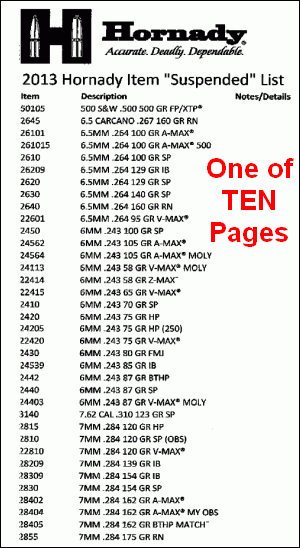
Hornady has listed the suspended bullet/ammo items in ten pages of attachments sent out to Hornady wholesalers and retailers. One representative page (covering 6mm, 6.5mm, and 7mm bullets) is shown below. This is NOT the complete list — there are TEN (10) pages! Click on each link below to see suspended items listed by caliber, small to large.
 Suspension List Contents by Page Suspension List Contents by Page
1. Suspended Bullets .17 -.25 Caliber
2. Suspended Bullets .270 – .32 Caliber
3. Suspended Bullets .338 – .475 Caliber
4. Suspended Bullets 6mm – 7mm (See at right)
5. Suspended Bullets 8mm – 9mm and Suspended .17 – .223 Ammo
6. Suspended Ammo, .223, .243, 25-06, 270 Win, 280 Rem, 30 Carbine
7. Suspended Ammo 300 Wby Mag, 300 Win Mag, 30-06 Spr, 303 Brit
8. Suspended ammo 6.5 Creed, 6.5×55, 6.8 SPC, 7mm Rem Mag, 7×57 and larger metric
9. Suspended ammo 30-30, .308 Win, .338 Lap, .338 Win Mag, 35 Whelen, .357 Mag
10. Suspended ammo .357 Sig, 38 SPL, 380 ACP, 40 SW, 41 Mag, 44 Mag, 45 ACP, 45 Colt, and rifle 375 H&H, 404 Jef, 45-70 Govt
Notable Bullets on the Suspended List:
22832 – 22 Cal .224 80gr A-Max
22420 – 6mm .243 75gr V-Max
24562 – 6mm .243 105gr A-Max
26101 – 6.5mm .243 100gr A-Max
29402 – 7mm .284 162gr A-Max
29405 – 7mm .285 162gr BTHP Match
30314 – 30 Cal .308 155gr A-Max Moly
30715 – 30 Cal .308 178gr BTHP Match
30733 – 30 Cal .308 208gr BTHP Match
33102 – 338 Cal .338 200gr SST
Note, the above selection of “notable bullets” is just a “short list” of items that caught our attention. Remember 150 bullet types are being suspended for the balance of the year. With some items on the list, partial orders will be filled, or current orders will be filled, but no new orders taken.
July 6th, 2013
 Need quality bullets at affordable prices? Powder Valley Inc. (PVI) has made a huge purchase of FOUR MILLION factory second bullets from a major manufacturer. These come in lots of 500 bullets at great prices. How about $73.95/500 for .224 caliber bullets? That’s just $14.79 per hundred! If you shoot a .30-caliber rifle, PVI also has 168gr and 175gr factory second bullets at great prices. The 168s are $109.95/500 while the 175s are $115.95/500. These factory-second bullets are found on Powder Valley’s Specials Page (Go to PowderValleyInc.com and click on the blue “Specials” Link in the top left.) Need quality bullets at affordable prices? Powder Valley Inc. (PVI) has made a huge purchase of FOUR MILLION factory second bullets from a major manufacturer. These come in lots of 500 bullets at great prices. How about $73.95/500 for .224 caliber bullets? That’s just $14.79 per hundred! If you shoot a .30-caliber rifle, PVI also has 168gr and 175gr factory second bullets at great prices. The 168s are $109.95/500 while the 175s are $115.95/500. These factory-second bullets are found on Powder Valley’s Specials Page (Go to PowderValleyInc.com and click on the blue “Specials” Link in the top left.)
NOTE: All these bullets are in stock right now, but we expect these to sell out fast. Note, you can not purchase small quantities. These are only offered in lots of 500.
| PVI Special Purchase Major Brand Bullets |
| Item # |
Description |
Price |
| PVI22477 |
.224 77 GR HPBT (500) (Major mfg factory seconds) |
$73.95 |
| PVI308168 |
.308 168 GR HPBT (500) (Major mfg factory seconds) |
$109.95 |
| PVI308175 |
.308 175 GR HPBT (500) (Major mfg factory seconds) |
$115.95 |
July 5th, 2013
 The updated Second Edition of the Cartridge Comparison Guide is now available. The Cartridge Comparision Guide is the product of many years of labor by Andrew Chamberlain, a Utah-based hunter. Andrew says his Guide “compares every factory available cartridge from the 17 calibers up to the 50 caliber cartridges”. (Sorry, most wildcat cartridges are not covered.) Chamberlain’s Guide also compiles cartridge data from major ammunition manufacturers such as Barnes, Federal, Hornady, Norma, Nosler, Remington, Sierra, Swift, Weatherby, and Winchester. It shows the optimal velocity achieved for each bullet weight and calculates bullet energy, recoil, and powder efficiency. The updated Second Edition of the Cartridge Comparison Guide is now available. The Cartridge Comparision Guide is the product of many years of labor by Andrew Chamberlain, a Utah-based hunter. Andrew says his Guide “compares every factory available cartridge from the 17 calibers up to the 50 caliber cartridges”. (Sorry, most wildcat cartridges are not covered.) Chamberlain’s Guide also compiles cartridge data from major ammunition manufacturers such as Barnes, Federal, Hornady, Norma, Nosler, Remington, Sierra, Swift, Weatherby, and Winchester. It shows the optimal velocity achieved for each bullet weight and calculates bullet energy, recoil, and powder efficiency.
The Cartridge Comparison Guide provides data for thousands of cartridge/bullet/velocity combos. Charts provide cartridge ballistics including downrange energy. The Second Edition adds 90 more pages devoted to ballistics. The Cartridge Comparison Guide offers a firearms lexicon, plus Appendices covering Cartridge Selection for Game Animals, Bullet Selection/Design, Bullet Expansion, Wound Channel Characteristics and more. In the Second Edition, there is expanded coverage of factory-loaded hunting ammo. The book now provides “100% coverage of all handgun and rifle cartridges produced in the USA by at least two minor factory load sources or one major factory load source.”
New Content in Second Edition of Cartridge Comparison Guide
The Cartridge Comparison Guide (2nd Edition) costs $32.95 plus shipping and tax. This is more pricey than the $24.99 First Edition (which is still for sale), but the latest Cartridge Comparison guide offers considerably more content. Here’s what’s new in the Second Edition:
- Addition of Shotgun Ammunition (Both Slug and Shot loads).
- Momentum Calculation for all Rifle, Shotgun and Handgun loads.
- Integration of Shotgun Slug Ammunition with Center Fire Rifle Data Tables.
- Factory Load Summary Added (Shows manufacturers and loads produced).
- One factory load and one hand load for every bullet weight available in each cartridge.
- Over 90 pages of additional ballistics content (roughly 35% more than in First Edition).
Award-Winning Content
The Cartridge Comparison Guide has been awarded the POMA Pinnacle Award for Excellence. (POMA, the Professional Outdoor Media Association, is the trade association for outdoor writers).

 Great Resource for Hunters Great Resource for Hunters
The Cartridge Comparison Guide’s author wanted to help hunters select the “right cartridge for the job.” Chamberlain states: “This started as a personal project to gather information on the more popular cartridges commonly used for hunting. I began comparing cartridge performance, versatility, bullet selection, powder efficiency, recoil generation vs. energy produced, standing ballistic data for different environments, etc.” Chamberlain adds: “I wanted to find the best all-around performing cartridge and rifle that a guy on a budget could shoot.”
Giant Cartridge Poster for Computer Wallpaper (1665×1080 pixels)
Here’s a great illustration of hundreds of cartridges and shotshell types. For dedicated reloaders, this would work great as desktop “wallpaper” for your computer. CLICK HERE for full-size image.


|


