At SHOT Show 2013, Lapua announced it was expanding its line-up of Scenar L projectiles to include two new 6.5mm bullets and three new .30-caliber Scenar Ls. We applaud this news. This Editor has tested 6mm Scenar L bullets in his own rifles, and they have proven to be some of the most consistent bullets we have ever measured. The Scenar Ls also shot great in 8-twist barrels from Brux, Krieger, and PacNor.
Two New 6.5mm Scenar Ls
Guys with .260 Rem, 6.5×47, 6.5 Creedmoor, and 6.5-284 rifles have been eagerly awaiting the new 6.5mm Scenar Ls. These will be offered in two weights: 120 grains and 136 grains.
Scenar Ls in .30 Caliber
Lapua will release three new .30-Caliber Scenar L bullets. Along with a new 155gr Palma bullet (GB 552), Lapua will offer a 175gr Scenar L (GB 550), plus a 220gr heavy-weight Scenar L (GB 551). In magnum and short magnum chamberings, the 220-grainers should prove very effective in Long Range comps.
What Makes the Scenar Ls So Good
While all Lapua Scenar bullets are made to exacting standards, Lapua “raised the bar” with its Scanar L series. Scenar L bullets feature closer weight tolerances, tighter jacket wall concentricity standards, and greater uniformity in every dimension. Building bullets this good isn’t easy — you have to get everything right — from the gilding metal cup, to the lead wire and jacket forming, core-jacket assembly, and finally boat-tail pressing and nose-tipping. To build L-series bullets to such high standards, Lapua had to adopt new manufacturing procedures, and install proprietary new machines and advanced instrumentation never seen before in bullet production. Lapua also took its already high quality control standards and kicked them up a notch.
New 6.5mm Scenar Ls — First Look
At SHOT Show, Lapua unveiled its much-awaited new 6.5mm (.264 caliber) Lapua Scenar L bullets. There are two (2) new 6.5mm Scenar Ls: a 120gr tangent ogive design and a 136gr multi-ogive design. These are both all-new bullets, though the new 120gr Scenar L bears a “family resemblance” to the current (and very accurate) 123gr standard Scenar. One look at the new 136-grainer, and you can see that this is NOT just a “tweak” of the popular 139gr standard Scenar. The new 136gr Scenar L has a streamlined secant-ogive shape that blends into a more conventional tangent ogive as the bullet approaches full diameter. This dual-ogive design enhances the bullet’s BC, making it more slippery. That should translate to less drop and less drift at long range.
These new 6.5-caliber Scenar Ls should hit the market very soon. Check with Grafs.com for availability. As soon as we can get our hands on Lapua’s new 120s and 136s we will test them in a 6.5×47 Lapua bench gun and see how they perform. The .30-Cal 175gr and 220gr Scenar-Ls should arrive by late spring according to Kevin Thomas of Lapua. Kevin is a member of our Forum and he can answer your questions about the entire line-up of Lapua projectiles, along with Lapua cartridge brass.
If you’ve tried to buy powder lately, you know that many of the most popular propellants are in short supply. To find out when we can expect powder supplies to catch up with the increased consumer demand, we headed to the Hodgdon Powder Company booth at SHOT Show. There we met up with Chris Hodgdon.
Chris understands that people are frustrated with the current shortages. But Chris assured us that his company is moving aggressively to get more powder on store shelves. Production is being stepped up and Chris said his employees are working “nights and weekends” to increase propellant shipments. But there is no “quick fix”. Chris reports: “We are trying to fill as much of the demand as we can right now, but we have got way more demand than supply obviously right now…”
Try Alternative Powders with Similar Burn Rates
For those customers who can’t find their favorite powder (such as Varget or H4350) right now, Chris suggests trying similar-burn-rate IMR- and Hodgdon-brand powders that are currently available in ample quantities. For example, Chris suggested that Varget users try IMR 4064. This powder offers excellent accuracy and a very similar burn rate. Likewise, if you can’t find H4350 you can try IMR 4350 or H414. Fans of H335 powder will find that Benchmark and CFE 223 are suitable replacement powders.
Of course, when changing to a different powder you can’t simply substitute loads. That’s a big no-no. You need to consult a good load manual or find a safe starting load on the Hodgdon Reloading Data Center. But you may find that, with a little load development effort, your “second choice” or “third choice” powder options shoot just as well as a previous favorite. We know guys who switched from Varget to IMR 8208 XBR in the .308 Win and they liked the 8208 XBR so well they never looked back.
At Media Day we test-fired the new 3000 FPS rimfire ammunition from Winchester. Shooting the new 17 Win Super Mag ammo from a pre-production Savage B.MAG rifle (more on that later) and a Browning m1885 falling block, we were able to shoot sub-minute-of-angle groups with a pretty primitive front rest and lumpy rear bag. So far, then, it appears the ammo is pretty darn accurate for a mass-produced rimfire cartridge. Savage has promised to send us a B.MAG rifle for further testing. Watch the video below for more details on this new cartridge.
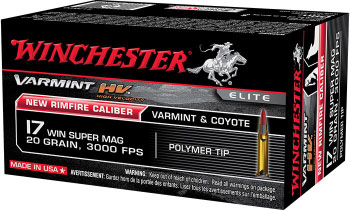
New 3000 FPS Rimfire Round Winchester has announced a new, high-velocity 17-caliber rimfire cartridge, the .17 Winchester Super Magnum (aka .17 Win Super Mag). The .17 Win Super Mag will initially be offered in three bullet types: 20gr plastic tip (Varmint HV), 25gr plastic tip (Varmint HE), and a 20gr JHP (Super-X). The 20-grain varieties boast a 3000 FPS muzzle velocity, earning honors as the fastest Rimfire ammo ever made.
.17 Winchester Super Mag Specifications
Symbol
Sub Brand
Bullet Weight
Muzzle Velocity
S17W20
Varmint HV
20-gr Plastic Tip
3,000 fps
S17W25
Varmint HE
25-gr Plastic Tip
2,600 fps
X17W20
Super-X
20-gr JHP
3,000 fps
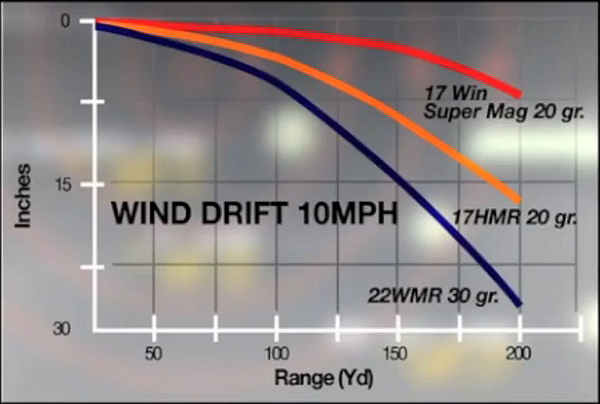
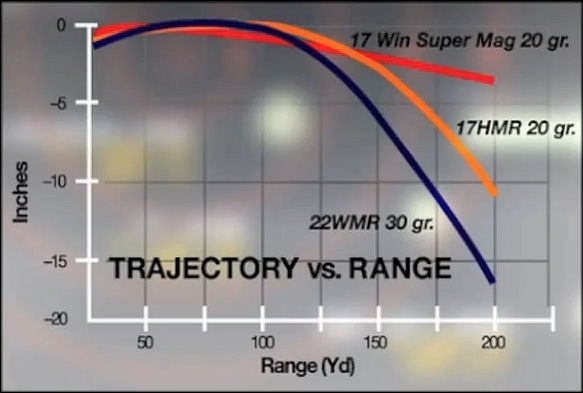
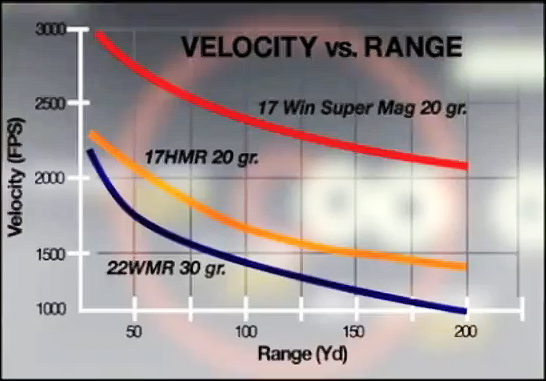
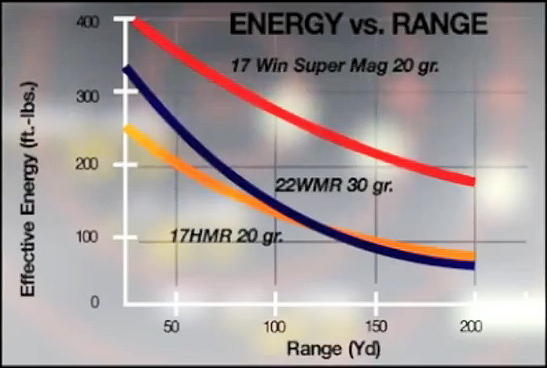
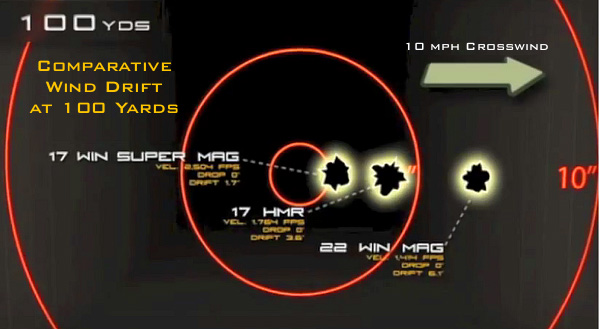
Winchester claims that all .17 Win Super Mag ammo types shoot much flatter than the .22 Win Mag and .17 HMR, while delivering more than 150 percent more energy than both. In addition, the .17 Win Super Mag “bucks the wind” better than any other rimfire ammo — exhibiting significant less horizontal drift at extended ranges. The ammunition should be available at Winchester dealers by April 2013.
To ensure the increasing demand of Lapua ammunition and Vihtavuori powder in the USA market is met with sufficient supply, Nammo Lapua Oy has made changes to its distribution network. Effective Jan 1, 2013, Lapua centerfire ammunition and components, as well as Lapua and SK brand rimfire ammunition, will be distributed by Graf & Sons of Mexico, Missouri; Sport Shooting International (SSI) of Anaheim, California; and Crow Shooting Supplies of Brooklyn, Iowa.
VihtaVuori smokeless powder products will continue to be imported and distributed by the Hodgdon Powder Company of Shawnee Mission, Kansas.
Sinclair Int’l has released a 7-part series of video interviews with Walt Berger (founder of Berger Bullets) and Eric Stecker (Berger’s Exec. VP and Master Bulletsmith). The series is hosted by Sinclair’s President, Bill Gravatt. You can watch Parts 1 and 2 of the interview here, and we’ve provided links to the remaining Parts 3 through 7. All seven interview segments offer interesting material. Part 6 mentions up and coming stuff like the reloading manual. Part 7, over 13 minutes long, contains interesting discussions of bullet testing and the hunting performance of Berger VLDs. NOTE: You can view this entire video series (and many other videos) on Sinclair’s YouTube Channel Page.
LuckyGunner.com, a leading online ammo vendor, has conducted a remarkable “torture-test” comparison of brass-cased and steel-cased .223 Rem ammunition. Four different kinds of ammo (one brass-cased, three steel-cased) were fired through four different Bushmaster AR15s — ten thousand (10,000) rounds PER GUN. The idea was to see if brass-cased ammo was better than the cheaper, steel-cased ammunition. During the course of the project, Luckygunner’s testers logged malfunctions and checked for accuracy, chamber pressure, gas port pressure, chamber wear, and overall barrel wear. At the end of the test, the well-worn barrels were sectioned to see the effect of thousands of rounds… and the results weren’t pretty.
Test Findings: For a multitude of reasons, the test crew determined that Federal brass-cased ammo was “healthier” than steel-cased ammo. The brass-cased ammo shot more accurately, had far fewer malufunctions, and produced less barrel wear. The USA-made brass-cased ammo also showed more consistent velocities. CLICK HERE to READ FULL TEST.
Watch the video below for a summary of results:
Torture Test Procedure
Four types of .223 Rem ammo were tested: Federal brass-cased 55gr FMJBT; Wolf steel-cased (polymer coating) 55gr FMJ; Tula steel-cased (polymer coating) 55gr Bi-Metal Jacket; Brown Bear steel-cased (lacquer coating) 55gr Bi-Metal Jacket. Each ammo type was paired with a specific Bushmaster AR-15. Tests were performed at various round-count stages:
At the start: record accuracy, velocity, chamber and gas port pressures, make chamber cast
After 2,000 rounds: record accuracy, velocity
After 4,000 rounds: record accuracy, velocity
After 5,000 rounds: record throat erosion, make chamber cast
After 6,000 rounds: record accuracy, velocity
After 8,000 rounds: record accuracy, velocity
After 10,000 rounds: record accuracy, velocity, chamber and gas port pressures, throat erosion, extractor wear, chamber cast, barrel wear, make chamber cast.
During testing, rifles were cleaned according to a preset schedule and temperatures were monitored. After testing, LuckyGunner sectioned the barrels and made careful inspections.
Click the links below for specific data, test results, and conclusions:
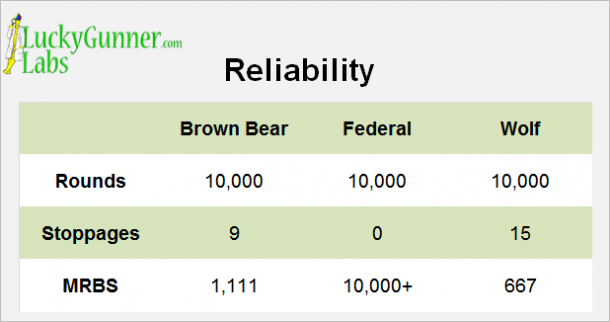
During the testing process, all malfunctions of each rifle-ammo combination were logged. The brass-cased Federal ammo was the clear winner:
Federal: 10,000 rounds, 0 malfunctions. Brown Bear: 10,000 rounds, 9 malfunctions
(5 stuck cases, 1 mag-related failure to feed, 3 failures to cycle.) Wolf: 10,000 rounds, 15 malfunctions (stuck cases) Tula: DNF (6,000 rounds in alternate carbine, 3 malfunctions)
Barrel Wear and Throat Erosion
Some of the barrels didn’t make it to 10,000 rounds: “The steel cased/bimetal jacketed ammunition caused accelerated wear to the inside of their respective bores. While the barrel of the Federal carbine had plenty of life left, even after 10,000 rounds … the Wolf and Brown Bear barrels … were completely shot out by 6,000 rounds. At the end of the test, the chrome lining of the Wolf and Brown Bear barrels was almost gone from the throat forward, and the barrels had effectively become smoothbores[.] A throat erosion gauge could be dropped into the bore from the muzzle end with absolutely no resistance.”
The better, up-to-date ballistics programs let you select either G1 or G7 Ballistic Coefficient (BC) values when calculating a trajectory. The ballistic coefficient (BC) of a body is a measure of its ability to overcome air resistance in flight. You’ve probably seen that G7 values are numerically lower than G1 values for the same bullet (typically). But that doesn’t mean you should select a G1 value simply because it is higher.
Some readers are not quite sure about the difference between G1 and G7 models. One forum member wrote us: “I went on the JBM Ballistics website to use the web-based Trajectory Calculator and when I got to the part that gives you a choice to choose between G1 and G7 BC, I was stumped. What determines how, or which one to use?”
The simple answer to that is the G1 value normally works better for shorter flat-based bullets, while the G7 value should work better for longer, boat-tailed bullets.
G1 vs. G7 Ballistic Coefficients — Which Is Right for You?
G1 and G7 refer both refer to aerodynamic drag models based on particular “standard projectile” shapes. The G1 shape looks like a flat-based bullet. The G7 shape is quite different, and better approximates the geometry of a modern long-range bullet. So, when choosing your drag model, G1 is preferrable for flat-based bullets, while G7 is ordinarily a “better fit” for longer, boat-tailed bullets.
Drag Models — G7 is better than G1 for Long-Range Bullets
Many ballistics programs still offer only the default G1 drag model. Bryan Litz, author of Applied Ballistics for Long Range Shooting, believes the G7 standard is preferrable for long-range, low-drag bullets: “Part of the reason there is so much ‘slop’ in advertised BCs is because they’re referenced to the G1 standard which is very speed sensitive. The G7 standard is more appropriate for long range bullets. Here’s the results of my testing on two low-drag, long-range boat-tail bullets, so you can see how the G1 and G7 Ballistic coefficients compare:
G1 BCs, averaged between 1500 fps and 3000 fps:
Berger 180 VLD: 0.659 lb/in²
JLK 180: 0.645 lb/in²
The reason the BC for the JLK is less is mostly because the meplat was significantly larger on the particular lot that I tested (0.075″ vs 0.059″; see attached drawings).
For bullets like these, it’s much better to use the G7 standard. The following BCs are referenced to the G7 standard, and are constant for all speeds.
Many modern ballistics programs, including the free online JBM Ballistics Program, are able to use BCs referenced to G7 standards. When available, these BCs are more appropriate for long range bullets, according to Bryan.
[Editor’s NOTE: BCs are normally reported simply as an 0.XXX number. The lb/in² tag applies to all BCs, but is commonly left off for simplicity.]
Becigneul Case Turning Motor, by German Salazar
Although there have been a variety of similar devices and ‘case lathes’ offered for sale in the past, they’ve been priced fairly high. Paul’s unit is reasonably priced ($220.00) and built like a tank. The motor turns at about 180 rpm which is just right for neck turning. What’s really nice is that the motor has enough torque to hold its speed throughout the whole operation and a/c power to run all day long!
The unit’s design is fairly straight-forward: a surplus electric motor turns a Forster case-holding collet. Paul makes a nice knurled collar to open and close the collet.Power is controlled by a household type wall switch attached to a long cabe. The whole assembly is mounted on a nice hardwood base.
Video of Paul Becigneul’s Case Turning Motor in Use
In operation, it works very well. The collet has enough clamping power to hold the case after a quick hand-tightening, no wrench is needed (although you can use one if you are so inclined). A quarter turn of the collar opens the collet and a quick turn of the wrist tightens it back up. As with any powered case neck turning device, the case wobbles a bit as it turns. This doesn’t matter a bit as the turning cutter is held in your hand (which is free to move) and the cutter’s arbor is the actual alignment device. The wobble is the same or less than what I had using a power screwdriver with a K&M holder.
For more information, email Paul Becigneul via: pbike4466 [at] directv.net. In 2012, the basic unit cost $220.00 each collet was $10 and shipping is $20 to most U.S. locations.
Editor’s Comment: In the video, Paul uniforms case flash-holes with a Lyman tool (from the inside) and then uniforms primer pockets (from the outside) with a K&M tool. While we do believe that flash-holes should be inspected to ensure there are no obstructions or flakes blocking the hole, we have not found that flash-hole or primer-pocket uniforming produced measurable improvements in accuracy with Lapua 6mmBR brass. In fact, in our tests using a manual K&M flash-hole uniformer, ES/SD actually got worse after the flash-holes were “uniformed”.
Keep in mind also that many deburring tools for 0.059 (PPC-size) flash-holes actually over-cut substantially, reaming the holes to as wide as 0.068″. The Lapua PPC/BR flash hole is spec’d at 1.5mm, which works out to 0.059055″. Most of the PPC/BR flash-hole uniforming tools on the market use a 1/16″ bit which is nominally 0.0625″, but these often run oversize — up to 0.067″. If you like to uniform your primer pockets, be our guest (this can be useful with lesser-quality brass). But before pocket-uniforming dozens of cases, you might do a comparison test (by shooting uniformed vs. un-uniformed ammo) to see whether this operation actually improves accuracy with the brass you are using.
New 3000 FPS Rimfire Round Winchester has announced a new, high-velocity 17-caliber rimfire cartridge, the .17 Winchester Super Magnum (aka .17 Win Super Mag). The .17 Win Super Mag will initially be offered in three bullet types: 20gr plastic tip (Varmint HV), 25gr plastic tip (Varmint HE), and a 20gr JHP (Super-X). The 20-grain varieties boast a 3000 FPS muzzle velocity, earning honors as the fastest Rimfire ammo ever made.
.17 Winchester Super Mag Specifications
Symbol
Sub Brand
Bullet Weight
Muzzle Velocity
S17W20
Varmint HV
20-gr Plastic Tip
3,000 fps
S17W25
Varmint HE
25-gr Plastic Tip
2,600 fps
X17W20
Super-X
20-gr JHP
3,000 fps
Winchester claims that all .17 Win Super Mag ammo types shoot much flatter than the .22 Win Mag and .17 HMR, while delivering more than 150 percent more energy than both. In addition, the .17 Win Super Mag “bucks the wind” better than any other rimfire ammo — exhibiting significant less horizontal drift at extended ranges. The ammunition should be available at Winchester dealers by April 2013.
Savage Will Release a .17 Win Super Mag Rifle
According to Outdoor Life’s John Snow, Savage will be the first gun-maker to produce rifles chambered in .17 Win Super Mag. Snow says Savage “hopes to have rifles shipping by mid-April”. Winchester states that, later in 2013, two other manufacturers will introduce .17 Win Super Mag rifles.
Ron Spooner writes: “For perspective, contrast the 17 Win Super Mag (no relation to the WSM centerfire cartridges) against the former rimfire velocity champ, the popular .17 Hornady Magnum Rimfire. While the 17 HMR shoots delightfully flat, the 17 Win Super Mag shoots two times flatter and drifts only half as far in the wind. Its 20-grain bullets retain more than twice as much downrange energy, and its 25-grain projectiles nearly triple the energy of the 17-grain V-Max in the HMR load”. Read Ron Spooner Review.
Watch Video Trailer for .17 Win Super Mag Rimfire Ammo
The .17 Win Super Mag offers higher velocities and more downrange energy than ever before. “Our engineers have been developing the top-secret .17 Win Super Mag [cartridge] for more than three years,” said Brett Flaugher, Winchester Ammunition vice president of sales, marketing and strategy. “At 3,000 feet per second it’s the fastest modern rimfire cartridge on the planet. The downrange energy deposited by the .17 Win Super Mag will be a game-changer for varmint and predator hunters everywhere. Now hunters will get the downrange performance of a centerfire cartridge at the more affordable price point of traditional rimfire ammunition. It’s the best of both worlds[.]”
Spawn of a .27-Caliber Nail-Gun
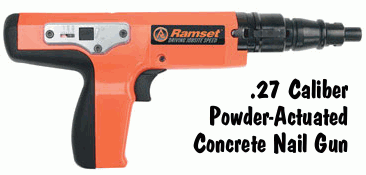
Believe it or not, Winchester’s new .17 Win Super Mag evolved from a “parent case” originally developed for .27-caliber powder-actuated concrete nail guns. Winchester has produced millions of nail gun blanks in .22, .25, and .27 calibers. This new .17 Win Super Mag is derived from Winchester’s .27-cal nail gun blank, necked down to .17-caliber and strengthened with a thicker head and stronger case-walls. With case-walls that are 50% thicker than those on 17 HMR cartridges, the .17 Win Super Mag can operate at 33,000 psi. By contrast, the 17 HMR maxes out at 26,000 psi.
Comment: Will the .17 Win Super Mag Rimfire Round Be a Hit or a Miss?
Initial tests of the .17 Win Super Mag show good ballistic performance compared to the 17 HMR. On the other hand, early accuracy reports have been mediocre, but keep in mind that the gun magazine tests were performed with prototype rifles, on make-shift, wobbly rests (that’s typical). It will be interesting to see how the round can really perform in a good barrel when shot from a stable rest by a skilled trigger-puller.
Economics may dictate whether the .17 Win Super Mag catches on. We’re told this new cartridge will sell for $17.99 per 50-round box. That works out to $0.36 per round, making it about 40-50% more costly than the popular 17 HMR which now sells for $11.50 to $14.00 per 50-round box. At $0.36 per round, the .17 Win Super Mag may exceed the cost of 17-cal centerfire reloads, but then you have the convenience of pre-made ammo. We think that, if the cartridge proves accurate, varmint hunters will pay the extra money (over the 17 HMR) for the added performance, which is pretty significant at 150 yards and beyond. For a squirrel shooter or prairie dog hunter, the .17 Win Super Mag is still much less expensive than the cheapest US-made .223 Rem ammo, which sold for about $10 – $12 per 20-round box (i.e. $0.50 – $0.60 per round) before the current buying frenzy.
Story tip by EdLongRange. We welcome reader submissions.
Review by James D. Mock
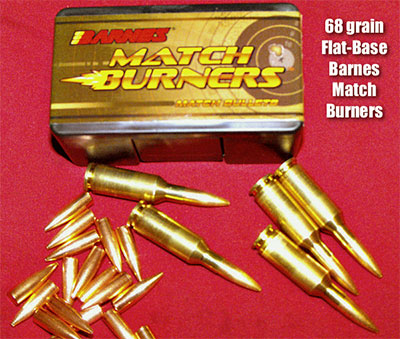
Around the first of November, I received a call from Boyd Allen. During one our conversations about all things Benchrest, he mentioned that Barnes made conventional match bullets. This I did not know. Most hunters are familiar with the excellent Barnes premium hunting bullets, but many like me did not know that they make match bullets also, marketed as “Match Burners”.
After contacting the good folks Barnes to request some Match Burners for a review in Precision Shooting Magazine, I received a box of 6mm 68gr match bullets and a box of 6mm 105gr VLDs. By the time I got these, I learned that Precision Shooting would no longer print a magazine.
These bullets sat around the house for quite some time, but I finally got around to testing them. First of all I weighed many of the bullets and found that the nominal 68gr bullets averaged 68.07 grains and the 105s averaged 105.08 grain. The 68gr bullets were .845 inches long and measured .2432 on the body and .2435 on the pressure ring of these flat-base bullets. The VLDs measured 1.192 inches long with a diameter of .2433 at the largest point and the boat tail measured .180 long with a diameter at the base of .210.
Flat-Base 68gr Match Burners Prove Very Accurate
Although I shot the 68gr bullets in some fairly “strong” conditions, they performed well as you can see below. I loaded the rounds with 28.4 grains of the new Accurate LT-32 powder (from Western Powders).
Above is a target with three 3-shot groups shot with the 68-grainers. I chose the following seating depths: (from left to right) .020 off jam*; .010 off jam; and .005 off jam. Since then I have shot a few more groups, and have been pleasantly surprised.
Barnes Match Burner 105gr VLDs Perform Well
For the 105 VLDs I chose my Dasher with a 26.5″ Bartlein gain twist (1:8.25″ to 1:7.75″). Like the 68gr bullets, these VLDs were a pleasant surprise. I plan to shoot these bullets again as soon as the weather improves.
*Editor’s Note: The term “Jam” (or “Jam Length”) is used to describe a maximum practical bullet seating dimension, typically measured from base to bullet ogive. As James uses the term, “Jam” means the maximum functional length to which he can seat a bullet in his brass, with his selected neck tension, before the bullet starts to move backwards in the case (in the direction of casehead) when he closes the bolt. Thus, if James specifies a load that is “.010 off Jam”, this means that James has seated the bullet ten-thousandths shorter than maximum functional length in his gun. His bullets are still engaged in the rifling at “.010 off Jam”, and probably still touching the rifling at “.020 off Jam”. The “Jam” length is specific to James’ barrel and brass. In different barrels, “Jam Length” can vary according to numerous factors — bore dimensions, land configuration, neck tension, bullet geometry et cetera.


 At SHOT Show 2013, Lapua announced it was expanding its line-up of Scenar L projectiles to include two new 6.5mm bullets and three new .30-caliber Scenar Ls. We applaud this news. This Editor has tested 6mm Scenar L bullets in his own rifles, and they have proven to be some of the most consistent bullets we have ever measured. The Scenar Ls also shot great in 8-twist barrels from Brux, Krieger, and PacNor.
 New 6.5mm Scenar Ls — First Look
 If you’ve tried to buy powder lately, you know that many of the most popular propellants are in short supply. To find out when we can expect powder supplies to catch up with the increased consumer demand, we headed to the
  Try Alternative Powders with Similar Burn Rates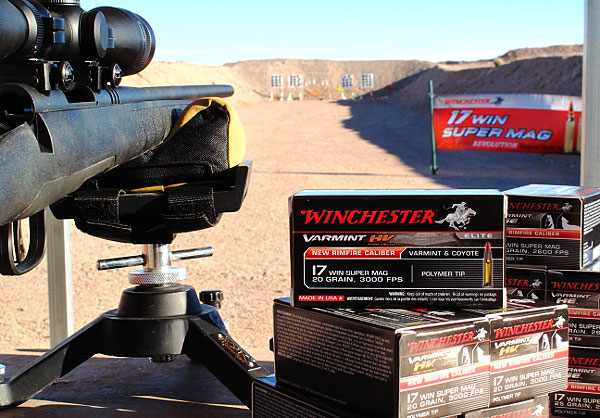
 New 3000 FPS Rimfire Round

 To ensure the increasing demand of Lapua ammunition and Vihtavuori powder in the USA market is met with sufficient supply, Nammo Lapua Oy has made changes to its distribution network. Effective Jan 1, 2013, Lapua centerfire ammunition and components, as well as Lapua and SK brand rimfire ammunition, will be distributed by

 Barrel Wear and Throat Erosion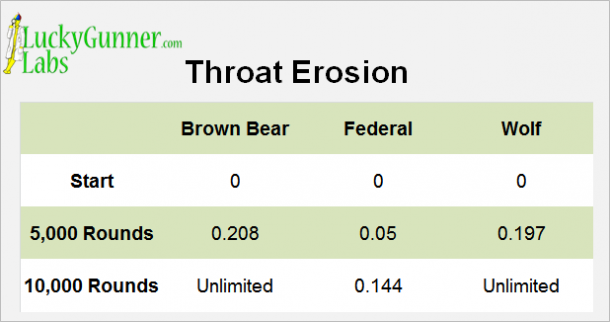
 The better, up-to-date ballistics programs let you select either G1 or G7 Ballistic Coefficient (BC) values when calculating a trajectory. The ballistic coefficient (BC) of a body is a measure of its ability to overcome air resistance in flight. You’ve probably seen that G7 values are numerically lower than G1 values for the same bullet (typically). But that doesn’t mean you should select a G1 value simply because it is higher.
 Drag Models — G7 is better than G1 for Long-Range Bullets

 Spawn of a .27-Caliber Nail-Gun
 After contacting the good folks Barnes to request some Match Burners for a review in Precision Shooting Magazine, I received a box of 6mm 68gr match bullets and a box of 6mm 105gr VLDs. By the time I got these, I learned that Precision Shooting would no longer print a magazine.


