In our Shooters’ Forum a reader recently asked: “How much neck tension should I use?” This prompted a Forum discussion in which other Forum members recommended a specific number based on their experience, such as .001″, .002″, or .003″. These numbers, as commonly used, correspond to the difference between case-neck OD after sizing and the neck OD of a loaded round, with bullet in place. In other words, the numbers refer to the nominal amount of interference fit (after sizing).
While these commonly-used “tension numbers” (of .001″, .002″ etc.) can be useful as starting points, neck tension is actually a fairly complex subject. The actual amount of “grip” on the bullet is a function of many factors, of which neck-OD reduction during sizing is just one. Understanding these many factors will help you maintain consistent neck tension as your brass “evolves” over the course of multiple reloadings.
Neck Tension (i.e. Grip on Bullets) Is a Complex Phenomenon
While we certainly have considerable control over neck tension by using tighter or looser bushings (with smaller or bigger Inside Diameters), bushing size is only one factor at work. It’s important to understand the multiple factors that can increase or decrease the resistance to bullet release. Think in terms of overall brass-on-bullet “grip” instead of just bushing size.
One needs to understand that bushing size isn’t the beginning and end of neck tension questions, because, even if bushing size is held constant, the amount of bullet “grip” can change dramatically as the condition of your brass changes. Bullet “grip” can also change if you alter your seating depth significantly, and it can even change if you ultrasonically clean your cases.
Bullet grip is affected by many things, such as:
1. Neck-wall thickness.
2. Amount of bearing surface (shank) in the neck.
3. Surface condition inside of neck (residual carbon can act as a lubricant; ultrasonic cleaning makes necks “grabby”).
4. Length of neck (e.g. 6BR neck vs. 6BRX).
5. Whether or not the bullets have an anti-friction coating.
6. The springiness of the brass (which is related to degree of work-hardening; number of firings etc.)
7. The bullet jacket material.
8. The outside diameter of the bullet and whether it has a pressure ridge.
9. The time duration between bullet seating and actual firing (necks can stiffen with time).
10. How often the brass is annealed
— and there are others…
Seating Depth Changes Can Increase or Decrease Grip on Bullet
You can do this simple experiment. Seat a boat-tail bullet in your sized neck with .150″ of bearing surface (shank) in the neck. Now remove the bullet with an impact hammer. Next, take another identical bullet and seat it with .300″ of bearing surface in another sized case (same bushing size/same nominal tension). You’ll find the deeper-seated bullet is gripped much harder.
Neck-Wall Thickness is Important Too
I have also found that thinner necks, particularly the very thin necks used by many PPC shooters, require more sizing to give equivalent “grip”. Again, do your own experiment. Seat a bullet in a case turned to .008″ neckwall thickness and sized down .003″. Now compare that to a case with .014″ neckwall thickness and sized down .0015″. You may find that the bullet in the thin necks actually pulls out easier, though it supposedly has more “neck tension”, if one were to consider bushing size alone.
In practical terms, because thick necks are less elastic than very thin necks, when you turn necks you may need to run tighter bushings to maintain the same amount of actual grip on the bullets (as compared to no-turn brass). Consequently, I suspect the guys using .0015″ “tension” on no-turn brass may be a lot closer to the guys using .003″ “tension” on turned necks than either group may realize.
Toward a Better Definition of Neck Tension
As a convenient short-cut, we tend to describe neck tension by bushing size alone. When a guy says, “I run .002 neck tension”, that normally means he is using a die/bushing that sizes the necks .002″ smaller than a loaded round. Well we know something about his post-sizing neck OD, but do we really have a reliable idea about how much force is required to release his bullets? Maybe not… This use of the term “neck tension” when we are really only describing the amount of neck diameter reduction with a die/bushing is really kind of incomplete.
My point here is that it is overly simplistic to ask, “should I load with .001 tension or .003?” In reality, an .001″ reduction (after springback) on a thick neck might provide MORE “grip” on a deep-seated bullet than an .003″ reduction on a very thin-walled neck holding a bullet with minimal bearing surface in the neck. Bushing ID is something we can easily measure and verify. We use bushing size as a descriptor of neck tension because it is convenient and because the other important factors are hard to quantify. But those factors shouldn’t be ignored if you want to maintain consistent neck tension for optimal accuracy.
Consistency and accuracy — that’s really what this all about isn’t it? We want to find the best neck tension for accuracy, and then maintain that amount of grip-on-bullet over time. To do that you need to look not only at your bushing size, but also at how your brass has changed (work-hardened) with time, and whether other variables (such as the amount of carbon in the neck) have changed. Ultimately, optimal neck tension must be ascertained experimentally. You have to go out and test empirically to see what works, in YOUR rifle, with YOUR bullets and YOUR brass. And you may have to change the nominal tension setting (i.e. bushing size) as your brass work-hardens or IF YOU CHANGE SEATING DEPTHS.
Remember that bushing size alone does not tell us all we need to know about the neck’s true “holding power” on a bullet, or the energy required for bullet release. True bullet grip is a more complicated phenomenon, one that is affected by numerous factors, some of which are very hard to quantify.
Here’s a good deal for fans of the “Terrific Twenties” — .204-caliber, low-recoil cartridges. Midsouth Shooters Supply now has Barnes 26gr “Varmint Grenade” bullets on sale. Midsouth has marked down 250-count boxes of these 26-grainers from $36.74 (reg. price) to $31.99 (sale price). The promo price works out to just $12.79 per hundred bullets. If you have a .204-Cal rifle, and are planning a prairie dog safari or ground squirrel hunt in the months ahead, you may want to grab these bullets while they’re on sale. These 26-grainers will work with 20-Cal cartridges from the .204 Ruger all the way down to the diminutive .20 Vartarg.
SHOT Show 2013 kicks off in two weeks in Las Vegas. One of our top priorities is to talk with the bullet makers from Berger, Hornady, Lapua, and Nosler.
At SHOT Show 2012 we chatted with Berger Ballistician Bryan Litz about Berger’s popular line of Hybrid bullets. Berger now offers a wide range of Hybrids in multiple calibers and weights. In fact, for .30-Caliber shooters, Berger now offers six different Hybrid match bullets, with weights from 155 grains up to 230 grains. New .338 Cal Tactical Hybrids were released in 2012 and big .375 Cal, and .408 Cal Hybrids are in the works (read more below).
Bryan tells us: “The hybrid design is Berger’s solution to the age old problem of precision vs. ease of use. This design is making life easier for handloaders as well as providing opportunities for commercial ammo loaders who need to offer a high performance round that also shoots precisely in many rifles with various chamber/throat configurations.”
For those not familiar with Hybrid bullets, the Hybrid design blends two common bullet nose shapes on the front section of the bullet (from the tip to the start of the bearing surface). Most of the curved section of the bullet has a Secant (VLD-style) ogive for low drag. This then blends in a Tangent-style ogive curve further back, where the bullet first contacts the rifling. The Tangent section makes seating depth less critical to accuracy, so the Hybrid bullet can shoot well through a range of seating depths, even though it has a very high Ballistic Coefficient (BC).
In the video we asked Bryan for recommended seating depths for 7mm and .30-Caliber Hybrid bullets. Bryan advises that, as a starting point, Hybrid bullets be seated .015″ (fifteen thousandths) off the lands in most barrels. Watch the video for more tips how to optimize your loads with Hybrid bullets.
Berger is Developing New Large-Caliber and Hunting Hybrids
In related news, Berger announced that it will be offering a series of .338-caliber Hybrids. First Berger is reintroducing the Gen 1 .338 Cal, 300gr Hybrid bullet in Berger’s Hunting line. Berger will also be making a 250gr Hybrid Hunting bullet using the same type of jacket as the original Gen 1 300gr Hybrid bullet. In addition, Berger has released a .338 Cal 250gr Match Hybrid OTM Tactical bullet, along with a 300gr Match Hybrid OTM Tactical projectile.
More big bullets are on the drawing board. Our source says “.375 Caliber and then .408 Caliber are the next new calibers to be made at Berger”. These are in the design phase, and Berger needs to build a new machine, so the .375s and .408s will not be available until 2013 at the earliest.
By Michael Bussard, edited by John B. Allen, David Kosowski, Charles F. Priore, Jr.
If you’re a serious shooter, the latest 4th Edition of the Ammo Encyclopedia (released in August, 2012), belongs in your library. This 972-page book is probably the most comprehensive and up-to-date book in print covering current and obsolete cartridges and shotshells. Bussard’s Ammo Encyclopedia is a massive resource work. The 4th Edition now boasts over 100 chapters.
One of the best features is a 12-page color section depicting actual size drawings of 265 current rimfire/centerfire cartridges and shotshells. You won’t find that many “life-size” cartridge drawings in one place even on the internet. Cartridge profiles and ballistic charts have been expanded to include all new factory cartridges. The authors have even included air rifle pellets and historical images and charts. Softcover, 972 pages.
Comments from guys who bought the book:
“This book contains a vast array of information on many modern and even obsolete ammunition. Definately recommend for any modern reloader novice or experienced.” – Duggaboy460
“It’s a great reference book for individuals who reload their own ammunition. There is a lot more info in this Edition. Everyone who likes this information should have it in their library.” – Reloader
“I like the general and technical comments that are available for each and every cartridge. Information that predicts if a cartridge will stay in production for many more years or rapidly become obsolete.” – RSL1
On his Riflemans’ Journal blog, German Salazar wrote an excellent article about cartridge Case-Head Separation. We strongly recommend that you read this article. German examines the causes of this serious problem and he explains the ways you can inspect your brass to minimize the risk of a case-head separation. As cases get fired multiple times and then resized during reloading, the cases can stretch. Typically, there is a point in the lower section of the case where the case-walls thin out. This is your “danger zone” and you need to watch for tell-tale signs of weakening.
The photo below shows a case sectioned so that you can see where the case wall becomes thinner near the web. German scribed a little arrow into the soot inside the case pointing to the thinned area. This case hadn’t split yet, but it most likely would do so after one or two more firings.
One great tip offered by German Salazar involves using a bent paper clip to detect potential case wall problems. Slide the paper clip inside your case to check for thin spots. German explains: “This simple little tool (bent paper clip) will let you check the inside of cases before you reload them. The thin spot will be immediately apparent as you run the clip up the inside of the case. If you’re seeing a shiny line on the outside and the clip is really hitting a thin spot inside, it’s time to retire the case. If you do this every time you reload, on at least 15% of your cases, you’ll develop a good feel for what the thin spot feels like and how it gets worse as the case is reloaded more times. And if you’re loading the night before a match and feel pressured for time — don’t skip this step!”
Here’s good news for purchasers of reloading components. Powder Valley Inc. (PVI) is “holding the line” on prices of powder, primers, brass, and bullets. In so doing, Powder Valley is “keeping the faith” with its customer base. By contrast, many local gun shops and big box retailers have jacked up prices on guns, ammo, and reloading supplies in response to a spike in demand. With the hue and cry for new gun control legislation, gun owners have rushed to stores to get guns, ammo, and reloading components. Predictably, some retailers have raised prices on everything from primers to all types of semi-auto firearms. Not so with Powder Valley. If you check the PVI website, you’ll see that prices for almost all products in stock are basically the same as a month ago (before the events in Newtown). Unlike some other vendors, Powder Valley has refrained from ramping up prices. We commend PVI for this.
Here is what Powder Valley owner Bryan Richardson told us about his company’s pricing policy:
“We watched back in 2009 as companies jacked up their prices due to supply and demand. This may make sense for some retailers and manufacturers. However, this is not the way we do business, nor will ever do business. It is completely against our conviction.
My wife and I established our business in 2000 with a mission statement of: ‘Providing the finest in reloading components and other shooting sports related products at the best possible price. In doing so, we will conduct business with the utmost respect and consideration for the customer’s needs by constantly demonstrating honesty and integrity.’
Therefore, increasing prices due to current market and political conditions is contrary to our mission of conducting business with the utmost respect and consideration for the customer’s needs. It is my opinion that if we want our industry to survive… we cannot price consumers out of shooting. Therefore, when you see our prices increase or decrease it is simply based off of the manufacturer’s or importer’s pricing. I think history shows that consumers remember the companies who elevated their prices for short-term profits and those who did not. We are here for the long haul and want to grow our business through building our customer base, not increasing our prices.”
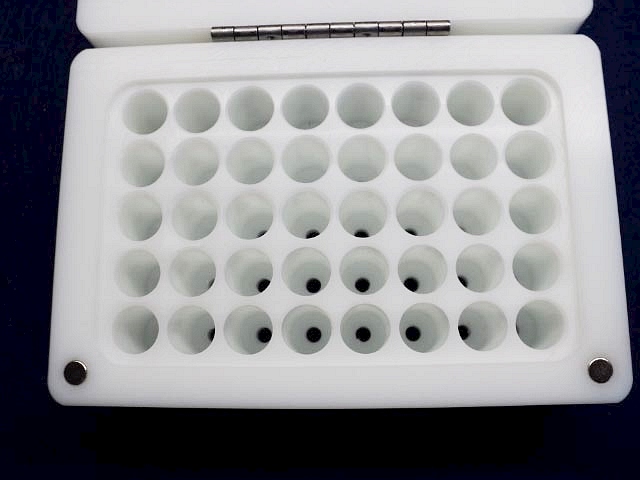
Up in Wisconsin, a gentleman named Joe Maisto crafts some exceptionally nice competition cartridge boxes. Each box is hand-machined (no molds, no CNC), with the holes precisely fitted to the cartridge you shoot. Joe has been building his boxes since 1996, first from wood, and now from more durable (and easier-to-clean) polymers. Joe started with a hinge-top 25-round box (with magnetic latch) for short-range benchresters. He still makes that box, but now he also offers 40-round boxes, high-top boxes (for bigger, taller cartridges), open top cartridge blocks, and combo blocks with holes for cases and a built-in tray. Our buddies in the short-range benchrest game say the Maisto boxes are perfect for carrying rounds from the loading bench to the firing line. GO TO Joseph Maisto website.
25-Round Cartridge Boxes
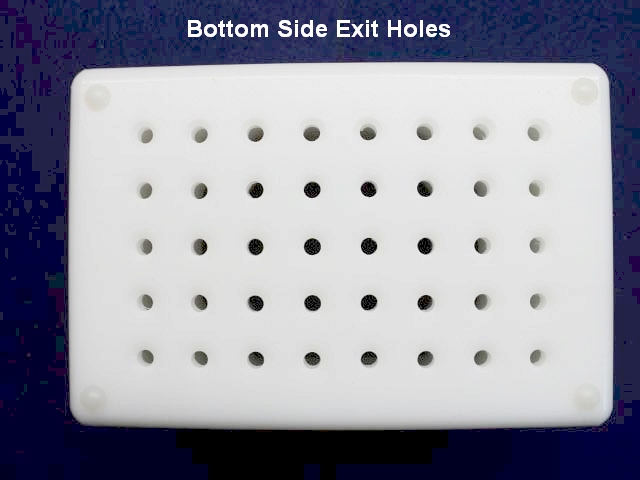
These units were designed in 1996. The originals were machined of Walnut, Cherry, or Birch. They were lovely, laborious, and expensive. To make the price more affordable, the wood units have since been retired in favor of high density polyethylene (HDPE). The front holes are separated for “record rounds”. Holes are bored with a minimum of clearance, and up to the shoulder. Additionally, each cartridge slot has a smaller hole in the bottom to allow debris to exist. These $60.00 boxes feature a quality stainless steel hinge with small but strong magnets that provide secure closure. While these were originally crafted for PPC cases, Joe offers various hole diameters for different-sized small cartridges.
40-Round Cartridge Boxes
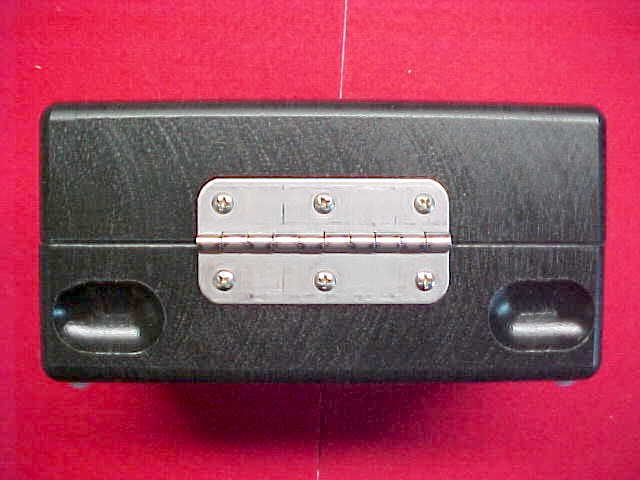
For those who want more capacity (for longer strings of fire), Joe offers 40-round cartridge boxes. These allow shooters to change loads on the line, or simply have more rounds in a single box. With finger grooves front and back, the 40-rd boxes work for both left and right handers. Just like the 25-rd boxes, the 40s have a stainless hinge and magnetic closure. Price is $130.00.
Large Cartridge Box
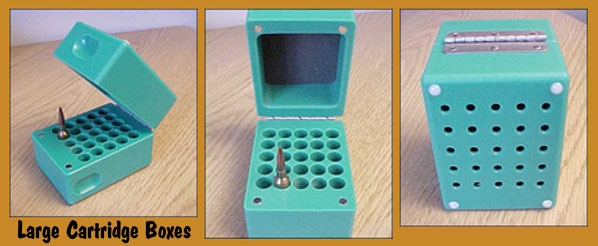
Joe’s Large Cartridge Boxes are taller to accommodate the bigger cartridges used for long-range shooting. These feature magnetic latching and and bottom exit holes, just like the Joe’s original PPC boxes. Joe notes that, for some cartridges, the Large Boxes “have 20 holes instead of 25 because of the larger cartridge head size”. When ordering the Large Boxes, you need to specify cartridge dimensions and cartridge overall loaded length (COAL). Price is $65.00 per box.
Cartridge Blocks
These cartridge “blocks” are made from the same material as Joe’s cartridge boxes. Each has finger grooves and exit holes. Joe says: “The size of the block is perfect for manipulating primed cases under a powder measure where space is a factor.” The 20-round block costs $19.00. Joe also offers a version with a recess on one side for empties. These have either 10 or 14 holes and cost $28.00.
Joseph A. Maisto www.benchrest.com/maisto
3647 Debby Lane
Franksville, Wl 53126
PH: (262) 886-1610
Email: jmaisto [at] wi.rr.com
Rimfire-ammo maker ELEY Ltd. recently opened a new test facility in Winters, Texas. On hand for the opening ceremony were triple Olympic Medal Winner Matt Emmons and 2012 Gold medal Winner Jamie Gray. Other notable shooters at the opening included legendary Olympian Lones Wigger and husband and wife team Sandra and Eric Uptagrafft. Media and industry were represented by NRABlog editor Chip Lohman, Corrie West of USA Shooting, and staff from Shilen Barrels and Stiller’s Precision Firearms.
Eric Uptagrafft praised Eley’s new facility: “To see this come to fruition is very exciting. It shows the level of support and dedication that Eley has as a partner of USA Shooting. I expect this will create a huge advantage for our team and our abilities to diligently do the testing that is required being an elite-level shooter.” Jamie Gray concurred: “It’s good to have a test range of this caliber in the United States because it makes it easier for [American shooters] to get out and test-fire more often. It’s easier for us to bring our guns to Texas than take them overseas, especially in England.”
Eley has invested heavily in the new two-lane test facility which allows pistol, rifle, and benchrest rimfire shooters to test their firearms with ELEY rimfire ammunition. Eley’s new Texas facility allows lot-by-lot batch testing to be done in the USA for the first time. Batch testing used to be limited to the UK, at ELEY’s Head Office. Earlier this year ELEY opened their second range in Stuttgart, Germany and now the third Winters, Texas. The facility will have the ability to test both .22 Rifles and Pistols with electronic target systems and advanced group-measuring software. All three Eley Test Centers have two 50-meter lanes for testing .22 Rifles and Free Pistols. The USA and Germany ranges also allow testing of Free Pistols and Rapid Fire Pistols at 25m.
Meanwhile, Out in Arizona…. We’re pleased that Eley has opened a two-lane facility in the USA. That’s great for shooters. But the new Eley facility is limited to 50m (fifty meters) maximum. By contrast, the new state-of-the-art Lapua Rimfire Service Center in Mesa, Arizona has the ability to record results at 50m AND 100m simultaneously. As your shots pass through special sensor grids positioned at both 50m and 100m, Lapua plots your group size at both distances during on the same string of fire. We think that’s a huge advantage for Lapua’s Arizona Test Center compared to Eley’s Texas facility. Another difference is that at Eley you can only test Tenex ammunition while at Mesa, you can test all types of Lapua rimfire ammo from the top of the line to the more economical products. That’s another significant advantage for the Lapua operation. But it’s great that American shooters now have a choice of two rimfire testing facilities within our national borders.
NECO a vendor of specialty reloading products include QuickLOAD software, recently revealed some impressive 6.5 mm bullet offerings — a new CNC-turned solid brass 107gr bullet and the hard-to-find Norma 130gr bullet (in both naked and moly-coated versions).
Solid Brass DaVinci 6.5mm Bullets The new solid brass NECO DaVinci Match Grade 6.5mm burner is an interesting High BC VLD-style design. Precision-machined on Swiss CNC machines, these bullets show exceptional dimensional and weight uniformity. And you won’t ever need to “tip” these bullets. The DaVinci 107-grainers feature a precision-drilled drilled hollow point and machined meplat. The DaVinci 107s are made from high-grade free machining brass. This is softer than copper but much harder and more durable than lead. If you’re wondering about the milled grooves in the body of the bullet, those are there to reduce the bearing surface area — a common design feature on solids. NECO is claiming: “Great lubricity resulting in less pressure than a solid copper or a jacketed bullet.” We haven’t tested this milled bullets yet but we hope to try them out soon in a 6.5×47 we have in the works. Initial tests by the manufacturer have soon good accuracy.
Thanks to a promotional offer from NECO, these new .264 caliber, 107gr bullets are more affordable than most other lathe-turned designs. Now through January 14, 2013, a 100-ct box of solid brass DaVinci 6.5mm bullets is $75.00. That’s not cheap, but it’s not outrageous when you considers some jacketed match bullets now run close to $50.00 per box. Currently only 107gr DaVincis are for sale, but NECO plans to offer 120gr 6.5mm solids in the future.
Norma 6.5mm 130gr Match Bullets In Europe, High Power-style shooting with 6.5mm rifles is extremely popular. In Germany and throughout Scandinavia, thousands of shooters compete in matches with 6.5×55 target rifles, notably the Sauer STR 200. One of the most popular projectiles is Norma’s 130gr match bullet. NECO now sells this bullet design in both naked (Golden Target) and moly-coated (Diamond Line) versions. Diamond Line 130s are moly-coated by Norma at the factory under license with NECO.
Both naked and coated Norma 130-grainers are affordable, priced at $34.95 per 100ct box, or $164.95 per 500ct box. Shooters have praised Norma’s 6.5mm 130gr match bullets. Check out these user reviews from MidwayUSA.com:
“Bullet has an excellent Litz G7 BC and a shorter ogive than the 130gr Bergers, making them more magazine friendly. Experience in my 26″ 1:8 barrel shows peak accuracy around 2900 fps with H4350, with another small node around 2960 fps.” — Paul, Sellersberg, IN
“Bought a box of 500 since the Berger 130s were in short supply due to competition season. First impressions: very well made, consistent weight, ogive, and bearing length. Loaded some up for my Savage 6.5×47 Bartlein 1:8″-twist 28″ and during load development at 200 yards I could shoot very small groups… with .409″ nice 5-shot clusters on a windy day. They seem to like just kissing the lands and you do not have to hot-rod them. Will buy another box of 500, these are very good mid range competition bullets and will use them in my next club match. Highly recommend!” — Steve, Nashville, TN
To see a 6.5×55 Sauer STR 200 rifle in action, watch the video. In this ‘Stangskyting’ competition, shooters have just 25 seconds to hit the target [at] 200-300m distance as many times as possible. In the video, a shooter named Børklop, using his Sauer STR 200, puts 16 rounds on target in just 25 seconds. (He starts with a round in the chamber and cycles through three, 5-round magazines). Børklop’s performance, with just a sling and iron sights, is impressive. Note that Børklop manipulates the Sauer’s bolt with his thumb and index finger, while pulling the trigger with his middle finger.
Product Tip from EdLongrange. We welcome reader submissions
Report by Jeff Williams, AccurateShooter Correspondent
If you’ve visited BergerBullets.com lately, you’ve noticed that Berger Bullets has completely over-hauled and updated its website. The new website has a very handsome, clean layout. It is also faster to load and much easier to navigate. We give Berger an “A” grade for the new website.
On Berger’s home page you’ll find product descriptions, easy-to-use (smart-phone friendly) product buttons, pull-down menus for all four Berger bullet line-ups, recent news items, plus videos. Click “Links” to access a comprehensive list of reloading resources with a directory of shooting association websites. Click the Berger Bulletin tab to read current product status reports, technical articles, and shooting tips.
Redesigned Bullet Info Tables
The bullet product info pages are much easier to read now. Simple tables display all the bullets of a particular type (hunting, target, varmint, and tactical), organized by caliber and weight within calibers. You’ll find BOTH G1 model and G7 model Ballistics coefficients (BCs) for all the bullets in the tables, and recommended twist rates are listed.
Berger Twist-Rate Stability Calculator
The new Berger website also offers a handy Twist-Rate Stability Calculator that predicts your gyroscopic stability factor (SG) based on mulitiple variables: velocity, bullet length, bullet weight, barrel twist rate, ambient temperature, and altitude. This very cool tool tells you if your chosen bullet will really stabilize in your barrel. LIVE DEMO BELOW — Just enter values in the data boxes and click “Calculate SG”.


 In our Shooters’ Forum a reader recently asked: “How much neck tension should I use?” This prompted a Forum discussion in which other Forum members recommended a specific number based on their experience, such as .001″, .002″, or .003″. These numbers, as commonly used, correspond to the difference between case-neck OD after sizing and the neck OD of a loaded round, with bullet in place. In other words, the numbers refer to the nominal amount of interference fit (after sizing).
 Neck-Wall Thickness is Important Too


 By Michael Bussard, edited by John B. Allen, David Kosowski, Charles F. Priore, Jr.
 On his

 Here’s good news for purchasers of reloading components.








 We’re pleased that Eley has opened a two-lane facility in the USA. That’s great for shooters. But the new Eley facility is limited to 50m (fifty meters) maximum. By contrast, the new state-of-the-art
 The new solid brass NECO DaVinci Match Grade 6.5mm burner is an interesting High BC VLD-style design. Precision-machined on Swiss CNC machines, these bullets show exceptional dimensional and weight uniformity. And you won’t ever need to “tip” these bullets. The DaVinci 107-grainers feature a precision-drilled drilled hollow point and machined meplat. The DaVinci 107s are made from high-grade free machining brass. This is softer than copper but much harder and more durable than lead. If you’re wondering about the milled grooves in the body of the bullet, those are there to reduce the bearing surface area — a common design feature on solids. NECO is claiming: “Great lubricity resulting in less pressure than a solid copper or a jacketed bullet.” We haven’t tested this milled bullets yet but we hope to try them out soon in a 6.5×47 we have in the works. Initial tests by the manufacturer have soon good accuracy.
  In Europe, High Power-style shooting with 6.5mm rifles is extremely popular. In Germany and throughout Scandinavia, thousands of shooters compete in matches with 6.5×55 target rifles, notably the Sauer STR 200. One of the most popular projectiles is Norma’s 130gr match bullet. NECO now sells this bullet design in both naked (Golden Target) and moly-coated (Diamond Line) versions. Diamond Line 130s are moly-coated by Norma at the factory under license with NECO.


