The Sporting Arms and Ammunition Manufacturers’ Institute (SAAMI) has produced an amazing 25-minute video that shows what actually happens to sporting ammunition involved in a fire. This video shows the results of serious tests conducted with the assistance of professional fire crews. We strongly recommend you watch this video, all the way through. It dispels many myths, while demonstrating what really happens when ammunition is burned, dropped, or crushed.
Watch SAAMI Ammunition Testing Video
Over 400,000 rounds of ammunition were used in the tests. Some of the footage is quite remarkable. Testers built a bonfire with 28,000 rounds of boxed ammo soaked in diesel fuel. Then the testers loaded five pallets of ammo (250,000 rounds) in the back of a semi-truck, and torched it all using wood and paper fire-starting materials doused with diesel fuel.
The video shows that, when ammo boxes are set on fire, and ammunition does discharge, the bullet normally exits at low speed and low pressure. SAAMI states: “Smokeless powders must be confined to propel a projectile at high velocity. When not in a firearm, projectile velocities are extremely low.” At distances of 10 meters, bullets launched from “cooked-off” ammo would not penetrate the normal “turn-out gear” worn by fire-fighters.
We are not suggesting you disregard the risks of ammo “cooking off” in a fire, but you will learn the realities of the situation by watching the video. There are some amazing demonstrations — including a simulated retail store fire with 115,000 rounds of ammo in boxes. As cartridges cook off, it sounds like a battery of machine-guns, but projectiles did not penetrate the “store” walls, or even two layers of sheet-rock. The fire crew puts out the “store fire” easily in under 20 seconds, just using water.
Additional Testing: Drop Test, Projectile Test, Crush Test, Blasting Cap Test
Drop Test
The video also offers interesting ammo-handling tests. Boxes of ammo were dropped from a height of 65 feet. Only a tiny fraction of the cartridges discharged, and there was no chain-fire. SAAMI concludes: “When dropped from extreme heights (65 feet), sporting ammunition is unlikely to ignite. If a cartridge ignites, it does not propagate.”
Rifle Fire Test
SAAMI’s testers even tried to blow up boxes of ammunition with rifle fire. Boxes of loaded ammo were shot with .308 Win rounds from 65 yards. The video includes fascinating slow-motion footage showing rounds penetrating boxes of rifle cartridges, pistol ammo, and shotgun shells. Individual cartridges that were penetrated were destroyed, but adjacent cartridges suffered little damage, other than some powder leakage. SAAMI observed: “Most of the ammunition did not ignite. When a cartridge did ignite, there was no chain reaction.”
Bulldozer Crush Test
The test team also did an amazing “crush-test” using a Bulldozer. First boxes of loaded ammo, then loose piles of ammo, were crushed under the treads of a Bulldozer. A handful of rounds fired off, but again there was no chain-fire, and no large explosion. SAAMI observed: “Even in the most extreme conditions of compression and friction, sporting ammunition is unlikely to ignite. [If it does ignite when crushed] it does not propagate.”
Blasting Cap Test
Perhaps most amazingly, the testers were not able to get ammunition to chain-fire (detonate all at once), even when using blasting caps affixed directly to live primers. In the SAAMI test, a blasting cap was placed on the primer of a round housed in a large box of ammo. One cartridge ignited but the rest of the boxed ammo was relatively undamaged and there was no propagation.
This week Student of the Gun (SOTG) heads to the range to see whether a suppressed centerfire rifle can be quieter than a rimfire rifle. SOTG tested sub-sonic .300 Blackout ammunition in an AAC Micro 7 bolt-action rifle fitted with an AAC suppressor (aka “silencer”). SOTG found that this suppressed AAC rifle, shooting sub-sonic ammo, was actually quieter than a rimfire rifle using standard velocity .22LR ammo. Watch the video below to see how the testing was done. Results are discussed at the five minute mark.
SOTG Video– Silent Shooting with the .300 Blackout
StudentoftheGun.com is a popular website that covers a variety of gun-related topics. (After the suppressor test, this week’s SOTG video includes segments on concealed carry and outdoor survival skills.) SOTG provides a full mix of content, including online videos, articles, books, and DVDs. A new video episode is uploaded every Tuesday by 6:00 pm. SOTG also offers self-defense instruction.
These are all normal-quality bullets, not “blems”. However, some of these bullet designs are being “phased out” by Berger (as we reported last week). If you have tried these bullets and they shoot well in your gun(s) you might want to pick up a supply before they are sold out. For example, one of our friends has had great luck shooting the BG30403 .308 125-grainers in his 30BR, winning local matches with them.
17 Cal (.172) 20 Gr Match Varmint (200 ct)
Code: BG17304 – Price: $56.79 $46.69
17 Cal (.172) 30 Gr Match Varmint (200 ct)
Code: BG17310 – Price: $53.39 $39.06
17 Cal (.172) 25 Gr Match Target (200 ct)
Code: BG17407 – Price: $48.19 $39.51
20 Cal (.204) 30 Gr Match Varmint (100 ct)
Code: BG20302 – Price: $28.39 $20.17
20 Cal (.204) 50 Gr Match Varmint BT (100 ct)
Code: BG20305 – Price: $29.79 $20.02
22 Cal (.224) 30 Gr Match Varmint (100 ct)
Code: BG22301 – Price: $24.39 $19.88
6mm (.243) 60 Gr Match Varmint (100 ct)
Code: BG24301 – Price: $31.99 $25.20
6mm (.243) 65 Gr Match Target (100 ct)
Code: BG24405 – Price: $27.09 $21.29
6mm (.243) 100 Gr Match BT Bullets (100 ct)
Code: BG24432 – Price: $35.69 $29.42
25 Cal (.257) 87 Gr Match Target (100 ct)
Code: BG25407 – Price: $46.99 $37.20
25 Cal. (.257) 115 Gr Match Target VLD (100 ct)
Code: BG25413 – Price: $40.29 $31.66
6.5mm (.264) 100 Gr Match Target BT (100 ct)
Code: BG26408 – Price: $47.59 $38.73
7mm (.284) 180 Gr Match Target BT (100 ct)
Code: BG28404 – Price: $47.99 $40.35
7mm (.284) 175 Gr Match Target XLD (100 ct)
Code: BG28408 – Price: $47.49 $38.87
30 Cal (.308) 110 Gr Match Target FB (100 ct)
Code: BG30401 – Price: $40.89 $33.40
30 Cal (.308) 125 Gr Match Target FB (100 ct)
Code: BG30403 – Price: $43.79 $34.28
30 Cal (.308) 135 Gr Match Target FB (100)
Code: BG30405 – Price: $47.59 $37.53
30 Cal (.308) 168 Gr Match Target BT (100 ct)
Code: BG30411 – Price: $45.99 $35.12
30 Cal (.308) 190 Gr Match Target VLD (100 ct)
Code: BG30414 – Price: $47.99 $38.69
While the 6.5 Creedmoor cartridge was devised primarily for High Power and Across the Course shooters, it has also found favor with tactical shooters looking for a highly accurate round that feeds well from a magazine, but offers significantly less recoil than a .308 Winchester. In fact, the 6.5 Creedmoor has become so popular that some vendors we checked were sold out of both brass and loaded ammo. (Don’t worry though — Creedmoor Sports has both 6.5 Creedmoor brass and loaded ammo in stock.)
6.5 Creedmoor vs. 6.5×47 Lapua — Cost Factor
The 6.5×47 Lapua and 6.5 Creedmoor offer very similar ballistics with 120gr and 140gr bullets. However, 6.5 Creedmoor brass AND loaded ammo are cheaper. That’s a big plus in the tactical game. At tactical competitions, there are “move and shoot” stages where you need to shoot quickly and then move to another position. It’s very difficult to recover all your brass. Losing a piece of 6.5×47 brass (at $1 dollar a pop) is painful. The Hornady brass is $34.49 per 50 (69 cents each) at Sinclair Int’l or $34.95 per 50 (70 cents each) at Creedmoor Sports.
Hornady’s 6.5 Creedmoor loaded ammunition is also much less expensive than the loaded 6.5×47 Lapua rounds. For shooters that don’t have the time (or skills) to reload, the 6.5 Creedmoor (at $25.95 per 20-rd box) makes more financial sense. Grafs.com currently sells loaded 123gr 6.5×47 Lapua ammo for $52.79 per 20 rounds.
On the other hand, the Lapua brass is tougher. Forum member Mudcat observes: “[As to] the Hornady brass, while it’s good, it ain’t no Lapua, so don’t try to run hot loads cause all you are going to do is blow out the primer pockets. Keep your loads reasonable and you will get over 20 loads out of em. I have some I have loaded well over 20 times during testing…they grow like a mother though, as they are a lot softer than Win or Lapua, which is why the pockets will go. However the necks haven’t been splitting.”
Barrel Life Looks Promising
Barrel life appears to be pretty good with the 6.5 Creedmoor. Barrels will last significantly longer than with a typical .243 Win or 6.5-284. Forum Member Mudcat reports: “Based on my throat wear at 600 rounds on my 6.5 Creedmoor barrel, I bet we are looking at 2500 rounds EASY of great accuracy and then probably to at least 3000 where you ain’t going to notice it shooting Cross the Course — you might see something at 600, but nothing worse than a few less Xs. At 600 rounds, I have not had to move my VLD seating depth yet.” Forum member Rob1, who shoots tactical comps with Team Blaster, notes that Hornady puts its load and velocity on every box (see photo below), so it’s easy for reloaders to duplicate the factory ammo. That way you can start with a few boxes of factory fodder, and then load your own.
We were recently asked: “What size neck bushing is best for Lapua 6mmBR brass in a ‘no-turn’ chamber?” The questioner planned to purchase a Redding Type ‘S’ full-length sizing die with neck bushings. The quick answer is that one should probably get 0.265, 0.266, and 0.267 bushings and see what works best.
Using current “Blue Box” Lapua brass, a loaded 6BR round with an unturned neck will typically run about 0.2680-0.2685 (depending on the bullet). A 0.266 neck bushing, after springback, will give about 0.0015 tension which can work well in a bolt gun. NOTE: With the older “Brown Box” Lapua Brass, the neckwalls are slightly thicker, so you may want to start with a .267 bushing. Remember, however, that with either older or newer Lapua brass you may want to experiment. Some bullets prefer more tension than others. And, you may find that it is useful to tweak neck tension slightly if you make major changes in seating depth during load development. In a gas gun, such as an AR15, you probably want .003 or more tension.
Alternative to Bushings — Honed Full-Length dies
Conventional, non-bushing full-length sizing dies can create ultra-accurate ammo with very low run-out. For some applications, we prefer a non-bushing FL die over a bushing die — so long as the neck tension is correct. But many FL dies have an undersized neck diameter so you end up with excess neck tension, and you work the brass excessively. Forster offers a simple, inexpensive solution — honing the neck diameter to whatever size you want.
If you purchase a Forster non-bushing, full-length sizing die, Forster will hone the neck dimension to your specs for $12.00 extra (plus shipping). This way you can have a FL die that provides the right amount of tension for your particular load. (The max amount of diameter change Forster can do is about .008″) Forster dies are relatively inexpensive so you can afford to have a couple of FL dies with necks honed to different diameters — such as 0.266″ and 0.267″ for a no-turn 6mmBR. The die itself is fairly inexpensive — currently Sinclair Int’l charges $33.99 for a Forster 6mmBR full-length sizing die (Forster Part # 018121).
Forster FL dies, necks honed to .265″, .266″, and .267″.
Steve Rasmussen of IowaHighPower.com gave this a try. In fact, he had three dies made — each with a different neck dimension. Here’s his report: “My original Forster 6BR FL die sized the necks down a lot [to about 0.260″]. I sent my die in and asked if they could supply two more FL dies (for three total) to have the necks honed to 0.265″, 0.266″, and 0.267″.” In addition to the purchase cost of two more FL-sizing dies, Steve paid $36 ($12 per die) for the three dies to be honed, plus about $12 for return shipping.
The table below shows the neck diameter range of 10 sized cases using each die. [NOTE: This is with older “Brown Box” Lapua brass!] Brass springback after sizing is running 1 to 1.3 thousandths. My loaded rounds are running 0.2697-0.2699 using Lapua I bought last year. So far the dies are working well. I sized 80 cases with the 0.266″ necked die. The shoulder is running 0.4582″ and 0.300″ up from the base is 0.4684". I spun 20 of ‘em and 16 had a runout of one thousandth (0.001) and the other 4 at 1.5 thousandths (0.0015).”
Berger Bullets recently announced that it is discontinuing a variety of bullet types in eight different calibers from .17 to .30. These bullet designs are being phased out, and many will be replaced with updated products in similar weight ranges. Though some bullet types are being discontinued, these projectiles might still perform great in your rifle(s). You should check the list of discontinued Berger Bullets below. If you are already using some of these, and find that they shoot well in your rifle(s), you may want to consider picking up a supply before they’re all gone. In our reloading-for-accuracy game, sometimes a “sure thing” is the best option.
Berger explains: “We are hearing about increased orders on both firearms and components. In preparation for the coming months, we are discontinuing several of our bullet designs which are not big sellers. This will give us more production capability for our more popular bullets and new releases, ensuring that you receive your bullets as quickly as possible. Also, this help us move forward on several new bullet designs for target, hunting, varmint and tactical applications.”
November 16th Deadline to Purchase Discontinued Designs
Berger has declared that “all existing orders for these bullets will be filled. Any additional orders must be placed by Nov 16, 2012. These bullets will no longer be available after November 16, 2012.”
Berger Bullets Discontinued After November 16, 2012
Part Number | Description
.17 Caliber
17304 17 CAL 20 GRAIN MATCH FB VARMINT
17310 17 CAL 30 GRAIN MATCH FB VARMINT
17407 17 CAL 25 GRAIN MATCH FB TARGET
.20 Caliber (.204)
20302 20 CAL 30 GRAIN MATCH FB VARMINT
20305 20 CAL 50 GRAIN MATCH BT VARMINT
.22 Caliber (.224)
22301 22 CAL 30 GRAIN MATCH FB VARMINT
22307 22 CAL 50 GRAIN MATCH FB VARMINT
22426 22 CAL 90 GRAIN MATCH BT TARGET
6mm (.243)
24301 6MM 60 GRAIN MATCH FB VARMINT
24405 6MM 65 GRAIN MATCH FB TARGET
24432 6MM 100 GRAIN MATCH BT TARGET
Part Number | Description
.25 Caliber (.257)
25407 25 CAL 87 GRAIN MATCH FB TARGET
25413 25 CAL 115 GRAIN MATCH VLD TARGET
6.5mm (.264)
26408 6.5MM 100 GRAIN MATCH BT TARGET
7mm (.284 Cal.)
28404 7MM 180 GR MATCH BT TARGET
28408 7MM 175 GRAIN MATCH XLD TARGET
.30 Caliber
30401 30 CAL 110 GRAIN MATCH FB TARGET
30403 30 CAL 125 GRAIN MATCH FB TARGET
30405 30 CAL 135 GRAIN MATCH FB TARGET
30411 30 CAL 168 GRAIN MATCH BT TARGET
30414 30 CAL 190 GRAIN MATCH VLD TARGET
Story tip by EdLongrange. We welcome reader submissions.
Here’s a good deal for you vintage military rifle shooters. For a limited time, Creedmoor Sports and Midsouth Shooters Supply are offering Hornady .30-06 Springfield M1 Garand Ammunition at special sale prices. Midsouth has this ammo for $27.38 per 20rd box — that’s 38% off the regular $44.33 MSRP. Creedmoor Sports offers Hornady’s .30-06 M1 Garand Ammo for $32.95 per 20rd box.
This ammo is favored by many CMP Garand match shooters. It is loaded with accurate, poly-tip A-Max bullets. The M1 Garand uses a gas port system to cycle the action, but existing .30-06 ammunition can burn too slow, causing the operating system to be driven harder and faster than intended. This new offering from Hornady is purpose-built to provide accurate, safe and reliable functioning for the M1 Garand. While optimized for M1 Garands, this ammunition also shoots well in 1903 Springfield rifles and other bolt-guns chambered for the .30-06 Springfield cartridge.
The folks at Desert Tactical Arms (DTA) in Utah recently held a Halloween “fun shoot”. How does an arms manufacturer celebrate Halloween? The same way they celebrate every other holiday–shooting stuff! The DTA crew figured the perfect Halloween event would include Precision Rifles, Superheroes, and Exploding Pumpkins.
Accordingly, DTA hosted its first ever Pumpkin Shoot at the Sniper Country range in Northern Utah. Shooters (all dressed as Superheroes) had three (3) rounds to engage targets at different distances, racking up points based on target distance (the farther the target, the higher the points). Participants included Batman, Spiderman, Iron Man, Captain America (after a few too many doughnuts), and Nacho Libre (still in superhero training). The DTA crew reports this Halloween Superhero shoot “was a great way to enjoy some fall air and pay homage to the all-benevolent pumpkin.” Take a look:
To add spice to the Halloween shoot, the DTA guys set up a few Tannerite reactive targets on the range. When hit, these produced impressive explosions — as the next video reveals:
If you enjoyed these Desert Tactical Arms Videos, check out the Halloween Pumpkin Shoot Out-takes featuring the full cast of Superhero characters (plus one very ‘dazed and confused’ coyote hunter who wandered on to the scene during filming).
Video find by EdLongrange. We welcome reader submissions.
Here’s good news for folks looking for another domestic source of cartridge brass. Federal Premium, the folks who make Federal Gold Medal match ammo, is now offering new, virgin, unprimed cartridge brass for a variety of rifle and pistol cartridge types. The new Federal Premium brass will be sold by Sinclair International, Grafs.com and other popular retailers. Sinclair has Federal brass in stock now for the most popular rifle cartridges, including .223 Rem, .243 Win, .270 Win, .308 Win, .30-06 Springfield, .300 WSM and seven more cartridge types (13 rifle brass types total — see chart below).
Federal’s new brass for reloaders starts at $25.99 for fifty (50) cases of .308 Win Brass. The equivalent of $51.98 per hundred cases, that’s pretty affordable. However, note that some types of Federal brass are much more expensive. For example, Federal’s .300 WSM brass costs $43.99 for fifty (50) cases at Sinclair. Click Here for Federal Premium Brass at Sinclair.
Sinclair Int’l notes: “Federal ammunition has long been prized for its reliability, consistency, and quality. But the only way to get Federal brass for reloads was to save your spent shells or scrounge them off the range – until now. Pristine, unfired, properly head-stamped Federal brass for popular rifle cartridges is now available from the manufacturer, and we’re pleased to offer it.”
Product Tip from EdLongrange. We welcome submissions from readers.
Fall is here, and winter is coming. What are you going to do when it’s too cold outside to go shooting? How about a game of “Cartridge Chess”, with chess pieces sourced from your own ammunition collection? We think the Cartridge Chess set is pretty clever, and it’s bound to be a conversation-starter at home or at the hunting lodge.
Create Your Own Cartridge Chess Set
This is a 3-D rendering found on the Cheaper Than Dirt Facebook page. We’d like to see a chess set with actual cartridges (assembled without powder or primers), perhaps with .32 ACP pawns and the 50 BMG and .338 LM as King and Queen.
Challenge: How many cartridge and shotshell types can you identify? The Pawns look like 9mm or 40sw pistol cartridges, while the Rooks (Castles) are obviously 12ga shotgun shells.


 The Sporting Arms and Ammunition Manufacturers’ Institute (SAAMI) has produced an amazing 25-minute video that shows what actually happens to sporting ammunition involved in a fire. This video shows the results of serious tests conducted with the assistance of professional fire crews. We strongly recommend you watch this video, all the way through. It dispels many myths, while demonstrating what really happens when ammunition is burned, dropped, or crushed.
 We are not suggesting you disregard the risks of ammo “cooking off” in a fire, but you will learn the realities of the situation by watching the video. There are some amazing demonstrations — including a simulated retail store fire with 115,000 rounds of ammo in boxes. As cartridges cook off, it sounds like a battery of machine-guns, but projectiles did not penetrate the “store” walls, or even two layers of sheet-rock. The fire crew puts out the “store fire” easily in under 20 seconds, just using water.
 This week


 6.5 Creedmoor vs. 6.5×47 Lapua — Cost Factor
 Hornady’s 6.5 Creedmoor loaded ammunition is also much less expensive than the loaded 6.5×47 Lapua rounds. For shooters that don’t have the time (or skills) to reload, the 6.5 Creedmoor (at
 We were recently asked: “What size neck bushing is best for Lapua 6mmBR brass in a ‘no-turn’ chamber?” The questioner planned to purchase a Redding Type ‘S’ full-length sizing die with neck bushings. The quick answer is that one should probably get 0.265, 0.266, and 0.267 bushings and see what works best.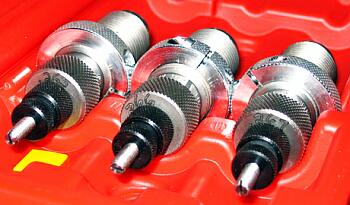


 The folks at
 Here’s good news for folks looking for another domestic source of cartridge brass. Federal Premium, the folks who make Federal Gold Medal match ammo, is now offering new, virgin, unprimed cartridge brass for a variety of rifle and pistol cartridge types. The new
 Fall is here, and winter is coming. What are you going to do when it’s too cold outside to go shooting? How about a game of “Cartridge Chess”, with chess pieces sourced from your own ammunition collection? We think the Cartridge Chess set is pretty clever, and it’s bound to be a conversation-starter at home or at the hunting lodge.


