by James Calhoon
(First Printed in Varmint Hunter Magazine, October, 1995)
In the course of talking to many shooters, it has become clear to me that the manufacturers of primers have done a less than adequate job of educating reloaders on the application of their primers. Everybody seems to realize that some primers are “hotter” than others and some seem to shoot better for them than others, but few reloaders know that primers have different pressure tolerances.
Primer Pressure Tolerance
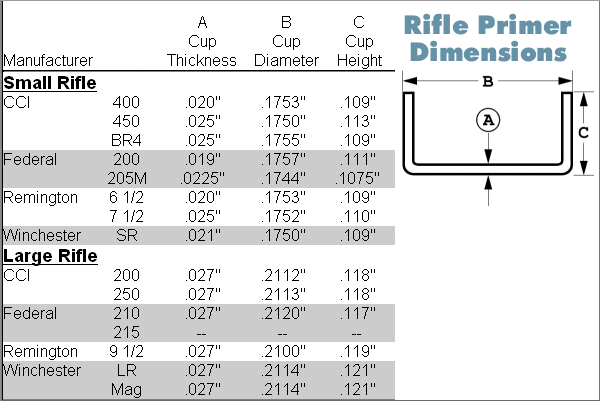
When loading a .223 to the maximum, I was getting primer piercing before I reached case overloading. I don’t know what prompted me to try CCI 450s instead of the 400s which I had been using, but I did. Presto! No more piercing! Interesting!? A primer that has a hotter ignition and yet withstands more pressure! Thats when I decided that it was time to do a dissection of all primers concerned. The chart below shows my results.
By studying the numbers (Cup “A” thickness), one can see which primers in the small rifle sections should be more resistant to primer cratering and/or piercing. Primer cup diameters are all similar and appear to follow a specification, but check out the cup thickness in the small rifle primers (Dimension “A”). Some cups are quite a bit thicker than others: .025″ for CCI 450 vs. .0019″ for Fed 200. Large rifle primers all appear to have the same cup thickness, no matter what the type. (As a note of interest, small pistol primers are .017″ thick and large pistol primers are .020″ thick.)
If you are shooting a 22 Cooper, Hornet, or a Bee, the .020″ cup will perform admirably. But try using the .020″ cup in a 17 Remington and you will pierce primers, even with moderate loads.
Considering that cup thickness varies in the small rifle primers, it is obvious that primer “flatness” cannot solely be used as a pressure indicator.
Another factor which determines the strength of a primer cup is the work-hardened state of the metal used to make the primer cup. Most primers are made with cartridge brass (70% copper, 30% zinc), which can vary from 46,000 psi, soft, to 76,000 psi tensile strength when fully hardened. Note that manufacturers specify the hardness of metal desired, so some cups are definitely “harder” that others.
What does all this mean to the reloader? - Cases that utilize small rifle primers and operate at moderate pressures (40,000 psi) can use CCI 400, Federal 200, Rem 6 1/2, or Win SR. Such cases include 22 CCM, 22 Hornet and the 218 Bee. Other cases that use the small rifle primer can use the above primers only if moderate loads are used. Keep to the lower end of reloading recommendations.
– Cases that utilize small rifle primers and operate at higher pressures (55,000 psi) should use CCI 450, CCI BR4, Fed 205 and Rem 7 1/2.
– All the large rifle primers measured have the same thickness. Therefore choose based on other factors, such as accuracy, low ES/SD, cost, cup hardness, and uniformity.
Hope this clears up some primer confusion. If you want more information about primers, priming compounds, or even how to make primers, the NRA sells an excellent book called “Ammunition Making” by George Frost. This book tells it like it is in the ammo making industry.
Berger Bullets has released a new 6mm (.243 caliber) bullet for short-range (100-300 yards) benchrest applications. The new bullet (shown below right), is called the “6mm BR Column”. This name does not mean the bullet is designed just for the 6mm BR cartridge. Rather it is designed for all 6mm short-range benchrest (BR) rifles, most of which are 6 PPCs (for group shooting at least). The “Column” in the name comes from the fact that Berger has optimized the height of the lead core column inside the bullet. Testing revealed that bullets which had very uniform core column heights shot more accurately and were also easier to tune. Does the new “Column” bullet work? Well, noted benchrest shooter Lou Murdica has already used them to win a Two Gun Agg in Florida against “big name” competition. Thankfully, you won’t have to wait long to try these bullets out — Berger says the new 6mm BR ‘Column’ projectiles will be available in mid-March, 2012. Call Berger at (714) 447-5422 to order.
Bullet Characteristics — Accurate and Easy to Tune
Berger’s Ballistician and lead bullet designer Bryan Litz says this new ‘Column’ bullet should be less sensitive to seating depth: “We worked very hard to produce a bullet that has a wider ‘tuning window’ for peak accuracy. This means there may be several seating depths where it shoots well. We also expect that it can shoot well at different speed nodes, but this will be dependent on your barrel.” The estimated G1 BC for these bullets is 0.277. The meplat is 0.062″, typical of benchrest bullets in this weight class. There is a small pressure ring in the bullet. Recommended twist rate is 1:13.5″ but the bullet should stabilize in a 1:14″ twist-rate barrel.
Berger’s Eric Stecker tells us: “There have been benchrest bullets in the past which were well-known for achieving consistently small groups over a wide tune range in many rifles and loads. One example of this was the Euber bullet. The seemingly ‘magical’ performance of these bullets has been attributed to special dies, stars aligning, owl feathers, or some other unknown influence. However, Bryan Litz has found that there are specific mass balance and aerodynamic properties which allow a bullet to mitigate dispersion and shoot precisely over a wide range of imperfect launch dynamics.”
Dispersion Mitigation in Bullet Design — Bryan Litz Explains The science of dispersion-mitigating bullets is understood, but until now, no one has ever deliberately designed a bullet that has these specific attributes. There have been other bullets which have accidentally achieved the partial effect and the resulting bullets became very well known. Three key things are required to develop an effective dispersion-mitigating bullet:
1. The knowledge required to design a dispersion mitigating bullet.
2. A bullet-maker with the ability to fabricate the design precisely.
3. The means by which to test the bullets extensively to determine optimal configuration.
Berger’s 6mm ‘Column’ bullet is specifically designed to mitigate the component of dispersion related to alignment. Variables related to bullet/bore axis alignment include tight necks, turning necks, bullet jump, chamber concentricity, powder charge, and so on. These are all variables which will be less critical for the new Berger 6mm ‘Column’ bullet.
To be realistic, these new bullets only mitigate dispersion effects related to axis alignment, NOT aiming error, wind deflection, or poor shooting.
Four Years of Prototype Testing Yields Superior Bullet Design
Using his knowledge of design factors that mitigate (reduce) dispersion, Berger’s bullet designer Bryan Litz went to work creating a bullet design that had a wide, forgiving tune range. This means that the bullet shoots well with a wide variety of loads and seating depths. Bryan came up with three different shapes. Then for each of these three bullet profiles, Berger tested three different core column heights to identify the truly optimal design. Over the next four years, Lou Murdica shot thousands of test rounds in the data capture phase of the project. When testing concluded, one bullet proved to be head and shoulders above the others in its ability to shoot well at the widest variety of loads and seating depths.
The prototype bullet design that shot best in Berger’s tests has entered production as the new Berger 6mm BR ‘Column’. You’ll notice that there is no listed weight. Berger doesn’t list weight because Berger learned that the bullet’s mass is not as important as the overall balance of the bullet, which is achieved with a specific internal lead column height. Due to slight variations in copper and lead material batches, one lot may weigh 64.8 gr while another lot might weigh 65.1 grains or 64.6 grains. Berger says: “So long as the column of lead is the correct height to achieve the desired balance” the bullets should perform, no matter what the average weight of a given lot of ‘Column’ bullets may be. That said, when loading for a match, you’ll want to load all your ammo with bullets from the same lot.
Berger is now accepting orders for the new 6mm BR ‘Column’ bullets. The first lots should be available around March 16, 2012. Call Berger at (714) 447-5422 for pricing info or to place an order.
Black Hills has announced three new types of loaded ammunition for 2012. (This is all-new factory ammo, not commercial reloads.) The first caliber is the .204 Ruger. The new round uses the 32gr Hornady V-Max™ projectile that has proven to be one of the most accurate and effective bullets available for use on varmints.
125gr and 220gr (subsonic) Options in .300 Whisper
The second is the .300 Whisper. This cartridge is the brainchild of JD Jones of SSK and has been around a long time as a proven wildcat cartridge. This versatile 30-caliber cartridge is designed primarily for use in M4/M16/AR-15 family of rifles and allows for use of a wide weight range of projectiles. Initial Black Hills loads for this cartridge are a 125 grain load that essentially duplicates 7.62×39 ballistics, but with far superior accuracy, plus a 220 grain Sierra MatchKing at subsonic velocity.
New 69gr SMK load in .223 Rem for AR15s
For use in AR15s with 1:9″ twist barrels, Black Hills’s customers have asked Black Hills to provide factory ammo loaded Sierra’s highly accurate 69gr MatchKing. In response to customer demand, for 2012 Black Hills will be offering the 69gr SMK loaded to 5.56mm pressures and velocities in military specification brass. In this new ammo, Black Hills has utilized modern temperature-stable, flash-suppressed propellant.
New Product Tip from EdLongrange. We welcome reader submissions.
Hornady Manufacturing has recalled seven lots of 500 S&W 300 grain FTX® Custom™ pistol ammunition. Hornady ballisticians have determined that some cartridges from Lot numbers 3101327, 3110256, 3110683, 3110695, 3110945, 3111388, 3111885, may exhibit excessive chamber pressures. These lots were shipped between September 9, 2010, and October 17, 2011. Use of this product may result in firearm damage and/or personal injury.
Recalled Lot Numbers: 3101327, 3110256, 3110683, 3110695, 3110945, 3111388, 3111885. The Lot number can be found printed on the lower portion of the box label.
If you own any of these Lot numbers or have any questions regarding this recall, Call Hornady at 800-338-1242 right away. Hornady Manufacturing Company will make all arrangements associated with the return and replacement of this product.
A while back, Werner Mehl of Kurzzeit.com produced a 10-minute video for the 2010 SHOT Show. When syndicated via YouTube, this amazing video became an internet phenomenon. It has been watched over six million times! Employing cameras recording at up to 1,000,000 (one million) frames per second, Mehl’s bullet flight video has been called “astounding”, “mesmerizing”, and a “work of art.” If you haven’t seen it yet, sit back and enjoy!
LINK: Kurzzeit.com Video System and PVM-21 Chronograph
Click the link above to learn more about Werner Mehl and his super-sophisticated camera systems that can record at 1,000,000 frames per second. On the same linked page you can learn about the advanced PVM-21 chronograph designed by Werner. Operating “all-infrared, all the time”, the PVM-21 is the best chronograph we have tested for very low light conditions, or very tricky light conditions.
With Copper Exchange prices edging towards $4.00/lb, cartridge brass in any condition is worth saving. (Prices reached $4.50/lb last year!) Even worn-out, split, or Berdan-primed brass with negligible value to reloaders can be worth real money given current scrap metal prices. People commonly leave .22 LR casings on the ground because they can’t be easily reloaded. Nowadays, it may be worth saving brass of any kind. In California, scrap metal dealers are paying $1.75 a pound for used cartridge brass — including buckets of used .22 LR casings.
Of course, if you have good pistol and rifle brass that’s worth reloading, don’t take it to a scrap dealer. You should be able to get more money selling the brass to reloaders via Forum Classifieds or Gunbroker.com. However, if you’ve got buckets of old, split, tarnished brass, .22 LR casings, or Berdan-primed cases and you don’t want to take the time to clean, inspect, and sort your cases… maybe you should just sell ‘em for scrap. For someone with hundreds of pounds of miscellaneous brass, current scrap prices can be attractive. In the past, at ranges, we’ve seen scores of milsurp Berdan-primed cases left on the ground since they are not easily reloadable. Now, we predict those cases will be collected and sold for scrap.
Nosler is offering deeply discounted pricing on Over-Run brass in these calibers: 6.5×55 Swede, .338 Lapua Magnum, 30-378 Weatherby, and 340 Weatherby. You can save up to 33% on the single-box price. Nosler puts 50 cases in a box of 6.5×55 brass. However, there are only 25 cases per box for the other, larger cartridges.
In addition to the bargain brass, Nosler is also offering big discounts on select Custom Competition bullets, and Nosler Custom Ammunition. For example, a 250-count box of Nosler’s 190gr .308-Cal Custom Comp bullets is marked down to $69.95 from $91.00, a 23% savings. Visit Nosler’s Over-Run Sales Page to see all the discounted products.
Nosler Sale tip by EdLongrange. We welcome reader submissions.
Forum member Skeeter has a 6mm Dasher falling block varmint rifle. The Dasher case is based on the 6mm BR Norma cartridge with the shoulder blown forward about 0.100″ and out to 40°. This gives the Dasher roughly 3.5 grains added capacity compared to the standard 6BR.
Last year, Skeeter needed to form 300 cases for varmint holiday. Skeeter decided to fire-form his brass without bullets. This method avoids barrel wear* and saves on components. There are various ways to do this, but Skeeter chose a method using pistol/shotgun powder, some tissue to hold the powder in place, Cream of Wheat filled to within an 1/8″ of top of the neck, and a “plug” of tissue paper to hold it all in place. Shown below are cases filled with a pistol/shotgun powder charge topped with Cream of Wheat and then a tissue paper plug.
To ensure the case headspaced firmly in his Dasher chamber, Skeeter created a “false shoulder” where the new neck-shoulder junction would be after fire-forming. After chamfering his case mouths, Skeeter necked up all his cases with a 0.257″ mandrel (one caliber oversized). Then he used a bushing neck-sizing die to bring the top half of the neck back down to 0.267″ to fit his 0.269″ chamber. The photo below shows how the false shoulder is created.
After creating the false shoulder, Skeeter chambered the cases in his rifle to ensure he could close the bolt and that he had a good “crush fit” on the false shoulder, ensuring proper headspace. All went well.
The next step was determining the optimal load of pistol powder. Among a variety of powders available, Skeeter chose Hodgdon Titewad as it is relatively inexpensive and burns clean. The goal was to find just the right amount of Titewad that would blow the shoulder forward sufficiently. Skeeter wanted to minimize the amount of powder used and work at a pressure that was safe for his falling block action.
Working incrementally, Skeeter started at 5.0 grains of Titewad, working up in 0.5 grain increments. As you can see, the 5.0 grain charge blew the shoulder forward, but left it a hemispherical shape. At about 7.0 grains of Titewad, the edge of the shoulder and case body was shaping up. Skeeter decided that 8.5 grains of Titewad was the “sweet spot”. He tried higher charges, but the shoulder didn’t really form up any better. It will take another firing or two, with a normal match load of rifle powder and a bullet seated, to really sharpen up the shoulders. Be sure to click on the “View Larger Image” link to get a good view of the cases.
The process proved to be a success. Skeeter now has hundreds of fire-formed Dasher cases and he hasn’t had to put one bullet through his nice, new match-grade barrel. The “bulletless” Cream of Wheat method allowed him to fire-form in a tight-necked barrel without neck-turning the brass first. The only step now remaining is to turn the newly Dasher-length necks down about .0025″ to fit his 0.269″ chamber. (To have no-turn necks he would need an 0.271″ or 0.272″ chamber).
Skeeter didn’t lose a single case: “As for the fire-forming loads, I had zero split cases and no signs of pressure in 325 cases fire-formed. Nor did I have any misfires or any that disbursed COW into the action of the firearm. So the COW method really worked out great for me and saved me a lot of money in powder and bullets.” To learn more about Skeeter’s fire-forming process, read this Dasher Fire-Forming Forum Thread.
*Skeeter did have a fire-forming barrel, but it was reamed with a .269 chamber like his 10-twist Krieger “good” barrel. If he fire-formed with bullets, he would have to turn all 300 necks to .267″ BEFORE fire-forming so that loaded rounds would fit in the chamber. Judging just how far to turn is problematic. There’s no need to turn the lower part of the neck that will eventually become shoulder–but how far down the neck to turn is the issue. By fire-forming without bullets now he only has to turn about half the original neck length, and he knows exactly how far to go.
Robert Whitley of AR-X Enterprises, LLC builds match-grade uppers for AR-platform rifles. Many of Robert’s favorite chamberings are based on the 6.5 Grendel case necked-down to 6mm. Until 2011, Lapua was the only source for 6.5 Grendel brass. As you’d expect, Lapua’s Grendel brass is truly excellent, but it is also pricey, and sometimes hard to find. Now Hornady is producing USA-made 6.5 Grendel brass. Robert Whitley has worked with the Hornady 6.5 Grendel brass for over a year now and he is able to assess its performance compared to the original Lapua version. Writing in our Shooters’ Forum, Robert reveals: “It’s decent brass but hot loads will loosen the primer pockets fast. With moderate loads you will get good case life and service from the brass and it can deliver excellent accuracy as well. Not Lapua but not bad either.”
Robert reports: “I was able to get my hands on some of Hornady’s 6.5 Grendel brass. My big question was how it would measure up, particularly the loaded necks, and whether it would be compatible with our existing 6mmAR and Turbo 40 die sets. As it turns out, this brass looks like a perfect fit for our existing die sets (and obviously 6.5 Grendel die sets too). Accordingly, folks with existing die sets will be able to use the Hornady brass without any issues.” However, as the loaded neck on the Hornady brass is .001″ (one-thousandth) slimmer than Lapua brass, you may want to try a smaller bushing when sizing Hornady Grendel brass.
The Hornady 6.5 Grendel brass has a LARGE Flash Hole, about .078″ versus .0591″ for Lapua brass. Dimensionally, the biggest difference is the shoulder diameter, with the Hornady brass measuring 0.428″ vs. 0.424″ for the Lapua brass. The Hornady is actually a better fit for 6mmAR chambers which are about 0.432″ at the shoulder. Interestingly, case H20 capacity is virtually identical. Water capacity of new, unfired Hornady 6.5 Grendel brass is 35.1 grains, while new, unfired Lapua Grendel brass holds 35.0 grains of H20. Both brands of Grendel brass increase to about 36.0 grains H20 capacity after firing and full-length sizing.
Here are some of the particulars of the Hornady cases:
Hornady 6.5 Grendel Brass
Lapua 6.5 Grendel Brass
Flash hole diameter: ~ .078″
OAL of brass: Average 1.515″
Weight of cases: 111.7 to 113.0 grains
Web diameter, unfired: 0.4375″
Shoulder diameter, unfired: 0.428″
Loaded neck diameter: 0.2895″
6mmAR loaded neck: 0.270″
Flash hole diameter: 1.5mm (0.0591″)
OAL of brass: Average 1.515″
Weight of cases: 111.0 to 112.5 grains
Web diameter, unfired: 0.4385″
Shoulder diameter, unfired: 0.424″
Loaded neck diameter: 0.290″
6mmAR loaded neck: 0.271″
Excellent ballistics apps have been available for iPhones and Android phones for quite some time. Well, Windows-phone users can now join the party. Ballistica, a $5.99 software App for WP7-OS smartphones (ver. 7.5+), is now on the market. Ballistica has all the features you’d expect from a modern ballistics solver. To get a solution, first enter your bullet info, MV, and BC (either G1 or G7). Then input the target distance, up/down angle, temp, altitude, barometric pressure, wind speed and wind angle. The program will create a drop chart with values of your choosing (MOA clicks or Mils). Conveniently, you can save Ballistic Profiles for particular loads (bullet/velocity combinations). CLICK HERE for Ballistica USER MANUAL (PDF file).
The user interface for Ballistica is simple and straightforward, with five primary screens:
Projectile Page: Enter data on bullet of choice: Caliber, Weight, Sight Height, BC (G1 or G7). Conditions Page: Set ambient conditions such as altitude, humidity, and wind direction/velocity. Target Page: Set target distance, target speed, and up/down line of sight angle. Chart Page: Shows POI drop chart with distance intervals you select. Mil- or MOA-segmented clicks. Quick Shot Page: This provides a fast firing solution at one distance. You can change variables as conditions change.
Video Review of Ballistics for Windows Phones
If you have a Windows-OS smart phone, Ballistica is definitely worth checking out. A FREE trial version is available. The trial version lets you access most of the features, however, you won’t be able to save profiles. You can download Ballistica from the Windows Phone Marketplace. You’ll find a “Try for Free” link for the free version right below the purchase link. You can also download a FREE USER Manual for Ballistica. NOTE: Ballistica requires Windows Phone ver. 7.5 or higher.




 The science of dispersion-mitigating bullets is understood, but until now, no one has ever deliberately designed a bullet that has these specific attributes. There have been other bullets which have accidentally achieved the partial effect and the resulting bullets became very well known. Three key things are required to develop an effective dispersion-mitigating bullet:
 Four Years of Prototype Testing





 Excellent ballistics apps have been available for iPhones and Android phones for quite some time. Well, Windows-phone users can now join the party.


