|
|
April 17th, 2012
Shaving bullet jackets is a problem reloaders encounter from time to time. It can be caused by excessive neck tension, burrs on the case mouth, or over-aggressive chamfering that leaves a ragged edge on the case mouth. Larry Medler discovered some rounds where the bullet jackets were getting shaved. Diagnosing the problem, he found that this was caused by his outside neck chamfer. He was using a powered screwdriver to rotate the case, and over-cutting plus tool chatter was causing the case neck to roll inwards. This created a thin, sharp edge that actually cut into the bullet jacket as the bullet was being seated.
 
Larry has a Load Force 250 measuring instrument that records the dynamic bullet seating force and displays the results on a computer screen. Larry noted that spikes in seating force were associated with the cases where the bullets were shaved. Inspecting the cases, Larry realized what was happening. Chamfering the outside after doing the inside allowed his tools to cut too much. Combined with tool chatter, this actually created a sharp, ragged edge that rolled inward towards the bullet: “I discovered I had rolled the case mouth rim inward while deburring the outer edge. When deburring the case mouth on the outside edge, every now and then I could hear some tool chatter. The effects of this chatter really show in the picture.”

The above chart shows the dynamic bullet seating force for the bullet with the shaved jacket. Note the large initial force used to cut and scratch the bullet outer surfaces. The final seating force of 47 pounds is just before the Wilson Seating Die bottoms out and the force on the load cell jumps. The chart below shows normal bullet seating force.

As a fix, Larry decided to reverse the neck deburring operations. Now he deburrs the outside first. This reduces tool chatter and prevents the edge from rolling over, because the neck thickness has not been thinned by inside chamfering. While Larry uses a powered screwdriver to speed his case processing, the lesson applies to those who chamfer manually as well–do the outside first and never overcut.
Remember, you simply want to remove burrs and create a slight chamfer. You don’t want to thin the brass significantly at the case mouth. This is why it is important to be very careful when using a deep-angle cutter such as the K&M inside neck chamferer. Click HERE to read Larry’s full report on neck chamfering, with more details on use of the Load Force 250 measuring instrument. Using device such as this, or a K&M arbor press equipped with a seating force gauge, will help you diagnose problems with your neck tension and reloading procedures.
April 14th, 2012
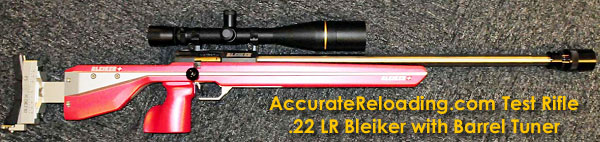
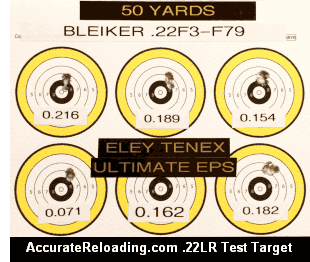 In 2010, the staff of AccurateReloading.com Forum completed a massive .22LR Rimfire Ammunition Testing Project. Some 55 different types of ammo were tested, using a highly-accurate Swiss-made Bleiker rifle, with a 2-stage trigger. All ammo varieties were tested at 50 yards, 75 yards, and 100 yards, shooting five, 5-shot groups at each distance. Though these tests were completed some time ago, many readers have requested a “reprint” of the ammo rankings, so we’ve republished this data below. In 2010, the staff of AccurateReloading.com Forum completed a massive .22LR Rimfire Ammunition Testing Project. Some 55 different types of ammo were tested, using a highly-accurate Swiss-made Bleiker rifle, with a 2-stage trigger. All ammo varieties were tested at 50 yards, 75 yards, and 100 yards, shooting five, 5-shot groups at each distance. Though these tests were completed some time ago, many readers have requested a “reprint” of the ammo rankings, so we’ve republished this data below.
The results are fascinating to say the least (and perhaps eye-opening). The tester observed: “I got some amazing groups, and some which are, frankly, absurdly bad! This has re-enforced what I had experienced with 22 ammo in the past — that is being consistently inconsistent.”
While we strongly caution that .22LR rimfire ammo may work well in one gun and not another, and ammo performance can be improved through the use of barrel tuners, the AccurateReloading.com research provides invaluable guidance for smallbore shooters. Overall, the testers burned through over 4,000 rounds of ammo, and you can see the actual test targets online. To read all the test reports, and view target photos visit AccurateReloading.com.
The lists below rank the average accuracy (by brand) of five, 5-shot groups shot at 50, 75, and 100 yards. CLICK HERE for Complete Test Results with target photos.
| 50-Yard Results |
75-Yard Results |
100-Yard Results |
0.162 Eley Tenex Ultimate EPS
0.164 Lapua Midas Plus
0.177 Lapua Polar Biathlon
0.187 Eley Match EPS
0.193 Eley Match
0.203 Lapua Midas M
0.215 Lapua Center X
0.216 Western Value Pack
0.229 Lapua Signum
0.241 Lapua Master L
0.243 Eley Pistol Match
0.256 Olin Ball
0.256 Akah X-Zone
0.261 Lapua Midas L
0.261 Lapua Master M
0.263 Eley Tenex Semi Auto
0.270 Lapua Super Club
0.272 Eley Tenex
0.303 Lapua Standard Plus
0.312 CCI Standard Velocity
0.319 RWS R 50
0.319 Eley Standard
0.328 SK High Velocity
0.339 Eley Club Xtra
0.340 Winchester T22
0.356 Federal Champion
0.362 Eley Subsonic HP
0.371 CCI Mini Mag
0.376 Federal American Eagle
0.377 Norinco Target
0.380 Sellier & Bellot Club
0.384 Eley Club
0.387 Eley Sport
0.388 Totem
0.392 Swartklip Match Trainer
0.398 Federal Gold Medal
0.403 Swartklip HV
0.409 Eley Match Xtra Plus
0.424 Sellier & Bellot Std
0.443 Remington Target
0.461 Lapua Crow HP
0.475 Eley Silhouex
0.479 Magtech
0.498 Eley High Velocity
0.513 Winchester Super X
0.516 Kassnar Concorde
0.539 CCI Blazer
0.560 Winchester Supreme Pistol
0.576 Norinco Pistol Revolver
0.593 SK Standard
0.611 Sellier And Bellot HP
0.626 SK Standard HP
0.686 Logo HV
0.956 Pobjeda Target |
0.274 Lapua Center X
0.283 Lapua Standard Plus
0.295 Eley Tenex Ultimate EPS
0.307 Lapua Midas M
0.329 Lapua Master M
0.346 Eley Match
0.373 Lapua Polar Biathlon
0.399 RWS R 50
0.432 Lapua Midas L
0.448 Eley Tenex Semi Auto
0.467 Eley Match EPS
0.474 Lapua master L
0.491 Eley Match Xtra Plus
0.494 CCI Standard
0.496 Eley Subsonic HP
0.507 Eley Sport
0.512 Federal American Eagle
0.513 SK High Velocity
0.514 Eley Standard
0.516 Eley Tenex
0.516 Lapua Crow HP
0.532 Western Value Pack
0.533 Fed. Champion Target
0.535 Lapua Midas Plus
0.564 Akah X Zone
0.566 Olin Ball
0.573 Eley Club Xtra
0.616 Lapua Signum
0.631 Winchester T22
0.639 Swartklip HV HP
0.641 Eley Club
0.642 Eley Silhouex
0.647 CCI Mini Mag
0.679 Eley Pistol Match
0.682 Swartklip Match Trainer
0.690 Federal Gold Medal
0.692 Remington HV
0.703 Lapua Super Club
0.720 Winchester Super X
0.738 Eley High Velocity
0.759 Kassnar Concorde
0.765 Sellier And Bellot Club
0.770 Winch. Supreme Pistol
0.770 Norinco target
0.775 CCI Blazer
0.802 Norinco Pistol Revolver
0.841 LVE Logo HV
0.855 Sellier & Bellot Std
0.871 Magtech
0.923 Sellier & Bellot HP
0.934 SK Standard HP
1.017 Remington Target
1.257 Totem Standard
1.442 SK Standard
1.578 Pobjeda target |
0.455 Eley Match
0.510 Lapua Midas Plus
0.549 Lapua Midas M
0.611 Lapua Polar Biathlon
0.611 Eley Tenex Ultimate EPS
0.619 Eley Match EPS
0.622 Eley Club
0.630 Lapua Center X
0.631 RWS R50
0.679 Eley Tenex Semi Auto
0.694 Lapua Midas L
0.729 Eley Tenex
0.739 Lapua Master L
0.753 Lapua Super Club
0.785 Lapua Master M
0.831 Eley Sport
0.851 Eley Match Xtra
0.859 Lapua Standard Plus
0.867 Akah X-Zone
0.877 Eley Pistol Match
0.907 Norinco Target
0.924 Eley Silhouex
0.939 CCI Standard
0.952 Eley Subsonic HP
0.963 Magtech
0.970 Olin Ball
0.978 Kassnar Concorde
0.995 Eley Club Xtra
1.009 Western Value Pack
1.032 Federal Champion
1.087 Norinco Pistol Revolver
1.100 CCI Mini Mag
1.112 Lapua Crow HP
1.143 Winchester T22
1.142 Federal Gold Medal
1.144 federal American Eagle
1.156 Swartklip Hollo Point
1.165 Lapua Signum
1.170 Swartklip Match Trainer
1.175 Fed. Champion Value Pk
1.182 SK high Velocity
1.201 Totem
1.224 Winchester Super X
1.358 Eley Standard
1.367 Remington High Velocity
1.375 CCI Blazer
1.414 Eley High Velocity
1.450 Remington Target
1.504 LVE Logo
1.813 SK Standard
1.879 S&B Club
1.947 S&B Hollow Point
2.073 SK Standard HP
2.221 S&B Standard
2.266 Pobjeda Target |
April 13th, 2012
Sierra Bullets has introduced two new hunting bullets with the proven bullet design of Sierra’s popular .30-cal 165gr GameKing. Sierra’s Carroll Pilant tells us: “Customers have been asking us for years to make a 6.5mm and 7mm version of our very popular .30-caliber 165 grain HPBT GameKing and we are happy to say we have fulfilled that request. Just like their .30-caliber cousin, these bullets will be ideal for mid-sized game with standard and magnum calibers. The thicker jacket promotes deep penetration while the skives (pre-cut longitudinal lines) at the meplat provide reliable expansion.”

April 3rd, 2012
 The impressive new Lapua Rimfire Service Center opens in Mesa, Arizona on April 24, 2012. Patterned after the world-renowned Lapua Service Center in Schönebeck, Germany, this facility gives American shooters the same opportunity to test various types and lots of rimfire ammunition, in their own firearms, under ideal conditions. This assures that customers can purchase not only the best type of ammunition for his or her particular rifle, but also the specific lots of ammo that perform best. Experienced competitive rimfire shooters know that the ability to select a particular lot of ammunition that performs best in their firearm(s) means a world of difference in a match. The impressive new Lapua Rimfire Service Center opens in Mesa, Arizona on April 24, 2012. Patterned after the world-renowned Lapua Service Center in Schönebeck, Germany, this facility gives American shooters the same opportunity to test various types and lots of rimfire ammunition, in their own firearms, under ideal conditions. This assures that customers can purchase not only the best type of ammunition for his or her particular rifle, but also the specific lots of ammo that perform best. Experienced competitive rimfire shooters know that the ability to select a particular lot of ammunition that performs best in their firearm(s) means a world of difference in a match.
Until now, the ability of a shooter to do this vital testing was dependent on the small quantities of ammunition of various lots on hand, generally without any guarantee that a vendor could provide more of whatever lot turned in the best results. Lapua will maintain an inventory of approximately two million rounds of rimfire ammunition on site — a wide variety of different types and grades, and many different lots. Lapua states that: “Our goal is that you, the shooter, will be able to purchase sufficient quantities of the best ammo for your needs. In future matches, you’ll be able to know that the ammo you take to the line is truly the very best.”
 |
CLICK “PLAY” to HEAR Adam Braverman TALK about Lapua’s New Arizona Rimfire Test Center:
|
[haiku url=”http://accurateshooter.net/Video/bravermanmemo.mp3″ title=”Braverman Voice Memo”] |
High-Tech Electronic Targets in 100m Test Tunnel
At the heart of Lapua’s operation is a new 100m test tunnel. Fully instrumented with state-of-the-art Meyton electronic targeting systems, the Mesa facility offers the unique ability to test ammunition at both 50 meters and 100 meters, simultaneously with a single string. As the bullets pass through the screen at 50 meters, a group will appear on the first targeting screen. As the bullet continues its flight downrange, it will also be picked up on a second screen at the 100 meter line. This approach allows the shooter to see, instantly, which ammunition performs best at both 50m and 100m distances.

Shooters are encouraged to visit the new Rimfire Service Center. Testing is by appointment only, with a $50.00 range fee. For more information, visit www.Lapua.com or email lapua [at] nammoinc.com. The Lapua Rimfire Service Center is located at 4051 N. Higley Road, Mesa, AZ 85215, on the grounds of Nammo Tactical Ammunition. The Lapua Service Center, just 20 miles from Phoenix Sky Harbor Int’l Airport, is easy to reach by major roadways. Not far away, in the general Phoenix area, you’ll find a wide variety of hotels, restaurants, golf courses, plus the outstanding Ben Avery Shooting Range.

April 3rd, 2012
GS Arizona, a top small-bore and centerfire shooter, uses the 6XC cartridge in some long-range matches. He has tried a variety of different types of brass for this cartridge, including necked-up 22-250 brass and Norma 6XC brass from David Tubb’s (Superior Shooting Systems). German’s measurements reveal significant differences in water capacity, as well as neck-wall thickness.
6XC Source Brass Dimensions

Case Capacity and Pressure Issues
GS has noted significant variances in capacity among the different “flavors” of brass. Norma-headstamp 6XC brass has 49.3 grains of H20 capacity, while Norma 22-250 brass holds only 47.8 grains of H20. Third-generation Tubb-brand 6XC brass is somewhere in the middle, with 48.6 grains of capacity. The tester did not have a chance to measure the high-quality Lapua 22-250 brass introduced in 2010. NOTE: These differences in case capacity are large enough that you MUST adjust your load to the brass type.

 We ran a 6XC QuickLOAD simulation with 115gr bullets and H4350 powder. QuickLOAD predicted that the observed difference in case capacity can result in pressure differentials as much as 4,500 psi! In other words, if you switch from Norma 6XC brass to a lesser-capacity brass type, your pressures could rise 4,500 psi (using H4350 and 115gr bullets). We ran a 6XC QuickLOAD simulation with 115gr bullets and H4350 powder. QuickLOAD predicted that the observed difference in case capacity can result in pressure differentials as much as 4,500 psi! In other words, if you switch from Norma 6XC brass to a lesser-capacity brass type, your pressures could rise 4,500 psi (using H4350 and 115gr bullets).
We recommend sticking with the Norma 6XC brass. It is available from DavidTubb.com for a reasonable $69.00 per 100 cases. These days, that’s cheaper than many other types of premium imported cartridge brass.
Neck Thickness and Chambering Issues
German noted that the different types of available brass varied quite a bit in neck-wall thickness — from 0.0121″ (Norma 22-250) to 0.0140″ (Tubb 3rd Gen). Consequently the diameter of loaded rounds also varied. Depending on the brass you chose, your loaded rounds could be 0.267″ at the neck or 0.271″ (with no-turn brass). That’s a huge difference and it’s something you need to take into account when you have your chamber cut for a barrel. For a cross-the-course rifle, you might want a chamber with at least .003″ total clearance over a loaded round. Obviously, to achieve that clearance, you’ll need to set chamber dimensions base on your preferred type of brass.
NOTE: The research for this story was conducted in 2010. Dimensions may have changed with more recent production, so you should double-check the case capacity of your own 22-250 or 6XC brass.
April 1st, 2012
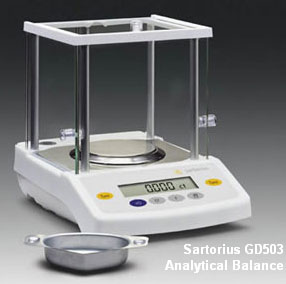 Successful long-range shooters know that careful weighing of powder charges helps them achieve superior long-range accuracy. By maintaining powder charges within very narrow weight tolerances, hand-loaders can produce ammo with more consistent muzzle velocities from shot to shot. Low Extreme Spread (ES) and Standard Deviation (SD) numbers translate directly to reduced vertical dispersion at very long ranges (although velocity is not the only contributing factor to vertical spread). In pursuit of load weight uniformity, many of our top long-range aces have invested in the latest, high-tech magnetic force restoration (MFR) digital scales (such as the Sartorius GD503). These laboratory-grade MFR scales are extremely stable (with minimal drift) and they can reliably measure to .005 grain, that is five thousandths of a grain. That is less than the weight of one kernel of typical extruded powder. For example, with Varget, there are three to four kernels in one-tenth of one grain of Varget. That means each kernel weighs .025 to .035 grains. Successful long-range shooters know that careful weighing of powder charges helps them achieve superior long-range accuracy. By maintaining powder charges within very narrow weight tolerances, hand-loaders can produce ammo with more consistent muzzle velocities from shot to shot. Low Extreme Spread (ES) and Standard Deviation (SD) numbers translate directly to reduced vertical dispersion at very long ranges (although velocity is not the only contributing factor to vertical spread). In pursuit of load weight uniformity, many of our top long-range aces have invested in the latest, high-tech magnetic force restoration (MFR) digital scales (such as the Sartorius GD503). These laboratory-grade MFR scales are extremely stable (with minimal drift) and they can reliably measure to .005 grain, that is five thousandths of a grain. That is less than the weight of one kernel of typical extruded powder. For example, with Varget, there are three to four kernels in one-tenth of one grain of Varget. That means each kernel weighs .025 to .035 grains.
With the capability of modern modern MFR scales to measure less than one-hundreth of a grain, we have a new frontier in precision reloading. You’ll note, in the preceding paragraph, we said that one-tenth of one grain of Varget is three or four kernels. Well, “which is it?” you might ask. The answer is that it might be three, or it might be four, depending on the size of the individual kernels. That’s a disturbing uncertainty that we simply had to accept… until now.
Powder Kernel Uniforming — A Breakthrough
We now have the tools and the methodology to resolve the inherent uncertainty in individual kernel weight. Using the new technique of powder kernel uniforming, first pioneered by German Salazar, we can now, for the first time, ensure that every kernel of powder that goes into a cartridge is virtually the same weight — the same, in fact, within 0.01 grain (one-hundredth of a grain) TOTAL spread.
 For a reloader looking to achieve “perfect” load weight uniformity, powder kernel uniforming offers the ultimate control over powder weight. The method we devised to uniform individual kernels consists of kernel core-drilling. The propellant we chose for this kernel-uniforming test was a new prototype (not yet commercially available) EuroChemie RL “X” propellant. This was chosen because it offered relatively large, can-shaped kernels that could be drilled relatively easily. For a reloader looking to achieve “perfect” load weight uniformity, powder kernel uniforming offers the ultimate control over powder weight. The method we devised to uniform individual kernels consists of kernel core-drilling. The propellant we chose for this kernel-uniforming test was a new prototype (not yet commercially available) EuroChemie RL “X” propellant. This was chosen because it offered relatively large, can-shaped kernels that could be drilled relatively easily.
 Core-Drilling Kernels with Micro Drill-Bits Core-Drilling Kernels with Micro Drill-Bits
The center of each kernel was bored out with a micro-drill. But here’s the key. Before drilling, we first weighed each kernel. Then we selected a micro drill bit of appropriate diameter to achieve uniform weights. With the heavier kernels (in the 0.04 gr range) we used a larger micro-bit. With the lighter kernels (in the 0.02 range), we selected a smaller diameter micro-bit that removed less material from the center of the kernel. Obviously, many kernels were ruined while we perfected the drilling process. It required great patience and a very steady hand. But after a few dozen hours of drilling, we had a batch of uniformed kernels that were all within plus or minus .005 grains (.01 grain ES). Now we were ready to do some testing.

 Proof That It Works Proof That It Works
All this time-consuming work to drill holes in individual kernels would be pointless, of course, if it did not produce meaningful accuracy gains. The proof, as they say, is “on the target”. We were curious to see if our uniformed powder kernels would out-perform unmodified kernels, so we did some field testing. We prepared two batches of 6mmBR ammo in Lapua brass, with full case prep, and bullet base to ogive sorting (we wanted to eliminate as many variables as possible). Bullets were Lapua 105gr Scenar Ls, which proved to be some of the most consistent projectiles we’ve ever measured.
One set of rounds was loaded with a carefully-weighed charge of unmodified kernels. Case to case charge weight was held to .05 grain (half a tenth uniformity). Then we prepared a second batch of cartridges with uniformed kernels, using the exact same charge weight, also held to .05 grain (half a tenth) tolerances. We took these rounds to the range, and did a “round-robin” test at 800 yards, shooting one of each type in sequence (i.e. one uniformed on right, then one non-uniformed on left) until we had two 10-round groups. The test was done with a rail gun fitted with a 1:8″ twist, 28″ Krieger 0.236″ land barrel. The uniformed-kernel ammo was shot at the right diamond, while the non-uniformed rounds were shot at the left diamond. Conditions were good, so we simply “held center” on every shot. No attempt was made to correct for wind as our primary concern was vertical dispersion.

Ammo with Uniformed Kernels Shows Significantly Less Vertical Dispersion at Long Range
As you can see, the uniformed-kernel ammo out-performed the non-uniformed ammo. The difference is quite clear. The rounds with non-uniformed kernels (on the left) produced a 10-shot group with roughly 3.0 inches of vertical dispersion. On the right, our ammo with uniformed kernels produced a group with 9 of 10 shots showing roughly 1.75 inches of vertical dispersion (we did have one high flier among the uniformed-kernel rounds). Additionally, we had a lower 10-shot ES and SD with the uniformed-kernel ammo. We repeated this test two more times and the results were similar. The targets speak for themselves. If you are looking for ultimate long-range accuracy, powder kernel uniforming is a “new frontier” you may wish to explore. With all other factors held constant, we were able to reduce vertical dispersion by more than an inch at 800 yards by drill-uniforming our NitroChemie powder. That’s huge in the long-range game.
Yes, the kernel-uniforming process is incredibly time-consuming and tedious, and a set of micro-drills is not cheap. We also freely acknowledge that the process may be much less productive with narrow-kernel propellants that are hard to drill. (Also EuroChemie powders are preferred because the burn rate controlling compounds are impregnated throughout the entire kernel — not just the outside.) But the potential for significant accuracy gains is there. We proved that.
Is it worth the huge investment of time to drill your powder kernels? That’s a question each reader must ask himself. But if you know the competitor on the next bench over has uniformed his kernels, can you afford not to do the same? Sometimes the extra effort is worth it, just for the peace of mind you get knowing you’ve done everything possible to achieve “ultimate accuracy”.
March 28th, 2012
American Rifleman Magazine is now available in a web-friendly online version. The eZine version of American Rifleman navigates like a conventional print magazine — so you start with an index at the front and you can flip pages from front-to-back. You can also navigate with thumbnails (on the left) and zoom in and out if you find items of interest. Those who prefer reading articles in a magazine-style format should enjoy the American Rifleman digital eZine.

 Excellent Article about Norma Excellent Article about Norma
In the lastest April digital edition of American Rifleman (on page 122), you’ll find “A Century of Bullets and Brass”, a fascinating 20-page history of the Norma company. Founded by the Enger brothers from Norway, Norma started producing boat-tail 6.5mm bullets in 1902. Using once-fired brass, Norma began loading 6.5×55 ammunition in 1914, and the company started making its own Norma-headstamp cartridge brass in 1917.
Other highlights of the April 2012 edition include:
- Interviews with Top Shot Winners Dustin Ellermann and Chris Reed (p.144).
- Review of the new Sig Sauer 224 compact pistol by Field Editor Wiley Clapp (p. 94).
- Discussion of the “Castle Doctrine” which allows citizens to defend home and family (p. 30).
- Previews of new Guns, Optics, and Gear at NRA Annual Meetings and Exhibits in St. Louis.
March 27th, 2012
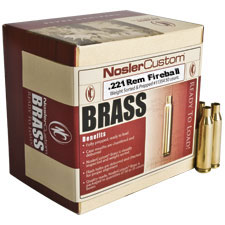 Here’s good news for .221 Fireball and 20 Vartarg Fans — within the next five to eight weeks, Nosler-brand .221 Fireball brass will hit the market. We just got off the phone with Nosler, whose representatives confirmed that Nosler will be selling 100-ct boxes of .221 Rem Fireball brass very soon (item #10078). Product is expected to start shipping “in a month or two”. Nosler’s .221 Fireball brass is crafted by a third-party supplier, and then final-finished by Nosler at its Bend, Oregon factory. Here’s good news for .221 Fireball and 20 Vartarg Fans — within the next five to eight weeks, Nosler-brand .221 Fireball brass will hit the market. We just got off the phone with Nosler, whose representatives confirmed that Nosler will be selling 100-ct boxes of .221 Rem Fireball brass very soon (item #10078). Product is expected to start shipping “in a month or two”. Nosler’s .221 Fireball brass is crafted by a third-party supplier, and then final-finished by Nosler at its Bend, Oregon factory.
We tried to find out the name of the third-party source without success. However, Nosler did confirm that this brass “is definitely NOT made by Remington“.
 Expected retail for the Nosler .221 Fireball brass is $60.00 to $80.00. Online retailer Precision Reloading currently has the Nosler-brand .221 Fireball brass on order, with a stated retail price of $69.39 for a 100-ct box, product # NS10078. You’ll find the Nosler .221 Fireball brass on the Precision Reloading website, but it is currently listed as “out of stock”. Check back in a few weeks to see if the Nosler .221 Fireball brass has started shipping yet. NOTE: In addition to the new .221 Fireball offering, Nosler has announced that it will sell brass in three other new calibers: 17 Remington, .222 Rem, and 270 WSM. Expected retail for the Nosler .221 Fireball brass is $60.00 to $80.00. Online retailer Precision Reloading currently has the Nosler-brand .221 Fireball brass on order, with a stated retail price of $69.39 for a 100-ct box, product # NS10078. You’ll find the Nosler .221 Fireball brass on the Precision Reloading website, but it is currently listed as “out of stock”. Check back in a few weeks to see if the Nosler .221 Fireball brass has started shipping yet. NOTE: In addition to the new .221 Fireball offering, Nosler has announced that it will sell brass in three other new calibers: 17 Remington, .222 Rem, and 270 WSM.
As soon as its new .221 Fireball brass becomes available, Nosler has promised to send us samples. We want to see how the Nosler brass compares to Remington-brand .221 Fireball brass — currently the only type on dealers’ shelves. With Nosler’s reputation for quality, we hope the Nosler .221 Fireball brass will be a step up from Remington’s product. The Remington brass does the job but case weights and neckwall thicknesses are not particularly uniform, and the Rem brass is fairly soft.
March 9th, 2012
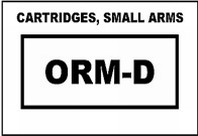
The days of the “ORM-D: Small Arms Cartridges” labels for ammo shipments are numbered. The Dept. of Transportation (DOT) is phasing out the current ORM-D ammo labels, replacing them with a larger striped diamond label that does not mention “Small Arms Cartridges”. This change is designed to harmonize U.S. shipping rules with United Nations standards. You can start using the new “Limited Quantity” diamond labels for ammo shipments immediately, but they are not mandatory — yet. You can continue to use the old ORM-D “Cartridges, Small Arms” labels until December 31, 2013. As of January 1, 2014 you MUST use the Striped Diamonds.
OFFICIAL UPS RULES — Elimination of ORM-D Classification
 In an attempt to harmonize and align with international standards, the DOT has amended the 49CFR regulations regarding the ORM-D classification. Effective January 19, 2011, with the publication of the HM-215K final rule, the hazard class of ORM-D is being eliminated. Those materials may still be shipped classified as a limited quantity (“Ltd Qty”). In conjunction with ORM-D hazard class elimination in HM-215K, limited quantity ground shipments will no longer require shipping papers when prepared under the new rule. This includes those materials previously classed as Ltd Qty that required shipping papers via ground transport. In an attempt to harmonize and align with international standards, the DOT has amended the 49CFR regulations regarding the ORM-D classification. Effective January 19, 2011, with the publication of the HM-215K final rule, the hazard class of ORM-D is being eliminated. Those materials may still be shipped classified as a limited quantity (“Ltd Qty”). In conjunction with ORM-D hazard class elimination in HM-215K, limited quantity ground shipments will no longer require shipping papers when prepared under the new rule. This includes those materials previously classed as Ltd Qty that required shipping papers via ground transport.
Ground Ltd Qty Marking

| Air Ltd Qty Marking
 |
NOTE: These illustrations are not true to scale. The actual default Ltd Qty Diamond label to be used for ammo shipments is much larger, about 5″ per side. A smaller 2″ per side version of the Ltd Qty striped diamond can be used on smaller packages. |
There is a transition period for shippers to comply with the new classification, marking and labeling requirements. Until December 31, 2013 a limited quantity package containing a consumer commodity as defined in 171.8 may be reclassed as ORM-D, or until December 31, 2012 for ORM-D-Air material. UPS began accepting materials with the new markings effective April 1, 2011. Note: To be in compliance with TDG, Standard (ground) Ltd Qty shipments to Canada prepared under HM-215K require the verbiage ‘Limited quantity’ or ‘Ltd qty’ to also be marked on the carton.
Download OLD and NEW Label Formats
On the Parallax Curio and Relic Forum, a thread includes PDF samples of both the new Diamond Ltd Qty Labels and the current ORM-D Labels. The thread explains: “The good news is the new label doesn’t have any indicator that the package contains ammunition. The bad news is the new label is gigantic compared to the old ORM-D label. You are required to use one of the larger labels on one side of any package containing ammunition. If the package is too small for one of the larger labels then you are permitted to use one of the smaller labels instead. Because of the size requirement in the regulations, you only get two of each label on standard piece of printer paper.”
CLICK HERE for PDF Template with Large and Small Striped Diamond Ground Shipping Labels
If you want to still use the ORM-D Small Arm Cartridges Labels until the new Diamond Labels are mandatory, here are links to PDF sheets of ORM-D labels. These PDFs have many rows of labels per page so you can save printer paper. The black version and blue version will use up more printer ink, so you might want to use the white version to be more economical.
March 8th, 2012
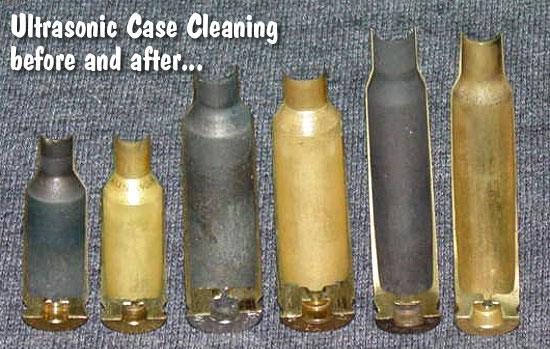
 With the price of premium brass topping $90/100 for many popular cartridges, it makes sense to consider annealing your brass to extend its useful life. Forum member Darrell Jones offers a full range of brass prep, brass forming, and brass restoration (annealing, ultra-sonic cleaning) at very affordable prices. Starting at just $15 per 100 cases, Darrell’s company, DJ’s Brass, will anneal your used brass using state-of-the-art Bench-Source annealing machines. He can also ultrasonically clean cases for $15 per 100 ($20 per 100 for magnum cases larger than 0.473″ rim). With the price of premium brass topping $90/100 for many popular cartridges, it makes sense to consider annealing your brass to extend its useful life. Forum member Darrell Jones offers a full range of brass prep, brass forming, and brass restoration (annealing, ultra-sonic cleaning) at very affordable prices. Starting at just $15 per 100 cases, Darrell’s company, DJ’s Brass, will anneal your used brass using state-of-the-art Bench-Source annealing machines. He can also ultrasonically clean cases for $15 per 100 ($20 per 100 for magnum cases larger than 0.473″ rim).
Custom Neck-Turning Services
Another great service DJ’s Brass provides is precision neck-turning. He can neck-turn any size case to your specified neck-wall thickness. The price is $0.30 per case (normal size) or $0.40 (magnum size) with a $20.00 minimum order. And if you’ve got a bucket of brass to neck-turn, that’s fine with Darrell — he recently neck-turned 1500 pieces of brass for one customer!

DJ’s Brass can process everything from .17 Fireball all the way up to the big magnum cases. And the job gets done quickly. Darrell has a 10-day turn-around guarantee. For most jobs, Darrell tells us, he gets the processed brass to the Post Office within three business days. DJ’s Brass charges only actual shipping fees, using USPS flat-rate boxes.

• Ultrasonic Cleaning + Annealing ($25.00/100 normal or $30/100 magnum)
• Ultrasonic Cleaning and Polishing ($15.00/100 normal or $20/100 magnum)
• Anneal Case Necks (after checking for splits) ($15.00/100 normal or $20/100 magnum)
• COAL Trim and Chamfer Case Mouths ($0.20 per case, $20.00 minimum order)
• Uniform and Square Primer Pockets ($0.15 per case, $20.00 minimum order)
• Expand Case Necks and Anneal brass (Call for Price)
• Create False Shoulder for Fire-Forming (Call for Price) |
Muzzle Brake Tax Break Special: FREE cleaning of up to two (2) Stainless Muzzle Brakes with a minimum $50.00 order. Special good through April 17, 2012 (Tax Return Deadline for 2012). |
DJ’s Brass Offers Specialized Custom Services
Darrell tells us: “At DJ’s Brass, we can handle all your brass refurbishing needs. From ultrasonic cleaning to custom annealing for specific wildcat cartridges. We can expand your necks from .22 caliber to .30 caliber and anneal shoulders for consistent bump-back. We can turn your case-necks and trim the brass to your specs. For some cartridge types, I can pre-form cases to assist in fire-forming a wildcat cartridge. We also remove the carbon build-up in muzzle brakes. Don’t lose your accuracy by having carbon build up and close off the clearance required for the most accurate bullet release through a muzzle brake.” Note: Extra charges apply for neck-turning and neck expansion operations, or specialized cartridge-forming operations. Please call 205-461-4680 for special services pricing.
Muzzle Brake – Tax Break Special for AccurateShooter.com Readers
Now through April 17, 2012 (Tax Due Date), Darrell is offering a Muzzle Brake – Tax Break Special for our readers. For all case prep/restoration orders of $50.00 or more, Darrell will ultrasonically clean one or two stainless muzzle brakes for no extra charge (offer does not apply to blued or coated muzzle brakes). For more info, visit DJsBrass.com or call Darrell Jones at 205-461-4680. IMPORTANT: Contact Darrell for shipping instructions BEFORE sending any brass for processing. ALL BRASS MUST BE DE-PRIMED before you send it.
Darrell has cleaned and annealed cases for shooters from across the country. Here are recent testimonials (this Editor reviewed all the original emails so I can confirm these are real):
“Your services were good with a quick turn-around time. Quality of the case annealing looked great[.]” — Tom, in Alaska
“The [300 Win Ackley] batch you did for me came back looking great.” — Chuck, in Arizona
“Since I started using Lapua brass, I’ve gotten gotten enough reloads out of them to notice that the necks were no longer sealing as well as I’d like. A friend suggested annealing them. I remembered seeing DJ’s ad on AccurateShooter.com and thought I’d give him a try. Not only did my [.308 brass] come back sorted exactly as I had sent them out, all had been so thoroughly cleaned that I realized I had been leaving lube on them after forming. DJ had taken the time to enclose a note cautioning me to brush the inside case necks and do a full-length resize for the first loading. And all 200 cases were back in my hands in DAYS, not weeks! Great service, great price, great follow up.” — Jim, in Alabama
|