Remington issued a Safety Warning And Recall Notice on 3/14/2011 concerning Remington’s .223 Rem ammo. Remington states that four (4) lots of its .223 Rem 62gr Hollow Point (Match) Ammunition may have been improperly loaded. The affected LOT numbers are H03RAI, H04RDI, H16NAI, and H17NDI. Lot numbers are found on the inside flap of each box. Do NOT use these lots of ammo — the cartridges may develop excessive pressure, causing “damage to the firearm, serious personal injury or death.” If you have any of the recalled ammo, contact the Remington Consumer Service Dept. at 1-800-243-9700, Prompt #4.
Remington .223 62 GR (MATCH) Hollow Point Ammunition
LOT NOS. H03RAI, H04RDI, H16NAI or H17NDI
Remington has determined that four (4) Lot Numbers of its .223 Remington 62 Gr Hollow Point (Match) Ammunition may have been improperly loaded. The four (4) Lot Numbers are identified above. Improper loading may cause a malfunction of the cartridge when the firearm is fired resulting in higher than normal pressures. This malfunction may result in damage to the firearm, serious personal injury or death.
Do Not Use REMINGTON .223 62 GR (MATCH) HOLLOW POINT AMMUNITION WITH
LOT NOS. H03RAI, H04RDI, H16NAI or H17NDI
To identify if you have one of these Lots of ammunition:
* If you have a case of .223 Remington 62 Gr Hollow Point (Match) Ammunition the Lot Number is stenciled on the outside of the case; and,
* If you have a box of .223 Remington 62 Gr Hollow Point (Match) Ammunition the Lot Number is stamped on the inside flap of the box.
If you have any of this .223 Remington 62 Gr Hollow Point (Match) Ammunition, as identified above, immediately discontinue use of this ammunition and contact Remington at the below telephone number. Remington will arrange for the return shipment of your ammunition and upon receipt will send you replacement ammunition at no cost to you. If you are unsure whether or not you have one or more of these Lots of ammunition or if you have mixed boxes of ammunition; please immediately discontinue the use of the ammunition and contact Remington at the below telephone number — we will replace this ammunition for you.
For any consumer questions or instructions on how to return of your .223 Remington 62 Gr Hollow Point (Match) Ammunition with one of the following Lot Numbers H03RAI, H04RDI, H16NAI OR H17NDI, please contact the Remington Consumer Service Department at 1-800-243-9700, Prompt #4.
Huntington Die Specialties (Huntington) has acquired a large selection of the hard-to-get RWS brass for 29 different cartridge types. German-made RWS brass, renown for its superb quality, is very, very hard to obtain in the USA. While the quantities to be imported are limited, this is NOT vapor-ware. The brass is “on the boat” right now and Huntington’s hopes the RWS brass will clear customs in the USA by mid-April. We asked Fred Huntington how he managed to bring in supplies of RWS brass, when other American vendors have tried for years to import the prized brass without much success. Fred revealed: “We acquired this through a third party in Europe. RWS would not sell directly to us in the USA.”
RWS Brass Inventory List — Quantities Very Limited
Here are the calibers that will be available in mid to late-April, 2011. NOTE: Prices are subject to change! If you want RWS cases for any of the calibers listed, you should place your orders promptly. Quantities range from a few hundred to a few thousand cases per caliber. To order, visit the Huntington website, or call 1-866-735-6237, or (530) 534-1210.
Nosler is running a great special right now on over-stock 6mm varmint bullets. Nosler is selling 55gr flat-base spitzer bullets at just $103.80 for ONE THOUSAND bullets. That’s right, you read that correctly — you can buy 1000 bullets for just $103.80. And get this, shipping on all Nosler orders over $150.00 is FREE in the contiguous USA.
55-grainers Were Produced for Australian Shooters
These bullets were specifically made for the Austrailian kangaroo market. They are a flat-base, soft-point, spitzer bullet. According to Nosler, these 55-grainers do “very well for target shooting and varmint hunts”. Why are the bullets so cheap? There was a factory overrun in production, so that’s why Nosler has excess inventory. If you need lightweight 6mm varmint bullets, get your orders in right away. We expect this deal to sell out quickly. (And by that, we mean they could well be gone within 24 hours. You snooze, you lose.)
Lapua recently announced that it is replacing three of its .224-caliber bullet types with new and improved versions. For service rifle shooters, the new GB541 looks like a good choice for short-course events.
55gr Softpoints Replaced with Non-Cannelure E539 Bullet
Two older soft point bullet designs, the 55gr E372 and the 55gr E369, are being replaced by Lapua’s new E539 55gr bullet. The E539 is a multi-purpose NON-cannelure soft point design with a 0.202 G1 BC.
New Higher-BC GB541 Bullet Replaces 69gr GB401
The .224 GB501 69gr Scenar has been replaced by a ballistically superior GB541 69gr Scenar bullet designed especially for long range target shooting. The new GB541 bullet has a 0.341 G1 Ballistic Coefficient and a 0.171 G7. Both numbers were established in field testing using Doppler Radar.
German Salazar has posted an informative article about concentricity-checking tools on his Rifleman’s Journal Blog. In that article, German provides a detailed review of the impressive new Bruno Concentricity Checker which features a high-grade dial indicator and an innovative system for holding both loaded cartridges and empty brass in place during the measurement process. German gives the Bruno tool high marks and it is now his favored concentricity gauge, replacing on older Sinclair tool (also reviewed in the article).
German writes: “When measuring a seated bullet, the Bruno [tool] is simple and intuitive in use: adjust the length of the tip holder, set up the indicator to bear on the ogive and get to it. I usually slip a Sinclair hex nut comparator over a bullet to make a faint mark right at the ogive to help me in determining where to set the indicator. I then set the indicator tip about 0.010″ behind the mark so that I am definitely on the bearing surface even if some of the bullets have a bit of variance. It’s a handy way to get set up consistently from one session to another.”
German continues: “Reading an empty case requires a little more effort, but not much…. Once the case mouth is smooth, the readings are in line with those of the Sinclair tool, although easier to read to a fine level of precision due to the finer gradations on the indicator and its horizontal mounting. The Bruno tool has become my principal tool for checking the concentricity resulting from different die setups and for comparing the results of one loading process to another. I simply have more confidence in my ability to get an accurate reading from it. After many years of service, I’ve decided to retire the old Sinclair and make the Bruno tool my primary concentricity tool. It is simply a better made, easier-to-use, more accurate tool and those are the qualities I value in any tool.”
Winchester is producing four new types of rimfire ammunition for 2011. Three of the four products should be of great interest to varminters, with new high velocity, high expansion, and lead-free designs. Winchester is also introducing its M-22 bulk pack .22LR ammo, designed for use in mag-fed semi-autos.
Varmint HV in .22 Magnum Rimfire SPECS: 30gr tipped V-Max bullet, 2250 FPS
The Winchester Varmint HV line of .22 WMR ammo has proven very popular, and this year Winchester adds a new version for varminters who prefer a plastic-tipped bullet. The latest Varmint HV round features the accurate and explosive 30gr V-Max bullet. With a V-Max loaded to an impressive 2250 fps, this gives you near 17HMR velocity, with a heavier bullet for added hitting power.
Varmint HE 3-in-1 Segmented .22LR SPECS: 37gr plated HP, 1435 FPS
The unique 3-in-1 segment design, exclusive to Winchester, features a 37gr plated HP fragmenting expansion bullet pushed at 1435 fps. This “progammed” hollow-point bullet fragments into three forward segments, plus a solid rear core that gives more penetration (and energy). “Without a doubt, Varmint HE ammunition provides explosive impact,” said Brett Flaugher, Winchester’s Marketing VP. “The 3/1 segmenting design makes this product truly innovative, but unlike other high-energy bullets on the market, our new 3/1 fragmenting design allows initial impact shock, and deep penetration resulting in maximum terminal effect.”
Varmint LF (Lead-Free) 17 HMR SPECS: 15.5gr NXT tipped lead-free bullet, 2550 FPS
For 2011, Winchester is introducing a new 17HMR version of its popular Lead-Free (LF) rimfire ammo. The new 17HMR LF shoots a lightweight, 15.5gr tipped NXT bullet at a blistering 2550 fps, making this some of the highest-velocity rimfire ammo you can buy. Along with the new 17MHR LF, Winchester’s LF rimfire line includes lead-free .22 WMR and .22LR LF ammo.
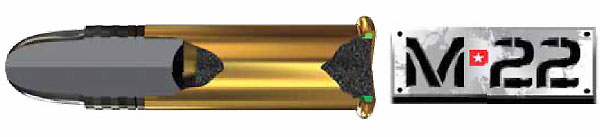
M-22 Ammo for .22LR Tactical Trainers SPECS: 40gr, Blackened Copper-plated Lead Bullet, 1255 FPS
New this year is Winchester’s M-22 line of affordable .22LR ammo. This is designed to function well in large-capacity stick magazines. If you are shooting one of the .22LR tactical-style semi-autos such as Smith & Wesson’s MP15-22, this ammo would be a good choice. It features a blackened, copper-plated 40gr lead bullet, and is available in 1000-count bulk packs.
Here’s the latest info on Alliant’s new AR-Comp powder. We had a chance to talk with Dick Quesenberry of Alliant, who revealed more details about this new propellant. First, Dick explained that AR-Comp is an advanced re-formulation of Reloder 15, a double-base Bofors powder. There are changes to internal and external chemistry to provide much better pressure/velocity stability across a wide range of temperatures.
AR-Comp Offers Uniform Velocities over a Wide Temp Range
Tests were done with .223 Rem and .308 Win ammo, loaded with AR-Comp and maintained at temps from -20° F to +160° F in a controlled test center. The ammo itself was heated or cooled to targeted temps before testing. Across that entire range of temperature, -20° F to +160° F, the ammo loaded with AR-Comp showed a variation of only 20 fps in muzzle velocity. The primary bullet type tested was a 77gr .224 bullet and the secondary was a 175gr .308 bullet.
Burn Rate Like Varget:Though this is a reformulation of Reloder 15, the burn rate of AR-Comp is slightly faster than Reloder 15. Alliant told us: “Reloder 15 is slightly slower, in burn rate, than Varget. The new AR-Comp, with the enhancements, ended up slightly faster than Reloder 15, so it is now very close to Varget in burn rate”. This is the result of the “tuning” of the powder to be much less temp-sensitive.
Meters Like Reloder 15:AR-Comp is a small-kernel, double-base extruded powder like Reloder 15, so it will continue to meter just like Reloder 15. The load density should be the same as Reloder 15.
Loaded Ammo:We asked if any manufacturer will be using AR-Comp in loaded ammo. Dick told us that he is “not allowed to release that information at this time”. Draw your own conclusions, but remember that Alliant is owned by ATK, which makes Federal rifle ammo.
Available in Summer 2011:Allliant hopes to ship AR-Comp in “June or July” of 2011, provided the DOT Classification process moves at a normal schedule. The powder is ready to go, Alliant is just waiting on the DOT to provide shipping authorization.
Reloder 15 Will Stay in Production:Fans of Alliant’s Reloder 15 don’t need to worry. Alliant will keep Reloder 15 in production. “We don’t drop powder lines”, said Quesenberry.
AR-Comp First in Series of New Alliant Temp-Stable Powders
Alliant has been working on AR-Comp for quite some time. This represents a major evolution for Alliant’s powder line. AR-Comp will be the first in a series of “new generation” temp-stable powders from Alliant. Quesenberry noted: “Our goal was to provide a powder that offers stable pressures in all temperatures. Shooters want to be able to stay with the same load in winter and in summer, in cold or in hot conditions.”
Quesenberry added: “We’ve been working on this quite a while. AR-Comp is the first example and we hope to extend this to other rifle powders. It’s a tough job. You have to balance the performance carefully. If you tweak it one way, say to improve the low temp performance, you lose something at the upper end. If you tweak it for the top end, you loose something at the bottom. You have to hit that balance. We worked very hard to do just that and we think shooters will be impressed with the results.”
There’s a lot of buzz about ballistics programs for smartphones. Those are handy, to be sure, but most people still need a solid, full-featured program to run on their home computers. Berger Bullets offers a sophisticated ballistics programs for MS Windows computers that works really well, and lets you print out results. Up-to-Date G7 BCs for Berger projectiles are built-in to the program, and the price is right — FREE.
The program is basic enough to be easy to use, but flexible enough to allow you to calculate custom ballistics for your rifle and load. The program accounts for all the basic external ballistic parameters including bullet BC and muzzle velocity, atmospherics, uphill/downhill shooting, etc. The output tabulates velocity, energy and time of flight as a function of range. Bullet path and wind deflection are displayed in your choice of inches, centimeters, MOA or MILS.
Instructions for Program
On the Berger Bullets Blog (1/26/2010), You’ll find a description of program features and a complete set of instructions. Here are instructions for the bullet variables: “The bullet inputs are straightforward. The BC can be entered in reference to either the G1 or G7 standard. You can find the G1 or G7 BC for your bullet either printed on the bullet box label, or on our products page. For accurate results, you should measure the muzzle velocity with a good chronograph. If you don’t have access to a chronograph, you can estimate the muzzle velocity based on your load data.”
Tips for Best Results
Bryan Litz includes tips on getting the most from the Berger Ballistics program. Some of Bryan’s suggestions will also help you when working with other ballistics software:
G1 vs. G7 BC: The accuracy of the ballistic solution is only as accurate as the inputs you give it. The advertised BCs for Berger bullets are established by actual field firing tests over long range and are very accurate. Using the properly referenced BC (G7 vs. G1) for the bullet you’re modeling is important. For any bullet with a boat tail, we recommend using the G7 BC.
Muzzle Velocity: Knowing your true muzzle velocity is important when calculating external ballistics. It’s best to measure your muzzle velocity directly with a chronograph.
Altitude and Atmosphere: If you want a truly accurate long-range trajectory prediction, you can’t ignore atmospheric effects. This is especially true the farther you get from standard conditions (sea level altitude, 59 degrees Fahrenheit, 0% humidity).
Scope Verification: It’s important to verify the most important link between the calculated ballistics and your point of impact: your scope. If the ballistics program calculates 30.0 MOA of drop for a particular shot, and you dial your scope to 30.0 MOA, are you sure it’s giving you exactly 30.0 MOA? In reality, many scopes have enough error in them to cause misses at long range. It’s important to verify the value of your scope clicks by firing groups at short range.
If you have further questions not answered on Berger’s Blog Page, email Bryan.Litz [at] bergerbullets.com. NOTE: If your computer won’t run the program, please download and install this Java update: http://www.java.com/en/download/index.jsp. This is a Windows PC program. You may have problems trying to run it on a MAC in emulation.
Black Hills Ammunition (BHA) produces high-quality new and remanufactured ammo. Black Hills remanufactured .223 Rem and .308 Win ammo is popular with tactical shooters because it is cost-effective, yet very accurate since it is loaded with premium match-grade bullets. Black Hills has now come out with a line of hunting ammunition using the very accurate Hornady GMX (Gilding Metal eXpanding) lead-free projectiles. New loads include: 80gr .243 Win; 120gr .260 Rem; 120gr 6.5-.284 Norma; 130gr 270 Win; 150gr .308 Win; 150gr .30-06; 139gr 7mm RemMag; and 165gr 300 WinMag.
The GMX (Gilding Metal eXpanding) bullets are constructed of gilding metal, the same material used for bullet jackets. GMX bullets expand quickly and reliably upon impact, and retain nearly 100% of their weight. These GMX bullets contain no lead, making them a good choice for areas that restrict use of lead-cored bullets. To learn more, contact Black Hills Ammunition at (605) 348-5150.
New Black Hills 5.56 Ammo
For 2011, Black Hills is releasing two new 5.56mm offerings for commercial sale. First, it offers a new match load with 77gr Sierra MatchKings (SMKs). The new 5.56mm ammo pushes the 77gr SMKs at 2750 fps from a 20″ barrel. According to Black Hills: “this load delivers sub-minute accuracy consistently from 10-shot groups.”
Next, Black Hills is making its 50gr police 5.56mm load available to the public. The BHA 5.56mm 50gr TSX load was developed for U.S. law enforcement. This load utilizes a specially-built version of Barnes Bullet Company’s TSX bullet. It provides expansion to .50 caliber immediately upon impact and consistently penetrates to an ideal average penetration depth of 14″ in ballistic gelatin. Black Hills calls this “an ideal civilian defense or law enforcement patrol-rifle round” that works well through a variety of barrel lengths.
Redding has introduced a new series of Bullet Seating Micrometers (aka Micrometer Bullet Seater Plug Replacements). These can be retro-fitted into standard Redding seater dies with 1/2-20 thousandths threads, replacing the standard dies’ seater plugs. So, for about forty bucks, you can now make your standard Redding seater die into a Micrometer Seater — and you can swap one Micrometer Seater top among a variety of dies in the same caliber class (such as .223 to 22-250). Notably, the new Bullet Seating Micrometers are offered in two different configurations — one for traditional bullet shapes, and another for VLD bullets. Redding’s new Bullet Seating Micrometers are priced at $48.90 MSRP, but expect to see an initial “street price” of about $37.00-$39.00.
VLD Version of Micrometer Fits Berger Bullets
Eric Stecker of Berger Bullets stated: “I spoke with Redding and confirmed that the new VLD-Version Micrometer plugs are specifically designed for Berger VLD bullets. We provided all of our VLD bullets to them from which they took deliberate measurements and made these new plugs. This is news that needs to be shared with anyone shooting Berger VLD bullets.”
Bad News: You Need Different Micrometer Units for VLD and Non-VLD Bullets
Unfortunately, the Micrometer Seater Plug Replacement is ALL ONE UNIT. You cannot interchange VLD and non-VLD seater stems inside a given Bullet Seating Micrometer. You have to buy one of each (one Micrometer unit for VLD bullets and another Micrometer unit for standard bullets). Likewise, you cannot swap in larger or smaller diameter seater stems to make one Bullet Seating Micrometer head work with dies for widely different bullet diameters. That means you can’t buy one Micrometer head and use it in both a .223 Rem Seater Die and a 30-06 die, for example. You have to stay within the same die class, as explained next.
Good News: Bullet Seating Micrometer — Use in Multiple Dies
As long as you stick with the same seater die class, one Bullet Seating Micrometer can be used on multiple dies. In practical terms, you can usually (but not always) use the same Micrometer assembly on multiple dies within the same caliber family. And when you move the Micrometer unit from one die to another, all you need to record is the Micrometer setting. Look at the photo — the knurled ring at the bottom of the black replacement plug is a dead-stop collar that does not move. That means the lower section of the Micrometer always maintains the same position relative to the die when installed. When moving the Micrometer plug from one die to another, simply adjust the Micrometer knob to the proper setting for that cartridge/bullet. Each hash mark represents an .001″ change in seating depth.
There are sixteen (16) part numbers for the new Bullet Seating Micrometers. These correspond to the VLD and Standard versions for eight (8) different classes of Redding seater dies. To see which Micrometer replacement you need, look for the number on the top of your standard Redding seater, and find that in the right-most column. Then chose whether you want the standard or VLD version (shown in columns one and two on the same line).
Editor’s Comment: We like that fact that Redding is offering these retro-fit Micrometer Seater Plug Replacements. And it’s great that the buyer has a choice between VLD and non-VLD styles. However, we think the lack of interchangeability of bullet seater stems is going to be a “deal-breaker” for many shoppers. Redding obviously wants to sell as many Micrometer Seater Plugs as possible. It doesn’t want you to be able to buy one $40 Replacement plug and use that one product for a half-dozen or more calibers. That’s to be expected. However, we think that, for a given cartridge/caliber, Redding should have engineered the Micrometer Bullet Seater Plug Replacement with swappable seating stems so that one $40 Micrometer head could seat BOTH VLD and non-VLD bullets… at least for that cartridge/caliber.


 Remington issued a Safety Warning And Recall Notice on 3/14/2011 concerning Remington’s .223 Rem ammo. Remington states that four (4) lots of its .223 Rem 62gr Hollow Point (Match) Ammunition may have been improperly loaded. The affected LOT numbers are H03RAI, H04RDI, H16NAI, and H17NDI. Lot numbers are found on the inside flap of each box. Do NOT use these lots of ammo — the cartridges may develop excessive pressure, causing “damage to the firearm, serious personal injury or death.” If you have any of the recalled ammo, contact the Remington Consumer Service Dept. at 1-800-243-9700, Prompt #4.


 Lapua recently announced that it is replacing three of its .224-caliber bullet types with new and improved versions. For service rifle shooters, the new GB541 looks like a good choice for short-course events.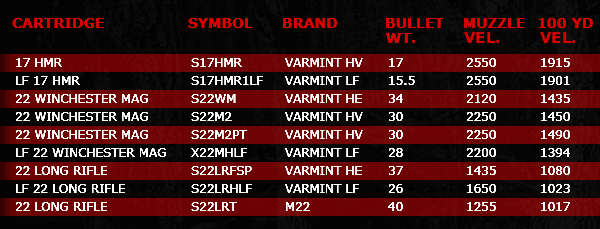


 Here’s the latest info on Alliant’s new AR-Comp powder. We had a chance to talk with Dick Quesenberry of Alliant, who revealed more details about this new propellant. First, Dick explained that AR-Comp is an advanced re-formulation of Reloder 15, a double-base Bofors powder. There are changes to internal and external chemistry to provide much better pressure/velocity stability across a wide range of temperatures.
 Instructions for Program
 New Black Hills 5.56 Ammo
 Redding has introduced a new series of Bullet Seating Micrometers (aka Micrometer Bullet Seater Plug Replacements). These can be retro-fitted into standard Redding seater dies with 1/2-20 thousandths threads, replacing the standard dies’ seater plugs. So, for about forty bucks, you can now make your standard Redding seater die into a Micrometer Seater — and you can swap one Micrometer Seater top among a variety of dies in the same caliber class (such as .223 to 22-250). Notably, the new Bullet Seating Micrometers are offered in two different configurations — one for traditional bullet shapes, and another for VLD bullets. Redding’s new Bullet Seating Micrometers are priced at $48.90 MSRP, but expect to see an initial “street price” of about $37.00-$39.00.


