|
|
July 23rd, 2010
Robert Whitley sampled a recent lot of Lapua 6mmBR brass and found that the neck-walls are marginally thinner, resulting in a very slightly smaller loaded neck diameter. Here is Robert’s report….
For the last few years the different boxes of Lapua 6mmBR Norma brass I have purchased (four different lots) have yielded brass with necks that measured around .269″ – .2695″ loaded. While this worked out very well in a variety of applications, sometimes I had to neck-turn that brass because it was a little too tight for an application or chamber I had. I recently received some of the latest “blue box” Lapua 6mm BR Norma brass (Lot # P00487801) and this latest lot of 6BR brass measures right around .268″ loaded (with popular 6mm bullet types). While some may bemoan the smaller neck diameter of this latest brass lot, for others, this can be a buying an opportunity to resolve an existing clearance issue with a “no neck turn” chamber. For example, if you have a .271″ “no neck-turn” type chamber, this may help resolve clearance issues that arose with other batches of brass. Or, for those who need to turn their necks to fit a tighter chamber, this new lot of 6mmBR brass has about .001″ – .0015″ less metal to remove, making the turning process that much easier.

 This lot of brass (Lot # P00487801) was obtained from Graf & Sons. Since the batches of Lapua 6mmBR Norma brass that come into this country typically sell out quickly, if this .268″-loaded-neck brass is of interest to you, get some soon as it may go fast. While in years past I tried to keep my neck clearance very close to the chamber neck diameter, as time passes, I am now finding that in some situations a little more neck clearance can help remedy an accuracy or consistency issue. A certain amount of clearance is clearly needed for the proper accuracy and consistency of ammunition, but in some situations a tight neck clearance is not optimum and may be more detrimental then beneficial. We tinker with everything else with our loads and rifles, why not neck clearance? — Robert Whitley

Editor’s NOTE: If you need some new 6BR brass, but your existing cases have no-turn necks which are .269″+ loaded, you may want to segregate the newer .268-necked brass. Segregating the new brass will allow you to use a a slightly smaller diameter bushing to maintain the same amount of grip on the bullet (as before). Other than this minor change in neck diameter with this lot of brass, this Lapua 6mm BR Norma brass is essentially the identical product as it has been all along.
Visit Robert Whitley’s 6mmAR.com website for more information on Grendel-based cartridges, and his 6mmHOT.com site for info on the 6mmBR Improved Dasher, 6-6.5×47, and 6.5×47.
July 22nd, 2010
John Hoover of Accuracy One Shooting Supplies is the 2010 Williamsport World Open Two-gun Overall Champion. Shooting a 6.5×284 in both Light Gun (LG) and Heavy Gun (HG) classes, John shot consistently, placing 3rd in Light Gun class, and 6th in Heavy Gun to win the overall Two-Gun with 34 rank points. It was a solid win. The next closest shooter was Paul Chackan with 59 rank points.

 Hoover’s Reloading Tips
We interviewed John after his World Open victory, and he shared his World Open-winning load, and some of the reloading secrets that allow him to craft ultra-accurate long range ammo. For his 6.5x284s, John loaded was Sierra 142gr MatchKings pushed by 48.0 grains of Hodgdon H4350, in “white box” Winchester .284 brass. Both rifles used exactly the same load. John revealed: “I have 9 match rifles, and they all shoot 48.00 grains of H4350.” John pointed his 142gr SMKs, using his own Accuracy One bullet-pointing tool: “I don’t shoot anything that isn’t pointed. All the loads we shoot use pointed bullets. I find that bullet pointing, combined with meplat trimming, reduces vertical dispersion at 1000 yards.”
Hoover’s Secret Ingredient? RWS Primers
Hoover lit his loads with RWS primers — the “Holy Grail” of rifle primers. Where did John get these superior German-made RWS primers, which are virtually unobtainable in the USA these days? John explained: “I bought those primers a long time ago, as a stocking dealer. I had about 100,000 at one time before they quit importing them, I kept a fair amount for us to use. I’m down to about 8000. When they’re gone I’ll have to change to something else.”
Hoover Now Anneals Brass “Early and Often”
Recently Hoover has changed his brass annealing procedure; he now anneals his Winchester brass earlier and more frequently: “I anneal more often now. I used to shoot my cases five to six times before annealing. Now before I shoot a case the very first time, I anneal it. That has help keep the ES and SD down. I anneal before I shoot the first time, and then every third firing. I use the Ken Light annealing machine.”
Ace Smiths Built Hoover’s Winning Rifles
John’s heavy gun was chambered by Al Warner of Warner Tools, while the light gun was chambered by 8-time National High Power Champion Carl Bernosky. Both light and heavy guns had Bartlein 1:8.5″ twist 5R barrels. All the stock work was done by Alex Sitman of Master Class Stocks. John credited these smiths: “I had good equipment from top to bottom, I had good smithing help from Alan, Carl, and Alex, who all did excellent work. When you’re walking to the firing line you get peace of mind from having the best equipment.”
READ MORE: To learn more about John Hoover’s successful 6.5-284s, read this Gun of the Week article.
July 7th, 2010
As word spreads of Jackie Schmidt’s historic 0.1118″ 5-target 100-yard Heavy Varmint Aggregate, many readers have inquired about Jackie’s gear and loading procedures. Interestingly, Jackie tells us that he selected the 30 BR “on a whim” for the Heavy Varmint stage of the Midland tournament, after he couldn’t get his 6 PPC Light Varmint gun to shoot up to his standards. With the PPC, he was getting some erratic vertical, with one shot popping up to spoil the group. Jackie turned to his trusty 30 BR, and, as they say, “the rest was history”. Jackie says his 30 BR “held perfect tune all day long”, with “absolutely no vertical”. Here are some other interesting facts about Jackie’s amazing 0.1118″ 5x5x100 Agg and the 30 BR he steered to the pending NBRSA record.
Jackie Free Recoils his 30 BR
Unlike many 30 BR shooters who shoulder their guns, Jackie shoots his 30 BR totally free recoil: “The only thing I touch is the trigger. I try to keep my body out of the equation. Free recoiling a 30 BR isn’t that difficult with a true 13.5-lb rifle.”

30 BR file photo. Jackie Schmidt does not shoot Moly bullets normally.
Jackie Didn’t Clean During Record Agg
Jackie shot his entire 100-yard HV Aggregate (25 rounds plus sighters) without cleaning his 30 BR rifle. Jackie told us: “I never cleaned the rifle until the end of the day. In fact I never took the gun out of the bags.” Jackie tells us that shooting a full Agg without cleaning has become standard practice with 30 BRs: “We’ve all learned that you don’t have to clean them. It’s a phenomenon of the 30 calibers. They shoot just as good on the last shot as the first shot.” When he does clean, Jackie uses patches soaked with Butch’s Bore Shine, followed by 10 strokes with a wet brush, then dry patches. Jackie adds: “For the past few years, I’ve never put any solvent but Butch’s in my bores.”
 Jackie Used 100% Case Capacity Charge
Jackie loaded a “100% usable case capacity charge” of Hodgdon H4198 (Extreme) in his rounds. His 112gr BIB bullets are “just kissing” the top of the powder column. To achieve that fill level, Jackie uses an 8″ drop tube. “That’s an old PPC-loader’s trick,” Jackie tells us. He added that his lot of H4198 is slower than most. He’s found that “some guys can reach the 3000 fps mark using nearly a full grain less powder than me.” But we wonder if loading at 100% of case capacity helps with accuracy? Folks with a faster lot of H4198 might not be able to reach 100% case capacity.
Jackie Schmidt’s ‘Snubber’ Tuner — The Inside Engineering
Everyone wants to know about Jackie’s “snubber” tuner, shown in the photo below. The Tuner is made from aluminum and brass and weighs 5.5 ounces. The tuner is 2 5/8″ long and extends past the true crown 5/8″. The inner cylinder is aluminum while the outer section is a marine bearing consisting of a brass shell with hard rubber vulcanized to the inside diameter. (These brass/rubber marine bearings are used for propeller shaft seals). The sandwiched brass/rubber bearing is then pressed on to the central aluminum shaft. The hard rubber helps dampen vibration. The tuner screws on and then is “locked” in place with a split clamp (the last 2″ of the barrel is threaded).

Unlike most tuners which have a fixed base and forward, rotating ring, Jackie’s tuner is one integrated unit. To adjust tune, Jackie’s “snubber” tuner is unclamped at the base and the whole assembly is screwed in or out on the threaded barrel. Jackie machined a very tight-pitched barrel thread so a full rotation of the tuner produces only .028″ of fore and aft movement. Jackie tells us that, once the basic position is set for a barrel, it doesn’t take much rotation to set the tune. He can usually optimize the barrel tune with less than 1/2 turn of the tuner. After the tune position is set, the split clamp at the inboard end is tightened. This way the tuner is basically locked in place while shooting.
Despite numerous requests, Jackie does not sell his tuners commercially. But someone with good machine skills could build a clone tuner. Team USA benchrest shooter Gene Bukys crafted a similar snubber-type tuner which he used successfully at the 2009 World Championships in South Africa.
The “25 Shots Heard Round the World”
Even people outside the Benchrest community are excited about Jackie’s 0.1118 Aggregate. Jackie’s achievement was noted by Michael Bane and broadcast on the Downrange TV Weekly Video Podcast.
July 1st, 2010
Lapua’s new 22-250 brass has finally started to arrive on dealers’ shelves. Forum member William P. (aka “Heath”) just got two boxes of the new brass. Both boxes have the same lot number. Heath was kind enough to sort the brass and report his findings.
 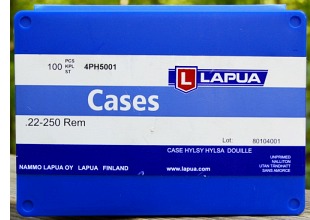
Based on Heath’s 200-count sample, we can say this new brass is very, very consistent in weight. The total weight spread (delta) for 200 cases was just 1.4 grains! And the vast majority, 83%, were within 0.7 grains in weight (160.3 – 161.0). For the varminter, sorting may be superfluous. Once again, Lapua has produced a superb new product, and we love the new, blue plastic boxes.
FYI, you 6mm shooters should know that the Lapua 22-250 brass can be made into quality 6XC brass. And it’s even easier to create a 6-250 wildcat. In May, Robert Whitley explained how he created a tack-driving 6-250 Wildcat from the new Lapua 22-250 brass.
June 29th, 2010
The U.S. Army has begun shipping its new, improved 5.56×45 cartridge, the M855A1 Enhanced Performance Round, to U.S. troops in Afghanistan. The Army will procure over 200 million rounds of the new M855A1 ammo in the next 12-15 months, and soldiers in Afghanistan will begin using M855A1 ammo in the summer of 2010. The new round replaces the current M855 cartridge used by U.S. troops since the early 1980s.

The military sought to replace current M855 ammo because M855 has not performed adequately in the Afghan theater. Specific complaints include: 1) inability to effectively penetrate vehicle windshields; 2) poor long-range performance; and 3) failure to fragment even in short-range anti-personnel use. The Army’s Picatinny Arsenal claims that the new M855A1 has improved hard target capability, more consistent performance at all distances, improved accuracy, reduced muzzle flash, and higher velocity. M855A1 ammo is tailored for use in M4 carbines but should also give enhanced performance in M16s and M249s.
 New Steel-Tip Bullet Design
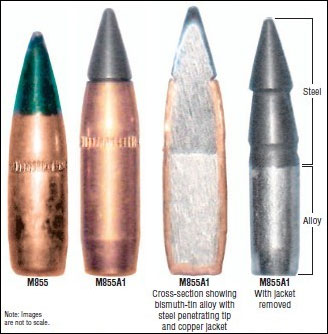
The 62-grain bullet for the new M855A1 ammo is a completely new design. While it may appear to have a plastic “ballistic tip”, that’s deceiving. The new bullet created for M855A1 ammo has a bismuth-tin alloy core with a steel “stacked-cone” penetrating tip. The photo at right shows the version from last year; the final production version may be slightly different (e.g. the final version tip is a different color). Apparently the latest bullet design is a winner. During testing, M855A1 ammo performed better than current 7.62mm ball ammunition against certain types of targets. According to Lt. Col. Jeffrey K. Woods, the program’s product manager, the new M855A1 ammo is “the best general purpose 5.56mm round ever produced. A true general purpose round, the M855A1 exceeds the performance of the current M855 against the many different types of targets likely to be encountered in combat.” The chart below illustrates how M855A1 ammo performs on hard targets compared to M855.

Over One Million Rounds Fired in Army Tests
Prior to initial production, the new M855A1 round underwent vigorous testing. Official qualification of the round consisted of a series of side-by-side tests with the current M855. Overall, the Army fired more than one million rounds to ensure the new cartridge met all expectations. The new M855A1 round is the “most thoroughly tested small caliber round ever fielded” according to Lt. Col. Woods. The new M855A1 is sometimes called “Green Ammo” because it uses a lead-free projectile. Woods said the M855A1’s bullet design shows how “greening” a previously hazardous material can also provide extremely beneficial performance improvements.
June 17th, 2010
Hand-loaders know how to assemble bullet, brass, powder and primer into a loaded cartridge. But have you ever wondered how brass cartridge cases are formed, or how bullets are made, starting with raw materials? Federal Ammunition (a division of ATK) has created an interesting video that shows how factory-loaded ammo is created, from start to finish. The video shows how cartridge brass is cupped, drawn, sized, annealed, then finished-formed. In addition, you can see how bullets are formed then inserted in cartridges with automated machinery. This is a fascinating video, worth watching.

Bullet-Making Process at the Sierra Bullets Plant
A second video, produced for the Discovery Channel’s How Stuff Works TV show, illustrates how bullets are made at the Sierra Bullets plant. Watch 80-lb billets of lead being drawn into wire to be used as bullet cores. Then see how copper jackets are formed, lubed, sized and combined with bullet cores to create the finished product — precision bullets for hunters and match shooters.
Thanks to German Salazar for finding these two videos.
May 21st, 2010
 Tune in to Tom Gresham’s Gun Talk Radio this Sunday, May 23rd. Tom has an all-star line-up for Sunday’s broadcast, leading off with Texas Governor Rick Perry. Gov. Perry talks about guns, freedom, and using his own carry pistol to fend off a coyote attack.
Military Cartridge Brass Controversy
U.S. Congressman Brad Ellsworth of Indiana also joins Gresham to discuss an amendment added to the National Defense Authorization Bill that would prohibit the U.S. military from destroying brass cartridge cases. Some base commanders have allowed this “once-fired” brass to be sold as scrap metal, which results in less revenue for the Department of Defense. It also eliminates millions of reloadable cartridge cases which should be sold through legal channels — something that can help with the brass shortages law recreational and competitive shooters have experienced recently.
“As a gun owner myself and a former sheriff,” said Rep. Ellsworth, “I know that these cases are mostly used for marksmanship training and competition and law enforcement agencies. Authorizing the military to re-sell these casing is a win-win for hunters and marksman and the Defense Department.”
SCAR Rifle Deployment for SOCOM
Gabe Bailey, FNH USA Marketing Director for Combat Rifle and Technical Support, will also visit Gun Talk Radio this Sunday. He will discuss the SCAR weapon system, which recently received final “Milestone C” approval for deployment to U.S. SOCOM troops.

 In its 15th year of national syndication, Tom Gresham’s Gun Talk Radio runs on 94 stations, plus SIRIUS XM Satellite Radio. All Gun Talk shows can be downloaded as podcasts through Apple iTunes or at Gun Talk Archives.
May 19th, 2010
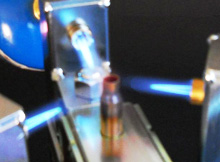 Forum member and long-range shooter Jerry Brandon has launched a new company, Ballistics Edge Mfg., which produces cartridge annealing machines for use by home reloaders. Brandon, a talented designer and fabricator, first tried annealing to maintain the quality of his own match brass. Brandon then built and tested a series of prototype annealing machines, working with a variety of brass sizes. Now Ballistics Edge Mfg. offers a full line of four annealing machines: the manually-operated Model 200 ($250), the motorized twin-torch Model 300 ($345), the motorized triple-torch Model 350 ($395), and the motorized Model 400 ($475), a beautifully-machined carousel design.
Brandon’s most versatile machine, and the one he recommends for annealing both normal- and magnum-sized cases, is the Model 350. Like the Model 300, the Model 350 features all-metal construction and motorized case transport. The Model 350 uses three torches rather than the Model 300’s two. The triple-torch system does a better job heating the large-diameter necks on .338, .416 and .50-caliber cases. The triple-torch design also ensures fast, uniform heating of the case-necks on smaller cases. The video below shows the Model 350 in action, annealing jumbo-sized .50 BMG cases.

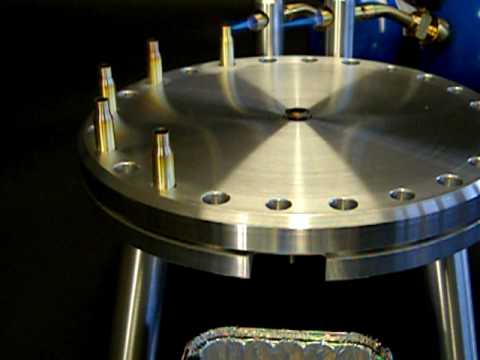
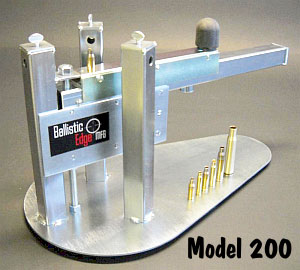 For PPC, 6mmBR, and .308-sized cases, you can use the Model 200, the Model 300, or the Model 400. The Model 200 is a simple, one-at-a-time annealer that works remarkably well using a sliding arm. Simply slide the case into the flame, then slide it out after the required dwell time. For the average reloader, the Model 200 may be more than adequate. If, however, you plan to anneal hundreds of cases a week, you may want to consider the beautifully-machined Model 400 carousel, which will anneal 100 cases in less than 15 minutes. The Model 400 features both .308-size and magnum/ultra magnum-size holes to accept both .47X and .56X diameter cases. Just choose the correct size hole and adjust the torch height to match your case. The .75″-thick shell-plate top acts as a heat-sink to protect the lower case body. View the Model 400 carousel annealer in the video below.
Ballistics Edge Website Offers Good Technical Advice on Annealing
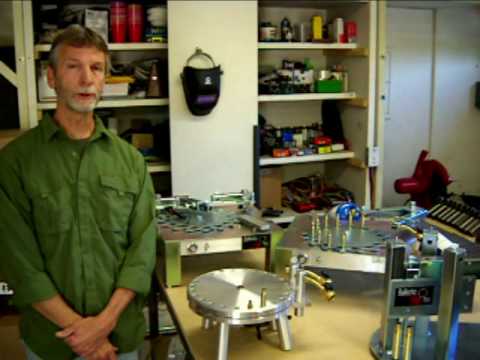
Anyone interested in learning about cartridge annealing should visit www.AnnealingMachines.com, Jerry Brandon’s website. There you’ll find a helpful, authoritative discussion of annealing, including the all-important factors of time and temperature. As Brandon observes, much MISinformation about annealing can be found. Brandon will set you straight. Read Brandon’s How to Anneal article and you can avoid making costly (and potentially dangerous) mistakes, whether you anneal manually or use an annealing machine. In the video below, Jerry Brandon reviews the features of Ballistics Edge annealing machines. He also provides some good, basic advice for shooters who are looking to try their hand at annealing for the first time.
May 6th, 2010
 Berger Bullets has just released its new .338-caliber “hybrid” bullet, Berger’s first-ever projectile larger than .30 caliber. The new bullet has a very high ballistic coefficient (BC): 0.891 under the G1 model, and 0.455 under the newer G7 standard for boat-tail bullets. That high BC should translate into exceptional long-range performance. According to Berger, the BC of the new Berger .338 bullet BC is roughly 14% better than the BCs of other .338-caliber 300gr offerings from Sierra and Lapua. This claim is supported by testing done on all three bullets and published in a detailed Bullet Comparison Report (PDF). The new .338 Hybrid bullets will be sold in 50-count and 250-count boxes. To order, call Berger’s Tech-Line, (714) 447-5458.
The key design feature of the new .338 bullet is its hybrid ogive, i.e. a shape that combines both tangent and secant geometry. A tangent ogive meets the bearing surface very smoothly, whereas a secant ogive has an abrupt juncture with the bearing surface. The figure below shows the geometric differences between a tangent and a secant ogive, as well as the strengths and weaknesses of each.

Practical Considerations — Load Length and Twist Rate
The superior ballistic performance of the 300gr Hybrid .338 is primarily due to the very long ogive and boat tail. However, that super-long bullet length can create some issues. Berger’s new .338 Hybrid bullets are so long that loaded rounds may not fit some magazines comfortably, unless you deep-seat the bullets, which cuts down on usable case capacity. If your loaded rounds with the new .338s are too long for your magazine, single-feeding is recommended. In addition, and this is IMPORTANT, to get optimal performance with the new bullets, you may want to extend the throat in your chamber. This can be done relatively easily by a competent gunsmith using a throating reamer. We caution, however, once the throat is pushed out, you can’t go back to a shorter throat without setting back the entire barrel.
The new .338 Hybrid bullets should stabilize well with a 1:10″ twist at the velocities achievable with popular .338 magnum cartridges. However, according to Bryan Litz, Berger’s Ballistician, at extreme long ranges (beyond one mile), as the .388 bullet goes trans-sonic, it may need more spin. As the bullet slows down into the trans-sonic range, extra stability is required — something you get by spinning the bullet faster. So, for those guys planning to shoot at one mile or beyond, Berger recommends a faster twist-rate. The faster twist provides more spin-stabilization at very long ranges. But for 1000-yard shooting, you don’t need to be concerned about trans-sonic stability. As Bryan explains: “So as long as you keep your shots under 1 mile, the 1:10″ twist is plenty adequate.”
Berger Bullets Video Update (Eric Stecker talks about the new .338 Hybrid and other matters.)

May 5th, 2010
Here is an interesting tool that lets shooters re-shape and uniform the tips of their .22 rimfire lead bullets. Paco Kelly’s Acu’Rzr comes in two basic versions, the “Phase III Nasti-Nose” and the “Phase IV Baby Scorp’n”. The Phase III tool produces a deep-dished hollowpoint (like an ash-tray) that opens quickly and efficiently. There is also a Phase III insert that creates a flatter, open dish HP for target shooting. The Phase IV Scorpion tool creates a deep hollow point with a central post. The internal post in the middle helps achieve deeper penetration in game. The designer claims that ammo modified with either tool is more accurate because the bullet diameter “comes out the same every time”. In addition to the Phase III & IV tools, which reform one round at a time, Paco offers a Maxi series for bulk production. These let you process either three rounds at once (Maxi 3) or four rounds at once (Maxi 4).

Why re-shape lead rimfire bullets? The first reason is accuracy. The tool’s designer, Paco Kelly, claims you can improve the accuracy of budget-priced ammo by using the dish nose rod with the Phase III tool: “The dish nose forming rod is for accuracy and paper targets. It makes very sharp and clean cut holes in paper. And the consistency of the [re-shaped] bullet diameter pulls the group together.”

The main reason to use Paco Acu’Rzr tools is to improve perfomance on small game such as squirrels, prairie dogs, and jack-rabbits. Kelly says: “Unlike most commercial 22 rimfire ammo with small holes and negligible HP expansion, the Nasti-Nose will open even with standard velocity ammo. Yet it will NOT explode on contact like the hyper-velocity ammo. For small eating game, such as squirrels, the Hyper ammo is too much and the medium-velocity, hollow-pointed commercial ammo often fails to open. But not so with the Nasti-Nose.” The idea, Kelly suggests, is that you get reliable expansion with medium-velocity ammo, without destroying the game the way hyper-velocity ammo does.
The Phase III tool costs $65.00, while the Phase IV tool costs $75.00. The Maxi 3 which does three (3) rounds at once, costs $100.00, and the four-round Maxi 4 is $128.00. All tools can be customized for target rifles or European chambers. To order, contact Paco Kelly, P.O. Box 1170, Cortaro, AZ 85652 or use this ORDER FORM.
EDITOR’s NOTE: Do NOT use this tool with premium-grade rimfire target ammo. It won’t help. Use it with the cheaper bulk-pack ammo. Also, we have not tested the reformed ammo on live targets, so you have to draw your own conclusions as to its benefits on small critters.
|


