Our friend Robert Whitley of 6mmAR.com has come up with a new, accurate 6mm wildcat based on the new Lapua 22-250 brass that has just started arriving. Robert provides this report:
“I just received a box of the new Lapua 22/250 cases — beautiful brass! My real desire with it was to make it into a 6mm version, preferably something that was ‘no neck-turn’ with a .308 Win-type body taper that would work well in bolt gun and semi-auto magazines and would have a capacity to allow superior velocities. I considered the 6XC, but since you have to bring a whole lot of the shoulder of the brass up into the neck (when you re-form the brass from 22-250 to 6XC) that would necessitate neck-turning it because with Lapua brass the shoulder metal is thicker than neck metal of the brass.
I wanted a simple ‘neck it up and shoot it’ approach so I made up a 6mm-250 Improved 30 cartridge (i.e. 6mm-250 Improved with a 30 degree shoulder) and this thing works great — just neck up the brass, load it and shoot it! The case is like a 6XC with a .030″ longer body and a .030″ shorter neck, which works out fine if you are going to be shooting mainly the 105-108 gr bullets (which it will do very well shooting 2950 – 3000 fps). If you want to hot-rod things, which I do not, I am certain the case can push the 105-108 gr bullets a fair amount faster.
I set it up and throated the reamer for the Sierra 107s and the Berger or JLK 105 VLDs (i.e. a .090″ free bore on the reamer) and it works great with them. If I was going to use it with the Lapua 105s or the Berger 108s I would add about .025″ – .030″ to the freebore of the reamer (i.e. make the freebore around .115″ to .120″).
The great thing is you can use a 6XC die set for it without modification, and all you need to do is keep the dies about .030″ up off the shell holder from their normal position and use them as is. You can make a spacer washer about .030″ thick that you can put on and take off the 6XC dies and use the dies for both cartridges (i.e. 6XC and 6mm-250 Imp 30).
6mm-250 Imp 30 Shows Great Accuracy
Fire-forming loads are real accurate. Here is a 10-shot group I shot prone at 100 yards shooting fire-forming loads with it — the group is the size of a dime. For fire-forming I use a milder, but still very accurate load: 32.0 grains of N140 with a Sierra 107 and a BR2 primer. For fire-formed cases you can jump up to N160 (around 38-40 grains — depending on lot) and it will push the 105-108 gr bullets real accurately in the 2950-3000 fps range, with low ES and SD. This cartridge has a neck length of .268″ which is plenty long for a 6mm shooting bullets with varying bearing surface lengths. The reamer diagram (link below) leaves about a .003″ neck clearance over a loaded round, which seems to work out very well for a ‘no-turn neck’ set-up.
So there you have it … the 6mm-250 Imp 30 is simple, easy to make, accurate as all get out, there are available factory die sets you can use, and it uses great new Lapua brass — what’s not to like!”
Hey guys, here’s your chance to buy Berger Bullets at super-low prices. Berger has arranged an exclusive “Bullet Sell-Off” promotion for AccurateShooter.com readers. These bullets are not blems or damaged. They are mostly first-quality overruns. After yesterday’s sale, what’s left are primarily 22 caliber. Some are moly-coated but most are not. The prices are insanely low on these sell-off bullets. You can save $10 per 100 (or more) on some types.
Eric Stecker, Berger’s Master Bulletsmith, explains: “Over time we accumulate bullets that are either discontinued, overruns or were part of a test that is completed. These bullets are Match Grade and every bit the same as any Berger. Circumstances specific to each lot available is compelling us to release these bullets for very low prices. Below I’ve listed the quantity, description, lot, price and a brief explanation on why they are available for such a low price.”
Berger will sell these bullets for the next few days. To purchase the Special Sell-Off bullets, call Berger’s main line at (714) 447-5456 to place the order. Doing this will help keep things sorted out as the calls come in — first call, first served. UPDATE: The 17 Cal just sold out.
MidwayUSA was able to take advantage of a Special Buy on factory-blemished bullets. These bullets have slight cosmetic defects that should not alter performance. These blem bullets will be sold on a first-come, first-served basis, with sale prices in effect through April 30, 2010. MidwayUSA shows a 6.5mm (.264) 129gr poly-tip (probably a Hornady) on sale, but it appears the 129s may have sold out already.
There are still some great deals. The remaining inventory of blem bullets includes:
17 Cal (.177) Varmint Bullets, 20gr FMJ, Item 685063
Regularly $16.99, NOW $10.49 per 100
25 Cal (.257 ) 100gr Spitzer, Item 817547
Regularly $21.99, NOW $14.29 per 100
.270 Cal (.277) 110gr HPBT, Item 513312
Regularly $23.49, now $15.19 per 100
Need “value-priced” .223 Rem Brass? Then give Graf & Sons a call. Graf’s has NEW Lake City Mil-Spec .223 Rem (5.56) unprimed brass on sale for just $19.99 per 100 cases. That’s right… just twenty bucks per hundred. But this sale price expires Friday 4/23/2010 at midnight. Large quantities of sale brass were on hand at this price as of 12:00 noon CST on 4/21. To order, visit Grafs.com, or call 1-800-531-2666.
Many shooters feel that Lake City makes some of the best .223 Rem (5.56×45) brass available. And it’s hard to beat Graf’s price for this LC 2009 headstamp brass (item FDU223). This is a good opportunity for varminters and service rifle shooters to lay in a large supply of quality brass.
We talked recently with our friend Darrell Jones, a talented benchrest shooter from Tennessee, who operates a brass processing business, DJ’s Brass Restoration Service. Darrell ultrasonically cleans old cartridge brass then carefully anneals each case, using temp-sensitive lacquers to ensure the brass is neither over-annealed or under-annealed. As far as we know, DJ’s Brass Restoration Service is the ONLY business in the country offering combined ultrasonic cleaning and annealing. And now Darrell can process your brass with even great efficiency.
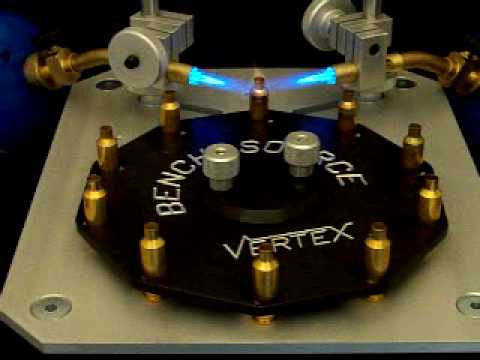
Darrell told us he has just received his new, automated dual-torch, carousel annealing machine from Bench-Source. This microprocessor-controlled unit may be the most advanced bench-top annealing machine ever created. Two torches are used to provide intersecting flames for uniform heating. The micro-processor precisely controls the heating time, and a special motor spins each case around its axis while in the heating position. This ensures that the neck and shoulder are annealed evenly.
Combined Ultrasonic Cleaning and Case Annealing
If you have “tired” brass with inconsistent neck tension from case to case, give Darrell a call. His cleaning/annealing process will extend the useful life of your brass, and his service is quite affordable. Darrell’s Basic Service starts at $20.00 per hundred cases — and that includes ultrasonic cleaning AND annealing. (Flat rate USPS shipping is extra.) Note: very large cases (such as the .338 Lapua) or damaged, dented cases may cost more.
In addition to the Basic Service, Darrell offers a 4-Step Full Service starting at $25.00 per hundred cases (plus shipping). Darrell’s Full Service brass restoration includes: Uniforming primer pockets; Chamfering Case Mouths; Ultra Cleaning and polishing; Annealing case necks.
Ultrasonic Muzzle Brake Cleaning
In addition to cleaning and annealing cartridge brass, Darrell offers Ultrasonic Cleaning for muzzle brakes. This removes carbon buildup to restore critical bullet clearance requirements. The price is $15.00 per brake (plus shipping).
For more information, visit DJsBrass.com, or call Darrell at (901) 826-1503. IMPORTANT: Contact Darrell for shipping instructions BEFORE sending any brass for processing. ALL BRASS MUST BE DE-PRIMED before you send it.
Berger Bullets has just released a video report from Eric Stecker, Berger’s “master bulletsmith”. In this video update, Eric explains why Berger’s popular 6mm, 25 cal, and 7mm bullets are in short supply. Eric reports that production delays were caused by mechanical problems with the jacket-making presses. The good news is that the jacket presses have now been fixed (this required a complete rebuild of the 7mm press), so production should be back on schedule very soon. You’ll find more current news and match reports on Berger’s new Facebook Page.
Berger also announced that, in order to better respond to customer inquiries, Berger has added a new representative to the customer service staff, Teresa Collins. You can contact Teresa by phone at 714-447-5456 or send email to: teresa.collins [at] bergerbullets.com.
Some weeks ago we reported that ATK was involved in a program with military-base commanders, under which one-fired cartridge brass was “de-milled” and then sold as scrap metal to ATK. The unit commanders then retained the proceeds for “discretionary use” at their bases. This procedure drew flack from gun owners and various members of Congress who believed the brass should be sold in reloadable condition — thereby returning its “highest use value” to the U.S. Treasury.
Apparently ATK has abandoned the process of purchasing, at scrap value, demilled once-fired brass from military base commanders. According to Jim Shepherd’s Shooting Wire: “Montana Congressman Denny Rehberg has been ‘personally assured’ by Alliant Techsystems (NYSE:ATK) that the company’s controversial purchasing of demilled, once-fired military brass from individual military post commandants was ‘done’. That program launched a firestorm of protest from ammunition reloaders toward the small arms ammunition manufacturer after Montana Shooting Sports Association president Gary Marbut alleged ATK was trying to ‘pull an end-run’ around a Congressional directive to stop the process of destroying once-fired military brass.”
We hope that ATK has abandoned the de-milling program for good, and that once-fired military brass will, without exception, be made available to surplus vendors through public auctions. This was the intent of a Congressional Directive which stated that once-fired brass should be sold in reloadable condition. The U.S. government should certainly receive the highest value for surplus cartridge brass which the taxpayer paid to produce in the first place. Once-fired military brass is a popular resource for recreational and competitive shooters nationwide.
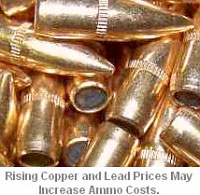
Expect the price of bullets and cartridge brass to climb upwards. Though demand for loaded ammunition has slacked off somewhat in the USA, as the buying frenzy of 2008-2009 has abated, there is still strong demand for sporting ammo and reloading components. Shortages persist for some types of reloading components and military ammo demand remains strong. But the primary reason for higher brass and bullet prices is the rise in raw materials costs. In the past year, the price of copper has risen from about $2.00/lb to over $3.50/lb. Likewise, the cost of lead (used for bullet cores) has jumped from $0.60/lb to $1.05/lb.
Will this trend continue? Probably. As the world economy sputters into recovery, increased global demand for raw materials will probably continue to drive metal prices upwards — and that means reloading components will cost more. A 100-count box of 140gr bullets contains two pounds of metal. If raw material costs rise $2.00 or $3.00 per 100 bullets, eventually we will see higher bullet prices.
The Economist predicts rising metal prices through 2011: “Growing optimism about the world economy helps explain why prices are surging. News from developed economies has become sunnier. And metal-hungry China ([which] consumes a third of the world’s base metals) is expected to grow so fast that its metal demand could return to pre-crisis levels in a year or so. Supply and demand is not the only thing helping keep prices aloft. There is an ‘extraordinary market’ for copper that has departed from fundamentals, reckons Andrew Keen at HSBC. Growing copper inventories at metals-exchange warehouses (half a million tonnes or so by some estimates) have coincided with increasing prices. The same seems to be happening with aluminium, lead and nickel.”
Alliant Techsystems (NYSE:ATK) has acquired Blackhawk Industries Products Group Unlimited, LLC, a major player in the lucrative tactical products and security accessories market. The acquisition of Blackhawk, combined with the recent purchase of Eagle Industries, strengthens ATK’s position in tactical equipment for domestic and international military, law enforcement, security, and sport enthusiast markets.
“The acquisition of Blackhawk supports our strategy of expanding into adjacent lanes while leveraging ATK’s existing core competencies,” said Mark DeYoung, President and CEO. “Blackhawk provides ATK with a leading tactical systems brand, an expanded portfolio of quality products, and additional design and development expertise[.] This acquisition significantly increases our presence and our potential in the growing domestic and international security markets.”
Blackhawk was founded in 1993 by former Navy SEAL Mike Noell. It all started with a failed pack in a mine field in Iraq that inspired Noell to create his own line of gear. Headquartered in Norfolk, Virginia, Blackhawk is a leading US manufacturer of tactical gear, body armor, law enforcement duty gear, holsters, hydration systems, protective gloves and gear, apparel and footwear, knives, illumination tools, breaching tools, hunting gear, and recoil reducing stocks. The company operates manufacturing facilities in North Carolina, Montana, and Idaho. Blackhawk is one of the most widely recognized brands for tactical, military, and law enforcement equipment. Blackhawk and ATK’s existing tactical accessories business will become a division of ATK’s Security and Sporting Group.
ATK is a global aerospace and defense company with more than 18,000 employees in 22 states, Puerto Rico and internationally, and revenues in excess of $4.8 billion. ATK operates the Lake City Army Ammunition Plant, while the ATK Security and Sporting Group now includes the following major brands: Alliant Powder, Blackhawk, CCI, Champion, Eagle Industries, Federal, RCBS, Speer, and Weaver Optics.
In recent years, environmental concerns over lead toxicity have inspired efforts to eliminate conventional lead-based ammunition. To protect endangered species from lead poisoning, California has banned hunting altogether on huge tracts of public land. In other areas which harbor protected species, hunters are forbidden to use lead-core or solid lead bullets. There is an ongoing FDA investigation into the health of venison taken with lead-core bullets. Responding to such concerns, in 2008, Barnes Bullets (now part of the Freedom Group), introduced its MPG™ (Multi-Purpose Green) lead-free bullets. These bullets are intended for hunting and for rifle training in locations where lead is restricted.
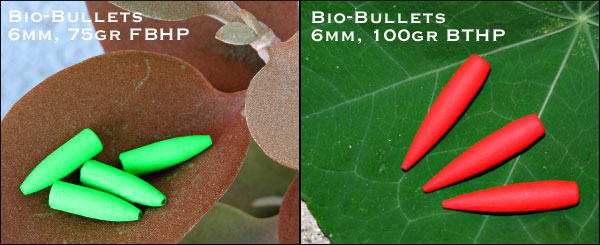
Following Barnes’ lead, BIO-Bullets, a small company in Wanganui, New Zealand has invented a jacketless bullet that is not only lead-free, but is also 100% non-toxic, and bio-degradable. The new bullets have zero lead content and are made from “all-natural”, organic compounds. Unlike conventional bullets formed in a die, the new BIO-Bullets are pressure-molded from a proprietary composite, using sintered mineral compounds in a silica matrix. The mineral compounds, interestingly enough, not only bind the bio-degradable bullet together, but they provide nutritional benefits for any game that might ingest the projectiles. If an animal eats the bullet, it won’t get sick — it will actually get healthier.
That’s right — these edible BIO-Bullets are not only non-toxic, they are actually nutritious. “When we came up with a non-toxic component mix, we realized we could actually provide a blend of flavorful nutrients in the matrix.” Said Trevor MacDiarmid, BIO-Bullets’ chief bullet designer. “It may seem far-fetched but just look at the label on a typical multi-vitamin supplement. You’ll see iron, chromium, magnesium, potassium, and zinc, among other minerals. These are all elements that can be combined into a durable bullet form that is actually healthy when ingested by an animal.” MacDiarmid, who holds a Ph.D in chemical engineering, explains that the health benefits of the BIO-Bullet came as an unexpected bonus: “Our first goal was simply to create a shootable, lead-free bullet that was non-toxic. But when our silica matrix proved more than hard enough to survive the friction, heat, and pressure of a 3500 fps trip through a rifle bore, we realized we could add additional minerals into the mix that would have a salutary effect on wildlife health.”
BIO-Bullet’s founder, Steven Williams, is a gregarious 45-year entrepreneur who earned his first millions promoting dietary supplements in his native New Zealand. Noting the growing interest in “eco-friendly” ammunition components, Williams expects a huge demand for his new BIO-Bullets. “Globally, the annual sales of hunting bullets exceed €500 million in value. And the military bullet market may be triple that number — as long as you Yanks keep fighting wars”, he joked. Williams believes his new company is in the right place at the right time: “Being based in eco-aware New Zealand gives us a strong marketing advantage in launching this new product.” Williams’ company has earned the coveted “100% Pure New Zealand” certification, signifying that Bio-Bullets are “all-natural” and organic.
A select group of New Zealand hunting guides has already been using prototype BIO-Bullets in the field. The new eco-friendly bullets have earned high praise from these tough-to-please outdoorsmen. “In terms of ballistics and knock-down power, I reckon the ‘greenies’ are as good as anything on the market”, reports veteran outfitter Bart Coutts. South Island guide and deer farmer Dennis Amon said, “I’ve used them for predator control, and, as a test I even fed them to some of our captive Red Deer. The Reds ate them up like they were candy. Ever since then we’ve been calling these BIO-bullets the ‘incredible edibles’.”
BIO-Bullets will initially be available in .224, 6mm, and .308 calibers starting at $40 (NZ) per box of 100. The varmint-grade, flat-based bullets will be finished with a day-glo green outer coating, while the longer, boat-tail match bullets will be fluorescent red. Said designer MacDiarmid: “Since our BIO-Bullets don’t use a conventional jacket, we can finish them in any color by adding non-toxic dyes to the silica matrix. It’s sort of like putting the colored shell on a jelly bean. I favored a more sedate color, but the boss wanted something bold and eye-catching. Steven’s the marketing guru, and he writes the checks, so we went with fluorescent colors. But any exterior color scheme is possible, even digital camo.”
BIO-Bullets is currently finalizing arrangements with North American distributors. The company expects its eco-friendly bullets to appear on American and Canadian store shelves in time for the traditional fall hunting season.


 Our friend Robert Whitley of 6mmAR.com has come up with a new, accurate 6mm wildcat based on the new Lapua 22-250 brass that has just started arriving. Robert provides this report:

 6mm-250 Imp 30 Shows Great Accuracy
 Hey guys, here’s your chance to buy

 There are still some great deals. The remaining inventory of blem bullets includes:



 Apparently ATK has abandoned the process of purchasing, at scrap value, demilled once-fired brass from military base commanders. According to
 Expect the price of bullets and cartridge brass to climb upwards. Though demand for loaded ammunition has slacked off somewhat in the USA, as the buying frenzy of 2008-2009 has abated, there is still strong demand for sporting ammo and reloading components. Shortages persist for some types of reloading components and military ammo demand remains strong. But the primary reason for higher brass and bullet prices is the rise in raw materials costs. In the past year, the price of copper has risen from about $2.00/lb to over $3.50/lb. Likewise, the cost of lead (used for bullet cores) has jumped from $0.60/lb to $1.05/lb.


 Following Barnes’ lead, BIO-Bullets, a small company in
 BIO-Bullet’s founder, Steven Williams, is a gregarious 45-year entrepreneur who earned his first millions promoting dietary supplements in his native New Zealand. Noting the growing interest in “eco-friendly” ammunition components, Williams expects a huge demand for his new BIO-Bullets. “Globally, the annual sales of hunting bullets exceed €500 million in value. And the military bullet market may be triple that number — as long as you Yanks keep fighting wars”, he joked. Williams believes his new company is in the right place at the right time: “Being based in eco-aware New Zealand gives us a strong marketing advantage in launching this new product.” Williams’ company has earned the coveted “100% Pure New Zealand” certification, signifying that Bio-Bullets are “all-natural” and organic.