|
|
April 1st, 2010
In recent years, environmental concerns over lead toxicity have inspired efforts to eliminate conventional lead-based ammunition. To protect endangered species from lead poisoning, California has banned hunting altogether on huge tracts of public land. In other areas which harbor protected species, hunters are forbidden to use lead-core or solid lead bullets. There is an ongoing FDA investigation into the health of venison taken with lead-core bullets. Responding to such concerns, in 2008, Barnes Bullets (now part of the Freedom Group), introduced its MPG™ (Multi-Purpose Green) lead-free bullets. These bullets are intended for hunting and for rifle training in locations where lead is restricted.
 Following Barnes’ lead, BIO-Bullets, a small company in Wanganui, New Zealand has invented a jacketless bullet that is not only lead-free, but is also 100% non-toxic, and bio-degradable. The new bullets have zero lead content and are made from “all-natural”, organic compounds. Unlike conventional bullets formed in a die, the new BIO-Bullets are pressure-molded from a proprietary composite, using sintered mineral compounds in a silica matrix. The mineral compounds, interestingly enough, not only bind the bio-degradable bullet together, but they provide nutritional benefits for any game that might ingest the projectiles. If an animal eats the bullet, it won’t get sick — it will actually get healthier.
That’s right — these edible BIO-Bullets are not only non-toxic, they are actually nutritious. “When we came up with a non-toxic component mix, we realized we could actually provide a blend of flavorful nutrients in the matrix.” Said Trevor MacDiarmid, BIO-Bullets’ chief bullet designer. “It may seem far-fetched but just look at the label on a typical multi-vitamin supplement. You’ll see iron, chromium, magnesium, potassium, and zinc, among other minerals. These are all elements that can be combined into a durable bullet form that is actually healthy when ingested by an animal.” MacDiarmid, who holds a Ph.D in chemical engineering, explains that the health benefits of the BIO-Bullet came as an unexpected bonus: “Our first goal was simply to create a shootable, lead-free bullet that was non-toxic. But when our silica matrix proved more than hard enough to survive the friction, heat, and pressure of a 3500 fps trip through a rifle bore, we realized we could add additional minerals into the mix that would have a salutary effect on wildlife health.”
 BIO-Bullet’s founder, Steven Williams, is a gregarious 45-year entrepreneur who earned his first millions promoting dietary supplements in his native New Zealand. Noting the growing interest in “eco-friendly” ammunition components, Williams expects a huge demand for his new BIO-Bullets. “Globally, the annual sales of hunting bullets exceed €500 million in value. And the military bullet market may be triple that number — as long as you Yanks keep fighting wars”, he joked. Williams believes his new company is in the right place at the right time: “Being based in eco-aware New Zealand gives us a strong marketing advantage in launching this new product.” Williams’ company has earned the coveted “100% Pure New Zealand” certification, signifying that Bio-Bullets are “all-natural” and organic.
A select group of New Zealand hunting guides has already been using prototype BIO-Bullets in the field. The new eco-friendly bullets have earned high praise from these tough-to-please outdoorsmen. “In terms of ballistics and knock-down power, I reckon the ‘greenies’ are as good as anything on the market”, reports veteran outfitter Bart Coutts. South Island guide and deer farmer Dennis Amon said, “I’ve used them for predator control, and, as a test I even fed them to some of our captive Red Deer. The Reds ate them up like they were candy. Ever since then we’ve been calling these BIO-bullets the ‘incredible edibles’.”
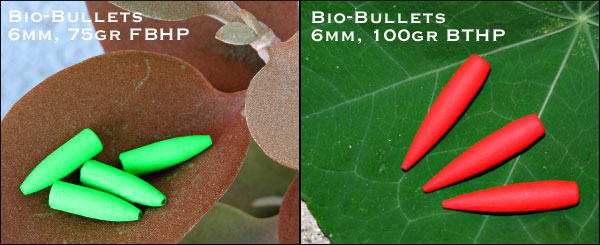
BIO-Bullets will initially be available in .224, 6mm, and .308 calibers starting at $40 (NZ) per box of 100. The varmint-grade, flat-based bullets will be finished with a day-glo green outer coating, while the longer, boat-tail match bullets will be fluorescent red. Said designer MacDiarmid: “Since our BIO-Bullets don’t use a conventional jacket, we can finish them in any color by adding non-toxic dyes to the silica matrix. It’s sort of like putting the colored shell on a jelly bean. I favored a more sedate color, but the boss wanted something bold and eye-catching. Steven’s the marketing guru, and he writes the checks, so we went with fluorescent colors. But any exterior color scheme is possible, even digital camo.”
BIO-Bullets is currently finalizing arrangements with North American distributors. The company expects its eco-friendly bullets to appear on American and Canadian store shelves in time for the traditional fall hunting season.
March 27th, 2010
 Lyman Products has introduced a new Universal Case Prep Tool Set that contains all the tools need for chamfering case-necks and uniforming primer pockets on all common sizes of brass. The new Tool Set features eight (8) separate tools, all with ergonomic handles with rubber inserts. A handy zippered case with elastic straps allows you to keep the tools organized on your loading bench. The Tool Set, Lyman product #7810212, includes large and small primer pocket reamers, large and small primer pocket cleaners, outside deburring tool, inside (VLD) chamfer tool, and large and small primer pocket uniformer tools.
MSRP for the Universal Case Prep Tool Set is $69.95, but we expect the Set to sell for about $55.00 retail. Currently, Midsouth Shooters Supply has the 8-piece Case Prep Tool Set in stock for $51.30 (Midsouth item 015-7810212).

March 25th, 2010
Gary Marbut, president of the Montana Shooting Sports Association, has revealed that once-fired military brass is being converted into scrap metal rather than being sold in reloadable condition with revenues going to the U.S. Treasury. The destruction or mutilation of once-fired brass runs contrary to the efforts of Congressional leaders to ensure that fired military brass be resold rather than destroyed. Marbut claims that once-fired brass is now being destroyed as the result of “sweetheart side deals with installation commanders that [are] being aggressively promoted by ATK.”

According to Marbut, ATK/Alliant Techsystems has encouraged military base commanders to sell their used cartridge brass directly to ATK. The brass is then demilled and rendered down to scrap metal for use in ATK’s future new cartridge production. Marbut states: “ATK even provides portable equipment to demil tons of cartridge cases at the military installations, destroying the brass for reloading purposes. Because the destroyed cartridge case brass is not suitable for reloading, it cannot command a price driven by auction for the highest-value use of reloading. Military installation commanders sell the Alliant-destroyed brass to ATK at a private, non-auction, special price. Commanders are willing to accept the reduced price because the sale proceeds go to the commanders’ discretionary accounts and not back to the U.S. Treasury via Government Liquidations.”
As a result of this reported arrangement between military commanders and ATK, Marbut believes, millions of used military cartridge cases, which otherwise could enter the commercial market for surplus brass, are being destroyed rather than sold at auction for fair value. In a time when there are still acute shortages of reloading components, this reduces the supply of reloadable brass, while depriving the U.S. Treasury of sales proceeds. Marbut calls for Congressional action to stop the “sweetheart deals” and ensure that “expended military brass of civilian-usable calibers generated domestically goes through the public auction process.” Marbut believes that “will benefit the U.S. Treasury, America’s gun owners, and the adequacy of the ammunition marketplace.”
CLICK HERE to read full story: Military Cartridge Brass Destruction 2010 – Round 2
March 24th, 2010
If you have a older version of QuickLOAD that won’t run on a Vista or Windows 7 computer, take heart, Neconos.com now has the updated version 3.6 of QuickLOAD. Version 3.6 is fully compatible with XP, Vista, and Windows 7, AND the latest update has an upgraded database with MORE powders, bullets, and cartridges. In addition, G7 Ballistic Coefficients are now supplied for many bullets in the database.

If you are currently running an older version of QuickLOAD on an XP machine, and you plan to upgrade to Windows 7, you should order the new QuickLOAD v. 3.6, with disk exchange. You will need to send in your CD so it can be “personalized” with your serial number. Ed Dillon of Neconos.com explains: “If you have 3.0, 3.1 or 3.2 and are planning on using a VISTA or Windows 7 machine you must install a new, compatible QuickLOAD disk. Send in your old CD and we will replace it with a Vista/Windows 7 compatible CD for $14.95 plus S & H.” (Note — this latest version 3.6 disk is also backwards compatible with Windows ME, 2000 and XP). Call Neconos at 800-451-3550, for instructions on how to send in your disk for the upgrade.
Data-only Upgrade Also offered
If you own a more recent version of QuickLOAD that already works with Vista, or if you plan to stick with XP, you can can order a data-only version 3.6 upgrade. That is the simplest way to get the enhanced databases, with new powders, bullets, and cartridges. If you have CD versions 3.0, 3.1, 3.2, 3.3, 3.4, or 3.5, you can purchase a new data update that adds new powders, cartridges, and bullets to your existing QuickLOAD program. For the data-only update, you do NOT need to send in your original installation CD, or uninstall the program. The data-only upgrade should simply update your QuickLOAD databases and you can keep running your program as usual.
Read our QuickLOAD Review to Learn More
The full QuickLOAD program costs $149.95, bundled with the QuickTarget ballistics program as a FREE extra. The latest version of QuickLOAD has comprehensive data for more than 1200 cartridges, 225 powders, and 2500 bullets. QuickLOAD is a remarkably powerful software program that will help you choose the most efficient powders for your cartridge. It can predict the effect (on pressure and velocity) of small changes in seating depth, barrel length, and even ambient temperature. Check out our detailed QuickLOAD Review to learn why this software is an invaluable tool for the serious reloader.
March 4th, 2010
Southwick Associates compiles statistics for the hunting/shooting industry and public wildlife agencies. Based on 2009 survey results, Southwick has ranked the most popular shooting/hunting brands and products. These rankings were based on HunterSurvey.com and TargetshootingSurvey.com online polls completed by nearly 45,000 hunters and shooters. The polls asked the hunters and shooters to list the outdoor products they purchased most often.
 There were some interesting results among rifle shooters. Remington is still the #1 rifle-maker, and Remington also leads the way in rifle ammunition. Hodgdon is the top reloading powder vendor with 36.5% of reported purchases. Top bullet-maker is Hornady with 30%, but remember this is for hunting AND target shooting. CCI makes the most popular rifle primers. We were somewhat surprised to see that the top scope brand for all firearms was Bushnell, which held a 17.3% share.
Southwick Associates’ HunterSurvey.com also measured buying activities over time. As you might expect, hunters spent the most money on gear in November. However the peak month for target shooters was June. We would have figured most of the spending would have taken place earlier in the spring — at least for rifle shooters who reload.

Rifle Shooting & Hunting
• Top rifle brand: Remington (16.5% of all purchases)
• Top muzzleloader brand: Thompson Center (29.5% of all purchases)
• Top scope for firearms: Bushnell (17.3% of all purchases)
• Top rifle ammunition brand: Remington (28.8% of all purchases)
• Top reloading bullet brand: Hornady (30.2% of all purchases)
• Top reloading powder brand: Hodgdon (36.5% of all purchases)
• Top reloading primer brand: CCI (36.0% of all purchases)
• Top shooting target brand: Shoot-N-C (38.9% of all purchases)
Shotguns
• Top shotgun brand: Remington (22% of all purchases)
• Top shotgun ammunition brand: Winchester (32.0% of all purchases)
• Top clay brand: White Flyer (34.3% of all purchases)
• Top balls, bullets, or shot brand: Hornady (26.2% of all purchases)
Handguns
• Top handgun brand: Sturm Ruger (16.6% of all purchases)
• Top handgun ammunition brand: Winchester (22.0% of all purchases)
• Top holster brand: Uncle Mike’s (21.4% of all purchases)
• Top blackpowder brand: Pyrodex (51.5% of all purchases)
Hunting Gear
• Top binocular brand: Bushnell (19.5% of all purchases)
• Top knife brand: Buck (16.7% of all purchases)
• Top scent or scent covering brand: Scent-A-Way (24.5% of all purchases)
• Top game call brand: Primos (34.8% of all purchases)
March 4th, 2010
Hornady has started shipping its new .308 Winchester Superformance™ match ammo. Loaded with a high-BC 178gr BTHP, the new ammo, which employs a proprietary blend of propellants (some of which are NOT commercially available), has shown outstanding velocities. One shooter reported 2820 fps from a 26″ barrel, while Hornady claims 2775 fps from a SAAMI-spec 24” test barrel. Hornady says this .308 match load is approximately 175 fps faster than any comparable factory .308 load.

CLICK HERE for Technical Info on Superformance ammo.
New Projectile Developed for this Match Ammo
With a 0.530 BC bullet moving around 2800 fps, the new Superformance™ ammo offers impressive ballistic performance — better than many reloaders may be able to achieve with their handloads. Accuracy has been very good also, according to Hornady Engineer, Joe Thielen, due in no small part to bullet design: “The new 178 grain BTHP Match bullet was purpose-built, and optimized specifically for the .308 Winchester chamber. It features an aggressive ogive as well as an extremely efficient boat tail that makes this projectile highly effective aerodynamically, [with] less wind drift and … flatter trajectories. Accuracy results were excellent. We shot a .680″ group at 200 yards with our test equipment, and field tests out to 1250 yards yielded 8″ groups (8 inches at 1250 yards is 0.611 MOA).”
The 178gr Superformance .308 ammunition should stay supersonic to approximately 1,275 yards. That’s a lot farther than any other factory .308 load for 175-180gr bullets. The ability to stay supersonic well past 1000 yards is a boone to long-range .308 shooters.
| Here is how Hornady has achieved high velocities with its new Superformance ammunition:
1) Superformance ammo uses advanced new Ball Powders (not yet for sale).
2) The powders are BLENDED, with different “recipes” for different cartridges.
3) The new powders maintain high-energy longer in barrel (like Reloder 17).
4) The new powders burn almost completely, reducing ejecta, for less exit pressure, and less felt recoil.
5) Superformance ball propellants pack very densely, so more grains of powder can fit inside a case, compared to typical extruded stick powders. |
Can Reloaders Replicate the Superformance .308 Match Ammo?
Forum members have asked: “How can we duplicate the Superformance ammo with our handloads?” Unfortunately, this will not be an easy task. The Superformance line of loaded ammo uses special blends of propellants customized for each cartridge/bullet combination. Hornady spent a lot of time and effort “tweaking” the blends to achieve maximum velocities. In addition, Hornady “commissioned” some new propellants expressly for the Superformance ammo. Therefore there’s no easy way to replicate Superformance loads with a single, off-the-shelf powder, and we caution strongly against “blending your own”. REPEAT: do NOT attempt to blend commercial powders to try to replicate Superformance velocities with your handloads.
March 1st, 2010
IBS 600-yard National Champion and recent 600-yard Shooter of the Year Sam Hall has been hard to beat when he’s got his 6BR or his Dasher dialed in. Sam recently told us that he’s been experimenting with the 6.5×47 Lapua cartridge, thinking that a larger, higher-BC bullet might perform better in the wind.


Sam’s competitors are probably hoping we’ll report that Sam is struggling with the new cartridge, and can’t get his new 6.5×47 to shoot. Well, guys… no such luck. Sam recently took his 6.5×47 Heavy Gun out in some fairly windy conditions, but still returned a spectacular four-shot group at 600 yards. Sam measured the group at 0.357 inches. We measured it at 0.371″ with OnTarget software, but that was going off a photograph, which can be less precise. Either way, 4 shots in well under 0.4 inches at 600 yards is spectacular.
As Sam told us, however, “I just wish I’d shot that in competition… with a fifth shot of course.” Even though Sam’s group was shot in practice, it’s still an amazingly small group — one that suggests that the 6.5×47 Lapua may have great potential as a Benchrest cartridge. The group size, in MOA, is 0.059!

Sam’s load was 37.0 grains of Reloder 15 with 130gr Berger VLDs and CCI BR4 primers. The gun is a Bat-actioned, 47-lb “true heavy” built by Leonard Baity using a McMillan 50BMG stock. The barrel is a 29.5″ Brux, 1.25″ straight contour, with a 1:8.5″ twist. Sam reports:
The gun has a BAT MB 1.55″ round action. The reamer was a Kiff (PTG) .290 neck with .160 freebore. The loaded round is .288 at the neck. I made a mistake labeling the target. The primers were CCI BR4s, not 450s. The 130gr Bergers VLDs are lot 0225 (the early ones). They are in the rifling as far as I can get them (jam). I use a .287 Redding bushing in my Redding “type S” FL dies. I seat with a Wilson seater. The stock is a McMillian Light 50 BMG stock full of lead from McMillian. With the 40x Leupold it weighs 47 pounds. The fore-end is 3.5 inches wide. Leonard Baity did the complete rifle. I had him to put a rail (3 inches wide) on the back so I could use my adjustable rest Leonard made me a few years ago for my Shehane Maxi-Tracker stock. Even though this rifle is only 14 pounds lighter than the 61-pound aluminum stock Maxi-Tracker 6mm Dasher I shot last year, it feels like it is 25 pounds lighter. It is much, and I mean MUCH more manageable carrying this rifle around than the Maxi-Tracker. I can actually use my Farley, joy-stick rest with the rifle. I just replace the 3 inch bag with a 3.5 inch wide bag. I can make adjustments much faster with the Farley than I can twisting knobs.
The reason I built the 6.5×47 Lapua is to try to beat the wind we have here in NC in the spring. Plus, the fact I love to shoot and experiment. The 6.5 bullets are not affected as much by the wind as the 6mms. I started shooting 600-yard competiton with a 6.5-284. I could predict where the bullet was going to hit much better with it than the 6mms I shoot now. In windy conditions, the 6mms seem to “dance around” when sighting in. The heavy 6.5 seems to say on track and Point of Impact is more predictable. In 600-yard competition, score is half the game. I figured if I could get a 6.5 shooting somewhere close to a 6BR or 6BR Improved, I would be ahead of the game in the wind. So far this rifle is agging at 600 yards pretty close to my Dasher and BRX, but not better. After I found this load that shot the 0.357 inch 4-shot group, I went out and shot four more, 4-shot groups in some wind of 10-20 mph and the rifle agged 2.08 inches.
I am still haunted by a “flier” in each group. I am still trying to work that out. The 0.357 group I will say was a fluke because it is the only group I have shot that did not have a flier. The rifle sure won’t group like that every time, but that one time sure was pretty! You may ask why I shoot 4-shot groups during load development and practice. Three is not enough, but four will tell you what the rifle will do, plus I can shoot more groups before the barrel gets too warm.
Our first match is next month at Piedmont. I am going to give this rifle a try. Time will tell if I will stick with this round for serious 600-yard competition or back to the 6mms. — Samuel Hall
February 28th, 2010
 While in Southern California recently I couldn’t pass up the invitation to spend some time with my friend Michelle Gallagher, the Marketing Coordinator for Berger Bullets. After my obligatory visit to Disneyland, Michelle offered me a tour of the Berger Bullets factory. That is something even a Sierra guy knows not to pass up!
The machines now run 24 hours a day to keep up with market demands. To increase production, Berger recently started a third shift, allowing the machines to run at maximum capacity. We walked into the factory to the sound of a machine pressing out bullet jackets: “ca-chung, ca-chung, ca-chung.” It is so loud that hearing protection is worn by the operator. Copper is fed into the jacket-making machine from a large coil. Then a series of sequentially deeper, narrower punches create one complete bullet jacket for every revolution of the machine’s huge crankshaft. The operator monitors the whole cycle, selecting jackets at random to test for dimensional accuracy.
After the jackets are formed, lead is placed into the jackets. As with the copper jacket material, the lead is fed into a large machine from a coil. Lead cores are then cut to length and given an approximate shape, a process called swaging. This particular core-forming machine has been in use since before WWII! Michelle said “these machines still work great so there is no reason to switch to anything else”.
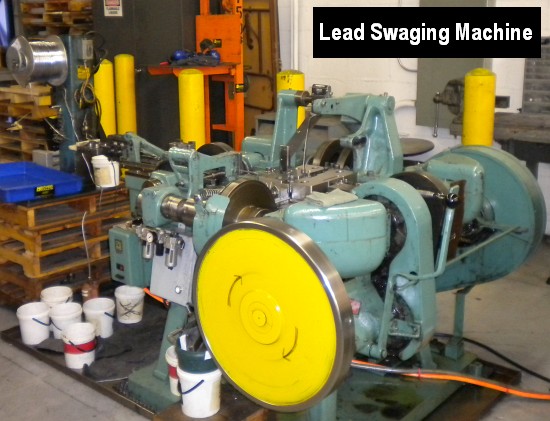
Next the copper jackets and lead cores are combined and shaped using a successive series of precision dies. The bullets are swaged (squished really) from the bottom up once the lead is inserted into the jacket via a tube feeder. This ensures there are no air bubbles between the lead core and copper jacket. I watched as one such machine was set up and calibrated. It was started then tested and adjusted a number of times before it was left to run automatically. Even then, handfuls of bullets are frequently tested for weight, concentricity, and dimensional accuracy. I was told that if any lot is found to be bad — for whatever reason — the entire lot is just thrown away! Sorry, but this means no boxes of seconds or “blems” at bargain prices from the Berger factory.
Some details of Berger’s operation surprised me. A number of tasks that I assumed would be automated are still done by hand, ensuring both accuracy and consistency. Bullets are weighed, packaged, and checked by hand. I overheard one employee say that they had a few thousand bullets to weight-sort before they could be packaged because they feared something may have been slightly off during production. That was a time-consuming task, but they did weight-sort bullet by bullet to make sure nothing had gone wrong.
 New Product Packaging
Berger is now offering “quantity packaging” for the most popular bullets in a number of different calibers. I was also surprised to see boxes in colors other than yellow on Berger’s shelves. Michelle explained to me that the yellow boxes are retained for match or target bullets. The thinner-jacketed hunting bullets now go in orange boxes while moly-coated bullets are packed in black boxes.
One last point worth noting is that if, like me, you (foolishly) wear a Sierra shirt to a tour of Berger Bullets, you will promptly be given a Berger shirt and hat to wear during the visit.
Michelle, thanks so much for the tour! — Kelly Bachand
February 17th, 2010
After learning that M855 NATO ammo does not perform well from short-barreled rifles such as the M4 carbine, the U.S. Marine Corps has started issuing a new type of 5.56×45 ammo to its troops in Afghanistan. The new SOST (Special Operations Science and Technology) ammo, officially designated MK 318 MOD 0 “Cartridge, Caliber 5.56mm Ball, Carbine, Barrier”, features a different open-tip 62mm bullet. The new bullet, with a lead core (in the top half) and solid copper bottom half, is similar to hunting bullets such as Federal’s Trophy Bonded Bear Claw. The SOST bullet was designed by Federal/ATK, which will produce the loaded ammunition.

The new SOST ammo was first developed for use by SOCOM (Special Operations) in the SCAR rifle, which has a short, 13.8″ barrel. Even in short-barreled rifles, the SOST provides impressive ballistics — achieving 2925 fps in a 14″ barrel. Compared to M855 ball ammo, SOST rounds are more lethal when shot from short-barreled rifles. According to the Marine Times, SOST ammunition delivers “consistent, rapid fragmentation which shortens the time required to cause incapacitation of enemy combatants”. Using an open-tip design common with some sniper ammunition, SOST rounds are designed to be “barrier blind”, meaning they stay on target better than existing M855 rounds after penetrating windshields, car doors and other objects. This is important to troops in the Middle Eastern theater who must engage insurgents inside vehicles or hiding behind barriers.
In Afghanistan, the USMC will issue SOST ammo for both the short-barreled M4 carbine as well as the original, full-length M16A4. The Corps purchased a “couple million” SOST rounds as part of a joint $6 million, 10.4-million-round buy in September — enough to last the service several months in Afghanistan.
M855 Criticized by Ground Troops and Pentagon Testers
The standard Marine 5.56 round, the M855, was developed in the 1970s and approved as an official NATO round in 1980. In recent years, however, it has been the subject of widespread criticism from troops, who question whether it has enough punch to stop oncoming enemies.
In 2002, shortcomings in the M855’s performance were detailed in a report by Naval Surface Warfare Center Crane, Ind., according to Navy Department documents. Additional testing in 2005 showed shortcomings. The Pentagon issued a request to industry for improved ammunition the following year.
CLICK HERE for Full Report on New SOST MK 318 Ammunition.
February 13th, 2010
 This may surprise you. We’ve learned that the time interval between neck-sizing operation and bullet seating can have dramatic effects on neck tension (as measured by the force required to seat bullets). Controlling neck tension on your cases is a very, very important element of precision reloading. When neck tension is very uniform across all your brass, you’ll see dramatic improvements in ES and SD, and your groups will shrink. Typically you’ll also see fewer fliers. Right now, most reloaders attempt to control neck tension by using different sized neck bushings. This does, indeed, affect how firmly the neck grips your bullets. But time of loading is another key variable.
James Phillips discovered that time is a critical factor in neck tension. James loaded two sets of 22 Dasher brass. Each had been sized with the SAME bushing, however the first group was sized two weeks before loading, whereas the second group was neck-sized just the day before. James noticed immediately that the bullet seating effort was not the same for both sets of cases — not even close.
 Using a K&M Arbor press equipped with the optional Bullet-Seating Force Gauge, James determined that much more force was required to seat bullets in the cases which had been neck-sized two weeks before. The dial read-out of seating force for the “older” cases was in the 60s, while the seating force for the recently-neck-sized cases was in the 20s. (These numbers loosely correspond to the amount of force required to seat the bullet). Conclusion? In the two weeks that had elapsed since neck-sizing, the necks continued to get tighter and stiffen.
When we first posted this information, it spawned some debate. Many people said they have observed the same thing, but the question is why? Something seems to happen over time that makes the necks less “springy”. Our theory is that, over time, the necks (as sized) are taking a “set” and seem to lose elasticity or the ability to stretch. When they are freshly sized, the neck material seems to be more ductile and expands more readily as the bullet is seated.
In a comment to this post, Steve Blair offered this explanation of how case necks can change over time: “When [metal] material is cold worked, the lattice stresses induced may not be uniform and immediately realized. The grain structure can continue to change for some time, becoming harder and less ductile as the lattice deforms further. Seating a bullet in a case neck provides ongoing radial stress to which the metal will respond over time.”
Concerning the seating force numbers (20 vs. 60) — keep in mind that the K&M simply has a dial read-out activated by a Belleville washer stack with a link rod. This isn’t an ultra-precise measure of force. But you CAN feel the difference between a 20 dial position and a 60. If you use the K&M you’d see what I mean -– the needle tends to swing back and forth as the bullet is seating. What you want to watch for is the max reading and “spikes” in the seating force. I think what is going on is the resistance to seating goes up as the brass becomes less elastic over time.
Lesson learned: For match rounds, size ALL your cases at the same time. If you want to reduce neck tension, load immediately after sizing.
Whether or not you accept the notion that case-neck bullet seating resistance rises with time (you’ll need to do your own experiments), it makes sense to size all your match cases at the same time, and then seat all the bullets you need for a match at the same time. If, for example, you need 200 rounds for an upcoming match, you don’t want to size all 200 cases and seat 100 bullets the same day, and then load the remaining 100 rounds three weeks later. Almost certainly you’ll find some difference in neck tension. That variance in neck tension may show up on the target.
This brings up another point — to minimize velocity variances from round to round, it makes sense to shoot the ammo you load in the same order it was loaded (or exact inverse order). That way, if you have some scale drift over time, causing small changes in powder charges, the shot-to-shot variation is reduced.
|


