|
|
January 17th, 2010
 Grafs.com has a handy new case lube unit from SmartReloader, the Swiss-owned “yellow” brand now competing with RCBS (Green) and Lee (Red). The SR-104 case lube pad/tray is so new you won’t even find it on the parent SmartReloader’s company website.
The SmartReloader Case Lube Unit is very nicely thought out. A closed-cell-foam lube pad is positioned in the middle. On left and right sides are small trays that can hold your lube bottle or cartridge cases. But the real brilliant feature of the design is the dual-purpose yellow pad cover/brass holder. When flipped open, the hinged cover has slots to hold your cases just like a reloading tray. When you’ve finished lubing your cases, fold the yellow lid back and it completely covers and protects the sticky lube pad. That’s really smart. Now you don’t have to worry about your lube pad attracting dirt, tumbler dust, and even unlucky insects that might wander across it.

If you still prefer to lube your cases on a rolling pad (there are easier methods in this Editor’s opinion), you should check this product out. The new SmartReloader Case Lube Unit costs just $12.99 at Grafs.com, item VBSR01702.
December 30th, 2009
 There is, understandably, quite a bit of confusion concerning caliber limitations for Palma rifles and Palma competition. Some folks say you can shoot a .308 Winchester (or 7.62 NATO) with a bullet weight up to 156 grains. Others say you can shoot a .308 Win (or 7.62 NATO) with any bullet weight. Still others opine that you can shoot EITHER a .223 Rem (5.56×45) or a .308 Win (or 7.62 NATO).
So who is right? Well, all these viewpoints are correct in part. That’s because different rules apply in different venues. In most, but not all United States Palma competitions, you can shoot either a .223 Rem or .308 Win with no restriction on bullet weights. In some U.S. Matches, most notably the Spirit of America, certain prizes are limited to .308s with 156gr max bullet weights OR .223s with 81gr max bullet weights. What’s the bottom line? In most USA Palma competitions you can shoot either a .308 or a .223 with no limit on bullet weight. In International Palma competitions you can shoot either a .308 or a .223 but the max bullet weight is limited.
Applicable Rules for NRA Palma Competition
To help clarify the Palma rules, German Salazar has collected the applicable NRA and international rules which govern Palma and iron-sights fullbore competition. First, German explains: “The Palma Rifle is defined by NRA High Power Rule 3.3.3″ which states:
3.3.3 U.S. Palma Rifle:
(a) A rifle with metallic sights chambered for the unmodified .308/7.62 or
.223/5.56 NATO cartridge case. Rifles which also meet Rules 3.1 (.308 only)
or 3.1.1 (.308 only) are authorized.
(b) A rifle with metallic sights chambered for the unmodified .308/7.62 NATO
cartridge case. Rifles which also meet Rules 3.1 (.308 only) or 3.1.1 (.308
only or 3.1.2 (.223 only) are authorized.
German tells us: “The references to Rules 3.1, 3.1.1 and 3.1.2 apply to the M1, M14 and M16 rifles or civilian equivalents thereof. Accordingly, Palma Division ‘A’, which is how all matches other than the National Matches are fired, allows any rifle chambered in .308 or .223 with metallic sights. Palma, Division B, which is rarely seen outside the Nationals, is a separate award category for the service rifle in a Palma match.”
German notes that: “In all instances, there is no restriction on bullet weight, rifle weight or trigger weight of pull. All of these are unrestricted. The rules specify that the rifle must be chambered for the unmodified .308 or .223 “cartridge case” but if the chamber has, for instance, a longer than standard throat to accomodate a heavier bullet, that is acceptable.”
CLICK HERE to download NRA High Power Rules Book (PDF File)

NEW NRA Fullbore Rules and International Rules
A few matches are run under the new NRA Fullbore Rules which are meant to align the USA with the rules observed in other nations competing in similar matches. The most notable of these is the annual Spirit of America Match which is also the Fullbore National Championship. The Grand Aggregate prize of the Fullbore National Championship is restricted to those competitors firing the International Target Rifle.
Under the Fullbore Rules, there are two categories of rifle, the Target Rifle, which is the same as the High Power Palma Rifle, and the International Target Rifle, which is compliant with the rules of most other nations. The International Target Rifle has restrictions on trigger weight of pull, but no restrictions on overall rifle weight. Additionally, there is an ammunition restriction which limits the weight of the bullet to 156 grains for the .308 and to 81 grains for the .223; this restriction applies to both Target Rifle and International Target Rifle categories. The applicable rules are listed below.
CLICK HERE to download NRA Fullbore Rule Book (PDF File)
3.3.5 Target Rifle:
(a) A rifle with metallic sights chambered for the unmodified .308/7.62mm
cartridge case. This rifle has no restrictions regarding weight of the rifle
or trigger, However, the trigger must be safe.
(b) A rifle with metallic sights chambered for the unmodified .223/5.56mm x
45 cartridge case. This rifle has no restrictions regarding weight of the
rifle or trigger. However, the trigger must be safe.
3.3.6 International Target Rifle:
(a) A rifle with metallic sights chambered for the unmodified .308/7.62mm
cartridge case with a minimum trigger weight of 0.5 kilograms (approximately
1.1 pounds and the total weight of the rifle is unlimited. OR…
(b) A rifle with metallic sights chambered for the unmodified .223/5.56mm
cartridge case with a minimum trigger weight of 0.5 kilograms (approximately
1.1 pounds) and the total weight of the rifle is unlimited.
3.17 Ammunition:
(a) Target Rifle / International Target Rifle — .308/7.62mm NATO with a
maximum permitted bullet weight of less than 156 grains or .223/5.56mm x 45 NATO with a maximum permitted bullet weight of less than 81 grains.
December 25th, 2009
Sam Hall of Boonville, North Carolina is “King of the Hill” when it comes to the 600-yard benchrest game. He is the 2009 IBS 600-yard Shooter of the Year, and he won the IBS 600-yard Nationals two years in a row. When Sam talks, people listen… if they’re smart. Sam was recently asked to compare the performance of Berger’s 6mm 108gr boattail vs. Berger’s 105gr VLD bullet. As Sam explains, both bullets have the potential to shoot really well, so your barrel and the conditions may dictate which projectile works best.
Berger 105gr VLDs vs. Berger 108gr BT by Sam Hall
I shot the 108gr Bergers (and 108 BT BIBs for a few matches) all last year in my Light Gun (LG) and Heavy Gun (HG) in 600-yard IBS competition, but switched to Berger VLDs during the Nationals because of the extreme winds in South Dakota.

When I started loading for the 108s, I quickly learned they are much easier to tune than VLDs. In the two barrels in which I shot the 108s, they did not seem to be sensitive to seating depth or powder charge like the 105 VLDs. I could not see much difference in groups at 600 yards during tuning. But, with the 108s, you will need to drop about one grain in powder compared to the VLDs due to longer bearing surface and extra weight. It seemed that the 108s show a consistent round-pattern group, where the VLDs many times have flyers. By this I mean, if both the 108s and 105 VLDs shoot a two-inch, 5-shot group at 600, the 108s will be evenly distributed in the two-inch circle. Conversely, the time the VLD’s will often have 3 or 4 shots in one inch but 1 or 2 flyers expanding the group to two inches. But when the VLDs don’t have a flyer, look out! That’s when most of the World Records have been set and VLD shooters have come from behind and won the match. (Yes, I am talking to you Mike Davis).
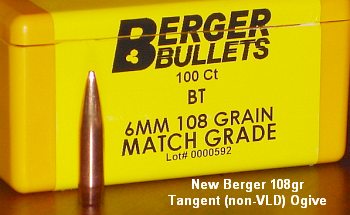 Mike Davis and I talked about the Berger 108s vs. 105s last year. The 108gr BTs are great until the wind gets up. They seem to get blown around more than the VLDs. A half-inch extra at 600 yards these days means the difference between winning or ending up middle of the pack. So, ideally, a shooter would have two loads. One would use the 108s for mild days, and the second would use the 105gr VLDs for those windy days.
If you don’t have time to tune the 105gr VLDs (tuning them can be difficult and time-consuming), I suggest you stick to the 108s. They will save you a lot of headaches and will stick close to the VLDs in most conditions.
How Temp and Humidity Affect Performance
I almost forgot to mention. As the temperature and humidity got up in the summertime last year in North Carolina, the 108s did not perform for me as well as they did during the cooler, less humid months. I tried developing a new, hot-weather load for the 108s, but I never got the 108s to perform as well in the summer as I did in the winter and spring — even when there was no wind. I don’t know why the 108s prefer cooler, less humid conditions, except maybe because they have more drag than the 105gr VLDs. High humidity may have had more of an effect on the 108s than we’d expect from the slight BC difference between the two bullets. The VLDs seem to drill through the wind and humidity better than the 108gr Bergers. NOTE: These findings are my own opinion based on many, many groups shot tuning and in competiton, while using several barrels of various manufacturers.
I hope this helps and does not further complicate your load development process. Try both bullets before you buy a large quantity of bullets. Your rifle will let you know which projectile it prefers. We have often found that a particular barrel will shoot one bullet design well but not the other. A few barrels will shoot BOTH bullet types really well.”
December 21st, 2009
 Grafs.com has received a large shipment of the new IMR 8208 XBR powder. This is good news as Powder Valley recently sold out. Grafs.com has both 8-lb jugs for $149.99 (item IMR82088) as well as smaller 1-lb containers for $21.99 (item IMR82081).
If you haven’t heard about IMR 8208 XBR, this is a very promising new powder that is very accurate, meters well, and is much less temp sensitive than other powders of similar burn rate. This powder should be ideal for many applications including .223 Rem, .204 Ruger, 6 PPC, and .308 Winchester. Will 8208 XBR work in a 6BR or Dasher with heavy bullets? We’ll let you know soon — we’re planning to test it ourselves with an 8-twist 6mm BR.
December 21st, 2009
 |
This is potentially big news for short-range Benchresters and for varminters who shoot PPC variants. Norma has resumed production of 6PPC brass — at least on a prototype basis. NOTE: We don’t have many specifics. Norma has not firmly committed to exporting production 6PPC brass to the USA, nor has Norma announced a product release date. However, we received the following email today:
“After some work Norma has just started production of 6 PPC cases again. A new double-press has been installed which allows us to work-harden the case better. Internal tests are promising and we wonder if you would be interested to test a bunch.”
That’s it… we’ve shared all that we know for now. |
December 18th, 2009
We just spoke to Bryan at Powder Valley. He confirmed that right now (0800 PST, Friday, Dec. 18th), Powder Valley has some IMR 8208 XBR on the shelves. All the 8-lb jugs are sold out, but Powder Valley still has roughly 100 1-lb bottles of IMR 8208 XBR. The price is $19.00 per pound, PLUS haz-mat and shipping.
Those interested in trying this promising new powder should contact Powder Valley immediately. Log on to powdervalleyinc.com or call (800) 227-4299.
If you want this powder, then act quickly. It may sell out within a few hours.
December 17th, 2009
IMR 8208 XBR is a new powder to be released by Hodgdon in January, 2010. The powder is said to be extremely accurate, and Hodgdon believes it will set new standards for stability across a wide temperature range. We spoke to Chris Hodgdon last week and he confirmed that “the 8208 XBR is packaged and ready to go. We plan to start shipping in quantity starting January 4th”.
Schmidt Tests IMR 8208 XBR with 6 PPC Railgun
Is the new powder as good as early reports have suggested? Ace Benchrest shooter Jackie Schmidt recently tested IMR 8208 XBR with his 6PPC rail gun. The results were very impressive. (Test observer 333 Smitty said: “This was the best testing session I have ever witnessed — It looks like the new 8208 is a huge success!”)

Shooting five, 5-shot groups, Jackie put together an .0976 Agg. His last two groups, both using weighed 8208 XBR loads, were in the zeros. (See target photo.) Jackie was shooting his Unlimited Rail with 65gr “Bartail” bullets, Fed 205 primers. The barrel was a 23.5″ straight-contour Kreiger with a 1:13.5″ twist. Conditions were “were really nice, just a gentle ebb and flow” with temps in the 50s and about 60% humidity.
Here is Jackie’s report, originally posted in the Benchrest Central Forum:
“I first started out with my ’08 Vihtavuori N133, just to see if the Rail was on its game. After a few 3-shot groups to find the window, I settled in on 30.4 grains with a 65gr Barts Boattail. I then nailed a nice 5-shot ‘zero’ that you can see on the far left, second row up. Average velocity was 3470 fps.
I then switched over to the 8208 XBR. I started with a load that Tom Libby recommended, 31.3 grains. While it did not nail a ‘zero’, you can see it shot pretty well. The average velocity for the five record shots was 3430 fps.
I then decided to drop the load down into another window, a flat 30.0 grains. The average velocity was 3320, and as you can see, the group opened up. I felt like I hit the condition just right on each shot. Maybe a little cool for this light of a load.


We then decided to up the charge until it matched the velocity of the N133. This took 31.8 grains. With a slow trickle this was just about half-way up into the neck. The group was really nice, so I decided to try the load again, only weighing each charge. The results were the group you see on the far right. That is really probably about a .040″, pretty darned small. The average velocity on both groups was about 3470 fps.
I then decided to go back to the 31.3 grain charge, but weighing each charge this time. The results were another nice “zero”. The velocity was the same as before, but the total spread on this group was only 12 fps.”
IMR 8208 Also Shoots Well in Sporter Rifle
Jackie reports: “I then pulled out my Sporter, and put the 31.8 grain XBR load in. I shot a couple of 3-shot groups that were about .110, then shot a 5-shot group that was a ‘zero’ for the first four. But I missed the last condition, and opened it up to about a .180, straight to the right.”

Observations and Conclusions
Jackie writes: “So, what did I find out? First, this stuff is more dense than N133. I can barely get the 30.4 grain N133 load in the case, but there is no problem at all getting the XBR in at darned near 32.0 grains. This shows that, by weight, XBR is slower than the ’08 N133.
The 8208 XBR also burned just as clean as N133. I could not tell the difference in the patches that came out after shooting N133 and the XBR. Also, this stuff meters VERY WELL. Much more consistant than N133. While I started weighing charges, I could count on the XBR out of my Hensler Measure to be within ± 0.1 grain. I simply cannot do this with N133.
An added note, the Rail Gun has a 23 1/2 inch barrel, the Sporter a 21 1/2. With the same load, I saw an average 70 to 80 fps slower velocity out of the shorter barrel. These two barrels are just about identical in the land and groove diameter, both .237 4-groove Kriegers[.] I guess this shows that some of the powder is still burning at 21 1/2 inches.
I showed that yes, at 52 degrees overcast and dreary, I made the stuff shoot pretty darned good. But, I do not have a clue what will happen when the weather changes. Only time will tell.
That about covers it. This new powder will shoot, and velocity is certainly not a problem. I had zero problems with any pressure signs, the handle on the Diamondback on the Rail and the Bat action on the Sporter lifted really easy on all loads, and the primers looked nice, with a generous radius still on the outside edge.”
| General Comments — Can 8208 XBR Live Up to Expectations?
Jackie offered these general thoughts about IMR 8208 XBR and how it stacks up versus Vihtavuori N133:
 “I have been shooting Benchrest since the mid ’90s, and I can’t think of a single product causing this much excitement, or generating this much hype. Just what are everyone’s expectations? Being able to arrive at a competitive tune, and have it stay there all day? Being able to shoot in the upper window without wrecking the brass? Being able to concentrate on the actual ‘shooting’ rather than worrying about the rifle going ‘vertical’ at any moment?
As of now, a few shooters have been able to test this new powder and found it to be capable of producing good velocity, and great groups. But, the realities of the ‘Competitive Arena’ can be very harsh. Nothing is more aggravating than trying to keep up with the pack when your rifle is locked into a .300 tune, and try as you do, nothing seems to work. We have all been there.
My expectations are that the new powder will be more stable in the perameters that govern that all important ‘Agging Capability’. By that I mean that if the rifle does get a little ragged, just a little tweek one way or another will get it back. Or even better, that the rifle will stay reasonably competitive over a day’s worth of aggregates without fear of getting so ragged that your entire day is ruined by two bullet holes worth of vertical.
This is a tough sell. But then, this is a tough game. I, for one, really hope that this new powder is more ‘user friendly’, so Benchrest can get back to being more about shooting, rather than chasing loads all day long.
N133 is probably the most used powder in 100-200 yard Benchrest today. It is also, at the same time, the biggest source of aggravation. If it is right, nothing can beat it. But, as we all know, if it isn’t quite right, the fun can go away real quick. One of the Holy Grails of Benchrest has always been how to make N133 shoot over an entire Aggregate.” |
Photos Courtesy G.A. Villarreal, used with permission.
December 15th, 2009
Darrell Jones, a talented benchrest shooter from Tennessee, has launched a new business that will provide a much-needed service for precision shooters. Darrell’s company, DJ’s Brass Restoration Service, will take your old, many-times-fired brass, and help bring them back to life. Darrell first cleans the cases inside and out using an ultrasonic bath. Then Darrell carefully anneals each case, employing temp indicators to insure the correct amount of heat is applied for the proper duration.

Combined Ultrasonic Cleaning and Case Annealing
The Basic Service starts at $20.00 per hundred cases — and that includes ultrasonic cleaning AND annealing. (Flat rate USPS shipping is extra.) Note: very large cases (such as the .338 Lapua) or damaged, dented cases may cost more. In addition to the Basic Service, Darrell offers a 4-Step Full Service starting at $25.00 per hundred cases (plus shipping). Full Service brass restoration includes:
• Uniform primer pockets
• Chamfer case mouths
• Ultrasonic cleaning and polishing
• Anneal case necks

Ultrasonic Muzzle Brake Cleaning
In addition to cleaning and annealing cartridge brass, Darrell offers Ultrasonic Cleaning for muzzle brakes. This removes carbon buildup to restore critical bullet clearance requirements. The price is $15.00 per brake (plus shipping).
Restoring Your Brass Can Save Time and Money
Your match-quality brass represents a significant investment of money and prep/sorting time. With 100 pieces of new premium brass costing as much as $100.00, we think Darrell’s service is a great deal for shooters who want to extend the life of their brass. We expect his cleaning/annealing service will soon be in high demand. (In addition, on a custom-order basis, for an additional fee, Darrell can trim cases to a specified OAL.) Also, if you have spent many hours turning necks or forming wildcat cartridges, DJ’s Brass Restoration can save you the hassle of trimming, sorting, turning and prepping new cases. You have a lot of time invested in those turned necks and fire-formed cases… you don’t want to toss the brass after a few firings.
For more information, visit DJsBrass.com, or call Darrell at (901) 826-1503. As a special benefit for AccurateShooter.com members, Darrell is now offering free return shipping on any order over 500 pieces (limited time offer). IMPORTANT: Contact Darrell for shipping instructions BEFORE sending any brass for processing. ALL BRASS MUST BE DE-PRIMED before you send it.
December 11th, 2009
– Match Report by German Salazar
This past week 89 shooters competed in what is traditionally the biggest winter Palma match in the USA — the 2009 Arizona Palma State Championship. Held at the Ben Avery Shooting Facility in Phoenix on December 4-6, the event included Palma, F-Open and F-TR classes. Ben Avery’s High Power range has 100 firing points to 1000 yards and is renowned for challenging conditions and excellent match administration.
Trend Towards Heavy Bullets
Chatting with competitors, we noted an increase in the use of bullets heavier than 155 grains, with the Berger 185 being the most frequently mentioned alternative, although the Berger 175 was also in use as were Sierra and Berger 190 grain bullets. Competitor frustration with the availability of Varget and its ever-changing burn rate are driving an increased use of H4895, IMR 4320 and IMR 4064 in the Palma. Tubeguns were also much in evidence, being a Western favorite with large number of them on the line in the hands of the California and Arizona shooters. Gary Eliseo was on hand as always and had a good performance throughout.

Match Kicks Off With Tough Conditions
The match opened Friday, December 4, as all Palma matches do, with the 800-yard stage. Relay after relay battled cold north winds. Over half the competitors were High Masters, yet only two shooters fired scores of 150 — Tom Whitaker of California and Phil Hayes of Arizona. As the morning wore on and the competitors moved back to 900 and 1000 yards, the wind eased off a bit and scores improved with 150s becoming more common. At the end of the day, Whitaker’s 450-30X topped the list, followed by Bryan Litz of Berger Bullets and Kelly Bachand from Washington.
On Saturday morning, the desert chill remained, but the flags hung limply, raising hopes for high scores. Those expectations were realized as Bud Solis, a retired Seattle police officer, put up a sterling 450-25X to lead the day. Close behind (all with 449 scores) were Bachand, Gary Rasmussen (WA), German Salazar (AZ), and Randy Teissedre (CA). The final day, Sunday, conditions began relatively calm but progressively got windier with frequent direction changes. No one was able to master the conditions for a 450, but the mother-daughter duo from Prescott, AZ, Nancy Tompkins and Michelle Gallagher, came closest, each shooting a 449 with Nancy’s 29X just edging out Michelle’s 26X. David Littlefield (WA) and Jim O’Connell (CA) also shot 449s on Sunday.
Gallagher Wins Match, with Whitaker and Bachand One Point Behind
Michelle Gallagher posted a 3-day tally of 1345-81X, giving her a one-point victory over runner-up Tom Whitaker (1344-91X) and third place Kelly Bachand (1344-79X). Note that Tom had ten more Xs than Michelle, but came up just one-point shy. Bryan Litz finished fourth overall, with German Salazar in fifth (on a tie-breaker over Michael Storer). All the Top Ten are listed, with scores, in the table below. In Team Competition, the US Team coached by Gary Rasmussen compiled a 1787-95X, edging second-place Team Berger (1783-96X) and third-place Bald Eagles Grand Seniors (1782-75X).
CLICK HERE for Individual Match Results | CLICK HERE for TEAM Match Results
 Top Ten Grand Aggregate
1. MICHELLE GALLAGHER: 1345-81X – MW
2. TOM WHITAKER: 1344-91X – HiSR
3. KELLY BACHAND: 1344-79X – HM
4. BRYAN LITZ: 1343-91X – HM
5. GERMAN SALAZAR: 1339-68X – HM
6. MICHAEL STORER: 1339-68X – HiJR
7. FELIX SOLIS: 1338-59X – HM
8. ROBERT GUSTIN: 1337-64X – HM
9. ALLEN SPIKER: 1335-50X – HM
10. JIM O’CONNELL – 1332-62X – HM
The F-Open Class was won by Rick Curtis of Phoenix at 1328-67X with Darren Sucato, another tough Phoenix shooter in second place. F-TR went to John Chilton with his factory Savage F-TR rifle putting up an impressive 1308-45X.
There are weekly matches in Phoenix for across the course High Power, Prone, F-Class, and Smallbore. A complete schedule is found on www.desertsharpshooters.com. The Arizona state association website ASRPA.com also has useful information.
December 7th, 2009
Adam Braverman of Nammo-Lapua just confirmed that Lapua, at the behest of the U.S. Palma team, has been quietly developing a NEW version of the .308 Winchester cartridge that has a small BR-style primer pocket. That’s right, this is no joke. Lapua has crafted small primer pocket .308 Winchester brass that will be introduced at SHOT Show in Las Vegas (Jan. 19-22).

The new .308 variant is identical to Lapua’s current .308 match brass with the exception of the primer pocket. The brass will be head-stamped “.308 Win Lapua Palma”.
FLASH HOLES: The flash-hole size for the current pre-production .308 Lapua Palma brass is 1.5mm (.059″), the same as Lapua 6mmBR and 220 Russian brass. Lapua spokesmen were not certain if the flash hole size will change for the regular production brass. Note: if you have a Redding .308 die, you can ask Redding for a smaller decapping rod tip (.057″) to use with the new brass.
Tests Reveal Better ES and SD with Small Primers
Initial tests of the small primer pocket .308 by U.S. Palma team members have been very promising. The small primer pocket case seems to have advantages in both accuracy and the ability to handle high-pressure loads. However, the primary improvement found with the smaller primer is reduced ES and SD. Palma Team members have found that, with almost every brand of primer tested (small vs. large), the smaller version has yielded reduced Extreme Spread and Standard Deviation. This pays dividends in 1000-yard shooting. Also, some testers believe that small primers are more consistent and require less sorting — and that there are more varieties of small primers that seem to work really well in the .308 case. Moreover, the small primer types are more uniform, from lot to lot, than are large primers, according to some testers. More info will follow later today.
|


