|
|
November 11th, 2007
This falls in the “industry rumor” category, but we have it on good authority that Alliant Powder plans to introduce a new powder in the Reloader Series early next year, Reloder 17. That’s right, Seventeen. This powder should work well with many of the high-accuracy cartridges used in competition.
 As expected from its product title, the new propellant will be a mid-range, high-energy powder that is a bit slower than Varget or Reloder 15, but slightly faster than H4350 or Reloder 19. The new Reloder 17 could be ideal for the new mid-size match cartridges such as the 6-6.5×47, 6XC, 6.5×47, and 6.5 Creedmoor. (FYI, Hornady plans to load the 6.5 Creedmoor with H4350.) We expect the new powder to be a double-base formulation for high velocities.
Reloader 15 is currently very, very similar to Norma 203B, produced by Dynamit Nobel in Europe. If Alliant is getting the new Reloder 17 from the same source, we predict RL17 may be similar to the new Norma URP (Universal Rifle Powder) released earlier this year in the USA. We have tested URP in a 6-6.5×47, and it is indeed slightly faster than Reloder 19, performing similarly to fast lots of H4350. Price at $19.00 per pound, Norma URP can be ordered through Powder Valley, (800) 227-4299.
Illustration is an “artist’s concept”. Actual packaging may differ.
November 7th, 2007
Hornady has announced a new, 6.5mm cartridge designed for Across-the-Course and High Power shooters, and 3-gun competitors. (We think the new round may also prove very popular with hunters and tactical shooters.) Dubbed the 6.5 Creedmoor, the cartridge is smaller than a .260 Remington (.308-size case) but larger than the 6.5×47 Lapua. Measuring 1.920″ from base to mouth, 6.5 Creedmoor brass features a 30° shoulder and minimal body taper. Case capacity is “right around 53.0 grains of H20″ according to Hornady. The 6.5 Creedmoor uses a large rifle primer and large flash hole.


Hornady says its 6.5 Creedmoor is designed to operate at “standard” .308 Winchester pressures, for increased “barrel and case life”. The 6.5 Creedmoor factory ammo is loaded to “under 60,000 psi” according to Hornady engineers. That’s quite a bit less than the 62,000 psi SAAMI max pressure limit for the .308 Winchester, or the 63,090 rated max psi of the 6.5×47 Lapua. Compared to max-loaded 6XC or 6.5×47 cases, the lower-pressure 6.5 Creedmoor should, theoretically, provide good barrel life. Dennis DeMille, who has been testing the factory 6.5 Creedmoor ammo, reports that the factory ammo is “not on the ragged edge at all–pressures are ‘sensible’, with excellent reliability as a result.”
6.5 Creedmoor Loaded Ammo Specifications
| Bullet |
COAL (max) |
Powder |
Grains |
Primer |
Velocity |
PSI |
| 120gr Amax |
2.820″ |
H4350 |
43.5 |
LrgR |
3020 fps |
under
60,000 |
| 140gr Amax
| 2.820″ |
H4350 |
41.2 |
LrgR |
2820 fps |
under
60,000 |
The new cartridge looks speedy on paper. Hornady claims its factory-loaded 6.5 Creedmoor ammo will deliver 3,020 fps with the 120gr Amax and 2,820 fps with the 140gr Amax from a 28″ barrel. Those velocities are at the extreme high end of what we’ve seen a 6.5×47 Lapua deliver with 123gr and 139gr Scenars. In the 6.5×47, with handloads, it’s more realistic to expect 2950 fps with the 123-grainer, and about 2800 with the 139. Lapua’s factory-loaded 6.5×47 rounds are considerably slower. So, it appears the 6.5 Creedmoor will enjoy a slight velocity edge over 6.5×47 handloads, and a sizeable speed advantage over Lapua 6.5×47 factory ammo (with similar bullet weights).
BALLISTICS: 6.5 Creedmoor vs. .308 Win vs. .223 REM
Background of Cartridge
 The new cartridge was conceptualized by Dave Emary, Hornady’s Senior Ballistician, and Dennis DeMille, General Manager of Creedmoor® Sports and two-time NRA National High Power Rifle Champion. Dave and Dennis wanted to provide factory-loaded ammo that would be 100% competitive with any High Power chambering, including the 6XC and 6.5×47 Lapua. The 6.5 Creedmoor was purpose-built for match rifles, including the Tubb 2000 and DPMS/Panther Arms LR Series. Its case is shorter than the 260 Remington, so you can load even the longest bullets into .308-Win length magazines. Pushing a 120gr Amax at 3000+ fps, the 6.5 Creedmoor offers a nice, flat trajectory plus good wind-bucking ability. Dennis Demille has used the prototype cartridge for many months now in a Tubb 2000 rifle. He says, the load is “moderate and very reliable. There have been no issues with stiff bolt lift or primer cratering.” The factory ammo runs “under 60,000 psi” according to Emary, and uses Hodgdon H4350 powder–43.5 grains with the 120 Amax and 41.2 grains with the 140 Amax.
Loaded 6.5 Creedmoor ammo is slated for release in January or February 2008 “at the latest”, according to Dave Emary. Ammo should be priced about $22 per box of 20 rounds, roughly the same as Hornady .308 Win match ammo. Brass, produced by Hornady in the USA, should be available by late spring. The new 120gr Amax bullet should be released very early next year.
DOWNLOAD 6.5 Creedmoor Illustrated Brochure

November 6th, 2007
Midsouth Shooters Supply has recently added Berger Bullets to its inventory. Midsouth’s representative informed us that: “Finally after about 4 years of discussion, [Midsouth has] picked up Berger Bullets. Our prices are very competitive. We actually based our final decision after reading some of the 6mmBR articles and looking in your forum and seeing how many of your shooters prefer Berger.” We applaud this move by Midsouth. This should give our readers a new affordable source for Berger match and hunting bullets.

Also check out Midsouth’s Fall “E-Flyer”. There are many good deals, including a handsome, khaki shooting cap for just $2.99 (with purchase of other items). Act soon though–the last batch of these promo hats sold out quickly.

November 4th, 2007
In our view, the 6.5×47 Lapua cartridge is a bit low on capacity to shoot the full-size 139-142gr 6.5mm bullets at optimal velocities. However, the round really performs with 120-130gr match projectiles. Don Nielson once again demonstrated the accuracy potential of the 6.5×47 at a recent Sacramento 600-yard NBRSA match. Don “cleaned house” in Heavy Gun class, winning HG Aggregate, and HG Score (283-3X), the latter a new record. Don was shooting the JLK 130gr VLD, produced by Swampworks based on an original Jimmy Knox design. The JLK 130 may be the “ultimate” bullet choice for the 6.5×47 case–with just the right combination of weight, bearing surface, and BC. The 6.5mm 130gr VLD, item 26130, costs $43.60 per 150. Specs are listed on the Swampworks website. To order call (417) 831-2309.

November 1st, 2007
Sierra surprised many by announcing a completely NEW 135-grain HPBT MatchKing in 30 caliber (.308 diameter). The new bullet is part of Sierra’s 2008 line-up, so expect the 135-grainer to be at vendors around mid-December 2007 (at the earliest). Sierra tells us: “This bullet was designed to fill the need for a lighter-weight / low recoil 30-caliber bullet for smaller-capacity cartridges. Sierra expects this bullet to be a popular choice for our across the course, handgun silhouette and 100-200 yard benchrest customers.” Hmmm, 100-200 BR? The bullet’s a bit heavy for the 30BR but it might prove effective for club-level “factory class” competition with .308 rifles. The bullet should also work well for Garand Matches.

The new 135gr SMKs will be available in boxes of 100 bullets (stock #2123) with MSRP of $35.30 per box or in boxes of 500 bullets (stock #2123C) with MSRP of $164.49 per box. We expect the 100-count boxes to cost about $25-$26, based on current “street price” for 150gr HPBT MatchKings.
October 4th, 2007
 If you’ve read our feature story on Ultrasonic Cleaning by Jason Baney, you’ve seen the remarkable results that can be achieved with this method. Ultrasonic cleaning has many advantages over traditional tumbling methods of case cleaning. There is no dust or media residue to remove from the brass, and when done right, the cases come out clean and shiney, inside and out, even the primer pockets.
In its Benchtalk Archives, Brownell’s has an excellent article discussing Ultrasonic Case Cleaning. Brownell’s staff compares results, with measured dwell times from 5 to 75 minutes, using both Mpro-7 and HCS 200 cleaning solutions. Tests are performed with once-fired and 5x-fired Tactical 20 cases, as well as once-fired Rem 260 Cases. The article also compares the results from ultrasonic cleaning vs. tumbling in walnut media.
How Does Ultrasonic Cleaning Work?
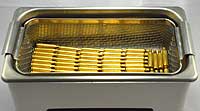 The Brownell’s article explains: “Ultrasonic cleaning uses high-frequency sound waves (generally between 20-80 kHz) to remove a variety of contaminants from objects immersed in a liquid. The result of these high-frequency sound waves is a process called cavitation. These high frequency bursts of ultrasonic energy produce a three-dimensional wave of alternating positive and negative pressure areas as the sound wave passes through the solution. During negative pressure, microscopic cavitation bubbles form and will continue to grown until they reach resonant size. As the positive sound wave passes, the pressure rises rapidly and implodes these tiny bubbles. Before these miniscule bubbles implode they store a tremendous amount of energy. These bubbles can be as hot as 10,000 degrees and have as much as 50,000 lbs per square inch of pressure. This sounds alarming, but you have to remember that these bubbles are microscopic in nature and pose no harm to anything, unless you are a carbon /powder residue deposit on a cartridge case!
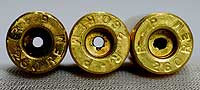 When this cavitation bubble implodes near your brass case, it transforms the bubble into a jet about 1/10th of its size. This jet of energy can travel as fast as 400 km/hour. At 43 kHz, as is the frequency for our L & R HCS 200 ultrasonic cleaner, this is happening 43,000 times per second. This micro-burst of extreme energy is responsible for removing contaminants from the surface of your cartridge brass. Ultrasonic cleaning can reach into crevices and inaccessible areas and remove surface debris that can’t be cleaned by any other process.”
Photos and quotes © 2007, Brownells®, Inc. All Rights Reserved, Used with Permission.
October 3rd, 2007
Robert Whitley has developed the very accurate “6mmAR” cartridge based on Lapua 6.5 Grendel brass necked down to 6mm. This round is optimized for the AR15 platform, and provides excellent performance with 105-108gr bullets, with ballistics that beat both the .223 Rem and the 6.5 Grendel. Robert offers complete 6mmAR uppers for the AR platform through his 6mmAR.com website.
Whitley’s INFO PAGE for 6mmAR TURBO
Not content with the success of the plain 6mmAR, Robert has created a new wildcat, the “6mmAR Turbo”. By moving the shoulder forward (while retaining its 30° angle), Robert has designed a case that delivers more velocity. The 6mmAR Turbo can push a 105gr 6mm match bullet to 2850+ fps. This rivals the performance of the larger 6mmBR cartridge, in a round better suited for the AR platform, with less both thrust and better feeding from the magazine.

Robert tells us: “I have been testing the ‘6mmAR Turbo’, which is an ‘improved’ version of the 6mmAR. The Turbo definitely has a good bit more speed. For a guy wanting to shoot plain bullets out of an AR-15, it appears somewhere between 2850 -2900 fps for a bullets like the Berger 105 VLD is a realistic number. With moly bullets, probably a bit more is possible. For the chrono work, all bullets were plain (no moly) and I pushed it to see where was a realistic upper end. I think about 2900 fps with naked 105 Bergers is a ‘practical max’. I could probably go to 2950 with plain (non moly) bullets, but I think that would be too hard on the brass.”

September 30th, 2007
 Randy Robinett, who makes the great 30-cal BIB bullets for the 30 BR, has a new 88gr match bullet in .257 caliber. Commenting on the new Robinett bullet, Al Nyhus notes: “I’ve already spun some of Randy’s 88gr 25s downrange. You’ll be very happy.” Jackie Schmidt reports: “It is a 10-ogive, but with a relative straight shank for at least 1/4″ past the base. The gas ring is about .2576″, and the shank is about .2573″. This is a really nice-looking bullet.” Jackie plans to build a new 25BR rifle using the 88gr BIB: “Why the 25BR instead of a 25 PPC? I already have all of the essential pieces to do it. That is a good enough reason for me. I happen to have an old 8-groove Shilen 25-caliber blank in 1-13 twist. I can picture this bullet at about 3250 to 3300 out of a 23 inch barrel with a big dose of N133 out of a 25BR.”
Can the 25BR be competitive? Jackie thinks so: “I used to shoot a 25BR, in fact, I actually won a couple of yardages in Registered Competition. I shot a teen agg at Tomball in the spring of 1998 with 85 grn Fowlers, N130, and a 1-13 Shilen. Back when I shot a 25BR, I believed that it was as accurate as any chambering available. The problem was, there was only ONE bullet that would allow it to live up to its potential, and that was the 85gr Fowler. As you know, being able to get components on a reliable basis is a big part of staying competitive. Since the offerrings for the 6mm were so abundant, I decided to go that route. I will, in all likelihood, stay with the 6PPC [for short range]. But an 88gr 25-caliber bullet running over 3200 fps just might be the hot ticket for other disciplines. F-Class is one that comes to mind. Or 600-yard Benchrest. For shorter ranges, while the 88gr BIB looks great, I feel that a 75-78 grain .257 bullet, on a little shorter jacket, might be more suited for the 100-200 yard game. Of course, we won’t know until we put holes in paper.”

For more details on the 25BR, read Darrell Jones’ Gun of the Week article on his “Peppermint” 25BR (photo above). Darrell achieved great accuracy shooting the 115gr Berger bullet with Varget powder. This rifle won its first-ever competition, a local 600-yard F-class match. Shooting the Berger 115s with 31.5 Varget, “Peppermint” won with a perfect score of 200 with 14 X’s. Darrell writes: “I’m very happy with the project, and more than satisfied with the accuracy of the 25 BR. This is definitely a worthy cartridge for Egg Shoots, 500m varmint matches, and the 600-yard F-Class game.”
September 27th, 2007
 Berger has started production of a new 22-caliber 82 grain BT bullet. It is a tangent ogive, non-VLD design, optimized to shoot well either in the lands or away from the lands. The new 82-grainer should prove popular with Service Rifle, Cross-Course, and SpaceGun shooters looking for a high-BC 22-cal projectile that works at various OALs and is easy to tune.
Berger’s Eric Stecker reports: “The new 82gr BT has performed exceptionally well in all tests. I want to thank those who took the time to shoot our new non-VLD design in several weights. Their feedback was the reason why we decided upon the 82gr weight. The G1 Ballistic Coefficient (BC) is .450, while the G7 BC is .228. We recommend a 1:8″ or faster twist rate. This bullet is perfect for those who shoot heavy 22 cal but do not like the sensitive nature of the VLD type bullets. All tests show that this bullet shoots very well at any OAL and with most loads.”
At Camp Perry, Shawn McKenna used this bullet to capture 2nd place in the NRA Civilian Service Rifle National Championship (3rd place overall Service Rifle). He reports shooting more Xs at 600 yards than ever before. Nick Till placed First Overall in the NRA Service Rifle National Championship using a Berger 80gr BT made on the same jacket and die as the 82 grainer. Both Shawn and Nick used Berger’s 22 cal 73gr BT at 200 and 300 yards. Shawn tells us “The 82 works ideally as a single-feed bullet for slow fire at long ranges. The nose length is .554″. At mag length on an AR, that would put the bearing surface into the neck .050″.
How soon can you buy the new 82gr bullets? Stecker noted: “Our next run of 22-cal, 82gr match bullets will be on the press soon, and we plan to ship in 2-3 weeks. Contact your preferrred dealers to ensure they are going to stock the new 82 grainers.”
September 23rd, 2007
By uniforming meplats, shooters can reduce variances in the Ballistic Coefficients of a set of bullets. Many top shooters, such as David Tubb, feel that meplat trimming can also reduce group size. Danny Reever has tested and reviewed the Meplat Trimmer from Montour County Rifles. Danny reports this $75.00 tool is well-crafted, easy to use, and it offers some advantages over other meplat trimmers on the market. Starting with a lot of bullets that varied in length up to .008″, Danny was able to bring them all within .003″ using the Montour Trimmer. CLICK HERE for Danny’s full report.


|


