|
|
August 4th, 2007
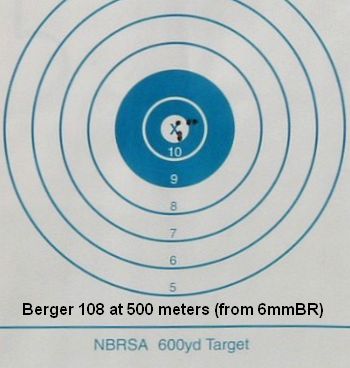
Danny Reever keeps nailing spectacular groups with the new Berger 108s, a length-tolerant tangent-ogive design. Shooting his 6BR “Toxic” with 8-Twist Krieger barrel, Danny produced this group at 500 meters (547 yards). It measures 0.964″ overall, with three shots in just 0.242″. The 0.964″ overall size works out to 0.168 MOA.

If you want to try for these kind of results, here’s Danny’s load: Lapua 6BR brass, turned (lightly) for .269″ neck, Berger 108gr BT seated .013″ in lands, CCI 450 primers, 30.5 grains Hodgdon Varget (max load in some guns, work up carefully). Danny says: “Never touched the meplats, they’re pretty good right out of the box. Nothing magic, that Berger 108 just flat out shoots!”
Danny tells us: “I’m a happy camper, this rifle shoots like a rail gun! This rifle proves one thing to me. A trued Remington action can shoot every bit as good as a custom action provided that it is trued and built by a good smith.” Danny’s 6BR was smithed by Clarence Hammond. It features a trued Rem 40XB (Jewell trigger) in a Tooley MBR stock with a weight system in the butt. Up front is a 28″ Kreiger 4-groove barrel, HV contour with a .237 bore, .104 Freebore (Kiff Reamer). Optics are a 12-42 Nightforce NXS with a NP2-DD reticle on a Leupold 20MOA base. Rifle weighs in at 18.5 pounds with the weight system.

Danny tells us “The rifle was named ‘Toxic’ by Logan, my 10-year-old son. He claims the stock color looks like the toxic chemicals that the Joker fell into in the first Batman movie. My wife calls it ‘The Ugly Gun’. It may be ugly to her, but with the way it shoots, it’s beautiful to me.”
July 21st, 2007
Now through the end of July, MidwayUSA has the Berger 35gr hollowpoint varmint bullets on sale. These are excellent .204-caliber projectiles. They are very accurate, with more consistent dimensions than many other varmint bullets. With a wide meplat, the Berger 35s provide reliable expansion in the target. You’ll like these bullets in your 20-222, .204 Ruger, 20 Tactical or 20 Vartarg. MidwayUSA customer C. Benson from Colorado reports: “After trying the Hornady V-max bullets with 100 yard groups 1″ or more, I ordered a new barrel, reamer and headspace gauge. While waiting for the new barrel & reamer I decided to try the Berger bullets. I was very pleased with the Berger 35 grain bullets. Groups were cut in half with the same powders with some powders the groups were even less, in the .3s I will be shooting Bergers from now on!”

July 12th, 2007
Thanks to Adam Braverman of Nammo Lapua, Zak Smith had a chance to test out the new Lapua 6.5×47 123gr factory ammo recently in his Accuracy Int’l tactical rifle. Zak reports: “Accuracy was excellent–the ammo shot as tight as I could hold in the windy conditions. This ammo is half-MOA or better, easy. When I did my job, all shots were touching at 100 yards. The ammo fed from my AI magazine perfectly–no problems at all. It seems the ammo is loaded pretty mild. From a 25.3″ barrel, velocity was 2820 fps over my chronograph. This compares with 2790 fps claimed by the factory from a 26″ barrel (see chart below). That 30 fps is easily within barrel to barrel variation (or chrono variation for that matter). So, consider the 123gr 6.5×47 ammo a 2800 fps product. With this 123gr factory load, there were no pressure signs–primer edges were round, there was no significant cratering, and case-head growth was minimal.”

Larger Chart (English Data) | Larger Chart (Metric Data)
Zak added: “Overall, I was very impressed with this ammo. Accuracy, on the test day, was actually a bit better than my handloads–but it was pretty windy. This stuff is definitely ‘good to go’ for someone who doesn’t reload and wants quality 6.5mm ammo for a tactical match. You won’t have the velocity of a ‘max’ handload, but even at 2800 fps, given the .547 BC of the 123gr Scenar, this ammo easily beats a .308 shooting 175s in terms of long-range ballistics. The chart below shows comparative drift in a 10 mph wind at 600 and 1000 yards.”
| Cartridge |
FPS |
BC |
600yd Wind |
1000yd Wind |
| 6.5×47 123gr Scenar |
2800 |
0.547 |
23.53″ |
75.34″ |
| .308 175gr SMK |
2700 |
0.496 |
28.12″ |
90.95″ |

July 10th, 2007
Many shooters and hand-loaders lack a clear understanding of certain elements of bullet design. While most serious shooters know that Secant and Tangent Ogive bullets are different, many of us would have trouble explaining the precise nature of the difference. Thankfully, Dan Lilja clarifies this and many other bullet design matters in his excellent article, Calculating Bullet Weights. Here’s the straight scoop on bullet ogive differences, in Dan’s words:
“Spitzer bullets all fall into one of several different design types. A bullet’s geometry can be broken down into symmetrical sections. The body (or shank) of the bullet is that part of the bullet that comes into full contact with the barrel rifling. It is the cylindrical portion of the bullet of nominal groove diameter for that caliber. It is also referred to as the Bearing Surface.
The term “Ogive” is commonly used to describe that specific point where the curving part of the bullet nose begins–i.e. where the bearing surface ends and the curved part begins. When we talk about “bearing surface length”, this is the distance from the top of the boattail to the point where the bullet starts to curve.

However, the terms “ogive” or “ogive profile” are also used to describe the entire forward curved section of the bullet, ahead of the bearing surface. The Ogive Profile, or nose of a bullet, can be one of three varieties, two being common*. The ogive can have a tangent radius; that is, the intersection of the body of the bullet and the radius of the ogive blend together at a tangent point. This is the most common type and is typical of most bullets handloaders use. The other common type is the secant ogive. In this case the intersection of the ogive and bullet body does not flow together smoothly. The point of intersection is not tangent, the ogive radius being a secant of the arc circle of the ogive.
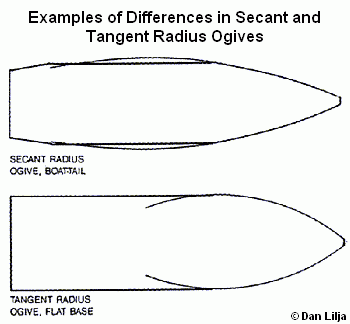
The radius of the ogive is generally given as a multiple of the bullet diameter. For example, a 30-caliber bullet might have a 7-caliber tangent ogive. That is to say that the radius, in inches, is seven times .308 or 2.156 inches. When a bullet is described as “7 Ogive” this is what is meant–the radius of the bullet’s nose section as a multiple of the bullet diameter. (A “7 Ogive” can be any caliber, not just 30 caliber–it is the ratio of the curve radius to diameter that counts).
The point or tip of the ogive is called the Meplat. This can vary in diameter from about .050″ to over 0.125″ for conventional spitzer-type bullets.
The base of the bullet can be either a boattail shape or flat base. If a boattail, its shape is determined by the axial length of the boattail and the angle at which the boattail leaves the body of the bullet.”
*The third bullet nose type is a cone. Cone-shaped bullets are not common with handloaders, but some experimental work is done with them.
July 7th, 2007
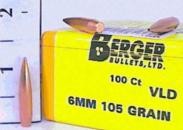 Now through the end of July, 2007, MidwayUSA has Berger 105gr VLD bullets on sale. The sale price is $19.99–that’s $6.50 under the regular $26.49 price. While MidwayUSA won’t guarantee specific lot numbers, all of the 105 VLDs (item 195087) that MidwayUSA has been shipping lately have been produced on the new die. So if it’s “new die” Bergers you want, here is a good source. Most user reports on these bullets have been very positive. NOTE: this is a secant ogive bullet that will probably work best seated into the lands.
June 23rd, 2007
Over the past few weeks, Berger Bullets has been evaluating three new tangent ogive (non-VLD) bullets, in 105, 107, and 108 grain weights. Berger sent samples to many top shooters, including Forum members Danny Reever, James Phillips, and Wm. Roscoe. The 107s shot the best for James (see Test Results), but Danny and many other shooters reported great results with the 108s, which seems to have a slightly shorter boat-tail than the other two prototypes. Here’s one of Danny’s targets, shot with an 8-twist 6BR with a .104″ freebore:
Yesterday, Michelle Gallagher of Berger announced that the 108-grainer had been selected as the design that will go into production. The 108s will start rolling off the bullet presses for general consumption very soon. The specs on the 108gr Berger are: 1.225″ OAL, .712″ base to ogive, .533″ bearing surface length, and 108.08 grains average weight (Measured with Acculab MXX-123).
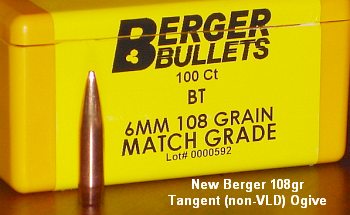
Why is Berger bringing out this new bullet when the existing 105 VLD shoots so well? A tangent ogive bullet is generally considered to work well jumped (i.e. seated away from the lands), whereas secant-ogive VLDs typically (but not always) prefer to be seated in the lands. This new bullet should offer optimal performance for shooters who prefer to jump their bullets. Berger’s Eric Stecker has explained: “All VLD bullets (any brand) are made using a secant ogive. This results in a more abrupt transition into the ogive radius as compared to a tangent ogive (non-VLD of any brand). This abrupt transition on the secant ogive (VLD) bullets means that the ogive contacts the lead angle differently than a tangent ogive (non-VLD) will.”
June 21st, 2007
Long-time visitors to this site will recall that, in 2006, Jackie Schmidt did an extensive 6BR accuracy test with his rail gun. It was fitted with a straight, heavy contour .237″ land-diameter Krieger barrel. Many interesting discoveries came from that test, including the relationship of barrel length to velocity. Jackie cut that barrel down in 1″ increments from 33″ to 28″ and we only lost 8 fps per inch.
That test barrel also showed a very strong preference for Berger 105gr VLD bullets, which (at that time) measured about .2433″ at the pressure ring. To our surprise, however, the accuracy of Lapua 105 Scenars was good, but not what we anticipated based on results in other rifles. We noted that the Scenars were extremely uniform in weight and dimensions. However, the max bullet diameter was around .2428″. So these Scenar bullets were about half a thousandth skinnier than the 105gr Bergers.

Can the Scenars shoot superbly in a Krieger? The answer is yes, if the Krieger is a .236″. Bore dimension (specifically land diameter) DOES make a difference, based on recent results from Jackie.
Jackie has recently learned that the Lapua 105 Scenars WILL shoot with blistering accuracy in a Krieger barrel–a Krieger .236″ bore barrel. Jackie told us: “Well, I have to admit it… you guys were right about those Lapua Scenars. I just built up a long-range 6BR rifle for a friend. We put a Krieger 4-groove .236″ barrel on it, and, man those Scenars shot like a house on fire. The accuracy is just amazing. After my experience with the rail gun project I never would have believed it. But yes, the Scenars are outstanding in a .236″. I personally shot a measured .270″ 5-shot group at 200 yards with the Lapua 105s in that gun. And the velocity–you wouldn’t believe it–we were seeing 3000 fps with a full case of Vihtavuori N150. In a long barrel, with a .236″ bore, the N150/Scenar combo is a winner–for accuracy and velocity. You just have to match the bullet to the barrel. Skinny bullet? Go .236″. It works.”
June 18th, 2007
During a summer prairie dog expedition, a serious varminter may shoot hundreds of rounds in a day. Value-priced components help keep a shooter’s budget under control. As a June Special, MidSouth Shooters Supply is offering 50gr and 55gr bullets in economical 500-round packs for just $34.74. That works out to just $6.95 per hundred bullets! These .224-caliber “Varmint Nightmare X-Treme” bullets feature a flat-base design with a soft point lead tip for good expansion.

June 15th, 2007
Precision shooters favor premium brass from Lapua, Norma, or RWS. (Lake City also makes quality brass in military calibers.) Premium brass delivers better accuracy, more consistent velocities, and longer life. Shooters understand the importance of good brass, but many of us have no idea how cartridge cases are actually made. Here’s how it’s done.
The process starts with a brass disk stamped from strips of metal. Then, through a series of stages, the brass is extruded or drawn into a cylindrical shape. In the extrusion process the brass is squeezed through a die under tremendous pressure. This is repeated two or three times typically. In the more traditional “draw” process, the case is progressively stretched longer, in 3 to 5 stages, using a series of high-pressure rams forcing the brass into a form die. While extrusion may be more common today, RWS, which makes some of the most uniform brass in the world, still uses the draw process: “It starts with cup drawing after the bands have been punched out. RWS cases are drawn in three ‘stages’ and after each draw they are annealed, pickled, rinsed and subjected to further quality improvement measures. This achieves specific hardening of the brass cases and increases their resistance to extraordinary stresses.”

After the cases are extruded or drawn to max length, the cases are trimmed and the neck/shoulder are formed. Then the extractor groove (on rimless cases) is formed or machined, and the primer pocket is created in the base. One way to form the primer pocket is to use a hardened steel plug called a “bunter”. In the photos below you see the stages for forming a 20mm cannon case (courtesy OldAmmo.com), along with bunters used for Lake City rifle brass. This illustrates the draw process (as opposed to extrusion). The process of draw-forming rifle brass is that same as for this 20mm shell, just on a smaller scale.


River Valley Ordnance explains: “When a case is being made, it is drawn to its final draw length, with the diameter being slightly smaller than needed. At this point in its life, the head of the draw is slightly rounded, and there are no provisions for a primer. So the final drawn cases are trimmed to length, then run into the head bunter. A punch, ground to the intended contours for the inside of the case, pushes the draw into a cylindrical die and holds it in place while another punch rams into the case from the other end, mashing the bottom flat. That secondary ram holds the headstamp bunter punch.

The headstamp bunter punch has a protrusion on the end to make the primer pocket, and has raised lettering around the face to form the headstamp writing. This is, of course, all a mirror image of the finished case head. Small cases, such as 5.56×45, can be headed with a single strike. Larger cases, like 7.62×51 and 50 BMG, need to be struck once to form a dent for the primer pocket, then a second strike to finish the pocket, flatten the head, and imprint the writing. This second strike works the brass to harden it so it will support the pressure of firing.”
Thanks to Guy Hildebrand, of the Cartridge Collectors’ Exchange, OldAmmo.com, for providing this 20mm Draw Set photo. Bunter photo from River Valley Ordnance, RVOW.com.
June 14th, 2007

Jeff Bartlett of GIBrass.com has some great prices on new Sierra production 55gr varmint bullets, .224 diameter. Two varieties are offered:
55gr BlitzKing with cannelure. Sierra item #9373.
Prices: $12/100; $55/500; $100 per thousand
55gr Varminter Soft Point. Sierra item #1360.
Prices: $12/100; $55/500; $100 per thousand.
Bartlett’s special production BlitzKings have cannelures, making them better for reloaders who prefer to crimp their ammo. Regular production Sierra 55gr BlitzKings (Sierra #1455) have no cannelure and typically sell for $16/box. Jeff also reports that he has plenty of the ultra-accurate ‘Euro’ 4895 powder, highly recommended by G. Salazar of ShootersJournal.com. This burns slightly slower than IMR 4895, closer to IMR 4064. It works great in the 6mmBR and .308 Win. Price is $100 per 8-lb jug.
|


