At the request of our readers, we provide select “Deals of the Week”. Every Sunday afternoon or Monday morning we offer our Best Bargain selections. Here are some of the best deals on firearms, hardware, reloading components, optics, and shooting accessories. Be aware that sale prices are subject to change, and once clearance inventory is sold, it’s gone for good. You snooze you lose.
NOTE: All listed products are for sale to persons 18 years of age or older. No products are intended for use by minors.
1. Powder Valley — Factory Seconds Bullet Sale, Save 30-52%
⏺ Save up to 52% on major brand factory-second bullets
Powder Valley is running a big sale on major-brand factory seconds bullets. For .22, 6mm, 6.5mm, and .308 calibers you’ll find a good selection of tipped and HPBT bullets on sale at up to 52% off the normal price. There are also some .284, .338, .375, and .416 caliber bullets at big savings. This is a great way to get good quantities of high-quality bullets for rifle training and/or varmint hunting. We’ve generally found “seconds” to shoot very well and be consistent in weight. They may just have a small visual flaw in jacket appearance. In addition, Powder Valley has pistol bullets on sale in 9mm, 10mm, and .45 calibers.
2. Sportsman’s Warehouse — Hunting Gear Sale
⏺ Save up to 40% on hunting gear, packs, and camo attire
⏺ Good prices on brass for hunting, match, and ELR cartridges
If you need good brass for your hunting rifle, check out the Nosler brass sale at Midsouth. Along with the popular .270 Win and .308 Win hunting cartridge offerings, you’ll find a variety of other hunting cartridges at attractive prices. Cartridge types on sale include: .17 Rem Fireball, .204 Ruger, .223 Rem, 22 Nosler, .22 Rem Mag, 24 Nosler, 6mm Creedmoor, .243 Win, .257 Roberts, 6.5 Grendel, 6.5 Creedmoor, .260 Rem, 6.5×55, 6.5-284, .270 Win, .280 Rem, 30-30 Win, .308 Win, 30 Nosler, .30-378 Whby, 325 WSM, 33 Nosler, 8×57, 8mm Rem Mag, 9.3×62 Mauser and more!
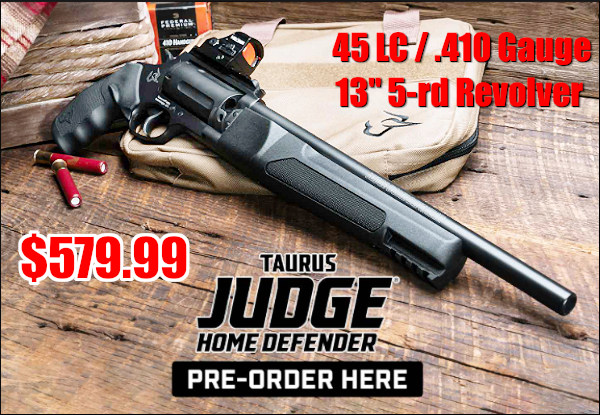
4. KYGUNCO — Taurus Judge Home Defender Revolver, $579.99
⏺ Shoot big cartridges or shotshells in 13″ defense weapon
Taurus recently released a compact, new firearm which has significant advantages as a home defense weapon. Officially a 13″ barreled revolver, the new Taurus Judge Home Defender can shoot .45 LC cartridges AND shoot .410 gauge shotshells. That means it can work like as a pistol-grip shotgun. This Judge Home Defender is easy to store yet powerful and effective when used against a criminal intruder. You can order this new defense gun for $579.99 at KYGUNCO.
6. KYGUNCO — Savage 64 Precision Rimfire Rifle, $249.99
⏺ Great deal on good starter rifle for NRL22
Here’s a bargain-priced .22 LR rifle in a nice, modern chassis. The modern Savage 64 Precision houses a semi-automatic action in a chassis with M-LOK slots and an ergonomic pistol grip. The heavy barrel has a threaded muzzle for easy attachment of brake, tuner, or suppressor. This is a good starting rifle for NRL22 — the semi-auto action allows fast follow-up shots. Get this rifle on sale now for $249.99.
7. Palmetto SA — Leupold Binoculars and Harness Kit, $99.99
⏺ Save 50% now on Leupold Binoculars and Harness
Hunters and varminters need binoculars. A great option is the Leupold BX-1 Timberline 10×42 Binoculars with Go Afield Harness. Right now this combo is just $99.99, a 50% savings off the regular $199.99 price. But act soon — we expect this deal to expire soon. These Leupold binoculars offer solid reliability and quality glass in a lightweight package. This combo includes the excellent, adjustable GO Afield binocular harness, that will hold your binocs and other items securely all day long.
8. Graf & Sons — LEE Classic Turret Press, $129.99
⏺ Amazingly low price for a 4-station turret, with many great features
Right now the LEE Classic Turret Press is just $129.99 at Graf’s — an awesome deal. This 4-station Turret Press has earned excellent user reviews: “This cast iron frame model with all-steel linkage is built like a tank”; “Great press — solid as a rock. I originally bought it for reloading pistol ammo but like it so well I use it for almost everything”; “the turret auto-indexes perfectly and locks solid with no effort. I really like how easy it is to still use it as a single-stage when working up a load but not have to change dies, just simply rotate the turret by hand.” With four stations you can keep dies for multiple cartridge types. The long stroke allows rifle cases over 3″ long to be loaded. Spent primers run directly through the ram to an attached clear PVC tube that reliably catches every primer.
8. MidwayUSA — Browning Sleeping Bag, Tent, Blanket SALE
⏺ Great deals on Browning branded camping gear
Many readers will be out in the field this fall on hunting trips. Here are three Browning-brand items that are hugely discounted at MidwayUSA. The Browning Endeavor Sleeping Bag is an amazing bargain at $59.99, 72% off the original price. The Browning Big Horn 5+ SR Tent is spacious, and a great value at $229.99, $270 (54%) off the regular price. We’ve used the 70″x50″ polyester-covered Endeavor Blanket for car camping and boat trips and it worked great. NOTE: This is not thin like typical blankets — it should be considered a polyester quilt.
9. Amazon — GuardTech Plus Gun Cleaning Kit, $48.95
⏺ Excellent full-featured cleaning kit for all types of guns
This big GuardTech Plus Cleaning Kit will work for rifles, pistols, and even shotguns. You get a big selection of brushes, jags, and mops that fit calibers .17 to .50. In addition, there are picks and tooth-brush-style brushes for cleaning your action, plus a pull-through cleaning rope. You get all this, in a nice fitted hard case, for just $48.95 on Amazon. Choose green case (as shown), or black case.
⏺ Good compact muffs for the price with a good 26dB SNR
We say it all the time but don’t ever shoot without quality hearing protection. Consider these Vanderfield folding ear muffs. Priced at just $15.99, these come in a variety of colors (black, brown, green, gray, red, purple, pink) so you can easily tell yours apart from others. The 26dB SNR sound protection rating is above average for compact muffs. For maximum protection use plugs under the muffs. (FYI, “SNR” or Single Number Rating, is the EURO equivalent of the NRR noise rating in the USA.)
“A bullet launched at a higher altitude is able to fly slightly farther (in the thinner air) for every increment of downward movement. Effectively, the bullet behaves as if it has a higher ballistic coefficient.”
It’s hunting season, and we have a friend who wants to go the high country of Colorado to pursue elk. He recently zeroed his rifle in California, at a range just a few hundred feet Above Mean Sea Level (AMSL). He wondered if the higher altitude in Colorado could alter his ballistics. The answer is a definite yes. However the good news is that free ballistics calculators can help you plot reliable drop charts for various shooting locations, high or low.
The question has been posed: “What effect does altitude have on the flight of a bullet?” The simplistic answer is that, at higher altitudes, the air is thinner (lower density), so there is less drag on the bullet. This means that the amount of bullet drop is less at any given flight distance from the muzzle. Since the force of gravity is essentially constant on the earth’s surface (for practical purposes), the bullet’s downward acceleration doesn’t change, but a bullet launched at a higher altitude is able to fly slightly farther (in the thinner air) for every increment of downward movement. Effectively, at higher altitudes, the bullet behaves as if it has a higher ballistic coefficient.
Forum member Milanuk explains that the key factor is not altitude, but rather air pressure. Milanuk writes:
“In basic terms, as your altitude increases, the density of the air the bullet must travel through decreases, thereby reducing the drag on the bullet. Generally, the higher the altitude, the less the bullet will drop. For example, I shoot at a couple ranges here in the Pacific Northwest. Both are at 1000′ AMSL (Above Mean Sea Level) or less. I’ll need about 29-30 MOA to get from 100 yards to 1000 yards with a Berger 155gr VLD at 2960 fps. By contrast, in Raton, NM, located at 6600′ AMSL, I’ll only need about 24-25 MOA to do the same. That’s a significant difference.
Note that it is the barometric pressure that really matters, not simply the nominal altitude. The barometric pressure will indicate the reduced pressure from a higher altitude, but it will also show you the pressure changes as a front moves in, etc. which can play havoc w/ your calculated come-ups. Most altimeters are simply barometers that read in feet instead of inches of mercury.”
As Milanuk states, it is NOT altitude per se, but the LOCAL barometric pressure (sometimes called “station pressure”) that is key. The two atmospheric conditions that most effect bullet flight are air temperature, and barometric pressure. Normally, humidity has a negligible effect. It’s important to remember that the barometric pressure reported on the radio (or internet) may be stated as a sea level equivalency. So in Denver (at 6,000 feet AMSL), if the local pressure is 24″, the radio will report the barometric pressure to be 30″. If you do high altitude shooting at long range, bring along a Kestrel, or remember to mentally correct the radio station’s pressure, by 1″ per 1,000 feet.
Trajectory of Bullet fired at Sea Level
Trajectory of Bullet fired at 20,000 feet
You can do your own experimental calculations using JBM Online Ballistics (free to use). Here is an extreme example, with two printouts (generated with Point Blank software), one showing bullet trajectory at sea level (0′ altitude) and one at 20,000 feet. For demonstration sake, we assigned a low 0.2 BC to the bullet, with a velocity of 3000 fps.
To learn more about all aspects of Exterior Ballistics, Hornady has a useful discussion of External Ballistics including the effects of altitude and temperature. To dig deeper, Sierra Bullets has a comprehensive Exterior Ballistics Resource Page with multiple sections from the Sierra Manual (4th and 5th Editions), including:
Example from Section 3.0: “When a bullet flies through the air, two types of forces act on the bullet to determine its path (trajectory) through the air. The first is gravitational force; the other is aerodynamics. Several kinds of aerodynamic forces act on a bullet: drag, lift, side forces, Magnus force, spin damping force, pitch damping force, and Magnus cross force. The most important of these aerodynamic forces is drag. All the others are very small in comparison when the bullet is spin-stabilized.”
Chris Simmons Wins International Precision Rifle Federation PRS World Championships
Lapua congratulates Team USA’s Chris Simmons on winning the first-ever International Precision Rifle Federation Precision Rimfire World Championships. This highly anticipated match took place August 28 through September 3 at the Piancardato Tiro A Volo range in Collazzone, Italy. Chris was shooting a Vudoo rifle with Lapua X-Act .22 LR rimfire ammunition. Simmons posted an Aggregate score of 165.00 points with a time of 1480.45. The first four finishers were also from the USA. CLICK HERE to see hundreds of photos from the event.
The International Precision Rifle Federation (IPRF) World Championships drew top shooters from 23 nations. The three-day event had competitors tackle a challenging course of fire at different distances, shooting from both supported and unsupported obstacles, with long-range shots, and moving targets, all within tight time constraints.
Simmons, no stranger to the winner’s circle, was part of a two-year selection process to represent the United States at the inaugural IPRF event. Over the past nine months, Simmons took his training to another level, getting up before daylight to hit the range. He also spent many evenings after work shooting 10-12 different positions in a 90-second timeframe, firing hundreds of rounds daily.
Match was conducted in a beautiful hillside location in Collazone, Italy.
After surviving tricky wind conditions and bad wind calls, Simmons found himself in second place prior to going into the last two stages. He then performed great in the final two stages, taking the overall win: “Paul Dallin and I ended up tied and it came down to the fastest aggregate time of all the stages,” commented Simmons. “I won the World Championship by 23 seconds in 2023! Paul is a hell of a shooter and competitors and was tough to beat. Congratulations to him on his second-place finish!”
Top Five Shooters at IPRF Rimfire World Championships:
1. Chris Simmons, USA
2. Paul Dallin, USA
3. Payton Grimes, USA
4. Tyler Orth, USA
5. Radek Novak, Czech Republik
“It was an honor to be able to represent Team USA in the World Precision Rifle Championships in Italy. Thank you to Lapua for supporting both myself and Team USA with quality ammunition,” stated Simmons.
Member of Team USA with a patriotic stars and stripes rimfire rifle.
Competitors came from 23 different countries from around the world.
The USA’s Payton Grimes was top lady shooter and 3rd overall.
The event included unusual stages with across-the-water shots.
Ammo Testing at Lapua Rimfire Performance Centers
The Lapua X-ACT .22 LR ammunition used by Chris Simmons was matched to his VuDoo rifle at a Lapua Rimfire Performance Center in the USA. Unique lots of ammunition are tested at 50 and 100 meters simultaneously, identifying the best performing ammunition for purchase. This service is available to any shooter who wishes to gain a competitive advantage. Schedule your testing at either of Lapua’s Rimfire Performance Centers located in Mesa, Arizona, or Marengo, Ohio.
To learn more about the Lapua Rimfire Performance Centers or to schedule an appointment, visit Rimfiretest.com.
At the request of our readers, we provide select “Deals of the Week”. Every Sunday afternoon or Monday morning we offer our Best Bargain selections. Here are some of the best deals on firearms, hardware, reloading components, optics, and shooting accessories. Be aware that sale prices are subject to change, and once clearance inventory is sold, it’s gone for good. You snooze you lose.
NOTE: All listed products are for sale to persons 18 years of age or older. No products are intended for use by minors.
1. Graf & Sons — Leupold Optics Rebates
⏺ Get big $100 or $50 Rebate on quality Leupold optics
Need a riflescope, spotting scope, or binocs for your fall hunt or shooting match? If so check out the Leupold Optics Rebates over at Graf’s. You can save $50 on BX-2 Alpine HD Binoculars and $100 on SX-2 Alpine HD Spotting Scopes and VX-5HD scopes. The SX-2 spotting scope has earned very positive reviews and the VX-5HD is great for long range hunting. Here are links for qualifying products: BX-2 Binoculars; SX-2 Alpine HD Spotters; VX-5HD Scopes.
2. Powder Valley — Popular Hodgdon, VV, Alliant Powders on Sale
⏺ Most popular accuracy powders in stock now at good prices
PowderValley.com has a large selection of highly desirable powders IN STOCK and discounted now through Wednesday, 9/27/2023. Powder Valley has Varget, H4350, Reloder 16, N133, N320, N550, AR Comp and many more top-tier propellants in stock now. If you need premium powders at very competitive prices, head over to Powder Valley immediately.
3. Midsouth — Lock-N-Load AP Auto Progressive Press, $549.99
⏺ Save $40 with sale and get 500 FREE Bullets
Progressive presses let you load ammo much more efficiently. The Lock-N-Load AP Loader Auto Progressive Press is on sale now for $549.99 ($40 off). This 5-station progressive features automatic indexing, priming, and ejection. The L-N-L AP Loader has a 5-station quick change bushing system that allows quick/easy cartridge type change-overs in less than 5 minutes. And right now, with this press purchase, Hornady provides 500 bullets for free.
4. Palmetto State Armory — 5.7×28 Rock Pistol Sale, $299.99
⏺ Impressive new cartridge in good pistol priced under $300.00
The 5.7×28 cartridge is a high energy defense round with reduced recoil compared to cartridges with big, heavy bullets. The PSA 5.7 Rock Pistol is a full-size polymer frame pistol with excellent ergonomics and great accuracy. Right now it is on sale for just $299.99 — a great price. Made from quality 416 stainless steel and advanced polymers, this 5.7 Rock pistol is a good choice for defense and gun games. Chambered in 5.7x28mm, the PSA 5.7 Rock is fed from a 23-round magazine and has a smooth Glock-style trigger. This pistol will accept Glock-compatible sights.
5. Creedmoor Sports — Crosman Challenger Air Rifle, $649.95
⏺ Accurate, match-proven, excellent starter competition air rifle
Airguns are more popular than ever for good reason. They’re inexpensive to shoot, can be used indoors, and you don’t need an FFL to acquire an air rifle. If you want an affordable, competition-grade air rifle, consider the Crosman Challenger 2021. This Sporter Class air rifle boasts an adjustable stock, swappable sidelever cocking handle, and competition sights. With good components and ergonomics, this Challenge rifle can compete with much more expensive rigs. This is a good choice for 3-position rifle training.
6. Amazon — Frankford Arsenal Case Prep Center, $120.30
⏺ Very capable case prep center with handy design
Case prep is critical for proper reloading but it can be a long and arduous process. Speed up your case prep with the Frankford Arsenal Case Prep System. The machine’s HSS cutters stay sharp for thousands of rounds to make trimming quick and easy and the heavy-duty motor and drivetrain are optimized for durability and performance. This prep center includes inside chamfer tool, deburr tool, large and small primer pocket cleaning tools, plus a trimmer with 3 collets and 6 shoulder bushings.
7. Midsouth — Frankford Arsenal Perfect Primer Seater, $61.48
⏺ Excellent Primer Seating Tool with very positive user reviews
Amazon has the Frankford Perfect Primer Seater Tool for $61.48 (14% Off). This is a GREAT primer seating tool. It has good feel, plenty of leverage, and the primer tray works well. Importantly, it has a click-adjust wheel for precise primer seating depth control. Read our Frankford Primer Seating Tool Product Review. The tool comes complete with 12 precision shell holders. A quick thumb release system allows you to switch from small to large primers easily. Plus there is a hard stop so you won’t over-crush a primer.
8. Midsouth — Aguila Rimfire Ammo Sale, from $3.19/50 rds
⏺ Incredibly low prices on Aguila .22 LR rimfire ammo
Shooting rimfire rifles and pistols is fun and affordable. Right now Midsouth is running an Aguila Rimfire Ammo Sale with great deals. Get reliable Aguila .22 LR ammo for as little as six cents per round (with $3.19 50rd box). There are many Aguila .22 LR rimfire ammo types on sale. Choose subsonic and supersonic, with a wide choice of bullet types.
9. Amazon — Digital Micrometer, $39.99
⏺ Good deal on precision inch + metric digital micrometer
A good micrometer is a key tool for accurately measuring cartridge components and gun parts. We found a good Digital Display Micrometer for just $39.99 on Amazon. This tool boasts a 0.0-1.0″ (0 to 25mm) range with with 0.00005″/0.001mm resolution and +/- 0.0001″ accuracy. This micrometer offers two measuring modes and is easy to operate.
10. Amazon — Wheeler P-Handle Tool Set, $48.71
⏺ Big discount on very complete set of drivers
If there’s one thing everyone needs in the workroom it’s a good set of hex and torq drivers. You can grab the Wheeler 30 Piece SAE/Metric Hex and Torx P-Handle Set for only $48.71 and have everything you need to work on guns and gear. This kit has SAE and Metric hex-type driver, plus Torx drivers, offering the full range of drivers you might need.
Many short-range Benchresters have thought about converting their 6 PPC to shoot a 30BR for score matches, or a Dasher for mid-range (or even 1000-yard) games. That way you have a rifle that does double duty, giving you the most bang for your buck. Though an action with a PPC bolt won’t normally work with 30BR/6BR/Dasher cases with their larger .308-class rim (0.4728″ diameter), there is a pretty easy solution that allows you to cycle these bigger cartridges with a 6PPC-style bolt (designed to fit .220 Russian rims).
“Rebating case rims … lets you shoot a 30BR in score matches using your PPC action. All you need is a new barrel. This saves buying another bolt, receiver, or rifle.” — Butch Lambert
Butch Lambert of ShadeTree Engineering provided this tip. Butch notes that many 6 PPC benchrest group shooters also enjoy shooting in score matches. But to be really competitive in the BR for score game, that means shooting a 30BR, which has a wider, .308-class rim (0.4728″ diameter). Likewise, if you want to compete in 600-yard registered BR events or in varmint matches, you probably want to run a bigger case, such as the 6BR, 6mm Dasher, or 6-6.5×47. Those cartridges also have the larger 0.4728″ rims.
Rebate Your 30 BR Rims
To convert a PPC-boltface action to shoot bigger cases you can spend a ton of money to buy a new bolt. That can cost hundreds of dollars. The simpler solution is to turn down the diameter of the larger cases on a lathe. Butch explains: “We’ve seen plenty of interest in rebating case rims. This lets you shoot a 30BR in score matches using your PPC action. All you need is a new barrel. This saves buying another bolt, receiver, or rifle if you have a PPC boltface. Anyone who has access to a lathe can do this job pretty easily. Yesterday I turned 150 case in about an hour.”
At right is the lathe form tool Butch uses to rebate the case rims.
Ever wondered how factory ammunition is produced, from start to finish? How are brass cases made, how are bullets created, and how are finished cartridges produced on automated assembly lines? Today’s video showcase features six major factories that, collectively, produce bullets, powder, and finished ammo. We start with the Berger Bullet plant, follow by Vihtavuori powder production in Europe. Then we show the Remington (now Vista Outdoor) ammo plant in Utah, along with a Federal plant that produces rimfire ammunition. Last but not least, there’s an excellent, very informative video from the Norma ammo factory, plus a Hornady ammo plant video.
Bullets being seating at Hornady ammo factory.
Berger Bullets Factory Tour — Made in USA
In this video, Recoil TV takes a behind-the-scenes look at Berger Bullets, and how the outstanding, match-winning Berger bullets are created. The video covers the entire process — from raw materials, to the placement of bullet cores inside jackets, to the final ultra-consistent and uniform projectiles. To see the complete line of Berger Bullets, with full Ballistic data, visit BergerBullets.com
Vihtavuori Powder Production in Europe
Vihtavuori produces some of the most consistent, high-quality powder on the planet. Vihtavuori powders have been used to set world records and win countless championships in multiple disciplines. This excellent video goes inside Vihtavuori’s European production centers. It is really fascinating — you see how extruded powder starts with long spaghetti-like strings, before being finalized into the tiny sticks that we load.
Along with the powder production process, this video includes the entire VV production line, so you see how powder bottles are filled with powder and the tops of the bottles are secured by automated machines.
Remington Ammo Factory (Now Operated by Vista Outdoor)
This SHWATteam video visits the Remington ammunition plant in Arkansas. Vista Outdoor, the company that produces Federal, Speer and CCI ammo, purchased Remington’s ammunition business in Lonoke, Arkansas. Including the new high-tech plant in the back, this facility has the equivalent of 13+ football fields (1200 acres) under roof at its ammo plant, with over 1100 employees. Production capacity is impressive. When running at maximum output, this Remington ammo plant can crank out a staggering 7,000,000+ rounds every day. To produce that volume of ammunition, the facility needs a huge amount of resources: one million pounds of copper per month and 124,000 pounds of lead per day. Remington started manufacturing ammunition at this Lonoke facility in 1970, but some of the machines have been churning out ammo since long before.
Norma Factory Tour
Guys — honestly, if you do anything today on this site, watch this video. You won’t be disappointed. Guaranteed. This is a very informative (and surprisingly entertaining) video. Every serious hand-loader should watch this video to see how cartridge cases are made. The camera work and editing are excellent — there are many close-ups revealing key processes such as annealing and head-stamping.
VERY Informative Video Show Cartridge Brass and Ammunition Production:
Norma has released a fascinating video showing how bullets, brass, and ammunition are produced at the Norma Precision AB factory which opened in 1902. You can see how cartridges are made starting with brass disks, then formed into shape through a series of processes, including “hitting [the cup] with a 30-ton hammer”. After annealing (shown at 0:08″), samples from every batch of brass are analyzed to check metal grain structure and hardness. Before packing, each case is visually inspected by a human being (3:27″ time-mark).
Federal Rimfire Ammunition Production
Field & Stream Tours Federal Ammo Plant in Minnesota
A reporter for Field & Stream recently got a chance to tour the Federal ammunition production facility in Anoka, Minnesota. This large plant produces both rimfire and centerfire ammunition. While touring the plant, the reporter was allowed to capture video showing the creation of .22 LR rounds from start to finish. This is a fascinating video, well worth watching. Watch and learn how rimfire ammo is made.
Note to Viewers — After Starting Video, Click Speaker Icon to HEAR audio!
This revealing video shows all phases of .22 LR ammo production including cupping, drawing, annealing, washing, drying, head-stamping, priming, powder charging, bullet seating, crimping, waxing, inspection, and final packaging. We recommend you watch the video from start to finish. You’ll definitely learn some new things about rimfire ammo.
Hornady Ammunition Factory
If you wonder how ammo is made, starting with raw metal, check out this video from Hornady. It shows how bullet jackets are formed from copper, followed by insertion of a lead core. The jacket is then closed up over the core with the bullet taking its final shape in a die (a cannelure is applied on some bullet types). Next the video shows how cartridge brass is formed, starting with small cups of brass. The last part of the video shows how cases are primed and filled with powder, and how bullets are seated into the cases, using an automated process on a giant assembly-line.
Here are two different bullet types, seated to the same CBTO length, but different COAL. Note the shiny scratches on the bullets made by the comparator tool which indicates a point on the bullet ogive near where the ogive will engage the rifling.
Effects Of Cartridge Over All Length (COAL) And Cartridge Base To Ogive (CBTO) – Part 2 by Bryan Litz forBerger Bullets. Part One of this series focused on the importance of COAL in terms of SAAMI standards, magazine lengths, seating depths, and pressure levels. Another measure of length for loaded ammunition is highly important to precision, namely Cartridge Base to Bullet Ogive Length (CBTO).
Figure 2. Chamber throat geometry showing the bullet jump to the rifling or lands.
Look at Figure 2. Suppose the bullet was seated out of the case to the point where the base of the bullet’s nose (ogive) just contacted the beginning of the riflings (the lands) when the bolt was closed. This bullet seating configuration is referred to as touching the lands, or touching the riflings and is a very important measurement to understand for precision hand-loading. Due to the complex dynamics of internal ballistics which happen in the blink of an eye, the distance a bullet moves out of the case before it engages the riflings is highly critical to precision potential. Therefore, in order to systematically optimize the precision of his handloads, it’s critically important that the precision hand-loader understands how to alter bullet seating depth in relation to the barrel rifling. Part of the required knowledge is understanding how to accurately and repeatably measure the Cartridge Base To Ogive (CBTO) dimension. This is explained in the FULL ARTICLE.
Bryan Litz offers an extended discussion on how to measure CBTO using different tools and methods, including the Hornady OAL gauge. You can read this discussion in the full article found on the Berger Bullets website. CLICK HERE to Read Full Article.
Why Not Use CBTO as a SAAMI Standard?
If CBTO is so important to rifle accuracy, you might ask, “Why is it not listed as the SAAMI spec standard in addition to COAL?” There is one primary reason why it is not listed in the standard. This is the lack of uniformity in bullet nose shapes and measuring devices used to determine CBTO.
Benefits of Having a Uniform CBTO
There is another aspect to knowing your CBTO when checking your COAL as it pertains to performance. With good bullets, tooling, and carefully-prepared cases you can easily achieve a CBTO that varies less than +/- .001″ but your COAL can vary as much as .025″ extreme spread (or more with other brands). This is not necessarily bad and it is much better than the other way around. If you have a CBTO dimension that varies but your COAL dimension is tight (within +/- .002″) then it is most likely that your bullet is bottoming out inside the seater cone on the bullet tip. This is very bad and is to be avoided. It is normal for bullets to have precisely the same nose shape and it is also normal for these same bullets to have nose lengths that can vary as much as .025″.
Summary of Cartridge Base To Ogive (CBTO) Discussion
Here are four important considerations regarding bullet seating depth as it relates to CBTO:
1. CBTO is a critical measurement to understand for handloaders because it’s directly related to precision potential, and you control it by simply setting bullet seating depth.
2. Tools and methods for measuring CBTO vary. Most of the measurement techniques have pitfalls (which may give rise to inconsistent results) that you should understand before starting out.
3. A CBTO that produces the best precision in your rifle may not produce the best precision in someone else’s rifle. Even if you have the same rifle, same bullets, same model of comparator gauges, etc. It’s possible that the gauges are not actually the same, and measurements from one don’t translate to the same dimension for another.
4. Once you find the CBTO that produces the best precision in your rifle, it’s important to allow minimal variation in that dimension when producing quality handloads. This is achieved by using quality bullets, tooling, and properly preparing case mouths and necks for consistent seating.
Many barrel-makers mark the twist rate and bore dimensions on their barrel blanks.
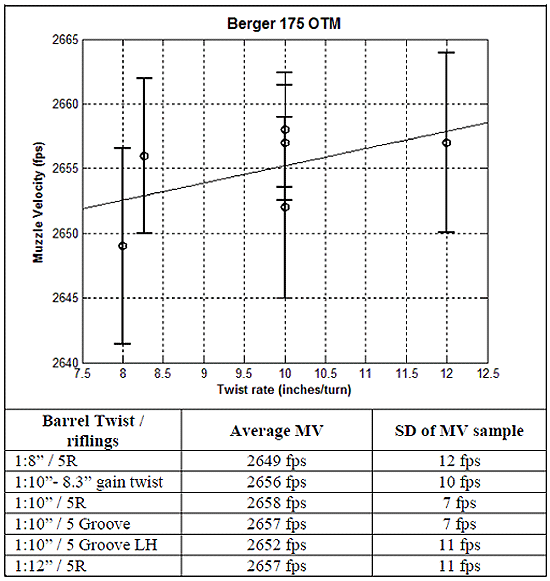
Does muzzle velocity change with faster or slower barrel twist rates? Absolutely, but much less than you might think. Faster twist rates do slow down bullets somewhat, but the speed loss is NOT that significant. With Bartlein .308 Win barrels of identical length and contour, a 1:12″-twist barrel was only 8 fps faster than a 1:8″-twist barrel. That was the result of testing by Applied Ballistics.
The Applied Ballistics team tested six (6) same-length/same-contour Bartlein barrels to observe how twist rate might affect muzzle velocity. This unique, multi-barrel test is featured in the book Modern Advancements in Long Range Shooting, Vol. 1. That book includes other fascinating field tests, including a comprehensive chronograph comparison.
Barrel Twist Rate vs. Velocity — What Tests Reveal by Bryan Litz
When considering barrel twist rates, it’s a common belief that faster twist rates will reduce muzzle velocity. The thinking is that the faster twist rate will resist forward motion of the bullet and slow it down. There are anecdotal accounts of this, such as when someone replaces a barrel of one brand/twist with a different brand and twist and observes a different muzzle velocity. But how do you know the twist rate is what affected muzzle velocity and not the barrel finish, or bore/groove dimensions? Did you use the same chronograph to measure velocity from both barrels? Do you really trust your chronograph?
Summary of Test Results
After all the smoke cleared, we found that muzzle velocity correlates to twist rate at the average rate of approximately 1.33 FPS per inch of twist. In other words, your velocity is reduced by about 5 FPS if you go from a 1:12″ twist to a 1:8″ twist. — Bryan Litz
Savage Test Rifle with Six Bartlein Barrels
Most shooters don’t have access to the equipment required to fully explore questions like this. These are exactly the kinds of things we examine in the book Modern Advancements in Long Range Shooting, Vol. 1. In that book, we present experiments conducted in the Applied Ballistics lab. Some of those experiments took on a “Myth Buster” tone as we sought to confirm (or deny) popular pre-conceptions. For example, here’s how we approached the question of barrel twist and muzzle velocity.
Six .308 Win Barrels from Bartlein — All Shot from the Same Rifle
We acquired six (6) barrels from the same manufacturer (Bartlein), all the same length and contour, and all chambered with the same reamer (SAAMI spec .308 Winchester). All these barrels were fitted to the same Savage Precision Target action, and fired from the same stock, and bench set-up. Common ammo was fired from all six barrels having different twist rates and rifling configurations. In this way, we’re truly able to compare what effect the actual twist rate has on muzzle velocity with a reasonable degree of confidence.
Prior to live fire testing, we explored the theoretical basis of the project, doing the physics. In this case, an energy balance is presented which predicts how much velocity you should expect to lose for a bullet that’s got a little more rotational energy from the faster twist. In the case of the .30 caliber 175 grain bullets, the math predicts a loss of 1.25 fps per inch-unit of barrel twist (e.g. a 1:8″ twist is predicted to be 1.25 fps slower than a 1:9″ twist).
Above, data shows relationship between Twist Rate and Muzzle Velocity (MV) for various barrel twist rates and rifling types. From fast to slow, the three 1:10″ twist barrels are: 5R (canted land), 5 Groove, 5 Groove left-hand twist.
We proceeded with testing all 6 barrels, with twist rates from 1:8″ to 1:12″. After all the smoke cleared, we found that muzzle velocity correlates to twist rate at the average rate of approximately 1.33 fps per inch of twist. In other words, your velocity is reduced by about 5 fps if you go from a 1:12″ twist to a 1:8″ twist. [Editor: That’s an average for all the lengths tested. The actual variance between 1:12″ and 1:8″ here was 8 FPS.] In this case the math prediction was pretty close, and we have to remember that there’s always uncertainty in the live fire results. Uncertainty is always considered in terms of what conclusions the results can actually support with confidence.
This is just a brief synopsis of a single test case. The coverage of twist rates in Modern Advancements in Long-Range Shooting Vol. 1 is more detailed, with multiple live fire tests. Results are extrapolated for other calibers and bullet weights. Needless to say, the question of “how twist rate affects muzzle velocity” is fully answered.
Other chapters in the book’s twist rate section include: · Stability and Drag — Supersonic
· Stability and Drag — Transonic
· Spin Rate Decay
· Effect of Twist rate on Precision
Other sections of the book include: Modern Rifles, Scopes, and Bullets as well as Advancements in Predictive Modeling. This book is sold through the Applied Ballistics online store. Modern Advancements in Long Range Shooting is also available as an eBook in Amazon Kindle format.
Need a top-notch Ballistics App for your iPhone, iPad, or iPod? Start with Ballistic: Advanced Edition (AE), the number 1 (i.e. most installed) App for iOS systems (iPhones and iPads). Ballistics AE (Advanced Edition) is the most popular iOS ballistics program for many good reasons. It offers a full feature set with Ballistic Solver, Ballistic Comparison (with up to 8 projectiles), Target Log (records group sizes), Advanced WindKit, and more. The Ballistic: Advanced Edition software is easy to use, with nice controls. Underneath it all is the proven JBM Ballistics calculator. And here’s the kicker — this excellent mobile App software is now FREE to download and install on iPhones and iPads!
This Video Explains How to Set Up and Use Ballistic: Advanced Edition
Full-featured and easy to use, Ballistics AE has been refined over many years, and it supplies rock-solid solutions derived from JBM Ballistics solver (created by James B. Millard). Unlike some other Apps, Ballistics AE is STABLE on iPhones (with various OS levels). What’s cool is that Ballistics AE is now available for FREE for both iPhones and iPads. This software is now provided by Federal Premium Ammunition, with in-App purchase functionality.
We’ve used the Ballistic: Advanced Edition program on an iPhone 5S, iPhone 6, and iPad, and it performed well. Here are some of the features we liked:
1. Mirrors output from online version of JBM Ballistics we often use for initial calculations.
2. Controls are simple to use and (mostly) intuitive.
3. Handy comparison feature lets you compare ballistics for different projectiles side by side.
4. Advanced Wind Kit allows you to account for complex wind situations.
5. Projectile and BC Databases are very comprehensive.
6. Software is regularly updated to match Apple OS changes.
This article is Copyright 2023 AccurateShooter.com. No republication is authorized. Any appearance of this story on another site obliges that site to pay liquidated damages and/or licensing fees.
Close-up view of a sectioned case. This one here was “fixin’ to pop”, observed Glen Zediker.
Here are highlights from an article Glen Zediker wrote for the Midsouth Blog. In that article Glen, who sadly passed away in 2020, focused on cartridge brass. Glen identified the most common failures that appear with brass that has been shot multiple times, or which has been fired at excessive pressures. Glen explained some simple ways to check your cartridge brass to detect “early warning signs” of case failure, particularly case head separation, which can be very dangerous.
How Cases Degrade with Multiple Firings By Glen Zediker
This article explains when, and then how, to check after the progress of changes commencing with the firing on a new case. It’s the “progress of degeneration,” in a way of looking at it because the concern is getting a handle on when enough change in the brass has come about to require attention. Or abandonment. As said then, for me that’s 4 firings. That, as said last time, is when I might see changes that need attention. Also as said, that figure didn’t come out of a hat, but from my own notes in running my competition NRA High Power Rifle loads. [Editor’s Note: With Lapua brass, using moderate loads, in bolt-action rifles, we typically get about 10 good (match-worthy) firings. But if you anneal your Lapua brass, and run modest pressures, Lapua brass can perform well for 20 or more load cycles.]
The areas most affected are the case neck and case head area. Case neck walls get thicker [but] the case head area body walls get thinner. Primer pockets get shallower and larger diameter.
This case shows a cracked neck AND a crack (separation) above the case head. Zediker says it is “rare to see one case with both of the most common failures. [This case] was attacked by an M14.”
Case Head — Causes of Separation and Cracking
When a case is under pressure during firing, the brass, like water, flows where it can, where it’s more free to move. Of course, the chamber steel limits the amount it can expand. The case shoulder blows fully forward and the case base is slammed back against the bolt face. There is, therefore and in effect, a tug on both ends — it gets stretched. The shoulder area is relatively free to expand to conform to the chamber, but the other end, the case head area, is not. Since that’s the area of the case with the thickest walls, it doesn’t expand “out” much at all. What it does is stretch. The “case head area,” as I refer to it here, is the portion of the case above the web, which is just above the taper that leads in to the extractor groove. The “area” extends approximately an eighth-inch up the case body.
Here’s a “pressure ring.” You’ll see this after firing, if you see it. And, if you see it, that case is done. The bright ring indicates excessive stretching, which indicates excessive thinning. If you see a ring circling the case, noticeable because it’s lighter color than the case body, and it’s in this area, I’d say that case is done. And that’s right where a “head separation” occurs. It can crack and also blow slap in two, and that’s the “separation” part of case head separation.
Photo courtesy GS Arizona.
This is a spot to keep close watch on as cases age. It is also the area that is more “protected” by sizing with less case shoulder set-back. That is, pretty much, where the freedom for the stretching movement in this area comes from (the case shoulder creates a gap). If you’re seeing a sign that a head separation [might happen with relatively few firings], chances are the shoulder set-back is excessive, and also… the load pressure level.
Bent Paper Clip Case-Wall Gauge
Editor: You can use a bent paper clip to detect potential case wall problems. Slide the paper clip inside your case to check for thin spots. GS Arizona explains: “This simple little tool (bent paper clip) will let you check the inside of cases before you reload them. The thin spot will be immediately apparent as you run the clip up the inside of the case. If you’re seeing a shiny line on the outside and the clip is really hitting a thin spot inside, it’s time to retire the case.” Photo by GS Arizona.
Monitor Primer Pocket Dimensional Changes
Another case-head-area and pressure-related check is the primer pocket. As said, the primer pocket will get larger in diameter and shallower in depth each firing. As with many such things, the questions are “when” and “how much,” and the main thing, “how much?”
If the pocket gets excessively shallow, and that’s judged by a primer that seats fully but isn’t at least a tick below flush with the case base, there could be function issues. There’s a risk of a “slam-fire” with a semi-auto that uses a floating firing pin, and, if there is actual protrusion, that has the same effect as insufficient headspace. A primer pocket uniformer can reset the depth of a shallowed primer pocket to what it should be, but the real test for me is how easily the next primer seats into it. If it’s significantly less resistance, I’ll say that case is done. Shallower can be refurbished. That’s a primary function of a primer pocket uniformer. Larger diameter, though, can’t be fixed. I’ve mentioned in another article or two that, any more at least, my main gauge of load pressure has become how much primer pocket expansion there’s been.




 The question has been posed: “What effect does altitude have on the flight of a bullet?” The simplistic answer is that, at higher altitudes, the air is thinner (lower density), so there is less drag on the bullet. This means that the amount of bullet drop is less at any given flight distance from the muzzle. Since the force of gravity is essentially constant on the earth’s surface (for practical purposes), the bullet’s downward acceleration doesn’t change, but a bullet launched at a higher altitude is able to fly slightly farther (in the thinner air) for every increment of downward movement. Effectively, at higher altitudes, the bullet behaves as if it has a higher ballistic coefficient.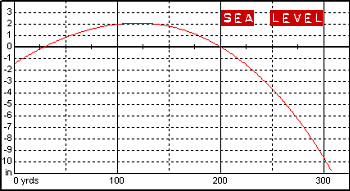


 Norma has released a fascinating video showing how bullets, brass, and ammunition are produced at the
  If you wonder how ammo is made, starting with raw metal, check out this video from
 Effects Of Cartridge Over All Length (COAL) And Cartridge Base To Ogive (CBTO) – Part 2