|
|
March 16th, 2015

It was an impressive “three-peat” for The West Virginia University (WVU) rifle team. The WVU Mountaineers clinched their third straight NCAA Rifle Championship this weekend in Fairbanks, Alaska. Remarkably, this victory was the West Virginia’s 17th NCAA Rifle Championship — and it was a great team performance. WVU’s 4702 team aggregate score is the second-best in NCAA Championships history. And if you are curious, this Mountaineers squad also holds the best-ever team score, a 4705 shot by WVU at the 2014 NCAA Championships.
“It was an amazing performance today,” said coach Jon Hammond. “Winning three titles back to back is unreal. We have stressed with them all year to focus on performance and not outcome. They did that today. No one did anything wrong yesterday, but they performed the right way today. All five of them shot incredible. We really tried to not think about point difference or score. That’s the nature of the sport. You can’t control the other teams.”
Top Air Rifle Performances
The Mountaineers shot a 2383 air rifle team score, the second highest in team and NCAA history, and also took home the top three places in the individual final. WVU’s Maren Prediger, who placed second in last year’s NCAA final, won the individual air rifle title, leading her squad to the team victory in the process. In the first relay Maren was on fire, shooting a near-perfect 598 (100-100-99-100-100-99) score. The Petersaurach, Germany, native scored 205.8 in the final, earning the 2015 air rifle individual title. This was Maren’s last match as a Mountaineer.

“For Maren to shoot a 598 air rifle in her last match is incredible,” Hammond said. “I can’t fault her on anything this weekend. It says a lot about her character to come back today and win. She’s a world-class air rifle shooter. For her to win the final after being so close last year is a huge credit to her. To do it during her final match is even better.”

Air Rifle Shooters at Alaska-Fairbanks’ Patty Center. (WVU Photo by Jason Colquhoun)
| Overall Team Results |
1. West Virginia: 4702
2. Alaska Fairbanks: 4700
3. TCU: 4667
4. Nebraska: 4667 |
5. Jacksonville State: 4664
6. Kentucky: 4657
7. Air Force: 4642
8. Murray State: 4637 |
March 14th, 2015

Congratulations to the University of Nebraska’s Rachel Martin, the new 2015 NCAA Smallbore Rifle Individual Champion! Competing at an indoor range in Alaska, Rachel fired a Final score of 453.3 to edge runner-up Ryan Anderson of the Univ. of Alaska Fairbanks (452.6). The NCAA Championship Air Rifle matches will be held this weekend. You can view Live target images and results on the CMP Match Results Webpage.
 In an interview with NRABlog.com, Rachel gave credit to her Cornhusker team-mates for helping her secure the championship. In an interview with NRABlog.com, Rachel gave credit to her Cornhusker team-mates for helping her secure the championship.
NRA Blog: Rachel Martin never wanted to learn how to shoot. But thanks to a little prodding from dad, she eventually found a passion for the sport. A passion that brought her the 2015 NCAA National Smallbore Rifle Championship.
“It’s a little overwhelming right now,” she said after winning the title.
Emerging from a crop of 48 shooters…this Nebraska sophomore blazed through the opening rounds to earn a spot in the coveted final round. It was there that she held steady until making her move for the win.
“I was so nervous going in. Luckily I talked to my teammates and they told me I was here because God let me be here so have fun with it. That’s all I needed to hear.”
Alaska Wins Team Smallbore Event
In Team competition, the University of Alaska Nanooks won the 2015 smallbore rifle team championship. West Virginia University (WVU) finished second and University of Nebraska placed third. Full team results can be downloaded via this link. Currently, in Saturday’s Team Air Rifle Competition, the “home team” Nanooks are leading by a narrow 3-point margin over the WVU Mountaineers.

Rachel Martin poses with Nanook, University of Alaska’s mascot, at 2015 NCAA Rifle Championships.
It Was Wicked Cold in Alaska
Yes it was cold in Fairbanks. A member of the Jacksonville State University (JSU) rifle team snapped this image on Thursday. The caption said it all: “It’s just easier to make a sign out of ice than paper here I guess. It was -35° F when we got to the range this morning!

March 13th, 2015
 Today is Friday the 13th. Oddly enough, this is the second month in a row with the 13th falling on a Friday. Does that mean double bad luck? For those of you who are superstitious — maybe you should avoid climbing ladders or using power tools today. Today is Friday the 13th. Oddly enough, this is the second month in a row with the 13th falling on a Friday. Does that mean double bad luck? For those of you who are superstitious — maybe you should avoid climbing ladders or using power tools today.
When it comes to shooting, there are many things that shooters chalk up to “bad luck”. In fact, most of these instances of “bad fortune” just come from a failure to anticipate problems. When you have a major, critical problem at a shooting match, i.e. a “train wreck”, this can be the end of your weekend. In this article, Ballistics Guru Bryan Litz talks about “train wrecks” and how to avoid them, even if you are shooting on Friday the 13th. As Bryan told us: “I don’t believe in superstition — we make our own luck!”
Urban Dictionary “Train Wreck” Definition: “A total @#$&! disaster … the kind that makes you want to shake your head.”
 Train Wrecks (and How to Avoid Them) Train Wrecks (and How to Avoid Them)
by Bryan Litz of Applied Ballistics LLC.
Success in long range competition depends on many things. Those who aspire to be competitive are usually detail-oriented, and focused on all the small things that might give them an edge. Unfortunately it’s common for shooters lose sight of the big picture — missing the forest for the trees, so to speak.
Consistency is one of the universal principles of successful shooting. The tournament champion is the shooter with the highest average performance over several days, often times not winning a single match. While you can win tournaments without an isolated stellar performance, you cannot win tournaments if you have a single train wreck performance. And this is why it’s important for the detail-oriented shooter to keep an eye out for potential “big picture” problems that can derail the train of success!
Train wrecks can be defined differently by shooters of various skill levels and categories. Anything from problems causing a miss, to problems causing a 3/4-MOA shift in wind zero can manifest as a train wreck, depending on the kind of shooting you’re doing.
Below is a list of common Shooting Match Train Wrecks, and suggestions for avoiding them.
1. Cross-Firing. The fastest and most common way to destroy your score (and any hopes of winning a tournament) is to cross-fire. The cure is obviously basic awareness of your target number on each shot, but you can stack the odds in your favor if you’re smart. For sling shooters, establish your Natural Point of Aim (NPA) and monitor that it doesn’t shift during your course of fire. If you’re doing this right, you’ll always come back on your target naturally, without deliberately checking each time. You should be doing this anyway, but avoiding cross-fires is another incentive for monitoring this important fundamental. In F-Class shooting, pay attention to how the rifle recoils, and where the crosshairs settle. If the crosshairs always settle to the right, either make an adjustment to your bipod, hold, or simply make sure to move back each shot. Also consider your scope. Running super high magnification can leave the number board out of the scope’s field view. That can really increase the risk of cross-firing.
2. Equipment Failure. There are a wide variety of equipment failures you may encounter at a match, from loose sight fasteners, to broken bipods, to high-round-count barrels that that suddenly “go south” (just to mention a few possibilities). Mechanical components can and do fail. The best policy is to put some thought into what the critical failure points are, monitor wear of these parts, and have spares ready. This is where an ounce of prevention can prevent a ton of train wreck. On this note, if you like running hot loads, consider whether that extra 20 fps is worth blowing up a bullet (10 points), sticking a bolt (DNF), or worse yet, causing injury to yourself or someone nearby.

3. Scoring/Pit Malfunction. Although not related to your shooting technique, doing things to insure you get at least fair treatment from your scorer and pit puller is a good idea. Try to meet the others on your target so they can associate a face with the shooter for whom they’re pulling. If you learn your scorer is a Democrat, it’s probably best not to tell Obama jokes before you go for record. If your pit puller is elderly, it may be unwise to shoot very rapidly and risk a shot being missed (by the pit worker), or having to call for a mark. Slowing down a second or two between shots might prevent a 5-minute delay and possibly an undeserved miss.
 4. Wind Issues. Tricky winds derail many trains. A lot can be written about wind strategies, but here’s a simple tip about how to take the edge off a worse case scenario. You don’t have to start blazing away on the command of “Commence fire”. If the wind is blowing like a bastard when your time starts, just wait! You’re allotted 30 minutes to fire your string in long range slow fire. With average pit service, it might take you 10 minutes if you hustle, less in F-Class. Point being, you have about three times longer than you need. So let everyone else shoot through the storm and look for a window (or windows) of time which are not so adverse. Of course this is a risk, conditions might get worse if you wait. This is where judgment comes in. Just know you have options for managing time and keep an eye on the clock. Saving rounds in a slow fire match is a costly and embarrassing train wreck. 4. Wind Issues. Tricky winds derail many trains. A lot can be written about wind strategies, but here’s a simple tip about how to take the edge off a worse case scenario. You don’t have to start blazing away on the command of “Commence fire”. If the wind is blowing like a bastard when your time starts, just wait! You’re allotted 30 minutes to fire your string in long range slow fire. With average pit service, it might take you 10 minutes if you hustle, less in F-Class. Point being, you have about three times longer than you need. So let everyone else shoot through the storm and look for a window (or windows) of time which are not so adverse. Of course this is a risk, conditions might get worse if you wait. This is where judgment comes in. Just know you have options for managing time and keep an eye on the clock. Saving rounds in a slow fire match is a costly and embarrassing train wreck.
5. Mind Your Physical Health. While traveling for shooting matches, most shooters break their normal patterns of diet, sleep, alcohol consumption, etc. These disruptions to the norm can have detrimental effects on your body and your ability to shoot and even think clearly. If you’re used to an indoor job and eating salads in air-conditioned break rooms and you travel to a week-long rifle match which keeps you on your feet all day in 90-degree heat and high humidity, while eating greasy restaurant food, drinking beer and getting little sleep, then you might as well plan on daily train wrecks. If the match is four hours away, rather than leaving at 3:00 am and drinking five cups of coffee on the morning drive, arrive the night before and get a good night’s sleep.”
Keep focused on the important stuff. You never want to lose sight of the big picture. Keep the important, common sense things in mind as well as the minutia of meplat trimming, weighing powder to the kernel, and cleaning your barrel ’til it’s squeaky clean. Remember, all the little enhancements can’t make up for one big train wreck!

March 12th, 2015

One of the great things about shooting is that one can excel in the sport even as an “elder statesman”. Senior citizen Tom Pampalone of Florida recently proved that in F-TR competition. Still “shooting and loving it” at age 76, Tom used his Eliseo R1 F-TR rifle to set not one but TWO Grand Senior National Records. Bravo Tom! Gary Eliseo of Competition Machine says Tom’s record-setting performance is an inspiration for all of us: “I don’t know about you, but I want to be like Tom when I grow up!”
Shown below is Competition Machine’s HD bipod system. Tom Pampalone used a similar set-up fitted to his red R1 F-TR rifle. The bipod “head” clamps around the fore-end, allowing the system to rotate around the barrel axis as needed to match the terrain. The long, ski-type feet distribute the load over a large surface area. This reduces hop and helps the gun track straight back during recoil.

March 5th, 2015
CMP Board Members and a few CMP staff members enjoyed a visit to the CMP Talladega Marksmanship Park yesterday. They fired a few shots downrange from the 200-yard line. Here’s an image from the Kongsberg electronic target system. Shot impacts are precisely triangulated with sonic target sensors, then shot locations (and scores) are displayed on monitors placed next to each shooter. For more information on the CMP Talladega Marksmanship Park, visit http://thecmp.org/competitions/talladega-marksmanship-park/.


The 13,000-square-foot CMP Park Club House overlooks the 600-yard range. Panoramic windows look out towards the firing line and the Alabama woodlands beyond.

Register Now for Inaugural D-Day Match at Talladega
The first official matches at the new CMP Talladega Marksmanship Park will be fired on the weekend of June 6-7, 2015. The celebration is a two-day event which includes tours of the facility. A special John C. Garand “D-Day Anniversary” Rifle Match On Saturday, June 6th will officially open the facility. On Sunday there will be an EIC Service Rifle Match, EIC Service Pistol Match, and a CMP .22 Rimfire EIC Pistol Match. The inagural event is limited to the first 350 Competitors, so register soon via the CMP’s Competition Tracker website.
March 3rd, 2015
At ranges across the country, on any given weekend, there are probably more IDPA matches than any other type of pistol competition. And now the IDPA has its own official steel practice target: the IDPA PT (Practice Torso). The new target, crafted by Utah-Based Action Target from 3/8″-thick AR550 steel, features a regulation torso shape with scoring zones. Green-colored reactive plates provide instant feedback. Notably, the target has no exposed bolts, clamps or brackets. The completely flat shooting surface reduces the risk of ricochets coming back at the shooter.

The IDPA target’s reactive plates feature an innovative hinge design. “A lot of work went into the design of this target,” said Chris Hess, Action Target’s marketing manager. “Not only did we ensure that the torso dimensions of the target perfectly match IDPA regulation, we also created a new patent pending hinge design for the reactive plates that minimizes the number of parts needed and provides consistent reaction on every shot. This new design will soon be used on all of our reactive steel targets.”
New IDPA PT Target features innovative, Patent-pending hinge design.

Two-time national IDPA champion Tom Yost helped develop the new steel target: “As a competitive shooter, this is exactly the kind of target I want to train with. Practicing on steel helps build muscle memory for accurate shots better than anything else because it provides instant feedback that you can hear and see.”
IDPA Matches feature “real-world” type scenarios, with guns drawn from cover.

February 28th, 2015
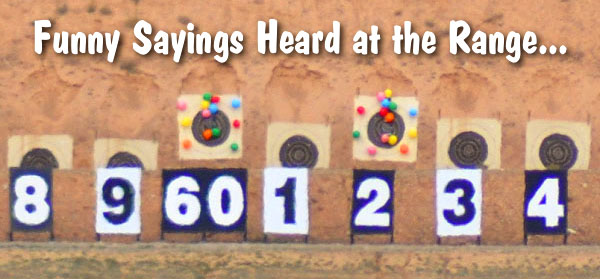
Shooting can be a frustrating sport at times, prompting shooters to say some funny things in the heat of the moment. Here’s a collection of humorous range riposts, supplied by Shooters’ Forum members (who are listed after each quote). Enjoy. (CLICK HERE for full Forum Funny Saying Thread).
“I paid to use all of the target and I’m getting value for money on all of the real estate!” (Macropod)
“How did I do?” “Well the gun went off and nobody got hurt, we can build on that….” (Mr. Majestic)
“Treat that trigger likes it’s your first date, not like you’ve been married to it for 20 years.” (Jet)
“It’s a good thing broad sides of barns aren’t at many shooting ranges.” (Rocky F.)
“At 65 years of age, 1000-yard benchrest is better than sex, because a relay lasts 10 minutes!” (The Viper)
“If you flip the safety off, velocity will increase 1000%” (Rope2Horns)
“If you chase the wind, it will always win.” (Boltline13)
“It’s not the arrow, it’s the Indian.” (Rocky F.)
“It was an 0.2″ group! Well, err, except for that flyer….” (Dsandfort, photo by RyanJay11)

“I can’t understand it. That load worked good in my other barrel”. (Hogpatrol)
“You bakin a biscuit?” Said to me as I was sitting at the bench ready to shoot with a cartridge in the chamber of a hot gun, taking longer than necessary. (Ebb)
“Shooting groups is easy. Just put the last three between the first two.” (Uthink)
“There is no Alibi for Stupid” (Seen at Berger SWN — Erik Cortina)

“I just shot two Xs, how can that be an 8!!!???” (Snuggie)
Shooter 1: “Hey you cross-fired on my target!” Shooter 2: “Well you cross-fired on mine first.”
Shooter 1: “Yeah but you could have at least shot an X like I did on yours.” (At Raton — Rocky F.)
“I had a bughole going and my second shot dropped straight down!” (JDMock)
“The nut came loose on the end of my stock.” (TXDan)
Quoting James Crofts: “That’s a pretty eight.” (REastman)
“I almost shot a record.” (Jay Christopherson)
February 23rd, 2015

Earlier this month, the Ben Avery Range in Phoenix hosted America’s top long-range shooters at the Berger SW Nationals. This week cowboys and cowgirls take over Ben Avery during Winter Range, the SASS National Championship for Cowboy Action Shooting. Winter Range, which runs February 23 through March 1, is the second largest Cowboy Action event of the year, after End of Trail, the annual Single Action Shooting Society World Championship held each year in Edgewood, New Mexico.
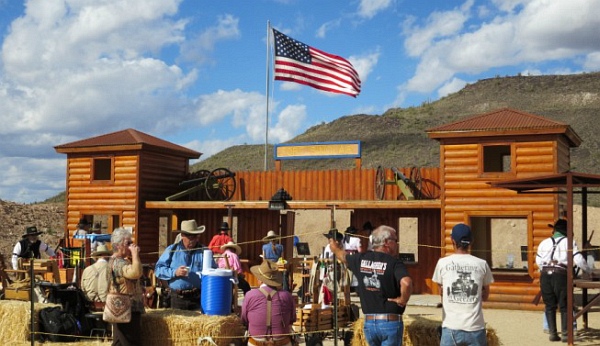

Hundreds of cowboy action shooters, ages 12-80, will compete in multiple classifications based on age, and type/caliber of firearms. In addition, this year the Cowboy Mounted Shooting Association and the SASS Mounted Shooters will run an exciting 3-day mounted shooting event. This is expected to draw more than 100 competitors mounted on horses. You’ll see this kind of action:

Cowboy Action Shooting requires that contestants compete with firearms typical of those used in the taming of the Old West: single-action revolvers, lever-action rifles, and period shotguns. Participants each have a registered cowboy shooting alias (such as “Deadeye Dave”), used in SASS events. Competitors, organized in “Posses”, shoot a series of multi-gun stages. This is a fun shooting sport that draws multiple generations of the same family. In addition to the primary competitions, Winter Range 2015 will feature displays of period militaria, exhibitions of western skills and crafts, a fast-draw contest, and nearly 100 vendors selling vintage-style clothing and “sundries”.


February 21st, 2015
Here is some serious Saturday “gun glamour” from the folks at Star Shooter Precision, a bipod-builder and stock-maker based in Montreal, Canada. This stunning .308 Win F-TR rifle features a carbon-wrapped Star Shooter stock, angle-adjustable tubular bag-rider, star-shaped escutcheons, and a Kelbly Panda action. Up front is Star Shooter’s signature lightweight bipod.
Click Each Image for Large, Full-Screen Version


 About the Rifle Builders About the Rifle Builders
Star Shooter Precision is a company located on the south shore of Montreal, Quebec, Canada. Fred Harvey is the designer. Fred says: “Our goal is to perfect the art of competition shooting the best we can with our custom bipods. The Star Shooter bipod is designed for shooters in F-Class competition, varmint hunting, load testing, tactical shooting and sighting in rifles.”

February 19th, 2015
Trijicon is out, and Magpul is in (as lead sponsor), so the much-ballyhooed NRA World Shooting Championship (WSC) will continue — at least for one more season. Held at the Peacemaker Nat’l Training Center in West Virginia, the inaugural 2014 “World Shooting Championship” left some folks shaking their heads after match directors made a few puzzling rule changes on the fly. In addition, it was hard to call last year’s NRA event a true “World Championship”. In 2014, almost all the WSC shooters were American, and, what’s more, a real ISSF World Championship was staged at the very same time last year in Granada, Spain. That important ISSF event in Spain had shooters from 40+ countries and many Olympic medalists.

Nonetheless, we’ll see more WSC action this fall. The 2015 NRA World Shooting Championship will be held September 24 – 26, 2015 at Peacemaker in WV. This will once again be a “big money” event, with a $200,000 prize table and $50,000 in cash awards. With a quarter-million dollars worth of cash and hardware prizes up for grabs, this is probably the richest shooting event in the world. And, as before, the match organizers will provide all the guns and all the ammo.
Competitors at the 2015 NRA World Shooting Championship will compete in three divisions: Pro, Amateur, and Junior. The event will feature twelve (12) stages drawing from a variety of firearm disciplines, such as Cowboy Action, F-Class, and Smallbore standing.
| World Shooting Championship Stages |
|
Stage 1: Cowboy Action
Stage 2: NRA Conventional Bullseye
Stage 3: NRA Bianchi Mover
Stage 4: NRA F-Class
Stage 5: 5-Stand
Stage 6: Double Wobble Trap |
Stage 7: .22 Smallbore Standing
Stage 8: 3-Gun
Stage 9: USPSA
Stage 10: USCA 2Gun
Stage 11: PRS Long Range Challenge
Stage 12: NRA Action Rifle |
“We’ve created the NRA World Shooting Championship to be the top competitive shooting event in the world,” said NRA General Operations Executive Director Kyle Weaver. “Not only will providing all firearms and ammunition help level the playing field, but it will alleviate competitors needing to buy new equipment and simplify international and domestic travel.”
Get more information about the WSC at NRAWorldShootingChampionship.com. Registration for the 2015 WSC is now open. Match fees, by division, are: Pro $395.00, Amateur $325.00, Junior $375.00. CLICK HERE to REGISTER
Peacemaker Nat’l Training Center, Glengary, West Virginia
|


