|
|
July 30th, 2014
Story Based on Report by Kyle Jillson for NRABlog.com
Joseph Hendricks won the 2014 NRA High Power Rifle Championship with a 1789-76X Score. Hendricks topped a large field of 288 total competitors. In second place, two points behind, was past champion Norm Houle with 1787-85X. Defending 2013 High Power Champion SSG Brandon Green was a close third, with 1786-89X. Green had the high X-Count for the match. The top “Any Sights” competitor was Kenneth Lankford, whose 1780-76X was the eighth-highest total overall.

Great Shooting Takes Hendricks from Fifth to First on Final Day
Dawn on the final day of the 2014 NRA High Power Rifle Championship saw Joe Hendricks sitting in fifth place. But by sundown the Team Remington shooter had become the national champion. What happened in between was a shining example of consistency and perseverance.
Hendricks started the final day (Tuesday) four points down of the leader, tied for third but with a low X-Count. “I assumed everybody would go clean … so I needed to go clean just to maintain my spot,” Hendricks said. And clean he went. All 60 of Joe’s shots on Tuesday fell within the 10-ring. In fact, he hit straight 10s for the last 100 shots of the 180-shot championship. That is an impressive feat.

Three Generations of Hendricks on the Firing Line
Hendricks has the unique privilege to shoot with his son, Joe Hendricks, Jr., and his father, Gary Hendricks. The rest of his family was there to cheer him on as well.
Altered Course of Fire on Final Day
Tuesday’s matches followed an unusual break after severe winds on Monday caused a complete cancellation of the matches. Normally, on the final day of the High Power Championship, competitors shoot matches at 200, 300, and 600 yards. This year, due to the Monday cancellation, competitors did not fire a 200-yard match, but instead fired the 300-yard match and TWO 600-yard matches.
View Photos from 2014 High Power Championships
When everyone found themselves back on the firing line Tuesday morning, the wind had died down. “The winds weren’t too tricky. I shot two nice groups at 300. Not the X-count I wanted, but I got all the points,” Hendricks explained. “When I got back to 600 I just tried to do the same thing. The wind dropped off enough a couple times that if I shot I’d lose points, so I waited until it came back.”
Hendricks finished with 1789-76X, two points ahead of Norman Houle (1787-85X), a three-time High Power National Champion. In third place, with 1786-89X, was SSG Brandon Green, last year’s High Power Rifle Champion.
July 29th, 2014
2014 and 2012 U.S. National F-TR Champion James Crofts is one of America’s top F-Class shooters. A member of the 2013 World Championship-winning F-TR Team USA squad, James knows a thing or two about long-range shooting, that’s for sure. But you may be surprised to learn how James sharpens his shooting skills at relatively short distances. You see, James often practices with a .22 LR rimfire rifle at distances from 50 to 200 yards. James tells us: “Shooting my F-Class rimfire trainer saves me money and improves my shot process and wind-reading abilities.”
Remington rimfire 40X barreled action in PR&T LowBoy stock with PT&G bolt.

Rimfire Training Teaches Wind-Reading Skills by James Crofts
Training with the rimfire is extremely useful and can be done from 25 yards out to 200 yards. I am lucky and can shoot 50 yards right off my back deck. That is far enough that any miscue on rifle handling will show up on the target. I use a two dry-fire to one actual shot routine for my practices. This gives me much more positive reinforcement without any negative reinforcement.
Wind reading is extremely important with a .22 LR rifle. I use a set of smallbore flags to aid my wind calls. The smallbore flags are a must and force you to look at the flags and mirage on each and every shot. If you think the flags at Camp Butner move a lot, try smallbore flags around tall pine trees.
Rimfire Training Is Cost-Effective
Rimfire ammunition is much less costly than centerfire ammo. Though .22 LR prices have risen in recent years (and rimfire ammo is harder to find), even now I can get a 500-round brick of .22 LR ammo for less than $75.00. That works out to fifteen cents a round. That’s a fraction of the cost of handloading .308 Win match ammo. Heck, you can pay 40 cents a piece for match-grade .308-cal centerfire bullets. Then you have to figure in brass, primers, and powder.

My CMP 40X Rimfire F-TR LowBoy Clone
My quest into the .22 LLR rimfire field started with an email from the Civilian Marksmanship Program (CMP) announcing Rem 40X stripped barreled actions for sale. I thought, “Hmmm… Could one of those little 40X barreled actions be turned into a F-Class training rifle?” My gunsmith Ray Bowman of Precision Rifle & Tool was brought in at this point.
After conferring with Ray, it was decided that he could indeed turn this into a F-Class training rifle. Ray contacted Dave Kiff of PT&G and ordered a new bolt for the Remington 40X rimfire action. Next was the stock decision. I decided to go with a PR&T Low Boy F-Class stock — this is an exact clone of the stock for my .308 Win F-TR competition rifle. Then a Jewell trigger was acquired to complete the components. Ray built this just like he would any custom rifle, other than using the stock barrel. The project turned out awesome. The rifle was a hammer from the beginning even with the stock barrel.

About James Crofts
This spring, James Crofts was chosen as the new Vice Captain for the USA F-TR National Team. James comes from a military background, having served 20 years in the U.S. Navy aboard fast attack submarines. James has also been a shooting member of the 8-man F-TR Team USA, and he is always one of the top shooters in any F-TR competition. James told us: “Now the work begins, but with Ray Gross as Captain I think we can handle it. It will be a tough act to follow. Darrell Buell and Mike Miller set the bar extremely high with back-to-back world championship gold medals.”

James Crofts — Photo by Kent Reeve.
July 28th, 2014
We are already half-way through the NRA High Power National Championship and SSG Shane Barnhart of the USAMU remains atop the leaderboard, with a score of 1193-64X out of a possible 1200 points. Barnhart shot a 595-28X during Sunday’s Navy Cup, Coast Guard Trophy, and Army Cup matches. Barnhart currently holds a three-point lead over second place SSG Brandon Green (1190-58X), the defending High Power National Champion. Like Barnhart, Green shoots for the USAMU. Kenneth Lankford leads the “any sight” (scopes allowed) division with 1191-54X.
High Power Hardware: The Guns of Perry
We thought our readers would like to see some of the ultra-accurate rifles campaigned by High Power competitors at Camp Perry. Both bolt-action and self-loading rifles are popular. Among bolt guns, Tubb 2000s and Eliseo tubeguns are popular. Semi-auto AR platform “Space Guns” offer some advantages (particularly during rapid-fire and for standing position), and are favored by many of the top marksmen. Many Camp Perry High Power competitors are also shooting less exotic AR service rifles.
Here is your current leader, SSG Shane Barnhart, with an AR Space Gun. Note the side charging handle and tall iron sight set-up.

Tubb 2000 with a shortened handguard, and custom hand support bracket forward of mag well.

The modern AR Space Gun, scoped version. Note the side charging handle, and absence of forward assist. A block fitted under the handguard helps with the standing position. The scope is mounted on a “piggy-back” rail that extends forward of upper receiver’s built-in rail.

Tubb 2000 rifle, left-hand version. Note how the butt-plate is adjusted for cant, angle, and drop.

Look carefully — it appears that a separate fore-arm section is duct-taped to the red free-floated handguard. Perhaps this AR owner experienced some wiggle, and that’s why he seems puzzled?

A countdown timer is attached directly to this shooter’s Tubb 2000 rifle.

This Service Rifle competitor shows how to get some “R & R” between relays.

All Photos courtesy NRA General Operations.
July 25th, 2014
The NRA maintains a webpage with the latest results for all the National rifle and pistol matches at Camp Perry. Click any of the links below to launch a page with match-by-match results. Once you navigate to the appropriate results page, click the particular match title (or 3-digit match number) to open a table with ranked lists of competitors with their scores. For example, the National High Power Rifle Championship is Match number 400.
CLICK for MATCH RESULTS
Over $25,000 Worth of Prizes at 2014 NRA Springfield M1A Match
The Springfield M1A Match was held Wednesday July 24, 2014. Sponsored by Springfield Armory, this popular event features big-money payouts and valuable hardware prizes. More than $25,000 in cash and prizes were awarded, with categories for shooters of all skill levels. There was a big turn-out for the event. Competitors were treated to bright, sunny skies yesterday. Here are photos from the match, courtesy NRA General Operations.


July 24th, 2014
Story based on report by Lars Dalseide for NRABlog.com
Kevin Nevius is the 2014 NRA smallbore prone National Champion. It’s not the first time Nevius has won the NRA Smallbore Prone Rifle crown. A phenomenal prone shooter, Nevius has now secured multiple National Titles. That may be surprising notion given Kevin’s relatively late start in the sport of competitive shooting.

“My brother got me into long range varmint hunting and I started building my own guns very early,” Nevius told Dan Holmes in an earlier Pronematch.com interview. “I had a hunting friend who shot indoor smallbore who started me in three position and I was hooked.”
With a practically perfect score of 4799-390X, Nevius beat out second and third place shooters by two points … on the final day of the Conventional Championships. The 2014 NRA National Smallbore Rifle Championships wrap up this weekend with Metric Prone. Will we have another new 2014 smallbore champion or will there finally be a repeat? Stay Tuned.

Kevin Nevius, 2014 Smallbore Prone National Champion
“He showed his steel,” said Assistant Match Director Victoria Croft. “On the last day, the final relay, when it really counted, he didn’t miss a shot.”

Kevin Nevius file photo from Southeastern Michigan Northern Ohio High Masters Shooting Club.
July 23rd, 2014
The President’s Rifle Match is a notable rifle competition that is steeped in history. This match was first held in 1878. The top shooter at the 2014 President’s Rifle Match Final was SGT Augustus Dunfey of Phenix City, Alabama. A member of the USAMU squad, Dunfey posted an Aggregate score of 393-14X. Reigning National High Power Champion Brandon Green, also of the USAMU, finished second with 388-15X. High Junior was Nash Neubauer firing a 383-8X. Interestingly. Neubauer’s 383-8X score was good for 6th place overall, beating 94 other shooters, including many military team members. Great shooting Nash! High Senior was Richard Zolnowsky with 376-14X.

CLICK HERE for Results of President’s Match and Other National Trophy Matches.
Origins of the President’s Match
The National Rifle Association’s President’s Match was instituted in 1878, as the American Military Rifle Championship Match. In 1884, the name was changed to the President’s Match for the Military Rifle Championship of the United States. It was fired at Creedmoor, New York until 1891. In 1895, it was reintroduced at Sea Girt, New Jersey. Today, the match is held at Camp Perry, Ohio.
 The President’s Match was patterned after an event for British Volunteers called the Queen’s Match. That British competition was started in 1860 by Queen Victoria and the NRA of Great Britain to increase the ability of Britain’s marksmen following the Crimean War. The President’s Match was patterned after an event for British Volunteers called the Queen’s Match. That British competition was started in 1860 by Queen Victoria and the NRA of Great Britain to increase the ability of Britain’s marksmen following the Crimean War.
The tradition of making a letter from the President of the United States the first prize began in 1904 when President Theodore Roosevelt personally wrote a letter of congratulations to the winner, Private Howard Gensch of the New Jersey National Guard.
After a hiatus in the 1930s and 1940s, The President’s Match was reinstated in 1957 at the National Matches as “The President’s Hundred.” The 100 top-scoring competitors in the President’s Match were singled out for special recognition.
CLICK HERE for history of the President’s Match.
July 21st, 2014
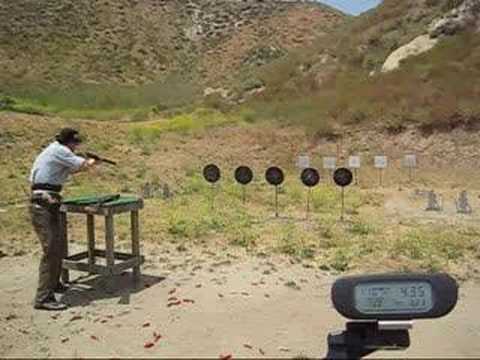
This Wednesday, July 23rd, on the Outdoor Channel, Shooting USA features End of Trail, the Cowboy Action World Championship. Hosted annually at the SASS Founders Ranch in New Mexico, End of Trail attracts nearly 1,000 shooters, hailing from 50 states and many foreign countries. SASS, the Single Action Shooting Society, is one of the most popular shooting organizations on the planet, having issued over 90,000 member badges. For SASS members, End of Trail represents the Superbowl and World Series combined. This special Shooting USA broadcast of the 2013 End of Trail airs at 3:30 PM, 9:00 PM, 12:00 Midnight (Thursday) Eastern Time. This year’s End of Trail took place June 19-29, 2014.

If you like multi-gun competition, you’ll enjoy watching Cowboy Action Matches. The top male and female shooters are experts with three kinds of firearms: Lever Rifle, Single-Action Revolver, and Shotgun (which can be a double-barrel side-by-side, or a pump, or even an 1887 lever-action). The guns must be originals or reproductions made prior to 1898 to be used in competition. A typical stage will require 5 shots from each of two six guns, ten rounds from the rifle, chambered in a pistol caliber, and 6 to 8 shotgun rounds.

24 Rounds from Four Guns in under 13 Seconds
To give you an idea of the action you can see on Shooting USA, here is a video of past world Champion Spencer Hogland, aka “Lead Dispencer”. In this video, Spencer fires 24 rounds, with four guns, in just 12.81 seconds (look at the timer in lower right corner). Spencer shows blazing speed with his lever gun and note how quickly he loads his shotgun. Fast loading is key to a successful stage run. Unlike modern multi-gun comps, normally Cowboy Action Shooters must start with empty shotguns.
July 20th, 2014
Neither rain, nor geese, nor gloom of morn stays these competitors from the [sometimes swift] completion of their appointed rounds.
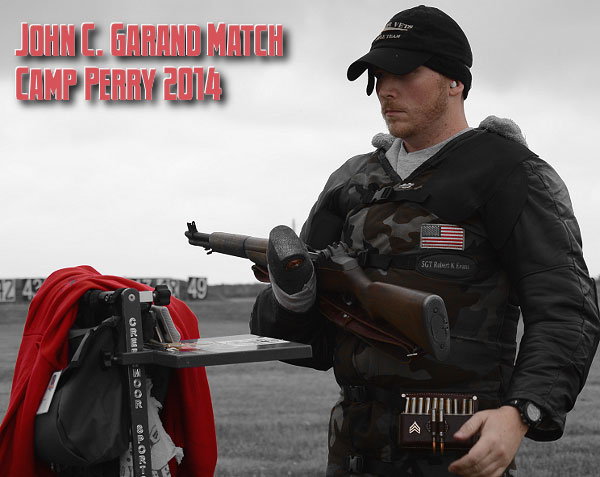
This year’s Camp Perry competitors at the John C. Garand Match had to battle rain, gloomy skies, plus an interruption by a bold flock of Canadian Geese. Nonetheless good fun was had by all. The challenge was to keep the guns and gear (and spectators) dry. All across the firing line one saw tarps and panchos, and even a few umbrellas. The match began on a very dark gloomy morning. Conditions improved during the day, but the rain clouds hovered all day long. CLICK HERE for hundreds more CMP photos from the event.
Wounded warrior Sgt. Robert K. Evans competes at Garand Match.

A flock of geese decided to fly across the firing line… VIEW LARGE PHOTO


It takes many helping hands in the pits to run a big match like this.


Here’s another way to store your gear on the firing line.

Spectators relied on panchos and umbrellas to stay dry.

“Been there, done that — got the T-Shirt.”


That’s all folks… until next year.

July 20th, 2014
Farley Manufacturing has just introduced a new gravity-fed cartridge caddy that puts your rounds right next to your rifle’s loading port. Farley’s new G-Feed Cartridge Elevator has a unique switchback-type feed path that provides high capacity in a compact unit. This unit is handy and fast to use. Farley says that, with a little practice, a skilled benchrest shooter can run five shots in less than 18 seconds. We believe that — provided a shooter has quality rests, a stock that tracks well, and good technique.

The G-Feed Elevator is held up by a 3/4″-diameter spring steel gooseneck (similar to 50s-style lamp support arm). You can easily adjust the gooseneck to the exact height and angle you want. (But Farley recommends at least 10 degrees of “tilt” to ensure proper feeding.)
Made from machined 6061 aluminum, the G-Feed Caddy ranges in price from $125.00 to $160.00 depending on cartridge size. Currently three sizes are offered: PPC, BR/PPC, and .284 Winchester. The BR/PPC model holds 22 rounds of BR cases or 23 rounds of PPC cases. The larger .284 Win model has a 25-cartridge capacity.

Product Tip from EdLongrange. We welcome reader submissions.
July 19th, 2014
 Tyrel Cooper of Creedmoor Sports will be competing at Camp Perry this summer. A past member of the USAMU, Cooper’s shooting resume includes five national championships (one each in 2008, 2011, 2012, and two in 2013). He is the current (2013) NRA National Long Range Champion, and reigning (2013) NRA National Service Rifle Champion. In this article, Cooper offers advice to other competitive shooters. Tyrel Cooper of Creedmoor Sports will be competing at Camp Perry this summer. A past member of the USAMU, Cooper’s shooting resume includes five national championships (one each in 2008, 2011, 2012, and two in 2013). He is the current (2013) NRA National Long Range Champion, and reigning (2013) NRA National Service Rifle Champion. In this article, Cooper offers advice to other competitive shooters.
Below is a 2012 file photo of SSG Ty Cooper shooting a service rifle. Cooper won the 2013 NRA National High Power Rifle Long Range Championships with a final score of 1243-71X. In the Long Range Championships, Cooper used a Nesika-actioned bolt gun with long barrel chambered in 7mm SAUM.

Mental Preparation
by Tyrel Cooper
Getting focused mentally is an important part of preparation for Perry. I have shot two long range team matches and a no-sighter, 50-shot across-the-course match since last Perry — that’s it. So I expect to be a little rusty but at the same time I am preparing myself to win mentally. I am telling myself “I am the 2014 Nation Champion”. Now my goal hasn’t been to be the Service Rifle National Champion; no, my goal the last 4 years has been to be the overall National Champion and do it with a Service Rifle. Now I haven’t achieved that goal and with today’s rifles and calibers it might never happen. The purpose of this goal is to look past a service rifle and go after everyone.
 In 2011 I was chasing Sherri Gallagher, since then I have been chasing Brandon Green and last year almost got him. If I get beat by a Service Rifle I am going to make him or her work for it. So there is your peak into my mental process. I go for the top and if I am hanging with them then the Service Rifle National Championship will come, Kind of like how I shoot for X’s and Tens will come. In 2011 I was chasing Sherri Gallagher, since then I have been chasing Brandon Green and last year almost got him. If I get beat by a Service Rifle I am going to make him or her work for it. So there is your peak into my mental process. I go for the top and if I am hanging with them then the Service Rifle National Championship will come, Kind of like how I shoot for X’s and Tens will come.
Now I understand everyone is at different levels. You have to figure out what your goals are and then lie to yourself that you’ve already achieved them. Here is a trick that I used back in 2008: When I was a kid just starting out, my Dad made me read several books on shooting. One of them being With Winning In Mind by Lanny Bassham. One of the things I remember from his book is that he would make notes and place them where he would see them often. They contained his goals or stated he was already a world champion. I took a page from his book and did the same thing.
I made 3×5 cards and wrote my personal best 500 and 800 aggregate scores and taped on the horn of my truck, above the radio in my truck, on my laptop and a few other places I would see them often. Every time I saw those I would tell myself that I average those scores and I would get used to seeing them. By doing this you are lying to yourself to overcome the mental blocks the subconscious mind lays out for you.
I went from my worst year in 2007 to winning my first National Championship in 2008. I kind of slacked off in 2009 because I had reached my goals and didn’t set new ones and it showed, so I had to find new goals and motivation which I did and that pushed me back to the top.
Long story short, this is a mental sport and you have to figure out what you need to do to perform at your highest levels and breaking through those mental road blocks. You have to figure out how to get yourself to relax and control your mind keeping calm when you are shooting a personal best, either standing or on the day.
Here is a tip from my mental process from shooting. First I shoot for Xs, I took the line from the movie The Patriot and applied it to my shooting, “Aim small, miss small” and it is true. If you accept wide shots then you will keep shooting wide shots.
| Slow, Solid, Smooth, Center
Always focus on the positive and good shots, and what you did physically and mentally, when you shot them. When I am nervous and need to calm myself down I tell myself: slow, solid, smooth, center.
Slow
I want my movement to be slow… I can shoot tens and Xs all day with slow movement.
Solid
Solid like a rock, a rock doesn’t move and that’s how I want my positions. By saying solid it reminds me to go through my little checks to make sure I am doing what I need to do make that happen.
Smooth
Smooth — that is my trigger word for smooth movement. You don’t want fast choppy movement but slow and smooth. This also reminds me to be smooth on the trigger. You can be smooth-fast or you can be smooth-slow but you have to be smooth and most people aren’t when they think they are. Just before leaving the USAMU, I walked up and down the line of five shooters during a rapid fire string and only one of them was smooth with their trigger control. It’s the second most important thing when it comes to shooting.
Center
This reminds me that I want my shots in the middle. It is just a positive reinforcement of where I want my shots to go. I shoot a reverse flat tire so it also kind of reminds me as to what I am looking for. |

Organizing Your Gear
[This year] I have all new gear, a new place, and I am creating a new system. Coming from the Army Marksmanship Unit, I had years to develop and refine my system from my daily routines, to my gear, and to my set-up process. I wanted to share with you a little bit of what I am going through right now.
I went and shot a match at [Fort] Benning a few weekends ago and I had more issues with my gear and system than I did with the act of shooting, it was frustrating and I didn’t like it one bit. So in my preparation for Perry, I took all of my gear apart in my living room and started over. I went through as if I was going to shoot a match; placing gear where I wanted it in or on my Creedmoor Range Cart. There is a lot to be said for having a system and not having to worry about where your gear is or isn’t. Once I got all of my gear in place, I put my new Ron Brown Sling on my rifle and dry fired a little bit. Worked on sitting and prone to figure out what sling notches I would need to use and how my new glove/mitt combination would work. My gear is set and ready to go in my living room, and even though I am not leaving until Sunday, I am setting all the shooting gear and equipment aside to make sure I have everything I need.
If you don’t have a system with your gear where everything has its place or certain spot, then I would suggest you start working on one. When it comes to a match, you don’t want to be searching for something or worrying if it was forgotten at home.
If you have a good system, it allows you to focus on the important things such as how to get your mind in your little bubble, working on what you need to think about to shoot Xs, and thinking about whatever reminders you need to think about to get you to perform at your highest level.
My reminder that I ask myself when I am setting up my gear either in my living room or getting ready to head down range is this: Scope, mat, rifle, stool, jacket, sweatshirt, sling, glove, ammo, mags, data book, and ear plugs. This is the most important stuff that I can’t shoot a match without. I always have extra pens, flags and small stuff in my stool.
Story Tip from EdLongrange. We welcome reader submissions.
|


