|
|
October 26th, 2013
Here’s a great Slide Show featuring images from the recent Western CMP Games at the Ben Avery Shooting Range outside Phoenix, Arizona. CLICK HERE for full match results. This video slide show features photos by Grant Guess and others. How many of your buddies do you recognize in the photos?
Click Arrow at lower left to start slide show (with music):
The Western CMP Games and Creedmoor Cup Matches were held October 11-20, 2013. As usual, the event was well-attended. The CMP Games featured the Small Arms Firing School, M16 Match, four Garand/Springfield/Vintage Military matches and the New Modern Military match. Other matches include a Carbine Match, a Rimfire Sporter Match, and the popular Vintage Sniper Match. The Creedmoor Cup events included a High Power Rifle Clinic, Creedmoor Cup (2400 point aggregate) Match, 4-Man Team Match, and Creedmoor EIC Match.
Western CMP Games Complete Match Results | 2013 Western CMP Games Program

October 25th, 2013
The pessimist complains about the wind; the optimist expects it to change; the realist adjusts the sails.” — William Arthur Ward
 Readers often ask us: “Is there a decent, easy-to-comprehend book that can help my wind-reading?” Many of our Forum members have recommended The Wind Book for Rifle Shooters by Linda Miller and Keith Cunningham. This 146-page book, published in 2007, is a very informative resource. But you don’t have to take our word for it. If you click this link, you can read book excerpts and decide for yourself. When the Amazon page opens, simply click the book cover (labeled “Look Inside”) and another screen will appear. This lets you preview the first few chapters, and see some illustrations. Readers often ask us: “Is there a decent, easy-to-comprehend book that can help my wind-reading?” Many of our Forum members have recommended The Wind Book for Rifle Shooters by Linda Miller and Keith Cunningham. This 146-page book, published in 2007, is a very informative resource. But you don’t have to take our word for it. If you click this link, you can read book excerpts and decide for yourself. When the Amazon page opens, simply click the book cover (labeled “Look Inside”) and another screen will appear. This lets you preview the first few chapters, and see some illustrations.
Other books cover wind reading in a broader discussion of ballistics or long-range shooting, such as Applied Ballistics for Long-Range Shooting by Bryan Litz. But the Miller & Cunningham book is ALL about wind reading from cover to cover, and that is its strength. The book focuses on real world skills that can help you accurately gauge wind angle, wind velocity, and wind cycles.
All other factors being equal, it is your ability to read the wind that will make the most difference in your shooting accuracy. The better you understand the behavior of the wind, the better you will understand the behavior of your bullet. — Wind Book for Rifle Shooters
|
The Wind Book for Rifle Shooters contains straightforward guidance on the thought processes, techniques, and tactics used by expert wind-readers. The written text is supplemented by numerous easy-to-understand charts and illustrations. The authors show you how to put together a simple wind-reading “toolbox” for calculating wind speed, direction, deflection and drift. Then they explain how to use these tools to read flags and mirage, record and interpret your observations, and time your shots to compensate for wind. The essential wind-reading basics taught in this book can definitely help any shooter. Here are some reviews from actual book buyers:
I believe this is a must-have book if you are a long-range sport shooter. I compete in F-Class Open and when I first purchased this book and read it from cover to cover, it helped me understand wind reading and making accurate scope corrections. Buy this book, read it, put into practice what it tells you, you will not be disappointed. — P. Janzso
If you have one book for wind reading, this should be it. Whether you’re a novice or experienced wind shooter this book has something for you. It covers how to get wind speed and direction from flags, mirage, and natural phenomenon. The book also details methods for recording shots and improving your shooting and thus your wind reading skills. In my opinion this is the best book for learning to read wind speed and direction. — Muddler
I found this book to be something I have needed for quite a while. I have been shooting Long Range for 20 years and always had problems with the wind. I would just chase the spotter. This book makes it all make sense. — L. Cash
As far as I know this is the only book of its type. It’s very well written in a way that’s easy to understand for such a complex subject. The charts and graphs are extremely helpful. It’s a bit on the short side at about 146 pages but still packed with knowledge. — R. Johnson |
|

October 25th, 2013
 We expect you’ve heard of David Tubb, 11-time NRA National High Power Champion. Without question, David is one of the greatest rifle shooters who ever lived. What you may not know is that David came from a family of shooters. David’s father, George Tubb, was a nationally-ranked High Power competitor. What’s more (now this may surprise you), David’s mother “Polly” was was a great shooter in her own right. When she wasn’t rearing a future Champion, Polly was hitting the X-Ring at rifle matches. We expect you’ve heard of David Tubb, 11-time NRA National High Power Champion. Without question, David is one of the greatest rifle shooters who ever lived. What you may not know is that David came from a family of shooters. David’s father, George Tubb, was a nationally-ranked High Power competitor. What’s more (now this may surprise you), David’s mother “Polly” was was a great shooter in her own right. When she wasn’t rearing a future Champion, Polly was hitting the X-Ring at rifle matches.
Pauline (“Polly”) S. Tubb of Canadian, Texas, earned several rifle championships during the course of her shooting career. In this photo, Polly took a moment to appear for a photo after winning the 1962 National Woman’s Bolt Rifle championship at Camp Perry. One shooter who competed against Polly observed: “I was there as a 1962 Pennsylvania State Team junior! I remember Polly. She beat some of the best Army and Marine shooters and always did it with style and good humor.”
Now that’s our kind of gal. God Bless you Polly. Thanks for being a Leading Lady of our sport.

Archive photo courtesy Civilian Marksmanship Program, TheCMP.org.
October 22nd, 2013

F-Class competition will be featured on this week’s episode of Shooting USA television. This week, Shooting USA takes an inside look at the rapidly-growing sport of F-Class shooting, with coverage of both F-TR and F-Open competition at 600 yards and beyond. This show will air three times on Wednesday, October 23rd, on the Outdoor Channel (see air times by region below). This episode will also feature the historic 1907 Winchester, a choice of gangsters in the 1920s.
 The Shooting USA Hour on Wednesdays: The Shooting USA Hour on Wednesdays:
AIR TIMES BY TIME ZONE
Eastern Time 3:30 PM, 8:30 PM, 12:00 Midnight
Central Time 2:30 PM, 7:30 PM, 11:00 AM
Mountain Time 1:30 PM, 6:30 PM, 10:00 PM
Pacific Time 12:30 PM, 5:30 PM, 9:00 PM
F-Class Basics
The ‘F’ in F-Class stands for Farquharson. Canadian George Farquharson is credited with founding the sport in the 1990s. Farquharson wanted to create a discipline for fellow older shooters whose fading eyesight made it difficult to compete in traditional iron-sight high power matches. In 2007, the United States NRA officially recognized the prone shooting disciple. Since then the sport has grown rapidly. Over 350 shooters attended the 2013 F-Class Nationals in Raton, NM.
F-Class is similar to High Power rifle shooting, with competitors taking turns in the pits, pulling and scoring targets. Unlike conventional High Power shooting with iron sights, F-Class shooters use scopes (with up to 80x max power, though the most popular scope is still probably the 12-42x56mm Nightforce Benchrest).
All F-Class competition is shot prone. Competitors are classified into two divisions, F-TR (Target Rifle) and F-Open. F-TR rifles must be shot from bipod, and must be chambered for either the .223 Rem or .308 Win cartridges. Max F-TR gun weight is approximately 18.18 pounds, including bipod. In the F-Open division, rifles can weigh up to 10 kg (22 pounds) and front rests can be used (but you may shoot from a bipod if you wish). F-Open competitors may shoot any cartridge which is .35 caliber or under.
October 21st, 2013
Here’s a feel-good story about a talented young shooter.
Article based on report by Lars Dalseide, for NRA Blog.

Finding the X-Ring while taking part in NRA’s National Rifle and Pistol Championships can be challenging enough. Finding the X-Ring from three positions during the smallbore rifle phase of the championships can be even more trying. But Amy Fister, winner of this year’s NRA 3-Position Rifle High Woman title, found it with no trouble at all. A surprising result given her wry self-description.
“I’m a nerd,” she said with a laugh. “I’m very dedicated to my studies.”
Based out of Kutztown, Pennsylvania, Fister walked away from the 3-Position Awards Ceremony with three titles: High Woman with Metallic Sights, High Civilian with Metallic Sights, and High Woman Overall. Fister finished with a score of 2374 – 140X (good for 7th overall). “Last year I was close but not close enough,” said Fister. “I guess this year it was my time.” Seeing her on stage, winning award after award, it’s hard to believe that it almost didn’t happen — she nearly fell victim to the summer heat at Camp Perry.
Fighting Dehydration at Camp Perry
About halfway through the National Championship match, Fister was setting up targets when she realized something was wrong: “I was delusional, seeing things,” Fister explained. “After setting up my target, it wasn’t there. I started chasing down the target guy for another one. It was an interesting and a little bit scary of an experience.”
She was dehydrated. Heartbeat rapid, extremely lethargic, unsteady on her feet — she recognized the signs and started back for the line. Pulling a bottle of Gatorade out of her bag, she gulped until it emptied. Feeling a touch steadier, she made for the water coolers behind the line. A few cups later and she was ready to proceed. “Luckily it happened during prone,” she said with a laugh. “Standing would have been a different story.”
How a Nerd Became a World-Class Rifle Shooter
Starting as far back as she can remember, Fister was out shooting with her dad. First as the official gear porter, then as a huntress. “Deer and goose, that’s what we went for,” she said. “I go out deer hunting whenever I can, but it cuts into my shooting time. You’ve got to find a happy medium.”
 Though it was dad who first put a rifle in her hand, it was her sister Valerie who started her down the competitive trail. Like most stories of sibling rivalry, big sister joined the rifle team so little sister (Amy) wanted to also. A little practice, a little patience, and it all came together — so well in fact that Amy has earned a shooting scholarship to the University of Memphis. But her ambitions don’t stop there. They reach as far as Rio de Janeiro, site of the 2016 Olympics. Though it was dad who first put a rifle in her hand, it was her sister Valerie who started her down the competitive trail. Like most stories of sibling rivalry, big sister joined the rifle team so little sister (Amy) wanted to also. A little practice, a little patience, and it all came together — so well in fact that Amy has earned a shooting scholarship to the University of Memphis. But her ambitions don’t stop there. They reach as far as Rio de Janeiro, site of the 2016 Olympics.
“I missed a spot on the U.S. Team by two points. Now the goal is to be part of the Olympic Rifle Team in 2016. Problem is that I don’t want my scores to drop and I don’t want my grades to drop.
“My goal is to become a pediatrician and an Olympian. Guess I’ll just find a way.”
To learn more about the NRA’s Competitive Shooting Programs, visit compete.nra.org.
October 18th, 2013
The National Benchrest Shooters Association (NBRSA) has adopted new rules, loosening restrictions on the Sporter Class of benchrest rifles. Now a Sporter fore-arm may be any width (or angle), and the underside of the buttstock can have any angle. Previously, fore-arm width was limited to three inches, and the bottom of the buttstock had to be angled up. (NBRSA Rules will continue to require this “up-angle” geometry for all Light Varmint (LV) and Heavy Varmint (HV) rifles). In addition, the NBRSA opened the Sporter Class to any caliber “no larger than .308 Winchester”.
The idea behind these changes is to allow greater innovation in at least one class of benchrest bag guns, and to avoid “redundancy”. Currently a 10.5-lb Light Varmint can be shot as a Sporter, so long as the LV complies with caliber rules. For practical purposes, that meant Sporter Class was redundant with the Light Varmint Class, and there was no real reason for the Sporter Class to exist anymore.
The Sporter weight limit remains unchanged at 10.5 pounds (including optics). All current LV and Sporter rifles will remain 100% legal under the new rule, so no one is forced to go out and build a new rifle to shoot in Sporter class. But if you want to try a more radical stock design, now you have the opportunity to do so. Here is the text of the new rule:
NBRSA Rule Book (New Sporter Rule)
B. Definitions: 2. Equipment (d) Sporter Rifle
A Sporter Rifle is defined as any rifle having a safe manually and mechanically operated firing Mechanism and must not weigh more than 10.5 lbs, inclusive of sights. The stock can be flat, or convex, but not concave. The Forearm can be any width and have any angle. The butt stock can have any angle including a reverse angle, the barrel shall not be less that 18″ long forward of the bolt face and can be any diameter or configuration including a straight taper or a reverse taper. The Sporter Rifle can be no larger than .308 Winchester. Sporter Rifles do not have to conform to the Varmint Rifles diagram. All sand bag rules apply to the Sporter Rifle.
View NBRSA Rule Book (Includes New Sporter Definition) PDF
| Bukys Explains the Thinking Behind the Sporter Rule Change
 On Benchrest Central, leading benchrest shooter Gene Bukys discussed the new NBRSA Sporter Rule Changes: “[This] does not create a new rifle or an experimental class — it simply removes most of the restrictive rules from the existing Sporter class. Every existing LV rifle and every existing Sporter Rifle in this whole world is still legal, and competitive, under these changes. On Benchrest Central, leading benchrest shooter Gene Bukys discussed the new NBRSA Sporter Rule Changes: “[This] does not create a new rifle or an experimental class — it simply removes most of the restrictive rules from the existing Sporter class. Every existing LV rifle and every existing Sporter Rifle in this whole world is still legal, and competitive, under these changes.
My purpose in all of this is to make the Sporter class, and the LV rifle, no longer redundant classes, and to have a class where we can have some innovation in Benchrest. If there is a better stock configuration out there or a better barrel profile shouldn’t we benchrest shooters be the leading edge of this innovation? Benchrest used to be the leading edge of virtually all accuracy innovation. I’m not sure if that’s true anymore. I would like that to be… true again.
For right now, I don’t see this as making any huge radical changes to benchrest, but given time and a venue to work in (Sporter Class) there may be some really meaningful innovation that comes about. Let’s have some fun with this.” |
Gene Bukys Commissions New Convertible Sporter/LV Stock by Bob Scoville
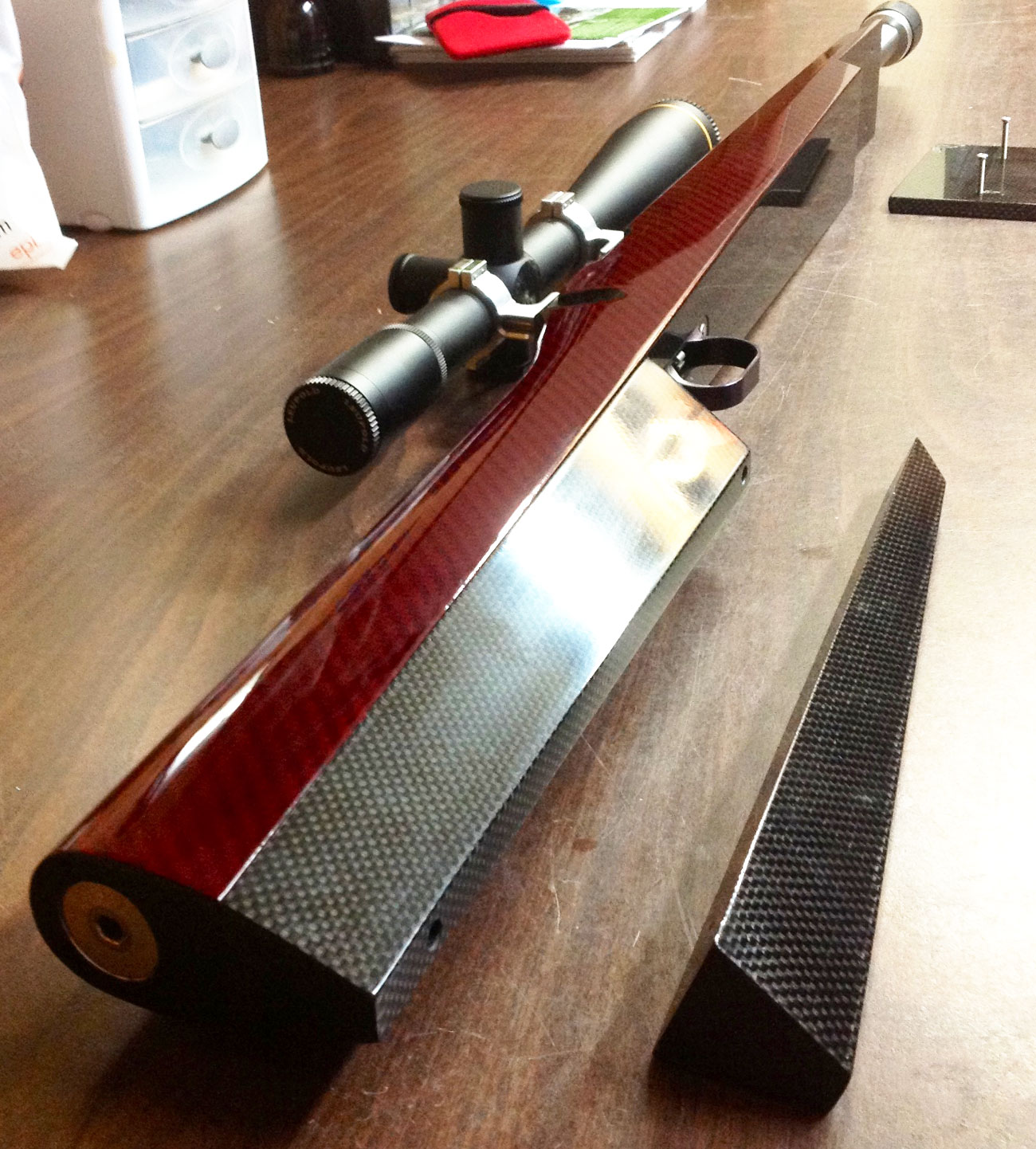
Under the new NBRSA Sporter standards, stock designers/fabricators can now experiment with a wider variety of stock shapes and geometry. Gene Bukys commissioned a new stock from Bob Scoville that shows what can be done under the new liberalized Sporter stock rules.
Gene’s latest NBRSA Sporter rifle features a stepped forearm that can fit a 5-inch wide bag rider plate. In the rear, this stock can run different size/shape “keels” (buttstock underbellies). The larger keel, shown attached in the photos, exhibits the flatter angle now allowed under the new NBRSA Sporter rule. (In fact, this keel may have a slight reverse angle, i.e. lower in the front than in the back). At any time, this Scoville stock can be switched back to a 100%-legal Light Varmint configuration by: 1) removing the 5″ front bag-rider plate; and 2) changing to the smaller, up-angled rear keel piece.
CLICK Photos to View Full-Screen Version


Photos and Links provided by Pascal Fischbach.
October 18th, 2013
About 24 miles east of Oceanside, California (near the Camp Pendleton Marine base) is the Pala Reservation. On that Native American land you’ll find a Casino Resort, plus an excellent shooting range. Each month, shooters come to Pala for the Varmint Silhouette Match hosted by the North County Shootist Association. Normally the match is held on the first Sunday of the month. But this October, the match will be held Sunday, October 20th. Matches start around 9:00 am and finish around noon.

Course of Fire: Five Yardages, 50 Critters
At five different yardages, ten steel “critter” targets are set as follows: 200 Meters – Field Mice (“pikas”); 300 meters – Crows; 385 meters – Ground Squirrels; 500 meters – Jack Rabbits; 600 yards – Prairie Dogs. The folks at Pala run a tight ship, cycling multiple relays efficiently, so everybody gets to shoot 50 targets (10 each at five different yardages), and the show is usually completed by 1:00 pm. A one-hour sight-in period starts at 8:00 am, and the match starts at 9:00 am sharp. Newcomers should definitely arrive no later than 7:45 am, because you may need the full sight-in period to get good zeros at all five yardages. CLICK HERE for full match INFO.

What to bring to Pala
 You’ll need an accurate rifle, plus at least 80 rounds of ammo (bring 100 rounds if you have no idea about your come-ups at these distances). You can shoot either rested prone (F-Class style), from bipod, or from a portable bench with front pedestal and rear bag. Most guys shoot from benches. Any rifle 6.5 caliber or under is allowed (max bullet weight is 107 grains). With no weight restrictions, any good varmint rifle, bench gun, or F-Class rifle can be competitive. Muzzle brakes are permitted. Spotter assistants are allowed, so bring a friend along — he/she can shoot in a different relay. Bring cleaning gear if your rifle can’t run 80+ rounds without losing accuracy. Pastry snacks are often provided, but bring water, and a lunch. You’ll spend some time in the sun helping to set targets, so bring a hat, sunglasses, and sunscreen. You’ll need an accurate rifle, plus at least 80 rounds of ammo (bring 100 rounds if you have no idea about your come-ups at these distances). You can shoot either rested prone (F-Class style), from bipod, or from a portable bench with front pedestal and rear bag. Most guys shoot from benches. Any rifle 6.5 caliber or under is allowed (max bullet weight is 107 grains). With no weight restrictions, any good varmint rifle, bench gun, or F-Class rifle can be competitive. Muzzle brakes are permitted. Spotter assistants are allowed, so bring a friend along — he/she can shoot in a different relay. Bring cleaning gear if your rifle can’t run 80+ rounds without losing accuracy. Pastry snacks are often provided, but bring water, and a lunch. You’ll spend some time in the sun helping to set targets, so bring a hat, sunglasses, and sunscreen.
Fun Weekend for the Whole Family
 There is a deluxe Indian Casino/Spa a half-mile from the range. So don’t hesitate to bring the wife. If she’s not a shooter, she can enjoy a fancy brunch or spa treatment while you’re having fun mowing down metal critters. Pala is a 30 minutes from the Pacific Ocean and beautiful beaches, so you can make this a weekend holiday for the whole family — kids love sand and surf. There is a deluxe Indian Casino/Spa a half-mile from the range. So don’t hesitate to bring the wife. If she’s not a shooter, she can enjoy a fancy brunch or spa treatment while you’re having fun mowing down metal critters. Pala is a 30 minutes from the Pacific Ocean and beautiful beaches, so you can make this a weekend holiday for the whole family — kids love sand and surf.
October 14th, 2013
We like to recognize outstanding shooting accomplishments — this example by one of our Forum members from across the border in Canada. In a regional F-Class match, Gordon Ogg (aka ‘Ont001′) shot a 100-16V, which is believed the highest score shot in a match of this type in Canada. Gord hit all Fives for a perfect 100-point, 20-shot string of fire, with 16 in the V-Ring, the equivalent of the X-Ring in the USA. (A FIVE in Canadian scoring is the equivalent of a TEN in USA scoring.) Here is a photo of the official score card and one of the 3″-diameter Shot Indicators.

In our Shooters’ Forum, Gord Ogg explained how the 100-16V was accomplished:
I was shooting 7mm WSM ammo I had left-over from the U.S. Nationals and F-Class World Championships. The rifle proved it still had life left in it — it continued to make me look good. My first relay went well, with a 99-15V. On the second match, it was working very well and I had not realized ’til after the last shot and Jim, my scorekeeper, gave me the total, did I actually think it could actually be a record. All I can say is… it felt GOOD.
Due to predicted thunderstorms for the afternoon, the match director changed the course of fire from [three matches], to two [20-shot] matches. First match was unlimited sighters and 20 on score and the second was 2 and 20 in string fire. As the weather did continue to deteriorate, it was a wise decision, as we would not have made it through all three matches.
Is This a New Canadian Record?
Though Gord’s fellow shooters believe this was a “best-ever” F-Open performance in Canada, it does not appear to be one for the record-books. Gord tells us: “As the Mons Range Championship was a DCRA/ORA sanctioned match in Canada, and our National body does not have a ‘records’ section to compare for a Canadian F-Open record, at best it can be considered a Mons Championship Match record of sorts.” Still, Gord’s 100-16V (the equivalent of a 200-16X under USA scoring) is an impressive feat. The current United States NRA F-Open Record for 20 shots at 1000 yards is 200-15X which is shared by a number of people but first set by Danny Biggs.
October 13th, 2013
 Get Official Targets, Target Centers, Pasters, Pit Supplies, and Training Targets Get Official Targets, Target Centers, Pasters, Pit Supplies, and Training Targets
Looking for training targets, competition targets, or fun targets? Well Creedmoor Sports has what you need for NRA smallbore and centerfire competition (including target pasters). Creedmoor has the official targets for most popular NRA disciplines along with the “Target Repair Centers” (Bullseye overlays that save money compared to full-size targets). In stock now are official F-Class targets, High Power rifle targets, smallbore targets, pistol targets, and air rifle targets. Creedmoor also now carries Birchwood Casey Shoot-N-C targets and Hi-Viz Orange Target Spots®. When practicing with scoped rifles, we use the 1″ Target Spots at 200 yards, and the 3″ Target Spots at 600.
October 7th, 2013
 Yes old dogs can learn new tricks. Just five years ago Forum member Henry Pasquet (aka “HenryP”) got started in 1000-yard benchrest shooting. He was 66 at the time. Henry worked hard, learned fast, and pursued accuracy with a vengence. That all paid off when Henry won the 2013 IBS 1000-yard Nationals this summer, finishing as the Two-Gun Overall National Champion. Henry was kind enough to talk about his rifle, his reloading methods, and his strategy for success. In fact, Henry was eager to share “everything he knows, so that other guys can fast-track their learning process”. Henry told us: “I want to share every lesson I’ve learned, so that other guys can improve their game and enjoy the sport more.” Henry also wants to encourage other senior shooters: “If you pay attention to details (when reloading), and get a good rifle with a good barrel, age is not a handicap. With a good set-up, older guys can compete with anyone out there. This is one sport where you can be a champion in later life.” Yes old dogs can learn new tricks. Just five years ago Forum member Henry Pasquet (aka “HenryP”) got started in 1000-yard benchrest shooting. He was 66 at the time. Henry worked hard, learned fast, and pursued accuracy with a vengence. That all paid off when Henry won the 2013 IBS 1000-yard Nationals this summer, finishing as the Two-Gun Overall National Champion. Henry was kind enough to talk about his rifle, his reloading methods, and his strategy for success. In fact, Henry was eager to share “everything he knows, so that other guys can fast-track their learning process”. Henry told us: “I want to share every lesson I’ve learned, so that other guys can improve their game and enjoy the sport more.” Henry also wants to encourage other senior shooters: “If you pay attention to details (when reloading), and get a good rifle with a good barrel, age is not a handicap. With a good set-up, older guys can compete with anyone out there. This is one sport where you can be a champion in later life.”
Click on Rifle Photos to View Full-screen Versions

Q&A with Henry Pasquet, IBS 1000-Yard National Champion
Q: First, do you have any advice for older shooters getting started in their golden years?
Henry: You’re never too old. In this sport, you can excel even in your 60s, 70s and beyond. At this stage in life, we now have the time and money to get good equipment and rifles. Plus, our years of work experience help us to think, analyze, and thereby make progress. In this game, we older guys can definitely compete on a par with younger shooters.
HARDWARE
Q: Tell us about your Nationals-winning rifle and bench gear. Is there anything unique about your hardware that gave you an edge?
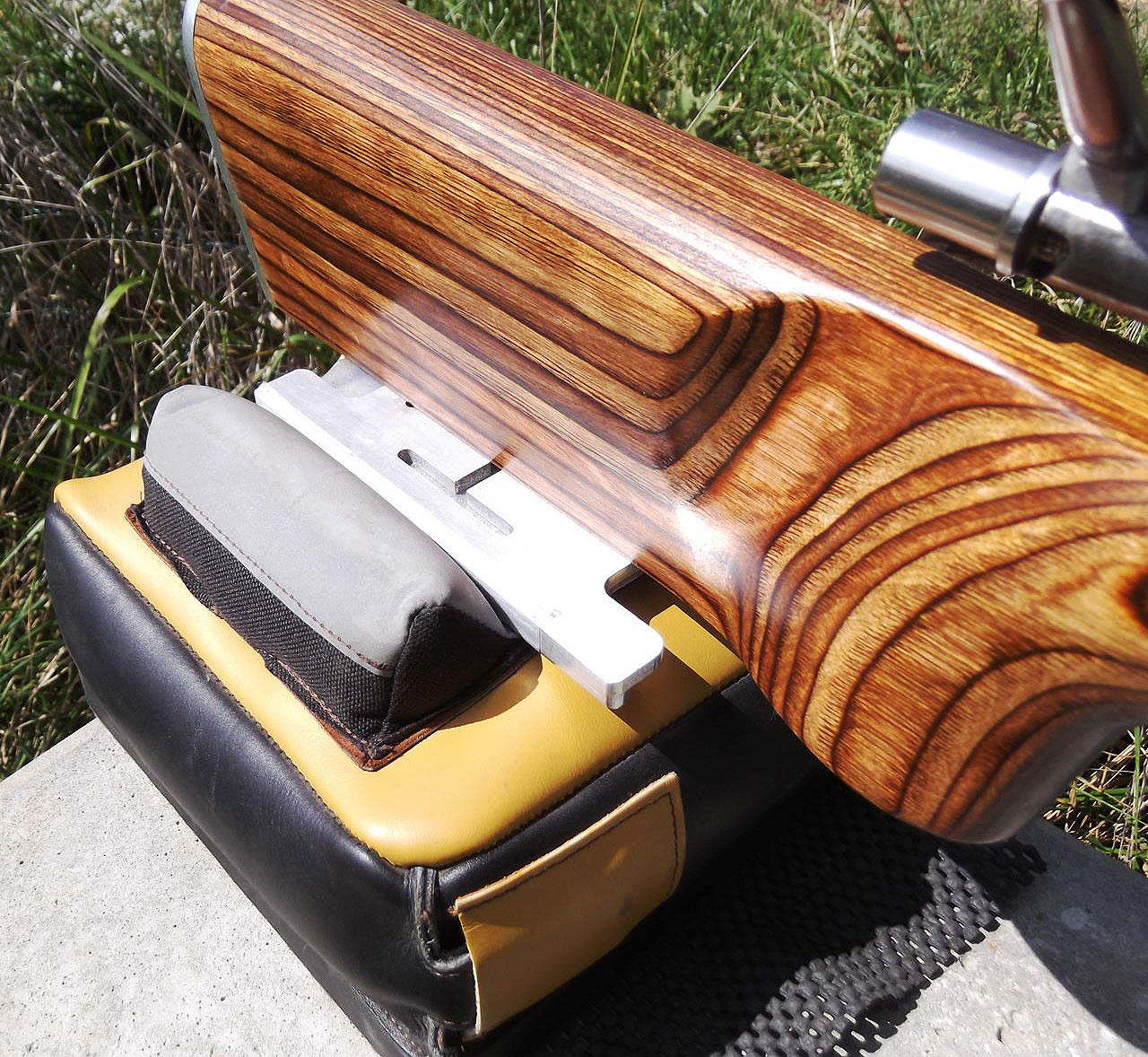
Henry: At the Nationals, I used my 17-lb Light Gun for both Light and Heavy Class. This rifle has a 1.55″, round BAT LP/RE action, fitted with a Bartlein barrel chambered for the .284 Shehane (an improved version of the .284 Winchester). The barrel was near-new; this was the first time I had used it this year. A great barrel and great batch of Berger 180gr VLDs all made a difference. Jay Cutright chambers my barrels. Jay’s metal-work is so precise that I can screw any barrel he’s chambered to any BAT action I own. The laminated stock was modified by Tommy Shurley from a standard 3″-wide fore-end to a 5″-wide True-Trac with an adjustable 3″-wide rear plate. It’s not pretty but it tracks like a Heavy Gun stock. Tommy made my other stocks as well.

 On top is a Nightforce 12-42x52mm Benchrest scope with CH-3 reticle. I used a Fulghum (Randolph Machine) front rest with an Edgewood bag made with the low-friction 3M material. In the rear I use a special-order Protekor rear “Doctor” bag with ears spaced 3 inches apart. The rear bag also has the new 3M material on contact surfaces (photo at right). On top is a Nightforce 12-42x52mm Benchrest scope with CH-3 reticle. I used a Fulghum (Randolph Machine) front rest with an Edgewood bag made with the low-friction 3M material. In the rear I use a special-order Protekor rear “Doctor” bag with ears spaced 3 inches apart. The rear bag also has the new 3M material on contact surfaces (photo at right).
Q: During the Nationals, at the last minute you switched guns. Why did you go from a 6mm Dasher to a 7mm Shehane?
Henry: I had planned to use my Light and Heavy Dashers, but after placing the Dasher on the ready line, decided to switch to the .284 Shehane. It was still early in the morning and I felt that the heavier bullets would be easier to see against the berm. The Dasher had actually been giving tighter groups under perfect conditions, but seeing the impact is important.
Q: Tell us about the combined tuner/muzzle brake on some of your barrels. How does this improve rifle performance and how do you set the “tune”? Do you tune the barrel to the load?
Henry: I use a tuner or tuner/brake on every barrel. I started with Time Precision tuners. Art Cocchia advised getting a load with a good known accuracy node with minimum extreme spread, which controls vertical. Do not go for the hottest loads, which just reduces brass life. Then use the tuner and tune the barrel to the load. The .284 Light Gun needed a muzzle brake and tuner. I had a local gunsmith cut a thread on the muzzle brake for a tuner I got from Sid Goodling. (Eric Bostrom developed an almost identical unit at the same time. I use Eric’s tuner/brakes on all my new barrels.) Just before Nationals, I tried going up and down one marker. Down one mark cut the group in half! Think how much range time (and barrel life) that saved me. Using a tuner is easier than messing around changing loads and tweaking seating depths. Tuners definitely can work. Last year I shot a 3.348″ 10-shot group at 1000 with my .284 Win Heavy Gun fitted with a Time Precision Tuner.

Q: What are the advantages of your stock’s 5″-wide fore-end and 3″-wide rear plate? Is there a big difference in tracking and/or stability? Does the extra width make the rifle easier to shoot?
Henry: I had true Heavy Guns with 5-inch fronts and 3-inch rears. They tracked well. I felt the same result could be had with a Light Gun. I talked two stock makers into making them. I initially had the standard rear stock until Tommy Shurley and Mike Hearn came out with an adjustable rear plate. The stocks track perfectly. You can see your scope’s crosshairs stay on the target the whole time and push the rifle back for the next shot. There is no torquing (gun wobbling) when cycling the bolt. Us old guys need all the help we can get. I am getting rid of my 45-pound Heavy Guns and replacing them with Light Guns with heavy barrels.

Q: Some people say the .284 Shehane is not as accurate as the straight .284 Winchester. You’ve proved them wrong. Why do you like the .284 Shehane? More speed, less pressure?
Henry: The reason I rechambered my 7mm barrels to .284 Shehane was not velocity, pressure, or brass life. It was all about bolt lift. My straight .284 almost required me to stand up to eject brass. I damaged an extractor and had to send the bolt back to BAT. With the .284 Shehane, my bolt cycles like there is no case to eject.
Reloading Methods
Q: People want to know about your load and your loading methods. What can you reveal?
Henry: For my .284 Shehane at the Nationals, I loaded 52.5 grains of Hodgdon H4350 and Federal BR-2 primers behind Berger 180gr VLDs. I usually anneal the brass each winter. I have used the same brass for years. I use Redding bushing dies, apply Imperial sizing wax, resize, wipe off wax, clean and uniform the primers pockets using the RCBS Trim Mate Case prep center, then apply Imperial dry neck lube with a bore mop.
 To dispense powder, I use a RCBS ChargeMaster set 0.1 grain below my desired load and then weigh them on a Sartorius GD-503 magnetic force restoration scale to get identical charges. I use a K&M Arbor Press with seating force gauge when seating the bullets with a Wilson inline die. My “target” seating force on the K&M dial is 20-23 units for Dashers and 35-40 units for the .284 Shehane. I put any variables aside for sighters. I do not weigh brass, bullets, or primers. My bullets were so consistent that I did not sort by bearing surface. I did trim the Berger VLDs to the shortest bullet length with a Hoover Trimmer, and then pointed the meplats just enough to close them with a Whidden pointer. I sort my bullets to 0.005″ overall length, rejecting about five percent. To dispense powder, I use a RCBS ChargeMaster set 0.1 grain below my desired load and then weigh them on a Sartorius GD-503 magnetic force restoration scale to get identical charges. I use a K&M Arbor Press with seating force gauge when seating the bullets with a Wilson inline die. My “target” seating force on the K&M dial is 20-23 units for Dashers and 35-40 units for the .284 Shehane. I put any variables aside for sighters. I do not weigh brass, bullets, or primers. My bullets were so consistent that I did not sort by bearing surface. I did trim the Berger VLDs to the shortest bullet length with a Hoover Trimmer, and then pointed the meplats just enough to close them with a Whidden pointer. I sort my bullets to 0.005″ overall length, rejecting about five percent.
Q: What kind of precision are you looking for in your reloads? Do you trickle to the kernel? Does this really help reduce extreme spread?
Henry: I try to keep my charge weights consistent to one kernel of powder. I use the Omega powder trickler with a Sartorius GD-503 lab-grade balance to achieve that. For accurate dispensing, put very little powder into the Omega so you can drop one kernel at a time. Single digit ES (Extreme Spread) is the goal. This does make a difference at 1000 yards. If you get the same push on the same bullet with the same neck tension, good things are going to happen.
Q: You believe consistent neck tension (i.e. grip on the bullet) is really important. What methods are you using to ensure consistent bullet release?
Henry: I apply Imperial dry neck lube to the inside of my case-necks with a bore mop. The K&M arbor with seating force gauge shows the need to do this. If you put a bullet into a clean case, it will be jerky when seating the bullet. You may see 40 units (on the K&M dial) dropping to 20, then slowly increasing pressure. I explained to a friend that not lubing the neck is like overhauling an engine without lubing the cylinders. Smooth entry gives the bullets a smooth release.
Barrel Cleaning
 Q: You go 60-80 rounds between cleaning and the results speak for themselves. What is your barrel cleaning procedure? Do you think some guys clean too often or too aggressively? Q: You go 60-80 rounds between cleaning and the results speak for themselves. What is your barrel cleaning procedure? Do you think some guys clean too often or too aggressively?
Henry: I cringe when I see people wearing out their barrels with bronze brushes between relays. I clean my barrels at the end of each day when I get home. I shot my best-ever 1K Heavy Gun group (3.348″) at day’s end after 60 to 80 rounds. After trying other solvents, I have gone back to Wipe-out’s Carb-Out and Patch-Out products. I use about four patches of Carb-Out, let it sit a few minutes, then use one stroke of a nylon brush followed by Patch-Out until the barrel is clean. I use a bore mop to clean inside the chamber, then some Break Free LP on the bolt followed by bolt grease on the lugs and cocking part. I use a bore guide when anything goes down the barrel.
Shooting Skills and the Learning Process
Q: Henry, you can shoot long-distance on your own property in Missouri. How important is practice, and what do you do during a typical practice session?
Henry: I can shoot 1000 yards on my farm. I have a concrete bench using a slab from a yard furniture place on concrete blocks. Two 4 x 8 sheets of plywood hold four IBS targets. I never practice. I only test, keeping a notebook with all the info. I do most of my testing at 300 to 500 yards, shooting off my deck so I can see my shots immediately.

Q: How much of your success do you credit to really accurate rifles, versus superior shooting skills?
Henry: I do not consider myself another Carlos Hathcock or some master marksman. I am an average 1000-yard shooter, but I do work hard getting the most out of my rifles. Four other people have shot their first 1000-yard matches with my rifles, including my wife, and all of them won relays! I loaned my Dasher to another shooter two years ago and he got second at the 600-yard Nationals. Others will tell you that the rifle must be “on” to win. If your barrel or bullets are average, don’t expect to perform above average in competition.
Q: What you do enjoy most about long-range benchrest shooting? What are the attractions of this sport?
Henry: The sport offers good people and a real challenge. 1000-yard shooting keeps us all humble, but we still keep trying to see how good we can do. I am thankful for Robert Ross providing the only match location that I can shoot regularly.
Q: Henry, you have been a Forum member for many years. Have you learned important techniques from other Forum members and other shooters?
Henry: I have followed the AccurateShooter Forum since 2008. At my age I am not good at computers. I copied and analyzed many articles, especially on the .284 and the Dashers. Without AccurateShooter.com, I would probably still be shooting double-digit (10″+) groups at 1000 yards, and I sure wouldn’t have my name on a National Championship trophy.
Q: You are in your 70s now and have only been shooting competitively for a few years. How did you get so good so fast? How did you manage to beat shooters who are decades younger?
Henry: I had 20/10 vision when I was young, but am down to only 20/20. I have been interested in long range shooting for a long time including ground hog hunting. I went to some VHA jamborees also. In 2008, I went to the Williamsport Benchrest School with a friend from Pennsylvania, John Haas. We would compare notes frequently. I bought a BAT three lug from Tom Mousel in Montana. We also compared notes and made each other better. At IBS matches I studied other shooters’ equipment and techniques. I tried some, accepting some and rejecting some.
Here’s my advice:
Always be ready to learn something new. If it makes sense, try it. I would also encourage other older shooters not to quit. Stick to it. You can make enormous progress in a few seasons.

|