|
|
March 29th, 2012
Three-gun match competitor Zak Smith employs a simple, handy means to store his elevation and wind dift data — a laminated data card. To make one, first generate a come-up table, using one of the free online ballistics programs such as JBM Ballistics. You can also put the information in an Excel spreadsheet or MS Word table and print it out. You want to keep it pretty small.
Below is a sample of a data card. For each distance, the card includes drop in inches, drop in MOA, drop in mils. It also shows drift for a 10-mph cross wind, expressed three ways–inches, MOA, and mils. Zak explained that “to save space… I printed data every 50 yards. For an actual data-card, I recommend printing data every 20 or 25 yards.” But Zak also advised that you’ll want to customize the card format to keep things simple: “The sample card has multiple sets of data to be more universal. But if you make your own data card, you can reduce the chance of a mistake by keeping it simple. Because I use scopes with MILS, my own card (photo below left) just has three items: range, wind, drop in MILS only.”
 
Once you have the card you can fold it in half and then have it laminated at a local office store or Kinko’s. You can keep this in your pocket, tape it to your stock, or tie the laminated card to your rifle. If you regularly shoot at both low and high elevations, you may want to create multiple cards (since your ballistics change with altitude). To learn more about ballistic tables and data cards, check out the excellent “Practical Long-Range Rifle Shooting–Part 1″ article on Zak’s website. This article offers many other insights as well–including valuable tips on caliber and rifle selection.
Scope-Cover Mounted Ballistics Table
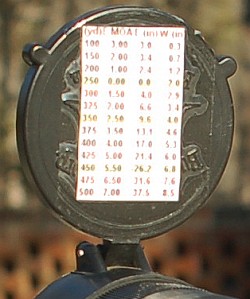 Another option is to place your ballistics card on the back of the front flip-up scope cover. This set-up is used by Forum member Greg C. (aka “Rem40X”). With your ‘come-up’ table on the flip-up cover you can check your windage and elevation drops easily without having to move out of shooting position. Greg tells us: “Placing my trajectory table on the front scope cover has worked well for me for a couple of years and thought I’d share. It’s in plain view and not under my armpit. And the table is far enough away that my aging eyes can read it easily. To apply, just use clear tape on the front objective cover.”
Updated Links for JBM Ballistics Program
With the release of version 5.1 of the JBM program, some URLs for the calculations pages have changed. You may want to update your bookmarks with the following web addresses:
March 27th, 2012

Mark you calendars for April 13-15, 2012. Those are the dates for the 141st NRA Annual Meetings and Exhibits, to be held this year in St. Louis, Missouri. As ever, there will be plenty to see and do at the NRA National Meetings/Exibits. There will be seminars, celebrity appearances, and priceless collections of firearms. Virtually all the major gunmakers in the country should have their latest products on display. In fact, there will be more than 500 exhibitors, whose displays will cover 340,000 square feet of exhibit hall space. In addition to fireams, you can see knives, wildlife art, shooting accessories, hunting gear, ATVs, and much more. You’ll even find an airgun range on site where you can shoot air rifles provided by Pyramyd Air.
To learn more about the NRA Annual Meetings and Exhibits, visit www.NRAM.org, the NRA’s Meetings/ Exhibits website. There you’ll find floorplans, seminar schedules, lists of exhibitors, plus information on hotels and travel. Look for the latest updates on the NRA’s Facebook Page.
March 25th, 2012
 If you want to learn how to shoot accurately at very long-range, one of the very best places to learn is the Williamsport 1000-Yard Benchrest School. The Fifth Annual Benchrest School will be held April 27, 28 and 29 this year. There are still a few slots available for this year’s sessions. Classes, taught by top 1K shooters, are held at the Original Pennsylvania 1000-Yard Benchrest Club Range, one of the best 1K ranges in the country.
Prospective students will be taught all aspects of long range benchrest shooting from some of the most skilled marksmen in the country. All areas are covered from load development, precision reloading, bench skills, and target analysis. Much time is spent at the loading bench and on the firing line.

If you’re interested, you need to contact the school directors right away. While these Benchrest schools typically sell out, as of 3/24/2012, there were still a few student slots available for the late-April class session. If you want to grab one of the remaining slots for the 3-day school, don’t hesitate. For more information or to sign up for the 2011 1000-Yard Benchrest Class this April, contact School Director Frank Grappone, or visit the Williamsport website, PA1000yard.com.
To see what the 1K Benchrest school is like, watch the slide show/video below, produced by Sebastian Reist, an alumnus of the 2009 Williamsport 1000-yard BR school. Sebastian, a talented professional photographer, captured the highlights of his Williamsport 1K training weekend:
Please enable Javascript and Flash to view this VideoPress video.

Photos and slideshow courtesy Sebastian Reist, www.sreistphotography.com.
March 23rd, 2012
 Now through May 31, 2012, the Civilian Marksmanship Program (CMP) is offering Free Shooting at the CMP Anniston, Alabama or Port Clinton, Ohio indoor Marksmanship Centers. To qualify, print out the coupon below, and bring a friend to the range with you. You get in free (with coupon) while your friend pays the normal charge. This Free Shoot offer applies only to the Open Public Shooting sessions. Open Public Shooting in Anniston is on Tuesday 4:00 pm – 7:00 pm. In Port Clinton, the Open Shooting sessions are held Tuesday and Thursday evenings 5:30PM – 8:00PM, through the end of May. Both 80-point, 10-meter air gun ranges are fully equipped with electronic targets that accommodate air rifle, air pistol or National Match Air Rifle shooting. Rental equipment is available for a small fee.

March 21st, 2012
If you’re looking for a great start for your summer, mark your calendars for June 1, 2, and 3 and plan to shoot the 2012 Remington-Bushmaster Long Range Regional at the Reade Range in central Pennsylvania. June in the Appalachian Mountains is a beautiful time and place. The Reade range is a first class facility and terrific place to shoot. The Regional tournament is open to conventional (sling), and F-class shooters (both F-TR and F-Open). Firing will begin on Friday, June 1st with a 4-man team match. Saturday is 3×1000 any/iron match followed by a wind clinic by Bryan Litz. The match concludes on Sunday with 3×1000 any/any matches and awards presentations where a meal will be provided by the range. Several Military teams are expected to be in attendance and pit service is being arranged (so shooters probably won’t have to pull targets, but this is still being worked out).
 |
CLICK “PLAY” to HEAR Bryan Litz TALK about LR Regional Match Course of Fire and PRIZES:
|
[haiku url=”http://appliedballisticsllc.com/AS_blog.mp3″ title=”Bryan Litz Voice Memo”] |
As if the fun of competitive shooting isn’t enticing enough, this match is heavily sponsored with some terrific prizes. Awards for the winners include: Remington rifles, Championship medals, and $1000 in cash awards. In addition to awards, the prize table will be presented as door prizes. So far over 18 sponsors have pledged product prizes totaling over $6,000 in value.

 You can visit the Reade Range website for directions to the range, accommodations, etc. CLICK HERE to view and download the Match Program as a printable PDF file.
Remington-Bushmaster Arms is the primary sponsor of the match. Applied Ballistics, LLC is promoting the match and you can see a full list of the match sponsors and prizes on the Applied Ballistics homepage, AppliedBallisticsllc.com. Sponsor donations are greatly appreciated. If you have a business in the firearms industry and would like to support the shooting sports by donating to this match, please contact Bryan Litz at: bryan.litz [at] appliedballisticsllc.com .

March 20th, 2012
 “Holy Mother of Mercy…” was this Editor’s reaction when I saw the “screamer” group shot by Forum member Tim Claunch this weekend in Memphis, at the inaugural MSSA 600-yard IBS match. Shooting his amazingly accurate 6BRX Light Gun, Tim nailed a 0.981″ group, centered up for an impressive 50-2X score. Conditions were favorable, with a light 3-5 mph wind and 70° temps. Shooting on the first target, first relay, Tim took his final sighter with 10 seconds to go, then drilled five shots “right down the middle” in about 20-25 seconds. The results were spectacular. Tim’s 0.981″ group works out to 0.156 MOA, and three of the shots clustered in about half an inch! This isn’t a new IBS small group record (Sam Hall holds that record with a mind-blowing 0.699″/50 shot in 2010), but it is still one of the best centered-up groups ever shot in IBS 600-yard competition.
Tim was shooting the same 6BRX we featured last month in the Daily Bulletin. It has a 26″ Bartlein 1.250″ straight contour barrel fitted to a Borden action in a Shehane fiberglass Tracker stock. Tim was running Varget powder with CCI 450 primers and pointed Berger 105gr VLD bullets. Tim anneals his Lapua brass after every firing though he does NOT uniform his primer pockets or ream flash-holes.


Just how impressive was Tim’s 0.981″, 50-score-value group?
Well, consider this comment from Forum member JeffG:
A .981″ group at 600 yards = .981/6.2832 = (H#LY $H*T) = .156 MOA…
Try doing that at 600 yards with wind and mirage and who knows how many little flying insects that might potentially disrupt the bullet… pulling the trigger when the crosshairs are at EXACTLY the same spot (give or take 1/10th the thickness of the crosshairs) EVERY TIME.
| CLICK Buttons to HEAR Tim Claunch Talk about Shooting his 0.981″ group. |
 |
Music Player Format
(1.7 meg) |
 |
QuickTime Mpeg Sound Format
(880 kb) |
With his 0.981″ small group, Tim did take top honors for Light Gun Group. However, he had one shot go wide on another target that raised his Light Gun Group Agg to 2.335″. You’d think that would be good enough to win, but a shooter from Birmingham, Alabama posted a 2.299″ Agg to claim the best Light Gun Agg for the day. Charlie Macke won Heavy Gun group and HG score. The Two-Gun Overall winner was Forum member Stephen Hall. Congrats to all the great shooters at the inaugural MSSA event.
March 17th, 2012
Based on Report By Kyle Jillson for the NRA Blog
Over the past few days, the NRA Intercollegiate Rifle Club Championship has been held at Fort Benning, Georgia, home of the United States Army Marksmanship Unit (USAMU). The rifle competition began with Air Rifle matches. The USAMU’s indoor range was large enough to accommodate every rifle shooter into one relay. Lead by Amos Peck (590), Tyler Luce (577), and Clayton Peck (566), Michigan State took the Air Rifle Team Title with a 2285 Aggregate, followed by Penn State (2216) and Michigan (2201). Amos Peck (photo below) was the top individual Air Rifle Shooter.

 Spartans Win Smallbore Title
The next phase was the Smallbore Rifle Championship. Although heading into the finals of team competition with a 69-point lead, Michigan State needed strong performances from Tyler Luce and the Peck brothers if the Spartans were going to win the 2012 NRA Smallbore Rifle Championship. The Spartan shooters delivered. Amos Peck finished first in smallbore, edging Michigan’s Anne Sullivan by one (1) point. Amos Peck’s win, combined with strong showings by teammates Tyler Luce and Clayton Peck, carried Michigan State to victory in the smallbore Team event.
Michigan State Wins Both Team and Individual Combined (Air Rifle/Smallbore) Titles
That smallbore victory, on top of the Spartans’ impresssive win in the Air Rifle event, secured Michigan State the overall title. Michigan State took the combined Intercollegiate Rifle Championship with a final score of 4457 — 96 points better than second place Penn State (4361). Michigan again finished third with a 4306. Michigan State’s Amos Peck took the Aggregate individual title, with a score of 1149, following by Spartan Teammate Tyler Luce with an 1130 total score.

2012 Rifle Team Championship
1. Michigan State – 4457
2. Penn State – 4361
3. Michigan – 4306
4. Clemson – 4155
5. Wisconsin-Oshkosh – 4135
6. Purdue – 4026
7. North Dakota State – 3857
8. Indiana U of Penn – 3416 |
2012 Individual Aggregate Championship
1. Amos Peck – 1149 Michigan State
2. Tyler Luce – 1130 Michigan State
3. Abi Winegarden – 1129 UNC-CH
4. Anne Sullivan – 1128 Michigan
5. Clayton Peck – 1118 Michigan State
6. Tonya Kocher – 1110 PSU
7. Kyle Freeley – 1095 PSU
8. Brandon Godbout – 1094 NDSU
9. Rebecca Picone – 1093 PSU
10. Kevin Tuten – 1085 Clemson |
March 16th, 2012
The Hickory Groundhog and Egg Shoot, the richest varmint shoot East of the Mississippi, is just three weeks away. The hugely popular Hickory Shoot will be held this year on Saturday, April 7, 2012. The basic entry fee is just $25.00 per gun. That’s cheap for a chance to win a bundle of cash, plus valuable prizes such as Shehane stocks and Nightforce optics.
Anatomy of a Hickory-Winning Rig — Brady’s Record-Setting 6BR
If you wonder what kind of rifle can win the big money at the Hickory Shoot, have a look at Terry Brady’s 42-lb 6BR. In 2010, Terry Brady won the Custom Class in the Hickory Shoot, setting an all-time record with a 99 score*. Terry was shooting a straight 6mmBR with 105gr Berger VLD bullets. His rifle looks “normal”, but it was actually purpose-built for Groundhog shoots, which have no weight limit in Custom Class. The fiberglass Shehane Tracker stock was stuffed with lead shot from stem to stern, so that the gun weighs nearly 42 pounds with optics. The Hickory winner, smithed by Mike Davis of Zionville, NC, featured a BAT DS action with a straight-contour, gain-twist Krieger barrel. The twist rate starts at 1:8.7″ and increases to 1:8.3″ at the muzzle. Terry was shooting a relatively moderate load of 30.5 grains Varget with Danzac-coated bullets. This load absolutely hammered, but Terry thinks the gun might shoot even better if the load was “hotted up a little.”

Minimal Recoil and Insane Accuracy at 500 yards
In the picture above you see the Hickory winner fitted with a 5″-wide front plate. This was crafted from aluminum by Gordy Gritters, and Terry said “it only adds a few ounces” to the gun. Mike Davis installed threaded anchors in the fore-end so the plate can be removed for events where forearm width is restricted to 3″. The plate is symmetrical, adding 1″ extra width on either side of the Shehane Tracker stock. Gordy can also craft a 5″ plate that offsets the rifle to one side or the other. Terry hasn’t experimented with an offset front bag-rider, but he thinks it might work well with a heavier-recoiling caliber. Terry actually shot most of the Hickory match without the front plate so he could use his regular 3″-wide front bag. Even with the plate removed, Terry’s Hickory-winning 6BR barely moves on the bags during recoil, according to Terry: “You just pull the trigger and with a little push you’re right back on target.” With this gun, Terry, his son Chris, Chris’s girlfriend Jessica, and Terry’s friend Ben Yarborough nailed an egg at 500 yards four times in a row. That’s impressive accuracy.
*The Hickory employs “worst-edge” scoring, meaning if you cut a scoring line you get the next lower score. One of Terry’s shots was right on the edge of the white and another was centered right between white and black at 3 o’clock. Accordingly he only received 27 points for each of the 300 and 500-yard stages. Under “best-edge” scoring, Terry would have scored even higher.

CLICK HERE for 2012 Hickory Groundhog & Egg Shoot Info Sheet (PDF)
March 13th, 2012
 The Winter 2012 Issue of the CMP’s On The Mark eZine is now available for downloading as a PDF file. You can download this issue, and previous issues, by logging on to the CMP’s On the Mark webpage. The Winter 2012 Issue includes articles on the 2012 U.S. Olympic Team Trials for Airgun, the 2012 Camp Perry Open, Learning to Compete Successfully, Mind Over Matter (Mental Training), and much more.
 CMP 2012 Summer Air Rifle Training Camps and Clinics
Each summer the Civilian Marksmanship Program (CMP) sponsors a popular series of Junior Air Rifle Camps and Clinics to teach intermediate and advanced rifle marksmanship skills to junior shooters and their adult leaders. There are seven camp sessions (plus two outreach clinics) scheduled for 2012. The first session starts June 11, and the last session begins July 30, 2012. Detailed information about the camps and how to apply to attend them are listed on the CMP website. All camp sessions are one-week-long, three-position air rifle camps, with the exception of the Outreach Clinics and the Advanced Standing Camp. These summer camps fill up quickly, so if you know a young shooter who wants to attend, be sure he or she submits an application soon. Most of the camps cost $230.00 for the week. For additional information, please contact Sommer Wood, CMP Junior Rifle Camp Director by emailing swood [at] odcmp.com.
March 11th, 2012
 The TCU rifle team used a dominating effort in air rifle to erase a five-point deficit to claim its second national championship in the last three seasons. TCU’s top-scoring Air Rifle shooter, Sarah Scherer, finished third in the air rifle individual finals, which was won by another lady shooter, West Virginia Mountaineer Petra Zublasing. Congrats to Petra!
In addition to the Team National Championship, the Frogs took home the air rifle title after firing a 2,353, topping West Virginia’s team score of 2,350. Kentucky finished the smallbore competition on day one in first place, but the KY Wildcats couldn’t hold off the TCU squad. TCU’s “Horned Frogs” fired a 2,353 in air rifle to record an impressive 4,676-4,661 overall victory over the defending champion Wildcats. Alaska-Fairbanks took third place overall in the team competition behind TCU and Kentucky.
Final NCAA Rifle Championship Team Rankings:
1. Texas Christian University (TCU)
2. Univ. of Kentucky
3. Univ. of Alaska – Fairbanks
4. U.S. Military Academy (West Point) |
5. Univ. of Texas El Paso (UTEP)
6. West Virginia Univ.
7. Jacksonville State Univ.
8. Univ. of Nevada – Reno |
|


