|
|
October 11th, 2009
 From October 17-25, the Arizona State Rifle & Pistol Association will host the 6th Western CMP Games and Creedmoor Cup at the Ben Avery Shooting Facility in Phoenix, Arizona. Western CMP Games events will be held Oct. 17-20, while the Creedmoor Cup Matches take place Oct. 21-25. Registration deadline is October 14, 2009. From October 17-25, the Arizona State Rifle & Pistol Association will host the 6th Western CMP Games and Creedmoor Cup at the Ben Avery Shooting Facility in Phoenix, Arizona. Western CMP Games events will be held Oct. 17-20, while the Creedmoor Cup Matches take place Oct. 21-25. Registration deadline is October 14, 2009.
| CLICK HERE for Match Program and Schedule |
| CLICK HERE to Register for Match |
The Western CMP Games kick off with a New Shooter Clinic on Saturday, 17 Octobe in the morning. On Sunday, 18 October, there will be an As-Issued M1 Garand EIC Match in the morning where shooters lacking EIC points can earn introductory “4-point legs.” That afternoon, there will be a new event on the schedule, a Rimfire Sporter Match. The Rimfire Sporter Match is a low-key event that caters to all ages and skill levels.

For more information, or if you have questions, vist the Western Games Webpage, or contact Christina Leveck-Roguski, (419) 635-2141 x1114, croguski [at] odcmp.com.
October 4th, 2009
As the trophy presentation concluded, our correspondent, John Whidden, filed this report from the 2009 F-Class Nationals at Camp Butner, NC. John reports that Charles Ballard (1328-62X) successfully defended his 2008 F-Open Title, edging Jim Murphy (1327-59X) by just one point. Both men were shooting 7mms — Ballard a straight .284 and Murphy a 7mm short magnum. The duel between Ballard and Murphy went down to the wire, but Ballard is now the F-Open Champ for the second year in a row. In F-TR class, Danny Biggs also won his second straight National Championship, finishing first with 1288-38X, four points ahead of Jeff Rorer (1284-34X). Congratulations to Charles and Danny on their back-to-back victories, and all the shooters who competed at the Nationals!
| F-Class National Championships, 2009 Final Results |
F-Open
1st Charles Ballard: 1328-62X
2nd Jim Murphy: 1327-59X
3rd Brian Otey: 1321-47X |
F-TR
1st Danny Biggs: 1288-38X
2nd Jeff Rorer: 1284-34X
3rd Derek Rogers: 1283-33X |
Milder Winds on Saturday, but Challenges Remained
Whidden reported that conditions were better on Saturday (Oct. 3) than on Friday: “On Friday it was tricky — winds were whipping everyone’s tail.” On Saturday, John said: “Winds were generally lighter, predominantly from the left, and a good deal more readable. We didn’t see the fishtailing winds as before. Saturday was a warm day, with highs about 85° and lots of sunshine.”
Even with milder weather, shooting at Butner can be challenging. John told us: “Having shot the Butner range before is definitely an advantage — experience helps. There are a few nuances you have to learn. For example, there is some vertical that comes off the berms, particularly if you have headwinds or tailwinds.” However, John added, “this vertical treated everyone pretty much the same. One side of the range wasn’t worse than another.” John noted that squading changes on Saturday (shifting from 4 relays to 6, with fewer firing points) created some initial confusion and made for a longer day. After shooting about half the match with six relays, shooters were re-organized back to four squads. Overall, however, everything went pretty smoothly.

Image courtesy NRAblog.com.
October 3rd, 2009
 Hodgdon Powder Co. has unveiled a brand new powder, IMR 8208 XBR. From early reports, this is an exceptional new propellant that may change the way the game is played in short-range benchrest. According to Hodgdon, “IMR 8208 XBR is a remarkably advanced technology propellant” formulated for popular match, varmint and sniper rounds, including 223 Rem, 308 Win, 6mm PPC, 204 Ruger, 6mm BR, 22-250 Remington and similar calibers. We’re told the powder is being produced by ADI in Australia. Hodgdon Powder Co. has unveiled a brand new powder, IMR 8208 XBR. From early reports, this is an exceptional new propellant that may change the way the game is played in short-range benchrest. According to Hodgdon, “IMR 8208 XBR is a remarkably advanced technology propellant” formulated for popular match, varmint and sniper rounds, including 223 Rem, 308 Win, 6mm PPC, 204 Ruger, 6mm BR, 22-250 Remington and similar calibers. We’re told the powder is being produced by ADI in Australia.
IMR 8208 XBR is Consistent in All Conditions
This short grain extruded rifle powder exhibits exceptional stability with virtually no change in velocity at temperatures ranging from -40 degrees F to 165+ degrees F. Lou Murdica, who helped develop this new powder, confirms that it is not temp-sensitive. Lou told us: “I have been shooting IMR 8208 XBR for over a year and I have done a lot of winning shooting it. One of the great things about this particular powder is, I always shoot the same load whether I shoot it in Florida or Phoenix AZ. I have never had to adjust for temperature or humidity.” That’s big news in the short-range BR game. Currently, most competitors must tailor their load to suit conditions.
IMR 8208 XBR is Already Winning Matches
Lou Murdica, one of the nation’s top BR shooters, won numerous matches with 8208 XBR in 2009, including the Heavy Varmint Grand Agg at the Cactus Classic. In August 2009, Jim Carmichel won the Heavy Varmint Grand Agg at the IBS Group Nationals. What is significant here is that Jim shot the exact same load of IMR 8208 XBR both days to win the event. That’s right–this powder requires far less “tuning” than most other powders currently used in short-range benchrest.
Product Development and Performance
Lou Murdica revealed some interesting facts about IMR 8208 XBR. Lou explained that the development team was initially trying to produce a propellant that would match the desireable characteristics of the “classic” T32 powder from the 1960s. In the process of developing a T-Powder clone, Lou says that the Hodgdon/IMR powder wizards came up with something even better: “We were originally pursuing a formula like T-Powder, but we came up with something a bit different. It was so good, and shot so well, that we didn’t want to lose it. It turned out that this stuff shot as well or better than the earlier T-clone mixtures and was incredibly stable.”
 Lou continued: “I’ve shot a lot of T-Powder and it is sensitive in certain way. I feel this new powder is equal to, if not better than, a T-Powder clone because 8208 XBR is not sensitive. I can shoot the same load, at any location, in any temperature or humidity. Additionally, and this is very important — the new powder is very forgiving. It has a very broad accuracy window. If you’re shooting 30.0 grains in a 6 PPC successfully, we found you could go down to 29.8, or up to 30.2 and the accuracy was still there. You won’t see a change in group size. It has a very wide and forgiving load window.” Lou continued: “I’ve shot a lot of T-Powder and it is sensitive in certain way. I feel this new powder is equal to, if not better than, a T-Powder clone because 8208 XBR is not sensitive. I can shoot the same load, at any location, in any temperature or humidity. Additionally, and this is very important — the new powder is very forgiving. It has a very broad accuracy window. If you’re shooting 30.0 grains in a 6 PPC successfully, we found you could go down to 29.8, or up to 30.2 and the accuracy was still there. You won’t see a change in group size. It has a very wide and forgiving load window.”
[CAUTION: These charge weights may be excessive with your rifle and your bullets. Always start 10% low and work up.]
The new powder is versatile and has plenty of energy. Lou tells us “8208 XBR is a great powder. With a 6 PPC shooting 68-grainers, I can get up into the 3500 fps range. And the powder will work with larger cases too. I’ve tried it with success in a 6BR with 105s and I think it will work in a Dasher or 6 BRX. I also shot it in a 22BR successfully.”
Lou predicts that IMR 8208 XBR will have a big impact on the Benchrest game once it is widely available: “Once this powder gets in people’s hands I think you’re going to see GREAT things. It’s not finicky. It meters really well out of normal powder measures. It’s really stable. There are plusses all around. We’ll know within a year whether it becomes the powder to beat.”
Lou is no longer involved in the sale or distribution of IMR 8208 XBR: “I’m not in it any more. I have to buy my powder like everyone else.” But he encourages all BR shooters to give it a try: “The powder is fantastic. I have been telling everyone to go to your powder dealers and order it. Buy a jug and shoot it.”
Lou has high praise for the folks at Hodgdon: “You can’t say enough good things about Chris Hodgdon and Hodgdon’s willingness to develop this new powder. They’ve finally given us something we’ve really wanted and really needed. What they have done is great.”
Product Availability — IMR 8208 XBR in Short Supply until 2010
IMR 8208 XBR will be available in 1-lb canisters and 8-lb kegs in 2010. Hodgdon has produced limited quantities already, and you may be able to find some 8208 XBR at popular vendors, such as Powder Valley, in early January, 2010. You’ll need to call around to see who has it.
For more information or complete data visit imrpowder.com, phone IMR at (913) 362-9455 or write to 6231 Robinson, Shawnee Mission, KS 66202.
October 2nd, 2009
Congrats to Team Sierra Spindle Shooters and Team Sinclair. The Sierra-sponsored Spindle Shooters won both the 600- and 1000-yard team events for F-Open and the F-Open Team Aggregate. Likewise, Team Sinclair won both 600- and 1000-yard events and the Team Aggregate for F-TR. In the process of winning the F-TR Team Championship, Team Sinclair set new records. Brad Sauve, Team Sinclair shooter, posted: “I am proud to announce that Team Sinclair, sponsored by Sinclair International and Sierra, set new national records at the 2009 F-Class National Championship at Camp Butner. The new 600-yard team record is now 784-40x and the new 1000-yard team record is now 774-20x. Paul Phillips did a fine job coaching the team (and also shooting) along with Jeff Rorer and Derek Rodgers.” Finishing second in F-TR Team competition was the USA Veterans Team, while Charles Ballard’s Precision Rifle & Tool Team was runner-up to the Spindle Shooters in F-Open class.
Sierra Spindle Shooters: Shawn Ahrens, Jeff Cochran, Brett Solomon, Jeff Traylor.
Team Sinclair: Paul Phillips, Derek Rodgers, Jeff Rorer, Brad Sauve.
Click Here to View All TEAM Results (PDF File)
Individual Results through Friday
There’s one more day left in individual Competition. Currently, after two days of shooting, Charles Ballard (893-48X) leads F-Open, followed by Jim Murphy (888-43X), and Larry Bartholome (885-29X). In F-TR Class, Danny Biggs (866-31X) is in first place, with Jeff Rorer (864-28X) two points behind, and Darrell Buell (859-18X) in third. There are 87 competitors in F-Open Class, and 56 in F-TR.
CLICK HERE for All Individual Standings Through Friday (Excel file)
 Whidden’s Report from Butner Whidden’s Report from Butner
John Whidden writes: “Today’s conditions have been very tough and most shooters have been humbled! Clearly the leaders figured something out but most of us struggled. Danny Biggs has a 2-point lead lead in F-TR while Ballard is up by 5 in the F-Open class.
Winds started out fairly mild for the first string but all of that changed shortly afterward. Winds were from behind the firing line and fishtailing. Wind velocity climbed through the middle of the day and any slight angle change could easily have shooters crying the blues. Mirage offered little help mostly looking like a boil. As the time for team match arrived things were starting to calm a bit. The last shooters to shoot the team match all had realtively easy conditions.
Again the day at the range was long. Firing was completed near 6:00 PM. Tomorrow’s schedule holds three, 15-shot strings of individual fire and no team match. Weather is forecast to be milder with highs of about 82° F.”
October 2nd, 2009
 The October issue of Shooting Sports USA e-zine is now online, FREE for the reading. Dedicated to competitive shooting, Shooting Sports USA offers a good mix of news briefs, feature stories, and a very extensive calendar of shooting matches. The October issue of Shooting Sports USA e-zine is now online, FREE for the reading. Dedicated to competitive shooting, Shooting Sports USA offers a good mix of news briefs, feature stories, and a very extensive calendar of shooting matches.
You won’t want to miss this issue. It contains a multi-page report on the High Power, Long Range, and Smallbore Championships at Camp Perry, complete with plenty of photos and interviews with participants.
 In addition the October issue features a number of articles of interest to AR-platform shooters. The competition models from major manufacturers (such as Armalite, Colt, and DPMS) are profiled. Plus, there is a detailed, two-page feature on Geissele AR triggers. These triggers are widely considered to be among the best available for AR service rifles, and they are also popular with space-gun shooters. In addition the October issue features a number of articles of interest to AR-platform shooters. The competition models from major manufacturers (such as Armalite, Colt, and DPMS) are profiled. Plus, there is a detailed, two-page feature on Geissele AR triggers. These triggers are widely considered to be among the best available for AR service rifles, and they are also popular with space-gun shooters.
Each month, Shooting Sports USA is “published” on the web in a print magazine-style format. You navigate with an index, and then flip pages to move from one story to the next. There’s no fee to read each issue, and you can sign up to receive a reminder in your inbox every time a new issue is released.
October 1st, 2009
 The 2009 IDPA Nationals were held in Tulsa, Oklahoma September 23rd through 26th. More than 350 competitors participated in the 4-day defensive pistol shooting event. Among the many action pistol disciplines, IDPA competition is probably the most “realistic” — the closest to actual defensive handgun use. Competitors use off-the-shelf pistols, suitable for carry. No exotic race-guns are allowed. Match stages simulate self-defense scenarios and real life encounters. An IDPA match is more than just a trigger-pulling contest. Shooters must use cover when available, and employ the same defensive strategies they would use in a real gunfight. The 2009 IDPA Nationals were held in Tulsa, Oklahoma September 23rd through 26th. More than 350 competitors participated in the 4-day defensive pistol shooting event. Among the many action pistol disciplines, IDPA competition is probably the most “realistic” — the closest to actual defensive handgun use. Competitors use off-the-shelf pistols, suitable for carry. No exotic race-guns are allowed. Match stages simulate self-defense scenarios and real life encounters. An IDPA match is more than just a trigger-pulling contest. Shooters must use cover when available, and employ the same defensive strategies they would use in a real gunfight.
The IDPA’s founders developed the sport so that practical gear and practical guns may be used competitively. Shooters can spend a minimal amount on equipment and still be competitive. The main goal is to test the skill and ability of the individual, not equipment or gamesmanship.
In IDPA competition, firearms are grouped into five (5) divisions: 1) Custom Defensive Pistol (.45ACP semi-automatics only); 2) Enhanced Service Pistol (9mm or larger caliber semi-automatics); 3) Stock Service Pistol (9mm or larger caliber double action, double action only, or safe action semi-automatics); 4) Enhanced Service Revolver (.38 caliber or larger double action revolvers); and 5) Stock Service Revolver (.38 caliber or larger double action revolvers).
 2009 IDPA Nationals Results 2009 IDPA Nationals Results
The 2009 IDPA Nationals were hosted at the United States Shooting Academy (USSA) in Tulsa last week. Participants fired a minimum of 241 rounds through 17 courses of fire which featured moving targets, a shoot house, low-light scenarios requiring use of a hand held flashlight, shooting from cover and prone positions including from in and around motor vehicles, with target distances ranging from three to ninety feet.
Team GLOCK Captain Dave Sevigny won his 8th IDPA National Championship in the Stock Service Pistol (SSP) division while teammate Randi Rogers won her 3rd title in the High Lady category. Bob Vogel of Team Eotec won the Enhanced Service Pistol Division as well as the High Law Enforcement Champion title and Backup Gun Champion. Tom Yost won Senior Champion and placed 4th in Stock Service Pistol Division.
IDPA Membership Continues to Grow
The International Defensive Pistol Association (IDPA) is the governing body of a shooting sport that simulates self-defense scenarios and real life encounters. It was founded in 1996 as a response to the desires of shooters worldwide. The organization now boasts membership of more than 13,500, including members in 36 foreign countries.
September 30th, 2009
 The 7th Long-Range World Muzzle-Loading Championships were held September 24-27 at Camp Butner, North Carolina. Shooters from seven nations competed at distances between 300 and 1,000 yards. Competitors employed percussion target rifles of 19th-century design (though many were modern reproductions). Typically between .40 and .50 caliber and weighing around fifteen pounds, these rifles represent the apogee of mid-1800s firearm technology. The 7th Long-Range World Muzzle-Loading Championships were held September 24-27 at Camp Butner, North Carolina. Shooters from seven nations competed at distances between 300 and 1,000 yards. Competitors employed percussion target rifles of 19th-century design (though many were modern reproductions). Typically between .40 and .50 caliber and weighing around fifteen pounds, these rifles represent the apogee of mid-1800s firearm technology.
The World Muzzle-Loading Championships, held since 1972, is the highest level of target shooting with muzzle-loading arms. Guns used range from Japanese matchlock muskets, through the flintlocks of the American Revolution, to the percussion arms of the Civil War era. Individual competitions are held in eight rifle, four pistol, and two shotgun events. Original antique arms and modern replicas compete in separate classes.

CLICK HERE for complete match results. American competitors excelled in the original-arms division of the matches. Firing 150-year-old antiques, Karl Kuehn took gold in the 1,000-yard match and silver in the 900-yard match, carrying him to triumph in the overall long-range aggregate and earning a bronze medal in the Grand Aggregate. Nor was Kuehn the only medalist. Al Roberts won the original division of the 600-yard match, while Mon Yee took bronze at 300 and 500 yards — scores which earned him bronze in the mid-range Agg as well.
The Long-Range Muzzle-Loading World Championship was held under the auspices of the Muzzle-Loading Associations International Committee (MLAIC), the world governing body for black powder competition. The 8th World Long-Range Championship will be held in 2011, at the famed Bisley range in Great Britain. Shown below is a Pedersoli Gibbs target rifle at Bisley during the UK National Championships. Repro rifles like this won 10 gold medals at the 2007 World LR muzzle loading championships in South Africa.
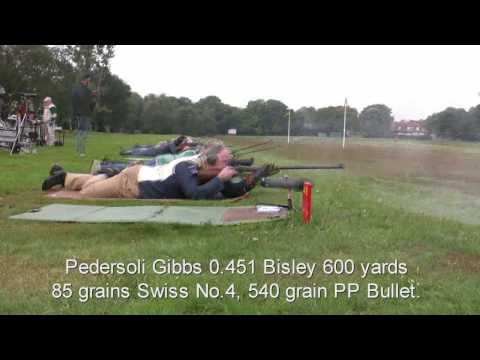
More information on long-range muzzle-loading is available at www.lrml.org and www.usimlt.org (USA Team website).
September 30th, 2009
Speaking of Camp Butner (NC)… the 2009 F-Class National Championships commence today, Sept. 30th, at that range. America’s top F-Class shooters, and many competitors from overseas, will compete for honors in the nation’s fastest-growing long-range discipline. Competitors will be divided in two classes: Open and F-TR. Open Class allows any chambering under .40 caliber with a total weight of about 22 pounds, and a front pedestal rest may be used. F-TR class is limited to .223 Rem or .308 Winchester chamberings, with a max weight of 18.15 pounds. In most F-Class matches, F-TR shooters are limited to bipods — no pedestal front rests allowed.

Hosted by the North State Shooting Club, the Nationals kick off today (Sept. 30th) with open and team practice sessions. Thursday (Oct. 1) is the 600-yard phase of the event, followed by 1000-yard phases on both Friday and Saturday. Sunday is reserved as a make-up day in case of rain. On both Thursday and Friday, a 4-person team match follows the individual events. Barring rain delays, the National Champion will be crowned on Saturday after three final individual 1000-yard matches.
For more information, visit the North State Shooting Club website, or CLICK HERE to download the complete 2009 F-Class Nationals Program.
September 28th, 2009
On Wednesday, Sept. 30th, Shooting USA television features the National Muzzle Loading Rifle Association (NMLRA) Creedmoor re-enactment, hosted at Camp Atterbury, Indiana. The show, a repeat broadcast, features black powder muzzle-loaders and black powder cartridge shooters recreating one of the most famous rifle competitions of the 19th Century. This show airs multiple times this Wednesday, Sept. 30th, on the Outdoor Channel:
Eastern Time 4:30 PM, 8:30 PM, 12:00 Midnight
Central Time 3:30 PM, 7:30 PM, 11:00 PM
Mountain Time 2:30 PM, 6:30 PM, 10:00 PM
Pacific Time 1:30 PM, 5:30 PM, 9:00 PM

Rifle shooting was a very popular spectator sport in the 19th Century. Thousands of spectators came to watch long-range rifle matches held on “Creed’s Moor”, a range built by the NRA with funds from the New York state legislature. The first International Creedmoor match took place in 1874, when a group of Americans responded to a “Challenge to the Riflemen of America” from the Irish rifle team, considered the world’s best. The match was shot at 800, 900 and 1000 yards and was decided on the very last shot. After an Irish cross-fire near the end of the match, American John Bodine shot a final bullseye to win the international challenge cup. The U.S. team used a combination of breech-loading Remington Rolling Blocks and Sharps rifles. The Irish team used Rigby muzzle-loading rifles.
Click Here for Creedmoor Match History | Click Here to view 12’x6′ 1874 Match Target
September 26th, 2009
 We live in a digital, electronic era. The very story you’re reading right now consists of digital data packets transmitted electronically around the globe. Because of cost factors, 99+% of shooting matches in the USA still rely on old-fashioned manual scoring methods. However, target scoring can be done faster and more precisely with electronic scoring systems. Olympic and international CISM shooting competitions now employ electronic target systems. And electronic scoring is widely used in Europe already. We live in a digital, electronic era. The very story you’re reading right now consists of digital data packets transmitted electronically around the globe. Because of cost factors, 99+% of shooting matches in the USA still rely on old-fashioned manual scoring methods. However, target scoring can be done faster and more precisely with electronic scoring systems. Olympic and international CISM shooting competitions now employ electronic target systems. And electronic scoring is widely used in Europe already.
Below is a video showing an electronic scoring system developed by Norway’s Kongsberg Mikroelektronikk AS. Watch as a prone shooter puts five rounds on a 300m target. You can see the group form on the video screen at his shooting station. He’s a good shooter (with an accurate rifle). The first three shots are touching.
As you can see from the video, viewing shots on the monitor is easier than using a spotting scope and waiting for targets to be marked. The electronic target eliminates the need for a crew of target pullers in the pits.
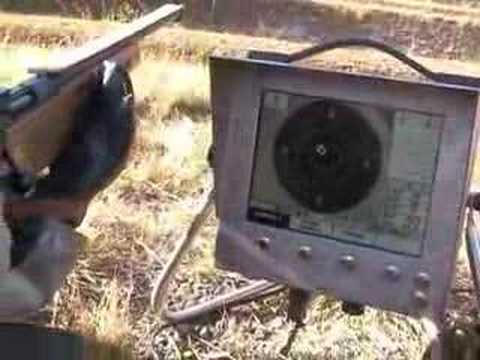
The Kongsberg system, like the electronic systems produced by Sius Ascor of Switzerland, do more than just display shot locations to the shooter. The target units automatically calculate scores, which are transmitted to a central computer. This can provide updated competitor rankings, and can even display the results to event spectators on large view screens.


CLICK HERE for a longer streaming Flash VIDEO showing how electronic target systems work. This video, produced by Sius Ascor, shows olympic target systems in action.
|


