|
|
March 1st, 2010
Eleven members of the 2010 World Championship team were selected following the Spring Airgun Championships, which served as Part II of the World Championship Team selection for the men’s and women’s open air rifle and pistol events. Six air rifle and five air pistol shooters qualified to represent the U.S.A. this August at the 50th ISSF World Championships in Munich, Germany.
 The 2010 World Championship team for airgun was determined by the match scores from the first two days of the 2009 Winter Airgun Championships (held last December), added to the match scores from both days of the Spring Airgun Championships and the best two finals from both matches. For complete results from the 2010 Spring Airgun Championships, please visit www.usashooting.org.
Olympic gold and silver medalist Matt Emmons qualified for the World Championship team in Men’s 10m Air Rifle with an overall score of 2600.7 points. U.S. Army Marksmanship Unit (USAMU) member Matt Rawlings grabbed the second spot in Men’s Air Rifle with a total score of 2584.2 and Jonathan Hall earned the third spot with 2577.1 total points.
Leading the Men’s Air Pistol team will be 2008 Olympian Brian Beaman, who finished with an overall score of 2507.4 points. Two-time Olympian and 2008 bronze medalist Jason Turner will finished right behind Beaman with 2506.2 points. Three-time Olympian and USAMU member Daryl Szarenski grabbed the third spot after firing a total score of 2502.1 points.
Two-time Olympian Emily Caruso lead the way in Women’s Air Rifle with 1800.4 total points. Jamie Beyerle, a 2008 Olympian, took the second spot with an overall score of 1798.8 points and TCU’s Sarah Scherer qualified in third place with 1796.4 points. Teresa Meyer finished first in Women’s Air Pistol after firing 1691.8 total points, while Brenda Shinn, a 2008 Olympian, took the second spot with 1679.0 points.
CLICK HERE for Info on 50th ISSF World Shooting Championship (PDF)

February 26th, 2010
Jeff Stover, President of the IBS (International Benchrest Shooters) just sent us the final rules and safety guidelines for AR benchrest competition under the IBS. Jeff noted: “Shooters should understand that the ranges and clubs will determine whether to allow AR rifles in their particular IBS benchrest matches.” This program is not mandatory, and each club will decide, based on its own priorities, whether ARs will be allowed to compete. When they ARE “invited”, AR-platform rifles will run in their own separate class.

Click the links below to download two .PDF files:
DOWNLOAD: IBS AR Benchrest Final Rules
DOWNLOAD: IBS AR Benchrest Safety Checklist
February 24th, 2010
After we reported that Tyler Rico of Arizona won the Nevada Regional High Power Championship (at the ripe old age of 15), some of our readers asked about Tyler’s match rifle. Tyler, who earned his Distinguished badge at age 13 (the youngest ever to do do), primarily shoots AR-platform rifles. The AR with which Tyler won the 2010 Nevada Regional featured a custom 6mmAR upper built by Robert Whitley’s AR-X Enterprises. The 6mmAR chambering, basically a 6.5 Grendel necked down to 6mm, was popularized by Robert, who is himself an avid High Power shooter.
Tyler Rico’s 6mmAR upper has an interesting history. Whitley explained: “Originally we built it up for some testing by the Marine Shooting Team and we took it down to Quantico. They liked it a lot but did not have authority or funding to buy them. When Tyler’s father called me looking for an upper for Tyler, I offered a special deal on it because we wanted to help support a junior shooter.” Built on a heavy-walled DPMS Low Pro receiver, Tyler’s upper features a 26″ Krieger 1:8″ twist barrel, and a side-positioned charging handle.

According to Whitley, “My test rifle with Tyler’s upper shot great. Above is a photo of one of the initial 10-shot, 100-yard test targets I shot with the upper at 100 yards. This gun really hammered. Remember The ‘X’ ring is the size of a dime”.
Five Shots at 300m that Could Fit under a Quarter
Robert Whitley took the photo below at the Marine’s Quantico, VA, Precision Weapons Section facility. The photo shows a target shot with Tyler’s upper at 300 meters. That’s a five-shot group the size of a quarter. Robert reports: “The Marines wouldn’t let me take the target home, because they planned to use the target to support their lobbying effort for funds to purchase new 6mmAR uppers.”

February 18th, 2010
A reliable 22LR conversion kit for an AR-platform rifle lets you train with inexpensive ammo. That’s a big advantage for 3-gun competitors who must engage multiple targets rapidly, often at relatively short distances. Multi-gun competition is a speed game, requiring plenty of practice to “run with the big dogs”. It’s not unusual for elite 3-gun shooters to put hundreds of rifle rounds down range every week. Service Rifle shooters can also benefit from cross-training with an AR equipped to shoot .22LR rimfire rounds. With a good .22LR conversion kit, Service Rifle shooters can practice their positions and gun-handling at minimal expense. In the winter, if you have a .22LR conversion for your AR, you can train at the many indoor ranges that allow rimfire rifles, but not centerfire rifles.
Complete Conversion Kit for $189.99 from CDNN
CDNN Investments in Texas is offering a good deal on the CMMG .22lr Stainless Conversion Kit for AR15-type rifles. This includes a stainless bolt and bolt carrier assembly and two (2) 25-round magazines or two (2) 10-round mags. The CMMG Kit uses your existing fire control (trigger) group and requires no internal gunsmithing. Just drop it in and shoot. While supplies last, the CMMG Conversion Kit with magazine(s) is priced at $189.99. NOTE: CDNN is offering 2 mags with this package as a “limited time offer”. (MidwayUSA also has this Kit, with one mag, for $199.99.)

CMMG .22LR Kit Is Reliable and Affordable
The CMMG conversion is widely used and has proved quite reliable, both with the 10-round and 25-round magazines. It is recommended by Brownells, though some Brownells customers have said the kits required some minor fitting or polishing. (This may be more of an issue with “off-brand” uppers — Colt AR owners reported no issues.) In the video below you see an AR15 being fired with the CMMG .22LR conversion in place. Then the CMMG bolt is exchanged for the original .223 Rem bolt assembly and the gun is shot in centerfire mode.

In the second video below you’ll see the CMMG conversion shot with two full (or nearly full) 25-round magazines, in rapid fire. There are no malfunctions.

February 14th, 2010
 Bryan Litz, Ballistician for Berger Bullets, is the author of the book Applied Ballistics for Long-Range Shooting. Before joining Berger, Bryan was a missile design engineer working with the U.S. Air Force. An NRA High Master, Bryan also happens to be one of the country’s top long-range shooters. Bryan (aka “bsl135″ in our Forum) has written many ballistics programs and technical papers dealing with long-range flight dynamics of projectiles. Bryan has recorded some very impressive match performances recently. At the 2008 NRA National Championships at Camp Perry, Bryan beat 258 other competitors to win the Palma Individual Trophy Match. Bryan shot a remarkable 450/26x, not dropping a single point.
Palma Match — Caught on Video
Bryan has crafted a cool video that puts the viewer “in the driver’s seat” as Bryan shoots an 800-yard match with his .308 Winchester, iron-sights Palma rifle. Watch as each shot is marked and scored. Bryan explains: “The inset target at upper right displays each shot location in sequence. The score card shows the windage used for each shot, as well as the windage that was ‘Required’ for that shot to be centered. Wind wasn’t very challenging in this string, only requiring between 2 and 3 MOA right. This particular match is the 800-yard phase of a Palma course fired in the summer of 2008 at Camp Atterbury, IN. NOTE: I’ve had to cut out some ‘pauses’, and speed up the film in order to meet YouTube’s size requirements, so that’s why we sound like chipmunks.”
CLICK SCREEN to WATCH VIDEO. Click Menu Button for High Quality (HQ) Option
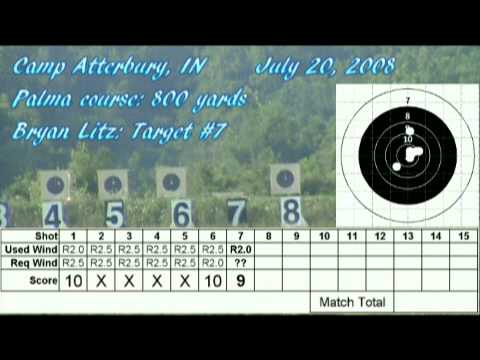
Bryan also has his own website with a number of authoritative articles. Topics include: Bullet Design, Meplat Trimming, Gyroscopic and Coreolis Drift, Palma Bullet Analysis, How Ballistics Programs Work, and Ballistic Coefficient Testing. CLICK HERE to visit BRYAN LITZ Website.
February 12th, 2010
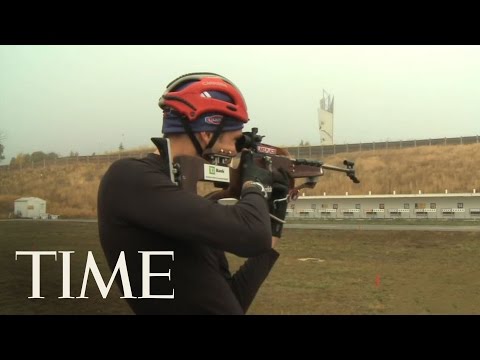
The 2010 Winter Olympics kick off tonight in Vancouver, BC, Canada. Shooting sports fans should follow the USA Biathlon team, which is considered the strongest group of American biathletes ever. Tim Burke, a top finisher in recent Biathlon World Cup events in Europe, is one of the favorites to collect a medal in Vancouver. That would be quite an accomplishment. Thus far, no American has ever won an Olympic Biathlon medal. Burke hope to change that. In the video below, Tim explains his training methods and his love for the sport. Definitely watch this video (produced by Time.com). Tim shows off his shooting skills and the reporter even tries out Tim’s Anschütz rifle. In an entire day of training, Tim only missed one target.
WATCH This Video — It Does a Great Job Explaining the Sport
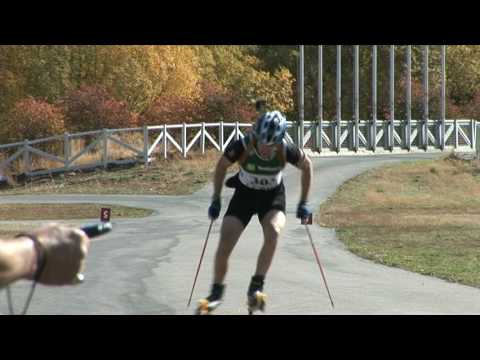
While the American team is strong, it will face tough competition from the Europeans. Biathlon is far more popular in Europe than it is in the USA. In fact Biathlon is the #1 televised winter sport in Europe. Nonetheless, the American team has been training hard in hopes of a strong performance. The video below shows members of the USA Biathlon team doing off-season “dry land” training. In the summer months, Biathletes train with special short skis equipped with wheels. They shoot with the same rimfire rifles used in winter events.
Over 90% of Olympic-level Biathletes use Anschütz rifles, most commonly fitted with a straight-pull Fortner action. These rifles are capable of 1/4 MOA accuracy at 50 meters. Of course, it’s not so easy to hold the guns steady after skiing many kilometers with no time to rest before engaging the targets. That’s what makes Biathlon so challenging. For more information on Biathlon competition, visit the TeamUSA.org website.

February 11th, 2010

The First Shot, the CMP’s online magazine, features a well-written article on Prone Shooting Technique by SPC Matthew Sigrist of the U.S. Army Marksmanship Unit (USAMU). The article covers all the major points of gun hold and body position: hand position, elbow position, stock weld, buttstock placement, and sling position/tension.

SPC Matt Sigrist of the USAMU breaks down the prone position into “fundamentals” and explains how you put each element together to create a stable body position: “The fundamentals are the building blocks of a position. Much like the framework of a house, a correct application of the fundamentals ensures a solid and stable structure. Since each person’s position will depend on their particular body build and shape, there is no ‘perfect position’ that applies to everyone. Experience, practice and knowledge of the correct fundamentals will dictate the best position for you.”
SPC Sigrist also demonstrates the two basic variations of the leg position when shooting prone: open/spread legged, and bent-legged.
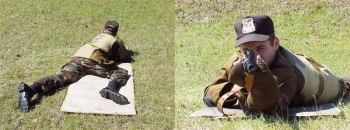

For any service rifle, highpower, cross-course, or prone shooter, this helpful article can improve your performance in the prone position.
February 7th, 2010
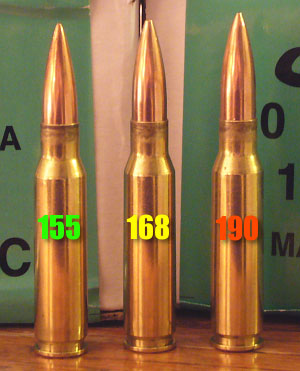 In December, we published the rules controlling choice of caliber and bullet weight for Palma competition. (CLICK HERE to Read.) In the USA, some events are still limited to 156gr or lighter bullets for .308-caliber shooters. But where such restrictions don’t exist, many shooters are using heavy 175-190gr bullets in their .308s. Is the heavier bullet always better? What considerations favor the lighter 155gr-class bullets in Palma competition? Top Palma shooter Kelly Bachand addresses these questions in today’s commentary.
Factors That Favor the 155s
by Kelly Bachand
It is clear that 155gr bullets are adequate. In the Palma game, more matches have been won and more 450 scores have been shot with 155gr bullets than with any other weight projectile. With the NRA allowing heavier bullets in Palma matches, many shooters prefer to shoot the longer, heavier bullets when possible. With their higher BCs, the longer bullets would seem to offer a ballistic advantage. There may be an edge, but in my opinion, it comes at a high cost.
Shooting a heavier bullet adds complications. You’ll probably need a different powder and new load development will have to be done. New zeroes must be calculated and confirmed on the range. An expensive new barrel with a faster twist rate may be needed to stabilize the heavier bullets. And unless you’re lucky, there’s a chance that the new barrel is less accurate than your existing barrel. (If you’ve got a “hummer” barrel for the 155s, what are the odds of getting another one as good for the 190s?) For a shooter who only competes domestically and who has plenty of time and money, this does not pose much of a problem, as he can work up multiple loads and acquire multiple barrels, or even build up a second complete rifle. But shooting BOTH the 155s and the heavy bullets (which may require a new barrel) certainly adds to the cost of competing, and the time required to work up loads. One who also competes internationally has much more to worry about, since you’ll likely be switching between the heavy bullets for most domestic matches and the 155s for most international matches.

Consider the challenges you’ll encounter switching between a heavy-bullet domestic load and a 155gr international load. Will changing between two different loads (with very different recoil levels) alter your gun-handling and follow-through? Will having two loads (with different ballistics) create confusion when making wind calls? And if you DO shoot both 155s and 190s, should you have two different barrels, or should you stick to one barrel which is adequate for both bullet weights, but perhaps not optimal for either? The heavier bullets typically have a better BC which means they should be less bothered by the wind. At the same time the heavier bullets travel at a much slower velocity. Does this negate the ballistic advantage? You need to check the ballistic tables carefully, looking at BOTH BC and velocity.
As a person who prefers to keep things simple and stick with what works, it’s no surprise I continue to shoot 155gr bullets exclusively in Palma competitions. But I understand this is just one viewpoint. A Palma shooter reading this should survey competitors who are consistently putting themselves in the winner’s circle. Talk to top shooters and then make your own rational, informed decision about which bullets to use. Good luck and keep them in the center.
February 6th, 2010
The new IMR 8208 XBR powder is quickly acquiring a reputation for accuracy and pressure stability over a very wide range of temperatures. In addition, it looks like 8208 XBR has a huge load window for accuracy, at least in the 6 PPC cartridge. Here are five successive targets shot by journalist James Mock. With loads range from 30.5 grains to 31.5 grains, Mock nailed five “zero” groups in a row. (These were all three-shot groups.) Mock nailed “zeroes” over a full grain load-weight spread. That’s very impressive, and it bodes well for those who want to spend less time “tuning” their loads.

James observes: “[Here are] 5 consecutive ‘zeroes’ with charges from 30.5 to 31.5. I used a Krieger barrel (583 rounds) and a BAT Model B action. The bullets are from Del Bishop. I used both Wolf SR and Fed 205 primers.The combination that I used that day was really working. The Bishop 65 grain FB bullets were seated to just touch the lands in a barrel with 583 rounds.”
February 5th, 2010
The U.S. Practical Shooting Association (USPSA) has announced the dates of its 2010 National Championships. Divided into four events, the Nationals are expected to draw more than 1,000 top shooters competing in a variety of divisions. Featured in the video below are “Women of USPSA” (including Team Glock’s Jessie Abbate) shooting at the 2009 USPSA Nationals. Be sure to watch this great video. Some very talented ladies demonstrate amazing shooting skills.
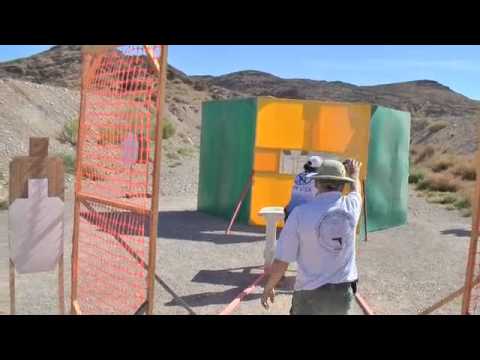
 The first event on the calendar, the USPSA Single Stack Nationals, will take place April 28 through May 1 at the PASA Park ranges in Barry, Ill. In 2009 this event drew 270-plus devotees of the venerable 1911 pistol. Next on the schedule is USPSA’s MultiGun Nationals which will take place in Las Vegas, Nev. at the Desert Sportsman’s Rifle & Pistol Club ranges September 9 through 12. The MultiGun championship draws close to 150 shooters using pistol, rifle and shotgun in the Open, Tactical, Limited and Heavy Metal divisions.
The USPSA championship season will wrap up with back-to-back handgun championships also held in Las Vegas from October 8 through 16, 2010. With over 600 shooters participating, the USPSA back-to-back handgun championships represent the largest gathering of Practical Shooting competitors in the USA. In addition to America’s top guns, the match will also draw some of the best shooters from South America, Europe and the Pacific Rim.
USPSA National Championship dates
April 28 – May 1: Single Stack Nationals (PASA Park, Barry, IL)
Sept. 9 – 12: Multi-Gun Nat’ls (Desert Sportsman’s Range, Las Vegas, NV)
Oct. 8 – 12: Open & Limited-10 Nat’ls (Desert Sportsman’s Range, Las Vegas, NV)
Oct. 13 – 16 Limited, Production & Revolver Nat’ls (Desert Sportsman’s Range, Las Vegas, NV)
To learn more about the USPSA National Championships and other major matches on the 2010 schedule, visit www.uspsa.org or call (360) 855-2245.
|


