|
|
February 4th, 2010
 Sgt. 1st Class James Henderson, a service pistol shooter with the U.S. Army Marksmanship Unit (USAMU), was selected as the Military Marksmanship Association (MMA) Soldier of the Year for 2009. Henderson became the first Soldier in 24 years to win the National Pistol Championship at Camp Perry, Ohio. He won the National Trophy Pistol championship, the President’s Pistol match, and the Interservice Service Pistol championship. He was also a member of the first-place National Trophy Pistol Team and the first-place Interservice Service Pistol team. During the course of 2009, SFC Henderson broke numerous national pistol shooting records and claimed countless other individual and team accolades. He was featured in Sports Illustrated’s “Faces in the Crowd” section and was promoted to SFC in 2009.
 Henderson stated: “This is a great honor. I have to thank the guys in the (custom firearms) shop. They help make this all possible. I couldn’t have done it without the support of my team. They push me every day and if I mess up I know one of them will win the match. Being on this team and in this unit is the best job in the Army.”
Henderson first served with the USAMU from 1991-1994 after tours at Fort Benning, Fort Sill and Korea. After a long stint in the Army Reserves, Henderson resumed active duty service and was assigned to the USAMU. Henderson is the only shooter to ever win the “Triple Crown” (President’s Hundred, National Trophy Individual Pistol Championship, and High Team Shooter) in the same year, and he did it twice (2002 and 2009).
January 31st, 2010
The IBS recently announced that it would allow AR-platform rifles to compete in local IBS benchrest matches in their own class. If you plan to campaign your AR in this new class, you should definitely add a 3″-wide front sled and some kind of rear bag-rider to your gun. Without a flat fore-arm “sled” and rear bag-rider, ARs tend to be very wobbly, and the standard rear stock (with sling loop in place) is terrible in a rear sandbag.

 
Robert Whitley’s AR-X Enterprises has just what you need to improve your AR’s bench behavior. AR-X sells precisely-fitted Delrin bag-riders, crafted expressly for ARs by Evolution Gun Works (EGW). The 3″-wide front bag rider (aka “sled”) features a “twin rail” design and attaches to a tubular fore-arm via a swivel stud. The rear bag-rider mates to the bottom of a standard AR stock and attaches via the rear sling swivel anchor. This provides a smooth, straight surface to ride the bags.
These Delrin EGW bag-rider units were originally designed and prototyped for AccurateShooter.com’s 20 Practical AR project rifle. We tried many different designs, and the final production versions really work — as you can see in the video above. The AR bag-riders cost $40 front and $40 rear, or $75.00 for the set of two. To order, visit 6mmAR.com, or email Robert Whitley: rcw3 [at] erols.com .
January 29th, 2010
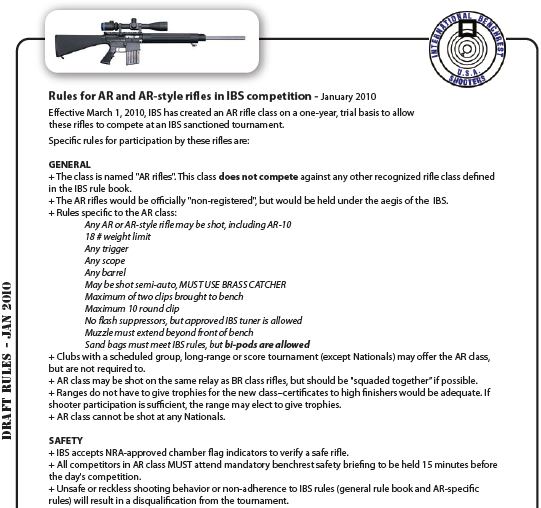
 Defying its reputation as a stodgy, conservative organization, the IBS will allow AR-style rifles to compete in their own class at IBS benchrest matches next year. Both AR15-platform and AR10-platform rifles can compete in this new, provisional class.
This will NOT displace any of the current classes (e.g. Sporter, LV, HV, Unlimited), nor change any rules for current classes. The “AR Experiment” will last for one year and then the IBS will determine whether to make the class permanent. IBS President Jeff Stover stressed three points:
1. This is an experiment for a one-year trial.
2. Clubs MAY have an AR class, but they are not required to do so.
3. The IBS Nationals are NOT affected — there will be no ARs at any Nationals
The IBS has distributed proposed draft rules, and the IBS plans to adopt final rules on March 1, 2010. Here are some of the key proposed rules:
January 28th, 2010
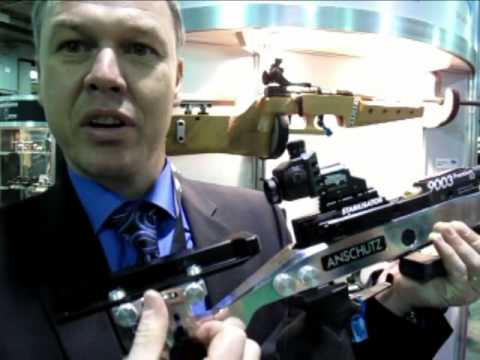
The 2010 Winter Olympics are coming up soon, so we asked Uwe Anschütz to show us the Fortner-Action rimfire biathlon rifle that will be used by the vast majority of top competitors. This high-tech 22LR rifle features a straight-pull action that can be cycled nearly as quickly as a semiautomatic. The rifle is designed to be carried on the back while skiing, then quickly deployed at the shooting stages, where competitors engage banks of targets either prone or standing. Note the slots on the forearm for storing up to four extra 5-round magazines.

Olympic Medal-Winning Air Rifles on Display
In addition to the Biathlon Rifle, Uwe Anschütz showed us the model 9003 S2 Premium Air Rifle, which features a 9003 S2 action in the Precise aluminum stock. This state-of-the-art airgun earned medals at the 2008 Olympics in China, and it is a favorite of top compeitors worldwide. The model 9002 S2 features a very sophisticated buttstock assembly which with great adjustability. With this metal stock, you can adjust every point at which the rifle contacts the shooter’s body, from shoulder to cheek to hand. Even the angle and fore/aft position of the trigger shoe can be adjusted.

January 27th, 2010
 Chip Lohman, Managing Editor of Shooting Sports USA Magazine, has authored an excellent article on barrel maintenance and cleaning. Chip’s article, Let the BARREL Tell You — Match Barrel Care, Part I, appears in the January 2010 edition of Shooting Sports USA, which is FREE online, in a digital e-zine format.
Chip Lohman is a talented writer, an NRA-Certified Instructor, and an active shooter. Like most writers, he maintains a healthy sense of curiosity. The debate about the proper care of a match barrel is a hot one, spiked with folklore and old wives’ tales, Lohman said. He and his staff set out to set the record straight: “We tried to interject some science into the discussion of cleaning a match barrel,” he explained. In his article, Lohman writes:
Why worry about a little barrel fouling when the throat is subjected to a brutal 5,600° F volcano at 55,000 PSI? To investigate these and other questions about taking care of a match barrel, we spoke with a dozen experts and share their knowledge in this first of a series of articles.
After listening to folks who shoot, build barrels or manufacture cleaning solvents for a living, we concluded that even the experts each have their own unique recommendations on how to care for a match barrel. But they all agree on one thing— the gun will tell you what it likes best. Because the life expectancy of a match barrel is about 1,500 to 2,500 rounds, the objectives of cleaning one should include: preserve accuracy, slow the erosion and remove fouling—all without damaging the gun. This article doesn’t claim that one cleaning method is better than the next. Rather, we set out to interject a little science into the discussion and to share some lessons learned from experts in the field.

CLICK HERE to read complete Barrel Care Article in Shooting Sports USA
CLICK HERE to read latest February 2010 Edition of Shooting Sports USA
January 25th, 2010
For decades rimfire shooters have used muzzle weights and various types of tuners to optimize barrel harmonics. Just in the last few years have tuners started to appear on centerfire bench guns. And for centerfire rifles, partly by reason of benchrest rules, most of the tuning systems are fairly heavy metal cylinders placed at the end of the muzzle.

 It is well-established that mid-barrel tuners can work on rimfire rifles, and we also know that certain types of materials (such as rubber, cork, and Delrin) can have beneficial damping effects on both rimfire and centerfire barrels. Given these facts, we were quite interested in the new Flexi-Weight System introduced by AirForce Airguns at the 2010 SHOT Show.
The Flexi-Weight system consists of a cluster of 3 to 6 metal weights, held in place by a rubber O-ring. Multiple Flexi-Weight clusters can be installed on a single gun and the fore-to-aft position is easily adjusted. The shooter can simply slide a Flexi-Weight cluster back and forth along the barrel until he finds the optimal position.
We have no idea whether Flexi-Weights can improve accuracy on a centerfire rifle, but it’s worth a try. Flexi-weights are affordable ($29.95 for a set of five, 48 gram weights) and you can slip them on your barrel without cutting threads or making any other permanent modifications. The weights are designed to fit a 1.25″ diameter tube. For more info, visit Airforceairguns.com or call (877) 247-4867. Airforce Airguns is a U.S. company based in Fort Worth, Texas.

January 17th, 2010
 Gary Anderson, who served the CMP as the Director of Civilian Marksmanship (DCM) for the past ten years, officially retired from that position on the December 31, 2009. Anderson celebrated his 70th birthday in October, 2009. The CMP has no immediate plans to appoint a new Director of Civilian Marksmanship. The CMP’s current Chief Operating Officer, Orest Michaels, will take over direct management of CMP programs.
Anderson will continue his association with the CMP in a consulting capacity as “DCM Emeritus”, working work on several projects that include training curriculum development, master instructor training, rulebook editing and technical writing. Anderson will also stay busy with international-level shooting. Anderson was recently elected President of USA Shooting, the U. S. Olympic shooting governing body. He also serves as a V.P. for the ISSF.

CMP Thrived Under Anderson’s Leadership
During his tenure at CMP, participation in CMP National Matches events doubled, the CMP Games expanded dramatically, and Anderson guided the growth of the Army, Marine Corps, Navy and Air Force JROTC marksmanship programs, and CMP Master Instructor training program. Anderson also had a key role in the construction of the CMP Competition Centers at Camp Perry and Anniston.
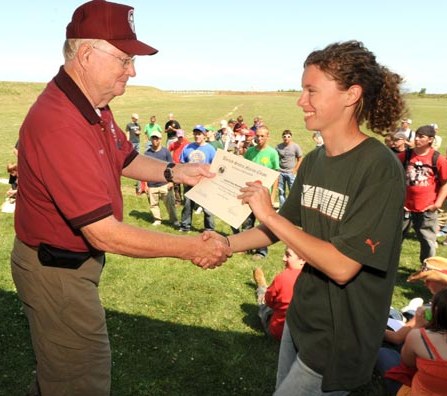
While serving as DCM, one of Anderson’s top priorities was increasing youth participation in the shooting sports. In the photo above Anderson awards a certificate to a CMP-USMC Junior High Power Clinic participant.
Anderson said, “My work as the DCM has been richly fulfilling and I am grateful to the CMP and its Board of Directors for the opportunities they gave me to realize so many of my dreams and expectations for the shooting sports.” The CMP Board will hold a tribute to Gary Anderson at Anniston, Alabama on March 28th, after the 2010 JROTC Air Rifle National Championship.
January 6th, 2010
 This week’s episode of Michael Bane’s Shooting Gallery features the Bianchi Cup, one of the world’s most prestigious (and lucrative) pistol competitions. The show will be broadcast on the Outdoor Channel at 3:30 p.m., 7:00 p.m., or 11:30 p.m. EST. (Check your local listings.)
The Bianchi Cup is the brainchild of former police officer (turned holster-maker) John Bianchi and the late Ray Chapman – one of the original IPSC “Combat Masters”. The Cup originated as a law enforcement training match. Since its inception in 1979, the NRA Bianchi Cup has retained its original course of fire, consisting of four matches: Practical, Barricade, Moving Target and Falling Plates. Competitors need to be both FAST and ACCURATE. This event now draws shooters from all over the world. In 2009, competitors came from Australia, Canada, Germany, Italy, Japan, New Zealand, Netherlands, Switzerland, United Arab Emirates, and the United States. Competitors shoot from both standing and prone positions and must shoot with both strong and weak hands at various stages.
CLICK HERE to watch preview video of Bianchi Cup telecast

Bianchi Cup Course of Fire
The Practical Event – From the appropriate shooting line, the shooter fires at distances from 10 yards to 50 yards under varying time limits.
The Barricade Event — From within shooting boxes and behind barricades, a shooter fires at targets on either side of the barricade at different distances and under varying time limits.
The Falling Plate Event — From the shooting lines, the shooter fires at 8″-round steel plates arranged in banks of six at distances from 10 to 25 yards under varying time limits.
The Moving Target Event — From within shooting boxes at distances ranging from 10 to 25 yards, the shooter fires at a target moving from left to right with the target being exposed for only 6 seconds.
December 30th, 2009
 There is, understandably, quite a bit of confusion concerning caliber limitations for Palma rifles and Palma competition. Some folks say you can shoot a .308 Winchester (or 7.62 NATO) with a bullet weight up to 156 grains. Others say you can shoot a .308 Win (or 7.62 NATO) with any bullet weight. Still others opine that you can shoot EITHER a .223 Rem (5.56×45) or a .308 Win (or 7.62 NATO).
So who is right? Well, all these viewpoints are correct in part. That’s because different rules apply in different venues. In most, but not all United States Palma competitions, you can shoot either a .223 Rem or .308 Win with no restriction on bullet weights. In some U.S. Matches, most notably the Spirit of America, certain prizes are limited to .308s with 156gr max bullet weights OR .223s with 81gr max bullet weights. What’s the bottom line? In most USA Palma competitions you can shoot either a .308 or a .223 with no limit on bullet weight. In International Palma competitions you can shoot either a .308 or a .223 but the max bullet weight is limited.
Applicable Rules for NRA Palma Competition
To help clarify the Palma rules, German Salazar has collected the applicable NRA and international rules which govern Palma and iron-sights fullbore competition. First, German explains: “The Palma Rifle is defined by NRA High Power Rule 3.3.3″ which states:
3.3.3 U.S. Palma Rifle:
(a) A rifle with metallic sights chambered for the unmodified .308/7.62 or
.223/5.56 NATO cartridge case. Rifles which also meet Rules 3.1 (.308 only)
or 3.1.1 (.308 only) are authorized.
(b) A rifle with metallic sights chambered for the unmodified .308/7.62 NATO
cartridge case. Rifles which also meet Rules 3.1 (.308 only) or 3.1.1 (.308
only or 3.1.2 (.223 only) are authorized.
German tells us: “The references to Rules 3.1, 3.1.1 and 3.1.2 apply to the M1, M14 and M16 rifles or civilian equivalents thereof. Accordingly, Palma Division ‘A’, which is how all matches other than the National Matches are fired, allows any rifle chambered in .308 or .223 with metallic sights. Palma, Division B, which is rarely seen outside the Nationals, is a separate award category for the service rifle in a Palma match.”
German notes that: “In all instances, there is no restriction on bullet weight, rifle weight or trigger weight of pull. All of these are unrestricted. The rules specify that the rifle must be chambered for the unmodified .308 or .223 “cartridge case” but if the chamber has, for instance, a longer than standard throat to accomodate a heavier bullet, that is acceptable.”
CLICK HERE to download NRA High Power Rules Book (PDF File)

NEW NRA Fullbore Rules and International Rules
A few matches are run under the new NRA Fullbore Rules which are meant to align the USA with the rules observed in other nations competing in similar matches. The most notable of these is the annual Spirit of America Match which is also the Fullbore National Championship. The Grand Aggregate prize of the Fullbore National Championship is restricted to those competitors firing the International Target Rifle.
Under the Fullbore Rules, there are two categories of rifle, the Target Rifle, which is the same as the High Power Palma Rifle, and the International Target Rifle, which is compliant with the rules of most other nations. The International Target Rifle has restrictions on trigger weight of pull, but no restrictions on overall rifle weight. Additionally, there is an ammunition restriction which limits the weight of the bullet to 156 grains for the .308 and to 81 grains for the .223; this restriction applies to both Target Rifle and International Target Rifle categories. The applicable rules are listed below.
CLICK HERE to download NRA Fullbore Rule Book (PDF File)
3.3.5 Target Rifle:
(a) A rifle with metallic sights chambered for the unmodified .308/7.62mm
cartridge case. This rifle has no restrictions regarding weight of the rifle
or trigger, However, the trigger must be safe.
(b) A rifle with metallic sights chambered for the unmodified .223/5.56mm x
45 cartridge case. This rifle has no restrictions regarding weight of the
rifle or trigger. However, the trigger must be safe.
3.3.6 International Target Rifle:
(a) A rifle with metallic sights chambered for the unmodified .308/7.62mm
cartridge case with a minimum trigger weight of 0.5 kilograms (approximately
1.1 pounds and the total weight of the rifle is unlimited. OR…
(b) A rifle with metallic sights chambered for the unmodified .223/5.56mm
cartridge case with a minimum trigger weight of 0.5 kilograms (approximately
1.1 pounds) and the total weight of the rifle is unlimited.
3.17 Ammunition:
(a) Target Rifle / International Target Rifle — .308/7.62mm NATO with a
maximum permitted bullet weight of less than 156 grains or .223/5.56mm x 45 NATO with a maximum permitted bullet weight of less than 81 grains.
December 27th, 2009
AccurateShooter.com offers dozens of FREE, printable targets for target practice, load development, and fun shooting. We also offer a few samples of the most popular NRA Bullseye targets. One or more of these printable targets should work for most training purposes. However, some readers have asked “where can we get the real targets… exactly like the ones used in NRA, IBS and NBRSA shooting matches?”
Sources for Official Shooting Competition Targets
Here are six (6) sources for official match targets: ALCO Target Company, American Target Company, National Target Company, Orrville Printing, Pistoleer.com, and U.S. Target Company. All five of these vendors carry nearly all the NRA High Power and Smallbore targets, including the new, smaller F-Class Targets. Most sources also have international 300m and 300m-reduced-to-300-yards targets.
National Target and Orrville Printing currently sell IBS targets for rimfire (50 yard) benchrest, short-range centerfire Benchrest (100, 200, 300 yards), Hunter BR Rifle (100, 200, 300 yards), plus the official 600-yard and 1000-yard IBS targets. However, this year the IBS designated Orrville Printing as the official source for IBS 100-200-300-600 group and score targets. Orrville Printing was selected after an extensive review of available target papers in 2008. Clubs hosting IBS registered shoots may use up old stock, but new purchases should be from Orrville Printing.
We are told that National Target supplies NBRSA matches. One other NRA-licensed target vendors is Central Target Company (Kentucky), (502) 895-3390, but it appears that Central Target doesn’t maintain a web site.
| Available Official Competition Targets |
| Vendor |
NRA High Power |
F-Class |
NRA Smallbore |
Air Rifle/Pistol |
IBS |
NBRSA |
Other |
ALCO Target
Company |
Yes, All |
No |
Yes |
Yes |
No |
No |
Archery, IDPA, IPSC, Police, Realistic, Shoot-N-C, Silhouette, Fun Targets, Pasters. |
American Target
Company |
Yes, All |
Yes |
Yes, All |
Yes |
No |
No |
USBR, Sight-in, Muzzle-Loading, Police Silhouette |
National Target
Company |
Yes, Nearly All |
Yes |
Yes, All |
Yes |
Yes* |
No |
IDPA, IPSC, FBI, Police Silhouette, Sight-in, Target Backers, Pasters |
| Pistoleer.com |
Yes |
Yes |
Yes, most and color training |
Yes |
Yes |
No |
Bianchi, FBI, IBS, IDPA, IPSC, Silhouette, Archery, Pasters |
| U.S. Target, Inc. |
Yes |
Yes |
Yes, All |
Yes |
No |
No |
Bianchi, FBI, Police Silhouette, IPSC, Realistic Silhouette, Varmint |
| *National Target Co. is allowed to sell off remaining IBS Target inventory. |
ALCO Target Co., Ph: (626) 358-4814, 2048 Central Ave., Duarte, CA 91010
American Target Co., Ph: (877) 733-0433, 1328 South Jason St., Denver, CO 80223
National Target Co., Ph: (800) 827-7060, 3958-D Dartmouth Ct., Frederick, MD 21703
Orrville Printing Co., Ph: (330) 682-5066, 1645 N. Main St., Orrville, OH 44667
Pistoleer.com, Ph: (618) 288-4588, 12 Schiber Court, Maryville, IL 62062
U.S. Target Inc., Ph: (800) 746-6836, 16472 Common Rd., Roseville, MI 48066
Alternate NBRSA Target Source
NBRSA 600-yard and 1000-yard targets are also available from Karl Huntstiger, wfo13 [at] aol.com, 2901 E. Cortez Street, Phoenix, AZ 85068.
|


