|
|
December 25th, 2009
Sam Hall of Boonville, North Carolina is “King of the Hill” when it comes to the 600-yard benchrest game. He is the 2009 IBS 600-yard Shooter of the Year, and he won the IBS 600-yard Nationals two years in a row. When Sam talks, people listen… if they’re smart. Sam was recently asked to compare the performance of Berger’s 6mm 108gr boattail vs. Berger’s 105gr VLD bullet. As Sam explains, both bullets have the potential to shoot really well, so your barrel and the conditions may dictate which projectile works best.
Berger 105gr VLDs vs. Berger 108gr BT by Sam Hall
I shot the 108gr Bergers (and 108 BT BIBs for a few matches) all last year in my Light Gun (LG) and Heavy Gun (HG) in 600-yard IBS competition, but switched to Berger VLDs during the Nationals because of the extreme winds in South Dakota.

When I started loading for the 108s, I quickly learned they are much easier to tune than VLDs. In the two barrels in which I shot the 108s, they did not seem to be sensitive to seating depth or powder charge like the 105 VLDs. I could not see much difference in groups at 600 yards during tuning. But, with the 108s, you will need to drop about one grain in powder compared to the VLDs due to longer bearing surface and extra weight. It seemed that the 108s show a consistent round-pattern group, where the VLDs many times have flyers. By this I mean, if both the 108s and 105 VLDs shoot a two-inch, 5-shot group at 600, the 108s will be evenly distributed in the two-inch circle. Conversely, the time the VLD’s will often have 3 or 4 shots in one inch but 1 or 2 flyers expanding the group to two inches. But when the VLDs don’t have a flyer, look out! That’s when most of the World Records have been set and VLD shooters have come from behind and won the match. (Yes, I am talking to you Mike Davis).
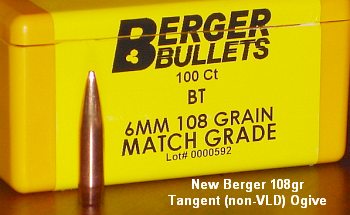 Mike Davis and I talked about the Berger 108s vs. 105s last year. The 108gr BTs are great until the wind gets up. They seem to get blown around more than the VLDs. A half-inch extra at 600 yards these days means the difference between winning or ending up middle of the pack. So, ideally, a shooter would have two loads. One would use the 108s for mild days, and the second would use the 105gr VLDs for those windy days.
If you don’t have time to tune the 105gr VLDs (tuning them can be difficult and time-consuming), I suggest you stick to the 108s. They will save you a lot of headaches and will stick close to the VLDs in most conditions.
How Temp and Humidity Affect Performance
I almost forgot to mention. As the temperature and humidity got up in the summertime last year in North Carolina, the 108s did not perform for me as well as they did during the cooler, less humid months. I tried developing a new, hot-weather load for the 108s, but I never got the 108s to perform as well in the summer as I did in the winter and spring — even when there was no wind. I don’t know why the 108s prefer cooler, less humid conditions, except maybe because they have more drag than the 105gr VLDs. High humidity may have had more of an effect on the 108s than we’d expect from the slight BC difference between the two bullets. The VLDs seem to drill through the wind and humidity better than the 108gr Bergers. NOTE: These findings are my own opinion based on many, many groups shot tuning and in competiton, while using several barrels of various manufacturers.
I hope this helps and does not further complicate your load development process. Try both bullets before you buy a large quantity of bullets. Your rifle will let you know which projectile it prefers. We have often found that a particular barrel will shoot one bullet design well but not the other. A few barrels will shoot BOTH bullet types really well.”
December 20th, 2009
The Civilian Marksmanship Program (CMP) invites air rifle and air pistol shooters to participate in the 4th Annual Camp Perry Open. This year’s match will include a 3-position air rifle competition, an international air rifle (all standing) event, a pistol course of fire, and optional clinics. The match will be held on 15-17 January 2010 at the new CMP Marksmanship Center in Camp Perry, Port Clinton, Ohio. Visit the Camp Perry Open webpage for complete information including rules, fees, event schedule, and match descriptions/courses of fire.

The U. S. National Team coaches, Maj. David Johnson and Sergey Luzov, plan to bring some National Team members to shoot in the International event. The Army Marksmanship Unit (USAMU) is also sending some of their best to shoot in the International standing course of fire event as well. Members of many top NCAA rifle teams will also attend. This is a great opportunity to see some of the best shooters in the US compete.

Special Junior Clinic
In addition to the regular matches, on Saturday, Jan. 16th, there will be a clinic for interested junior shooters from 5:30pm – 8:15 PM. The cost is just $10, which includes a pizza dinner! This Saturday clinic is limited to 60 junior shooters — all those wishing to attend should pre-register. On-the-line training will be provided by the members of the U. S. National/Development Team, and members of the U.S. Army Marksmanship Team (USAMU). The clinic will conclude with a 20-shot standing competition.
What to Bring
Shooters that use Sporter Class air rifles (Daisy M853/753/888/XSV40) should bring an air rifle for each shooter plus a sling, kneeling roll, and glove. You will not need spotting scopes. Shooting mats are provided at the range, but you may bring your own. Shooters using precision air rifles should bring them along with their shooting jackets and other equipment. Also, bring your own pellets. The CMP will have air tanks and CO2 available at the range. Please bring your own adapters.
How to Register
CLICK this LINK to Register for the Camp Perry Open. Competitors over the age of 18 must complete and sign a CMP Affidavit and Liability release prior to competing at Camp Perry. Shooters under the age of 18 must have a Parental Permission Form completed prior to competing at Camp Perry. The forms may be submitted to Katie Harrington at: CMP, P. O. Box 576, Camp Perry OH 43452. Alternatively, fax forms to 419-635-2565. Email inquiries may be addressed to kharrington [at] odcmp.com.
December 11th, 2009
– Match Report by German Salazar
This past week 89 shooters competed in what is traditionally the biggest winter Palma match in the USA — the 2009 Arizona Palma State Championship. Held at the Ben Avery Shooting Facility in Phoenix on December 4-6, the event included Palma, F-Open and F-TR classes. Ben Avery’s High Power range has 100 firing points to 1000 yards and is renowned for challenging conditions and excellent match administration.
Trend Towards Heavy Bullets
Chatting with competitors, we noted an increase in the use of bullets heavier than 155 grains, with the Berger 185 being the most frequently mentioned alternative, although the Berger 175 was also in use as were Sierra and Berger 190 grain bullets. Competitor frustration with the availability of Varget and its ever-changing burn rate are driving an increased use of H4895, IMR 4320 and IMR 4064 in the Palma. Tubeguns were also much in evidence, being a Western favorite with large number of them on the line in the hands of the California and Arizona shooters. Gary Eliseo was on hand as always and had a good performance throughout.

Match Kicks Off With Tough Conditions
The match opened Friday, December 4, as all Palma matches do, with the 800-yard stage. Relay after relay battled cold north winds. Over half the competitors were High Masters, yet only two shooters fired scores of 150 — Tom Whitaker of California and Phil Hayes of Arizona. As the morning wore on and the competitors moved back to 900 and 1000 yards, the wind eased off a bit and scores improved with 150s becoming more common. At the end of the day, Whitaker’s 450-30X topped the list, followed by Bryan Litz of Berger Bullets and Kelly Bachand from Washington.
On Saturday morning, the desert chill remained, but the flags hung limply, raising hopes for high scores. Those expectations were realized as Bud Solis, a retired Seattle police officer, put up a sterling 450-25X to lead the day. Close behind (all with 449 scores) were Bachand, Gary Rasmussen (WA), German Salazar (AZ), and Randy Teissedre (CA). The final day, Sunday, conditions began relatively calm but progressively got windier with frequent direction changes. No one was able to master the conditions for a 450, but the mother-daughter duo from Prescott, AZ, Nancy Tompkins and Michelle Gallagher, came closest, each shooting a 449 with Nancy’s 29X just edging out Michelle’s 26X. David Littlefield (WA) and Jim O’Connell (CA) also shot 449s on Sunday.
Gallagher Wins Match, with Whitaker and Bachand One Point Behind
Michelle Gallagher posted a 3-day tally of 1345-81X, giving her a one-point victory over runner-up Tom Whitaker (1344-91X) and third place Kelly Bachand (1344-79X). Note that Tom had ten more Xs than Michelle, but came up just one-point shy. Bryan Litz finished fourth overall, with German Salazar in fifth (on a tie-breaker over Michael Storer). All the Top Ten are listed, with scores, in the table below. In Team Competition, the US Team coached by Gary Rasmussen compiled a 1787-95X, edging second-place Team Berger (1783-96X) and third-place Bald Eagles Grand Seniors (1782-75X).
CLICK HERE for Individual Match Results | CLICK HERE for TEAM Match Results
 Top Ten Grand Aggregate
1. MICHELLE GALLAGHER: 1345-81X – MW
2. TOM WHITAKER: 1344-91X – HiSR
3. KELLY BACHAND: 1344-79X – HM
4. BRYAN LITZ: 1343-91X – HM
5. GERMAN SALAZAR: 1339-68X – HM
6. MICHAEL STORER: 1339-68X – HiJR
7. FELIX SOLIS: 1338-59X – HM
8. ROBERT GUSTIN: 1337-64X – HM
9. ALLEN SPIKER: 1335-50X – HM
10. JIM O’CONNELL – 1332-62X – HM
The F-Open Class was won by Rick Curtis of Phoenix at 1328-67X with Darren Sucato, another tough Phoenix shooter in second place. F-TR went to John Chilton with his factory Savage F-TR rifle putting up an impressive 1308-45X.
There are weekly matches in Phoenix for across the course High Power, Prone, F-Class, and Smallbore. A complete schedule is found on www.desertsharpshooters.com. The Arizona state association website ASRPA.com also has useful information.
December 9th, 2009
In Norway, the annual Landsskytterstevnet (Rifle Country Fair) is Norway’s largest shooting tournament. One of the most popular Landsskytterstevnet events is a rapid-fire competition. The objective is to achieve the most hits on multiple targets in the alloted time period (typically 25 seconds or less). In some stages, all targets are at the same distance, while in other stages the shooters engage targets at 3 or 4 different distances.
You would think that a semi-automatic rifle would dominate the rapid-fire matches, but that isn’t the case. In the video linked below, civilian shooters with mag-fed Sauer 200 STR bolt-action target rifles outpace Norwegian army personnel using HK select-fire rifles in semi-auto mode. You’ll be amazed to see how fast the civilians can shoot their target rifles. It’s a great video… be patient and let it load from the Norwegian server.
CLICK HERE to load MATCH VIDEO (May take 30 seconds or more to load page).

 Crowds Cheer Shooters
Equally amazing is the size of the crowd and the spectators’ enthusiasm. We’ve never seen anything like this in the USA. Over 1000 Norwegian fans are clapping, cheering, and singing during the match. You’d think this was a Big Ten Football game! Obviously the Norwegians love their shooting sports. Electronic scoring and big display screens allow the crowd to follow the fast-paced action.
Thanks to Gary Eliseo for finding this video. Gary says: “Check out how the boltgunners manipulate the bolt and operate the trigger, also how the gas gunners struggle to keep up! Looks like great fun, were going to try to put on a ‘Stangshoot’ like this at BRRC (Burbank Rifle & Revolver Club) next year.”
December 8th, 2009
Doan Trevor, a gunsmith based in New Mexico, has created a stunning Palma rifle to benefit the USA Veterans Rifle Team. Doan, a gifted wood-worker and machinist, crafted the high-grade walnut stock, fitted the barreled action, and custom-fabricated many of the gun’s metal features. The step-by-step process of creating this one-of-a-kind rifle is illustrated on Doan’s website. Visit DoanTrevor.com, to see the Veterans Team Rifle being built from start to finish. Below are photos of the finished rifle, plus the “work in progress”.

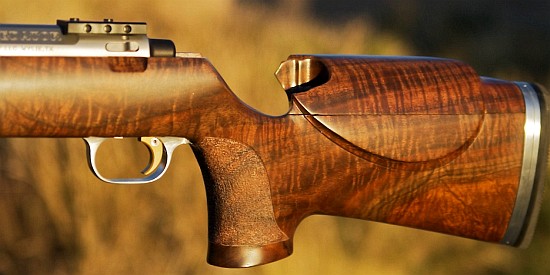
The USA Veterans Team Rifle carries a unique serial number signifying the 2011 World Championships in Australia. CLICK HERE to learn more about the US Veterans Rifle Team, www.USAVRT.org.
Rifle Raffle Tickets Cost $5.00
You have a chance to own this special Trevor-built Palma Rifle. Raffle tickets for the USA Veterans Team rifle can be bought for $5 each or six (6) for $25 from Mike StClair, 12138 Eastglen Street, San Diego, CA 92131. Questions? You can email Mike: estclai1 [at] san.rr.com. Make checks payable to Palma Promotions.
Components Donated for USA Veterans Team Rifle
A variety of individuals and businesses donated components for the USA Veterans Team Rifle. Krieger Barrels donated the barrel while Scott Riles provided front sight and trigger. Doan Trevor and Richards Microfit jointly donated the stock, while Stillers Precision Firearms, LLC provided the stainless Predator action.
Contact: Doan Trevor, DoanTrevor.com, Ph: 505-890-0368. Photos © Sue Trevor 2009.
December 8th, 2009
 In April 2010, Purdue University will host the expanded NRA Intercollegiate Rifle Club Championship. This event will be open, for the first time, to ALL levels of collegiate shooters. This new championship format will include NRA College Rifle Clubs, Varsity Rifle Teams, ROTC Teams, and independent shooters, for which there is currently no national championship. The 2010 NRA Intercollegiate Rifle Club Championship will be held April 8-11 at the Purdue University Armory.
The championship will feature smallbore and air rifle competitions, plus training summits for participants and coaches. Both individual and team champions will be named for NRA College Rifle Clubs, Varsity Rifle Teams, and ROTC Teams. Shooting in the NRA Intercollegiate Rifle Sectionals is required to qualify for the championship. Additionally, the top three teams and top five individuals from sectionals earn free entry to the championship. The official NRA Collegiate Smallbore target is the NRA/USAS 50 target, which must be used for Intercollegiate Sectionals.
NRA Intercollegiate Rifle Club Championship
April 8-11, 2010
Purdue University, West Lafayette, IN
2010 Rifle Championships Program
December 4th, 2009
Here’s good news for iPhone and iPod owners. There are two new FREE applications (Apps) that let you use your device as a firearms shot timer. It may be a while before we see iPhones used at 3-gun matches, but it’s nice to know that Apple’s smartphones can do double duty as timers. Both Surefire, maker of tactical flashlights, as well as Taurus, firearms manufacturer, offer Shot Timer Apps that can be downloaded, for FREE, from the iTunes store. (Note: you must have iTunes software installed on your computer to download the Shot Timer programs. iTunes software is free, but it is a hefty 90-meg install.)
CLICK HERE for Taurus Shot Timer App Download | CLICK HERE for SureFire Shot Timer FAQ
With either the SureFire ShotTimer or Taurus Timer apps installed, your iPhone/iPod can function just like a dedicated shot timer (such as the PACT Club Timer III), but you no longer need a dedicated unit. All the key functions can be performed with your iPhone or iPod. The screen displays the elapsed time and the split time for every shot fired. You can review time between consecutive shots, shot count, and total firing time. A “start delay” option let you train alone, and you can use the Par Time mode to train “against the clock”.
Once the unit is adjusted, the built-in microphone on an iPhone or iPod should be able to track every shot without fail. Even indoors, anti-echo technology provides reliable shot detection. The software allows you to adjust microphone sensitivity to the unique sound “profile” of the shots. Just tap ‘Adjust Sensitivity’ on the display to raise the sensitivity in 10% increments until the Shot Timer consistently detects all your shots.
 With either the SureFire or Taurus Timer Apps, you can hold your iPhone like a traditional shot timer or use the start delay mode with the iPhone placed on a shooting bench, or held in your shirt pocket. The Shot Timer will display both elapsed time and split time for every shot. You can store practice session results in your iPhone’s internal memory.
December 2nd, 2009
Over 260 rifle and pistol airgun shooters from across the United States, as well as 40 athletes from 11 countries around the world, will gather at the U.S. Olympic Training Center (Colorado Springs, CO), December 4-6 to compete at the 2009 USA Shooting Winter Airgun Championships (formerly known as 3 X Air).
The 2009 Winter Airgun Championships will serve as a U.S. team tryout for 2010 ISSF World Cups, the 2010 World Championships (part I) and the Bavarian Airgun Championships in the Air Pistol and Air Rifle Events. For non-U.S. competitors only, this three-day event will serve as a minimum qualifying score (MQS) qualifier for the first-ever Youth Olympic Games, which will be held August 14-26, 2010 in Singapore.
Identical competitions will take place in rifle and pistol with finals matches closing out each day of competition at the Winter Airgun Championships.
 Many Olympians to Compete
Among the athletes competing will be two-time Olympic medalist Matt Emmons along wife his wife Katy Emmons, who is a three-time Olympic medalist for the Czech Republic. Two-time Olympian Jason Turner, who is the 2008 Olympic bronze medalist in Men’s Air Pistol, will also be shooting in the match.
Colorado Springs Olympic Training Center Resident Athletes and 2008 Olympians Jamie Beyerle and Emily Caruso will be competing in the Women’s Air Rifle event. Vying for titles in pistol will be four-time Olympian Libby Callahan as well as three-time Olympian and U.S. Army Marksmanship Unit (USAMU) member Daryl Szarenski and 2008 Olympians Brian Beaman and Brenda Shinn.
A full match schedule as well as complete results throughout the competition can be found by visiting USA Shooting’s website at www.usashooting.org.
November 30th, 2009
 On Sunday November 29th, the Ojai Valley Gun Club hosted its first-ever NBRSA-sanctioned, 600-yard Benchrest match. Ojai boasts a beautiful range in the Southern California foothills about 40 road miles from the coast. Many Pala Range regulars from the San Diego area were on hand, and some “big names” turned up for the event including Lou Murdica and 2007 NBRSA 600-yard Champion Don Nielson. In sunny but wildly changeable conditions (ranging from near-calm to 20 mph gusts), Don showed how it was done, winning the match with his 6.5×47 Lapua rifle.
Don finished first in ALL LG and HG categories except Heavy Gun score, where he placed second. In Light Gun class, Don shot a 2.207″ Agg for three, 5-shot targets (1.523″, 2.344″, 2.754″). Mind you this was in conditions where some pretty good shooters were off paper. Don said the secret was to shoot fast: “When it’s switchy, you can’t wait. I pretty much never stopped and never slowed down. Even for the 10-shot Heavy Gun Groups I think I was done in 30 seconds.” Second in Two Gun Overall was Brenda Hill. Brenda has established herself as one of California’s top F-Class and long-range shooters. At Ojai, Brenda was shooting a very accurate 6BRX rifle smithed by Leroy Johnson, jpgrifles [at] yahoo.com. John Crawford, Bruce Duncan, and Lou Murdica also all shot well in the difficult conditions.

On the firing line we found some very interesting equipment. John Crawford of the Bay Area had a beautiful Leonard-stocked gun chambered in 6mm Grendel. John is getting over 2900 fps with his 6mm Grendel, shooting 105gr Berger VLDs. He does have a long throat, but that is still impressive — 6BR velocities from the smaller-diameter Grendel case. Along with its gorgeous wood stock, Crawford’s rifle featured some very cool hardware. The trigger guard was radically skeletonized and anodized black. John’s scope was mounted with 4-bolt integrated scope rings/bases with 20 MOA built-in elevation. Produced by Marvin Pearson in Oregon, (360) 748-3429, these custom ring/bases were beautifully finished with radiused edges. Pearson’s ring/bases are available for 1″, 30mm, or 34mm tubes, with zero elevation “pre-load”, or up to 30 MOA of built-in elevation. Pearson charges $125.00 per set (plus shipping).

Crawford carried his 6mm Grendel ammo in compact 100-round ammo ammo cases from J&J Products. These cases pack big capacity in a relatively small footprint. There is enough clearance for long VLD-style bullets, but not so much extra “headroom” that the rounds can fall out if the box is inverted. John uses a piece of pink foam, cut to box dimensions, to protect his bullet tips when traveling. These 100-round J&J boxes measure 5.375″L x 5.375″W x 2.400″D and cost just $4.88 (J&J item BR-100).
 Match director Barry Bluhm had a very nice ammo caddy that places ten loaded rounds up close to the loading port for fast cycling. Southpaw Bluhm keeps his ammo caddy on the right side, but the design would work equally well when used on the left side by a right-handed shooter.
Barry, who shoots a 6-6.5×47 for the most part, deserves a huge amount of credit for organizing this event. He spent many long hours building new target frames, and organized volunteers to man the pits and run the range. Without Barry’s dedication and hard work, this 600-yard match, hopefully the first of many registered events at Ojai, couldn’t have happened.
To learn more about the Ojai Valley Gun Club, or view the schedule of upcoming events, visit www.OVGC.net.

November 19th, 2009
SFC Emil Praslick III sent us this report on the U.S. Palma Team tryouts at Camp Butner, NC. You can read other reports from Coach Praslick on the U.S. National Rifle Team Blog.
Last Tryout in the Books… On to the National Team
By Coach Emil Praslick
It was a hardy and intrepid group of US Palma Team hopefuls that braved the last vestiges of Hurricane Ida last weekend at Camp Butner, North Carolina. Camp Butner is the home range of the North State Shooting Club, which hosted the US Palma Team’s third and final tryout session. Temperatures in the 40s, winds from 20-30 mph, and a driving rain tested the mettle of both coaches and shooters.
 US Team Captain, Dennis Flaharty flung his net across the entire United States in a search for the best team shooters. By adopting a regional format for the tryouts, and separating the country into three areas (West Coast, Midwest, and East Coast), the team maximized the potential for attracting the best shots our vast nation has to offer. The three venues were: Sacramento, CA; Lodi, WI; and Butner, NC. At each venue, the top performers were invited to become members of the United States National Developmental Team.
New Team Tryouts Format
The format for the tryouts was different than any ever conducted by the United States. In the past, these events were held very much like individual matches. Shooters were evalauated by the scores they shot in a series of matches. While this undoubtedly picked the best individual shooters, those who experienced difficulty doping the wind, or those who simply shot during more difficult conditions, were often deselected early in the process. The current procedures call for shooters to be supervised by coaches at all times. This not only removes a shooter’s ability to negotiate wind from the process, it also gives the team management the opportunity to evaluate prospective coaches and to work on firing line procedures. Shooters are graded on their ability to shoot “elevation”, their speed, and their overall performance as part of the team.
The intent of forming a National Developmental Team was to establish a pool of skilled, international-quality shooters; not only for the upcoming 2011 Palma Match in Australia, but as the nucleus for future teams. The US National Team has an ambitious schedule for 2010, with trips to Canada, Camp Perry, Raton (NM) for The Spirit of America Matches, and Australia.
 The next milestone for the US National Developmental Team is to finish the processing of the shooter’s elevation data, and to begin planning which shooters will represent the United States at the planned events. Shooters will then be evaluated in match conditions and recieve further training/evaluation prior to the final Palma Team selection in the Fall of 2011.
I would like to thank all of the volunteers who assisted with the target pulling, scoring, running the firing line, and the host of myriad tasks that are necessary to conduct an event of this complexity. I would also like to thank the coaches who coached 400 rounds per day at 1000 yards with no complaint. It was a grueling (but very beneficial) exercise for them. We will announce the final US National Developmental team soon.
TWITTER: You can also follow the US National Team on Twitter. Visit www.twitter.com/usnationalrifle for the latest news.
|


