|
|
October 1st, 2009
 The 2009 IDPA Nationals were held in Tulsa, Oklahoma September 23rd through 26th. More than 350 competitors participated in the 4-day defensive pistol shooting event. Among the many action pistol disciplines, IDPA competition is probably the most “realistic” — the closest to actual defensive handgun use. Competitors use off-the-shelf pistols, suitable for carry. No exotic race-guns are allowed. Match stages simulate self-defense scenarios and real life encounters. An IDPA match is more than just a trigger-pulling contest. Shooters must use cover when available, and employ the same defensive strategies they would use in a real gunfight.
The IDPA’s founders developed the sport so that practical gear and practical guns may be used competitively. Shooters can spend a minimal amount on equipment and still be competitive. The main goal is to test the skill and ability of the individual, not equipment or gamesmanship.
In IDPA competition, firearms are grouped into five (5) divisions: 1) Custom Defensive Pistol (.45ACP semi-automatics only); 2) Enhanced Service Pistol (9mm or larger caliber semi-automatics); 3) Stock Service Pistol (9mm or larger caliber double action, double action only, or safe action semi-automatics); 4) Enhanced Service Revolver (.38 caliber or larger double action revolvers); and 5) Stock Service Revolver (.38 caliber or larger double action revolvers).
 2009 IDPA Nationals Results
The 2009 IDPA Nationals were hosted at the United States Shooting Academy (USSA) in Tulsa last week. Participants fired a minimum of 241 rounds through 17 courses of fire which featured moving targets, a shoot house, low-light scenarios requiring use of a hand held flashlight, shooting from cover and prone positions including from in and around motor vehicles, with target distances ranging from three to ninety feet.
Team GLOCK Captain Dave Sevigny won his 8th IDPA National Championship in the Stock Service Pistol (SSP) division while teammate Randi Rogers won her 3rd title in the High Lady category. Bob Vogel of Team Eotec won the Enhanced Service Pistol Division as well as the High Law Enforcement Champion title and Backup Gun Champion. Tom Yost won Senior Champion and placed 4th in Stock Service Pistol Division.
IDPA Membership Continues to Grow
The International Defensive Pistol Association (IDPA) is the governing body of a shooting sport that simulates self-defense scenarios and real life encounters. It was founded in 1996 as a response to the desires of shooters worldwide. The organization now boasts membership of more than 13,500, including members in 36 foreign countries.
September 30th, 2009
 The 7th Long-Range World Muzzle-Loading Championships were held September 24-27 at Camp Butner, North Carolina. Shooters from seven nations competed at distances between 300 and 1,000 yards. Competitors employed percussion target rifles of 19th-century design (though many were modern reproductions). Typically between .40 and .50 caliber and weighing around fifteen pounds, these rifles represent the apogee of mid-1800s firearm technology.
The World Muzzle-Loading Championships, held since 1972, is the highest level of target shooting with muzzle-loading arms. Guns used range from Japanese matchlock muskets, through the flintlocks of the American Revolution, to the percussion arms of the Civil War era. Individual competitions are held in eight rifle, four pistol, and two shotgun events. Original antique arms and modern replicas compete in separate classes.

CLICK HERE for complete match results. American competitors excelled in the original-arms division of the matches. Firing 150-year-old antiques, Karl Kuehn took gold in the 1,000-yard match and silver in the 900-yard match, carrying him to triumph in the overall long-range aggregate and earning a bronze medal in the Grand Aggregate. Nor was Kuehn the only medalist. Al Roberts won the original division of the 600-yard match, while Mon Yee took bronze at 300 and 500 yards — scores which earned him bronze in the mid-range Agg as well.
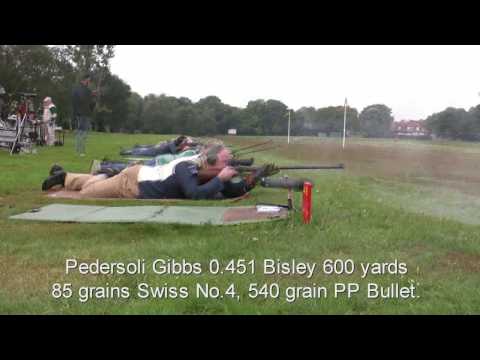
The Long-Range Muzzle-Loading World Championship was held under the auspices of the Muzzle-Loading Associations International Committee (MLAIC), the world governing body for black powder competition. The 8th World Long-Range Championship will be held in 2011, at the famed Bisley range in Great Britain. Shown below is a Pedersoli Gibbs target rifle at Bisley during the UK National Championships. Repro rifles like this won 10 gold medals at the 2007 World LR muzzle loading championships in South Africa.
More information on long-range muzzle-loading is available at www.lrml.org and www.usimlt.org (USA Team website).
September 30th, 2009
Speaking of Camp Butner (NC)… the 2009 F-Class National Championships commence today, Sept. 30th, at that range. America’s top F-Class shooters, and many competitors from overseas, will compete for honors in the nation’s fastest-growing long-range discipline. Competitors will be divided in two classes: Open and F-TR. Open Class allows any chambering under .40 caliber with a total weight of about 22 pounds, and a front pedestal rest may be used. F-TR class is limited to .223 Rem or .308 Winchester chamberings, with a max weight of 18.15 pounds. In most F-Class matches, F-TR shooters are limited to bipods — no pedestal front rests allowed.

Hosted by the North State Shooting Club, the Nationals kick off today (Sept. 30th) with open and team practice sessions. Thursday (Oct. 1) is the 600-yard phase of the event, followed by 1000-yard phases on both Friday and Saturday. Sunday is reserved as a make-up day in case of rain. On both Thursday and Friday, a 4-person team match follows the individual events. Barring rain delays, the National Champion will be crowned on Saturday after three final individual 1000-yard matches.
For more information, visit the North State Shooting Club website, or CLICK HERE to download the complete 2009 F-Class Nationals Program.
September 28th, 2009
On Wednesday, Sept. 30th, Shooting USA television features the National Muzzle Loading Rifle Association (NMLRA) Creedmoor re-enactment, hosted at Camp Atterbury, Indiana. The show, a repeat broadcast, features black powder muzzle-loaders and black powder cartridge shooters recreating one of the most famous rifle competitions of the 19th Century. This show airs multiple times this Wednesday, Sept. 30th, on the Outdoor Channel:
Eastern Time 4:30 PM, 8:30 PM, 12:00 Midnight
Central Time 3:30 PM, 7:30 PM, 11:00 PM
Mountain Time 2:30 PM, 6:30 PM, 10:00 PM
Pacific Time 1:30 PM, 5:30 PM, 9:00 PM

Rifle shooting was a very popular spectator sport in the 19th Century. Thousands of spectators came to watch long-range rifle matches held on “Creed’s Moor”, a range built by the NRA with funds from the New York state legislature. The first International Creedmoor match took place in 1874, when a group of Americans responded to a “Challenge to the Riflemen of America” from the Irish rifle team, considered the world’s best. The match was shot at 800, 900 and 1000 yards and was decided on the very last shot. After an Irish cross-fire near the end of the match, American John Bodine shot a final bullseye to win the international challenge cup. The U.S. team used a combination of breech-loading Remington Rolling Blocks and Sharps rifles. The Irish team used Rigby muzzle-loading rifles.
Click Here for Creedmoor Match History | Click Here to view 12’x6′ 1874 Match Target
September 26th, 2009
 We live in a digital, electronic era. The very story you’re reading right now consists of digital data packets transmitted electronically around the globe. Because of cost factors, 99+% of shooting matches in the USA still rely on old-fashioned manual scoring methods. However, target scoring can be done faster and more precisely with electronic scoring systems. Olympic and international CISM shooting competitions now employ electronic target systems. And electronic scoring is widely used in Europe already.
Below is a video showing an electronic scoring system developed by Norway’s Kongsberg Mikroelektronikk AS. Watch as a prone shooter puts five rounds on a 300m target. You can see the group form on the video screen at his shooting station. He’s a good shooter (with an accurate rifle). The first three shots are touching.
As you can see from the video, viewing shots on the monitor is easier than using a spotting scope and waiting for targets to be marked. The electronic target eliminates the need for a crew of target pullers in the pits.
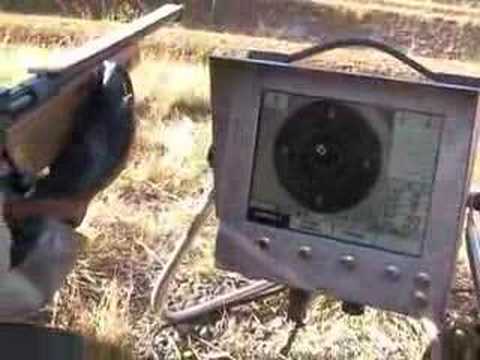
The Kongsberg system, like the electronic systems produced by Sius Ascor of Switzerland, do more than just display shot locations to the shooter. The target units automatically calculate scores, which are transmitted to a central computer. This can provide updated competitor rankings, and can even display the results to event spectators on large view screens.


CLICK HERE for a longer streaming Flash VIDEO showing how electronic target systems work. This video, produced by Sius Ascor, shows olympic target systems in action.
September 25th, 2009
 The 2009 NBRSA 100/200 yard Benchrest (for Group) Nationals are underway this week in Missouri at the Benchrest Club of St. Louis. Conditions have been extraordinarily calm, with very little wind. As a result, a host of potential records have been set. At the completion of Unlimited (UNL), Sporter (SPTR), and Light Varmint (LV) classes, there have been thirteen (13) possible new World records shot, and more may come in the final Heavy Varmint (HV) relays. Potential records set so far include:
UNL 10-100: Tony Boyer and Eric Stanton
LV 5-100: Jack Neary and Tony Boyer
LV 5-200: Gene Bukys
LV Grand: Jack Neary and Tony Boyer
SPTR 5-200: Tom Libby
SPTR Grand: Jack Neary, Gary Ocock, Mike Ratigan, Mark Buettgen, and Rodney Brown.
Thus far, Jack Neary has won the Sporter Grand Aggregate, and he won the LV 100 with a spectacular 0.15+ Agg. We’ve been told that Gene Bukys won the SPTR 200 with yet another 0.15+ Agg. That’s amazing shooting by Jack and Gene. Tom Libby also shot a .093 in Sporter at 200 yards to set a potential record.
To give you an idea of how many shooters have turned in truly superior performances, there were 20 teen aggs in the LV 100 alone. Below are the Top Ten LV 100 Aggs. As one observer commented on Benchrest Central, “I can’t imagine how it must feel to shoot a .1690″ Agg and finish 7th…or worse yet, a .1498″ and NOT win!”
1. Jack Neary .1482 (Possible New World Record)
2. Tony Boyer .1498
3. Mike Conry .1574
4. John Horn .1626
5. Larry Costas .1648
6. Tim Courtney .1660
7. Larry Scharhorst. 1690
8. Lester Bruno .1708
9. Eddie Harris .1794
10. Bob Scarborough Jr. .1800
On Day 1 of the Unlimited Match, Tony Boyer shot brilliantly at 100 yards, nailing a 0.1894 Agg which lowers the existing record by 0.0271, a large margin in short range benchrest. The previous UNL 8-10-100 NBRSA World Record Agg was 0.2165 set by Lester Bruno in 2001. In the same St. Louis UNL 100 match, Eric Stanton also broke the existing record with an 0.2161.
We will update this report as more official results are received. If you have photos of the NBRSA 100/200 Nationals in St. Louis, please email them to mailbox@6mmBR.com. Please include caption information (Date, Event, Shooter, Equipment etc.).

September 21st, 2009
The 2009 U.S. Practical Shooting Association (USPSA) Nationals were held Sept. 11-19 at the Desert Sportsman’s Rifle & Pistol Club outside Las Vegas, NV. The event drew more than 620 top shooters from across the country and around the world.
 Abbate Wins Both Production and Limited Titles
Glock shooter Jessie Abbate won dual national women’s titles at the 2009 USPSA National Handgun Championships. This year Abbate claimed both the Production and Limited division championships. In 2008 she was crowned the Limited and Limited-10 champion.
In the Production division, Abbate took top honors among lady shooters posting a final score of 1097.9378, outpacing runner-up and Julie Goloski-Golob by more than 111 points. Abbate’s score was also good enough to finish 37th overall among all shooters, male and female. In the Limited division, Jessie again put on an impressive display shooting a score of 1050.2892 and finishing over 114 points ahead of Team SVI shooter Lisa Munson, who came in second with 935.3943.
Max Michel Wins Open Division in Tight Race
Just over 11 points separated the top three shooters in the battle for the coveted Open Title at the USPSA National Championships but it was Max Michel who took home the crown.
Heading into the final stages, three ace shooters had a chance to win: Max Michel, K.C. Eusebio, and J.J. Racaza. In the end it was Michel who emerged on top. Max had the best time on 4 of the 16 stages on his way to winning the USPSA Open Title. “Max is one of the top shooters in the sport and a threat to win any match he enters,” observed Michael Voigt, USPSA president. “He faced intense competition this year from both K.C. and J.J. but was able to pull out the win.” Michel’s victory cemented his reputation as one of the top action shooters in the world. His “shooting bio” now includes two World Speed Shooting Championships (2007 and 2005), five USPSA National Championships (2009, 2007, 2006, 2005 and 2004) and nearly 30 USPSA Area Championships. In May 2009, Max completed his U.S. Army service. Leaving the USAMU team, Max is now Sig Sauer’s Manager of Competitive Shooting Activities. In the video below, created while Michel served with the USAMU, Max explains how to shoot on the move:

September 20th, 2009
 After scanning the equipment list for the recent 600-yard IBS Nationals, one of our readers noted how the 6mm Dasher dominated the Top 10 list in both Light Gun and Heavy Gun Classes. But Sam Hall won the Grand Agg with a straight 6BR, Mike Davis won the Heavy Gun Agg with a 6BRX, and Richard Schatz won the Light Gun Agg with a 6mm Dasher. So which cartridge should you pick? What’s the best for the 600-yard game — 6BR or Dasher or BRX?
Sam Hall, 2008 IBS 600-yard Shooter of the Year and back-to-back 2009/2008 IBS 600-yard National Champion, offers this advice:
“I shot a Dasher most of this year at IBS 600-yard matches and shot a no-turn BRX in a couple of shoots. I even tried a BRDX (40° improved with a longer neck than Dasher) in a practice barrel. By looking at the results on my target, I would never have been able to tell the difference between any of them if I did not already know what cartridge I was shooting. The 6BR or an improved version are just downright inherently accurate. They are all easy to load for and tune. I do believe the 6-6.5×47 Lapua is harder to get tuned than the 6BR. There are always the exceptions though. I have been beaten a few times this year by one exceptionally good shooting 6-6.5×47.
My next step is to try a no-neck-turn 6BR. I have been beaten by some a few times. I am now wondering if neck-turning is worth the time. A lot of the top BRX and Dasher shooters are not turning their necks and doing extremely well.

In my opinion pick your favoite BR or improved version, learn it well, practice, and don’t deviate. If someone you know shoots a BRX (or Dasher) and has a lot of experience with it — that is a good head start for loads. You can then compare what shoots good and what does not. I sure did not learn everthing on my own. I got some good load info here on this website (AccurateShooter.com) and I used to hound Terry Brady to death for loads to find out what he was winning with. Don’t be afraid to ask questions! I still do! Good luck and have fun.”
– Samuel Hall
September 19th, 2009
The 2009 200-300 Yard IBS Score National Championship was held September 12-13 at the Thurmont Conservation & Sportsmans’ Club in Thurmont, Maryland. Competition was fierce with the combined yardage winners taking one-point victories in two of the three classes. Shooting a 498-17X, Wayne France won the 200/300 combined in the Varmint for Score (VFS) class, followed by Al Weaver (497-17X), and Hal Drake (497-10X). In Hunter Class, Gary Long (491-10X) took top honors for the combined yardages, followed by Frank McKee (487-5X), and David Apple (484-11X). Finally, in Varmint Hunter Class, David Thomas (494-11X) edged Eddie Harren (493-12X), with Sara Haran finishing third with 484-5X.

During the match, there were four perfect 250s shot at 200 yards: Curtis Nelson (250-12X) and Fred Ridgway (250-11X) in VFS, Gary Long (250-6X) in Hunter Class, and David Thomas (250-8X) in Varmint Hunter Class. Wayne France nailed the best score overall at 300 yards, an impressive 249-7X in VFS class. Congratulations to the winners and to all the competitors.
2009 200/300 IBS Score Nationals Equipment List (Partial)

September 18th, 2009
Sam Hall did it again. The 2008 IBS National Champion and 2008 Shooter of the Year captured his second straight National Championship, winning the 2-Gun Grand Agg shooting a standard 6BR in both Light Gun (LG) and Heavy Gun (HG) classes. It was an impressive victory in challenging conditions at the Varmint Hunter Assn. (VHA) range in Pierre, South Dakota. But this was a very close match. Mike Davis, runner-up in the Grand Agg, tied Sam in 2-Gun points, but Sam was awarded the title based on 2-Gun Small Group tie-breaker. Richard Schatz was just one point behind Sam and Mike. All three men shot superbly and any of the three could have won it all. Davis won the HG Overall Agg (with Hall second), while Schatz won the LG Overall Agg, with Hall again placing second. Both Davis and Schatz shot 6BR Improved cartridges in both LG and HG — Davis shooting the 30°-shoulder BRX, while Schatz campaigned a 40° Dasher. Rodney Wagner (6BRX) and John Griswold (6 Dasher) tied with 27 points in the 2-Gun overall, with Wagner earning 4th place overall on the tie-breaker.
Horrendous Conditions on Friday — Many DQs
Sam Hall said the conditions on Friday were “horrendous” with 25 to 35-mph gusts. Conditions were among the worst ever seen by the VHA rangemasters, and a third of HG competitors (17 of 48) DQ’d because the wind blew shots off paper. Luckily, conditions moderated for the Saturday relays, with mild 10 mph winds. Regulars at the VHA range said Saturday’s conditions were “about as good at it gets in Pierre.”
Complete Results are posted under Long Range Match Results on the IBS Website.
Equipment — Still dominated by 6BR and 6BR Improved
A quick look at the equipment lists for both LG and HG classes showed the 6mm as the preferred caliber, with a 6mm Dasher or 6mm BRX the most popular cartridge (though Hall won it all with his standard 6BR). Despite the windy conditions, the mid-sized cases such as the 6-6.5×47 Lapua couldn’t outshoot their smaller brothers. Notably, Sam Hall used a plain vanilla 6BR to win LG Agg with a 2.852″. Shooting a 6BRX, Mike Davis won HG Agg with a 2.492″, with Hall’s 6BR only .054″ behind.
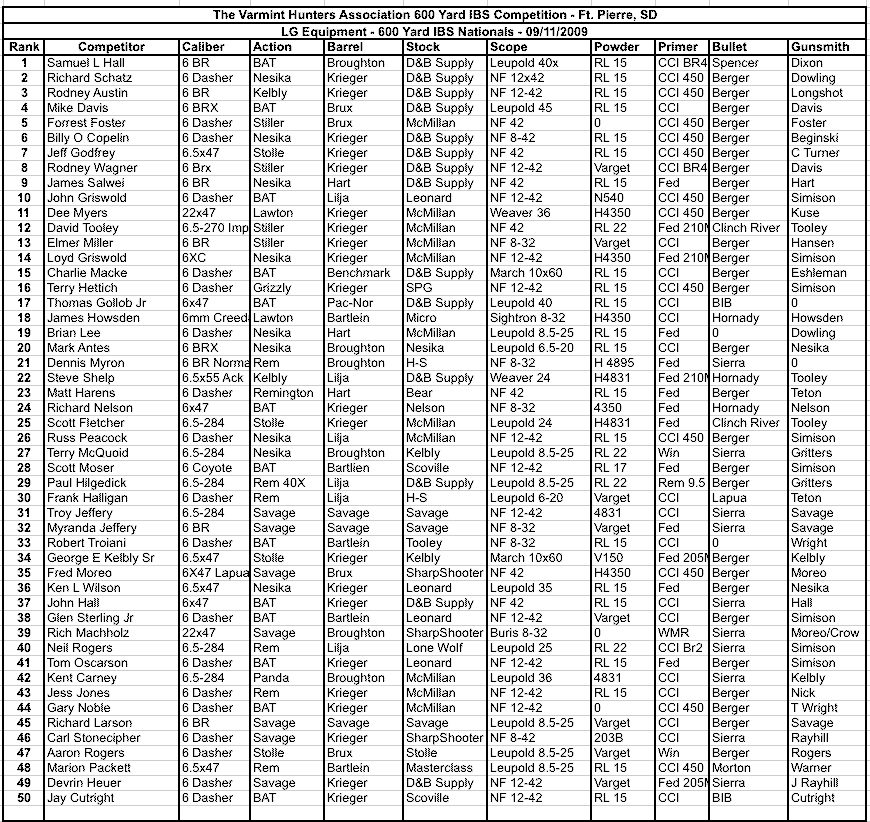
LG Equipment List


HG Equipment List

Calibers: 17 of the top 20 in LG shot 6mms, mostly Dashers (but Hall won LG with a standard 6BR). There was one .22 and two 6.5s. In HG it was pretty much the same story, 16 of 20 using 6mms, with a couple 6.5s, a .308 Baer and a 30 BooBoo (not “39” as stated in equipment list).
Barrels: Sam Hall won LG Group Agg with a Broughton button-rifled barrel, but otherwise cut-rifled barrels from Brux, Krieger, and Bartlein dominated the Top 20 in both classes. In HG, Mike Davis shot a Brux to finish #1. NOTE: Sam Hall had a Lilja barrel on his second-place, 28-lb Heavy Gun, not a Brux as shown on the official equipment list.
Bullets: Sam Hall used Spencers in LG, and Steve Shelp shot BIBs in his 30 BooBoo Heavy Gun. Otherwise it was “all yellow box”, with Berger filling the Top 10 equipment rankings for both LG and HG. It’s fair to say Berger Bullets dominated the match.
Powder/Primers: Alliant Reloder 15 and CCI 450s (usually pushing Berger 6mm bullets) composed the preferred combo in both LG and HG. Sam Hall did use CCI BR4s, however. Rodney Wagner was the only Dasher shooter to use Hodgdon Varget, but he finished fourth overall in the 2-Gun Aggregate.
Optics: While ace shooters Sam Hall and Mike Davis both used Leupold Competition Scopes in both LG and HG classes, Nightforce scopes, (mostly 12-42 BR models) dominated the Equipment Top 20 lists. To our surprise, there were only a couple March Scopes in the Equipment Top 20 in HG, and just one in LG.
Stocks: Shehane (D & B Supply) stocks were used by 8 of the Top 10-ranked LG Shooters, and 5 of the Top 10 in HG rankings. The Trackers, both ST 1000 and MBR Tracker, remain hard to beat. We did see some “true maxies” in this match.

Hall Reveals Shooting Secrets in Home-Made Video
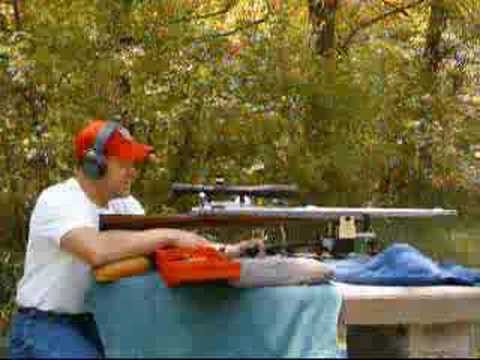
If you’re interested in 600-yard competition, or just want to shoot more accurately and consistently from the bench, you should watch a video Sam Hall put together last year. Because of wind noise, the audio is pretty bad at first, but be patient. Sam delivers some invaluable advice in the video. His tips on body positioning, gun-handling, and follow-through can earn you some points in your next match.
|