A few seasons back, Forum member Rick from Louisiana (aka RMulhern) rigged up a fantastic target for long-range shooting. Rick, a long-time competitive Palma shooter, had a large 72″x72″ steel target fabricated with two separate center rings that are equivalent to the official paper Palma/Creedmoor target. He says he’s “shot a lot of Palma on that target, as well as lots of Black Powder Cartridge (BPCR) rounds”. The big steel target works great when Rick shoots his Sharps 45/110 BPCR at 800 to 1000 yards. The large steel background (painted white) helps Rick see and hear his hits. If you understand the high-arching trajectory of 500+ grain projectiles shot from a 45/110, you know it can take a few rounds to get Point of Impact dialed in.
Rick reports: “These are two of my favorite rifles to shoot: a M1874 Shiloh Sharps in caliber 45/110 (2 7/8) made in Big Timber, Montana by Kirk Bryan and family. The other is a 6.5×47 Lapua on a blue-printed M700 action with 1:8.5″-twist Krieger barrel and F5 McMillan Tactical stock. Many of the shooters that take up BPCR have a tendency to get away from their smokeless powder rifles in favor of the blackpowder game. Frankly I have the best of both worlds as I enjoy shooting both (smokeless and BPCR), although I must admit that I probably spend the majority of my time on the range with the Sharps rifles these days.” (Rick’s pretty good with his Sharps by the way — he recently shot a 95, 96, and 100 (clean) for 3×10 shots at 800 yards.)
Gongzilla: $1000 Worth of Steel with Three Plate Layers
Rick tells us: “Here’s the deal — everything is steel! The large plate is 72″x72″ and the black bull is 44″ diameter. The 20″-diameter central white bull is made from 1/2″-thick AR400 bull-dozer plating. That’s the same size as the regulation Palma/Creedmoor paper target. The white square and black bull are 3/8″-thick mild steel. Plates are off-set 2″ from each other. I welded a 2″ length of square tubing to the back of both plates and the bolt slides through and is attached to the large plate. I used 2 3/8″ upset tubing (oil field pipe) for the holder framing.” Rick says he invested about $1000.00 in metal for the target, but that was 15 years ago. Today the steel would be much more expensive.
Rick says the AR400 armor plate in the center bull is very strong: “You can shoot a .338 Lapua Magnum at 200 yards and it won’t damage the center bull”. The mild steel works well for the cast bullets Rick uses with his Sharps 45/110. Also, Rick says the mild steel is rugged enough for 6.5mm and .308 hollowpoint match bullets, if you’re at least 500 yards away. However, Rick told us, “If I would make [the target] again, I would make the black bull AR400 as well. [That way] you would never have to worry about big dents or beating the plate up at any distance. The AR400 is very tough steel. You can shoot a Sierra or Lapua HP bullet and they will just splatter.”
Rick told us: “I built this target with off-set clanger plates. The white clanger is AR400. Bullets just splatter!” Does he worry about hitting the bolt head? Not at all. Rick says: “When I hit the bolt head, I break my arm patting myself on the back!”.
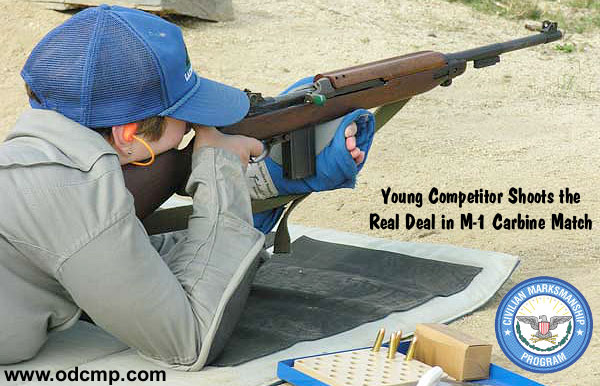
One of the CMP’s most popular competitions is the M1 Carbine Match. The little carbines are easy to hold and easy to shoot, with relatively low recoil compared to an M1 Garand or M1903 shooting the full-power .30-06 cartridge. Unfortunately, genuine GI-issue M1 Carbines are now hard to find at affordable prices. The CMP has announced: “CMP’S Carbine Inventory has been exhausted and we do not expect to receive any additional shipments.” Authentic, “all-original” M1 Carbines are going for $1800 to $2100.00 these days on Gunbroker.com.
CMP M1 Carbine Matches — Growing in Popularity
The CMP M1 Carbine Match is part of the CMP Games program that already includes Garand, Springfield and Vintage Military Rifle Matches. “As-issued” U. S. Military M1 Carbines are fired over a 45-shot course of fire at 100 yards on either the old military “A” target or the “SR” target. The course includes 5 sighters and 10 shots for record prone slow fire in 15 minutes, a 10-shot rapid fire prone series in 60 seconds, a 10-shot rapid fire sitting series in 60 seconds and 10 shots slow fire standing in 10 minutes.
CMP M1 Carbine Match at Western CMP Games
New Production M1 Carbines
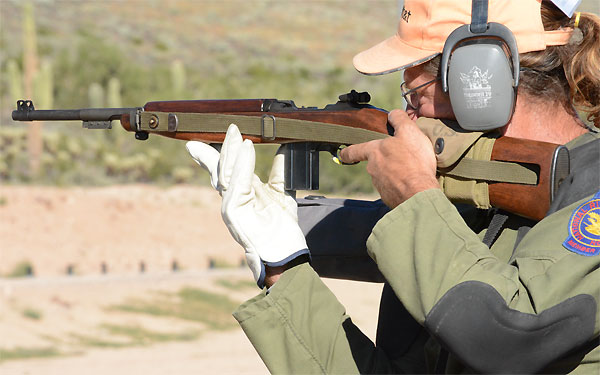
Thankfully, you don’t need to source a real WWII-era M1 to enjoy CMP M1 Matches. You can now get a brand new, American-made M1 Carbine clone for much less than an original CMP M1 rifle. And these new M1 clones are approved to shoot in CMP M1 matches. Auto-Ordnance sells new production .30-Caliber M1 Carbines that look, feel, and shoot just like the originals, for a lot less money. These are made in Kahr’s modern manufacturing plant in Greeley, PA. There are two versions:
Another producer of M1 Carbine replica rifles is Inland Manufacturing, a modern company which shares the name of a leading WWII M1 Carbine maker. These made-in-the-USA, newly manufactured M1 Carbines are very authentic copies of the original carbines from the World War II era. With a $1139.00 starting MSRP, they feature authentic 1944-type adjustable sights, push button safety, round bolt, “low wood” walnut stock, and a 10–round or 15-round magazine. There are three (3) versions: M1 1944 style, M1 1945 style, and M1A1 Paratrooper model.
GunsAmerica.com report compares new Inland M1 Carbines side-by-side with original vintage M1 Carbines: “We had to get in close to tell the difference. Overall, the two examples we were able to handle looked great and held up when next to the originals. The stampings are even close to correct with a few minor differences that were chosen to stop the new Inlands from being mistaken for originals. Take a look at the photos and see for yourself.” READ M1 Carbine Review.
Register Now for the 2024 National Matches at Camp Perry Article based on Report by Ashley Dugan, CMP Staff Writer
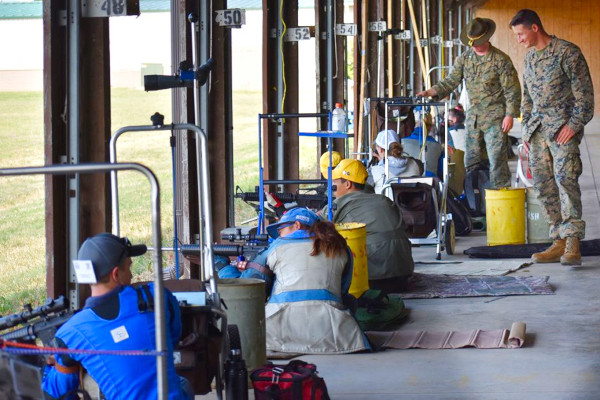
Registration for the Civilian Marksmanship Program’s (CMP) 2024 National Trophy Rifle and Pistol Matches is officially open. The National Matches include a huge variety of competitions for rimfire and centerfire rifles, pistols, and airguns. The annual event, held at the Camp Perry National Guard Training Base since 1907, is conducted via a partnership between the CMP and the Ohio National Guard. The month-long series showcases a variety of indoor and outdoor events for both adults and juniors, with spectators welcome. The CMP National Matches offer something for all target shooters — both novices and seasoned competitors. Our friend Dennis Santiago, who has competed at Camp Perry many times, offers five good reasons to attend the CMP National Matches:
Top 5 Reasons to Go to Camp Perry
1. It’s the Nationals. A thousand competitors on the line. You get to be a player in the Super Bowl of marksmanship.
2. The President’s Hundred Match. Camp Perry is the only place you can earn the right to wear this prestigious tab on your shoulder.
3. Rattle Battle. Also known as the Infantry Trophy, this fast-paced match is a bucket list experience.
4. Making friends. Camp Perry is where you will meet and get to know shooters from all across the USA who share your passion. They will become lifelong friends.
5. It will make you a better shooter. The exposure to the level of competition will ooze into your soul. You will pick up knowledge about technique, equipment, and discipline that will amplify your skills and raise your performance level.
The National Matches is comprised of the CMP National Trophy Pistol and Rifle Matches, National Games Matches, National Smallbore Matches, National Air Gun Championships, and the National Mid-Range and Long Range Matches. Along with the competitions, the National Matches includes a variety of training clinics for all experience levels. The CMP will also run a sales center where accessories and ammo can be purchased. CLICK HERE to review the 2024 National Matches schedule and event info on the CMP website.
Garand and Vintage Military Rifle Matches
Among the most popular events at the Camp Perry National Matches are the Garand and Vintage Military Rifle matches. This summer, classic military rifles will fill the firing lines at Camp Perry. The Garand, Springfield, Vintage and Modern Military Match (GSMM) is set to start on Thursday, August 1, 2024 with the one-day M1A Match on Sunday, August 3, 2024. (See CMP Camp Perry 2024 Calendar.) Some participants will shoot just one rifle type, but there is also a combined GSMM 4-Gun Aggregate. The Vintage Sniper Match, set for August 4th, will include a new category — Vietnam Era. NOTE: the Springfield Armory M1A event is now the McKee Memorial Match (M14 Heritage Match), sponsored by Fulton Armory.
Rimfire Sporter Rifle Match
One of the most popular events of the National Games events, the Rimfire Sporter Rifle match features .22 caliber competition at 25 and 50 yards. There are three (3) classes: open sights (O-Class), telescopic (T-Class) and tactical/unlimited (TU) classes, fired at 50 and 25 yards. The event is perfect both for novice shooters and for experienced competitors who want to compete with a simple, affordable .22 LR rifle.
Smallbore Rifle Matches on Electronic Targets
Like last year, all National Smallbore (rimfire) events will be fired on electronic targets on Petrarca Range. The schedule includes three-position and prone events. In addition, rimfire F-Class will run concurrently with the smallbore prone matches.
National Air Gun Matches
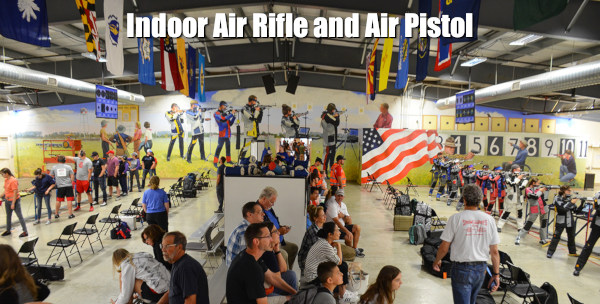
For air rifle and air pistol competitors, the National Air Gun Matches will be held on the electronic target range within the Gary Anderson CMP Competition Center. The air rifle series features training and an elimination two-team member match, two days of 60-shot competitions and an accompanying four-member team event. NOTE: The Air Pistol Championships will be held in the evenings to allow competitors to take part in the Match Pistol 2700 during the day.
High Power, Service Rifle, and Vintage Rifle Matches
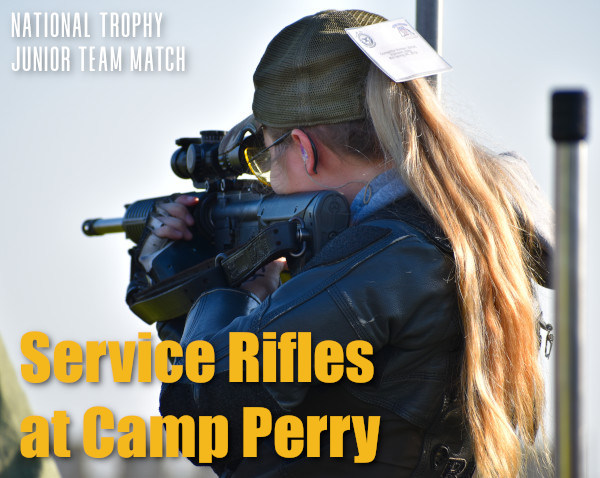
The National Trophy Rifle series includes prestigious matches like the President’s Rifle, Hearst Doubles, Rattle Battle, National Trophy Individual and National Trophy Team events. A paired Junior Team Match is also on the schedule for young competitors, along with an assortment of vintage and modern military rifle events like the John C. Garand, Springfield and Vintage Sniper matches for individuals at every stage of their marksmanship abilities. A 4-man team event and three 80-shot matches will appeal to those looking for more high power rifle events, each fired on CMP’s line of outdoor electronic targets.
Mid-Range and Long Range Rifle Matches
The CMP’s National Long Range series features 10 individual and team competitions. Returning in 2024 is the Mid-Range event (with a course of fire consisting of three rounds of 20 shots slow prone at 600 yards), along with Long Range matches. These are all open to Match Rifle, Service Rifle, Palma Rifle, F-Open, F-TR or AR Tactical categories. Long Range Matches are fired on Camp Perry’s 1000-yard Viale Range.
Pistol Events — Centerfire and Rimfire
The National Pistol events include a mix of traditional matches like the President’s Pistol (President’s 100), National Trophy Individual and Team events, alongside a series of 900 Aggregate matches for .22 LR, .45 ACP, and other Centerfire Pistol. The fan-favorite GSSF GLOCK National Challenge will be returning to the schedule in 2024, while the Service Revolver EIC Match has been renamed the Philip Hemphill Memorial Service Revolver EIC Match in honor of Philip Hemphill — a repeat national champion lost in late 2023.
Pistol Practice will be available on July 15 and 16, 2024 (cost: $5.00 per practice time). Competitors will receive a Pistol Practice card at check-in, with additional practice time open for purchase (if available).
Marksmanship Clinics and Small Arms Firing Schools
Small Arms Firing Schools (SAFS) will be held for centerfire rifle, smallbore rifle, and pistol. Participants in SAFS are instructed by some of the top military instructors in the country on firearm safety and competition basics. All firearms and ammo are provided for the live-fire portion of the clinic. Other clinics during the National Matches include a Rimfire Sporter Rifle Clinic, the CMP/USMC Junior Rifle Clinic, and the CMP Advanced High Power Clinic, for more experienced competitors. Most clinics include both classroom and live-fire training on the range.
More Camp Perry Summer Services — Sales and Housing
Sales: Behind the range, Commercial Row offers a variety of items for spectators and competitors – with an array of manufacturers selling used firearms, ammunition, competition gear, accessories, apparel and much more. The CMP North Store, located on the grounds of Camp Perry, allows even more buying opportunities at the Matches with a selection of military surplus rifles, memorabilia and equipment needs.
Housing: Housing for the National Matches is currently available on the grounds of Camp Perry. Accommodations include four-person huts, cottages, barracks, RV spaces, and camp sites. Camp Perry housing info posted at CPLCC.com/national-matches. If base housing is full, numerous hotels are available in the surrounding Port Clinton, Fremont, and Sandusky areas. CLICK HERE for information on local hotels and tourism resources.
CLICK PHOTO for article on after-match activities in the Camp Perry region.
More Info: All events are open to the public, free for viewing. Spectators are welcome to observe firing on the Camp Perry ranges at any time, with ample parking on-site. Guests are encouraged to participate in the many exciting activities and visual attractions offered during the National Matches season.
Directions to Camp Perry:
The Civilian Marksmanship Program is a federally chartered 501 (c) (3) non-profit corporation. It is dedicated to firearm safety and marksmanship training and to the promotion of marksmanship competition for citizens of the United States. For more information about the CMP and its programs visit www.TheCMP.org.
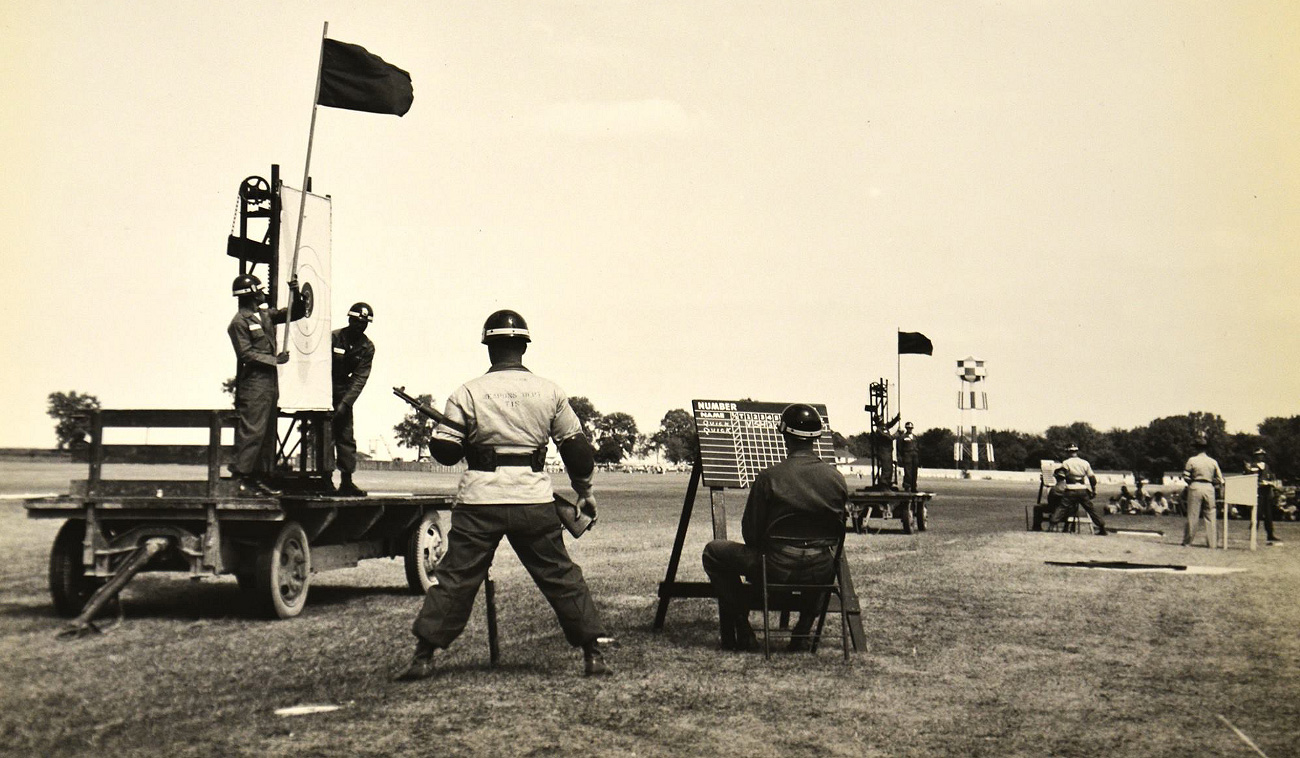
Ever wonder what “Maggie’s Drawers” means? Well, in the shooting community it means a complete miss on the target, as originally indicated by a large red flag. In this 1957 photo, the U.S. Army brought the targets to the students at the annual Small Arms Firing School. Wheeled carts with “demo” targets were positioned at the firing line, between shooting stations, so trainees could better see the procedures. Soldiers demonstrated firing a shot, scoring the target and scorecard on the Camp Perry firing line. Targets in use at the time were the “V” type.
In this demonstration shot, the pit worker waves a red flag, known as “Maggie’s Drawers”, signifying a miss. This old photo comes from the Civilian Marksmanship Program (CMP) Archives.
If you click the gray tab to view the photo full-screen, you can see something extra. Look carefully at the horizon below the muzzle of the M1 Garand held by the shooter in the foreground. If you look carefully, you can see a crane being used to erect the beach tower that now watches over Lake Erie and the ranges when they are “hot”.
Origin of ‘Maggie’s Drawers’ Term Hap Rocketto, noted shooting historian, has explained the etymology of “Maggie’s Drawers”. This term “refers to the red flag waved vigorously across the face of the target to signify a complete miss of the target during practice”. The term came in use in the early 20th Century (prior to WWI) when flags were used to signal shot locations on long-range rifle targets.
Hap writes: “Since [the early 20th Century] the target has changed to the decimal bull and the marking system has been revised several times. Flags are no longer used, being replaced by value panels and chalk boards. However, one term from the flag days has held on with a tenacity that is indicative of the strong traditions of the high power community. If a shooter had the misfortune of firing a miss a red flag was waved across the front of the target. The flag is commonly known as ‘Maggie’s Drawers’ giving us the term now generally used to refer to a miss. The term ‘Maggie’s Drawers’ seems to be based on, as many things are in the military, a bawdy song. Prior to The Great War there was an old music hall song entitled The Old Red Flannel Drawers That Maggie Wore which [was creatively altered], as things tend to be by the troops, into something less delicate than might have been sung in vaudeville in the United States or in British music halls of the day.”
An accurate, self-loading .22 LR rifle, such as this Volquartsen, is our gun of choice for speed shooting with rimfire reactive targets.
Reactive targets offer “instant gratification” — with every hit your target moves, spins, or falls. Shooting reactive targets with a rimfire rifle is fun AND affordable. Times are a-changin’ — rimfire ammo prices have dropped dramatically, so you can now get very decent rimfire ammunition for under $4.25 a box, such as Norma Tac-22 or Aguila Super Extra. Currently priced at $3.49 for 50 rounds, the Aguila is just seven cents a round! At that price, you can afford to shoot every weekend.
Rimfire Know Your Limits Target Rack Challenge Targets offers the popular Know Your Limits (KYL) rimfire target for $139.00. This KYL target has become popular for NRL22 and PRS Rimfire shooters. Start on the left by engaging the 2″ round target and work your way to the right. Each shot gets progressively harder as the target sizes decrease. With each solid hit, the target plate will spin giving providing hit confirmation. The target rack easily breaks down for transport in a couple minutes.
Make Your Own Shooting Gallery with Reactive Rimfire Targets
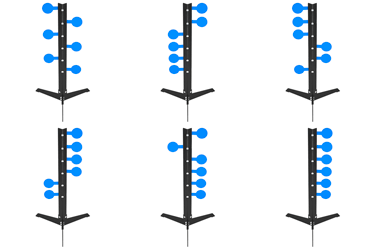
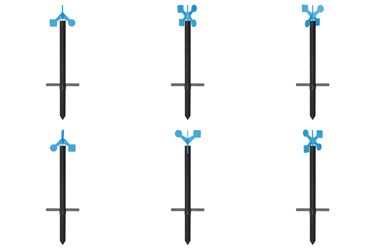
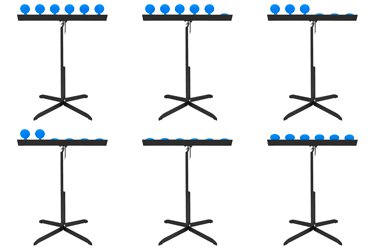
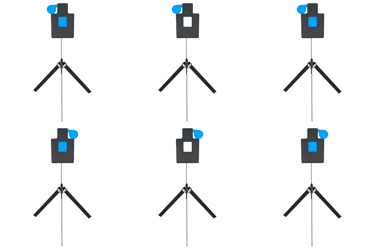
For .22 LR fans, the folks at Action Target have created a whole series of steel rimfire targets. Much lighter than their centerfire counterparts, these rimfire targets are easier to transport and easier to set up. With this wide selection of reactive targets, you can create your own shooting gallery.
Rimfire Dueling Tree
Rimfire Spinning Jack
Rimfire Plate Rack
Rimfire Buffalo
In this video, Michael Bane reviews Action Target’s line of rimfire targets, which includes plate racks, spinners, dueling trees, and more. As Michael explains: “This line of targets is very well thought out. For example — dueling trees are a lot of fun. But a centerfire dueling tree weighs a lot, it’s hard to cart it around. A rimfire dueling tree is easy to set up, easy to carry around.”
New PT Target “Walks” When Hit
Action Target has a cool reactive target that doesn’t even need a stand or base. The patent-pending PT Twist rests on the ground, and flops over or “walks” when hit. Constructed from a single piece of 3/16″-thick A514B steel, the PT Twist has no welds or bolts to break or ricochet. Watch the PT Twist in action:
Team Vihtavuori won the Southwest Nationals (SWN) F-Open Grand Aggregate Team Award with a score of 2589-156X (out of a possible 2600) at the popular match, which was held, February 14-18, 2024. Team Vihtavuori achieved the overall victory by first winning the Palma Team Match with a score of 1790-111 (out of a possible 1800). Then followed with a 799-45 in the 1,000 Yard Team Match.
We congratulate Vihtavuori team members Gwen Basalla, Brandon Zwahr, Matthew Basalla, Tracy Harrold, and Doug Skogman, with Norm Harrold as Team Captain and Tim Vaught as Coach. Additionally, team members Tim Vaught, Norm Harrold, and Tracy Harrold added individual accomplishments: Tim took Second Place overall, Norm was High Senior, and and Tracy was High Woman. These impressive F-Open Grand Aggregate individual awards showcased how dominating Team Vihtavuori’s members were at the 2024 SWN event.
SWN F-0pen Team Top 5
Team Vihtavuori 2589-156X
Bayou Boys 2580-155X
Team Grizzly 2577-128X
Team Lapua-Brux-Borden 2576-162X
Team Canada Red 2571-131X
F-Open LR Top Five
Jay Christopherson 1248-79X Tim Vaught 1247-83X
William Kolodziej 1247-74X
Johnny Ingram 1246-82X Norman Harrold 1246-69X
The 2024 Southwest Nationals were held February 14-18 at the Ben Avery Shooting Facility in Phoenix, AZ. Hosted by the Desert Sharpshooters Rifle Club, the Southwest Nationals is a “must-attend” event for competitive long-range shooters around the world. The Southwest Nationals features F-Open, F-TR, and Sling disciplines. Competitors from over five different countries were in attendance this year.
About Vihtavuori
Vihtavuori is world renowned for producing the cleanest-burning and temperature stable smokeless powders with unprecedented lot-to-lot consistency. Vihtavuori is a part of the Capstone Precision Group, exclusive U.S. distributor for Berger, Lapua, Vihtavuori and SK-Rimfire products. For more information, visit Vihtavuori.com.
Do you occasionally get completely unexplained flyers, or have a shot land straight down at 6 O’Clock, right below your point of aim? That could be caused by poor or inconsistent trigger technique. How you pull the trigger can and does affect your accuracy.
Many gun enthusiasts start with pistols. When they later start shooting rifles they may carry over some not-so-good practices acquired from shooting handguns with heavy 4 to 6-pound trigger pulls. You may want to “re-learn” your trigger techniques to get better rifle results.
Shooting Sports USA has a good article on trigger technique that offers many useful tips. That article also has many helpful illustrations, including the one shown above. Another illustration shows different types of trigger shoes (straight vs. curved) and explains how each makes a difference: “With a lightly curved trigger, the shooter’s finger can contact the trigger either high or low according to preference. Higher contact will increase the resistance.” READ ARTICLE HERE.
The article analyzes common errors, such as pulling the trigger with the very tip of the finger rather than the pad of the index finger: “Using the tip of the finger can lead to lateral pressure on the trigger, which throws off the shot.”
The article also explains that you should check your trigger regularly to make sure it is functioning properly and is not out of adjustment: “Just like any other moving part, the trigger can suffer from wear. In such a precise mechanism, tiny amounts of wear can cause major problems.”
The ergonomics of the Eliseo Tubegun allow a nice, straight trigger pull.
Trigger Tips
Six Suggestions for Making your Trigger Control More Consistent.
1. If your triggers are adjustable, set the pull weight appropriate to the discipline. For a hunting rifle, you don’t want an ultra-light trigger pull. For High Power, you may want a two-stage pull, while on a Benchrest rifle you may prefer a very light trigger.
2. If you have a two-stage trigger, experiment with different combinations of First Stage and Second Stage.
3. Have a friend watch you as you pull the trigger, and maybe even take a close-up video as you pull the trigger. This can reveal a variety of flaws.
4. Practice dry-firing to see if flaws in trigger technique are causing gun movement.
5. As an experiment, try pulling the trigger with your middle finger. Ergonomically, the middle finger has a more straight alignment with the tendons in your hand. This exercise can help you identify alignment issues with your index finger.
6. For stocks with adjustable Length of Pull you may want to set the LOP differently for bench shooting vs. prone or F-Class shooting.
When Only the Best Will Do…
German-made Bix’N Andy triggers, available from BulletCentral.com, are among the very best you can buy. Available in both single-stage and two-stage, Bix’N Andy triggers are extremely precise, repeatable and smooth. The unique internal, friction-reducing roller ball system allows for extremely low reset force, yielding an ultra-crisp let-off. Bix’N Andy triggers can be fitted with a variety of trigger shoes according to shooter preference.
The prone position demonstrated by two talented Service Rifle shooters. At top is SFC Brandon Green, multi-time High Power National Champion. Below is Tony Chow, a gifted match shooter. NOTE: Current Service Rifle rules allow the use of optics up to 4.5X.
Jay Christopherson, 2024 and 2020 Southwest Nationals F-Open Champion, is one of the nation’s best F-Class shooters. When shooting F-Class, Jay uses a SEB Mini front rest and a large rear sandbag to support his big 22-lb F-Open rifle. Though he loves F-Class, Jay has also been interested in Service Rifle competition where no external supports are allowed. You hold the rifle with your arms and a sling. Some Service Rifle competitions involve three position (Standing, kneeling/sitting, and prone), while others are prone only. Even in the prone position, the sling is a vital accessory.
Jay dramatically improved his Service Rifle “hard-holding” technique by enlisting the help of Emil Praslick III, former U.S. Army Marksmanship Unit (USAMU) rifle coach. Emil’s guidance and advice resulted in an immediate increase in Jay’s scores on target, as recorded by his ShotMarker electronic target system. Jay noted: “These targets show the difference between hacking it on your own, and spending an hour with someone who knows what they are doing and can tell you that you are doing it wrong.” These targets show Jay’s “before and after” Service Rifle results shooting slung up prone at 600 yards:
Service Rifle, Prone with Sling at 600 Yards
Here is Jay’s target BEFORE training with Emil Praslick — a 194-3X with lots of vertical.
And here is Jay’s improved target AFTER putting Praslick’s advice to work — impressive 199-8X with significantly less vertical.
You can see on this second target much improved vertical. All 20 shots were in a vertical range much smaller than the vertical height of the 10-Ring. Had shot 16 not gone wide left, this would have been a 200. Shot 16 was OUT of the 10-Ring to the left, but note that vertically it has almost perfect elevation.
Jay stated: “I was pretty amazed at not only the difference on the target, but how much difference the changes Emil suggested made to how my hold felt. The entire feel was different and a ton less stress in my neck and arms compared to what I was feeling before. I was actually feeling pretty good about that 194 yesterday, because I hadn’t slung up in two years and that was my highest score (by one point) after doing some load fixing. But having someone explain what you are doing wrong and why makes a world of difference.
A multi-time F-TR National Champion, James “Jimmy” Crofts is one of America’s top F-Class competitors. And now this F-TR ace has a stunning new rifle in his arsenal. AccurateShooter Forum member CigarCop, head honcho of KW Precision LLC, built a stunning F-TR rig for Crofts a few seasons back. This handsome, top-tier rifle features top-tier components: Borden action, twin Brux barrels, Cerus RifleWorks F-TR Stock, and Jewell trigger, all resting on a wide-base Phoenix Bipod.
James Crofts photo by Kent Reeve.
Have a good look at these photos below. Yes, envy is the appropriate reaction. With the smooth operation of the Borden action and the predictable accuracy of Brux barrels, we know James’s rig shoots as good as it looks.
CigarCop actually chambered two barrels for James, with different fluting patterns — conventional linear flutes for one tube, and lines of staggered ovals for the other. Finished length for both barrels is 30″. Yes it looks cool, but the fluting was done mainly to save weight with the 30″-long lengths. CigarCop tells us the complete rifle, without scope and rings, weighs just under 15 pounds. Max allowed weight for an F-TR rifle, with scope, is 18.18 pounds (8.25 kg).
When James Crofts is not shooting his .308 Win F-TR rig,
he often trains with a .22 LR Rimfire rifle. Read on…
Rimfire Training for F-Class Competitors
2014 and 2012 U.S. National F-TR Champion James Crofts is one of America’s top F-Class shooters. A member of 2013 World Championship-winning F-TR Team USA squad, James knows a thing or two about long-range shooting. But you may be surprised to learn how James sharpens his shooting skills at relatively short distances. You see, James often practices with a .22 LR rimfire rifle at distances from 50 to 200 yards. James tells us: “Shooting my F-Class rimfire trainer saves me money and improves my shot process and wind-reading abilities.”
Remington rimfire 40X barreled action in PR&T LowBoy stock with PT&G bolt.
Rimfire Training Teaches Wind-Reading Skillsby James Crofts
Training with the rimfire is extremely useful and can be done from 25 yards out to 200 yards. I am lucky and can shoot 50 yards right off my back deck. That is far enough that any miscue on rifle handling will show up on the target. I use a two dry-fire to one actual shot routine for my practices. This gives me much more positive reinforcement without any negative reinforcement.
Wind reading is extremely important with a .22 LR rifle. I use a set of smallbore flags to aid my wind calls. The smallbore flags are a must and force you to look at the flags and mirage on each and every shot.
This Rimfire rifle features a CMP-sourced Rem 40X barreled action, PR&T Low Boy stock, Jewell trigger, and Phoenix bipod. The gun was built by Ray Bowman of Precision Rifle & Tool. James Crofts told us: “The project turned out awesome — the rifle was a hammer from the beginning even with the stock barrel.”
Rimfire Training Is Cost-Effective
Rimfire ammunition is much less costly than centerfire ammo. Though .22 LR prices have risen, you can still get a 500-round brick of decent ELEY .22 LR target ammo for around $70.00. That works out to fourteen cents a round. That’s a fraction of the cost of handloading .308 Win match ammo, with the price of bullets, brass, and primers these days. The top match-grade, .308-cal centerfire bullets can cost around $70 per hundred. Then you have to figure in brass, primers, and powder. Finally you have to consider your precious centerfire barrel life lost to practice.
PRS and NRL tactical matches are now among the most popular competitive rifle disciplines in the USA. And rimfire tactical disciplines are actually growing faster than centerfire PRS/NRL because .22 LR ammo is way cheaper than centerfire ammo, and there are many more ranges where rimfire matches can be held. NRL22 and PRS Rimfire offers the same kind of fun without the high cost of centerfire ammo and the time-consuming burden of hand-loading. You can compete successfully in .22 LR rimfire precision disciplines with affordable rifles, which also offer a whole lot less recoil than centerfire rigs. To learn more, we recommend you read All About Precision Rimfire Competition, by Shooting Sports USA Editor John Parker.
Interview with NRL22 Founder Travis Ishida
This Vortex Nation video features an 80-minute interview with Travis Ishida, one of the original founders of the NRL22 and NRL22-X disciplines. Travis told us that the NRL now runs 7-8 times as many rimfire matches as centerfire matches.
The NRL22 2023 World Championship — Biggest Match of Its Kind
The NRL22 Championship took place in North Carolina in July 2023 and was the biggest match of its kind to date, with over 230 competitors from all over the world. Watch this video to see the latest and greatest equipment, and to see top competitors in action. NOTE: This match also included an AIR RIFLE division. You can see one of these precision air rifles below:
Getting Starting in PRS/NRL Rimfire Competition — The Rifle
Interested in getting started in PRS/NRL Rimfire competition? This MDT video explains the components you’ll need for a top-level .22 LR PRS rig. While you can spend many thousands on a top-tier rig, you can also do very well with a used rifle costing under $800 before optics. Rimfire barrels tend to last a very long time, so an older rig can still be quite competitive with over 4000 rounds through the barrel.
Cleaning Rimfire Barrels — How Often Should This Be Done?
Some say never clean a rimfire, others scrub their bore after every shooting session. So, who’s right? Like so much in life, the answer falls somewhere in between. Michael Shae, author of Rimfire Revolution, explains when to break out the jags/solvent and how to efficiently clean your barrel to restore peak performance. We have found that, with some .22 LR barrels, you may want to clean every 200-300 rounds, with others every 1000. Much depends on the ammo you use and the rate of fire. When cleaning, be careful with the muzzle crown. Damage to the crown can definitely harm accuracy.
How to Get Started in Rimfire Tactical Competition
This video offers plenty of smart tips for folks getting started in NRL22 and PRS rimfire competition. The host explains the rifle, optics, and other essential gear. The video also explains how to mentally prepare yourself for your first match and before each stage. We do recommend you do some target work before the first match to understand the challenge of .22 LR ballistics. This relatively slow, low-BC cartridge has very significant drop at longer ranges (100 yards and beyond).
PRS Rimfire 2023 Finale — Over 200 Competitors
Want to see how a top-tier rimfire tactical match actually runs? Then check our this video from the 2023 PRS Rimfire Series Finale hosted last October by MKM Precision in Kennerdell, Pennsylvania. This PRS Rimfire Finale Match drew over 200 competitors. PRS Rimfire offers similiar shooting challenges to PRS centerfire, but at shorter ranges at a much lower cost per round.
BONUS Rimfire Practice Targets
SPECIAL BONUS–Rimfire Tactical Precision Targets
These FREE targets by DesertFrog are offered in Adobe Acrobat format for easy printing. CLICK HERE to download all six targets as a .ZIP archive.


 A few seasons back, Forum member Rick from Louisiana (aka RMulhern) rigged up a fantastic target for long-range shooting. Rick, a long-time competitive Palma shooter, had a large 72″x72″ steel target fabricated with two separate center rings that are equivalent to the official paper Palma/Creedmoor target. He says he’s “shot a lot of Palma on that target, as well as lots of Black Powder Cartridge (BPCR) rounds”. The big steel target works great when Rick shoots his Sharps 45/110 BPCR at 800 to 1000 yards. The large steel background (painted white) helps Rick see and hear his hits. If you understand the high-arching trajectory of 500+ grain projectiles shot from a 45/110, you know it can take a few rounds to get Point of Impact dialed in.



 Top 5 Reasons to Go to Camp Perry







 Hap Rocketto, noted shooting historian, has explained the etymology of “Maggie’s Drawers”. This term “refers to the red flag waved vigorously across the face of the target to signify a complete miss of the target during practice”. The term came in use in the early 20th Century (prior to WWI) when flags were used to signal shot locations on long-range rifle targets.